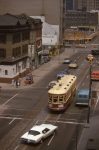
Bombardier Undermines Streetcar Credibility

Updated on July 5, 2018 at 8:00 am: Minor typos corrected. Explanation of replacement service as Flexitys displace older cars clarified.

Over the past day there have been a number of media comments, articles, tweets triggered by the announcement that 67 of Toronto’s new streetcars must return to Bombardier to repair bad welding. This started with an article by Ben Spurr in the Star, with a followup by Spurr and a Globe article by Oliver Moore. I’m sure there are others, but they will do for now.

The problem is described, briefly, in the TTC CEO’s Report released on July 4 as part of the agenda for the Board’s July 10 meeting.

As of June 25, the TTC has 80 Bombardier low-floor streetcars available for service. Unfortunately, we have learned that frame imperfections were found on assembled sections of the 67 vehicles manufactured before 2017 at Bombardier’s facility in Mexico. It is important to note that these welding deficiencies pose no safety threat. Bombardier has agreed to make the required repairs by removing cars from service and sending them to the Bombardier Welding Center of Excellence in La Pocatière, Quebec for repair.

We are working with Bombardier on a repair schedule that will have minimal to no impact on our service to customers. All vehicles will be repaired by the end of 2022.

[From “current issues” on p 6]

There is an inconsistency in the size of the fleet reported by Spurr and repeated by Moore. Although the CEO’s report says they have 80 cars, the number 89 has been used in media reports. This discrepancy is likely due to how Bombardier and the TTC count deliveries. Car 4488 was delivered to TTC Hillcrest today (July 4), and this makes a total of 88 cars in Toronto. (4401 was a prototype and is back at Bombardier for retrofits.) However, the highest car number actually in revenue service, and therefore formally accepted by the TTC, is 4482. This may seem like railfan trivia, but keeping track of just how deliveries are going is an important part of knowing how the roll out of new vehicles is actually progressing day-by-day, not in infrequent updates from the TTC.

The chronology of the problem has also been confused somewhat, and I have to own up to misinterpreting Spurr’s recounting of TTC information until this was sorted out in emails with TTC spokesperson Brad Ross.

  • 2015: TTC and Bombardier identify welding problems at the plant in Mexico where frames for the new cars are manufactured. This was one of the key problems that delayed the early shipments of cars to Toronto. TTC refused to accept cars whose parts would not fit together when they arrived at Thunder Bay for final assembly. In time, this manufacturing problem was corrected, or so it was thought.
  • June 2017 (quoting Spurr): “Company representatives said the problem is a “lack of fusion” in some of the welds on the car’s skeleton, particularly around bogie structures and the articulated portals where different sections of the articulated vehicle are joined. The company says it brought the issue “under control” last June and it won’t be repeated in future deliveries.”
  • October 2017: The TTC becomes aware that repairs would be required according to Ross as quoted by Spurr. One must ask what the TTC’s quality control inspectors were doing in Mexico between June and October.
  • February 2018: 4466, presumably the last car completed with bad parts, is delivered to the TTC. This is a rather long span after Bombardier’s claim that the issue was under control in June 2017.
  • July 2018: TTC and Bombardier announce the need to send the defective cars to a Bombardier plant in Québec which is their “world centre for excellence in welding”. In other words they are giving the job to people who should know what they’re doing.

There is a further inconsistency in that the TTC CEO’s report talks of 67 vehicles manufactured before 2017 in Mexico. This is clearly a typo and the date should be 2018.

If the problem finally escalated to TTC management in October 2017, this was during the Byford era, but there was no report of the problem publicly. If we are to believe tweets from members of the TTC Board, Councillor Mihevc in this case, he was unaware of the need for cars to return to Bombardier until this report broke a few days ago. This begs the question of how much the Board is actually in touch with critical issues on the system they govern.

Teething problems with new equipment are common, although Bombardier has a particularly checkered record in that regard and was dropped from a subway car bid by New York City due to problems with a previous batch of cars. In Toronto, the new TR subway trains continue to have problems, although the worst of these have been ironed out. On subway car orders, riders do not usually see the effect of equipment troubles because the TTC has its older fleet to fall back on, not to mention a generous pool of spare trains, and service gets out to the lines. The streetcar network, starved far too long for new cars, does not have this luxury, and Bombardier’s screwups are in plain sight affecting the transit network.

(One might also recall reliability problems with hybrid buses that could be regularly found parked around the city after going disabled. Again, the full effect is not visible to riders because the TTC maintains a large spare pool to cover for these failures.)

Both Bombardier and the TTC state that the problem is not a safety issue for existing cars, but that over time the poor welds would led to premature failure of cars that are supposed to last 30 years. In a particularly bizarre comment, Bombardier spokesman Eric Prud’Homme is quoted by Moore as saying that this recall spurs interest only because of previous problems with the order and that welding problems are “not uncommon” in the industry. Well, yes, maybe, but when they are on a scale requiring that cars be shipped back to the manufacturer, this is a different problem from minor corrections that can be performed at the customer’s site. And, of course, any retrofit that takes cars out of service reduces the pool available to replace the aging CLRV and ALRV streetcars.

The process is expected to require 19 weeks which is subdivided as:

… 19 weeks total for the repairs: 2 weeks to ship the cars to La Pocatière, 12 weeks for maintenance, 2 weeks to ship back to TO, and then 3 weeks for commissioning. [Tweet from @benspurr]

If the cycle time at Bombardier is 12 weeks (delivery each way and commissioning can take place in parallel with repair work), and there are 17 cycles (4 cars x 17 cycles = 68 cars), then this will take almost 4 years (204 weeks) and will complete in 2022. (I include this detail because the initial impression was that the repairs alone would take 19 weeks, not 12, leading to a mismatch between the proposed end date and the length of the project anyone could calculate.)

If there are only about ten cars out of the fleet at any time (in transit either way, or in commissioning activities when they return), the TTC will get by with the proviso that some of the older cars, likely the smaller CLRVs which although older are more reliable than the ALRVs, will stay in service longer. Ideally, they should be scheduled on peak-only runs so that most of the service is provided by the Flexitys on hand.

Politicians and others with their own agendas have seized on this latest setback to say “maybe we should bus some routes permanently” or just get rid of streetcars. With a hostile government in Queen’s Park, this could be a problem especially if Doug Ford decides to meddle in control of the TTC.

It is important to understand what is possible with the fleet the TTC should have available as well as the planning issues about the streetcar corridors in Toronto.

Buses are now operating on the 505 Dundas and 506 Carlton routes, as well as on a Broadview shuttle replacing a small part of 504 King during track work. Streetcars will return to Carlton in September, possibly with some bus trippers, and likely to Dundas sometime in the fall depending on car availability. 511 Bathurst will revert to bus operation in September because of major construction work on the bus roadway at Bathurst Station, and the 502/503 Kingston Road service will also go back to buses. It should be noted that between them, the peak requirement for streetcars on 502, 503 and 511 is only 28 CLRVs plus spares, and this makes these routes easy candidates for bus substitution because relatively few vehicles are needed for any one route.

The streetcar system has been fleet constrained since the mid 1990s. Ridership losses of the early 90s recession allowed service to be cut back to the point that the 510 Spadina line could open using existing spare cars in the fleet, and the planned rebuild of about 20 PCCs was not required. Since then, there has been no capacity for growing demand, and if anything this has fallen through added congestion on major routes and the gradual decline of fleet reliability and availability. The TTC would like to retire the last of its old cars in 2020, although that may not now be possible.

Toronto is fortunate in that the order for Flexitys represents a considerable addition to potential capacity over the fleet it will replace. The old fleet contained 196 CLRVs and 52 ALRVs. Counting the ALRVs as 1.5 cars, this is the equivalent of 274 CLRVs. The 204 Flexitys counting as 2.0 cars each represent 408 CLRVs. This means that the TTC can improve service capacity rather than simply replacing it one-for-one.

This has been a boon on King Street where the capacity of service provided is now considerably improved even though the number of cars operating has stayed almost unchanged.

The 204-car fleet (or 194 if one takes 10 out of the pool for rotation to Bombardier), can provide service improvements, but it cannot replace the full streetcar service on a 1:1 basis. The table below shows the vehicle requirements for all routes assuming streetcar operation at current service levels, or at a recent level when streetcars were in use. The total cars is 214 which clearly cannot be handled by the Flexity fleet if old cars are substituted 1:1. (Allowing for spares at 20%, the total fleet would have to be 257 cars, and this is roughly the level that an added 60 cars would provide.)

However, that would represent a doubling of capacity on the affected routes, and this is well above what is needed in the short-to-medium term. The tradeoff, if replacement is less than 1:1, is that headways (the time between cars) would widen.

For example, on a 2:3 basis (two new cars for three old ones, a capacity increase of 33%), the fleet requirement would go down by 50 cars (one third of the 153 CLRV/ALRV total below). This would bring the total requirement, just barely, within a 204-car fleet. Headways on affected routes would grow by one third. For example, the peak headway on 511 Bathurst would go from 4.5 to 6.0 minutes. This will inevitably affect ridership just as the replacement of CLRVs by ALRVs did years ago on Queen.

A more generous replacement rate of 3:4 (a capacity increase of 50%) lessens the effect on headways, but requires more cars than are available while maintaining a spare pool of 20%.

An important question is the degree to which additional peak service could be provided by the surviving CLRV fleet, or if bus trippers or replacements are the only viable solution. The smaller the replacement vehicle, the more are required. Moreover, if buses are used, this draws vehicles from an already-strained fleet that cannot meet demands on the bus network.

“Why use streetcars” is a question posed by some. A vital issue for City Planning is that growth in the population and in travel demand will occur disproportionately in the old city and along the streetcar corridors. Service will have to be substantially improved to handle future demand that is expected within the next decade.

The streetcar network once provided considerably more service on some routes than it does today. Demographic shifts and ridership lost to service cuts, not to mention a declining fleet of streetcars, have stretched peak headways in some cases quite substantially. But the capacity is there to carry more riders if only the TTC had the vehicles to operate and the City had the will to fund transit service at higher levels on key routes.  (This is also an issue on the bus network which has its own artificial, budget-driven limitations.)

Ed Keenan, writing recently in The Star, noted that the 506 Carlton car once carried 60,000 riders per day, but has fallen back by 2014, the last year for which the TTC has published ridership stats, to 39,700. In all the hand wringing about the effect of fare systems on ridership, the TTC has lost track of a basic driver of demand: the quality and quantity of service. The infrequent publication of stats does not help in tracking of demand, but even those numbers hide latent demand that simply does not show up out of frustration. The King Street Pilot has shown what can happen when service and capacity improve, and the TTC is proud of their success, but substantial movement beyond King is a political minefield.

Fortunately for Toronto, the streetcar infrastructure is in good shape unlike the situation years back when it declined through less-than-ideal maintenance from which the system has only recently recovered. Likewise, Toronto lost its trolley coaches (electric buses to those too young to remember) in part because the system was allowed to decay by management who wanted rid of this mode and colluded with alternate technology providers to bring this about.

Another requirement for new streetcars waiting in the wings comes from the proposed Waterfront extensions west to Humber Bay and east at least to Broadview. This perennial wallflower project has not attracted funding support, and Waterfront Toronto is reduced to planning for a BRT right-of-way that might, someday, mirror the Queens Quay West design with streetcars.

Toronto’s challenge now will be to decide whether Bombardier can be trusted with an extension to its existing Flexity order (the fastest way to get more cars and build up service), or if a delay to seek bids from other builders is the way to go. In the best political tradition, the Board will consider a recommendation from management that this decision be put off to early 2019 when the financial situation for new streetcars will be clearer.

This brings me to funding from Queen’s Park which is unlikely from an avowed streetcar hater, Doug Ford, now Premier. But, that said, Toronto needs to remember that many capital projects have little provincial money in them, and there is also funding from the Federal government. Toronto needs to decide what it needs, and cobble together funding for its many projects where this can be done. It won’t be easy with competing demands for subway expansion and for the renewal of the existing Line 2 Bloor-Danforth, a great deal of which is “below the line” in the unfunded portion of the City’s capital plans.

Expansion of streetcars or LRT, whatever one might want to call them, has always been an uphill battle in Toronto for various reasons including the idea that streetcars are old fashioned and just  get in the way. Tell that to major cities around the world running and expanding their networks. Toronto needs more capacity to move people on many corridors with easy access to transit, something a few subway lines alone can never achieve. Buses at the density required to replace streetcars will only worsen congestion, not relieve it.

Bombardier, through its ongoing cock-ups with provision of new streetcars, has been no friend to the Toronto system. We must get past this with, if need be, a new supplier of vehicles so that the system can grow. Bombardier’s incompetence should not be used as the justification to retrench and, by implication, eventually dismantle the streetcar network.
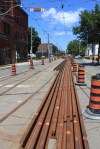
 

Broadview Avenue Reconstruction Summer 2018 (Updated August 9, 2018)

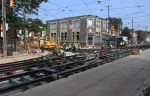
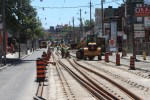
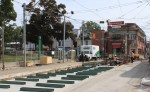
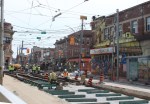
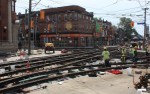
This summer, the TTC will rebuild the special work at the intersections of Broadview with Dundas and with Gerrard, as well as replacing the tangent track between these two locations. Minor repairs are also planned between Gerrard and Danforth.

This post will track the progress of the work.

As of August 9, the TTC has announced that the intersection will reopen to traffic and normal routes for 504 King, 505 Dundas and 506 Carlton will resume on Sunday, August 12 at 7:00 am.

Thursday, June 28, 2018

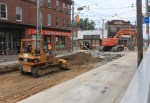
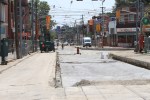
By the fourth day of the project, the old intersection had been demolished and the new concrete foundation was nearly ready for the new track.

Sunday, July 1, 2018

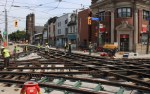
On day seven, the intersection is fully in place, and work is in progress on various connecting tracks.


Wednesday, July 11, 2018

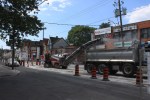
These photos illustrate the first stage in replacing track that was built with the now-standard three-layer technique. At the bottom is a concrete slab, and in the middle layer are steel ties with mount points for Pandrol clips that hold the rail in place. The top  layer of concrete goes from the top of the ties to the rail head.

In the first photo below, the machine is cutting away the concrete between a pair of rails to the depth of the first layer and throwing the spoil into a dump truck. The second photo shows the resulting structure with the rails still in place, but only a narrow band of concrete on either side. In the third photo, the remaining concrete is broken away from the track.


Friday, July 13, 2018

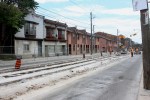
The photos below work north from Dundas Street. In some of them, the old track has been removed while it others it remains in place. The last photo shows the result after the track is removed with the connection points for the Pandrol clips exposed but not yet cleaned up for new track installation.


Tuesday, July 17, 2018

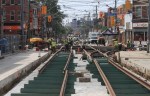
The photos below show the progress of attaching new rail strings to the pre-existing structure.

In the first and second photos, the attachment points for the Pandrol clips are exposed, but the rail strings have not yet been placed.

In the third photo, the rail is positioned on the ties, and the rubber vibration insulation has been placed around the rail.

In the fourth photo, the clips have been installed locking down the rails.

In the fifth photo, covers have been added over the clips, and concrete work (in the foreground) has already begun. A gauge bar is used to verify the rail spacing. Although the attachment points for the clips effectively dictate the gauge, there is a bit of play, and the rail is checked and adjusted if necessary before the concrete pour.

In the sixth photo, the concrete pour is underway north from Dundas.

Thursday, July 26, 2018

Demolition of the old intersection at Broadview & Gerrard is well underway. Work began on July 24.

Sunday, July 29, 2018

Most of the concrete foundation is in place ready for track to arrive.

Monday, July 30, 2018

The central diamond had been placed and part of the southern quadrant was roughly in position when I visited about noon. The diamond is unusual in that it is not a 90 degree crossing, and there the curve coming out of the east side begins within the diamond itself. Also, the intersection slopes from south to north.

The only other intersections with a non ninety degree diamond are at Bathurst & Queen, Dundas & McCaul and College & Spadina.  [Thanks to reader “Max” who pointed out the Dundas/McCaul location, and L. Wall who pointed out Spadina & College both of which I missed in the original article.]

August 2, 2018

At midday, the intersection was almost completely assembled with only the approaches still in progress. The City of Toronto tweeted yesterday that the intersection work is ahead of schedule and should open on August 20.

Great news! Broadview & Gerrard St E expected to fully reopen by Aug 20, ahead of schedule as crews make excellent progress on TTC track replacement. Thank you for your patience during this work. [Tweet from @TorontoComms August 1, 2018]

Diversions in Progress

The assembly of the intersection will likely take the balance of the week through to August 4, and then there are the connection tracks to the adjacent structures. Once concrete is placed, it would be about a week before before traffic could return. This has now been announced for August 12.

504 King and 505 Dundas buses have shifted to use the roads connecting to Gerrard at St. Matthews. 506 Carlton buses divert via River, Dundas and Logan both ways. When the intersection reopens to traffic, the replacement bus service will operate on the normal route. Streetcars return to 504 and 506 on Sunday, September 2.

Ooops!

The TTC has confirmed that although the Board approved addition of a north-to-west curve at this location back in 2010 (along with other changes), corporate amnesia caused this to be omitted from the current work.

The Tour Tram Debuts in 1973

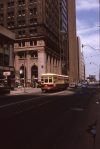
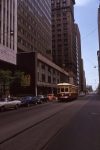
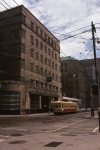
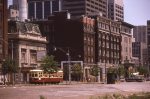
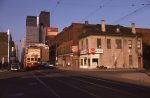
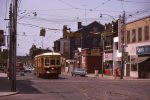
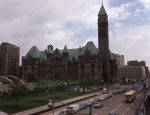
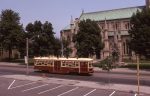
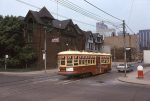
Forty-five years ago, on June 24, 1973, Peter Witt car 2766 began operating on the streets of Toronto as the Tour Tram. For that first day, the car was decked out with bunting, Canadian and Ontario flags, a Union Jack and photos of HM Queen Elizabeth whose official birthday was celebrated about a week earlier in mid June.

In a previous article, five years ago, I showed the restoration work at Hillcrest Shops. Now, here are photos from on-street operation in the early days. The photos are arranged geographically around the route rather than by date. At the end of the gallery are a few shots of a Tour Tram diversion on Adelaide Street on its third day of operation.

Throughout these photos there are many buildings that no longer exist and views that are now impossible to take because open spaces have been filled in with redevelopment.

King Street Update: May 2018 Data (Part II)

This article continues the analysis of the King Street Pilot with May 2018 data. Part I is in a separate article.

Many topics are covered here, and the intended audience is those readers who want to look at the details of how routes operating on King Street behave. The sections include:

  • Headway reliability on 504 King both in the downtown pilot area and at the terminals.
  • Short turning on the 504 King car.
  • Headway reliability on 514 Cherry and 503 Kingston Road.
  • Headway behaviour for the consolidated 504, 514 and 503 services downtown.
  • A detailed review of 504 King operation on certain days in May 2018.

A common factor through this article is that while travel times in the pilot area have improved thanks to the transit priority scheme, the headways on all affected services are erratic, especially on 514 Cherry and 503 Kingston Road.

The pilot transit project on King is intended to make service more attractive to riders, and this can occur in various ways:

  • Travel times through downtown are shorter and more reliable than during the pre-pilot period.
  • Route capacity has improved partly from schedule changes and recapture of excess travel time, but mainly through the replacement of the older streetcars used on King with larger ones, primarily the new Flexity cars.
  • Headway reliability (consistent times between cars) can be improved if random congestion events are reduced or eliminated, and reliable travel times lessen the need for short turns.

No one change by itself “solves” King Street’s problems, and all three are needed to achieve benefits that will attract riders.

An important part of a transit journey is the time spent waiting for a vehicle. One reason the subway is so popular, aside from its speed, is that trains come frequently and reasonably reliably, although this has become a sore point in recent years. Surface route reliability has always been an issue, and although trips may be faster, there is still the issue of how reliably vehicles actually show up to carry riders.

Continue reading

The Sixth Worst City Myth

Recent stories beginning with the Toronto Sun, and followed by other media including Global, CTV and City, latched onto a claim from a recent study that Toronto was the sixth worst city in the world for commuting. The study from UK’s Expert Market blog writer Sean Julliard combines data from several other sites and indices to formulate a commuting index for 74 cities around the world.

Toronto likes to think of itself as a “transit city” while having severe congestion problems that are regional in scope, not simply confined to the core area which is a tiny fraction of the overall territory covered by this study. That ranking intrigued, but did not surprise me, and I set out to determine just how Toronto ranked so low in a rather long list.

Links to both an Excel and PDF version of the scores and their components are available in Julliard’s article.

First off, it is vital to understand just how these scores were compiled. Here are the components:

  • Metro population: This is the regional population, not necessarily the same as the city population. No source is cited for these values, nor is there a guarantee that other factors are drawn from the same geographic scope. For example, the population given for Toronto is almost 6 million (obviously the GTA), but the price of a monthly farecard is based on the undiscounted value of a TTC Adult Metropass.
  • The following four values come from the Moovit Insights compendium of public transit facts and statistics (Toronto page):
    • Average time spent commuting: These are transit commuting times and have nothing to do with traffic congestion except as it might affect transit vehicles.
    • Average time spent waiting for a bus or a train daily: Again, this is a transit value and appears to be a compendium of all wait times on journeys, not just the initial stage of a trip.
    • Average journey distance: This is a transit journey distance. The value shown for Toronto, 10km, lines up with information from other studies. It is slightly higher than the average for the TTC itself because regional commutes are included in the total. This is a one-way value.
    • Proportion of commuters who have to make at least one change during a transit journey.
  • The following value is derived from the Numbeo Cost of Living index (Toronto page):
    • The percentage of a monthly salary represented by the cost of a monthly transit travel card. In Toronto’s case, this is a salary for Toronto proper, and an undiscounted adult Metropass.
  • The following value is derived from the INRIX Global Traffic Scorecard:
    • Average hours spent in traffic congestion over 240 days (twelve twenty-day months)

Note that most of these factors refer only to transit with only the final one having anything to do with road congestion. This did not prevent many from reporting on how the study showed Toronto with the sixth worst congestion in the world.

Julliard notes that his composite index was primarily based on two factors:

The final ranking is weighted, with cost and time spent commuting judged to be the most important factors.

He does not explain exactly how much weight each factor is given in the total score.

Toronto ranks high on the transit cost component because of our relatively expensive Metropass. Numbeo notes:

Toronto has 13th Most Expensive Monthly Pass (Regular Price) in the World (out of 444 cities).

As for congestion, Toronto sits at 49th place (with 1st being the worst), and its position is rising (bad) thanks to increased time spent by commuters in traffic.

And so we have a sixth worst ranking on Julliard’s scale because we have rotten traffic and expensive transit.

Traffic Congestion

The INRIX scores rank many North American cities, including Montréal (38th), worse off than Toronto for congestion. Los Angeles tops the list with New York (3rd) and San Francisco (5th) not far behind. On a world scale, we are better off than London (7th) and Paris (12th) among many others.

This is a very different view than presented in media reports based on Julliard’s blog.

Transit Indices

Toronto is almost at the bottom of the list for the average time spent commuting by transit at 73rd place out of 74 in Julliard’s list. This is not surprising with a very high 96 minutes spend on average claimed by Moovit. Remember that this is for a round trip, and so their value for the average one-way trip is 48 minutes. That’s a reasonable number for Toronto. It is worth noting that of the 74 cities, only 24 have values of an hour or less. Others in the 90+ list include: Portland, Miami, Istanbul, Philadelphia, Sao Paulo, Birmingham (UK), Salvador (Brazil), Rio de Janiero, Brasilia, and Bogata.

This also begs the question of the scale of transit service in various cities. It is quite likely that in the overall list, it is physically impossible to spend as much time as in Toronto on commute journeys either because the city regions are smaller, or their transit networks do not reach as far as Toronto’s.

For transit wait time, Toronto is much better off at 41st with a relatively low value of 14 minutes. We may take long journeys, but we spend less time waiting to make them.

Our journeys are comparatively long at 10km reflecting the geography of the GTA’s population and work locations, and we sit at 63rd place in the list.

As for transfers, we rank well down on the list at 69th, and that is a direct result of our transit network’s design. Most riders (73%) have to transfer at least once, and given the size of Toronto, that would be hard to avoid except with massive duplication of routes to provide many more one-seat rides. Only 17 cities in the list have a value under 50%, and they tend to be smaller than Toronto with populations averaging 1.7 million (25% of the GTA value).

Toronto is 62nd on the list for cost of a monthly travel card (a TTC Metropass) as a percentage of monthly income at 6.5%. Montreal has a value less than half of Toronto’s, and most cities in Julliard’s list fall below 5%.

Concluding Thoughts

If you want to complain that the TTC costs too much, especially its monthly pass, that’s a valid point, but it has nothing to do with traffic congestion. Travel distances and times are a direct consequence of a region that has, for the most part, built up around a road network, not around transit. Where once the “old” city with its spine of subways and frequent surface routes dominated the travel market, the city region is now overwhelmingly car-based with sprawling populations and job centres to match. This model “worked” when roads had capacity and the assumption that everyone had a car was taken as read. That is not what Toronto has become, and we now have a crisis in transportation network capacity and in the economic viability of so much travel for work and study taking so much time out of everyone’s day.

The Toronto Sun has even taken up the fight against the streetcar again lumping in the downtown know-it-alls who killed the Spadina Expressway with those who preserved the streetcar system. The fact that the vast majority of the GTHA has never seen a streetcar and manages to be hopelessly congested all the same has escaped them. Toronto being “sixth worst” is yet another reason to drag out this hobby horse.

And, of course, some of the greatest congestion lies on our “express” road network. Unlike downtown Toronto, Etobicoke, Scarborough and North York never faced the prospect of demolishing large residential areas in the name of “progress”. A plan to widen the expressways beyond lands long-ago acquired for their construction might teach folks outside of downtown just what provision of adequate road capacity would mean in their own back yards.
Julliard’s study (really a collection of data, but not a “study” in the sense of a detailed review of how the underlying numbers work and what they reveal) is a convenient jumping off point for lazy politicians (and sadly, I must say, for journalists too), but it has been used without context and with even the data it does include misrepresented. If Toronto had a cheaper transit pass, we would have ranked much better, and there would be no story, but this would have no effect on traffic congestion.

Are there problems in the GTA? Of course there are, and they start with a built form and demand pattern that are extremely difficult (impossible in places) to serve with transit. Once the roads are full, they guarantee congestion, and this will not be solved with a few subways or by getting rid of a handful of streetcar lines in Toronto’s core. The “fix” will take time, and must begin with a recognition that shifting people to transit is hard, expensive work. Simplistic, campaign-driven, vote-buying “solutions” are worthless.

King Street Update: May 2018 Data

This article is part of a continuing series reviewing operations on King Street during the transit priority pilot. In Part I here, I review travel times and line capacity in the King Street Pilot’s area. In a follow-up Part II, I will look at headway reliability not just downtown but on the outer ends of the 504 King, 514 Cherry and 503 Kingston Road lines, as well as details of 504 King operation on days when it was badly disrupted.

There has been enough accumulation of data since November 2017 to establish that the pilot has a benefit, although the exact nature varies depending on location, weather and other factors. I will not publish this analysis again until August by which time the effect, if any, of the revised route structure to take effect on Sunday, June 24 will have been in place long enough to accumulate sufficient data. By then there will also be a number of major downtown events to use as reference points in how well the pilot area sustained its transit service.

Continue reading

TTC Plans For a Zero-Emission Bus Fleet

Updated June 13, 2018: Discussion and motions from the TTC Board Meeting added.

At its meeting on June 12, 2018, the TTC board will consider a staff report which sets out in some detail the first stages of Toronto’s migration from diesel and diesel/hybrid buses to a zero-emission fleet.

The TTC’s abrupt shift from diesel to zero-emission followed a July 2017 motion adopting the TransformTO climate change plan which included a reduction target of 80% by 2050. After continued defense of “clean diesel” technology on the basis of cost and reliability, ongoing problems with Hybrid buses, and a view that new technologies were not yet mature enough for system-wide use, the TTC has reversed course and embraced a move to buying only zero-emission vehicles by the mid-2020s. As older vehicles reach end of life, the diesel and hybrid fleets would gradually disappear.

In September 2017 at an unusual Board meeting a vendor, BYD, was given the opportunity to make an extended product pitch as a “deputation”. This led to a more general interest in zero-emission vehicles from two other vendors (New Flyer and Proterra), as well as natural gas alternatives thanks to lobbying by Enbridge Gas.

In November, the Board approved a 30-bus trial with ten vehicles from each of the three vendors, as well as a less definitive study of the role of gaseous fuels.

A major problem through the entire process is that much of this is new technology, and there are many competing claims for its suitability that are not yet substantiated by real world experience. A recent article in the Los Angeles Times details problems with their battery buses and the gap between promises and actual performance.

Toronto is just beginning to learn the cost of moving to a greener fleet and the escalation not only in vehicle costs but in related infrastructure. $50 million has been allocated for those first 30 buses, and a further $88 million is on the table for another 30 plus associated infrastructure. The report is deliberately vague about specific prices for vehicles because negotiations with vendors are still underway.

Without extra investment by other governments, the technology change simply would not happen. In a November 2017 report, TTC staff noted that battery buses were “significantly less expensive” than other options based on the availability of PTIF funding.

Indeed, the current plan is structured to burn through as much of the Federal government’s Public Transit Infrastructure Fund Phase I money as possible. When PTIF was announced, all projects to be part of the first phase were required to be finished by March 2019. This is partly a political date given the election next year, and partly an accounting requirement so that spending occurs within a few fiscal years (government fiscal years start on April 1). The PTIF deadline was extended from 2019 to 2020 when it became obvious that actually spending the new money would not be possible for many cities.

Toronto found itself without projects either in the City or Transit budgets that could soak up the available money in only a few years, and initially the focus was on a massive replacement of the bus fleet to retire the worst of the older buses and, at the same time, shift from an 18-year to a 12-year replacement cycle.

In this context – a subsidy windfall plus an unusually large, multi-year bus order – the opportunity for a fast change in technology presented itself both to the politicians and to the would-be vendors. Whether this will work out remains to be seen, but the TTC is moving cautiously with a trial program that will determine whether the new technologies are credible replacements for what we have today. Meanwhile, the TTC will shift back to Hybrids from Clean Diesel on the premise that Hybrid technology has improved since the less-than-reliable generation of buses they are about to retire.

Recommended Action

The staff report recommends that:

  1. The quantity of electric buses will be increased from 30 to 60 with all vehicles to be delivered by March 31, 2020, and the TTC will work with Toronto Hydro on the design and installation of charging and energy storage systems; the project cost is increased from $50 to $120 million.
  2. The TTC will work with Toronto Hydro to modify one bus garage to accommodate up to 300 buses through the supply of a substation and backup generator at an estimated cost of $18 million.
  3. Staff will provide a project update in first quarter 2019 to the new TTC Board following the Council election in the fall of 2018.
  4. Staff will conduct a feasibility study of all garages and report in the fourth quarter of 2019 on “preliminary estimates for the total costs, benefits, and potential funding opportunities associated with the green bus plan”.

Separately from these reports, staff will present a plan in July 2018 feeding into the 2019 budget process with updated capital plans and tradeoffs necessary to free up money for the new bus infrastructure.

Continue reading

Will Toronto Get More New Streetcars?

Updated June 13, 2018 at 10:00 am: The discussion and actions at the Board Meeting are reported at the end of this article.

Correction June 18, 2018 at 3:45 pm:

The section reporting the debate at the TTC Board meeting originally stated that Acting CEO Rick Leary was waiting to see if Bombardier could ship 20 cars/month by fall 2018 in order to hit the target for contract completion by the end of 2019. This should have read “20 cars/quarter”.

Original Article

Streetcar riders in Toronto are a long-suffering bunch. The size of the fleet has not changed since the mid-1990s despite the addition of a new streetcar line on Spadina in 1997 and the Harbourfront extension to Exhibition Loop in 2000. As the fleet wore out, its reliability dropped, and the now 40-year old CLRVs (single section) and 30-year old ALRVs (two section “articulateds”) are showing their age.

The TTC needed new cars some time ago, and the process of ordering the low floor Flexity fleet goes back to 2006. The first attempt, one that might have brought Toronto new cars about the same size as the ALRVs with a mixture of low and high level floors, was called off when the 100% low floor Flexitys (a design originally for Berlin) became available. That delay, combined with foot-dragging by incoming Mayor Rob Ford, and manufacturing incompetence by Bombardier, has left the TTC with a fleet far below its needs, and new cars straggling onto the property at a glacial rate.

During the past 20 years, population and employment downtown has grown far faster than in other parts of Toronto, and the residential density, once on a downward trend as family neighbourhoods gentrified, is growing. This is not confined to the new south-of-King areas, and is pushing north into the territory of other streetcar lines. The rate of growth is also changing. When the TTC ordered 204 Flexitys, these were expected to handle rising demand through 2027. This date has been revised much earlier to 2020

A major issue for the TTC, and for transit advocates in Toronto, has been the problem of “latent demand”. If the fleet stays the same size or declines, service and capacity follows the same path. The original plan for Flexity roll out onto the streetcar lines focused as much on reducing the number of operators required to carry demand little changed from then-current levels. Now, the TTC acknowledges that growth on streetcar lines went unmet for years.

The 1990s were a critical period because Toronto was coming out of a recession during which the TTC had lost 20% of its ridership, but the streetcar fleet, sized to mid-1990s demand, was unable to expand service as the system recovered. Many of the complaints about “bad streetcar service” come directly from the failure to add capacity as the economy rebounded, and then as the population along streetcar lines began to grow.

Much of the residential growth Downtown between 2012 and 2016 took place south of Queen Street. Almost 50% of all Downtown growth occurred in the King-Spadina and Waterfront West neighbourhoods. The Bay Corridor, King-Parliament and Waterfront Central saw moderate increases accounting for 36% of new residents. As a result of the increase in development in Toronto’s Downtown area, TTC streetcar ridership increased by 20% between 2008 and 2018 which is much higher than what was anticipated back in 2008. Transit mode share across the City has also increased from 23% (2006) to 27% (2016), putting additional pressure on the system.

Recent revision of the projected employment and population growth for Downtown Toronto has introduced higher forecasts which now extend to 2041. The revised estimate of number of new residents in the Downtown is 500% greater than originally projected. The revised estimate of new jobs in the Downtown is 200% greater than originally projected.

The size of the TTC’s streetcar fleet has been unchanged for almost 30 years, during a period of continuously-increasing ridership growth. This has resulted in streetcar capacity, during peak periods, being completely exhausted more than 10 years ago, with no ability to accommodate additional ridership during peak periods. Experience with deployment of the new LFLRVs on the first few streetcar routes has shown that there is an existing unmet, latent demand for peak-travel on the TTC’s streetcar routes. King Street is an excellent example of this. Over the first few months of operation the route experienced an increase of all-day weekday ridership of 16%. There are other factors that have contributed to the ridership increase (such as priority treatments and increased reliability); however, latent demand is one factor driving the ridership increase.

On King Street, the TTC has seen the combined effect of running more capacity (larger vehicles) and more reliable service (the King Street pilot). This number is still constrained by the capacity of service on the street.

On Queen Street, the shuffling of vehicles between routes and the retirement of most of the ALRVs has led, finally, to a schedule that reflects the equipment actually available to operate the route and a net increase in capacity provided, as opposed to scheduled.

Higher-density development is beginning on the Dundas, Carlton and St. Clair routes, and it is spreading away from the central part of the city where the subway is the primary mode.

Future new routes in the eastern waterfront as well as a new link to southern Etobicoke will require even more streetcars.

The TTC projects that by 2033, the peak service requirement will be 287 cars, (345 including spares), equivalent to about 570 (690) CLRVs. At their height, there were only 196 CLRVs and 52 of the larger ALRVs. This is a huge increase in the streetcar system’s capacity, almost to the level of the 745-strong PCC fleet which dominated the system through the 1950s and 60s.

At its meeting on June 12, 2018, the TTC Board will consider a report from staff that summarizes the result of a vendor survey to gauge interest in producing streetcars and proposes the following actions:

Over the coming months, staff will undertake the following:

  1. Request funding approval through 2019 budget process;
  2. Update contract documents based on stakeholder input, contract changes, and lessons learned;
  3. Engage consultant to validate RFI responses (e.g. technical and commercial performance, on-time delivery performance, etc.);
  4. Develop scope and budget for additional maintenance capacity at Hillcrest; and
  5. Report back to the TTC Board in Q1 2019 with recommendations.

The wild card in all of this will be the outcome of the provincial election on June 7, and the degree to which the incoming Premier will support or attempt to sabotage any expansion of streetcar service. Funding arrangements, especially under the federal PTIF scheme, depend on all three levels of government contributing. This effectively gives any one level the ability to veto a project unless there is a change in the rules.

Continue reading

So You Want To Own A Subway (2018 Edition)

Among the many promises made by the Progressive Conservative Party in the run-up to the June 7 election is a scheme to upload the Toronto subway system to the province with the intention of relieving Toronto of this ongoing cost. This was also part of their 2014 campaign, and it is born no doubt from the Ford brothers’ assumption that (a) this could be done cheaply and (b) Toronto would save money overall. The pot is sweetened this time around with the guarantee that Toronto would keep the fare revenue and operate the system. The overall tradeoffs in operating and capital costs are not entirely nailed down.

Oliver Moore in the Globe has written about this proposal wondering whether it is actually workable. The quotes below are taken from his article.

The Tories are framing the upload largely as an accounting exercise, making it easier to find funding and thus facilitating transit construction. The province would pay an estimated $160-million annually for major capital maintenance on the subway network, taking an obligation off city books.

Under the proposal, the Toronto Transit Commission would keep operating the subway, with its board setting fares and the city retaining revenues. Expansion planning would be controlled by the province, although Toronto and Ottawa would be asked to help fund construction.

Note that the proposal is silent on the operating cost of the subway. There is something of a myth that the subway “breaks even”, but this is not true, especially for the more-recently opened segments. It is a matter of record that the Sheppard Line loses money, and the TTC estimated that the operating impact, net of new fares, of the Vaughan extension would be $30 million per year.

If the province builds a new subway line, would Toronto, through the TTC, still be on the hook for paying its operating cost?

Any concept of “breaking even” requires that fares be allocated between surface and subway routes and this is an impossible task. One can propose many schemes, but they all have built-in biases because a “trip” and a “fare” are such different things. The situation is even more complex as an increasing number of riders pay through some form of pass all the way from the yearly Metropass (formerly called the “monthly discount program”) down to the two-hour transfer.

How Much Does The Subway Cost?

The estimated value of an upload to Queen’s Park of $160 million/year is woefully inadequate because the TTC’s capital budget for ongoing maintenance is much, much larger. There is much more to owning a subway than collecting billions in construction subsidies. Despite the frequent claim that “subways last 100 years”, they require a lot of ongoing maintenance and replacement of subsystems. With the exception of the physical tunnel and station structures, a large proportion of the older subway lines has been completely replaced or undergone major overhaul at least once since they opened. Line 1 YUS is on its third generation of trains, for example.

I wrote about this four years ago, and this article is an update of my earlier review.

A big problem arises for anyone taking a superficial look at the TTC’s books because so many projects are not funded, or are not even part of the approved “base budget”. They are “below the line” or, even worse, they are merely “proposals” of future works that might find their way into the official list. Looking only at current, approved funded projects ignores a large and growing list of projects that, for political convenience, are out of sight, the iceberg below the water line.

Slogging through the TTC’s Capital Budget is no fun, but somebody has to do it. You, dear readers, get the digested version of hundreds of pages of reports. Thank you in advance.

Continue reading

TTC Contemplates Earlier Subway Closing

At the TTC’s Audit & Risk Management Committee meeting of May 29, 2018, staff presented a report entitled Internal Audit Quarterly Update: Q1 2018. That is not the sort of title that would prompt avid late-night reading, but one item within the report sparked a brief conversation between the committee and staff.

There are several issues related to the management of overnight work in the subway which requires a variety of resources including staff, work cars, power cuts and central supervision to keep all of the crews from tripping over each other. One part of the ongoing audit work is to review the systems (many automated, but some manual) used to schedule and track the work plans, but another issue raised was the relatively short maintenance window within which work can be done. Responding to a question, staff advised that they are reviewing the operating hours of the subway to determine whether changing these hours could improve the productivity of overnight maintenance work.

Here are extracts from the report:

Audit Observation #3: Track Level Maintenance Window

TTC’s revenue subway service hours limit the nightly maintenance window, which impacts the efficiency and effectiveness of track level work and exposes subway infrastructure to accelerated deterioration.

Limited Track Level Maintenance Window

Per an international CoMET/Nova benchmark study of “Metro Key Performance Indicators (2016 data)”, TTC ranked fourth amongst 34 participants in terms of subway service density or network utilization – a standardized method that measures operated passenger capacity compared to network size. This KPI reflects the ‘intensity of utilization of the metro network’, which is a function of train frequency, train length and car capacity. The study asserts high train frequency may reflect a good use of fixed infrastructure, but the intense impact on asset utilization should be warranted by ridership demand, i.e., recognizing the need to balance competing objectives of making subway service more available for customers versus the costs associated with accelerated deterioration of subway infrastructure and assets due to an increase in daily use. The study comments that TTC offers relatively high levels of capacity primarily due to larger trains and higher frequencies across its entire, relatively small network.
TTC track level work starts once the system is fully cleared of revenue trains. TTC’s subway system is closed to the public at 1:30am and opens at 6:00am on week days and Saturdays, and at 8:00am on Sundays. However, trains continue to run through the system until approximately 2:30am and re-enter the system at around 5:30am, leaving an average total available daily maintenance window of 180 minutes (300 minutes on Sundays as service preparation starts around 7:30am).

Night shift work typically runs from 10:30pm to 7am, including a 30-minute unpaid meal break. Per discussion with Subway Infrastructure management, track level set-up activities typically start at 2:45am and Transit Control requests crews to complete work and start clearing the track at 5:00am. Work activities expected to be performed out-side of this track level access time period include employee roll-call, safety-talks/briefings, work car preparation, and tools maintenance, etc.

[…]

In a Nova comparison study, “Track Possession Timings ” (2014), it was noted that given TTC’s subway service hours, and taking into account estimated time required for set-up and safety check activities, as well as post work preparation for service, TTC workers’ total available time to work productively at track level was between 30 and 225 mins less than the other ten participants. Further, the average maintenance window of these other participants was almost 2hrs longer than that of TTC.

If the maintenance window was to be increased by 2 additional hours, 5 nights a week, Audit estimates the opportunity for improved productivity by SI’s Track Maintenance and Structure Maintenance Sections alone to be valued at approximately $3.38 million. Such a change would also reduce overtime and potentially the need for weekend closures by these two groups. Based on payroll data, Track Maintenance and Structure Maintenance incurred overtime costs of $4.58M and $1.26M respectively in 2017. Structure Maintenance Management estimates that if the maintenance window was to be extended by 2 hours, 5 nights a week, the annual overtime for this Section could be reduced by 75%, which in 2017, would be equal to approximately $945K. It is reasonable to assume productivity improvements and material overtime savings could be realized by other groups that complete maintenance and capital project work at track level if the maintenance window is extended.

[pp 8-9 of Attachment 3, at pp 27-28 of the document]

Note that the “other ten participants” are not listed nor are the relative service levels of their transit systems mentioned to indicate whether they are valid comparators for Toronto.

A proposed action plan appears a few pages later in the report:

Audit Observation #3 – Management Action Plan Considerations:

To maximize and optimize the track level maintenance window, Management should:

  • Evaluate actual ridership and revenue associated with TTC’s late-night subway service (after midnight runs) to ensure current intensity of service and impact on subway infrastructure (and vehicle) asset maintenance costs are warranted.
  • Conduct in-depth analysis of TTC’s current subway infrastructure asset management approach, resource planning and crewing methods, work car dispatching techniques and work methods to identify opportunities for maximizing productivity and transparency of resource utilization at track level.

This was striking on at least two counts.

First, there is no recognition in the report that closing earlier is anything more than a question of sending trains back to the yard earlier, and no mention of providing replacement service. It is no secret that night buses on Yonge and Bloor-Danforth are very heavily loaded after 2 am and, if anything, more service is needed then. A similar problem occurs during the early part of the day before the subway opens. The auditors also seem to be unaware that there is no night service to replace the University-Spadina subway, and this is difficult (as users of Spadina shuttles know) because the subway does not follow an arterial road like Yonge or Bloor.

If two hours were added to the shutdown period, the amount of bus service required to replace the subway would be substantial, and it is likely that ridership would be lost thanks to the relative inconvenience. Moreover, there would be knock-on effects for users of connecting bus services who would face much longer journeys to their connection points on a surface bus, and who might also face a decline in service thanks to the unattractiveness of the night bus replacement for the subway.

This change could actually trigger a system-wide retrenchment of service hours.

Second, there was absolutely no intimation that anyone at the meeting was aware of just how severe the impacts of this proposal would be on riders, nor was there any attempt to defend their interests. Indeed, the focus is on making the maintenance teams more efficient and saving millions without considering the offsetting costs and potential lost revenue.

Some of the basic assumptions in the text quoted above are wrong, notably a claimed closing time for the subway of 1:30 am. In fact, the closing time varies across the system. There is a scheduled meet of the last northbound, eastbound and westbound trains at Bloor-Yonge at about 1:54 am that has been in place since the BD line opened in 1966. Stations close as these last trains make their way outbound to terminals. One might hope the auditors would check with TTC planners or even simply look at their own website.

The last train eastbound on Line 4 Sheppard does not leave Yonge-Sheppard station until 2:14 am.

It is quite clear to anyone who actually rides the subway late at night that it does not close at 1:30 am across the network. This is only the start of a process that continues until about 2:30 am, and some trains have to return to their overnight storage locations even later. The maintenance window varies depending where one is on the network.
The comment in the report about “accelerated deterioration of subway infrastructure and assets” is a function of the very frequent service the TTC provides across the entire subway system at all hours with trains every 5 minutes or better until almost the end of service. How much extra wear and tear this represents since the subway opened in 1954 might be of interest, but this service level is a matter of TTC Service Standards. One could argue that full service is not required, based on demand, beyond a core portion of the system late at night. However, I dare any politician to stand up and tell suburban Toronto that they will lose their frequent service just because the trains are not full.

Another issue here is that actually running the trains is only part of total subway costs, and unless one can also drop staffing levels associated with stations, security, line supervision and on-call maintainers, the saving of running, say, only half of the service beyond a turnback point such as Eglinton is small. The same consideration applies to running less frequent service generally – the trains are only part of the overall operating cost.

It is important to note that this “accelerated deterioration” is a function of frequent service over long hours, not some side-effect of inefficient maintenance procedures as one might erroneously read the audit report.

I hope that if there is a detailed study, it will take into account the benefits of good late night and early morning service on the subway, not to mention the requirements for substantially improved night bus service. Indeed the existing night service needs improving, but languishes thanks to a combination of indifference and budget restraints.

It is only a few years since the TTC began Sunday service at 8:00 am rather than 9:00 am in January 2016.

In a Nov. 4, 2015, letter to the Board, Mayor John Tory and Chair Josh Colle wrote:

“As a vibrant and growing city, Toronto does not conform to a traditional Monday to Friday schedule … Our businesses are open, our cultural centres are operating and the engines of our economy remain in motion. The people of Toronto should be able to move around this city with ease — seven days a week — and the TTC plays an instrumental role in providing this mobility.”

Early Sunday openings are the latest service improvement to be introduced in recent months, following this year’s expansion of overnight service and all-day, every-day service across the city, implementation of ten-minute-or-better service and reduced off-peak crowding on bus and streetcar routes.

Someone should send a copy of this letter to the auditors who appear to be incapable of making a full evaluation of the effects of their recommendations or even appreciating the seriousness of what they propose. “Efficiency” in one department does not mean better service for the organization and the City as a whole.