This is a follow-on to my article about the number of spares on the bus fleet.
The question of the day is why do we have so many surplus streetcars and subway trains. This article will provide some history of how the fleets and service levels evolved in recent years.
First off, I must report an error in my previous article which includes a table showing that the TTC has 551 spare buses. The actual number turns out to be 478.
The reason for the error is that a chart in the CEO’s report incorrectly shows the total bus count at 2,114. That was the value when this chart was originally used back in early 2021, but it has not been updated to reflect retirements of old vehicles. The actual number of active vehicles, according to the TTC’s Scheduled Service Summary for March 26, 2023, is 2,041. (This number does not appear as a total, but is obtained by adding up the number of active buses for each group in the fleet. See the last page of the summary for details.)
This still leaves the TTC with more buses on their hands than they strictly require for scheduled service plus maintenance, or to put it another way, with headroom to run more service without buying more buses.
The TTC has three new bus orders in the works for delivery in 2023-24:
135 40′ hybrids from New Flyer
68 60′ hybrids from New Flyer
134 40′ hybrids from Nova Bus
It is not clear how many existing buses these will replace and what the resulting fleet mix will be by the end of 2024.
Separately from these will be a new fleet of over 300 battery electric buses. This contract (or possibly contracts) has not been awarded yet while the TTC awaits confirmation of federal funding for “green” buses.
The TTC Board met on April 13 with an agenda that did not give any indication that there would be lengthy debate on any item. I previewed the major issues in a previous article and will not repeat those comments here.
The big items in the public portion of the agenda are the monthly CEO’s Report and an update on TTC’s finances and major capital projects to the end of 2022.
There are also two reports on collective agreements and non-union salaries. Although the details lie in confidential attachments, the public reports give an overview of the various labour contracts and salary drivers across the organization. I leave perusal of these to interested readers.
Finally there are a few references to the TTC’s eBus program scattered through reports. I will consolidate this info in its own section at the end of the article.
Correction April 18, 2023: It turns out that the size of the bus fleet shown in the graphic below is wrong. There are only 2041 buses, not 2114, in service as of March 2023. The article has been amended to reflect this.
Our brand new City Council meets this week. After the requisite speechifying and back-patting typical of the inaugural gathering, they will get into the business of appointing members of various Committees and Boards, including the one that runs the Toronto Transit Commission.
There are two sets of Board members: Councillors and citizens, a.k.a. civilians who (in theory) are not politicians. Only the first group will be appointed at this meeting, and the citizen members will come up for review in the new year once the City goes through the motions of soliciting applications.
The choice of a TTC Chair is up to Council, although it’s hard to believe that a nod from the Mayor, even without any new powers, would be ignored.
On the past Board, the Council members were: Jaye Robinson (chair), Brad Bradford, Shelley Carroll, Cynthia Lai, Jennifer McKelvie and Denzil Minnan-Wong. Of these, Councillor Lai died just before the election, and Minnan-Wong chose not to run. The Chair’s job should go to someone with experience and a strong commitment both to transit and to making something of the position, not just being a seat warmer.
Oddly enough, none of the existing Councillor/Commissioners has asked to be reappointed. This could lead to turnover (good, maybe) but also the loss of institutional memory at the Board level. That works to management’s advantage, but an organization as large as the TTC needs experience at the top for policy and oversight, not just ribbon cutting.
The new Board, to be confirmed by Council today, will have Councillor Burnside as Chair, with Councillors Mantas, Holyday, Moise and Ainslie as members. The citizen positions will be filled separately in the new year, and current members remain in office until that occurs. I cannot say that I am enthusiastic abouy Burnside as Chair, and do not expect much advocacy from that quarter beyond a knife aimed at the budget, and hence the quality of transit service.
The new Board will face very, very serious problems affecting transit’s future in Toronto. As pandemic-era financial supports wind down, the TTC will simply not be able to afford to operate service without new revenues through fares or subsidies. Moreover, their capital plans vastly exceed available resources.
Since 2020, the struggle has been to just get past the crisis, but the TTC faced a bleak outlook even before the pandemic. I have no crystal ball or magical insights, but offer this article as advice to the new Board.
On October 13, 2022, the TTC issued a Request for Proposals for a new fleet of subway trains. The submission deadline is July 28, 2023, and the anticipated contract award date is December 22, 2023.
This article is not an exhaustive review of the specification which is over 1,200 pages long, but an attempt to pick up major points including differences between the new fleet and the existing TR trains. The information has been organized for easy reading with related points grouped together, not necessarily the sequence in which they appear in the RFP.
Updated October 21, 2022 at 9:10 am:
A section has been added with information on car ventilation as it relates to health concerns and air quality.
A section has been added with more details of the emergency detrainment at the cab ends of the train.
The initial order would be for 480 cars (80 6-car trains) to replace the existing T1 fleet which operates on Line 2 Bloor-Danforth and to provide both for ridership growth and added trains for the Scarborough and Yonge North extensions. The delivery window is 2027-2033.
The trains are intended to be operated as much as possible like the existing TR fleet on Line 1 to minimize retraining requirements.
Although it is buried in an appendix, the TTC proposes a new exterior livery for the trains bringing the red from surface vehicles back into subway territory.
The requested design life for the cars is 35 years, somewhat longer than the 30 year span usually associated with a new fleet, but not unreasonable given the usual lag in replacement orders. For example, the T1 fleet of 370 cars was delivered between 1995 and 2001, and so the first of them will be 33 years old when the first new trains arrive.
Pre-pandemic service on Line 2 was provided at peak by 46 trains (January 2020 schedules). Allowing for spares at 20 per cent, this makes the peak requirement 55 trains compared to the present T1 fleet of 61 trains. (The extra T1s were displaced from Line 4 Sheppard when it converted to 4-car TR sets.)
The initial round of industry consultation took place in 2021 and resulted in pre-qualification of four potential suppliers:
Alstom Transport Canada Inc.
CRRC Qingdao Sifang Co., Ltd.
Hyundai Rotem Company
Kawasaki Rail Car, Inc
The next round of vendor consultations and proposals will only occur with these four companies.
A key issue here is funding. The RFP states:
The TTC has secured commitment to date of $624 million from the municipal government and is actively pursuing additional funding from the other orders of government (Provincial and Federal) towards the full estimated cost of the project. Timelines associated with this RFP have been communicated to potential funding partners, and a request for confirmation of funding by early 2023 has been requested. In order to receive the NST [“New Subway Train”] deliveries in time for the legacy fleet replacement and to meet growth needs, the TTC has elected to commence the procurement at this time, however, contract award is subject to receiving full funding commitments.
TTC RFP, Page 4, Section 1.2.2
There is a 25 per cent Canadian content requirement in the RFP.
There is an ironic leftover in the specification that the trains should be capable of operation on existing lines, new extensions and a new “Relief Line”. This spec has been around for a while. [Technical Specification section 1.1.1]
In past financial plans, TTC management warned about due dates for funding needed to acquire trains in a timeframe that would fit with earlier proposals for a Line 2 Renewal project. That timeline has now passed, and it is clear that delivery of the new fleet might not be completed in time for the Scarborough and Yonge North proposed opening dates in 2030. This could leave more of the old T1 fleet in operation until enough trains are available to provide full service on extended Lines 1 and 2. That, in turn, has implications for the full transition to ATC signalling on Line 2.
It is possible that the total train requirement will be reduced from pre-pandemic levels by operation of both lines at a higher average speed taking advantage of Automatic Train Control and of the “high rate” available but not used. However, that option comes with caveats about the timing of ATC installation on Line 2 as well as the effect of higher speeds on track maintenance and power consumption.
The proposed delivery schedule is shown in the table below. The first two trains are planned for 2027 to allow acceptance testing and tweaking of the specification should problems arise before the main production run. Cars will be delivered to Wilson Carhouse by flatbed truck.
The 32 optional trains are allocated as below:
7 for the new Scarborough Subway Extension
8 for the new Yonge North Extension
5 for the headway improvement on Line 1
8 for the maturity service on the new Yonge North Extension
4 for the maturity service on the new Scarborough Subway Extension
Delivery schedule relative to Notice to Proceed:
40 months: Availability of first train at Wilson Carhouse for testing and commissioning
42 months: Availability of second train at Wilson Carhouse for testing and commissioning
52 months: Trains 3 to 10
60 months: Trains 11 to 20
66 months: Trains 21 to 30
72 months: Trains 31 to 40
77 months: Trains 41 to 50
81 months: Trains 51 to 60
85 months: Trains 61 to 70
89 months: Trains 71 to 80
Availability for service is one month later. To put it another way, when a train arrives, it is expected to work more or less “out of the box” without months of testing and fixes.
Those of us who can remember back to days before the pandemic, when Andy Byford was the TTC’s CEO, will know that there were frequent questions at the TTC Board about upgrades to the Bloor-Danforth subway, Line 2. All of the focus seemed to be on the Yonge-University-Spadina Line 1 with new signalling, trains and the Vaughan extension.
Byford confirmed that work on a Line 2 plan was underway, but never presented one in public. However, it does not take a lot to work out what might have been in this plan.
Automatic Train Control (ATC) signalling to replace the 1960s-era technology still in use.
New trains to replace the existing fleet of T-1 trains that would reach their design life of 30 years in the late-2020s.
Additional trains for service increases possible with ATC as well as for the Scarborough extension.
Additional/new maintenance facilities for a larger Line 2 fleet, plus provision for the then-planned stabling of Relief Line trains at Greenwood Yard.
Storage and maintenance facilities for the growing fleet of subway work cars.
Potential integration of a western yard project with an extension of Line 2 beyond Kipling Station.
This plan requires a lot of funding that the TTC still does not have, action to launch procurement of long lead time rolling stock and infrastructure, and a level of project co-ordination for which the TTC is not particularly noted.
That co-ordination issue arises in part from the funding challenge, and the tendency politically to ask for only what is strictly needed for “today’s” work hoping that Santa Claus will arrive in time to fund the rest. This was a direct cause of technical problems with the Line 1 ATC project that was cobbled together over time. It started with a superficially simple desire to replace the then-existing 1950s signals on the original line from Eglinton to Union. The feeling was quite clear: the TTC Board and Council would never commit to a full ATC conversion project because it would be too expensive.
Unfortunately what resulted was a mixed bag of signalling technologies that were incompatible with each other. To rescue the project, Byford recommended ripping out some already-installed equipment so that the line could be standardized. A related decision was that the Vaughan extension would open with ATC in place rather than, as originally planned, a traditional block signal system that would have to be replaced as a separate project.
At its meeting of July 14, 2022, the TTC Board received a Green Bus Update. By the time a contract is awarded later this year, it will be almost five years since the TTC began this process.
Among the issues not yet resolved are the status of various potential vendors, the degree to which the head-to-head comparison of buses will actually influence product selection, and the financial arrangements in the short and long term for a major shift in bus propulsion technology.
In a comment on my article TTC eBus Study: Final Results, an alert reader noted that the claimed GHG reduction from the new fleet was vastly out of proportion. Here is the TTC’s chart from that report and accompanying text (highlighing added).
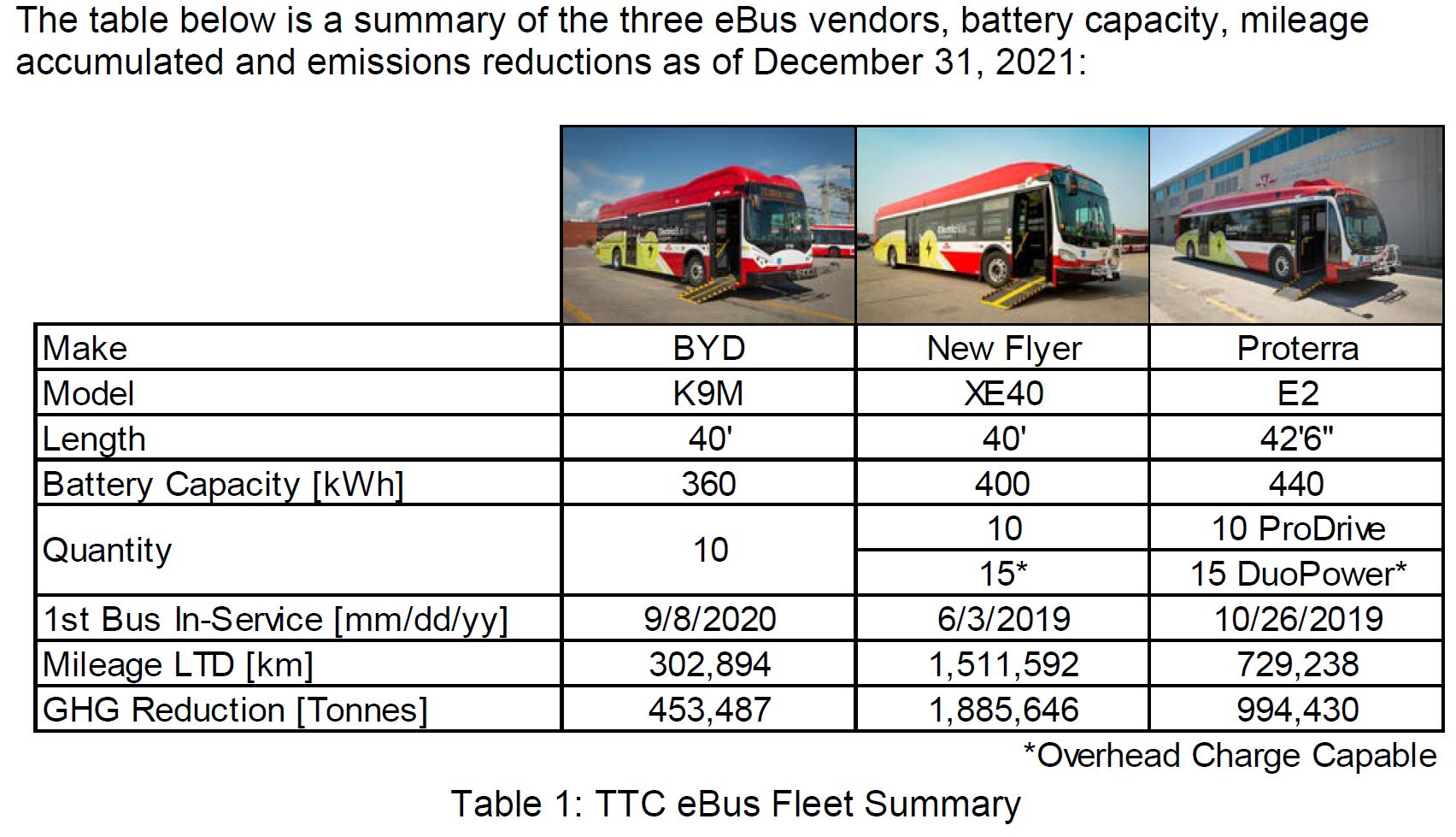
The TTC’s first 60 eBuses were procured from BYD, NFI and Proterra. Prior to the delivery of these eBuses, three garages (Arrow Rd, Mt Dennis and Eglinton Garages) were retrofitted with depot charging systems to accommodate charging up to 25 eBuses per location. All 60 eBuses procured have now been in-service between one to 2.5 years at the TTC with more than 2.5 million kilometres driven, and have reduced GHG emissions by 3.3 million metric tonnes.
TTC Report at p. 14
The basic problem here is the claim that for every kilometre travelled by an eBus rather than by a diesel bus, the saving would be over 1 Tonne of GHG. In the paragraph above, the saving should be 3.3 thousand metric tonnes, not 3.3 million. Who knows how many times this erroneous number will be cited.
The basic numbers are summarized in one paragraph on page 97 of the report:
GHG Reduction
The greenhouse gases (GHG) reduction is primarily due to the avoidance of diesel fuel consumption. At an average fuel economy of 0.53 l/km, the TTC’s Nova clean diesel buses release 1.4 kg of CO2 per kilometre driven. The generation of electricity also creates emissions through many factors including direct emissions from fuel-fired power plants. For Ontario, the average CO2 emission for base load power is 32 g/kWh. The eBus fleet in 2021 averaged 1.62 kW/km (including all non-operating energy consumption sources), which equates to emissions of 0.05 kg CO2/km. Based on the fleet mileage of 1,555,174 km in 2021, emissions associated with the electricity supply are 80.8 Tons CO2. An equivalent clean diesel bus fleet would have emitted 2,177 Tons of CO2.
Note: The highlighted value should be 1.62 kWh/km. This is a typo in the TTC’s original text.
Running the Numbers
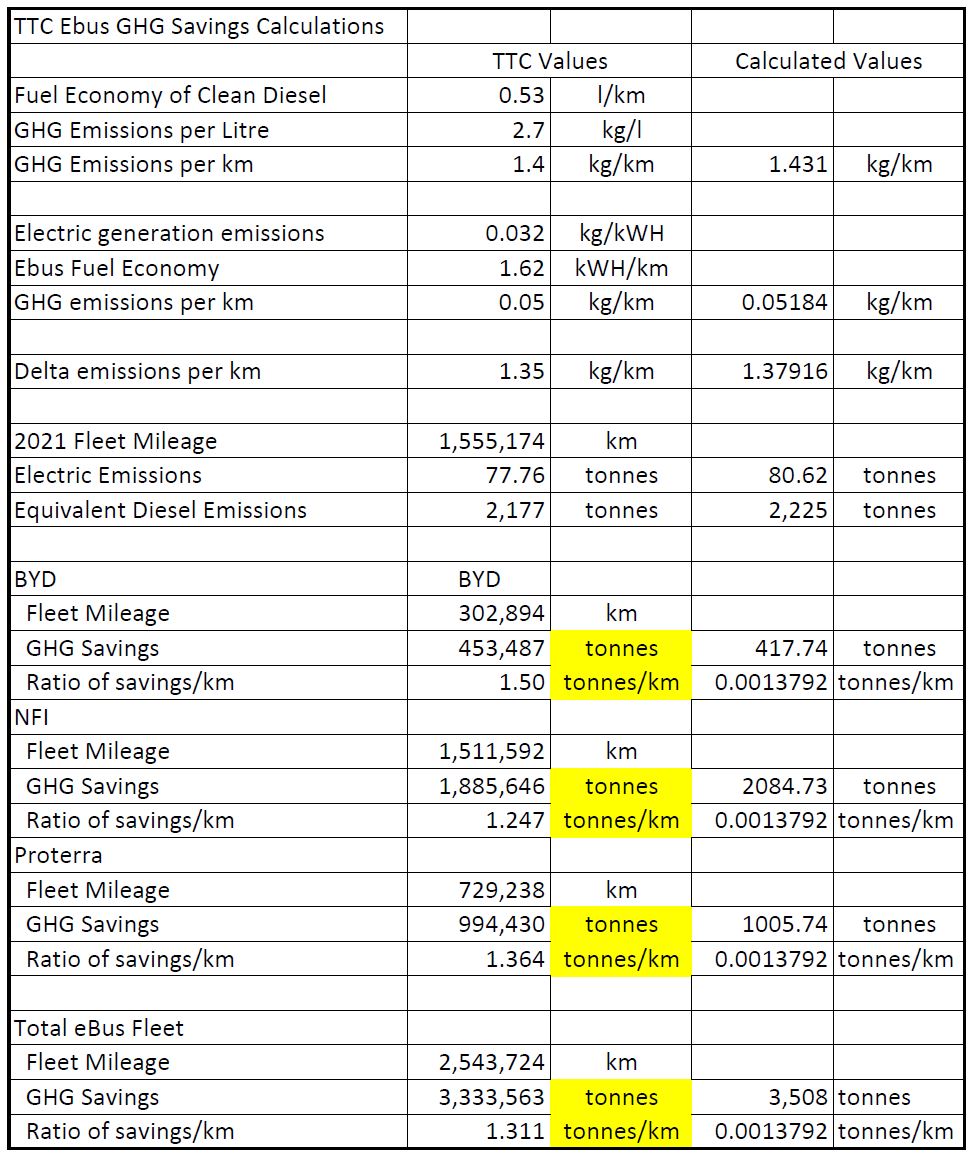
To save readers from working through these numbers, here they are consolidated as a spreadsheet.
The table below compares the TTC’s cited numbers with calculated values. Where a value is calculated, I have not rounded it as in the TTC’s descriptive text. For example, the GHG emissions per km for eBuses is shown as 0.05184 rather than 0.05 kg/km. Cells highlighted in yellow have the wrong units, but this is what the TTC specified in its chart.
The problem here is that the line “GHG Savings” claimed is erroneously stated in Tonnes (1,000 kg) rather than in kilos making the numbers 1,000 times bigger than they actually are.
This has the absurd effect of making the “saving” per kilometre over 1 tonne when the diesel fuel we start with weighs less than 1 kg.
I checked with the TTC, and, yes, the chart is wrong. It should specify savings in kilos, not in tonnes.
The calculated emission savings are obtained by multiplying the “delta” value (difference in emissions by fuel source) by the reported fleet mileages. The claimed values are taken from the TTC’s chart above.
There is a further problem that the ratio of claimed GHG savings to distance operated varies from one vendor to another. There is no explanation for this although the report does cite different fuel consumption rates for each manufacturer’s bus.
Although I have asked, the TTC has not explained why these values are different.
Clean Diesels vs Hybrids as a Reference
There is a further issue with the numbers published by the TTC. They are based on a comparison with “clean diesels” even though some of the vehicles to be replaced include the first generation of hybrids with have lower fuel consumption.
The TTC reports that the GHG saving between a first generation hybrid and an eBus is about 1.315kg CO2/km, as against 1.379 for clean diesels (from the table above). This suggests that the first generation hybrids are not saving much fuel compared to the diesels (less than 5%).
Getting It Right
The main report contains a more reasonable number:
When the entire fleet is zero-emissions, the following benefits are expected to be realized:
1. Greenhouse gas emissions will be reduced by approximately 250,000 tonnes of CO2 annually; […]
TTC Report at p. 3
In pre-covid times (2019), the TTC operated 145.1 million km with its bus fleet. At a saving of about 1.38 kg CO2/km, this translates to 200,000 tones of CO2, a somewhat lower figure than the TTC claims.
As Toronto launches into a new electric era, the TTC needs to clean up its statistics and calculations so that those trumpeting our efforts use the correct data.
Environmentalists, transit boosters, city planners, anyone who is touting electrification should be careful to cite correct figures for the expected benefit of eBuses.
I have no problem with “going green” and welcome the shift to electric vehicles. That said, it is important that the benefits be stated accurately and clearly so that “green” is not oversold. Toronto’s transit history is littered with hucksters.
Updated April 10, 2022 at 10:30pm: Minor typos fixed. Bus order size for eBuses by TTC corrected. Reference to use of pantographs for charging on TTC buses corrected.
Updated April 18, 2022 at 2:50 pm: Note that the GHG savings cited in the TTC’s chart below are off by a factor of 1,000 because they mixed up kilos and tonnes partway through the calculation. See also TTC eBus Errata: Tonnes and Kilos Are Different.
Since June 2019, the TTC ran head-to-head trials of three manufacturers’ battery-electric buses with a fleet of 60 vehicles:
New Flyer models SR2304 (10) and SR2382 (15)
Proterra models Catalyst 40 E2 RR Pro Drive (10) and DuoPower (15)
BYD model K9M (10)
Nova Bus was not part of the trial because, when it was launched, they did not have a vehicle with sufficient range to meet the specifications. However, their hybrid diesel-electric bus, of which the TTC has many, was used as a comparator for the trial.
The low number of BYD buses was due to their inability to supply vehicles even though their lobbyists had engineered, through Deputy Mayor Minnan-Wong, a “deputation” at a TTC Board Meeting that turned into a full sales pitch clearly hoping to short-circuit the procurement process. This was not a high point in TTC history, and the move to a green fleet was launched under very dubious circumstances.
There is also bitter irony for those who remember TTC history. Three decades ago, the TTC opted for the allegedly-green technology of Natural Gas buses as a replacement for trolley bus system expansion. The CNG buses are long gone from Toronto, and the TTC now plans to move completely to electric transit. Lobbyists are good at selling things – whether they work or not is a secondary consideration.
The 102 page report TTC’s Green Bus Program: Final Results of TTC’s Head-to-Head eBus Evaluation goes into great detail of Toronto’s experience with their trial fleet and sets out many “lessons learned” and “must haves” for any large-scale procurement. This article is organized somewhat like the report with an overview followed by some of the technical background. The “lessons learned” have been consolidated at the end. Interested readers should consult the full report.
The clearly superior vehicles in the trial were the New Flyer buses. There were severe problems with reliability and maintainability in both the Proterra and BYD fleets, and some of the “must haves” would exclude them from consideration even if both vehicles and manufacturers had performed better.
Whether this technical outcome will be coloured by another round of lobbying remains to be seen. There will be a lot of money sloshing around as governments rush to “buy green”, but running transit requires a fleet that delivers reliable service, not just publicity photos. Toronto cannot afford to tie the future of its bus fleet to a manufacturer whose political connections outweigh their ability to deliver good products.
The TTC has funding in place from various governments to cover the purchase of about 600 vehicles. These will meet its replacement and growth needs from 2022 to 2025. In February 2022, the TTC ordered 336 buses for delivery by the end of 2023:
Nova Bus LFS Hybrid 40′ (134)
New Flyer Xcelsior Hybrid 40′ (134)
New Flyer Xcelsior Hybrid 60′ (68)
These will be the last buses with diesel propulsion for Toronto, and they would be due for replacement in the mid 2030s completing the conversion to an all-electric bus fleet.
An RFP (Request for Proposals) was issued on April 4, 2022 for a large purchase (at least 240 vehicles) of eBuses with contract award planned for the third quarter of 2022. This lands in the middle of the municipal election campaign, and the authority to award will be delegated to TTC management by the Board. Bids will close on June 17, and the successful vendor(s) would be notified in July with execution of agreements in August. (The last scheduled TTC Board meeting is on July 14, 2022.)
The specification for these buses was developed jointly by the TTC with other agencies:
The TTC is engaged with other peer transit agencies in the province, including Brampton Transit, Mississauga Transit, York Region Transit, and others through the Ontario Public Transit Association on the first interagency co-operative procurement of eBuses. The aim of this collaboration is to develop a single zero-emissions bus procurement specification with the immediate benefit of reducing cost through economies of scale. The long-term benefit is through the optimization and standardization of customer experience and, operations and maintenance throughout the GTHA and beyond.
TTC Report at p. 4
The potential quantity of buses is considerably higher with options for both the TTC and other agencies.
Source: TTC Vendor Briefing Session Deck April 8, 2022 at p. 5
In parallel to its migration to an electric fleet, the TTC must convert its bus garages including the provision of charging infrastructure for hundreds of vehicles at each location. At a previous meeting, the Board authorized an agreement with Ontario Power Generation and Toronto Hydro for the charging infrastructure. The utilities will build, own and maintain this as an extension of their distribution system.
Although the specification includes a requirement for on-route charging using stationary charging points, the TTC has not yet determined if or how such facilities would be used. There is no consideration of “in motion” charging using conventional trolleybus infrastructure to avoid the need for buses to lay over to recharge during their revenue service hours.
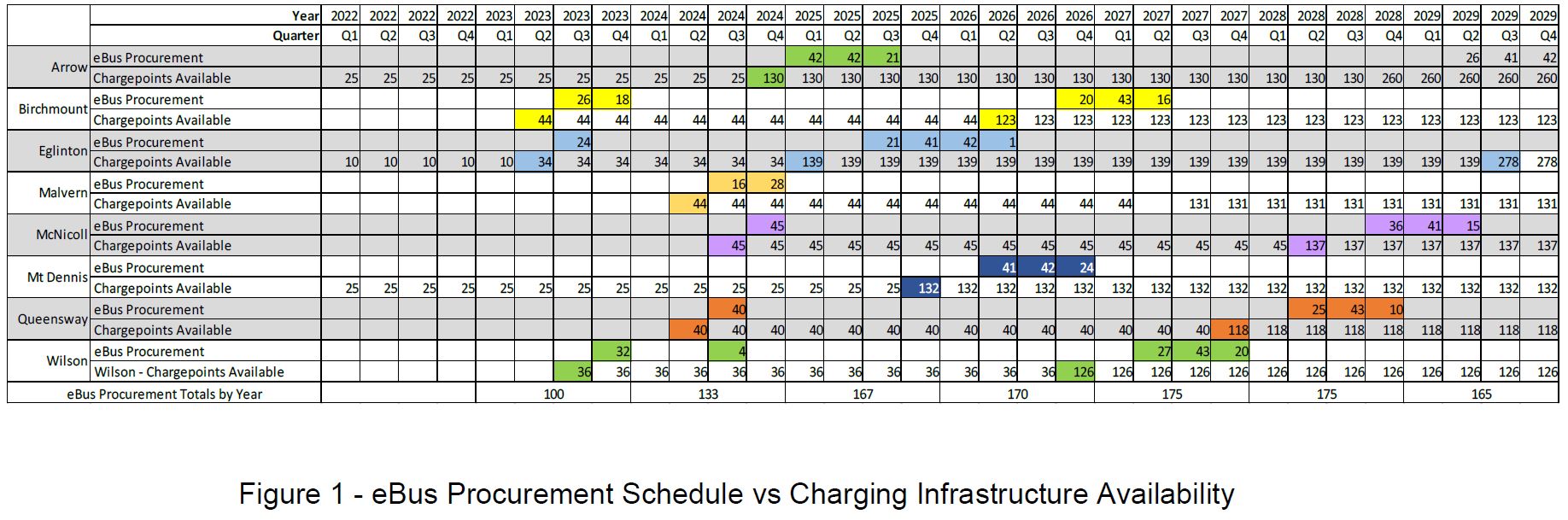
The overall plan for both buses and charging infrastructure is shown in the table below grouped by garage. This accounts for 1,085 buses, about half of the existing fleet. The first 240 buses planned in the contract award this year would take the TTC into early 2025. The program is not funded yet beyond that point. As and when more money appears, the TTC would extend its order.
Note that there are two phases to the installation of charging facilities at garages as the roll out of electrification works its way through the system. This allows some routes from each garage to operate with eBuses earlier in the program than might be practical if the conversion went garage-by-garage over the next decade.
The two-step scheme would also allow for a tactical change in charging strategy to move more of this to enroute facilities such charging stations at terminals. Although the TTC report is mostly silent on any charging technique beyond garage-based plug-in systems, there is a reference in “lessons learned” to a conversion to pantograph charging as a cure for problems with charging cables.
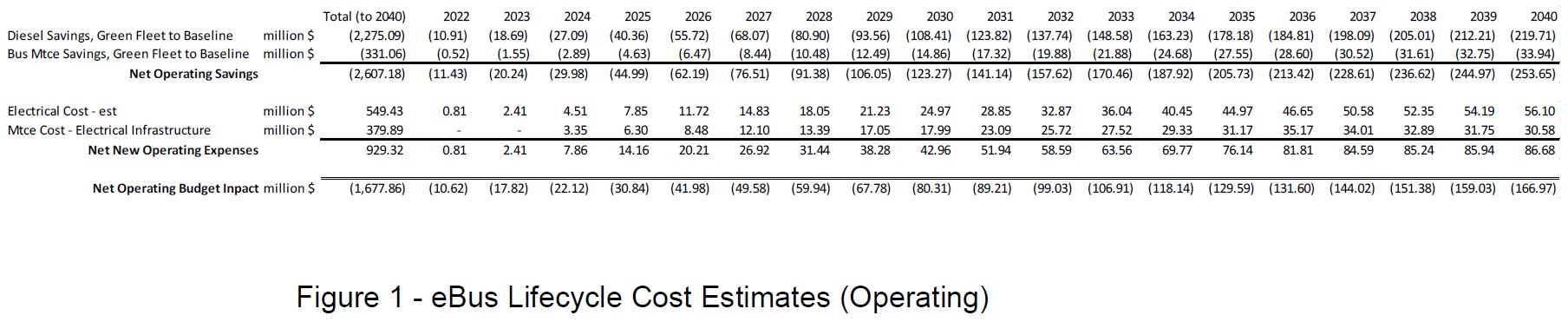
The TTC projects that life cycle costs for an electric fleet will be lower than for the diesels and hybrids it will replace because both energy and maintenance costs will go down. By 2040 this would save about $167 million annually. These estimates are sensitive to the future price of diesel fuel compared to electricity, but the TTC has not shown a range of values to indicate what the effect might be.
An 18-Year Design Life
Although the TTC report does not mention this, the actual RFP includes an interesting specification for fleet longevity. This signals a return to 18-year lifespans for the bus fleet after a retreat to 12 years in current fleet planning. If this can be achieved, it will offset the higher capital cost of the vehicles compared to hybrids or diesel buses.
1.1.1 The Bus shall have an 18-year design life and be equipped with a long life structure in accordance with Specification Section 1.8, made from full stainless steel in accordance with Specification Section 3.0, have a body with a maximum overall length of 12.8 m (42ft.) including a stowed Bike Rack , 2.59 m (8 ft.-6 in.) in width and a maximum overall height of 3.4 m (134 in.).
RFP Technical Requirements Section 1, Page 6
Later in the RFP:
1.8 SERVICE LIFE
Buses shall be designed for a minimum service life of 18 years or 1,610,000 km (1,000,000 mi.), under severe operating conditions similar to revenue transit operation in the City of Toronto.
RFP Technical Requirements Section 1, Page 19
And in more detail:
The vehicle design life shall be validated by successful completion of a simulated 12-year average New York City duty cycle service life. The test program shall be designed around input measurements taken from a vehicle configured similarly to the test vehicle while it’s being operated over a known severe route. The New York City B.35 route or an approved equivalent (i.e., the Queens Q.44 route is now reportedly used by New York City), shall be used for a simulated 800,000 km (500,000 mi.) to demonstrate Bus longevity. This is generally considered to be the equivalent of 16 to 18 years operating life at all other transit properties.
RFP Technical Requirements Section 1, Page 20
“Must Have” Specifications
An important outcome of the trial has been the development of a “must have” list, and certain aspects of any new fleet are not negotiable. Toronto has a history with every type of vehicle (subway, streetcar, bus) where pervasive problems have hobbled fleet performance and availability.
TTC’s next large-scale eBus procurement includes ‘must have’ requirements that are informed by the head-to-head evaluation and focus on ensuring longevity of the bus structure and high system reliability through a proven platform (e.g. stainless steel structure, doors, HVAC, suspension, etc.).
TTC Report at p. 2
These requirements are:
1. Altoona and shaker table testing has been successfully completed; 2. A full stainless steel structure with a minimum of six years of in service experience; 3. A minimum usable battery capacity of 400 kWh; 4. A maximum overall bus length of 12.8 m (42 ft.) including a stowed bike rack; 5. A maximum overall height of 340 cm (134 in.) including any roof-mounted equipment; 6. Ability to charge via roof mounted pantograph charging interface, capable of accepting a minimum charge rate of 300kW (400 ADC) at 750 VDC or greater via SAE J3105/1; and 7. Two rear-mounted charging ports capable of accepting a minimum charging rate of 150 kW (200 ADC) at 750 VDC or greater via SAE J1772.
TTC Report at p. 24
Requirement 3 conflicts with statements elsewhere in the report where a maximum length of 40 feet is cited so that buses will fit within existing garage designs and operations. The difference appears to be in whether the bike rack counts toward the total, but it is not clear whether the Proterra bus would meet this requirement.
Physical Compatibility: The industry standard bus length is 40-feet (12 metres). This standard was used to design storage facilities in the TTC’s existing bus garages.
The Nova HEV, BYD, and NFI buses meet this standard. Proterra buses are 42.5 feet long, but also offers the highest seating and standee capacity. Based on our bus garage layout, procurement of additional Proterra buses would result in a loss of storage capacity of approximately 10% at four of eight garages. The remaining four bus garages could accommodate this additional length. However, this would impose a significant operational constraint that would prevent movement of buses between garages.
TTC Report at p. 15
A maximum bus length specification of 40 feet is required in order to preserve bus storage density at existing maintenance facilities; …
TTC Report at p. 16, also p. 28, under “Lessons Learned”
It is not clear whether the TTC is prepared to accept buses over 40 feet long, and what position they will take about Proterra vehicles on that account. Other issues with that vendor, notably bus reliability, might knock them out of the running regardless of bus length.
An additional requirement applies to the contract itself rather than to the buses, and it addresses the City’s equity goals:
In support of the commitment to diversity, equity, and inclusion, the Contractor must agree, as a fundamental component to the Contract, to meet the Procurement Equity Requirements, by applying a percentage of the Contract Price in respect of the Diverse Business Enterprise Requirement and a specified number and percentage, as stated in the Proposal, in respect of the Equity Hired Requirement.
TTC Report at p. 7
This is a contrast to recent provincial actions to back away from equity and community benefit components in contracts.




 Steve Munro