TTC To Order Artic Buses from Nova Bus

NOW magazine’s Ben Spurr reports that the TTC will award a contract to Nova Bus for 153 articulated buses.  The award is already shown on the TTC’s website with a date of August 2, and this will be confirmed by the Commission at its meeting on September 27.

Plans to buy artics have been in the works for a while at TTC, but this is a particularly large order, roughly the equivalent of two years’ of past bus purchases.  NOW lists many routes where these might run (the topic has been discussed in past reports to the Commission), and there are no surprises.

The critical point in any rollout will be the degree to which service capacity is actually increased.  For decades, riders on Bathurst and Queen streetcars have put up with wider headways (which are compounded by delays and short-turns) from the use of articulated streetcars.  The TTC bases service levels on the alleged demand and capacity of the route.  Demand that gives up and walks, cycles or drives isn’t counted.  Vehicles that never show up because of short turns, or which appear in a parade and run little-used, are of no benefit to riders but count toward the scheduled capacity.  TTC service standards were changed thanks to the Ford administration’s penny-pinching to stuff more people on routes that provide frequent service, and there is no sign this decision will be reversed.

With luck, by the time the new buses arrive, a more enlightened transit funding policy will be in place at Council, but until then, riders on major routes shouldn’t count on any improvement.

CLRVs Visit Boston

Back in 1980, the Urban Transportation Development Corporation (UTDC) had suffered the demise of their planned magnetic levitation train system in Toronto, and the “Intermediate Capacity Transit System” (ICTS) we know as the Scarborough RT had not yet been foisted on Toronto.

During a brief period when the only viable UTDC product was its new light rail vehicle, the CLRV, they shopped the design around to various systems.  The only taker they ever got was San Jose, California, for a small order.  Three CLRVs found their way to Boston for a demonstration, and I was lucky enough to catch them out on the Riverside line in May 1980.

A train of 4027 and 4029 prepares to leave Riverside Yard (the outer terminal of the line which includes a large parking lot and the carhouse/shops for the route.  A train led by Boeing car 3400 sits beside the CLRVs.  The overhead in Boston at this point was set up for operation by cars with either trolley poles (the remaining PCC fleet) or pantographs (the Boeing cars).

The CLRV train pulls out of the yard.

… and onto the main line.

The Riverside Line was build on an abandoned railway corridor, the Highland Branch, and opened in 1959.  A new connection into the existing central subway (a streetcar subway dating from 1897) was built to bring cars through downtown.

Here the CLRVs pass outbound through Reservoir Yard.  The larger part of this yard and an old carhouse are out of shot to the left, and they serve the Cleveland Circle line which terminates there.  Work cars in the yard include a PCC converted for use as a line car, and several “Type 3” passenger cars adapted as snow plows, essential equipment for a network with so much private right-of-way.

Outbound at Newton Centre station.

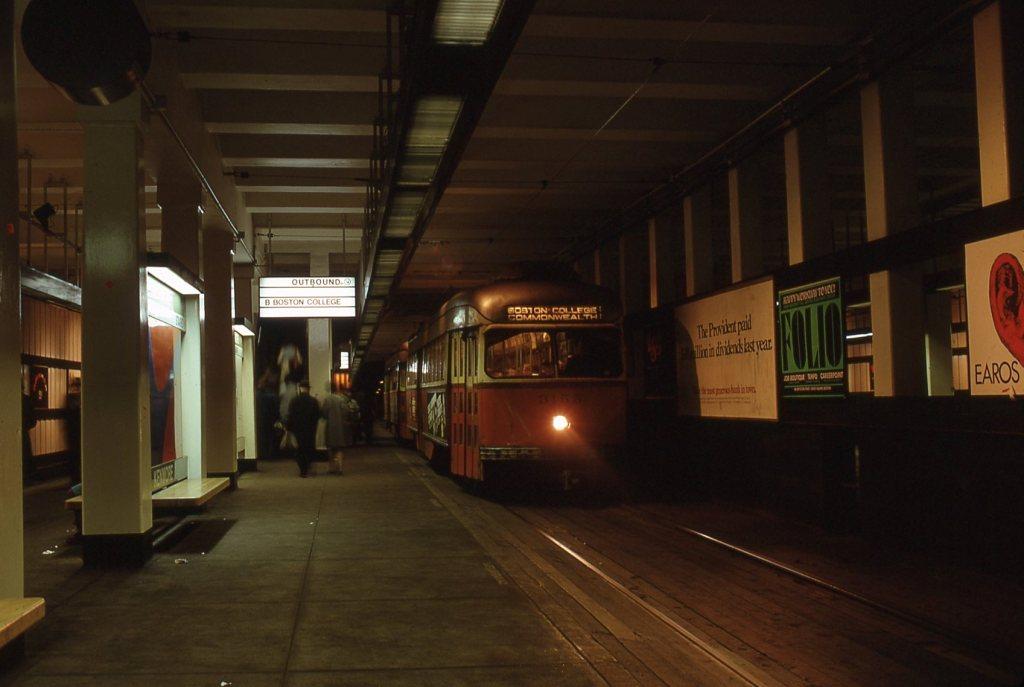
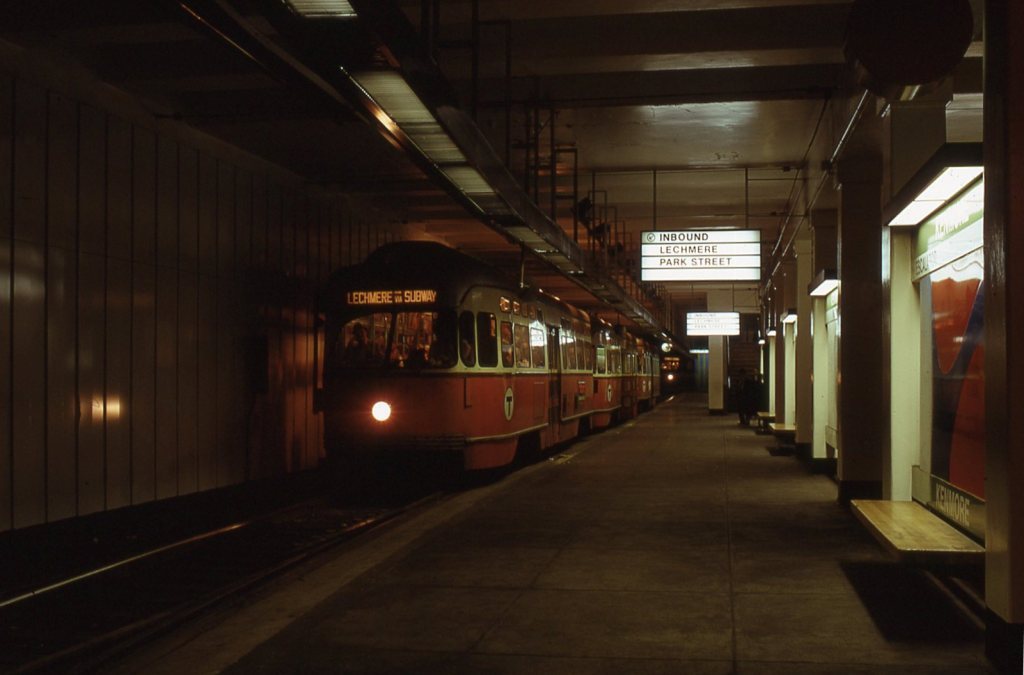
The shot below is from May 1972 at Kenmore Station which opened in 1932.  Readers with eagle eyes and long memories will recognize this shot which I loaned to the UTDC for inclusion in a brochure advocating the wonders of LRT which, at the time, the Ontario Government was actually pushing as a product, if not as a “solution” for Toronto.  It didn’t last long, and they went back to their old lies about how there was nothing to fill the gap, the missing link, between buses and subways — hence the need for an “intermediate” capacity system.

Kenmore Station is a busy place and has separate platforms for routes which diverge here.  Boston cars have doors on both sides so that they can serve island platforms like this.  Needless to say, the CLRVs served only stations with right-side platforms.  (The sign in the front window says “All stops except Kenmore” because the Riverside trains used the outside tracks at this station.)  Yes, that’s a three-car train of PCCs sitting at the platform.

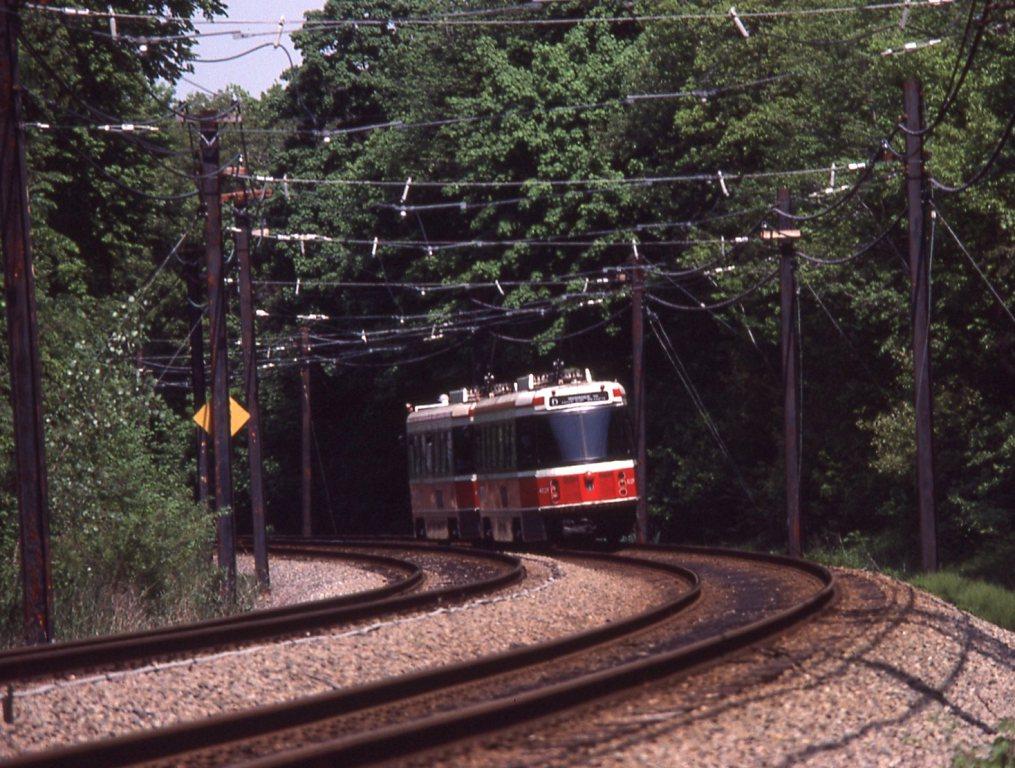
Finally, a look outward towards Riverside terminal (off to the left behind the trees in the distance)  in October 1968.  The small building on the right is an abandoned railway station.  This line could have been a model for the Scarborough RT, an implementation of “LRT” at the high end of what this technology can accomplish with almost complete grade separation, rapid transit station spacing, and speedy operation.  (Although the CLRVs are capable of 70mph operation — itself a design excess by the UTDC — they were limited to 50mph operation on the Highland Branch.)

By the time the SRT and its expensive ICTS opened at a cost more than double the original estimate for LRT, the Riverside line had been operating for 25 years.

TTC Meeting Preview: May 30, 2012

The Toronto Transit Commission will meet on May 30, 2012.

CEO’s Report

The scoreboard which begins the CEO’s Report includes the Key Performance Indicators (KPIs) about which I have written elsewhere.  Subway performance continues to be monitored against schedule ±3 minutes 96% of the time.  It remains unclear how a systemic delay — where many trains are one or more headways out of place but service is otherwise well-spaced — affects this metric.  Surface routes aim to be within 3 minutes of the scheduled headway 65% of the time for buses and 70% of the time for streetcars.  Considering the headway on which all major routes operate, 3 minutes represents close to if not more than one headway, and much service will easily hit that target even though the rider sees disorganized bunching service with many short turns.  I will address this problem in separate articles looking in detail at specific routes’ behaviour.

Riding is up relative both to actual results in 2011 and to budget in 2012 (see following section on additional service to handle growth), and the offpeak increase is running ahead of peak as it has for some years.

The top source of complaints continues to be “Other” with “Surface Delays” and “Discourtesy” coming next in that order.  The TTC has initiated a rolling survey of customer satisfaction, but it has not yet accumulated enough data to produce a metric that shows a trend over time.  One big challenge of “customer service” is that some initiatives have an effect at limited points — clean and well-maintained washrooms may be appreciated by those who use them, but they don’t make any difference to overall service for most riders.  Pervasive changes — more frequent and regularly spaced buses, improved station cleaning and escalator/elevator maintenance — require changes in how the system thinks about its operation as a whole, not in discrete chunks that are easily targeted. Continue reading

Russell Carhouse Track Construction Plans (Updated)

Updated February 16, 2012 at 6:05pm:  The Public Works & Infrastructure Committee deferred consideration of the report on Eastern Avenue’s reconfiguration until March 21, 2012, “to enable the Acting General Manager, Transportation Services, to explore further alternatives that will maintain the capacity of parking on the roadway”.

Original post from February 13 below:

TTC’s Russell Carhouse at Queen and Connaught will see major track reconstruction this year.

A project to rebuild track Queen Street and Connaught Avenue was deferred from 2011 at the Mayor’s request, but the work is now out for tender.  This will include the replacement of all of the special work on the north side of the carhouse including the yard accesses and the intersection at Connaught.  On Connaught itself, the track layout will be changed by the removal of the existing crossover between the northbound and southbound tracks.

At Eastern Avenue, the roadway will be rebuilt to isolate the streetcar ladder tracks from the rest of the pavement and raise their level.  This change will reduce the effect of the combined curve and grade between Eastern Avenue and the yard tracks which is especially pronounced at the carhouse itself.  A report on the recommended layout for the street is on the Public Works agenda for February 15, 2012.

This work is part of the overall preparation of the streetcar system for the arrival of the new LFLRVs.

TTC Meeting Preview for January 31, 2012

The TTC agenda for January 31, 2012 contains a few items of interest.

The proposed disposition of an additional $5-million in subsidy is discussed in a separate article.

Eglinton Scarborough Crosstown Project Update

A long report giving an update on the Eglinton Crosstown LRT does not address any of the issues currently swirling in the media, and it gives only a basic sense of where various parts of the project sit.  The most important part comes in Recommendation 3 in which the TTC would ask the Minister of Transportation and Infrastructure to hold off on any decision regarding overall project management and delivery until outstanding issues are resolved.

The critical paragraph (on page 7) reads:

Recently, Metrolinx has indicated that it is considering a different project delivery and governance arrangement for the Crosstown Project which could involve project management by another entity, rather than the TTC, a more extensive role for Infrastructure Ontario and one large alternative financing and procurement contract including final design and construction of all stations, the SRT, yards, and systems.

Infrastructure Ontario and Metrolinx have been trying to muscle into the Eglinton project for some time.  That’s no surprise considering the billions at stake and the desire by IO and Metrolinx to show that they can do a better job than what is perceived as the TTC’s historical ham-fisted project management and control.  How this attitude fits with current experience on the Spadina extension, and why we should believe another agency will do better, remains to be seen.

Moreover, the question of what, exactly, we are building on Eglinton has yet to be answered.  Queen’s Park and Metrolinx are dodging the question and claiming that they just want agreement between the TTC, Council and the Mayor.  Well, two out of three is likely, but unanimity is impossible after the highly misleading and misinformed post by Ford on his Facebook page.  The Pembina Institute (a somewhat left of Ford think tank) has responded to misrepresentations Ford makes about their position on their own site.

The meddling from Queen’s Park puts the Commission and Council in a position where a definitive policy for Toronto on the Eglinton corridor is needed soon.  Beyond that, the disposition of any leftover money (presuming that Queen’s Park would leave it on the table) needs informed debate by all concerned, and a compromise that won’t be worked out overnight.

Various factions argue for the Finch and Sheppard LRT lines, for some or all of the Sheppard subway extensions, and for the Finch BRT.  Everyone has a set of magic markers and their own map.  This is no way to plan a transit system.

Ashbridges Bay Carhouse and Shops

The Commission will award a contract for construction of the new yard, carhouse and shops at Ashbridges Bay in the amount of $237.4m.

Roncesvalles Carhouse

The Commission will award a contract for revisions to Roncesvalles Carhouse to accommodate the new LFLRV fleet in the amount of $9.9m.

Town Hall Update

There will be a presentation on the results of the recent “town hall” on TTC customer service and plans for future events.  This item is not yet available online.

Goodbye to the H4 Trains

For all the lovers of non-air conditioned trains, noisy ceiling fans, but comfy seats, Friday, January 27 will be the last run of the H4 class cars on the TTC.

Run 64 will leave Greenwood Yard eastbound at 7:27am to Kennedy, make a round trip to Kipling, and then run back to the yard at 9:44.

As more of the Toronto Rocket trains enter service on Yonge, they will replace the H5 and H6 fleets, and the BD line will become an all T1 route.  The last of the TRs now on order are for the Spadina/Vaughan extension opening in 2015.

How Many Buses Does Toronto Need?

Toronto’s budget debate for 2012 brought many issues of transit financing into the open thanks to an ill-considered proposal by Mayor Ford to cut transit operating subsidies by 10%.  Recently the TTC put off implementing service cuts originally planned for January 8, 2012, pending a decision by Council on the final version of the budget and the level of TTC subsidy.

However, the TTC’s Operating Budget is not the only one that is constrained by City spending policies.  On the Capital Budget, the total projected City borrowing required to pay for all of the projects the TTC would like to undertake exceeds a self-imposed target on total City debt.  To bring the 10-year debt projection within that target, the TTC restructured its capital plans.

Some projects were postponed beyond the 10-year window so that some or all of the spending (and associated debt) did not count, or might be offset by future improvements in subsidy programs from other levels of government.  Other projects were modified in scope or cancelled.

I discussed the amended Capital Budget in a previous article, but the current debate about Service Standards also has a capital component.  Among the cutbacks on the capital side were a purchase of new buses and the provision of storage space to hold these vehicles.

An order for 134 new buses (of which 26 were for “contingency” to handle unexpected growth in demand) has been cancelled along with the provision of temporary yard space.  Before Transit City was proposed, the TTC had planned to build another bus garage to accommodate its growing fleet.  However, Transit City (plus the opening of the Spadina subway extension) would replace some existing bus service with rail, and reduce the total bus fleet requirement.

Even with a short-term pre-Transit City bulge, only temporary storage would have been needed.  However, now that much of Transit City has been either cancelled or pushed off into the next decade, there will be continued pressure on the bus fleet and on the need for storage space.

  • The Spadina extension will not open until late 2015.
  • The Sheppard subway, if it is actually built, will cover only the portion of the Sheppard East bus services west of Kennedy.  Service east to Meadowvale will still be provided by buses.  The original opening date for the Sheppard LRT was 2013.
  • Finch West will continue to be served by buses, not an LRT line that originally would have opened in 2013.
  • The proposed extension of the SRT to Malvern was originally planned to open in 2015.  In the revised plan, this extension has been dropped.

In a briefing note, TTC’s Chief General Manager Gary Webster states that the capital cost of restoring the bus order and storage for the vehicles could be up to $93-million.  However, in the TTC’s budget presentation, this number is stated as $73m (see Shortfall Reduction Plan on page 52).  If the order is reinstated, the quantity of buses will be smaller by at least the contingency of 26 according to staff comments at the TTC’s last meeting.

The challenge in this whole process is to understand just how big the bus fleet should be given the robust state of TTC ridership.  For this we must first go back to the bus fleet plan as it existed in 2006.

There were two competing views of the future for ridership.  In one version, growth would continue at just over 1% per year following a long trend of the past decade.  In another version, growth would be more robust at 3% per year.  The bus fleet plan had been based on the lower rate, but if the stronger trend prevailed, the TTC would need more buses sooner.  A new garage would be needed by 2012/13 even at the low growth rate, possibly by 2010 if the fleet grew faster than expected.

Indeed, stronger growth is exactly what arrived.  On the original projection, ridership was expected to grow from 436m to 469m between 2006 and 2011.  At the higher rate, it would reach 505m.  The actual number we now know will be about 499m.  The accelerated growth began just after the Ridership Growth Strategy (RGS) rolled out, a policy the current crop at the TTC would undo in the name of “efficiency”.

By 2010, the fleet planning had to take into account new factors including the proposed Transit City LRT lines and the Spadina extension.  Transit City was expected to displace 168 buses between 2014 and 2019, and a further 30 would be replaced by the Spadina extension in 2016.  This led to a plan in which there would be no bus purchases for several years, and the total fleet would actually shrink through attrition back to 2008 levels, well within the capacity of existing garages.

By early December 2011, the active bus fleet stands at 1,820 vehicles for a scheduled peak service of 1,520.  Requirements for 2012 and beyond will be very different depending on the service quality and ridership we assume in making fleet plans.

  • Service actually operated in 2011 was based on a budgeted ridership of only 487m, not the 499m Toronto actually achieved.  This is one reason why there are some routes already over the supposed loading “standards” — there is no budget to operate all of the service the standards would dictate.  Conversely, the planned cuts on some routes are impractical and this situation is tacitly admitted by the proposal to retain service on “busy” routes.
  • If the RGS service standards are retained, then the planned peak cutbacks on major bus routes cannot go forward.  In the short term, this can be handled with the existing fleet, but more buses will be needed (by the TTC’s projection) in fall 2013.
  • Multi-year projections in the TTC budget (see TTC Final Budget report for 2012 at Page 7) start from a base of 503m in 2012 and rise to 523m by 2015.  The base itself is less than 1% above 2011’s projected 499m, and the cumulative growth rate is about 1%.  By contrast, ridership is running over 4% above last year, and an ongoing rate of 3% should be easily attained provided that there is sufficient capacity and no economic catastrophe to drive down demand overall.

If we take 499m for 2011 and increase at 3% per annum, this would give a cumulative increase of about 12.5% to 2015.  In turn, the bus fleet would have to grow from 1820 to 2045.

The TTC has not published a detailed fleet plan including such an analysis, but this is as important to the future of Toronto’s transit as the fantasy subway plans.  The capital budget does not include any projection of funding needed to sustain strong transit growth, and the operating budget assumes a much lower rate of growth than we actually see.  The situation is very much like the one back in 2006.

Delaying or cancelling the implementation of Transit City created a crisis in the bus system’s ability to serve growing demand.  The Commission’s response is merely to cut service and ignore future problems with meaningless, low-balled projections of ridership, fleet requirements and operating costs.

Most of the transit Commissioners don’t want to entertain these debates because to do so counters the received wisdom that transit funding must be cut no matter what.  They might even have to admit that the course they advocate — of limiting the growth of service and capacity — is truly a “service cut”, certainly a reduction in the attractiveness and quality, such as it is, of the system, not merely an “efficiency”.

This type of “planning” badly serves Council and the citizens of Toronto because we don’t know what the alternatives are and the implications of various future paths.  Indeed, we risk hobbling the TTC with reduced service, fleet and staff, and creating a hole out of which a more-enlightened administration must first dig just to undo past errors.

Postscript:

In a Briefing Note to the City’s Budget Committee, the TTC advises that it is contemplating the purchase of 150 articulated buses in 2014-16.  If Council decides to retain higher service quality in 2012, the need for these buses could be accelerated.

Seven routes (not named) would convert to artic operation.  The fleet replacement ratio the TTC would use is 1.35:1.

The anticipated annual saving would be $60k/bus mainly in the labour cost of drivers.  The annualized saving with the 150-bus fleet fully in operation would be $9m.  Savings from this scheme have already been built into the multi-year budget projections.

TTC Unveils New Streetcar Design and Mockup (Update 2)

Updated November 10 at 4:45 pm: Photos of the mockup have been added to this article.

This shows the mockup (actually three sections of the five-section vehicle) including street level (front door) and island level (at the second door with a ramp deployed) comparisons for boarding heights.

For more photos, scroll down to the bottom of the article.

See also coverage on the Torontoist, Urban Toronto and blogto websites.

Updated November 9 at 5:20 pm:  In response to questions that have come up in this thread and previous articles about the new cars, I have added information at the end regarding the issues of weight-per-axle and the Toronto requirement that the cars negotiate single-point track switches.

The TTC will display a mockup of the new streetcar fleet for public viewing.

TTC Hillcrest Yard
November 12 to 15, 2011
10:00 am to 7:00 pm

Additional information about this event and the new cars is on the TTC’s LRV Page.

39 years ago, the TTC decided to retain its streetcar system, and this will be the second generation of new streetcars.  Toronto joins the rest of the world with a modern car based on designs used in other major cities.

They’ve been a long time coming, and design changes have added almost a year to the process that TTC and LRT advocates expected when the order with Bombardier was approved.  When I have details of the delivery schedule, I will update this post.

For additional hi-res views of the new cars, visit the “Meet Your New Ride” page.  Something that’s immediately obvious is a family resemblance to the interior of the new Toronto Rocket subway cars.

Two observations about the TTC’s website:

  • Comments about the improvement of capacity on routes and the approach to scheduling service are now out of sync with statements in the TTC’s budget papers.  Originally, the TTC was committed to improving capacity on streetcar routes and keeping wait times reasonably short.  Today, this position is no longer as definite because running service above a full standard load is transit gravy.
  • The new cars will operate, according to the TTC, on new routes for the eastern waterfront.  Considering the foot-dragging on this project, the cost escalation and the low priority given to waterfront transit generally, it’s hard to say whether these routes will ever actually be built.

Updates regarding technical issues with the cars follow the break below.

Continue reading

Thirty-Nine

Thirty-nine years ago, the TTC made its historic decision to retain streetcars in Toronto.  At the time service on streetcar routes was considerably more frequent than today, and Torontonians generally thought kindly of that mode.

Over the years, it has been an uphill struggle to maintain this.  Service cuts on the TTC led to fleet reductions, and improvements we should have seen go unfilled thanks to the too-small fleet of unreliable cars.

We have been through one generation of “new” streetcars, and it’s hard to believe that these are now due for retirement.  The CLRVs (regular sized cars) are over 30 years old and although they may physically be capable of continued operation and body rebuilds, their ancient electronics are a challenge.  The ALRVs (two-section cars) are a bit younger, but still elderly.

Ongoing debates about the type of car that would replace Toronto’s fleet and, indeed, whether 100 of the CLRVs would receive a major overhaul including new control systems, delayed the replacement process.  This delay would be merely annoying had control of the Mayor’s office and Council stayed with a streetcar and transit friendly administration, but we’re now in an era where the streetcars are tolerated, not celebrated.

A mockup of the next generation of Toronto cars, Bombardier’s Flexity, goes on display next weekend at Hillcrest Shops.  Design delays, not to mention political foot-dragging, have this project running at least a year late.  Meanwhile, construction of the new carhouse and maintenance facility at Ashbridges Bay has not progressed beyond site preparation.

When the Streetcars for Toronto Committee (of which I was a member) advocated for streetcars, this was not just for the nostalgia of seeing rails in Toronto’s streets.  “Light Rapid Transit” (LRT), a then-modern-sounding pseudonym for streetcars on reserved rights-of-way, could have brought an inexpensive network of suburban routes long before the suburbs as we now know them were built.  Not until the Transit City plan, decades later, did we have an administration that took this concept seriously.  Transit City had its flaws, but these pale beside the madness of an all-underground alternative foisted on Toronto by Mayor Ford and Premier McGuinty.

Engineering challenges may force a rethink for Eglinton’s valley crossings at the Don River and other locations, but these will come grudgingly and the original surface alignment is at best “on the back burner” until less hostile forces occupy City Hall.

The rest of Transit City is so far in the background that even the name has been expunged from official use except as a slur against the Miller years.

Day-to-day transit service is under attack from City budget cuts and Provincial underfunding.  Toronto’s recent history of strong ridership may continue only by an accident of high energy prices and traffic congestion, not from an active plan to serve growing demand and population.

This is really not where I had hoped to see our transit system by now.

The 40th anniversary will come in 2012 when transit will still be fighting for its life politically and financially in Toronto.  We should have been celebrating a renaissance.

Readers of Douglas Adams will know that “42” is the “Answer to the Ultimate Question of Life, The Universe and Everything”.  What will 2014 bring?