TTC Meeting Wrapup: March 27, 2013

The Toronto Transit Commission met on March 27.  This wrapup includes comments on:

  • Purchase of Articulated Buses
  • The CEO’s Report for March 2013
  • The Gateway Newsstand Contract
  • Priorities for Subway Station Elevators

The Leslie Barns project, and the streetcar system renewal in general, received comments in the press recently about the scale of expenditures, and the sense that the TTC estimates understated the full cost.  See the National Post here and here.  I will discuss these issues in a separate article.

Updated April 2, 2013:  Rahul Gupta has addition background on the Gateway issue at InsideToronto.com.

Continue reading

Second New Streetcar Enroute to Toronto (Updated)

Updated March 25, 2013 at 1:50pm:  The TTC has advised me that 4402 has been unloaded at Hillcrest and is now in the shops for inspection and testing.

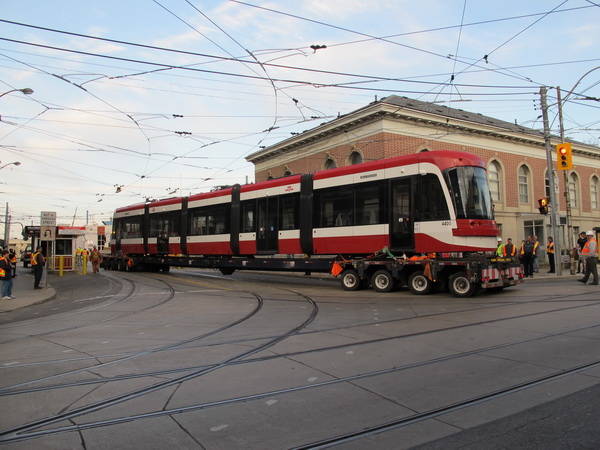
Thanks to reader NickL who included a link in a recent comment to a photo of car 4402 on a flatcar coming to Toronto.  The photo is by Eric May on the Railpictures.ca website.

Car 4401 remains in Thunder Bay as Bombardier’s test car.

Past and Future Streetcar Service Capacity

Now that the first Low Floor Light Rail Vehicle (LFLRV) is rolling through Toronto streets on test runs, the question of service quality and capacity for streetcar routes is once again an issue.

The most recent TTC document setting out their intended use of the new fleet appeared in the 2013 Capital Budget Blue Books.  These are not available online, but I presented the TTC’s fleet plan in an article last fall.  From the numbers of vehicles to be assigned to each route, one can work back to the service frequency and capacity numbers.  In general, peak period headways get a bit wider, but the capacity goes up, in some cases dramatically.

The TTC faces two challenges: one on the budget, and one in operations.

Toronto Council has been extremely stingy with operating subsidies and “flat lined” the TTC over the past two budget cycles.  Hard liners will want the TTC to simply replace service on an equivalent capacity basis and maximize the savings in operator costs.  This would be a disaster for service quality even if the TTC actually ran cars on the headways they advertise.

On the operational side, any increase in headways brings even wider gaps when the service is upset by weather, random delays and short turns.  It is already a matter of record that the largest drop in riding over the past two decades came on the lines where 50-foot long CLRVs (the standard Toronto cars) were replaced by 75-foot long ALRVs (the articulated version) on an equivalent capacity basis.  Falling riding led to reduced service and the familiar downward spiral.  This must not happen when the new fleet rolls out across the system.

Since at least the mid-1990s, the TTC has told us that they cannot improve streetcar service because they have no spare cars.  In part, they are the victims of their own fleet planning.  The TTC originally rebuilt some of its old PCC cars (the fleet preceding the current one) in order to have enough to expand operations on the Harbourfront and Spadina lines.  However, by the mid-1990s, service cuts on many routes thanks to the economic downturn in that decade and the subsidy cuts by the Harris government, reduced the fleet requirements to the point where the PCCs could be retired and the Spadina line opened without buying any new cars.  When riding started to grow again, the TTC had no spare vehicles to improve service, and to make matters worse, the fleet was entering a period of lower reliability thanks, in part, to poor design.

Toronto waited a long time for new cars to be ordered, and this process was delayed both by the decision to go with all low-floor cars, and by political meddling at City Hall.  New residential construction along the streetcar lines pushes up demand, but the TTC cannot respond with better service until they have more cars.

Recent discussions about the new cars have included comments about how we cannot possibly have more streetcars on the road.  What many people forget is that the streetcar services were once much better than today.  In this article, I will look back at service levels once operated in Toronto, and at the service that we might see if the TTC actually operates the new fleet in the manner their Fleet Plan claims.

Continue reading

4400 Makes Inaugural Run to Bathurst Station (Update 2)

Early on March 14, the TTC’s first new LFLRV (low floor light rail vehicle) made its inaugural test trip out of Hillcrest Yard to Bathurst Station and return.  The TTC’s Brad Ross posted photos of the event.  (Three photos were added at about 4:00 pm on March 14.)

Owly ImagesLeaving Hillcrest Yard

Owly ImagesSB on Bathurst at the CPR underpass

Owly ImagesUnder the CPR underpass

Owly ImagesAt Bathurst Station

Owly ImagesLeaving Bathurst Station

Owly ImagesNB north of Bathurst Station

Owly ImagesReturning to Hillcrest

Another test run is tentatively planned for the morning of March 15 leaving Hillcrest after the last 512 St. Clair car has passed enroute back to Roncesvalles carhouse at about 2:30am.  Car 4400 will make a round trip to Exhibition Loop.

Updated March 15, 2013 at 11:20 am:

Photos from the run to Exhibition Loop are in a gallery on the Torontoist’s website.

TTC Meeting Preview: February 25, 2013 (Update 2)

Update 2 on Tuesday, February 26, 2013 at 10:00 am:

Additional information from presentations and debates at the Commission meeting has be added to this article.

The Toronto Transit Commission will meet on Monday February 25, 2013.  This month’s agenda is a tad on the thin side, but there are some reports of interest.

  • CEO’s Report (updated)
  • Status Report on TTC Accessible Services
  • Second exit planning & consultation / Response to Ombusman’s report
  • Leslie Barns connection to Queen Street
  • Accommodating strollers
  • Purchase of 126 articulated buses (updated)
  • Amending the Automatic Train Control System contract to include Spadina/Vaughan extension (updated)
  • Update on Bus Servicing and Cleaning Contract (new)
  • Deputation by Merit OpenShop Contractors Association of Ontario (new)

There was also a presentation on new shelter maps and stop poles.  This item is likely to generate a strong response in the comment thread, and I will create a separate article for it.

Continue reading

TTC November 2012 Meeting Wrapup

At its November meeting, the TTC considered various matters other than the 2013 budgets on which I have already reported.

New Commissioners

The new “citizen” members of the TTC were sworn into office: Maureen Adamson, Nick Di Donato, Alan Heisey and Anju Virmani.  Ms. Adamson was elected Vice-Chair of the Commission under a new Council-approved structure where the Vice-Chair is chosen from the citizen member ranks.  At this point we know little of where the newcomers will take the Commission beyond background articles such as one in The Star.

Although they may claim to be focused on customer priorities, whether this will survive the political onslaught of budget constraints and the organizational morass of “TTC culture” remains to be seen.  Commissioners tend to catch a “TTC disease” when it becomes easier to defend what the TTC has done and the official management outlook than to ask difficult questions, publicly, about how things could be better.  At least there is a CEO in place whose goals lie in improvement, not in justifying more of the same.

Continue reading

A Debut Party for Car 4400

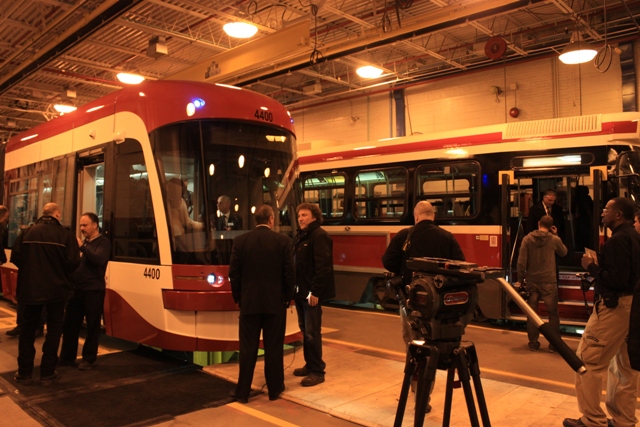
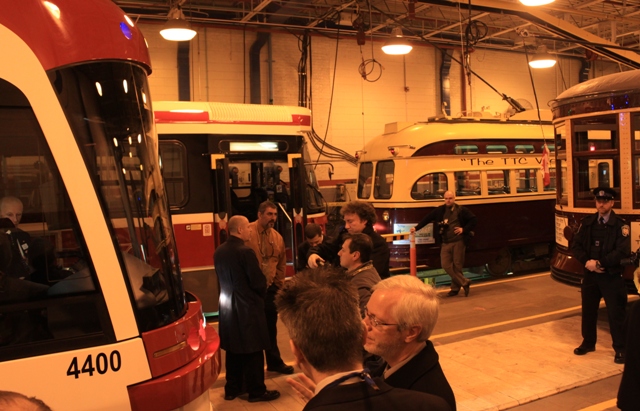
The TTC unveiled the real car 4400 — not the imitation, half-car mockup seen on an earlier occasion — at its Hillcrest Shops today to a crowd of press, politicians and staff.

Representatives of all governments were present.  Councillor Karen Stintz as TTC Chair, Ontario Minister of Transportation Bob Chiarelli, Metrolinx CEO Bruce McCuaig, and Peter Van Loan representing the Federal Government.

Van Loan’s inclusion was rather odd considering that his government famously told Mayor David Miller to get lost (in somewhat earthier terms) when Miller asked for a 1/3 federal share in funding these cars.  Now we learn than some of the federal gas tax transit revenue in Toronto has been earmarked for the streetcar project.

  • City of Toronto share: $662m (55.8%)
  • Ontario share: $416.3m (35.1%)
  • Ottawa share:  $108m (9.1%)
  • Total $1,186.3m

In fact, Toronto gets a flat annual allocation from the federal gas tax that now runs at $154m.  In 2012, the total TTC capital spending (not including projects with their own accounts such as the Spadina extension) will be $1,034m.  This puts the federal gas tax at about 15% of current spending although the proportion rises in future years when the currently planned rate of spending tails off.

I have asked the TTC to explain how they came up with the $108m figure, and as I write this (2:20 pm, November 15), I have not received a reply.  Federal capital grants go into the general pot of capital funding (see pdf page 36 of the TTC Capital Budget).

During her remarks, TTC Chair Karen Stintz joked that she hopes to see Van Loan back soon with a big cheque for the Downtown Relief Line.
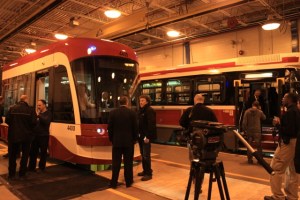
This is a fully working car, although we won’t see it out on the street for several months, and even then only for test runs, not in passenger service.  Cars 4401 and 4402 will arrive over coming months to add to the test fleet.
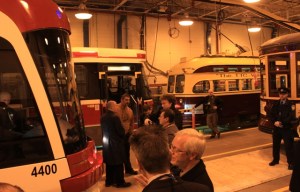
The 4400 sat among representatives of three earlier generations of streetcars each of which represented the technological pride of its age — the Peter Witt (1920s), the PCC (1930/40s), the CLRV (1970s).  That CLRV (and its relative, the articulated ALRV) is odd man out, in a way, because it was, in part, the product of an era when Ontario thought it needed to reinvent the streetcar.  Only one other buyer was ever found for these vehicles as compared with Witts, PCCs and now Bombardier Flexities running all over the world.

The car’s interior is divided into sections, each with its own door very much like a subway car.  All-door loading will spread out the demand through the interior.  Space dedicated for large objects such as shopping buggies, baby carriages, wheelchairs and bicycles will allow them to be carried without plugging circulation.

Although the cars are “low floor”, there is still one step up from the ground into them unless one boards from a platform or widened sidewalk (as on Roncesvalles).  However, that’s the only step, and riders will be able to flow into and out of the cars quicker than they do on the earlier models.

Presto readers are mounted on either side of the entryways.  The rules for Presto use on TTC are not yet decided including whether there will be any need to “tap in” for transfer connections or to “tap out” when leaving a vehicle.  [That’s a separate debate and I would prefer that the comment thread on this article not fill up with a discussion on that topic.]

Visible in the photo below is a small pedestal (left side, just ahead of the articulation) which will hold the fare equipment.  This will be used by passengers who need to pay a cash or token fare while the system is in co-existence mode between current practices and Presto.  Machines will also be provided at busy stops along the routes as the new cars roll out.

The box under the pedestal is a heater/blower (another is located under the seat just inside the door) whose purpose is to keep the vestibule warm even in the winter and an attempt to dry out the floor.

Stop displays hang from the ceiling through the length of the car, not just at the front as on the retrofitted CLRV/ALRV fleets.

Notable by their absence is any provision for advertising on either the interior or exterior of the car.  Something may be fitted in the coves between the top of the windows and the lighting strip, but there is nothing on the 4400.  This would change the look of the cars inside and out.

Here is another view through the articulation showing the fare machine pedestal.  Note that the window has a separate panel at the top.  This is a “flip in” window similar to those on the CLRVs intended for situations where the AC fails and some ventillation is required.  The flip-up seating in the area beyond keeps it clear for use by wheelchairs in a similar format to that already used on the subway.
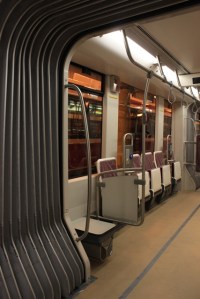
At the doors, there is a red button for passengers to open them when they are activated by the operator.  Actual operation will likely vary from stop to stop and car to car just as it does today with the CLRVs.  At some stops, the operator will simply open all doors; at others, only doors passengers want to use will open.  This is a common practice elsewhere to which Torontonians will, I am sure, adapt.

This door is also the wheelchair location, and the blue button is intended for a request to deploy the wheelchair ramp.  That ramp has two levels — one is a short bridge to get from a car to a nearby platform, the other is a longer ramp to get down to pavement level.  The operator controls which version is deployed.

Not visible in these photos is an LED strip mounted on the trailing edge of each door.  This will be brightly lit when the doors are open as a warning to passing motorists and cyclists that they should stop.  I hope to get a photo or video of this in operation from the TTC and will add it here when available.

Low-floor design brings seating above the wheel sets, and a mixture of forward and rear facing seats.

The front of the new car, in profile, can be read as a face, here in contemplation of a human.  The paint treatment at this end is different from the rear (see the next photo) with the white stripes swinging down.

The rear end of 4400 seen from the transfer table.  The white stripes at this end simply wrap around the car.

Finally, a view along the runway for the transfer table that moves cars and buses between the shop entrance and the various repair bays.  The mockup version of 4400 is visible in the middle distance.

I must say that having a genuinely new streetcar in Toronto, one that is based on a proven international design, gives me good feelings.  All the same, there remain questions of how the vehicle will perform in service, how riders will adapt to the new layout and fare collection tactics, and whether the TTC will actually improve service capacity (as implied in the Fleet Plan that I reviewed recently) and improve line management so that expected wider headways are not compounded by ragged service and short turns.

The fight for better streetcar service is far from over.

Postscript: What The Design Panel Did

I was one of the members of design review panel recruited by the TTC to tweak the new car design.  The physical layout of the cars was more-or-less settled by the time we came on board, and our opportunity for influence was limited.  The factors we affected were mainly aesthetic including:

  • The use of a different, patterned seat fabric rather than the standard TTC red.
  • The use of a darker red than the bright cherry found on the CLRVs.  It is not as dark as the colour used with cream trim on the PCCs and Witts, but not as bright as the CLRVs.
  • The presentation of a distinct “front” and “back” to the cars by bringing the white stripes down at the front of the car.
  • The presentation of a uniform black stripe down the side of the car (the original version made the doors look like a mouth with missing teeth).

One thing we hoped to see was interior surfaces that had some texture and variation from lighter off-white on the ceiling to a darker gray on the floor.  That idea did not become part of the final version probably for a combination of cost and maintenance issues.

Eventually the cars will go into service and we will see how their layout works in practice and whether it can be improved.

An idea I would particularly like to see would be a subset of the fleet as “art cars”.  We came up with this idea before GO Transit started its own program, but given the state of transit funding and municipal attitudes to non-essential “gravy”, this was an idea that has gone into a deep sleep.  Could we find a sponsor to underwrite a competition for, say, ten cars each with its own “total wrap”, a set of “one of” cars whose designs would change from season to season, year to year?

Car 4400 Is In Toronto

Updated October 4:

Thanks to Harold McMann for the following photos of 4400 arriving at Hillcrest.

A previous “first car” arrives at Hillcrest:

Updated September 28:

Thanks to Mike Filey for this photo of 4400.

Original Post of September 26

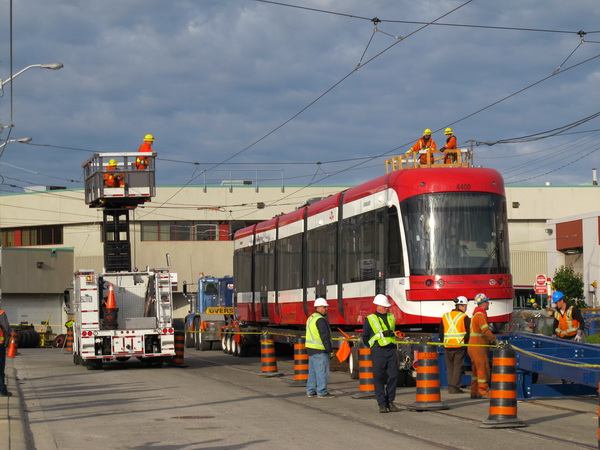
The Junctioneer reports that the first of the prototype low floor LRVs is in CPR Lambton Yard.  The car is expected to move to Hillcrest in the early hours of Saturday, September 29.

A media event will be scheduled for October.

Thanks to all who forwarded me this link.

See also the Torontoist and Randy Risling on Twitter.  Note that the car has both a trolley pole and a pantograph.

Zero Percent Is Not Acceptable

Recent press coverage of the opening salvos in Toronto’s 2013 budget process tell us that the Budget Chief, Mike Del Grande, is trying for another year in which he, the Mayor and the City Manager dictate a zero percent increase in city funding to all agencies.  This is not playing well with some members of Council according to The Star, and with some luck this will extend to boards of agencies like the TTC.

The dynamics of Council have changed since the 2012 budget launch a year ago when the Mayor and City Manager issued a zero-percent edict and drove through cuts to many city services while claiming a massive, if fictional, deficit threatened the city’s integrity.  Trying for a repeat performance may play well as part of the already-in-progress 2014 election campaign, but such an attempt runs counter to the will of many on Council.  This is a delicate time for management at the City and its agencies like the TTC, and the leadership for a different world view must come from Council and the agency Boards.

This will not be as easy as holding a press conference to announce a $30-billion plan for a fairytale network of rapid transit lines that would be paid for through as-yet unknown future taxes and contributions from other governments.  This is the real world where the City and its agencies must raise real money from existing revenue streams today, must make decisions that will affect real service levels today, must be prepared to fight for policies that will deliver results today, not decades in the future.

The Operating Budget in Brief

The Operating Budget covers the day-to-day cost of running and maintaining the transit system.  Major repairs, new vehicles and infrastructure come out of the Capital Budget (about which more later).  Generally speaking, expenses and funding cannot be moved between the two budgets.

2012 Budget (Revised)        Operating     Wheel-Trans
                               ($m)          ($m)
Farebox & Other Revenues      1,069.9           5.3
Expenses                      1,444.0         100.2
Subsidy                         374.1          94.9

2012 Projected

Farebox & Other Revenues      1,076.6           5.3
Expenses                      1,447.4         101.4
Subsidy Required                370.8          96.1
Subsidy Available               374.1          94.9
"Surplus"                         3.3        (  1.2)

Source: CEO's Report for April 2012 (Published June 2012)

The projected figures are always different from the budget for various reasons.  The most common is that expenses never work out exactly as expected due to actual conditions including unexpected changes in major cost centres such as fuel and vehicle repairs.  Some details are in the CEO’s report (see compendium of links at the end of the article).  Revenue is affected by ridership, but can also be hurt or helped by fluctuations in advertising and rent revenues.  While these are small numbers in the larger budget scheme, all of the political debates about transit funding revolve around such small amounts and discuss service cuts or adds in millions of dollars.  A bad year for ad revenue coupled with a Council unwilling to backstop the loss with subsidies translates to worse service for riders.

The 2012 budgets were amended twice.  In June 2012, Council approved increasing the regular expense budget by $2.1m to provide additional service beginning this fall with funding to come from increased revenues.  Earlier, when the Commission was still dominated by Ford-friendly appointees, an attempt by Council to fund $5m in added service was thwarted by the Commission who diverted the funding to Wheel-Trans.

Continue reading