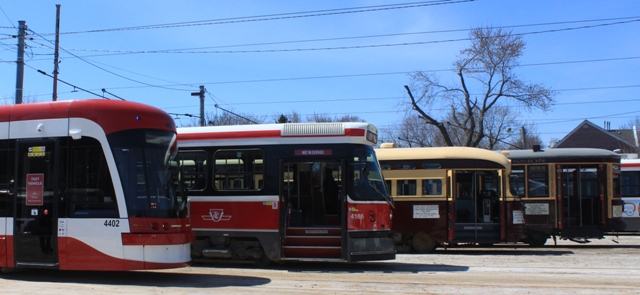
At Last! 4404 Arrives (Updated)

Updated November 30, 2014 at 6:20 am:

Car 4404 entered revenue service on 510 Spadina just before 6:00 am today. This also marks the introduction of Presto! on the Toronto surface network. Later today, 4400 should join 4404 in service, and by Wednesday, December 3, 4403 is expected to be on the street as well.

Delivery of additional Flexities from Bombardier has been slow because the TTC is insisting that quality control at the plant be improved, and they will not accept cars only to have them fail in Toronto during testing. The TTC is also working with Bombardier to get the production and delivery rate up to a higher level so that the conversion of routes to Flexity operation can get underway properly.

Meanwhile, as already announced by CEO Andy Byford, the coming 2015 budget will include money for renewal work on the ALRV fleet (the articulated streetcars used mainly on King and Queen) to extend their lives and retain their higher capacity during the transition to Flexity operation.

Continue reading

The Creeping Presence of Buses on 504 King

Toronto’s streetcar shortage is about to show up quite graphically on the King car where many peak trips now operated by streetcars will change to buses. This begins with the schedule change on November 23, and continues with the January 4, 2015 schedules. Also, in January, 508 Lake Shore PM Peak service is discontinued.

                                   Oct 12     Nov 23     Jan 4
                                   2014       2014       2015
                                   Veh Hdwy   Veh Hdwy   Veh Hdwy
AM Peak
Dundas W to Bview Stn (CLRV)       32  4'00"  32  4'00"  33  4'00"
Trippers
Dundas W to Bview Stn (ALRV)        7          7          7
Dundas W to Bview/Queen (CLRV)      8          4
Ronces/Queen to Bview Stn (CLRV)    3
Ronces/Queen to Bview/Queen (CLRV)  2          2
Ronces/Queen to Bview/Queen (Bus)             11         20
Lake Shore (CLRV)                   3          3

PM Peak
Dundas W to Bview Stn (CLRV)       45  3'10"  40  3'30"  38  4'00"
Trippers
Ronces/Queen to Bview/Queen (CLRV)  3   6*                2
Ronces/Queen to Bview/Queen (Bus)             12         18
Lake Shore (CLRV)                   6          6

* Most trippers make only one trip. For the PM Peak in October, 3 cars make two trips each.

These changes are alleged to be due to the shortage of streetcars, a situation that is not helped by the late deliveries of new Flexities from Bombardier, as well as the resumption of full streetcar service to Long Branch in late December. However, there are a few anomalies in the plans.

  • The reduction of cars in service comes entirely from CLRV runs even though the TTC has repeatedly claimed that it is the ALRV fleet which is the less reliable.
  • The TTC is widening the off-peak headways on King by extending running times without adding vehicles, and claims that this is needed because of the “shortage”. Of course, there is no shortage of vehicles off peak, only the will (and budget) to operate more of them.

The TTC has still not produced a fleet plan showing expected deliveries for new streetcars, their proposed rollout on the system, and details of extending the lifespan of the ALRVs as mentioned recently by CEO Andy Byford.

… we are taking another look at our fleet plan to maximize the number of higher capacity, articulated streetcars, or ALRVs, on King (and Queen) before the new streetcars enter service on these routes. We had originally intended to retire the ALRVs first as they are less reliable than the standard-sized cars, but our 2015 budget request will seek funding to extend the life of the ALRVs to maximize capacity and mitigate crowding.

Second, we are reviewing the roll-out plans for the new streetcar to see if sufficient vehicles can be delivered in time for earlier deployment onto these two major routes, rather than the current plan of 2016/17. [Toronto Moves November 7, 2014]

With the uncertainty on the TTC budget status at Council until well into 2015, and the lead time to implement new schedules, we can expect to see bus operations continue on King until at least late spring 2015.

[I will publish full details of the January 2015 schedule changes by the end of November.]

Flexities Debut on Spadina (Update 2)

Updated September 5, 2014 at 3:00 pm:The Nextbus site now displays wheelchair symbols on route tags for the Flexities running on the 510 Spadina line.

Updated September 2, 2014 at 12:45 pm: Thanks to Darwin O’Connor for the URL that takes us to a page on his website showing where the new cars are located in real time.

Original article from August 31, 2014:

August 31, 2014 marked the reopening of the 511 (oops!) 510 Spadina streetcar between Bloor and Queens Quay, and the introduction of the first two of Toronto’s new fleet of Bombardier Flexity streetcars.

Regular service had been operating since 5:00 am, but the official ceremony took place at Spadina Station at 10:00 with the usual speechifying by sundry officials and politicians. Particularly gratifying were remarks by TTC CEO Andy Byford praising the people who had designed and built the new cars. Politicians show up for the ribbon cutting, but it’s the folks who have spent years to bring us these new cars who did the real work.

Continue reading

The Crisis in TTC Service Capacity (Update 3)

Updated August 8, 2014 at 6:40 am: According to an article in today’s Toronto Star, TTC CEO Andy Byford is advocating a move to Proof-of-Payment (POP) fare collection on all streetcar routes effective January 1, 2015. He will also seek funding for service improvements including a return to the 2012 crowding standards, although this will only be applicable for off-peak service thanks to the shortage of vehicles.

Updated August 7, 2014 at 4:20 pm: The City’s Planning & Growth Management Committee has voted to defer the McNicoll Garage issue until 2015. More political point scoring by the Ford/Stintz faction in their waning hours.

Updated August 7, 2014 at 7:50 am: Information has been added about the bus and streetcar fleet sizes in 1990 before the recession that led to widespread service cuts. Service in 1990 was better on the streetcar network than it is today, and the bus fleet is barely back to 1990 levels in terms of scheduled capacity across the system.

Comments about system capacity that were originally in the post about service changes for August 31, 2014 will be moved to this thread.

Transit is “The Better Way”, or so we have been told by the politicians responsible for managing our transportation system. Road building simply won’t work — there is no room for more cars in many locations even if we could build more expressways — and transit is the answer.

Sounds great! Transit advocates like me should be cheering. With the election of those champions of infrastructure spending, Kathleen Wynne’s Liberals, to Queen’s Park and the imminent demise of the Escalade-loving Brothers Ford at City Hall, transit’s future should be assured.

If only it were that simple.

Continue reading

The National Post Discovers “Streetcarnage” (Updated)

The National Post has two articles about the utter frustration of streetcar riders with what passes for service on the TTC:

Readers erupt with tales of anguish about riding TTC streetcars

Overcrowded streetcars, uninterested drivers part of the rolling horror show on Queen

Updated July 17, 2014 12:30 am: The National Post has published two additional articles. My comments are added at the end of this article.

Fare evasion and aging fleet large part of streetcar problem, TTC says

A TTC streetcar driver’s view on the Queen line chaos

These articles focus on the streetcar as a problem, but this is symptomatic of a much deeper malaise at the TTC: the refusal to acknowledge and publicly report on the crisis in the amount and quality of service actually provided on the street. This affects the entire surface system, not just the streetcars, but because there are so many more people trying to ride the streetcar lines, the effect is more concentrated. On top of everything else, the entire city is suffering through a huge number of concurrent construction projects.

For years, no, it’s now decades, the TTC has a stock response to complaints about streetcar service: we have no spare streetcars, and in any event they get stuck in traffic so we can’t do anything. For off-peak service, that excuse is pure crap because the number of vehicles is not the problem, only the will to staff at a sufficient level to actually operate them. Vehicle reliability has been falling over the years, and the ever-receding arrival date for new vehicles leaves Toronto facing two or more winters with most of the service provided by an aging fleet. It is unclear whether the TTC has stopped properly maintaining the fleet it has on the assumption that the worst of the cars will be retired soon, but the non-delivery of new cars will make a hash of any fleet plan now in place. The TTC has still not published an updated rollout plan for new cars (not to mention improved service) that reflects the reality of vehicle deliveries and availability.

On the bus fleet, things are not much better. Thanks to the combined efforts of Queen’s Park, Rob Ford, Karen Stintz and their cohorts, the bus fleet plan is in chaos. The first problem lies at Queen’s Park with the arbitrary changes to implementation dates for the LRT lines that would have replaced busy bus routes and reduced total requirements. Next up are the Ford/Stintz transit gong show with cutbacks to service standards and expansion plans for the fleet and garage space. Current TTC plans indicate there will be no relief for crowded bus passengers until — wait for it — 2019. Heads should roll for such outrageous “planning”, but instead we get platitudes about making more out of limited resources. That line may have played well to the neo-cons (or simply tight-ass tax cutters) now in office, but it was an irresponsible commitment to suggest that efficiencies could make up for inadequate funding especially with riding growth at 2-3% every year.

If there is an “efficiency problem”, it lies with line management and customer service. The problem of maintaining reliable headways (spaces between vehicles) stems from a foul brew of bad scheduling (inadequate time for some vehicles to complete their trips), operators who drive only vaguely on time and often close to the vehicle in front (a minority, but enough to cause problems), a laissez-faire attitude to traffic problems and transit priority by the city’s political elite, and an overriding emphasis on keeping operators close to their schedules to avoid punitive overtime costs.

Customer service falls apart with operators who, frustrated with an intolerable environment, either choose to “see no evil” when passengers misbehave, or to take out their anger on passengers who are just as ticked off with the TTC as the staff are. The TTC’s own performance measures aim for only two-thirds of surface service to be within three minutes of schedule, a target that is routinely broken on many, many routes. For years, the TTC has patted itself on the back for “hitting its target” when that target guarantees riders will encounter problems with their trips on a daily basis. (On the subway, the target is so ludicrously constructed that half of the peak service could be missing, but they would still hit 100%.)

And, as the Post notes, there is the ongoing “left hand doesn’t know what the right is doing” problem of keeping passengers accurately informed about service changes. Multiple notices, confusing notices, contradictory notices, are far too common.

Budget planning has to be mentioned too. On one hand, the service budget (planned number of vehicle/operator hours per year) allowed for modest growth overall. However, the amount of construction and resulting delay/diversion effects has chewed up so much unplanned-for time that service improvements are on hold until, probably, mid-October. When City Council says “you’re only getting X dollars of subsidy, make do”, the real effect on what people experience is neither explained nor understood.

Meanwhile, we have a former TTC Chair, Karen Stintz, more interested in blowing a so-called “surplus” from 2013 on a fare freeze in 2015 rather than addressing the real problem, the amount of service actually on the street. Fortunately, City Council spiked that ridiculous scheme, but the problem of TTC funding remains for the 2015 Council to sort out. Do we have tax revenue to support TTC operations? No, but we can levy a special tax to pay for the Scarborough subway. Such are Toronto’s priorities.

Do we have discussions about strategic planning and options for future budgets at the TTC? No. As we learned recently from a motion by one member, strategy is something the TTC Board doesn’t bother itself with. An attempt by now-Chair Maria Augimeri to bring forward a discussion on service options was spiked by the board’s Stintz faction lest it provide support for Olivia Chow’s campaign to improve bus service. When you freeze in the cold this winter, remember the faded blooms of the Stintz campaign.

Some folks, notably our Mayor, will delight in people slagging the streetcar system when the real problem lies with transit generally, not just the mode serving the densest part of the surface network. Toronto has big problems, but we prefer to talk about wasted spending as an excuse to make cuts to vital services, all in the name of “the taxpayer”. We prefer to use transit as a political soapbox, a way to show we care about people with fare freezes and future subway lines while we refuse to pay enough to operate the system we have today.

Carnage? Yes, but there is far more to this battle than atrocious service on the Queen car.

Update July 17, 2014:

In an astounding admission, the TTC has all but confirmed that although there are supposed to be fare inspectors working the Queen line which runs on a proof-of-payment (POP) basis. in fact these employees are responsible for security system wide and are rarely on Queen.

This is confirmed by comments from an anonymous operator working the route who hasn’t seen a fare inspection in ten years.

From my own experience, I vaguely remember a check well over a decade ago.

How many times has the TTC blamed its frequent riders who use passes for the drop in average fares when they don’t even bother to police their own POP route?

Four Generations of Streetcars for Easter (Updated)

The TTC has announced that one of the new streetcars will be in the Beaches Easter Parade along with the Peter Witt, a PCC and a CLRV.

The parade sets off at 2:00 pm westward from Munro Park [no, not mine] westward to Woodbine.

Updated with photos on April 20, 2014 at 5:00 pm.

IMG_4763w

LFLRV 4402, CLRV 4186, PCC 4549 and Peter Witt 2766 at Russell Yard before the parade.

Continue reading

TTC Board Meeting: March 26, 2014

The Toronto Transit Commission Board will meet on March 26, 2014 at 1:00 pm in Council Chambers at City Hall.  The Agenda contains a number of items of interest.

  • An update on the Union Station project (Revised to add info from Metrolinx)
  • The March 2014 CEO’s report
  • Purchase of 10 additional “TR” subway trains for future demand growth
  • A report on Community Bus services
  • A proposed design for Kennedy Station’s interface to the Eglinton LRT line
  • A report on a temporary bus terminal at Islington Station

Continue reading

Toronto Deserves Better Transit Service Now! Part 4: Streetcar Riders Count Too

Much discussion of improved service has talked about bus riders in the suburbs who have long trips and whose bus routes lost peak service when the crowding standards were rolled back in 2012.

Peak period crowding standards had never been improved for streetcars because there were no spare vehicles, and so there was nothing to roll back. However, over past decades, that shortage of streetcars limited peak service in a way that the bus system didn’t have to deal with.  This was compounded by two factors:

  • The TTC opened a new Spadina-Harbourfront line without increasing the fleet.  This was possible because service cuts on the early 1990s left Toronto with “spare” streetcars.
  • The project to buy new streetcars dragged on for years thanks both to the embrace of 100% low floor technology, and the obstructions posed by Mayor Ford to streetcar and LRT plans in general.

Between 1998 and 2014, the total number of streetcars scheduled for the peak periods has risen only 10%, and there is no headroom for further growth with the existing fleet. Indeed, service quality is compromised by vehicle failures, and the scheduled service may not all get out of the carhouse.

This year, the TTC will finally take delivery of the first “production” vehicles in its new fleet, and claims that service will operate as of August 31, 2014 on 510 Spadina with the new cars.  Whether the line will convert 100% to the new fleet in one go remains to be seen.

The TTC Fleet Plan contains no provision for improving service on any streetcar route beyond the higher capacity that new cars will provide. This will come only as the new fleet rolls out line-by-line and some routes will wait until late this decade to see more capacity (and even then with less frequent service).  Existing cars would be retired at a rate that matches or exceeds the new fleet’s ability to replace service, and would also eliminate any spare capacity for growth on lines running older cars.

This is what passes for responsible planning in an organization that claims a dedication to “customer service”.

This article looks at each streetcar route in turn and at a possible revised fleet plan that would make provision for short term improvements as the new fleet arrives.

Continue reading