Challenges Ahead For The 2019 TTC Board

January 10, 2019 brings the first meeting of a new TTC Board with a new crop of Councillors and a new Chair while, for now, three non-Council or “citizen” members carry over from 2018.

Jaye Robinson, formerly Chair of Toronto’s Public Works and Infrastructure, was appointed as the new Chair of the TTC replacing Josh Colle who did not stand for re-election. She will be joined by Councillors Brad Bradford, Shelley Carroll, Jim Karygiannis, Jennifer McKelvie, and Deputy Mayor Denzil Minnan-Wong. Of these, only Carroll and Minnan-Wong have sat on the TTC Board before, and two members, Bradford and McKelvie, are new to Council in this term. The geographic distribution of members is unusual in that none of them represents a ward west of Yonge Street.

Three citizen members remain pending a review of these appointments by Council: Alan Heisey (who was Vice-Chair in the previous term), Joanne De Laurentiis and Ron Lalonde.

The first meeting includes housekeeping activities of selecting a Vice-Chair (who must be picked from the citizen members) and setting up the Audit & Risk Management Committee. Two previous committees will be disbanded in the interest of reducing the call on Councillors’ time:

  • Human Resources and Labour Relations: The TTC is at the beginning of a four year labour contract and does not foresee the need for a standing committee to deal with these matters. Any related matters would be brought either to the full Board, or to a committee struck for the purpose.
  • Budget: Although the TTC had a Budget Committee in the past term, it hardly ever met. For the new term a two-member “Working Group” is proposed, and this means that any budget meetings will take place in private except when the finished product comes to the Board for approval.

Also on the agenda for January 10 are:

  • “Richard J. Leary, CEO will give a presentation to the Board about the TTC, its accomplishments, challenges, vision and next steps.” [This presentation is not yet online.]
  • “Brian M. Leck, TTC General Counsel and John O’Grady, Chief Safety Officer will give a presentation to the Board about Member Legal, Safety & Environmental Responsibilities.”

The legal background emphasizes the Board’s role in providing oversight, general direction and strategy, as opposed to micromanagement of the system. However, this does not make for a completely hands-off arrangement as the Board has specific responsibilities and liabilities under legislation notably relating to worker safety and the environment.

Sadly, there is no legislative requirement to ensure high quality transit service.

The Board will meet again on January 24 with a meatier agenda including the Capital and Operating budgets. They are both huge documents, and the Board is unlikely to understand how their components fit together.

With the increased workload for members of the 2019 Council, moves are afoot to trim agendas and shift decisions to lower levels. In the case of the TTC:

In order to manage the number of items being presented to the Board for consideration while simultaneously seeking opportunities to improve decision making efficiency, it is recommended that staff begin to review options where delegated authority from the Board to staff is feasible. [TTC Board Governance at p. 5]

Staff will report on this in the next few months, but it is important that changes do not stifle public debate and that new “policy” does not appear out of thin air from a delegated responsibility.

Important Board roles are strategic planning and oversight of management. For the past two terms, TTC Boards have been less than engaged with overall strategy and the potential future of transit in Toronto. There are the inevitable debates about a few subway lines, but the larger question of the TTC’s purpose goes unanswered. One might argue that Council (or at least the Mayor and his allies) don’t want ideas that will add to costs getting a full airing at the TTC.

The political direction might well be to limit growth in fares and subsidies, but this should not prevent the Board from engaging in “what if” discussions to gauge the possibilities and implications for service levels, fare structures and technology, and large scale planning for system growth and maintenance.

One past example of TTC advocacy was the August 2014 “Opportunities” report produced by former CEO Andy Byford and staff. It contained many proposals including the Two Hour Fare which has only recently been implemented. The 2018 Ridership Growth Strategy contains many principles, but is lighter on specifics.

We cannot, as a city, understand what transit might do if the agency and Board charged with this are content to avoid discussions of what transit could be if only we had the will to pursue a more aggressive outlook on system improvement. The Board needs to actually do its job – be informed and make strategic plans for transit even if, in the short term, we cannot “afford” some options.

This will be a difficult term for the TTC Board who must wrestle with the proposed provincial takeover of the subway system, but this should not divert attention from several major issues affecting the transit system.

Continue reading

Brill Bus Fantrip July 29, 1972

As a holiday gift to the fans of old buses (and I know you’re out there even if you think this is really a streetcar blog), a photo gallery from a fantrip I organized many years ago using one of the TTC’s Brill coaches. Bus 1935 dates from 1955, and was retired in the mid 1970s.

For more information on the TTC’s fleet before the arrival of the GM “New Look” buses, see Before the New Looks on Transit Toronto.

Why Can’t I Get On My Bus (II)

Correction August 15, 2018: Off peak service for the Westway branch of 52 Lawrence has been corrected.

In Part I of this article, I reviewed the evolution of bus and streetcar fleet capacity measured by scheduled service over the period from 2006 to 2018. The central point was that there has been little improvement in the overall peak period capacity operated on the bus network for much of the past decade. On the streetcar network, two recent changes – the addition of buses to supplement streetcars and the replacement of old cars by new, larger ones – have provided some peak period capacity growth. However, in both cases, this growth is small seen over the long run. Off-peak service has improved more because the system is not fleet-constrained outside of the rush hours, but there is still a budgetary limitation which affects how much staff are available to operate these vehicles.

In this article, I will review several major suburban bus routes to compare service in January 2009 when the benefits of the Miller-era Ridership Growth Strategy had kicked in with service operated in January 2018. Given the results seen in Part I, it was no surprise that when I compiled this information, many routes have less capacity today than they did a decade ago and improvements where they do exist are not major. That is not a recipe for system growth. How did this happen?

First off, when Rob Ford became Mayor, he rolled back the RGS Service Standards and service just stopped improving. Several off-peak improvements were undone, but these affected periods outside of the range reviewed in Part I (mainly evenings and weekends). Ironically, the streetcar system suffered less because, thanks to the vehicle shortage (even a decade ago), the loading standards for streetcars in the peak period had not changed. There were few RGS improvements to unwind. When John Tory reinstated some of the RGS standards, this allowed growth to resume, but almost entirely in the off-peak period because neither the bus nor the streetcar fleets had spare vehicles.

Another more subtle problem lies in TTC scheduling. As congestion built up on routes, the reaction was to stretch existing headways (the space between vehicles) rather than adding more buses to a route. This responded to the vehicle crunch, but it gradually trimmed service levels across the system. Even though the same number of buses were in service, with fewer passing a point per hour the capacity of service riders saw declined. The TTC made excuses for this practice as simply running buses to the conditions, but the long term effect was to cut service to keep operational demands within the available fleet size.

The balance of this post summarizes the data for each route. The full set of tables is linked below as a PDF.

2009_2018_ServiceComparisons_V2

A few notes about these tables:

  • Services are grouped by corridor because, in some cases, more than one route operates along a street. For example, Lawrence Avenue West has been served by 52 Lawrence, 59 Maple Leaf and 58 Malton (now folded into the 52).
  • Service capacity is shown as buses/hour. The only adjustment for vehicle size is that articulated buses count as 1.5 so that 6 artics per hour is the same, from a capacity point of view, as 9 regular-sized buses. Where a headway is followed by the letter “A” in the tables, this means that artics are operated.
  • In some cases, routes have a branch where every “nth” vehicle takes a longer trip. For example, some of the services running through to York Region have every 3rd, 4th or 5th bus going beyond the “standard” destination. These do not provide net additional service where the branches rejoin in the same way as a branching route where half of the buses go one way and half the other. In other words, if a 5 minute service runs to Steeles and every 4th bus runs beyond on a 20 minute headway, the headway to Steeles is still only 5 minutes, or 12 buses per hour. These cases are noted with an asterisk “*” in the tables.
  • Some routes were affected by the opening of the Vaughan extension. In these cases, data are shown for November 2017, the last set of schedules before the routes changed, so that the evolution of service right up to that point is clear.

The information for these comparisons is from the TTC Scheduled Service Summaries:

Continue reading

Why Can’t I Get On My Bus?

Recent years brought much hand-wringing from TTC Board members and management about falling ridership numbers. One oft-cited source for this is the combination of fare evasion and the under-reporting of fare payments by Presto. These are linked in that the multiplicity of fares and rules create situations where a rider can validly enter a vehicle without showing a pass or tapping a card. Indeed, there are a number of cases where Presto users are explicitly told not to tap to avoid double charging by software that cannot distinguish many types of valid transfer movements.

Riders, on the other hand, might be forgiven for wondering whether there is enough service actually on the street to carry them. There are two aspects to this problem. One is vehicle bunching, a topic I will explore in coming weeks in detail for several major suburban bus routes, and the other is the actual amount of service.

An important factor in the provision of TTC service is that, in general, it lags demand growth rather than leading it. When the buses and streetcars are full, the TTC runs more of them provided that there is headroom in the budget, enough vehicles and enough operators to actually field more service. City Councillors have a fetish for controlling headcount, and this is one major problem at the TTC – more service requires more drivers (not to mention other staff), but increases to the approved staffing levels are only grudgingly approved. The other big problem for both the streetcar and bus fleets is that the TTC does not have enough vehicles thanks to constraints on capital spending and increases in garage capacity.

I wrote about the TTC’s capacity crisis in an earlier post, but here I will turn to the long-term trends in service provision. This is of particular interest in an election year when competing claims will be made about the actions and policies of current and previous administrations.

All of the charts included in this article as well as the underlying data are consolidated in one PDF linked at the end.

All data here comes from the TTC Scheduled Service Summaries. An archive of these is available on this site.

Scheduled Fleet Capacity

When tracking and comparing capacity for the bus and streetcar fleet, simply looking at the number of vehicles or the distance they travel is not enough. Other factors are at play including the capacity of each vehicle type, and the degree to which schedule changes are in the peak of off-peak periods. Maintenance factors come into play as well because the size of each fleet is larger than the scheduled service.

As a starting point, I converted the scheduled service to a fleet capacity by taking the “standard” vehicle as “1” and scaling up for larger vehicles. Note that the intent is only to track the ratio within each mode and the associated routes, and therefore a basis of “1” can be used for both fleets.

  • Standard 12m low floor bus: 1
  • Articulated low floor bus: 1.5
  • Canadian Light Rail Vehicle (CLRV): 1
  • Articulated Light Rail Vehicle (ALRV): 1.5
  • Flexity Low Floor Streetcar: 2
  • Bus running on a streetcar route: 0.7

Therefore, for the purpose of the chart which follows below, if a Flexity is scheduled to operate, it counts as twice the capacity of a CLRV. One immediate problem with this is that the TTC does not actually operate as many ALRVs as the schedules call for. Recently, although nearly 30 ALRVs are supposed to operate at peak, one is lucky to find a dozen of them on the road. Conversely, where a conversion of a route from old to new streetcars is in progress, there may be more Flexitys in service than scheduled. Similarly, one can find cases where bus trips that are supposed to be provided by longer artics are actually operated by standard length vehicles. The discrepancy between TTC schedules and the real world cannot be helped, and we must take the scheduled numbers as the intended service for an historical review.

To put this in a political context, in January 2007 David Miller beginning his second term as Mayor. He was replaced by Rob Ford in the election in fall 2010. John Tory was elected in fall 2014. The effect of a new administration is not visible in the January schedules which are generally in place before the election is determined.

The increase in bus service capacity in 2009 is the result of the Ridership Growth Strategy which changed the crowding standards to allow for less crowded vehicles. There is some growth in off-peak streetcar service capacity, but little for peak periods because there were no spare vehicles.

Peak capacity on the streetcar network begins to grow in 2013 with the substitution of buses on Queens Quay during its reconstruction while the displaced streetcars went to other routes. A few years later the arrival of the first Flexity cars and the continued substitution of buses on streetcar routes allowed more service to be provided on the streetcar network. The 514 Cherry route began operating in June 2016, but its requirements were absorbed within the available fleet.

Peak capacity on the bus network has not grown much in recent years. The downturn in January 2018 was caused partly by the opening of the subway extension to Vaughan and partly by changes in TTC spare ratio policies that reduced the number of vehicles available for service.

The big changes in recent years came in the off-peak period when there are spare vehicles in both fleets to provide better service.

In brief, there has been little improvement in the peak capacity operated on the TTC network for several years. For streetcar routes, there is some improvement, but for bus routes, not much for almost a decade.

There are a few caveats that must be included here:

  • The bus fleet capacity has not been adjusted for the migration from high floor to low floor buses which reduced capacity by up to 10%. This was already well underway in 2006, but there were still over 800 high floor buses in scheduled service in January 2006. Conversion to low floor buses represents a loss of a substantial capacity which is not reflected in the chart above.
  • In the mid 2000’s, the TTC operated more contract service than they do today. The decline in buses running outside of the city boundary is around two dozen (AM peak) counted as fractional vehicles where the service inside of Toronto is part of TTC routes that continue to exist. The capacity of these vehicles is included in the total.
  • These numbers represent vehicles in service. TTC maintenance practices have increased the spare ratio in recent years causing the total fleet size and garage requirements to rise while the actual amount of service does not. Some recent bus purchases made in the name of service improvements actually went into enlarging the pool of maintenance spares. These spares do not contribute to in service capacity and therefore do not affect the charts.
  • As traffic congestion increases, routes overall slow down, and the amount of service (counted as passenger kilometres) a vehicle can provide goes down. More buses are needed to carry the same number of trips. This factor is not included in the charts which only look at how many buses are in service, not how far they actually carry riders. The net effect is that service from a rider’s point of view does not go up as fast as the fleet capacity. Although this varies by route, there is a system wide effect that slower travel times “eat” buses and streetcars that might otherwise be adding to service.

Continue reading

TTC Board Meeting July 10, 2018: Part I

The July 10, 2018 meeting of the TTC was its last before the October 22 municipal election. When the new Council meets in early December, it will update the Councillor appointments to this Board and select a new Chair. Whether the existing Chair Josh Colle will return in that role remains to be seen, although he did not sound averse to the idea in his closing remarks. The political balance of the Board will depend on the new Council and on whether the Mayor feels more disposed to a better representation of the centre-left. The new Board’s first meeting will be on December 12, 2018.

The “Citizen” members of the Board (those who are not Councillors) will remain in place until Council deals with appointments to various boards and agencies early in 2019.

The TTC has appointed Rick Leary, who has been Acting CEO since Andy Byford’s departure, to the CEO’s position. Leary had strong support from the Board, and now he must deliver. It will be interesting to see how much of Byford’s style and work, if any, are carried over into this new era. [See Challenges For TTC’s New CEO].

A vital part of the Board’s responsibility (and through them, City Council’s) is a clear understanding of the future needs of transit in Toronto. This is not simply a case of planning a few subway lines, but of understanding how the network as a whole works and what its needs would be under various scenarios. This is especially true when addressing unmet needs of the existing system. From the CEO’s report:

In support of the City of Toronto’s ongoing focus on transformation, the TTC committed in the 2018-2022 Corporate Plan to undertake a comprehensive service review. In addition to assessing efficiency and effectiveness, the study will evaluate how best to provide services mindful of reliability, safety and system integration. Actioning this commitment will help inform deliberations of the newly-appointed Board in 2019. In tandem, as noted last month, we are also preparing an updated and comprehensive long-term Capital Plan that will provide full clarity on the TTC’s long-term capital requirements mindful of legislation, reliability, safety and service standards. The plan will be prepared over the course of 2018 and presented as part of the 2019 Budget process. [p. 8]

This woolly statement could be the basis for better understanding how the Capital Budget works and how its many projects fit together, or this could simply be a rehash of juggling costs back and forth to make the numbers come out right for City financial targets. If the TTC needs more money for bona fide projects, it should say so, and should make the spending levels and timing clear rather than hiding costs “below the line” or beyond the 10-year planning horizon.

Several items on the agenda bear on the TTC’s ability to carry riders, but they were not discussed or presented in that context. This is a fundamental problem for the TTC Board and for the new CEO.

Continue reading

TTC Plans For a Zero-Emission Bus Fleet

Updated June 13, 2018: Discussion and motions from the TTC Board Meeting added.

At its meeting on June 12, 2018, the TTC board will consider a staff report which sets out in some detail the first stages of Toronto’s migration from diesel and diesel/hybrid buses to a zero-emission fleet.

The TTC’s abrupt shift from diesel to zero-emission followed a July 2017 motion adopting the TransformTO climate change plan which included a reduction target of 80% by 2050. After continued defense of “clean diesel” technology on the basis of cost and reliability, ongoing problems with Hybrid buses, and a view that new technologies were not yet mature enough for system-wide use, the TTC has reversed course and embraced a move to buying only zero-emission vehicles by the mid-2020s. As older vehicles reach end of life, the diesel and hybrid fleets would gradually disappear.

In September 2017 at an unusual Board meeting a vendor, BYD, was given the opportunity to make an extended product pitch as a “deputation”. This led to a more general interest in zero-emission vehicles from two other vendors (New Flyer and Proterra), as well as natural gas alternatives thanks to lobbying by Enbridge Gas.

In November, the Board approved a 30-bus trial with ten vehicles from each of the three vendors, as well as a less definitive study of the role of gaseous fuels.

A major problem through the entire process is that much of this is new technology, and there are many competing claims for its suitability that are not yet substantiated by real world experience. A recent article in the Los Angeles Times details problems with their battery buses and the gap between promises and actual performance.

Toronto is just beginning to learn the cost of moving to a greener fleet and the escalation not only in vehicle costs but in related infrastructure. $50 million has been allocated for those first 30 buses, and a further $88 million is on the table for another 30 plus associated infrastructure. The report is deliberately vague about specific prices for vehicles because negotiations with vendors are still underway.

Without extra investment by other governments, the technology change simply would not happen. In a November 2017 report, TTC staff noted that battery buses were “significantly less expensive” than other options based on the availability of PTIF funding.

Indeed, the current plan is structured to burn through as much of the Federal government’s Public Transit Infrastructure Fund Phase I money as possible. When PTIF was announced, all projects to be part of the first phase were required to be finished by March 2019. This is partly a political date given the election next year, and partly an accounting requirement so that spending occurs within a few fiscal years (government fiscal years start on April 1). The PTIF deadline was extended from 2019 to 2020 when it became obvious that actually spending the new money would not be possible for many cities.

Toronto found itself without projects either in the City or Transit budgets that could soak up the available money in only a few years, and initially the focus was on a massive replacement of the bus fleet to retire the worst of the older buses and, at the same time, shift from an 18-year to a 12-year replacement cycle.

In this context – a subsidy windfall plus an unusually large, multi-year bus order – the opportunity for a fast change in technology presented itself both to the politicians and to the would-be vendors. Whether this will work out remains to be seen, but the TTC is moving cautiously with a trial program that will determine whether the new technologies are credible replacements for what we have today. Meanwhile, the TTC will shift back to Hybrids from Clean Diesel on the premise that Hybrid technology has improved since the less-than-reliable generation of buses they are about to retire.

Recommended Action

The staff report recommends that:

  1. The quantity of electric buses will be increased from 30 to 60 with all vehicles to be delivered by March 31, 2020, and the TTC will work with Toronto Hydro on the design and installation of charging and energy storage systems; the project cost is increased from $50 to $120 million.
  2. The TTC will work with Toronto Hydro to modify one bus garage to accommodate up to 300 buses through the supply of a substation and backup generator at an estimated cost of $18 million.
  3. Staff will provide a project update in first quarter 2019 to the new TTC Board following the Council election in the fall of 2018.
  4. Staff will conduct a feasibility study of all garages and report in the fourth quarter of 2019 on “preliminary estimates for the total costs, benefits, and potential funding opportunities associated with the green bus plan”.

Separately from these reports, staff will present a plan in July 2018 feeding into the 2019 budget process with updated capital plans and tradeoffs necessary to free up money for the new bus infrastructure.

Continue reading

TTC 2018 Capital Budget: (1) Fleet Plans

The TTC’s detailed version of the Capital Budget is known as the “Blue Books” because they are issued in two large blue binders. They are not available online. Over coming weeks, I will post highlights from this material beginning with the fleet plans.

These plans were drawn up in late 2017 as the budget was finalized, and there have actually been changes since that are not reflected here. I will note these where appropriate.

For starters, a review of how all of these capital projects are paid for.

Financing and Funding the Capital Budget

The TTC’s budget process at times looks like a game of Three Card Monte where one is certain that one card is the Queen of Diamonds, but never quite sure where she is. This shows up in various ways:

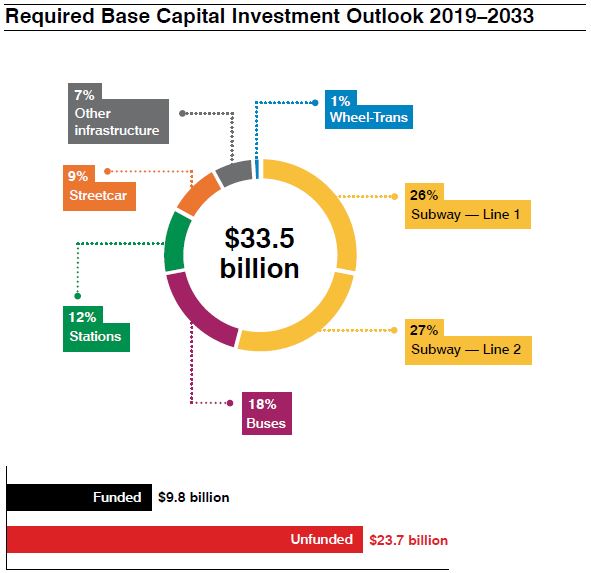
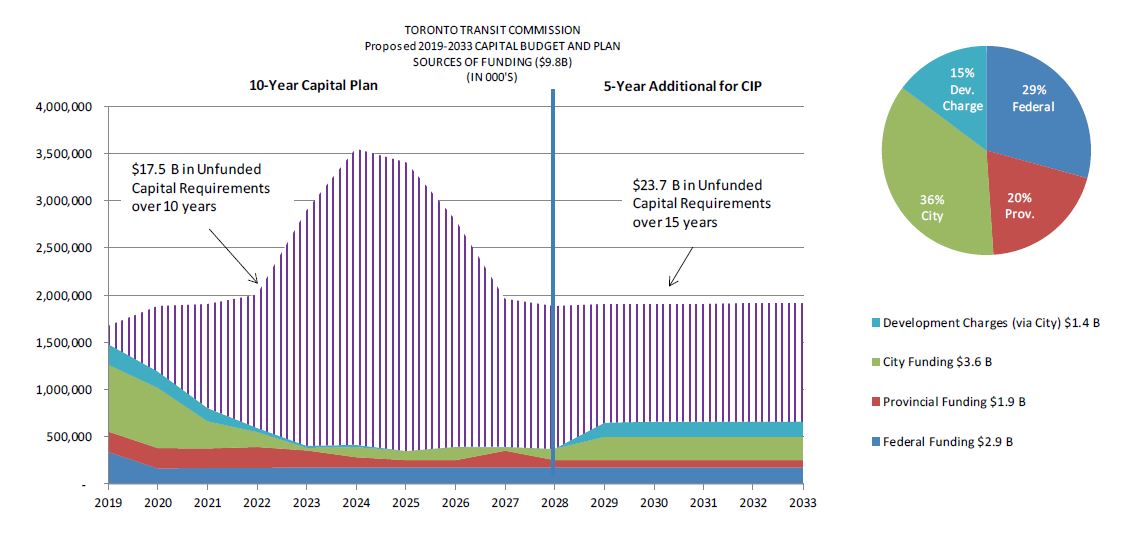
  • There is a “base program” consisting of projects that have Council approval for inclusion in the ten-year plan. The estimated cost of this program is $9.240 billion, but there is funding shortfall of $2.702 billion.
  • There is an “unfunded list” of projects making up the shortfall. These will migrate to funded status as and when money becomes available.
  • The City requires that the TTC make provision for “capacity to spend” reductions in its projects based on the premise that all of the money in the budgets will not actually be used. This offsets $427 million of the shortfall, although one can argue that this is a polite fiction meant to convey the idea that the funding hole is not quite as deep as it seems. The premise is that not all projects will be spent to their full budgets, and an across-the-board provision will soak up the underspending. In practice, some of this “shortfall” is a question of timing – project slippage that shifts spending to other years – not a question of budgeting too high.
  • Some projects have their own, dedicated funding streams and appear separately from the base program. At present, these are the subway extensions to Vaughan and to Scarborough.
  • Some projects in the base program have funding directed specifically to them. The provincial 1/3 share of the new streetcars is an example. This is separate from provincial money that flows to Toronto from the gas tax.
  • Some projects have timelines associated with the structure of funding programs. Ottawa’s Public Transit Infrastructure Fund (PTIF) Phase 1 requires that projects be completed by March 31, 2019 so that the subsidy is expensed, federally, by the end of the 2018-19 fiscal year. PTIF phase 2 has not yet been announced either as to amount or to the timeframe in which spending will occur. These constraints prevent many projects from receiving PTIF money because they do not fit within the prescribed window for spending.
  • Metrolinx projects do not appear on the TTC’s books, but in some cases they can trigger payments from the TTC and/or the City of Toronto. Examples are Presto and SmartTrack.
  • Some transit proposals are not even in the base program, but wait in readiness as “nice to haves”.

“Funding” is the process of paying for projects, while “Financing” is the mechanism by which that money is raised. A “funded” project is associated with revenue from “financing” sources that the City can depend on such as property taxes and committed monies from other governments. Where there is a shortfall, someone has to step up with new money, however they might raise it, or something must be removed (or at least reduced in scope) from the list of funded projects.

City of Toronto contributions to capital come primarily from current taxes (“capital from current” and development charges) and from borrowing. The amount of borrowing available to the TTC each year is dictated by the City’s self-imposed 15% cap on the ratio of debt service costs to property tax revenue. A few major projects in the near future, notably the Gardiner Expressway rebuild, are crowding the debt ceiling, and there are years when little new debt will be issued on the TTC’s behalf. In turn, this affects spending plans at the TTC, and projects are shifted into future years with more borrowing room to get around this.

Other constraints can arise from a program like PTIF which, because it has a sunset date, requires that spending that might otherwise occur some years in the future must actually happen sooner than planned. This, in turn, requires matching funds from the City in years where they might otherwise have been spent on other projects.

Continue reading

Toronto’s Transit Capacity Crisis

In recent days, Mayor Tory has announced, twice, a ten point program to address crowding on the TTC. The effectiveness of this program is limited by years of bad political decisions, and the hole Toronto has dug itself into is not one from which it will quickly escape.

This article is a compendium of information about the three major portions of the “conventional” (non-Wheel-Trans) system: subway, bus and streetcar. Some of this material has appeared in other articles, but the intent here is to pull current information for the entire system together.

Amendment February 15, 2018 at 5:30 pm: This article has been modified in respect to SmartTrack costs to reflect the fact that over half of the cost shown as “SmartTrack” in the City Manager’s budget presentation is actually due to the Eglinton West LRT extension which replaced the proposed ST service to the commercial district south of the airport. A report on SmartTrack station costs will come to City Council in April 2018. Eglinton LRT costs will take a bit longer because Council has asked staff to look at other options for this route, notably undergrounding some or all of it.

Continue reading

TTC Board Meeting February 15, 2018

The TTC Board will meet on February 15, 2018. Among the items on the agenda are:

Scarborough Subway Extension (SSE)

The SSE itself is not on the agenda, but it has been the subject of much recent debate over when the projected cost and schedule for the extension will be released.

In the November 2017 CEO’s Report, the project scorecard included a schedule showing that 30% design would be complete in the second quarter of 2018, and an RFP [Request for Proposals] would be issued in the third quarter. Even when this report came out, former CEO Andy Byford was hedging his bets about a spring 2018 date saying that more work would be needed to verify and finalize the figures. A key note in this scorecard states:

EFC [Estimated Final Cost] was approved in 2013 based on 0% design. With the alignment/bus terminal now confirmed by City Council, the project budget and schedule will be confirmed as design is developed to the 30% stage, factoring in delivery strategy and risk. The performance scorecard will continue to report relative to the project’s original scope, budget and schedule, as approved by Council in 2013, until the project is rebaselined at the 30% stage in late 2018.

In other words, neither the schedule nor the projected cost reflected the evolving and expanding design of this project.

Jennifer Pagliaro in the Star wrote about the result of a Freedom of Information Request that revealed a briefing to Mayor Tory in September 2017. That briefing included a statement that the cost estimate for a Stage 3, 30% design, would be available in September 2018.

Because Council will not meet until 2019, numbers that might have been available before the election would not be released until after the new Council takes office. After the story appeared, City staff replied:

The cost information referenced in page 9 of the October TTC briefing deck refers to the planned timing for initial cost inputs from TTC engineering staff. These are not the full cost estimates necessary for consideration by Council. Further work will be required to appropriately account for financing, procurement model, market assessment and other critical factors. The final cost estimate, subject to the variability ranges noted below, will include these inputs.

This additional work will be undertaken by various TTC staff as well as city officials from corporate finance, financial planning, city planning and other divisions. [Tweet from Jennifer Pagliaro, February 7, 2018]

I wrote to the TTC’s Brad Ross about this conflicting information, and particularly about the question of how an RFP could be issued in 3Q18 when Council would not be approving that the project pass beyond “stage gate 3” until 2019. He replied:

No RFP will be issued until after Council approval. You will note in the Key Issues and Risks section of the scorecard from November reads, “The performance scorecard will continue to report relative to the project’s original scope, budget and schedule, as approved by Council in 2013, until the project is rebaselined at the 30% stage in late 2018.”

To be consistent with the report to Council in March 2017, only the revenue service date was revised in the scorecard (from Q4 2023 to Q2 2026). The TTC recognizes and acknowledges that this has led to confusion. The TTC will be taking steps to ensure greater clarity in its next CEO Report in March 2018. [Email of February 9, 2018]

The February CEO’s report states:

Work continues to progress design towards Stage Gate 3, expected in fall of 2018. At this time, the project will provide initial cost inputs from the TTC team (includes detailed costs for the Scarborough Centre station, tunnel, Kennedy station, systems, property and utilities). Further work is underway by the new Chief Project Manager with key stakeholders within TTC and the City to define the activities, approval process and timelines to arrive at the final Class 3 Cost Estimate, Level 3 Project Schedule, and associated Risk Analysis.

As requested by City Council, a report will be presented at the first opportunity to the Executive Committee, TTC Board and City Council, which is expected to be Q1 of 2019. [pp 15-16]

The debate, as it now stands, is about releasing whatever material will be available in September 2018 so that it can inform the election debates. Additional costs as cited by the city would sit on top of the September numbers, but at least voters and politicians would know whether the SSE’s cost has gone up just for the basic construction, let alone factors related to financing and procurement that would be added later.

Meanwhile, SSE promoter Councillor Glenn De Baeremaeker speaking on CBC’s Metro Morning said:

I don’t think it matters what the costs are.

This has been taken to read that money is no object, and that well may be the political reality in Scarborough – there is no way the many politicians who have so deeply committed to the subway project can back out. De Baeremaeker continued:

Whether the costs go up or the costs go down, people who have tried to sabotage the subway and stop the subway, will continue to try to sabotage it, they’ll continue to try to stop it, and they will never vote for it. So I would challenge the Councillors who say “I want to see the cost”. My response is and if it’s a reasonable cost, will you support the subway? Well, no. [At 3:26 in the linked clip]

What De Baeremaeker does not address is whether he has an upper limit beyond which even his enthusiasm might be dimmed. Also, on the question of a “reasonable cost”, what has been lost here is the fact that the subway “deal” was sold on the basis that the $3.5 billion included the Eglinton LRT extension to UTSC Campus. What had been a $2 billion-plus subway when it was approved as a compromise by Council, quickly grew to $3 billion-plus, and the LRT extension is left to find alternate funding. One could reasonably ask whether the LRT was ever really part of the deal, or was simply there as a sweetener that pulled in wavering supporters who now see just how gullible they were.

A related issue that has not yet surfaced is the question of whether building the SSE for a 2026 opening will require concurrent changes in timing and/or scope for the planned renewal of the Bloor-Danforth subway including a new signalling system and fleet. A report on the renewal is expected in April 2018, although this date has changed a few times over past months. The TTC/City capital budget and ten year plan do not reflect this project, at least with respect to timing, and probably with respect to total cost.

Continue reading

TTC Board Meeting October 16, 2017 (Updated)

The TTC Board will meet on October 16. Among items of interest on the agenda are:

Continue reading