Service Analysis of 502/503 Downtowner/Kingston Road Tripper: 2013 to 2015

Recent articles on this site looked in great detail at the 501 Queen car and the problems with its service. Often, when people talk about Queen, they miss the streetcar routes that are, in effect, branch operations of the Queen line serving Kingston Road in The Beach:

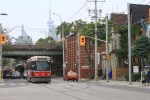
  • 502 Downtowner (formerly Kingston Road) operates between Bingham Loop (at Victoria Park & Kingston Road) and McCaul Loop sharing trackage with 501 Queen west of Woodbine Loop (which is actually at Kingston Road, and is named for the old racetrack, which itself became “Greenwood” when “New Woodbine” opened in northern Etobicoke). This route operates weekdays until the end of the PM peak. Evening and weekend service is provided by the 22a Coxwell bus.
  • 503 Kingston Road Tripper operates rush hours only between Bingham Loop and York Street running into the core via King from the Don Bridge, and looping downtown via Church, Wellington and York.

This service design has been in place, with only a few changes, since 1948:

  • 1954: Streetcar service cut back from Birchmount Loop to Bingham Loop.
  • 1966: Coxwell bus replaced Coxwell streetcar and evening/weekend service on Kingston Rd./Coxwell (same as the 22A today).

The route name “Downtowner” arose from an ill-advised proposal to provide “relief” to the downtown subway by extending Kingston Road cars from McCaul Loop west and north to Bathurst Station in 1973. This didn’t last long. A year later the extended service became a peak-only operation, and that remained, on paper at least, until 1984. We have the name as a memento of that extension now 30-years in the past. The basic problem was that very little of the service actually reached Bathurst Station with many cars short turning either at Wolseley Loop (Queen & Bathurst) or at McCaul Loop.

The situation is not unlike what we see today because the 502 Downtowner schedule does not provide enough running time, and short turning is a chronic problem. This is particularly troubling because the short turns defeat the purpose of the route’s existence:

  • A short turn eastbound at Woodbine Loop removes service from the street which the route is intended to serve.
  • A short turn westbound at Church (looping via Richmond and Victoria) sends a car east without serving the major stops downtown from Yonge to University.
  • A short turn westbound at Parliament (looping via Dundas and Broadview) removes a car even more from downtown, and not even a clever rider walking a block east from Yonge (an “illegal” move with a regular transfer) can take advantage of the service.

This is compounded by extremely erratic headways that are far worse than I have seen on any other route I have analyzed. According to TTC route performance stats, the 502 is “on time” (that is to say, within ±3 minutes of the scheduled headway) 30% of the time. As we will see later, even that claim is a stretch.

As for the 503 Kingston Road Tripper, service on that route is supposed to be blended with the 502, and during AM peaks it can work out, sort of, there is a vaguely reliable headway of alternating 502/503 cars on Kingston Road. But it’s a hit-and-miss situation, and very large gaps in 503 service are quite common.

Anyone attempting to use transit on or to Kingston Road is well advised to get on the first thing that shows up and be prepared to transfer. This appalling situation is a mockery of what the TTC claims is its “customer service”.

Service on Kingston Road was substantially better in past decades, and it is no wonder that ridership and scheduled service levels have fallen given the unpredictable nature of these routes. Recently, there has been some improvement. In April 2013, off-peak headways of 502 Downtowner improved from 20 to 16 minutes, and in June 2015, from 16 to 10 minutes. However, the fundamental problem of headway reliability undoes much semblance of “improvement”.

Continue reading

Service Analysis of 501 Queen 2013 to 2015: Part 2, Running Times

In the first article of this series, I reviewed the headways (time between vehicles) on route 501 Queen from August 2013 to May 2015. A pattern there is that headways on the outer parts of the route are consistently, at times extremely so, worse than the advertised frequencies. Even in the central part of the route, average headways are close to scheduled values, but the regularity of vehicle spacing is not – cars commonly run in pairs on a much wider combined headway than the schedule calls for.

With this route listed among those that will be part of the TTC’s “Ten Minute Network”, actually achieving that goal will be as important as the inevitable hype that will accompany the announcement. This is also a route destined for better service thanks to new loading off-peak loading standards.

This article turns to the question of running times – the period required for a typical vehicle to get from point “A” to “B” on a route. These are important for a variety of reasons:

  • If the scheduled time is commonly less than the actual time needed, then vehicles will always be late, and there will be a strong incentive for cars to short turn.
  • If the scheduled time is commonly more than what is needed, then vehicles will either dawdle along their routes, or take extended siestas at terminals.
  • “Congestion” is a routinely cited reason for the TTC’s inability to operate reliable service, but it is not a consistent phenomenon across the route, by time of day or by day of the week. Some of the worst disruptions arise not from chronic congestion, but from events such as construction projects or diversions around festivals. The location of the delays is not confined to the core area.

There is a lot of material here, and I don’t expect that most readers will go into all of the detail. The first part looks at the route overall, and then I turn to individual segments. If there is any overall message, it is this: the operation of a long, busy route like Queen is affected by many factors. Some are institutional (schedules, procedures). Some are chronic (predictable congestion). Some are transient (accidents, illness). Some of the worst are from relatively short-lived events such as construction work or event diversions where the resulting service leaves much to be desired. There is no one “magic solution” that will fix all of them with minimal pain for either for the TTC or for other road users.

Continue reading

TTC Board Meeting July 29, 2015 (Updated August 3, 2015)

The TTC Board will meet on July 29, 2015, and various items of interest are on the agenda. These include:

  • The monthly CEO’s Report (Updated August 2, 2015)
  • A presentation by Toronto’s Chief Planner Jennifer Keesmaat (Updated August 3, 2015)
  • Faregates for PRESTO implementation
  • Purchase of new buses and implications for service growth (Updated August 1, 2015)
  • Improved service standards for off peak service on “frequent” routes
  • Proposed split operation of 504 King during TIFF opening weekend (Updated August 2, 2015)
  • An update on Leslie Barns
  • Excluding Bombardier from eligibility for future contracts (Deferred to September Board meeting)
  • Council requests related to Lake Shore West streetcar service (Referred to TTC Budget Committee)

Continue reading

Service Analysis of 501 Queen 2013 to 2015: Part 1, Headways

Of the TTC’s many routes, 501 Queen is the longest and the subject of ongoing complaints about service quality and reliability. Two standard explanations are offered to the long-suffering riders: we cannot operate a reliable service thanks to traffic congestion, and we have no equipment with which to operate more service.

I have published detailed reviews of individual months of operation in past articles, but an accumulation of data for various periods and conditions now makes a retrospective look at the route’s behaviour possible.

The data used in this analysis come from the TTC’s vehicle monitoring system which collects GPS information on the fleet every 20 seconds. The raw data are transformed by several programs I have developed over the years so that they can be presented in a consolidated format. Interested readers should see Methodology For Analysis of TTC’s Vehicle Tracking Data for details of this process. The data were provided by the TTC, but the analysis and interpretation are entirely my own.

Service History

The last significant change to 501 Queen schedules occurred in Spring 2013 when weekday services were adjusted to address overcrowding. Since then, there have been only two basic schedules used on the route:

  • The standard schedule provides service between Neville Loop in the east and Long Branch Loop at the city’s western edge. Half of the cars are scheduled to short-turn at Humber Loop, and except for overnight service, from that point westward the scheduled service is half the level of that east of Humber.
  • On some occasions, construction has required that the line operate in two segments. One is from Neville to Humber, and the other (using buses) is from Humber to Long Branch. Service east of Humber is similar to that on the standard schedule. To the west, scheduled bus service is more frequent to allow for the capacity of low floor buses versus the two-section streetcars (ALRVs) used on 501 Queen. (A variation on this includes a shuttle service from Humber Loop to the condos east of Park Lawn, but it does not alter the service provided on the main part of the route east or west of Humber. This shuttle is not part of the service analysis.)

501_ServiceHistory

This table shows the two service designs for 501 Queen including the headways (scheduled time between vehicles), numbers of vehicles, end-to-end trip times and “recovery” time.

This last item deserves comment because it is not, as the name implies, intended to give operators on this extremely long route a break after their journeys. Instead, its primary function is to make the schedule work out so that the round trip time is a multiple of the headway. Because of the difference in trip times on the two branches of the route, this can produce long recovery times at periods in the day when they are not badly needed simply to make the schedule work out properly. I will turn to trip times and reliability in the second part of this series.

This article covers the following periods of operation on 501 Queen:

  • August-October 2013 (service split at Humber Loop after Thanksgiving weekend)
  • January-April 2014 (service split at Humber Loop for April)
  • September-October 2014 (service split at Humber Loop)
  • March-May 2015

As a general observation, service on much of the Queen route is very unreliable and, in some cases, to the point where it exists more in theory than in practice. Bunching is commonplace, and there is no evidence of any attempt to keep cars spaced apart from each other even long before they enter the most congested section of the route. If there is an operating discipline, its aim is to keep operators on time, with service to riders coming as an afterthought. In principle, if all of the service is on time, then reliability will take care of itself. However, in practice, the service routinely operates well off of its scheduled headways. This cannot be put down entirely to “traffic congestion” given how pervasive a problem this is and has been on 501 Queen for years.

Service on this route, particularly on its outer portions, has been an issue for as long as I can remember, and the TTC always has an excuse. If only they would expend one tenth of the effort to manage headways on this major route as they do to tell us about their latest of clean subway stations and other “customer service initiatives”, there would be many happy riders, and an incentive to bring even more. The route is developing medium and high intensity buildings along its length, but the service levels are unchanged since 2013 (and with only minor changes before that).

The TTC plans to introduce new schedules on Queen later in 2015 (or possibly early 2016) to address some of the reliability problems. However, without the will to ensure that vehicles on this very  long route maintain proper spacing, the concept of reliability, let alone the “ten minute service” network of which Queen will be a part, will be meaningless.

Continue reading

Coming Soon: July 2015

Since that blizzard of articles about TTC budgets and fares, it’s been rather quiet in here. Fear not! I actually have works in progress to tide us over the relatively quiet summer months until the political season heats up in the fall.

There will be a series of articles about the operation of the downtown streetcar lines looking at their behaviour over time, and reviewing how changes that have been made (or are planned) affected them. These include:

  • 501 Queen (including the effect of split operation with a bus shuttle on Lake Shore to Long Branch)
  • 502/503 Downtowner & Kingston Road (including the recent move to a 10-minute off-peak headway on 502)
  • 504 King (including the effect of additional running time on service levels and terminal operations)
  • 505 Dundas
  • 506 Carlton (including a look at the effects of the College/Spadina construction diversion)
  • 509 Harbourfront (including a review of the changes on Queens Quay)
  • 510 Spadina

The TTC plans additional meetings of its Budget Committee and these will, no doubt, produce more details about plans and options for 2016 and beyond. I will cover this material as it becomes available.

Toronto To Propose Peak-Hour Extensions on Queen, Dundas, Carlton/College

The City of Toronto will hold three public meetings regarding proposed changes in rush hour traffic restrictions on Queen, Dundas and Carlton/College between Parliament and Roncesvalles.

  • Wed. June 17 at 6:30 pm: Mary McCormick Community Centre, 66 Sheridan Avenue
  • Thurs. June 25 at 6:00 pm: Scadding Court Community Centre, 707 Dundas Street West
  • Mon. June 29 at 6:00 pm: City Hall, Committee Room 2

Work underway by City Transportation Services and the TTC includes:

The project team is currently:

  • Analyzing GPS-based data for the streetcar routes along Dundas Street, College/Carlton Streets, and Queen Street West
  • Looking at how existing peak-hour restrictions function along the routes
  • Finding opportunities to improve streetcar travel times and reliability. For example, where streetcar travel times increase sharply after current restrictions end (e.g. 6pm), the project team is considering extending the peak period by a half-hour or hour on each end to improve the flow of transit, general traffic, and cyclists
  • In a few cases, where no clear benefit is observed from an existing extension, peak hours are being reduced

Additional measures to improve transit operations, in various stages of implementation, include:

  • Re-timing signals to give more green time to the priority direction
  • Active Transit Signal Priority (extended green or shortened red when transit vehicles are detected and meet certain requirements)
  • All-door boarding / Proof of Payment (POP)
  • Greater enforcement of restrictions

[From the “Overview” tab]

Disclosure: I have acted as a consultant to this project in the analysis of TTC vehicle tracking data.

504 King Cars Returning to King Street (Updated)

After a long absence courtesy of a shutdown of the King Street branch of the Queen/Don Bridge, streetcars will return to King east from Parliament to the Don on Friday, June 5. This will put the 504 King and 503 Kingston Road Tripper cars back on a route they have not seen since mid-2013.

Construction under the Don Bridge of infrastructure to support the development of West Don Lands undermined the bridge foundations which, as it turns out, are wooden piers. Infrastructure Ontario, the agency in charge of the overall project to build the Atheletes’ Village in the WDL, has claimed that King Street would reopen at several possible dates going back to fall 2014.

This will also mark the first streetcar traffic over the new intersection at Sumach Street that leads south to Cherry Street, the WDL and the Distillery District. That line is expected to begin service in Spring 2016 when new residents start moving in to the neighbourhood. The TTC has not yet announced what route structure will be used to serve Cherry south to the loop at the rail corridor (just north of the old Cherry Street Tower).

A comment left by a reader in another thread adds a few details:

503/504 service will be restored on King St. East between Parliament St. and Queen St. East at 5 AM June 05 2015. The city and its contractor (Aecon) have completed repairs and the TTC has replaced the trolley wire. Test streetcars have already been conducted with good results. The TTC will be posting at stops and on web site of changes, as well as having alternate duties employees at the affected Queen St. East stops to advise customers of the restoration of service. (nfitz will be very happy)

Updated June 5, 2015 With Photos

The century-old housing that provided a backdrop for diverting King cars on Parliament will soon disappear under yet more new condominiums.

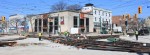
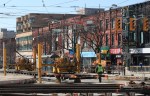
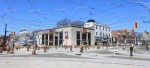
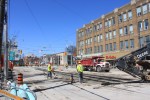
Meanwhile, down on King, the landscape has changed a lot since the 504 last plied these rails. The black building is a new condo while the brown one across the street, with a Tim Horton’s that has been busy from the day it opened, is a new Toronto Community Housing building.

At Sumach, the new intersection leads south to track on Cherry that will be activated in Spring 2016 when new condo residents move in to what is now the Pan Am Games Athletes’ Village.

The Evolution of Service on 512 St. Clair (2) (Updated)

This article is a follow-up to an early April review of the gains and losses brought by the St. Clair right-of-way and subsequent “transit priority” measures. When it was published, the TTC had just changed schedules on this route to shorten trip times in response to repairs on several traffic signal locations where that “priority” function was not working. Did these repairs actually have an effect? How well did the line operate with less running time?

Updated May 23, 2015 at 12:40 pm:

Data for weekend operations has been added to the end of this article.

Conclusions

  • There was a definite increase in travel times in fall 2014 as compared with summer 2010 when the right-of-way operations west of St. Clair West Station began. The location and severity of the problem varied along the route with notable effects between Bathurst and Oakwood where there are many traffic signals.
  • The amount of running time added in the October 2014 schedules was slightly more than the actual increase in average running time over the route from 2010 to 2014.
  • Travel times were reduced after the repair of transit priority functions at several signals along the route, notably in sections with many traffic signals. This did not completely reverse the longer running times of 2014.
  • Short-turns as a proportion of all service declined with the new schedules in place.
  • The increased supervision produced more reliable headways.
  • The improvements of October 2014 have been slightly reduced with the new April 2015 schedules that clawed back much of the additional running time.

For reference, here is a table from the first article showing changes in schedules for the route since 2007.

512_ServiceHistory

Generally speaking, the April 2015 changes reduced one-way running time by 6 minutes during most periods with a few, minor adjustments to terminal “recovery time”. Those “recovery” values are as much a rounding factor to make the headway  come out to an even value as they are a calculated amount of time needed to deal with random delays.

Continue reading

The Evolution of Service on 29 Dufferin: Weekdays 2011 to 2015

29 Dufferin is one of the TTC’s target routes for improved performance, and it also happens to be a route that I have been following with TTC vehicle tracking data from selected months going back to November 2011. This article reviews the line’s operation on weekdays.

This article is somewhat technical, but has been written for a general audience to the degree the subject allows.

Scheduled Service History

An important factor in reviewing service on the street is the schedule itself: the headways (time between vehicles) and the running times provided for each trip. Headways may look good on paper, but if service arrives unreliably, or if some of it never reaches the destination thanks to short turns, then the advertised service is a polite fiction. Running times also have an effect, especially if they are shorter than the typical time required to drive from one end of a route to the other. When an operator cannot make the scheduled trip, the bus runs late and is quite likely to short turn simply to get it back on time. In theory, this “restores” normal service, but if vehicles are chronically late, the process never ends. The “treatment” never cures the “patient”.

The months included in this article are:

  • November 2011
  • March 2012
  • May 2013
  • September 2013 (Dufferin Bridge at CNE closes)
  • March 2014 (Diversion from College to Queen southbound for water main construction)
  • November 2014 (Introduction of articulated buses)
  • April 2015 (Major schedule revisions to reflect actual operating conditions)

29_ServiceHistory

This spreadsheet shows the scheduled headways and trip times for all of the periods covered by this article. In a few cases, there are two schedules shown for the same month because a change was implemented part way through.

The Dufferin Bus operates primarily between Dufferin Loop (at the Western Gate of the CNE ground) to Wilson Station. During peak periods there is a short turn at Tycos Drive where half of the service returns south. During certain periods (with seasonal variations), half of the service runs through the CNE grounds to the Princes’ Gate (eastern entrance).

In September 2013, the bridge on Dufferin at the rail corridor north of the CNE closed on very short notice for repairs. Service that was scheduled to operate to the Princes’ Gates turned back at Dufferin Loop. This resulted in half of the buses having more running time for their trips between Dufferin Loop and Wilson Station. Concurrently, a diversion for water main construction was operated southbound between College and Queen. These two offset each other, at least for the buses that were scheduled to run through to the Princes’ Gate. Extra running time (up to 10 minutes)  was not added to the schedules until the end of March 2014 in anticipation of the re-opening of the Dufferin Street bridge.

In November 2014, the route officially switched to articulated bus operation Weekdays and Saturdays, although these vehicles had been present for some time before.

In April 2014, there was a major restructuring of the schedules: considerably more running time was provided to reflect actual conditions, and the split operation at the south end of the route was discontinued on weekends.

Continue reading

College & Spadina Reconstruction (Updated May 8, 2015)

Updated May 8, 2015: The TTC has posted a time-lapse video of the reconstruction for those who want to see the whole thing in two minutes.

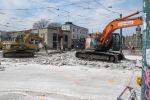
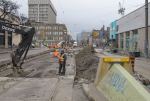
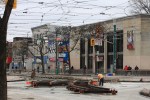
On Monday, April 6, 2015, the TTC began reconstruction of the intersection at College & Spadina. The work is planned for a three-week interval, and as of April 10 the project is moving along swiftly. During this work, 510 Spadina buses and 506 Carlton cars are diverting around the site. Resumption of through service is planned for Monday, April 27.

As with all such jobs, the work began with demolition of the existing intersection followed by the pour of a new concrete foundation on which the new track will sit. The track was pre-assembled at Hillcrest Yard and then broken apart into panels which have been delivered to the site on many trailers spotted around the intersection. The TTC’s Brad Ross posted an excellent photo on Twitter of the fully assembled intersection.

Reassembly begins with the diamond in the middle of the structure, and works outward to each arm of the intersection.

My thanks to Harold McMann for the photos of early stages in this work.

Updated April 12, 2015 at 1:40 pm: New gallery added.

Assembly of the intersection began on Friday morning, and two days later, it is nearing completion with only the south quadrant still missing. At the end of the gallery below, the track panel that will be the southbound section of the south quadrant is being reading for its move into position.

Updated April 18, 2015 at 1:10 pm: New galleries added.

Tuesday, April 14: Assembly of the approaches to the intersection is well underway.

Saturday, April 18: Concrete work around the tracks is substantially complete, and some pedestrian paths through the intersection have been shifted onto the pavement to allow work to begin on sidewalk and curb repairs.