504 King Cars Returning to King Street (Updated)

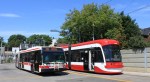
After a long absence courtesy of a shutdown of the King Street branch of the Queen/Don Bridge, streetcars will return to King east from Parliament to the Don on Friday, June 5. This will put the 504 King and 503 Kingston Road Tripper cars back on a route they have not seen since mid-2013.

Construction under the Don Bridge of infrastructure to support the development of West Don Lands undermined the bridge foundations which, as it turns out, are wooden piers. Infrastructure Ontario, the agency in charge of the overall project to build the Atheletes’ Village in the WDL, has claimed that King Street would reopen at several possible dates going back to fall 2014.

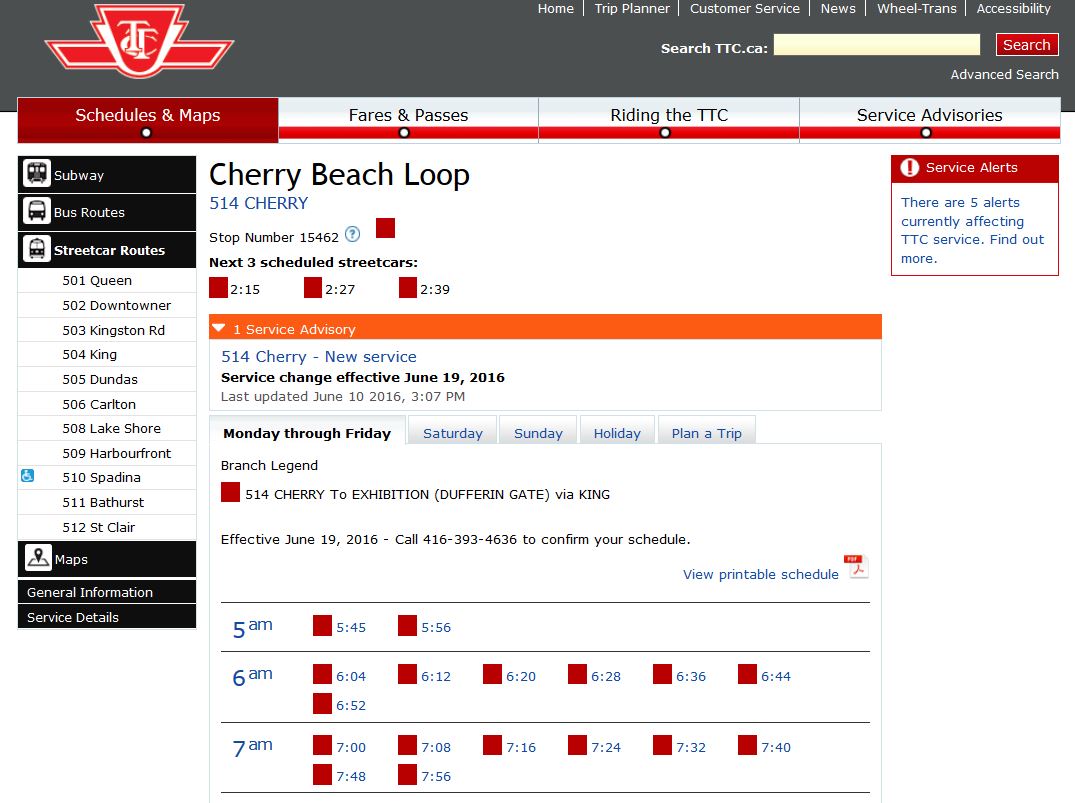
This will also mark the first streetcar traffic over the new intersection at Sumach Street that leads south to Cherry Street, the WDL and the Distillery District. That line is expected to begin service in Spring 2016 when new residents start moving in to the neighbourhood. The TTC has not yet announced what route structure will be used to serve Cherry south to the loop at the rail corridor (just north of the old Cherry Street Tower).

A comment left by a reader in another thread adds a few details:

503/504 service will be restored on King St. East between Parliament St. and Queen St. East at 5 AM June 05 2015. The city and its contractor (Aecon) have completed repairs and the TTC has replaced the trolley wire. Test streetcars have already been conducted with good results. The TTC will be posting at stops and on web site of changes, as well as having alternate duties employees at the affected Queen St. East stops to advise customers of the restoration of service. (nfitz will be very happy)

Updated June 5, 2015 With Photos

The century-old housing that provided a backdrop for diverting King cars on Parliament will soon disappear under yet more new condominiums.

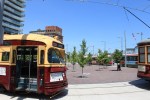
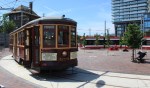
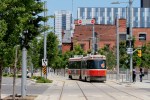
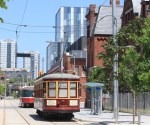
Meanwhile, down on King, the landscape has changed a lot since the 504 last plied these rails. The black building is a new condo while the brown one across the street, with a Tim Horton’s that has been busy from the day it opened, is a new Toronto Community Housing building.

At Sumach, the new intersection leads south to track on Cherry that will be activated in Spring 2016 when new condo residents move in to what is now the Pan Am Games Athletes’ Village.

The Evolution of Service on 512 St. Clair (2) (Updated)

This article is a follow-up to an early April review of the gains and losses brought by the St. Clair right-of-way and subsequent “transit priority” measures. When it was published, the TTC had just changed schedules on this route to shorten trip times in response to repairs on several traffic signal locations where that “priority” function was not working. Did these repairs actually have an effect? How well did the line operate with less running time?

Updated May 23, 2015 at 12:40 pm:

Data for weekend operations has been added to the end of this article.

Conclusions

  • There was a definite increase in travel times in fall 2014 as compared with summer 2010 when the right-of-way operations west of St. Clair West Station began. The location and severity of the problem varied along the route with notable effects between Bathurst and Oakwood where there are many traffic signals.
  • The amount of running time added in the October 2014 schedules was slightly more than the actual increase in average running time over the route from 2010 to 2014.
  • Travel times were reduced after the repair of transit priority functions at several signals along the route, notably in sections with many traffic signals. This did not completely reverse the longer running times of 2014.
  • Short-turns as a proportion of all service declined with the new schedules in place.
  • The increased supervision produced more reliable headways.
  • The improvements of October 2014 have been slightly reduced with the new April 2015 schedules that clawed back much of the additional running time.

For reference, here is a table from the first article showing changes in schedules for the route since 2007.

512_ServiceHistory

Generally speaking, the April 2015 changes reduced one-way running time by 6 minutes during most periods with a few, minor adjustments to terminal “recovery time”. Those “recovery” values are as much a rounding factor to make the headway  come out to an even value as they are a calculated amount of time needed to deal with random delays.

Continue reading

The Evolution of Service on 29 Dufferin: Weekdays 2011 to 2015

29 Dufferin is one of the TTC’s target routes for improved performance, and it also happens to be a route that I have been following with TTC vehicle tracking data from selected months going back to November 2011. This article reviews the line’s operation on weekdays.

This article is somewhat technical, but has been written for a general audience to the degree the subject allows.

Scheduled Service History

An important factor in reviewing service on the street is the schedule itself: the headways (time between vehicles) and the running times provided for each trip. Headways may look good on paper, but if service arrives unreliably, or if some of it never reaches the destination thanks to short turns, then the advertised service is a polite fiction. Running times also have an effect, especially if they are shorter than the typical time required to drive from one end of a route to the other. When an operator cannot make the scheduled trip, the bus runs late and is quite likely to short turn simply to get it back on time. In theory, this “restores” normal service, but if vehicles are chronically late, the process never ends. The “treatment” never cures the “patient”.

The months included in this article are:

  • November 2011
  • March 2012
  • May 2013
  • September 2013 (Dufferin Bridge at CNE closes)
  • March 2014 (Diversion from College to Queen southbound for water main construction)
  • November 2014 (Introduction of articulated buses)
  • April 2015 (Major schedule revisions to reflect actual operating conditions)

29_ServiceHistory

This spreadsheet shows the scheduled headways and trip times for all of the periods covered by this article. In a few cases, there are two schedules shown for the same month because a change was implemented part way through.

The Dufferin Bus operates primarily between Dufferin Loop (at the Western Gate of the CNE ground) to Wilson Station. During peak periods there is a short turn at Tycos Drive where half of the service returns south. During certain periods (with seasonal variations), half of the service runs through the CNE grounds to the Princes’ Gate (eastern entrance).

In September 2013, the bridge on Dufferin at the rail corridor north of the CNE closed on very short notice for repairs. Service that was scheduled to operate to the Princes’ Gates turned back at Dufferin Loop. This resulted in half of the buses having more running time for their trips between Dufferin Loop and Wilson Station. Concurrently, a diversion for water main construction was operated southbound between College and Queen. These two offset each other, at least for the buses that were scheduled to run through to the Princes’ Gate. Extra running time (up to 10 minutes)  was not added to the schedules until the end of March 2014 in anticipation of the re-opening of the Dufferin Street bridge.

In November 2014, the route officially switched to articulated bus operation Weekdays and Saturdays, although these vehicles had been present for some time before.

In April 2014, there was a major restructuring of the schedules: considerably more running time was provided to reflect actual conditions, and the split operation at the south end of the route was discontinued on weekends.

Continue reading

College & Spadina Reconstruction (Updated May 8, 2015)

Updated May 8, 2015: The TTC has posted a time-lapse video of the reconstruction for those who want to see the whole thing in two minutes.

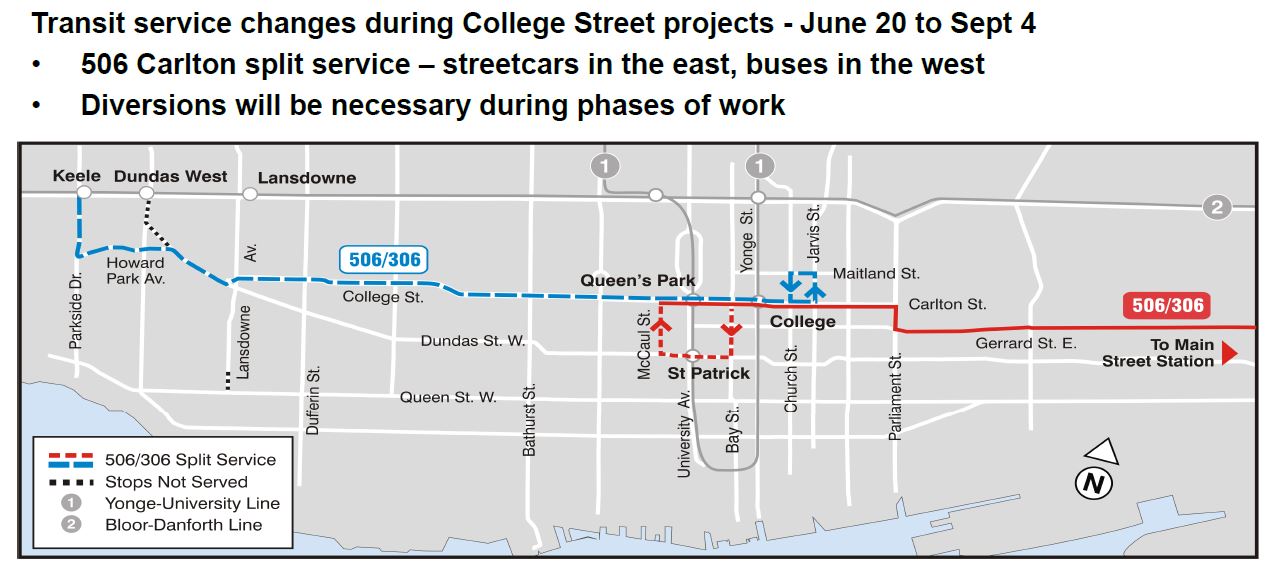
On Monday, April 6, 2015, the TTC began reconstruction of the intersection at College & Spadina. The work is planned for a three-week interval, and as of April 10 the project is moving along swiftly. During this work, 510 Spadina buses and 506 Carlton cars are diverting around the site. Resumption of through service is planned for Monday, April 27.

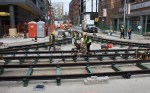
As with all such jobs, the work began with demolition of the existing intersection followed by the pour of a new concrete foundation on which the new track will sit. The track was pre-assembled at Hillcrest Yard and then broken apart into panels which have been delivered to the site on many trailers spotted around the intersection. The TTC’s Brad Ross posted an excellent photo on Twitter of the fully assembled intersection.

Reassembly begins with the diamond in the middle of the structure, and works outward to each arm of the intersection.

My thanks to Harold McMann for the photos of early stages in this work.

Updated April 12, 2015 at 1:40 pm: New gallery added.

Assembly of the intersection began on Friday morning, and two days later, it is nearing completion with only the south quadrant still missing. At the end of the gallery below, the track panel that will be the southbound section of the south quadrant is being reading for its move into position.

Updated April 18, 2015 at 1:10 pm: New galleries added.

Tuesday, April 14: Assembly of the approaches to the intersection is well underway.

Saturday, April 18: Concrete work around the tracks is substantially complete, and some pedestrian paths through the intersection have been shifted onto the pavement to allow work to begin on sidewalk and curb repairs.

The Evolution of Service on 512 St. Clair

The St. Clair streetcar route has seen its share of political battles over the years. Back in 1972, it was the heart of the fight to save the streetcar system from a plan that would have dismantled all routes by 1980 when, wait for it, the Queen subway would have opened. As a first step, trolley buses (remember them?) displaced from the North Toronto’s route 97 Yonge were to take over St. Clair with buses replacing streetcars on a 1:1 basis, a huge cut in the line’s capacity.

An ironic point about this plan shows how riding patterns can shift depending on other aspects of the network. Before the Bloor-Danforth subway opened in 1966, St. Clair had very frequent service (every 1’00” between Oakwood and Yonge including the Rogers Road cars), and the line carried many people east to the Yonge subway. Vaughan Loop was a major transfer point to the Bathurst cars which ran into downtown via Adelaide Street, returning on King.

After BD started running, many riders shifted to north-south routes to reach the new subway line and its connection to a route downtown via the uncrowded University subway. Demand and service on St. Clair declined. Years later, with the opening of the Spadina subway, many riders shifted back to the streetcar because it provided a direct link to the University line with one less transfer. More recently, the population along St. Clair is growing adding to demand on the line.

Unlike most streetcar routes in Toronto, 512 St. Clair operates on a street with more than four lanes. The TTC proposed conversion to a reserved right-of-way in the early 2000’s and this was approved by Council in 2005. The actual construction took forever thanks both to a legal attempt to block construction and to fouled-up co-ordination between various agencies and meddling by local Councillors in the timing of work. (You can read the whole sad story on Transit Toronto’s website.)

By spring 2007, the first segment from Yonge to St. Clair West Station was completed, and streetcar service returned, briefly between St. Clair Station and Keele Street. Summer 2007 saw the launch of work on the western portion of the line, and it did not fully reopen until summer 2010.

Recently, the TTC has been messing around with the schedules on this route and adding supervision in an attempt to provide reliable service, a sad situation given that the route is entirely on reserved lanes. The evolution of schedules from 2007 to 2015 is intriguing, and speaks to the failure of what should be a showcase route.

512_ServiceHistory

The information in this table is organized with the impending March 29, 2015 changes at the left and progressively older schedules moving to the right. Only the January schedules are shown for 2011-2013 to save on space during a relatively quiet period for service changes on this route.

  • April 2007: The line operated over its full length, but with a right-of-way only on the eastern leg.
  • June 2010: Service resumes over the full route with shorter running times, particularly on weekends, and more frequent service than in most periods in 2007.
  • January 2011: Service during some periods on Saturday and Sunday has been improved by 2011 to handle demand on the route.
  • January 2012: Weekday midday service has improved over 2011, but there are no other changes.
  • January 2013: Peak service has improved slightly, offset by some weekend service cuts.
  • January 2014: A 2012 service cut on Sunday afternoons was partly restored during 2013.
  • July 2014: Slightly wider peak service (typical for summer) with improvement in Saturday early evening and Sunday morning service.
  • October 2014: Running times substantially increased in response to a large number of transit priority signals being out of order (13 along the route)
  • March 2015: Running times reduced (but not all the way to July 2014 levels) in response to repair of most (9) of the non-working TSP locations, and experience from a higher level of route supervision implemented in fall 2014.

It is worth noting that during almost all schedule periods, the allocated running times in October 2014 were equal to or longer than those used in April 2007 when most of the route ran in mixed traffic. Some of this was due to added recovery time (weekday schedules), and some to added travel time. In effect, the benefit of the right-of-way on scheduled speed was almost completely undone. This is partly, but not completely, corrected with the March 29, 2015 schedules, but there is still generally two minutes more running time for the route compared with most schedules from 2010 onward (presumably for the residual effect of non-working TSP locations).

A related problem on St. Clair has been irregular headways. The TTC’s stock response to complaints about this sort of thing is that “traffic congestion” is the root of all evil, and reliable service is impossible. In fact, as has been demonstrated by repeated analyses on this site, the real problem lies in uneven departures from terminals and from intermediate time points along the route. This cannot be explained by saying that operators are adjusting to known conditions because these irregular headways appear under all seasons, days of week and hours of the day.

In the fall of 2014, the TTC added route supervisors on St. Clair to act as dispatchers and regulate the service. This had some effect, but the level of on-street supervision cannot be afforded across the system. Indeed, there is no reason why dispatching on headways cannot be achieved centrally and at least in part automatically. This problem is not confined to streetcar routes, and it is a fundamental issue that TTC  management must address particularly as the effects of larger vehicles and wider scheduled headways accentuate the problem on streetcar and articulated bus routes.

How has the actual service evolved over the years? For this we must turn to the TTC’s vehicle tracking data. As regular readers will know, I have been looking at routes on a selective basis since 2007. The discussion below includes data from April 2007 (pre-construction), July 2010 (full line re-opened) and September-November 2014 (pre/post implementation of longer running times and more aggressive supervision).

Continue reading

A New Way To Measure Service Quality?

At its recent Board Meeting, the TTC received a presentation [scroll to p. 3] from Chief Service Officer Richard Leary on plans to update management and measurement of surface route service quality.

The monthly CEO’s report includes a number of “Key Performance Indicators” (KPIs) intended to track various aspects of the transit system. However, the methodology behind some of the KPIs, notably those related to service quality, leaves a lot to be desired. Moreover, information that could track basic issues such as vehicle reliability is not included. This begs the question of whether the indicators exist more as a security blanket (“we have KPIs therefore we are good managers”) than as meaningful management tools, not to mention as reports to the politicians and public.

A telling chart on page 6 of the presentation shows how badly the TTC has drifted from transit industry norms:

ServiceKPIsAssessment

The TTC aims to have almost enough vehicles available for service relative to actual needs, and operates with a lower spare ratio than the industry overall. This has two effects.

  • When unusual demands for service arise, there is no cushion to roll out extras.
  • Vehicles are not maintained often enough to prevent in service breakdowns. This shows up in a mean distance between failures that is very much lower than the industry average.

The situation is actually compounded by an internal measure of service delivery: a garage counts a bus as “entering service” if it makes it across the property line onto the street. Whether the bus runs for an entire day or breaks down a block from the garage, it counts toward service provided. This is complete nonsense, but shows how the construction of a metric can induce behaviour that is counterproductive. Actually keeping the bus in the garage could allow it to be repaired and improve reliability, but that’s not what the garage is measured for.

Moving to a higher spare ratio and more frequent routine maintenance on vehicles is expected to yield better service with fewer in service breakdowns. Late in 2014, the TTC began this shift by slightly increasing spare ratios at each garage, and the MDBF for the bus fleet has risen to 7,000km. This will have to be tracked over a longer time, however, to ensure that the improvement is permanent and can be linked to further increases in spares and maintenance work.

This has a non-trivial cost for the TTC. With a total scheduled service of about 1,500 buses, a 6% increase in spares represents 90 vehicles, or a substantial portion of a typical yearly bus purchase, not to mention a fair amount of garage space.

Continue reading

TTC Board Meeting March 26, 2015 (Update 2)

The TTC Board met on March 26, and considered a meaty agenda that begins to address some important policy issues.

Updated March 29, 2015 at 3:45 pm: The presentation on One Person Train Operation (OPTO) given at the meeting has been added along with comments.

Updated March 24, 2015 at 8:10 am: After this was published, the TTC posted the CEO’s Report.

In a previous article, I wrote about the Spadina subway extension project update. This will undoubtedly be the main attraction both for board members and the media. Other items of interest include:

  • An overhaul of system key performance indicators (KPIs)
  • A door monitoring system for Toronto Rocket trains and one person train crews (Updated March 29)
  • Revision and consolidation of the resignalling contract for the Yonge-University line
  • A study of express bus routes
  • CEO’s Report

Continue reading

City of Toronto Budget Amendments 2015 (Updated)

At its meeting of March 11 and 12, 2015, City Council passed a few budget amendments affecting the Toronto Transit Commission. Some of these reflect a sense that the TTC has not been “minding the store” quite as well as it claims, and a little belt tightening is good for any organization. Others address specific concerns that, quite frankly, should have been on the TTC’s agenda before now, but were buried under the rapid transit debates.

The motions address the following topics:

  • Additional Streetcars
  • Automatic Train Control
  • Waterfront West Transit
  • TTC Staffing and Project Management

Updated March 13, 2015 at 1:50 pm with further information about proposed staffing reductions.

Continue reading

Where Should We Put A (Downtown) Relief Line?

The City of Toronto began a series of public meetings yesterday (March 3) to advance the cause of a a new subway line that would relief capacity constraints into downtown.  This round focuses on the question of station locations in the segment from the core area east and north to the Danforth Subway.

It is no secret that I have strongly supported the “Downtown Relief Line” (DRL) for a long time, and yet I could not help being disappointed by the structure of studies now underway and the public participation process. There is a sense of a process that is too low-key, that may give the impression of movement while failing to advance the cause.

In this article, I will review the presentation deck being used in these meetings, the questions being asked of participants, and the shortcomings in the advocacy for this new subway line.

Continue reading

4405 Arrives On Spadina

Car 4405 made its revenue service debut today, March 2, 2015, on route 510 Spadina joining 4400, 4403 and 4404 already on that line. (4401 and 4402 are prototypes that have yet to be retrofitted for public service.)

I together with all the riders who yearn for improved capacity on the streetcar system look forward to the day that each new car’s delivery is not cause for its own article.

Car 4405 loads northbound at Baldwin Street.

IMG_5478c

Northbound at College Street. The slow order signs for the intersection are due to its delicate condition. The special work will be replaced in April 2015.

IMG_5481c

Cars 4403 (northbound) and 4404 (southbound) at Willcocks Street.

IMG_5484c