TTC Service in 1928

A recent comment sent me looking for service levels early in the TTC’s existence (post 1921), and I was pleasantly surprised to rediscover that this information is in a book, now long out-of-print, by John F. Bromley called TTC ’28. This book provides a view of the system when the electric street railway in Toronto was at its height.

In a recent presentation to the TTC Board, staff argued that the streetcars were an integral part of the growth of Toronto, but their viewpoint was comparatively recent, from the 1950s onward, and even that did not fully show the former extent of the transit network which was once almost entirely operated with streetcars.

I often get questions about the streetcar system as it was, and this article is intended to consolidate the bits and pieces in one place. The route histories will give some indication of why there is so much streetcar track in apparently odd places today. Remember also that the downtown one-way streets date from the 1950s when the DVP/Gardiner recruited several streets as on/off ramps to the expressway network and “optimised” them for use by motorists.

Information for 1928 is taken mainly from Bromley’s book. Other sources are Rails From The Junction by James V. Salmon, Riding the Radials by Robert M. Stamp, and The Toronto Trolley Car Story by Louis H. Pursley.

The following map shows TTC routes in August 1928. It was scanned by Pete Coulman from a guidebook, and the original scan lives on the TransitToronto website’s maps page.

ttc-map-1928-08-22

Only a few routes on this map are bus operations, generally small lines on the periphery of the system.

Serving Downtown

Anyone born in the past half-century is used to the idea that the Yonge-University and Bloor-Danforth subways (now known as Lines 1 and 2 respectively) provide the lion’s share of transit capacity into the core area, supplemented by the streetcar network and GO Transit. However, before the subways opened, their role was provided not just by streetcars on their namesake streets, but on parallel routes that fed into a common area. This was an essential part of service design not simply to spread out the network through many neighbourhoods, but because all of the streetcars needed to serve the core could not fit onto one street.

“Downtown” was quite different from the area we think of today, and much of the development was concentrated south of Dundas with areas to the north more residential than commercial. Construction of Eaton’s College Street store began in 1928, and it was thought to be a huge risk building so far away from downtown. The building is much smaller than original plans because of the combined effect of its location and the recession.

The land around the port and the railway corridor was used mainly for industrial purposes, and the large workforce in these areas required a lot of transit service. This land is now home to tens of thousands as the condo boom recycles the old city and changes travel demands.

Services to downtown in 1928:

  • Bathurst cars ran south from Vaughan Loop at St. Clair to Front, then east to Frederick Loop at Sherbourne Street. (Although there was track linking Bathurst to the Exhibition ground, it was used only during special events such as the CNE or Royal Winter Fair.)
  • Bathurst trippers (peak period cars) ran from Caledonia Loop on St. Clair east to Vaughan/Bathurst, south to Adelaide and then east to Church.
  • Bay cars ran from Caledonia Loop on St. Clair east to Avenue Road, then south to Bloor, east to Bay and south to Ferry Loop (York & Queens Quay where the circular ramp from the Gardiner is today).
  • Beach cars ran between Neville Loop on Queen to Sunnyside Loop west of Roncesvalles. Today the route is 501 Queen.
  • Beach trippers ran from Neville Loop to King & Bay looping via Bay, Wellington and Sherbourne. Today’s 503 Kingston Road Tripper is a descendant of this route.
  • Queen cars ran initially from Bingham Loop on Kingston Road (still in use by routes 502, 503 and 12) looping downtown via Victoria, Richmond and York. During 1928, service was extended east to Birchmount Loop, but streetcar service was cut back to the City of Toronto boundary in 1954 with the creation of “Metro Toronto”. Today’s 502 Downtowner is a descendent of this route.
  • Bloor cars ran between Luttrell Loop (between Dawes Road and Victoria Park on Danforth) and Jane Loop (south side of Bloor opposite the foot of Jane Street).
  • Danforth trippers ran from Luttrell Loop west to Church & Bloor, then south to Queen looping via Queen, York and Richmond.
  • Carlton cars ran between Luttrell Loop and High Park over almost the same route as today’s 506 Carlton. College Street ended at Lansdowne, and so streetcars jogged south to Dundas to continue their trip west.
  • Carlton tripper cars followed the east end route to Parliament, then jogged south to Dundas and west to loop via Victoria, Adelaide and Church.
  • Church cars began at Christie Loop (corner of Dupont & Christie) and ran east via Dupont, Avenue Road and Bloor to Church, then south to loop via Front, Yonge and Wellington.
  • College cars took a rather scenic route from Royce Loop (southeast corner of what is now Lansdowne & Dupont, formerly Royce Street) via Lansdowne, College, Bay, Dundas, Broadview, Gerrard, Carlaw, Riverdale and Pape to Lipton Loop (current site of Pape Station).
  • Harbord cars also originated at Royce Loop, but took a different route into downtown via Lansdowne, Lappin, Dufferin, Hallam, Ossington, Harbord, Spadina and Adelaide to Church looping via Richmond and Victoria. Sunday service followed much of the College route from downtown to Lipton Loop. This evolved eventually into a consolidated Harbord route which was its form until 1966 when the BD subway opened.
  • College trippers ran from Royce Loop to College and McCaul where they turned south and then east to York looping via Richmond, Bay and Adelaide.
  • Dovercourt cars ran from Townsley Loop at St. Clair & Old Weston Road (the loop still exists as the western terminus of 127 Davenport) then later in 1928 from Prescott Loop (a small parkette west of the railway at Caledonia). They operated via Old Weston, Davenport, Dovercourt, College, Ossington, Queen, Shaw to loop via Adelaide, Crawford and King. This route served the Massey-Ferguson industrial district which is now the eastern part of Liberty Village. Peak period service extended via King looping via Church, Front and George Streets. The most substantial remnant of the Dovercourt car is the 63 Ossington bus which was once operated with trolley coaches taking advantage of the electrical system already in place.
  • Dovercourt Trippers originated at Davenport & Dovercourt (reversing using the wye at that location as there was no loop) and followed the main route to King & Church.
  • Dundas cars operated between Runnymede Loop (now the western terminus of 40 Junction) and City Hall Loop (from Bay via Louisa, James and Albert Streets). This route has operated through to Broadview Station (now as the 505) ever since part of City Hall Loop disappeared under the Eaton Centre development.
  • King cars operated over essentially the same route as they do today between Vincent Loop (across the street from Dundas West Station) and Erindale Loop (one block north of Broadview Station). Peak service was extended in the west to Jane Loop and in the east to Danforth & Coxwell with some trippers looping downtown via Sherbourne, Front and Bay.
  • Parliament cars ran from Viaduct Loop (now a parkette at Bloor & Parliament) south to Queen then west to loop via Church, Richmond and Victoria.
  • Sherbourne cars ran from Rosedale Loop (at Rachael Street) south to King and then west to York and Front to Station Loop (Simcoe, Station and York Streets). Peak service operated east to Danforth & Coxwell rather than to Rosedale Loop.
  • Spadina operated with double-end cars between crossovers at Bloor and Front.
  • Yonge cars operated between Glen Echo Loop (east side of Yonge, just before the hill down to Hogg’s Hollow, the originally proposed name for York Mills Station) and Station Loop. Short turn services operated as far north as Lawton Loop (now a parkette on the west side of Yonge north of Heath Street) and AM peak trippers originated at Eglinton Carhouse (of which parts remain in the bus garage now recycled into a “temporary” bus terminal).

This is a huge number of routes that collectively linked the commercial and industrial core of Toronto to the residential neighbourhoods, some of which were comparatively recent “suburbs”.

The level of service was equally impressive. In the table below, numbers under “Two-Car Trains” give the number of trains (a motor car plus a trailer) operated followed by the total number of runs so that, for example, the Beach car has 44 runs of which 37 operated with trailers.

Route                 PM Peak      Two-Car
                      Headway      Trains

Bathurst                2'00"        3/30
Bathurst Tripper        5'00"        9/14
Bay                     1'15"
Beach                   2'30"        37/44
Beach Tripper           3'00"
Bloor                   3'00"        All 41
Carlton                 3'00"
Carlton Tripper         4'00"        14/17
Church                  4'00"
College                 4'00"        2/23
College Tripper         7'00"
Danforth Tripper        7'30"        7/10
Dovercourt              2'45"
Dovercourt Tripper      4'00"
Dundas                  2'00"
Harbord                 2'30"
King                    2'00"        31/54
King Rush               4'00"
Parliament              3'00"
Queen                   5'00"        16/17
Queen Tripper           5'00"
Sherbourne Tripper      2'45"        10/26
Spadina                 2'45"
Yonge                   1'45"        All 42

The West End and Suburbs

In addition to many routes listed above, a few were entirely “local” to their areas, and others were part of separate suburban network, the lines called “radials” that had been built separately from the “city” system.

  • The Davenport route was a remnant of a longer route on the Toronto Suburban Railway, but by 1928 was reduced to operating a shuttle service from Bathurst to Dovercourt. It survived until 1940 when it was replaced by a bus.
  • Lansdowne operated as two separate routes because of the railway level crossing (now an underpass) north of Dupont (Royce). The Lansdowne North route operated as a shuttle from St. Clair to the north side of the railway. Service from Royce Loop southward was provided by the College car weekdays and Saturdays, but there was a Lansdowne South Sunday service from Royce Loop to Dundas.

The TTC operated routes for York Township under contract.

  • Oakwood cars operated from Oakwood Loop at St. Clair (still existing) north to Eglinton and west to Gilbert Loop (west of Caledonia Road).
  • Rogers Road cars also operated from Oakwood Loop north to Rogers and west to Bicknell Loop (east of Weston Road).
  • Lambton cars, a remnant of the Toronto Suburban Railway, operated from Runnymede Loop west to Lambton Park. The line did not carry well, and it was converted to a bus route in August 1928.
  • Weston Road cars operated from Keele & Dundas north to Humber Street in Weston. This was another TSR line that originally had operated to Woodbridge (1914-1926). The line was converted to TTC gauge in stages, and for a time ended at a loop at Northland Avenue (at the City limits).

The Oakwood and Rogers routes eventually became trolley coach lines as part of what is now 63 Ossington, although Rogers Road has been extended and split off from Ossington for many years. The Weston Road route also became a trolley coach, although streetcar service remained as a peak-only extension of St. Clair until 1966. That extension was not possible until the opening of the “St. Clair Subway” under the Weston rail corridor in 1932, and the streetcars originally operated to Northland Loop. That is the reason why St. Clair cars were signed “Northland” even after they were extended to Avon Loop at Rogers Road.

Another leftover from the radial system was the line on Lake Shore Boulevard West.

  • Mimico cars operated from Roncesvalles Carhouse via the old trackage on Lake Shore (pre-Gardiner Expressway) west to Stavebank Road, just east of the Credit River in Port Credit. In the fall of 1928, the city trackage was extended to Long Branch, and the “Mimico” route disappeared. “Port Credit” cars ran on the remaining “radial” line until February 1935.

Updated: I have been remiss when listing routes operating in 1928 by omitting the Toronto Suburban’s line to Guelph. This was not a TTC operation, but remained part of CN’s electric operations to the end.

The line began at Keele & St. Clair, but was abandoned in 1931. This electric railway was never extended into downtown and suffered from its “suburban” nature even though its terminus was on the CN corridor now used by GO’s Kitchener-Waterloo service. The small station building remained for decades after. A fragment of the line still sees streetcar operation as the Halton County Radial Railway museum.

The East End and Suburbs

Most of the services in the east end ran to the downtown area and they are included in the main list above.

  • Coxwell cars shuttled between Danforth and Queen with Sunday/Holiday service extended via Queen and Kingston Road to Bingham Loop. This route exists almost unchanged today.

Service on Kingston Road east of Victoria Park was provided by the Scarboro radial car to a point east of Morningside Avenue where Kingston Road and Old Kingston Road diverge today. In late 1928, the line was double-tracked to Birchmount, the city routes were extended into Scarborough and the radial service operated from there east. Rail service ended in two stages: east of Scarborough Post Office in 1930, and the rest of the line in 1936 to allow highway widening.

The North End and Suburbs

The northernmost of the remaining streetcar lines is on St. Clair. In 1928, it operated from Caledonia Loop to Mt. Pleasant Loop at Eglinton, although service on St. Clair was also provided by the Bay and Bathurst cars west to Caledonia (see above). Eventually, the line was extended west to Keele Loop (replaced now by Gunn’s Loop) when the underpasses at Caledonia (1931) and at Weston Road (1932) opened. Caledonia and Prescott Loops were no longer needed.

By far the most extensive of the radial lines was the Metropolitan Division of the Toronto & York Radial Railway. This was not taken over by the TTC until 1927. Cars ran from Glen Echo Terminal north to Richmond Hill and Lake Simcoe with the line ending in Sutton. Service operated every 15-20 minutes during peak periods to/from Richmond Hill with some cars running through to Newmarket every 45-60 minutes all day. Cars to and from Sutton operated every two hours or so leaving from Sutton between 5:50 am and 10:25 pm with a running time of 2 hours and 25 minutes. The Lake Simcoe route was cut back to Richmond Hill in 1930.

College & Bathurst Construction

The reconstruction of College & Bathurst began on June 20, and is expected to continue for three weeks. This will involve both the full replacement of trackwork as well as other road and watermain works. The eastbound safety island will be removed because there is not sufficient space to expand it for accessibility requirements. The westbound island will be rebuilt and expanded.

The originally announced diversion for the 506 Carlton service operating with streetcars for the east end of the route was a loop clockwise via Bay, Dundas and McCaul. This has been revised so that 506 cars now run south on Parliament from Gerrard to Queen, and then west to McCaul Loop. The meet between 506 streetcars and buses is at Parliament.

This change is required because of construction at Bay to remove the two existing safety islands. Whether the route will revert to the original loop once it is physically possible remains to be seen.

Construction photos will be added here as the work progresses.

June 22, 2016

June 26, 2016

Cherry Street Day One

The first day of revenue service was beautiful and warm, ideal for tourists and photographers, although service on the 514 Cherry was quite spotty at times with cars running bunched and off schedule.

For anyone trying to find a 514, there was the added challenge that the TTC export to NextBus has not been set up correctly, and the “main” route appears to be from Queen and Broadview to Dufferin Loop with a spur down Cherry Street. This fouls up predictions for stops on the “spur”, and the clever rider must know enough to look nearby on King to see when a car might show up. Then there is the small matter of the claim that the car goes to “Cherry Beach” which I mentioned in yesterday’s post.

An additional issue was the absence of a low floor car among the five scheduled vehicles, although 4421 was running as an extra all day. The problem appears to be that the TTC neglected to flag crews for this route as requiring Flexity training, and so the operators generally can only drive the older high-floor cars. With 4421 running as an extra, it does not appear on NextBus and anyone needing an accesible vehicle faces an indeterminate, long wait while the car makes its 80 minute round trip. This extra will also be crewed with operators on overtime, rather than as a piece of work integrated into the normal schedule.

Yes, we all know there are not yet enough Flexitys to flesh out all of the service, but like 509 Harbourfront, the 514 could be operated with a few cars sprinkled in (well spaced, please) between the CLRVs as a first step. The TTC made a big point of flagging this as a new accessible service, but have been back peddling saying “when we get more new cars”. That’s not what Chair Josh Colle said in the press release two days ago:

“The 514 Cherry Streetcar will reduce congestion and provide more frequent service along the central section of TTC’s busiest surface route, the 504 King. The new route will be served by the low-floor streetcars, which will provide a more comfortable experience for our customers, and add a new east-west accessible route.” – TTC Chair Josh Colle

4421 was the first car out of Dufferin Loop providing an early trip at about 7:30 am, while 4044 was the first car from Distillery Loop at 7:45.

Another aspect of the route that is not working is the “transit priority” part of the signal system. Yes, there are transit signals, but they cycle through whether a streetcar is anywhere in sight or not. This is particularly annoying at King & Sumach which is a multi-phase signal that now includes eastbound and northbound “white bar” call ons for streetcars. These operate whether they are needed or not, and steal green time that could be used for King Street itself where the 504 cars spend considerable time awaiting their signals.

Although the TTC took several stops served by the 514 (and 504) out of service on June 19, they did little to flag this situation at the stops. Old pole cards, some falling off or visible only from one direction of approach, were all that told people the stops were not in service. The usual TTC signs for out of service stops, so commonly seen for construction projects and diversions, were nowhere to be found, and many riders were waiting at the stops (which were served by considerate operators). Some of the streetcars continue to announce these stops, and they remain in the stop list on NextBus and on the TTC’s schedule pages.

Finally, the shelters installed on Cherry Street are of a smaller type that was supposed to have been discontinued as they provide no “shelter” at all. An example is in the photo at Front Street below beside the former Canary Restaurant.

A lot of this may seem like small change, but collectively there is a lack of attention to detail especially on a new route’s launch where current, accurate info should be the easiest to provide. These are the details that annoy riders because the system and its “customer service” cannot be relied on.

The line is quite photogenic, and the real shame is that there is so little of it. When or if the planned Waterfront East streetcar and the link of Cherry under the rail corridor and into the Port Lands will happen is anyone’s guess.

Finally, there has been some discussion on Twitter about the absence of a stop northbound on Sumach at King. The reason for this is evident when one looks at a Flexity sitting where the stop should be: the sidewalk lip is some distance from the car and does not provide the sort of platform one would expect. This creates a safety hazard were this used as a stop, and probably interferes with operation of the wheelchair ramp. In the absence of a stop (and without a sympathetic operator), north to eastbound transfers (514 to 504) must be made at the next stop west on King at Sackville. This is not the most intuitive arrangement for riders, and the configuration of the sidewalk at Sumach should be corrected as soon as possible.

Kvetching About 512 St. Clair

The opponents of the 512 St. Clair streetcar right-of-way don’t miss any opportunity to slag the line. The TTC doesn’t help when it does not fully explain what is going on with this summer’s construction projects, and paints the work primarily as “accessibility” and “new streetcar” related.

A common complaint in Toronto is that nobody co-ordinates construction projects. Well, for those who bother to pay attention to the announcements of such things, co-ordination on a large scale is happening, and St. Clair is part of it. Many projects fit together like a jigsaw puzzle this summer.

  • St. Clair Station bus and streetcar loops require structural repairs that will take from now until late in the year. This has nothing to do with accessibility (the station already is accessible), nor with overhead changes for new streetcars (new pantograph-friendly overhead has been in place since 2011).
  • The ramps leading into St. Clair West Station Loop were not rebuilt during the line’s shutdown a few years ago (this is the only part that was, for some reason, omitted). They are the original installation from the Spadina subway opening and require reconstruction.
  • St. Clair West Station is not accessible, and work on this will begin this summer. However, that has nothing to do with the shutdown for all bus and streetcar routes serving the loop.
  • The overhead within St. Clair West Station must be converted for pantograph operation, but this is work that would typically be done overnight, or at most over a weekend.
  • Presto conversion of St. Clair West Station can be conveniently done while the station is closed, but did not strictly require it.
  • Reconstruction of small sections of the islands on St. Clair is required for proper operation of the low floor cars’ boarding ramps, but these island also require electrical fit-outs for Presto. This work is similar to that was done on Spadina.
  • Track construction at College & Bathurst prevents streetcar operation including access to St. Clair (although if this were the only issue, it would be handled by storing cars at Hillcrest or on the line as has been done in the past). The controlling factor is the ramp construction at St. Clair West. The Bathurst trackage will re-open in mid-July.
  • Work on College Street West by Toronto Water and as part of local street improvements for the BIA requires partial street closures. This has been co-ordinated with TTC trackwork at Bathurst and at Lansdowne.

In all of this, if one wants to knock the TTC, one might ask “why were the islands not done sooner” and “why were the ramps at St. Clair West left so long”. As for the islands, that’s partly a head-scratcher for accessibility, but Presto is a net new requirement. I suspect that the work could be done in under two months, but co-ordination with the other projects makes for one shutdown, not two. The ramps are another matter, and I have never heard an explanation of why this work was not done during the previous shutdown.

As for the replacement bus service running in mixed traffic, yes, that is going to be annoying. TTC does not want to use the streetcar right-of-way understandably because of narrow clearances with the overhead poles and the meandering path the lanes take. Those poles (notably absent on Spadina) were put in despite many questions to the TTC (including from emergency services) about the need for this design. What was really happening was that there was a boffin in the consulting firm working on the new streetscape who wanted the street lighting poles (which traditionally held up the TTC’s overhead) to be spaced further apart than TTC requirements. In the fullness of time, this wasn’t how the street was built (because the illumination level would not have been adequate), but meanwhile the TTC insisted on its own centre median poles except where buses share the right-of-way west of Bathurst.

It wasn’t a technical requirement, it was the combined stupidity of the street designer and the TTC’s sticking with a design that they no longer required. The result we have is a streetcar right-of-way that cannot host temporary bus service.

There is a lot to complain about with the TTC, and I am often criticized for writing more about the negatives than the positives. However, this is a case where a great deal of work has been collected into one set of shutdowns, and that is precisely the sort of thing the TTC and City should be doing.

514 Cherry Opening Ceremonies

The 514 Cherry streetcar had its official opening on June 18, 2016, although regular service will begin on June 19 at 7:45 am. The route will operate between the new Distillery Loop near Cherry and Mill Streets in the Distillery District and Dufferin Loop at the western entrance of the Canadian National Exhibition grounds.

20160619Map514Changes

This is only the beginning of what should be a much larger network in the eastern waterfront, but work on that stalled thanks to the previous administration at City Hall. The impetus to restart on a serious basis will be funding of the Don River realignment and the active development of the land south of the railway corridor. Some idea of the potential network is shown in the following illustration from the Gardiner Expressway realignment study.

Cherry Street will be realigned south of the railway and will cross the Keating Channel on a new bridge including provision for streetcar track. New track along a realigned Queens Quay East will meet up at Cherry and provide the link to Union Station. Also shown (dotted) below is the proposed southerly extension of Broadview Avenue including streetcar track from Queen to Commissioners Street (out of frame below this illustration). Track on Commissioners would link east from New Cherry Street at least to Broadview and thence to Leslie Street and the southwest corner of Leslie Barns.

GardinerFig7HybridAlternative

For the occasion, five streetcars were on hand:

  • Flexity 4421, the newest of the cars in service
  • ALRV 4225
  • CLRV 4140
  • PCC 4500
  • Peter Witt 2766

4421 laden with many passengers and a few politicians set off from Distillery Loop after the usual speechifying such occasions bring, and made a round trip to Dufferin Loop. On its return, the original four cars were still waiting, but in due course the whole parade set off back to the carhouse.

An amusing note from our journey was that the car stopped at (and even announced) most of the stops along King Street that are scheduled to be taken out of service on June 19. This will be the only time that a 514 Cherry car served those stops. No, we did not have a photo op at each one to mark its passage.

Already there is word that operators are displeased with the absence of a loo at Distillery Loop. It’s a shame the Canary Restaurant isn’t still in business at Front Street where streetcars stop right at the door. I suspect this would have been a favourite layover point.

The TTC appears to be slightly confused about the location of the eastern terminus of 514 Cherry. According to the schedule website, this would be Cherry Beach Loop which is somewhat further south across both the Keating Channel and the Ship Channel, a lot sandier, and notably without any track. Not even any Swan Boats.

20160619_514_CherryBeachLoop


King Street Service Update: June 2016

The City of Toronto is about to launch its review of how King Street “works”, and Chief Planner Jennifer Keesmaat has an op-ed in the Star, It’s time to reimagine Toronto’s streetcar ‘King’.

Both for personal interest and as part of my work for the TTC and City of Toronto on the behaviour of streetcar routes, I have been following the 504 King route for some time using TTC vehicle tracking data. This article updates the consolidated stats in anticipation of the King Street project with data to May 2016, and looks in detail at some of the current information from that month including vehicle speed profiles.

For information about the creation of these charts, please see Methodology for Analysis of TTC’s Vehicle Tracking Data.

Continue reading

Analysis of Services on Wilson Avenue (Part I)

Wilson Avenue is served by many bus routes and branches, and this arrangement has been through two major reorganizations since fall 2015. In these articles, I will review the changes and the quality of service provided at various locations along the route.

Until March 27, 2016, service on Wilson Avenue was provided by 96 Wilson and 165 Weston Road North with most trips originating at York Mills Station.

In October and November 2015, both routes became part of the 10-minute network, and their schedules were reorganized accordingly. Blended service is provided in off-peak periods on the common section of the routes on Wilson Avenue between Weston Road and Yonge Street.

In March, this was changed to split off routes 118 Thistle Down, 119 Torbarrie and 186 Wilson Rocket as separate entities but on the same routes as the original branches of 96.

  Before                                      After

  96A Wilson YMS to Carrier Drive             Unchanged
  96B Wilson YMS to Claireville               Unchanged
  96C Wilson YMS/WS to Thistle Down           118 Thistle Down from WS
  96E Wilson WS to Humber College Express     186 Wilson Rocket from YMS
  96G Wilson YMS to Sheppard & Torbarrie      119 Torbarrie from WS
  165A Weston Road N YMS to Steeles & Weston  Unchanged

  YMS: York Mills Station
  WS:  Wilson Station
  • The 186 Wilson Rocket operates weekday peak and midday periods from York Mills Station whereas its predecessor 96E was peak only from Wilson Station.
  • All Thistle Down trips are now to/from Wilson Station only.
  • Service to Torbarrie remains peak only and its eastern terminus is now Wilson Station, not York Mills Station.
  • Additional 165 services operate into York Region with various destinations including seasonal service to Canada’s Wonderland.
  • The 96A and 96B services are identical over most of the route branching primarily at their outer ends just beyond Humber College, terminal for the 96E/186. The 96C/118 service branches off at Albion Road, and the 96G/119 west of Jane Street.

An obvious question here is whether all of this shuffling made any difference in the service beyond giving the various sub-routes their own numbers.

For those who want the short version, the service is a bit better, but still not very good, and it certainly does not meet the TTC’s goal of providing reliable service at terminals, let alone along the way. Wilson provides a good example of inferior service for riders notably when there is an attempt to blend multiple routes and branches. There is no individual location or time to point at, but rather an overall lack of rigour in provision of service throughout all of the routes at all times and days of the week.

There is no sign through any of the data here of an attempt to manage headways (or equivalently, to keep buses “on time”). In some periods and locations, many overlapping services could usually guarantee a bus to somewhere a rider is going. Inbound on Wilson, any bus will take you at least to Wilson Station, and most will go beyond to York Mills. However, for individual branches, simply letting the service operate as it might produces a much less satisfactory result with unreliable service, wide gaps and bunching.

These are services that would benefit from explicit “time point” dispatching with vehicles expected to leave points enroute, notably those where services merge as well as points where an enroute layover to achieve an even headway could easily be handled. A range of +1 to -5 minutes relative to the schedule on this route gives far too much latitude.

In Part II of this article I will examine running times in comparison with schedules for these services if only to deal with the usual “if only we had more running time” argument that has become the standard response to unreliable service.

The schedule summaries for these routes and periods are at the end of this article for reference.

Continue reading

TTC Service Changes Effective June 19, 2016

Many changes will affect TTC operations with the onset of summer schedules for 2016. These include both the usual seasonal changes to service levels, several construction projects affecting routes, and the restructuring of routes serving the waterfront.

Updated May 24, 2016 at 7:30 pm: Preliminary information on construction diversions at Broadview Station has been added to this article.

2016.06.19 Service Changes

The information in the spreadsheet linked here is organized into three sections:

  • Routine, mainly seasonal, changes
  • Groups of changes related to specific projects and route reorganization
  • Construction project calendar

20160619Map514Changes

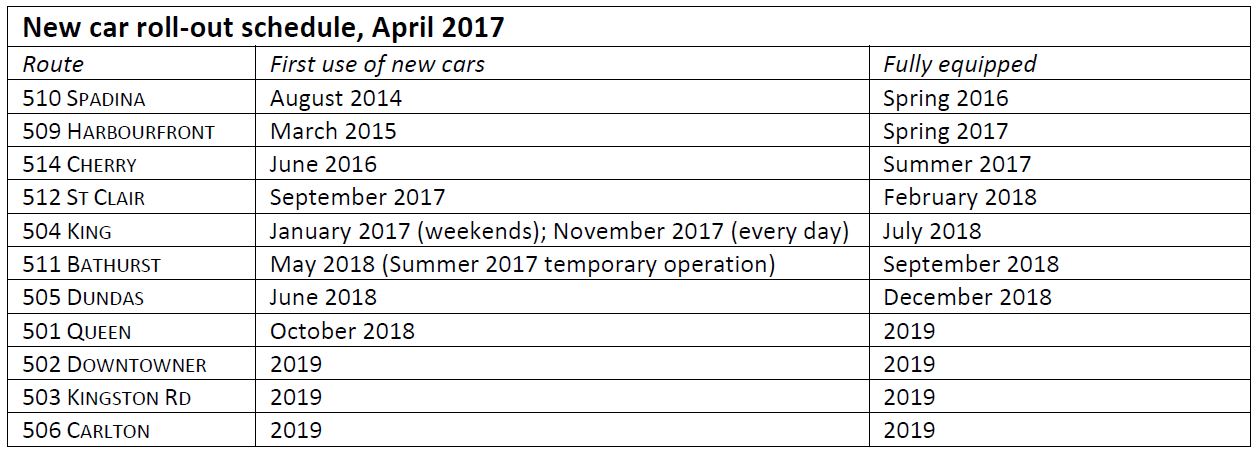
The 514 Cherry streetcar route begins operation running via a short spur south from King to Distillery Loop. Initially this will run with a mix of Flexities and CLRVs pending an increase in the fleet of new cars. Eventually track on Cherry will extend under the rail corridor and south into the Port Lands, but that is a project still years away and subject to the usual wrangling at Council about capital spending priorities.

In the 2016 Budget, the TTC Board and Council chose not to fund the new service with additional money, and so this operation will be implemented by cutting service on the outer ends of the 504 King route. Peak service will operate every 8-9 minutes, and off-peak periods, the line will operate on a 15 minute headway with five cars. A blended service on King is impractical given the large difference in frequencies between the 514 and 504 routes. Whether the Cherry cars actually pull out onto King into gaps and carry passengers, or merely slip in behind King cars and let them do the work remains to be seen.

The 172 Cherry Street bus has been replaced by an extended 72 Pape over a new route serving Queen Quay East, and by a new 121 Fort York – Esplanade bus that will operate on, at most, 15 minute headways, a considerable improvement over the former 172 Cherry.

Sunday Stops

The TTC continues its program to remove Sunday Stops from the system with removal of stops at the following locations.

20160619SundayStops

Streetcars Return due to Bus Shortage

With the onset of construction season, and despite the summer service cuts, several streetcar routes will be partly or completely replaced by buses: 512 St. Clair, 511 Bathurst, 506 Carlton. This will be offset by the return of streetcar service to the 502 Downtowner and 503 Kingston Road Tripper lines, as well as full streetcar service on 504 King with no bus trippers. Service will likely revert to combined streetcar/bus operation in September thanks to the late deliveries of new Flexity streetcars by Bombardier.

Construction Work on College Street

Several projects on College Street West have been timed to occur over the summer of 2016.

  • Special track work replacement at Bathurst and at Lansdowne
  • Removal of safety islands at Bathurst eastbound and at Bay Street both ways
  • Expansion of the safety island westbound at Bathurst
  • Water main upgrades on College and on Lansdowne
  • Streetscape improvements on College

The effects of these will be:

  • 506 Carlton will operate with buses in the west and streetcars in the east on weekdays, and with buses over the entire route on weekends. The weekday services will overlap between Church and Bay. This will continue throughout the summer.
  • 47 Lansdowne will divert around the construction area via Dufferin Street.
  • 511 Bathurst will be operated by buses until the next schedule change at the end of July diverting around construction via Spadina between Harbord and Dundas.
  • The 509/511 bus shuttle on Fleet Street will be replaced by the 511 bus service.

Details of the service diversions are in a separate article.

When streetcar service returns to Bathurst Street, the cars will operate into Exhibition Loop so that through service is provided until the Labour Day weekend. In September/October, service will be cut back again to Fleet Loop for a track replacement project in Exhibition Loop.

St. Clair Construction

Major construction work at St. Clair and St. Clair West Stations will require removal of streetcar service over the summer and early fall. The approach ramps at St. Clair West were not rebuilt during the line’s reconstruction, and the track must be replaced. The entire 512 route will be operated with buses through the summer, and streetcars will return from St. Clair West to Keele in September. Full streetcar service will resume on the Thanksgiving weekend in October.

Buses will not be able to enter either station during this project. At St. Clair Station, all bus service will loop on street via Avoca, Pleasant Boulevard, Yonge and St. Clair with transfer connections at the Pleasant Boulevard entrance. At St. Clair West Station, the 90 Vaughan bus will be extended south to Bathurst Station, and routes 33 Forest Hill and 126 Christie will be interlined. All buses will make an on street transfer connection at St. Clair West.

Broadview Station Construction

The bus loop at Broadview Station will be rebuilt over the summer and all bus services will loop on street via Erindale, Ellerbeck, Danforth and Broadview using an on street transfer. Given the frequent congestion of streetcars on Broadview awaiting entry to the station, the bus service will add to the congestion at Danforth northbound. The arrangement of on street stops for the four bus routes affected here has not yet been announced. Running time has been added to allow for the around-the-block loop except in cases where there was already enough recovery time in the existing schedule.

Updated May 24, 2016: Brad Ross at the TTC has provided the preliminary construction notice for the service and street changes. In addition, the Brick Works shuttle bus which normally loads on Erindale outside of Broadview Station will be relocated to Chester Station.

Bayview Services Reorganized

Peak period frequent service on 11 Bayview now ends at Davisville & Bayview, but this will be extended to Sunnybrook Hospital with every second bus running through to Steeles.

The 28 Bayview South route serving the Brick Works now operates only on weekend daytime hours, but will provide service during all periods.

Victoria Park North

Service in York Region on Victoria Park will now be provided by York Region Transit. The 24D Victoria Park branch to Major Mackenzie will be dropped and all service will turn back at Steeles Avenue. The 224 Victoria Park North route will cease operation.

Richmond Street Construction

All Downtown Express services will divert westbound from Church to Peter while Richmond Street is rebuilt from Victoria to York. Whether there will be any provision to assist the left turns west-to-south at Peter that will block 501 Queen Service (itself forced to divert and turn south at Spadina for water main construction) remains to be seen.

Streetcar Track Construction Update: Spring 2016 (Update 2))

Several projects sprang up with the warm weather in Toronto, and more are to come.

Updated May 13, 2016: Details of diversions and replacement services for College Street projects have been added to the end of this article.

Updated May 13, 2016 at 3:00 pm: Details of diversions and replacements updated for 506 Carlton and 512 St. Clair.

First off was the replacement of special work on Charlotte Street at Adelaide and at King including removal of the never-used lead to Adelaide Street eastbound.

Next was the replacement of the southwest ladder track at Roncesvalles Carhouse. Because of the odd shape of the property, this carhouse has many interesting twists and turns in its layout.

A short section of Bay Street south from Elm has been in rough shape with a slow order for a few years. Now the track has been replaced.

Pending work for the construction season includes:

  • Richmond Street tangent track from east of Yonge to York. This is part of an overall reconstruction of the street previously begun by Toronto Water.
  • College at Bathurst (June 20 to July 22) and at Lansdowne (July 11 to 22). This is part of a set of projects affecting College Street described in detail on the City’s website. See below for details of service diversions and bus replacements.
  • A shutdown of 512 St. Clair will be required for the reconstruction at both St. Clair West and St. Clair Stations. This will begin concurrently with the reconstruction of Bathurst & College.

As of May 9, the 501 Queen service is diverting around Toronto Water construction via Spadina, King and Shaw. This will be in place until Thanksgiving weekend unless the work is finished early.

Diversions for College Street Projects (Added May 13, 2016)

Illustrations here are taken from display panels for a public meeting earlier this year.

Through the summer to the Labour Day weekend, the 506 Carlton route will operate with streetcars on the eastern portion of the route looping downtown via Bay, Dundas and McCaul. This route stays the same throughout the period because it is not affected by construction projects further west.

The western end of the route will operate with buses whose location will vary from phase-to-phase of the work. The service will loop east of Yonge Street via Jarvis, Maitland and Church. Note that the section between Dufferin and Lansdowne will be affected by construction work that will take place for some or all of the summer (see later maps below).

Updated May 13 at 3:00 pm: The split service shown below will operate on weekdays. On weekends, buses will provide service over the entire route diverting as necessary between Spadina and Lansdowne.

201606_506Diversion_1_CarltonSplit

While College and Bathurst is under construction, services will be modified as shown below.

The 506 west bus will divert via Spadina, Harbord and Ossington. The 511 Bathurst car will be replaced with buses diverting via Dundas, Spadina and Harbord.

201606_506Diversion_2_CollegeBathurst

During a considerable portion of the project, water main work between Dufferin and Lansdowne will require the 506 west bus to divert via Dufferin and Dundas.

201606_506Diversion_3_DufferinLansdowne

While the intersection of College and Lansdowne is under construction, the 47 Lansdowne bus will divert via Dufferin Street from Bloor to Queen southbound, and will operate northbound via Lansdowne only to Dundas Street, then via Dundas and Dufferin to Bloor.

201606_506Diversion_4_CollegeLansdowne

Updated May 13 at 3:00 pm: 512 St. Clair will be converted to bus operation during construction work at St. Clair West and St. Clair Stations throughout the summer. Buses will serve St. Clair West at on-street stops. During the September-October schedule period, construction work at St. Clair Station will require bus operation from St. Clair West Station to St. Clair Station.

Analysis of 510 Spadina for December-January 2015-6

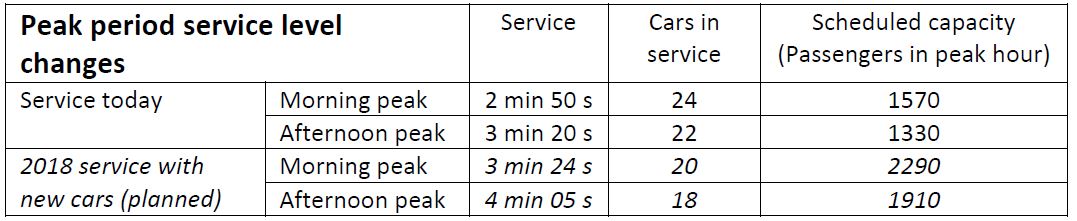
On January 3, 2016, the schedule for route 510 Spadina changed from one based on the use of standard-sized streetcars (the CLRVs) to the new longer low-floor cars (Flexitys or LFLRVs). This article reviews the operation of the line before and after the new schedule.

The revised service provided an increase in capacity with a replacement ratio of new cars for old on a ratio considerably lower than 2:1, and during periods of infrequent service (early weekend mornings, late evenings), the replacement was 1:1.

510_20151122_ScheduleSummary

510_20160103_ScheduleSummary

In brief, the service actually operated on 510 Spadina bears little resemblance to the advertised schedule. Headways (the time between cars) are erratic and often wider than the scheduled values for both the “old” and “new” service designs. The proportion of service operated to the three destinations (King, Queens Quay and Union Station) do not always match the schedule, and indeed during January (when only two destinations are supposed to be in use at any time), service to all three persists just as in December.

However, padding the schedule, a tactic used on other routes to eliminate the need for short turns, is impractical here because terminal congestion with queued vehicles would severely interfere both with passenger travel times and with terminal operations. Unlike a route such as 501 Queen where most riders depart from vehicles before the terminal, 510 Spadina has very strong demand to its destinations at subway stations.

Line management consists of dispatching cars and operators as available, and the service levels on each branch do not match the actual design, notably the proportion of service that should operate on each section of the route. This particularly affects riders south of King and on Queens Quay whose service is erratic and below the advertised level even though the area has a large and growing population.

Continue reading