With the shutdown of Queen Street for Ontario Line construction between Victoria and Bay, we will not see streetcars there for many years. The last cars will run just before midnight on April 30, 2023.
Until early 2024, the absence will be over a longer stretch from Broadview to McCaul until new diversion track via York and Adelaide is finished. In turn, that depends on relocating nine utility vaults under the new Adelaide trackage.
It is possible that the TTC will revise the diversion pattern once the Don Bridge reopens to streetcars later in 2023 (it will close for maintenance on May 7), but nothing has been decided yet.
Here are photos of various generations of streetcars on the central section of Queen as a memento while we await their return.
Note that this is a large gallery, and it will take a while to load after you first click on a photo.
Updated June 13, 2023 at 2:50pm: The proposed expansion of Broadview Station Loop has been deferred to an unspecified date. Street trackage at the loop will be replaced this year as planned. The planned removal of most bus service from Broadview Station will not occur. Routes 8 Broadview and 62 Mortimer will continue to serve the station. Route 100 Flemingdon Park will be rerouted to Pape Station where it will interline with 72A Pape to King and Parliament.
Other changes have been made in future plans and this article should be used only for historical reference to the original plans. See also:
No. This is not supposed to be an early April Fool’s joke.
TTC Customer Service has announced that the 504 King streetcar service western terminus will change on April 1 to its regularly scheduled location at Dufferin Loop. At the same time, the 29/929 Dufferin buses will also return to that loop.
Looking at tracking data (thanks to TransSee), it appears that some but not all 329 Night buses have already resumed their normal route south on Dufferin into Exhibition Place.
Currently, King cars loop from Queen south via Shaw to King, west to Dufferin and north to Queen without serving Dufferin Loop. In the revised routing, cars will operate both ways via Shaw, King and Dufferin to Dufferin Loop as shown below.
Because these are the routes published in the electronic version of schedules (GTFS), tracking apps should correctly predict behaviour of streetcars and buses in this area.
The TTC and City of Toronto have announced that Roncesvalles Avenue will reopen to traffic including the 504C King bus with the beginning of service on Tuesday, March 14.
Work is still in progress to adapt the passenger islands on Roncesvalles for the Flexity ramps, but traffic will swerve around work as it proceeds. Why this wasn’t done sometime in past months is one of those mysteries of construction staging.
Streetcar service on the 504 to Dundas West Station will resume in May, although an exact date has not been announced.
Meanwhile, the 504A Distillery and 504B Broadview Station services will turn back at Bathurst using Exhibition and Wolseley Loops respectively, although many cars in fact only get as far as Spadina and loop back via Charlotte Street. The 504C King bus loops via Church, Wellington and York.
Coming in May will be the removal of streetcar service on Broadview north of Gerrard for track construction, and for the redesign of Broadview Station Loop so that both the King and Dundas platforms will be able to hold two cars at once. Currently there is room for only one car on the Dundas platform.
Streetcar service on the west end of the Queen route beyond Sunnyside Loop is expected to resume in the summer, but again there is no specific date announced for this.
This article is a companion to Red Lanes for Jane Street? with a review of the behaviour of local and express service both in travel time and in headway reliability. The area covered is that of the proposed RapidTO Red Lane implementation between Eglinton and Steeles, and the time period is late 2019 to February 2023.
This is a long read with many charts. My intent is to establish how the route operated over the past three years with a detailed look at recent data. This will provide a base level to compare with any changes when and if transit priority measures are implemented. More importantly, the data show how headway reliability, the uneven and unpredictable spacing of buses, is a severe problem contributing at least as much variation in total travel times as the in-vehicle portion of a rider’s experience.
The high points are:
Travel times:
Travel times on Jane between Eglinton and Steeles dropped by about 10 minutes in peak periods at the beginning of the covid pandemic in 2020, and by lesser amounts at other times. That saving gradually disappeared over three years and travel times grew beyond pre-pandemic levels thanks to construction projects on the route most recently in the second half of 2022.
The covid drop likely represents the greatest saving possible through red lanes that would eliminate or at least reduce traffic delays to transit.
Buses on the 935 Jane Express take about 5 minutes less to make the trip than the 35 Jane locals, but the amount varies day-to-day and during different time periods with the greatest saving during the pm peak and the smallest during the early evening.
Headways:
The median values of headways generally lie near the scheduled service level for 35 Jane local service indicating that most trips do operate. This is not true for 935 Jane express where the statistics indicate that, especially in the afternoon and pm peak, service is very erratic and some of the service does not operate.
During some periods, the 85th percentile of headways is very high, especially for the 935 express, showing that riders can encounter long waits for their bus to appear.
Service leaving terminals is not well spaced with pairs, or worse, departing together particularly later in the day. As buses progress along the route, gaps become wider and bunching tightens up, a common behaviour on transit routes.
Examples of service details in February 2023 show a generally laissez-faire approach to service management with little intervention to regulate bus spacing and break up bunching.
The TTC and City of Toronto work on the RapidTO proposal for Jane Street has reached the public consultation stage. There will be an online session on Wednesday, March 8, 2023 from 6-8 pm, and in person Drop Ins on March 22 and 28. Details are on the City’s RapidTO page for the project.
The proposed area for transit priority lies between Eglinton and Steeles Avenues with varying degrees of transit separation.
Options For Discussion
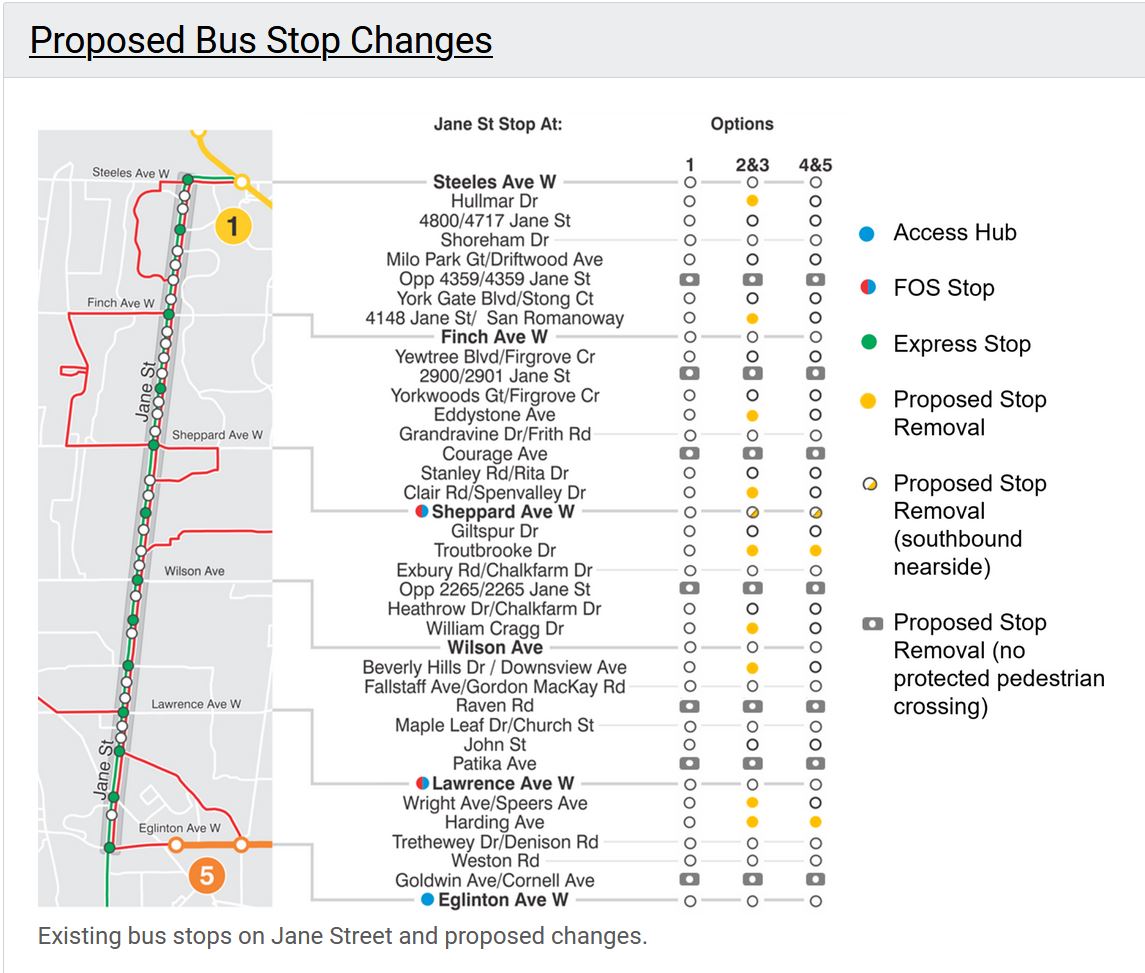
Stop Removals
As with the Eglinton-Kingston-Morningside RapidTO lanes, the Jane Street proposal includes the removal of some bus stops in the name of speeding transit.
The TTC proposes removal of 7 of 38 stops (18%) even if no transit priority is implemented. For options 2 and 3 which provide a relatively high level of priority, there would be a total of 16 stops (42%) removed. For options 4 and 5 which provide a lesser degree of priority, 9 stops (24%) would be removed.
Of the 38 stops, 13 are shared by the local and express services and they are not affected. This means that there are 25 local stops, of which Options 2 and 3 would remove 16, or two-thirds of these stops.
The premise for the Option 1 locations is that these have no crossing protection and, therefore, create a risk for jaywalking pedestrians. The additional stop removals for Options 2 and 3 are justified as “optimizing” the spacing. The proposal changes the route substantially to the spacing of express stops.
The unanswered question is why these stops exist in the first place, and what local traffic pattern to they support. Should the change be to improve pedestrian protection and access rather than simply telling riders they must walk further to reach their bus?
Another important question here is how much of the supposed benefit of the project will be gained from stop removal as opposed to provision of an all-day reserved lane for transit. The TTC touts the travel time saving through transit priority, but does not net this out against increased walking distance to and from stops.
The City’s page includes maps showing the changes in the 4-minute walking distance catchment areas for transit stops. They do not include information about stop usage, population density or the effect on major traffic generators such as schools.
Revised Lane Allocation
Jane Street is different from the Scarborough RapidTO implementation in important ways:
Part of the Scarborough RapidTO area already had reserved bus lanes in peak periods.
Eglinton Avenue and Kingston Road are six lanes wide plus a median/left turn lane in places. Jane is generally a four-lane street with a shared left turn lane.
Here is the typical existing layout.
Options 2 and 3 reserve the curb lane for transit as well for vehicles turning onto and off of Jane Street.
Option 4 assigns the curb lane for high occupancy vehicles, and Option 5 leaves the street as is with selected widening for queue jump lanes where right turns delay traffic today.
How well any of this will be enforced is anyone’s guess, and the situation on King Street does not inspire confidence.
Travel Time Changes
The anticipated changes in travel time are summarized in the table below. Note that these are for trip over the full distance between Steeles and Eglinton.
The change in stop access times is averaged over the entire route. This dilutes the effect on riders at specific stops by including many riders whose access distance is unaffected. This understates the impact on those who are directly affected. (Note that at an assumed walking speed of 1m/sec the change in distance is equivalent to the change in walking time in seconds.)
The TTC has beaten the transit priority drum for queue jump lanes for years, with only a few examples to show for their efforts. In this case, the provision of such lanes is by far the most expensive option, the longest to implement because of road reconstruction, and the least beneficial to riders. This is really a tactic that should be reserved for key areas with very high transit vehicle congestion where there is very frequent service and a clear payback.
Option 1
Option 2
Option 3
Option 4
Option 5
Change in bus travel times (mins)
0
-5
-4
-2 to -3
-2
Average change in stop access (m)
None
+55
+55
+45
+44
Change in auto travel times (mins)
0
+3 to +4
+2 to +3
+2 to +3
Minimal
Estimated Cost ($m)
N/A
$4.7
$3.9
$2.5
$10.7
Time to Implement (years)
N/A
1 to 2
1 to 2
1 to 2
3 to 4
In a separate article, I will review the behaviour of the Jane 35/935 local and express services. A few key points from that review are worth making here:
The variation in headways (time between buses) can substantially exceed the travel time savings shown here. Operation of reliably-spaced service would improve the rider experience today with any priority savings coming as gravy on top. Conversely, if headway reliability is not improved, then the benefits of red lanes will be undermined by erratic service.
The difference in travel time for express and local buses over this section of Jane is comparable to the travel time saving foreseen in Option 2 (full bus priority). It is not clear whether this difference would persist especially in Options 2 and 3 where over 60% of the local stops are removed.
This article is a follow-up to my earlier piece about the TTC’s Rapid Transit Expansion report including the effect of Ontario Line construction on the 501 Queen service.
Updated March 1, 2023:
The reason that track installation on Adelaide, which by itself is relatively straightforward, cannot proceed immediately is that nine Toronto Hydro and Bell vaults must be relocated. Metrolinx opted not to do this work, but the City has taken over.
Streetcars will remain on 501 Queen but will divert both ways via Broadview, Dundas and McCaul from May 2023 to March 2024. A bus shuttle will operate over the central portion of the route.
The list of track construction projects for 2023-24 has been clarified.
Back in December 2021, the City approved a report with a very long list of proposed road closures for Ontario Line construction.
The construction at Queen Station will entail a multi-year diversion of 501 Queen service, and the plan was for streetcars to operate:
Eastbound via York, Adelaide and Church
Westbound via Church, Richmond and York
Track already exists for the westbound route, but new track is required on York and on Adelaide for the eastbound diversion.
Much of this work was supposed to have been completed in 2022, with the intent that the diversion would be available in May 2023. Various factors combined to foul up this schedule.
The contract to install new track on York and on Adelaide east to Victoria was, for some reason, to be a Metrolinx responsibility separate from City work on utility upgrades and relocation. This lengthened the potential timespan with two separate procurements, and inevitable delays as one contractor waited for the the other to finish.
Metrolinx was supposed to build the new track on York Street in 2022. This did not happen. According to a recent City report (about which more below), Metrolinx has been preoccupied with the Ontario Line.
Construction on Adelaide west from York to Spadina was done by the City to restore track inactive for many decades and to provide more flexibility for downtown diversions. This went quickly through the fall, and was performed by Midome Construction who were also working on utilities east of York.
For various reasons, notably discovery of unexpected underground Toronto Hydro and Bell plant, the work east on Adelaide from York did not complete in 2022, although it was substantially finished from York to Bay. Some water main connections were incomplete with pipes blocking the curb lanes, and this complicated traffic and transit diversions around a major sinkhole at King and University.
Until quite recently, if one ignored the incomplete work on the diversion trackage, it was possible to think that the streetcars would simply divert as planned beginning in May. This is obviously not going to happen, and it must have been clear to the TTC for months that the 501 Queen service would have to be modified.
The first hint of this was buried in the report under discussion at today’s (February 28, 2023) TTC Board Meeting.
Metrolinx has identified that the potential delay to complete the streetcar detour work will result in approximately 20 months of shuttle bus service commencing in early May 2023. The TTC is still working closely with Metrolinx and the City on exploring options to optimize the construction schedule of the Adelaide civil and streetcar track construction work to reduce the duration of shuttle bus service.
TTC Transit Network Expansion Update at p. 14
The words “shuttle bus” will send hapless TTC riders screaming from the room. There is a long history, particularly in recent years, of the TTC’s incompetence in operating construction shuttles including changing routes with little or no notice, conflicting information online and at stops, and erratic service with shuttles running in packs and taking long layovers at terminals. This was compounded by the number of planned and unplanned construction projects and the overlapped periods of construction on what should have been distinct route and road closures.
The grand daddy of them all is the King-Queen-Queensway-Roncesvalles project where all manner of delays including pandemic effects on work, unexpected utility relocations, slow work by affected companies such as Toronto Hydro, Bell and others, pushed the completion date out to, with luck, July 2023.
The idea that Queen would see 20 months of shuttle buses before the streetcar diversion would be ready is a testament to fouled up planning. The work should never have been divided between Metrolinx and the City but consolidated as a single contract with a goal of completion as fast as possible.
We now know, courtesy of the Star’s reporting that the delay will be only ten months instead of twenty thanks to the City’s contract consolidation. That’s an improvement, but it should never have been necessary.
For the TTC’s part, this continues a sad tale of communications and consultation foul-ups. The need for shuttles would clearly have been known months ago. How exactly they will operate is totally unknown because the TTC has issued no guidance on this. Will there be shuttles downtown? Over the entire route? Will the route be split to make it more manageable and give different routing options for eastern and western legs?
This should have been a public discussion months ago even if some details were still to be nailed down rather than a surprise landing on already-suffering riders who have dealt with many disruptions on Queen and other routes.
There are several planned track and road construction projects on Queen and King Street in coming years, and I learned recently that several of these have been deferred to reduce overlaps and conflicts. The revised schedule has not been published, and yet this will be essential to any discussion of transit service through the Ontario Line’s construction period. These include:
Scheduled for 2023, but deferred:
King West from Close to Strachan.
Queen East from Parliament to River.
Queen East from Carlaw to Greenwood.
Queen at Degrassi. Revision to streetcar power distribution for Ontario Line. 2023, date TBA.
Scheduled for 2024:
Queen West from O’Hara to Triller. 2024.
Queen East from Davies to Carlaw. 2024 (likely during Metrolinx work at Degrassi underpass).
King West from Strachan to Spadina. 2024.
Bathurst Street from Queen to Front
Scheduled for 2024, but deferred:
King East at Church (intersection).
The City, TTC and Metrolinx owe everyone an apology for this cock-up, and a commitment to resolve conflicting schedules and publish credible plans as soon as possible.
In response to budgetary limitations, the TTC will be modifying service on several routes in two waves of changes. The first will occur on Sunday, March 26 and the second on Sunday, May 6. Details of the second wave are not yet available.
The first wave is detailed in a report to the TTC Board for its meeting of February 28, 2023.
This report shows the changes in headways and service levels on affected routes. It is not as detailed as the Service Memo that will come out just before these schedules are implemented, nor as the Scheduled Service Summary. When the fine details including changes in travel time and vehicle allocations are available, I will publish the usual breakdown.
Updated February 23, 2023 at 9:00am: A table consolidating old and new headways where changes occur has been added. The times in this table is shown in “mm:ss” format rather than in decimal minutes as in the original tables. The new version is at the end of the article.
Updated February 23, 2023 at 10:00pm: The tables in this article have been consolidated for simplicity. All times are now shown in mm’ss” format. The new version is at the end of the article replacing the version that was added earlier.
My apologies for the constant reformatting. With the widespread desire to see what the changes would be, I pushed the original tables out faster than I might otherwise, and my readers got to watch as I tweaked the format. The intent is to have a standard chart that will be used for all future comparisons of service.
Changes of Special Note
Within the list of changes, there are a few worth highlighting:
Subway Services
Service on 2 Bloor-Danforth will improve slightly in the AM peak, but will drop in other periods notably late evenings when trains will operate every 8 rather than every 5 minutes on weekdays.
Service on 4 Sheppard will be cut from 4 trains at all times to 3 with a corresponding widening of headways from 5’30” to 7’20”.
Express Services
Service will be suspended on the following routes and periods:
935 Jane Express weekday evenings
941 Keele Express weekday midday
943 Kennedy Express peak periods
984 Sheppard West Express weekends
In most cases, the local service will not be improved to compensate, and indeed there are local service cuts as well.
501 Queen Streetcar
Weekday service on 501 Queen will be reduced considerably except late evenings.
60/960 Steeles West
The 60C peak period service west of Pioneer Village Station to Kipling will be suspended.
Service Improvements
The 128 Stanley Greene bus was approved by the Board in the 2021 Service Plan, but was not yet implemented. It will begin operation during peak periods on a half-hourly headway.
The 335 Jane Night Bus will operate every 20 minutes rather than half hourly Monday-Friday (which effectively means Tuesday to Saturday).
The 336 Finch West Night Bus will operate every 10 minutes rather than half hourly after 5am Monday-Friday.
These changes are presented in the context of improvements to Neighbourhood Improvement Areas. The same cannot be said for the many service cuts affecting NIAs.
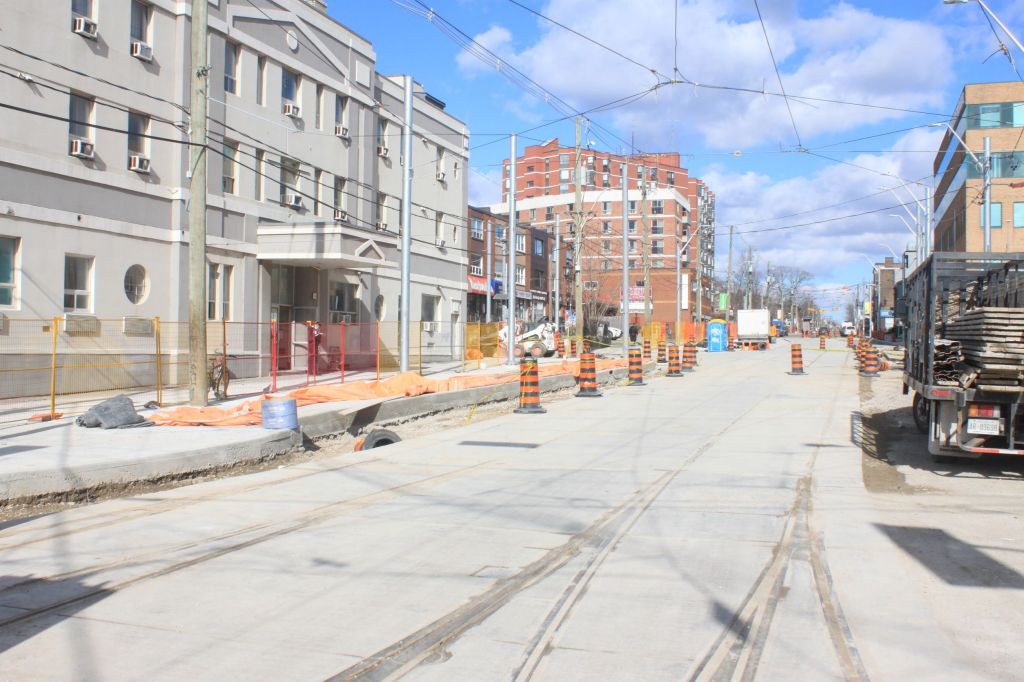
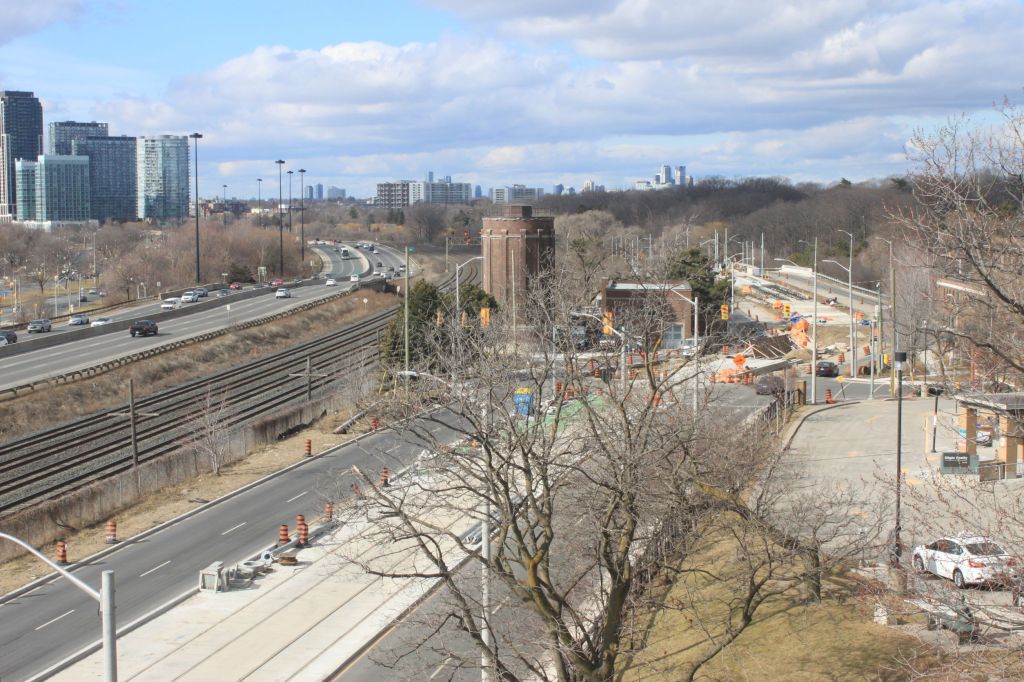
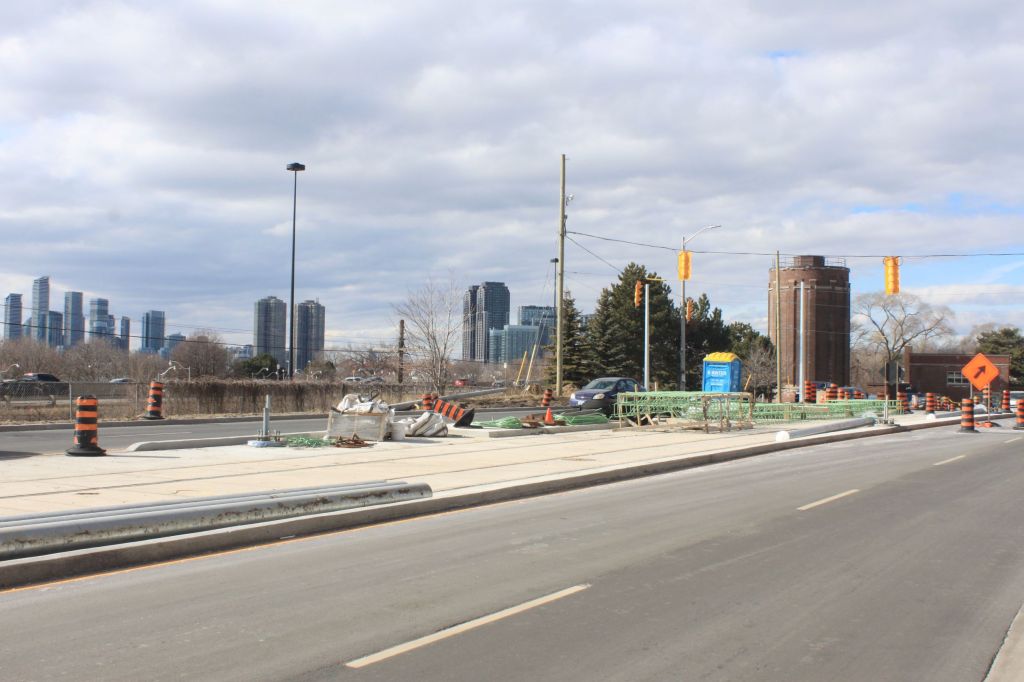
Construction continues on Roncesvalles and on The Queensway. Track work is complete at the intersection, but still in progress between Glendale and Parkside.
According to the latest email update from the city, Roncesvalles Avenue is expected to re-open by mid-March, and streetcar service should resume at the start of May.
After the track and road works on The Queensway are completed, the TTC overhead system must be installed. Streetcar service west of Sunnyside Loop would resume in “the summer”, but with no specific date.
Conversion of overhead on King west from Bathurst to Roncesvalles for pantograph operation is in progress. Segments are in various stages all the way from complete to not yet started with about 50% completion overall. 504 King streetcar service now ends at Bathurst, although many cars turn back at Spadina. 504C King bus service runs between downtown and Dundas West Station via Parkside until Roncesvalles re-opens in March.
The photos below show:
Stop construction southbound on Roncesvalles at The Queesway
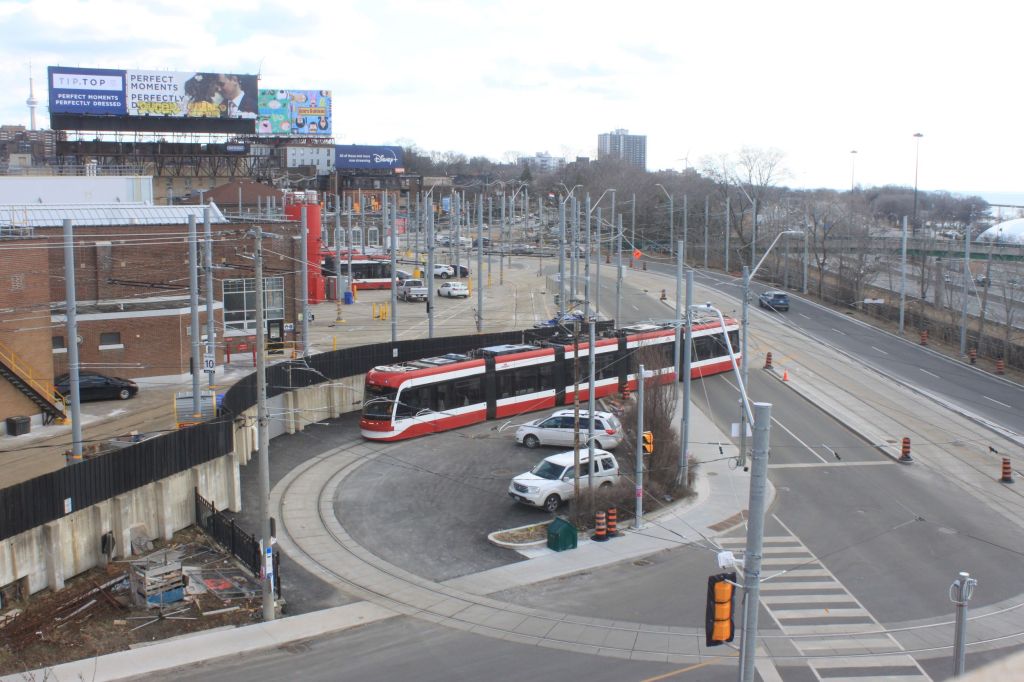
Sunnyside Loop, now the temporary western terminus of 501 Queen service. The intersection at The Queensway and Sunnyside will be signalled, but this is not yet activated.
The Queensway at Glendale (St. Joseph’s Hospital)
Looking north on Roncesvalles from QueenSunnyside LoopLeaving Sunnyside LoopLooking west on The Queensway to GlendaleEastbound stop at GlendaleAll photos by the author taken on Feb. 20, 2023
Service on 501 Queen, 504 King, 29/929 Dufferin and 503 Kingston Road has been affected by two major water/sewer repairs both of which struck over the weekend of January 21-22, 2023.
Updated: The south end loop for the 29 Dufferin local service has been extended into Exhibition Place.
Updated: 501 Queen streetcars are now looping via Sunnyside Loop rather than around Roncesvalles Carhouse.
The intersection of King & University is closed due to a water main break which both undermined the road and flooded St. Andrew Station. The station was closed for a time, but reopened on the afternoon of January 22. The station is not currently accessible due to water damage of escalators and the elevator between the platform and concourse levels.
Dufferin is blocked north of Springhurst (the north side of Dufferin Gate Loop) due to a sewer failure. This affects the 29/929 Dufferin bus routes as well as the 501 Queen streetcar which has been using Dufferin Loop as a western terminus during the King-Queen-Queensway-Roncesvalles project.
501 Queen
The Queen car has been rerouted west to Sunnyside Loop Roncesvalles where it loops using the carhouse runaround track. Sunnyside Loop is not yet available as a terminus. (Updated Jan. 25/23)
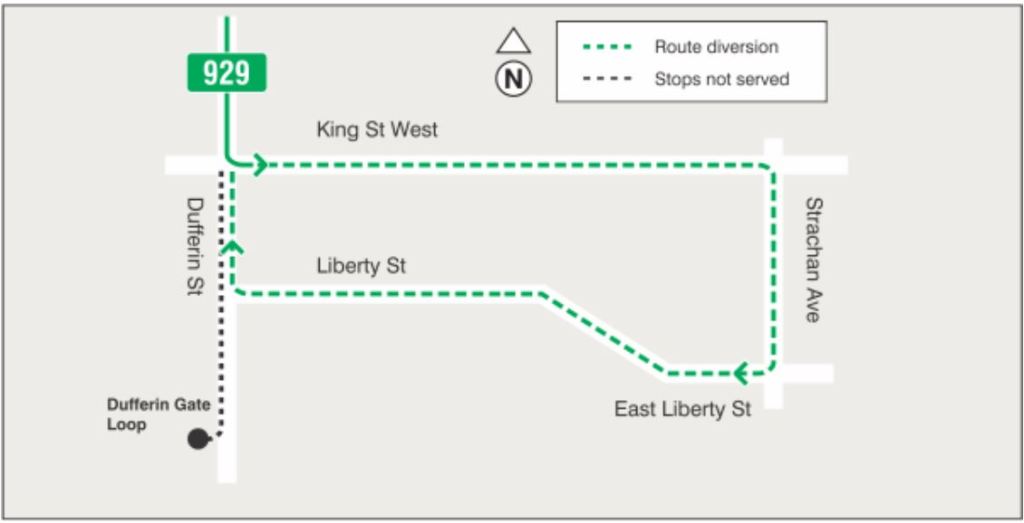
29/929 Dufferin
The Dufferin bus services are making a long loop around Liberty Village instead of running south to Dufferin Loop.
Update: This loop has been revised for the 29 service to include Exhibition Place. Also, although the 929 express service is shown as operating east to Strachan, some buses make a shorter loop and turn south from King closer to Dufferin.
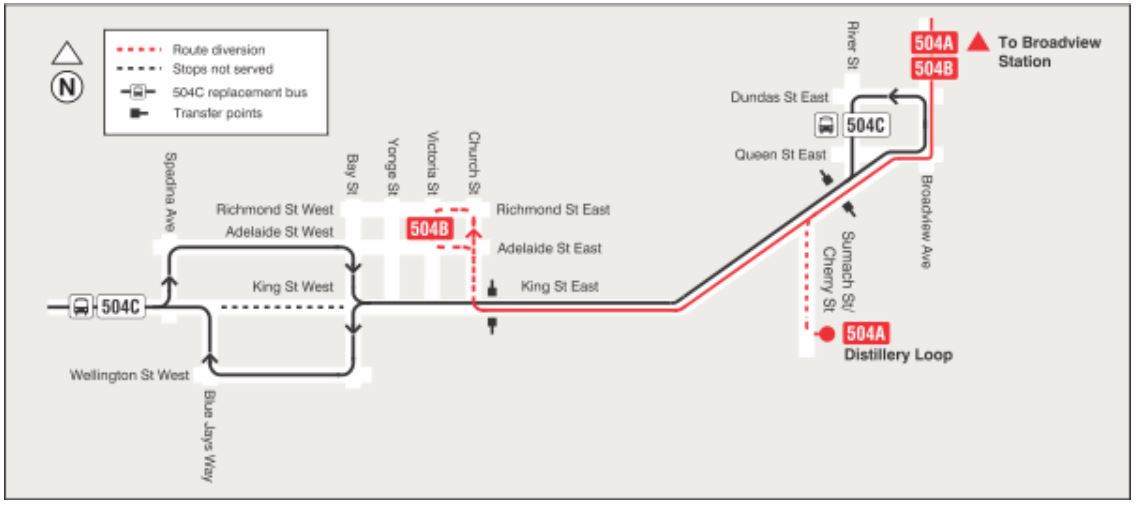
504 King
The King streetcars and buses are operating on a much-modified route due to the closure at University Avenue.
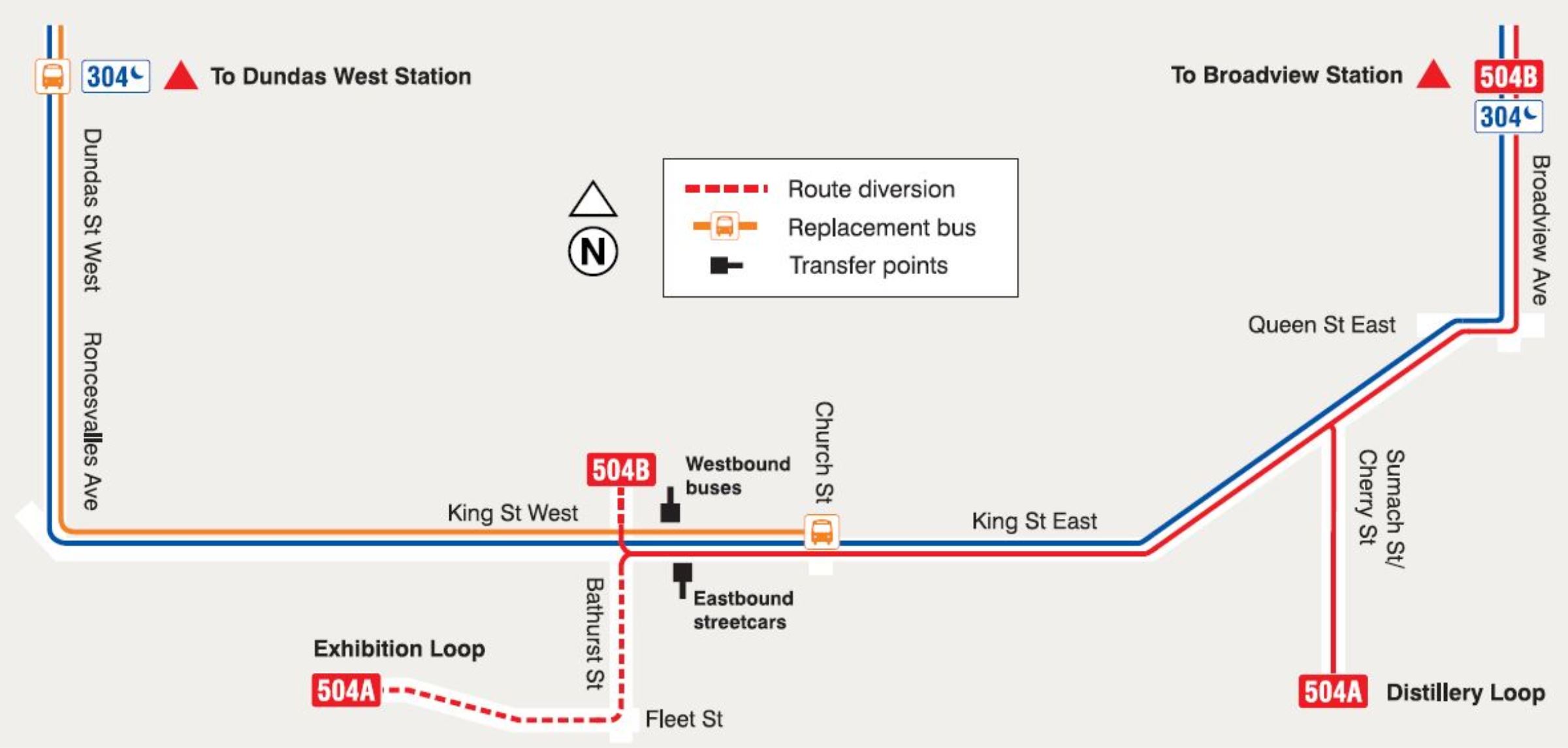
504A cars would normally operate between Dufferin Loop and Distillery Loop. They are running between Broadview Station and Distillery Loop
504B cars would normally operate between Exhibition Loop and Broadview Station Loop. They are running between Broadview Station and Church Street looping as shown below.
504C buses are in theory providing service to River. However, many of these never get east of Bathurst Street (their normal terminus) due to congestion over the diversion route. Parallel service through the construction zone operates eastbound via Adelaide and westbound via Wellington as shown below, and these buses terminate at River Street.
Information in vehicle tracking/prediction apps is rather scrambled because many vehicles are not where they are supposed to be on the schedule, and extra buses operating on the 504C are not tracked at all.
503 Kingston Road
The 503 Kingston Road streetcars are currently operating as buses and their normal loop downtown would be via York, Richmond and University. This has been changed to run via York, Queen and Bay.
There are no firm dates for reopening the streets and resuming normal service at either location.
Apologies for the soft images here. This is what the TTC provides on its site.








 Steve Munro