The City/TTC project to rebuild utilities, track and the roadway on King Street between Dufferin and Shaw Streets has completed earlier than originally planned. The roadway is now open, and TTC will be restoring power to allow testing of its new tracks and overhead.
Streetcar service between Shaw and Roncesvalles on King will resume with the October schedule change on October 6. Affected routes will resume their normal destinations:
501 Queen will operate to Humber Loop.
504B King will operate to Dufferin Loop.
63 Ossington will resume its Liberty Village loop via Atlantic Avenue and King Street. (Although there was a proposal to change this route to use Dufferin Loop as a western terminus in the Service Plan, this is not being implemented.)
This project originally included the reconstruction of the King/Dufferin intersection, but this was deferred to 2025 as part of a planned water main and track replacement project from Dufferin Street west to Close Avenue.
According to the TOInview map of planned construction work, other water main and track projects affecting King Street in 2025 include:
The Church Street intersection
Shaw to Bathurst
Updated September 18, 2024 at 3:40 pm:
The 63 Ossington bus will revert to using Atlantic Avenue, and then King west to Roncesvalles on Monday, September 16 until October 5. From October 6 onward, the Ossington bus will loop east on King to Shaw, its original pre-construction route and streetcars will serve King Street.
Once again the Toronto International Film Festival will disrupt streetcar service downtown. This year, the effect is more severe because of already existing diversions and construction projects.
The TTC’s announcement of diversions is on their News page and on their Updates page in separate postings. The information differs between the two. There is also an announcement in their Service Advisories.
Updated September 5 at 1:20pm:
A map of the 504B service from Distillery to Woodbine Loop has been added to the Service Advisory. This advisory has been updated, but is still incomplete.
The table comparing the three notices has been modified to reflect recent revisions.
Updated September 5 at 7:50am:
The correct layout of King east diversions appears to be on the map in the Updates page which is included below. There are two services operating:
504A between Broadview Station and King & York via Church and Wellington.
504B between Woodbine Loop and Distillery Loop.
Updated September 4 at 10:00pm:
The three announcements are inconsistent, and the “Update” page for 504 King service in the east end does not make sense.
The TTC is setting a new record here for inconsistent public information. Here is a comparison of the claimed services.
Route
News Item
Update
Service Advisory
East of University
503 Kingston Rd
Turns back from York.
Turns back from York.
Turns back from York.
504A King
Turns back from York. No mention of Distillery District service.
See below. Original version was correct, but this was updated to a nonsensical routing.
Turns back from York. Broadview Station reroute not mentioned.
504B King
Broadview Stn to Distillery
Broadview Stn to Distillery
Turn back from York. No special routing mentioned originally, but a map showing the Distillery to Woodbine Loop service has been added.
303 Kingston Road
Not mentioned.
Turns back from York.
Not mentioned originally. Updated to show turnback from York.
304 King
Turns back from York.
Streetcar not mentioned, only shuttle bus.
Turns back from York.
508 Lake Shore
Turns back from York. (Nonsensical)
No service.
Not mentioned.
West of University
504A King/Dundas West
Turns back from Spadina.
Turns back from Spadina.
Turns back from Spadina
504B King/Humber
Turns back from Spadina.
Turns back from Spadina.
Turns back from Spadina.
304 King
Turns back from Spadina.
Streetcar not mentioned, only shuttle bus.
Turns back from Spadina.
303 Kingston Road
Not mentioned.
Not mentioned.
Not mentioned originally. Update implies there is no service west of York.
508 Lake Shore
Turns back from Spadina.
Turns back from Spadina.
Turns back from Spadina.
Diversion periods
Sept 5-8 Sept 9-10 (3:30-9:30pm)
Sept 5-8
Sept 5-8 Sept 9-10 (3:30-9:30pm)
Map
Downtown area only.
Full map but 504 east services do not match text.
Downtown area only.
“Update” notice for 504 east end services:
Original (retrieved from archive.org):
504A King streetcars in the east end of the city will operate between Broadview Station and King and Church streets. Streetcars will then turn south on Church Street, west on Wellington Street, and north on York Street and east on King Street towards Broadview Station.
504B King streetcars in the east end of the city will operate between Broadview Station and Distillery Loop.
Revised version (from ttc.ca):
504A King streetcars in the east end of the city will operate between Broadview Station and Kingston Road and Queen Street East (Woodbine Loop). Streetcars will then turn south on Church Street, west on Wellington Street, and north on York Street and east on King Street towards Broadview Station.
504B King streetcars in the east end of the city will operate between Broadview Station and Distillery Loop.
This is different from the map which showed the 504A running from Broadview Station while the the 504B runs between Woodbine Loop and Distillery Loop. This turned out to be the service actually operated.
From 5am Thursday, September 5 to 5am Monday, September 9:
Service will be broken at University Avenue into east and west halves of routes.
The map below was added to the Service Advisory on the morning of September 5.
The descriptions below have been updated to reflect actual operations on the morning of September 5.
In the east:
503 Kingston Road cars will operate from Bingham Loop to York via Church and Wellington, a cutback from their current terminal at Spadina (Charlotte Loop).
504A King cars will operate from Broadview Station to York via Church and Wellington.
504B King cars will operate from Woodbine Loop to Distillery Loop.
508 Lake Shore cars will not operate east of Spadina.
304 King and 303 Kingston Road night cars will turn back from the east at York.
In the west:
504A King cars will operate between Dundas West Station and Spadina (Charlotte Loop).
504B King cars will operate between Humber loop and Spadina.
508 Lake Shore cars will operate between Long Branch and Spadina.
304 King night cars will operate between Dundas West Station and Spadina.
There is no mention of any 303 service west of York Street.
Shuttle buses:
Replacement bus service will operate between Jarvis and Portland bypassing the TIFF area via University, Richmond (WB) / Adelaide (EB) and Spadina.
303 Kingston Road Night Car
There was no mention in the announcement of the 303 Kingston Road night car in the original TTC notices. It appears that the 303 is running only between Bingham Loop and York Street similar to the 503 daytime service.
I have asked the TTC for clarifications, but they remain silent on the topic.
Monday and Tuesday September 9-10
“Red carpet events” on King Street will require diversions between 3:30 and 9:30pm.
Wednesday to Saturday September 11-24
“Red carpet events” will occur, but are not expected to require diversions. Some service delays are likely.
What About Adelaide/Richmond?
Thanks to the glacial pace of construction on the Ontario Line diversion, an alternate route for streetcar service eastbound via Adelaide around TIFF is not available. Next year we are likely to see Richmond/Adelaide diversions rather than split routes.
Transit Signal Non-Priority
There is no mention in the announcement of signal adjustments, notably eastbound at King & Spadina and westbound at King & Church to support the greatly increased volume of streetcar left turns the 2024 diversions will require. Similarly, there has never been any transit priority for left turns westbound at King & Sumach to support a Broadview Station / Distillery Loop service. A major problem with past TIFF diversions has been queues at turning locations on diversion routes.
This is an example of how the City compounds the traffic issues caused by events such as TIFF with an absence of pro-transit signalling. We have millions to study red lanes and paint streets, but well-known routine diversions must fend for themselves.
The TTC will be making repairs to the track at Church & King, a location that has needed serious tender loving care for some years. This project will run from 11pm Friday July 12 to 4am Wednesday July 17.
This event and the confusion it will add for downtown travellers is a direct result of delays in complete replacement of the intersection, compounded by the Queen Street closure for the Ontario Line and the still-incomplete work on the Richmond/Adelaide diversion around Queen and Yonge that limps along with a vague “fall” completion date.
501/301 Queen:
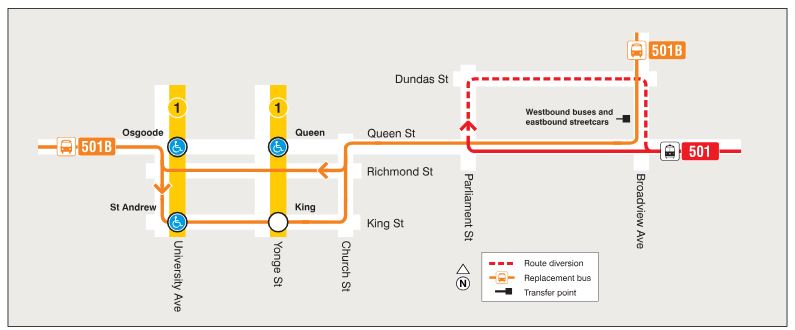
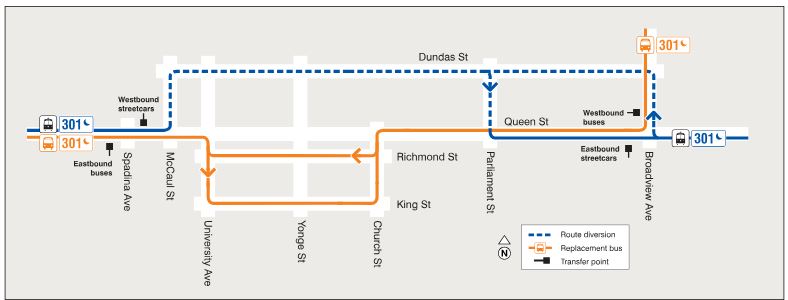
Streetcars in the east end will operate only to Parliament Street and will loop back via Dundas and Broadview.
The 501B shuttle buses will operate westbound via Richmond and eastbound via King between Church and University.
Night service will be provided via streetcars diverting onto Dundas as shown in the map below, and night service on the 301 bus covering the central part of the route on the same path as the 501B daytime service.
503 Kingston Road:
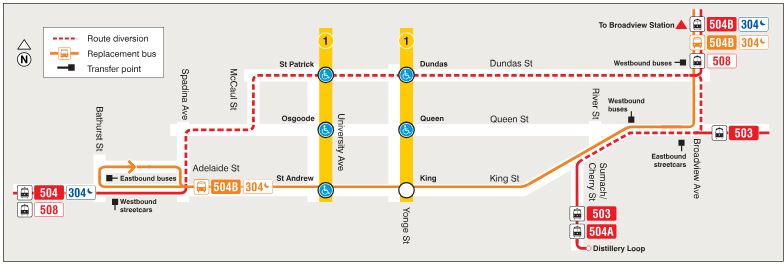
503 Kingston Road cars will operate as far west as King & Sumach, and then turn south to Distillery Loop.
504 King:
504A King Dundas West to Distillery: Cars will divert both ways via Spadina, Queen, McCaul, Dundas, Broadview, Queen, King and Sumach/Cherry to Distillery Loop.
504B King Humber to Broadview Station: Cars will divert on the same route as 504A to Broadview, then run north to Broadview Station.
504 buses will operate from Broadview Station to Bathurst over the regular King route.
508 Lake Shore:
508 Lake Shore cars will divert via the same route as the 504B King cars.
How well any of these services will operate remains to be seen especially the 504A route that will be much longer than normal.
Toronto’s Infrastructure and Environment Committee will consider a report at its May 2, 2024 meeting which updates Council on the status of the King Street corridor.
A notable shortcoming in the report is the absence of a map showing locations of proposed or completed works, and how King Street relates to other nearby sites where roads have limited capacity or are completely blocked.
As previously reported, the City implemented new measures late in 2023 to resolve traffic gridlock at several intersections along the corridor between Bathurst and Jarvis streets. Many overlapping construction projects reduced road capacity and caused severe backlogs on King Street rendering transit service, especially eastbound, almost worthless. Charts later in this article update my previous reports on the situation and how travel times on King have returned to preconstruction levels.
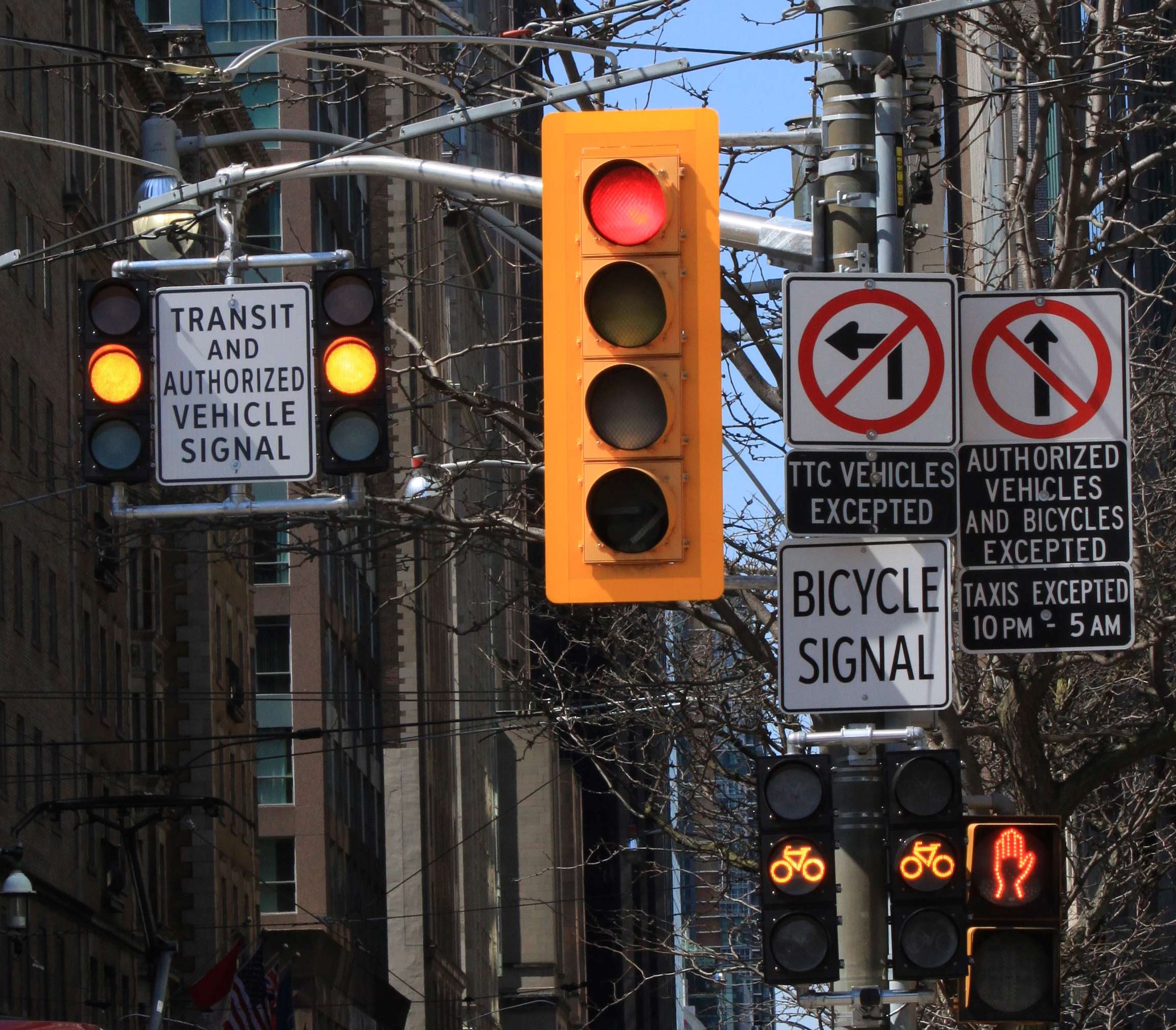
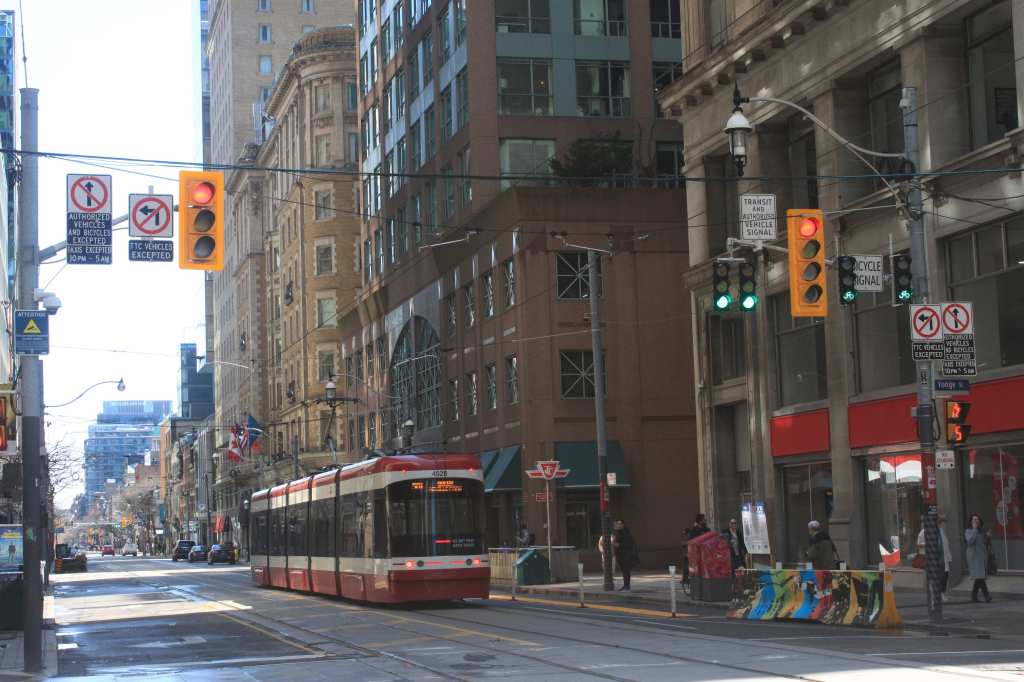
Recently, new traffic signals have been installed at the King/Yonge and King/Church intersections where through movements by most traffic is prohibited. A constant red signal with green arrows for permitted turns is intended to make through movements a “red light running” offense, although the arrangement and signage confuse motorists. The intent is that the arrangement, together with red light traffic cameras, will deter motorists from driving straight through, although it remains to be seen how well this will work.
A complication is that “authorized vehicles” (i.e. licensed taxis) are allowed through between 10pm and 5am, but to the casual observer a car is a car is a car, especially when it is operating for a service like Uber as opposed to a branded taxi with company colours. When traffic agents are present to manage the intersections, motorists go where they are told, but at other times the signals are often ignored. Driving through a full red signal is not a behaviour that should be encouraged, especially out of frustration.
Facing west at King and Church, northwest corner
Travel times across the priority corridor dropped substantially after traffic agents prevented motorists from blocking intersections, and a further improvement is expected when work is complete on parallel streets related mainly to the 501 Queen diversion tracks for Ontario Line construction. Some eastbound traffic now attempting to use King will shift north to Adelaide.
The date for the 501 Queen shift to Richmond/Adelaide is not yet certain. However, track repairs are planned at King & Church in August, and it would make sense to have an alternate streetcar route across the core available by then. Whether it will be is quite another matter.
The effectiveness of these improvements is being monitored and, if successful, Transportation Services is proposing to implement similar changes at other locations along the King Street corridor. It is anticipated that these measures, if successful, may also mitigate the need for Traffic Agents at two or more locations.
Update Report at p. 4
In the short term, there is a budgetary issue because Toronto Police are providing direction and enforcement at some locations. This provides an incentive for technological solutions.
The City intends to purse automated enforcement, but current legislation only allows this for red light running, but not for entering and blocking an intersection because there is no space clear on the far side. “Blocking the box” cannot currently be charged against a vehicle owner, only against a driver. This must change to match red light enforcement where the owner is charged regardless of who is actually driving.
Also under consideration (and subject to the same legislative requirements) are offenses such as blocking bicycle and reserved transit lanes. (Note that there are no reserved transit lanes on King.)
What is painfully clear since the priority corridor was installed is that motorists will do whatever they damn well like unless there is enforcement. Toronto’s laissez-faire attitude undermines whatever bylaws Council might enact.
Since their installation, the curb lane pedestrian areas at stops have deteriorated. After a mid-2023 inspection, 180 missing or badly damaged yellow tactile mats and five bollards were replaced. Other needed work includes basic street cleaning, graffiti removal on barriers, pothole repair and repainting of pavement markings. These are to be addressed in 2024. Another annoyance not mentioned in the report is the relocation of stops without concurrent shifts in transit shelters and benches. The gradual decline of the pedestrian facilities on King tells its own story about the City’s real priorities.
A trial raised platform for passengers was installed at Peter Street and at Portland Street in 2019, although the latter was removed for adjacent construction activity. That platform will be “redeployed” elsewhere. Of the 20 stops along the corridor, some can accommodate platforms without any utility conflicts. Five-to-seven will be installed in fall 2024 (locations not yet named). The remaining stops require co-ordination with utilities for the effect of a platform on their access with the intent of installing these in 2025.
Some mid-block curb extensions for public realm improvements will be designed in 2024 and built in 2025. However, major work to reconfigure King Street is not planned until after 2030, presumably when the Ontario Line is open (or at least substantially complete) and its construction disruptions end. In the meantime, improvements will be made where possible in co-ordination with other construction in the area.
The bylaw governing the corridor will be amended to include the Billy Bishop Airport Shuttle as a service that is permitted to use King Street as a transit vehicle.
Once again, streetcar service in the east end will be disrupted for construction diversions, although this will not be as long lasting as projects in recent years.
Updated April 27, 2024: The diversion for work at the Don Bridge on Queen Street finished early and all streetcar routes returned to their normal routes today.
505 Dundas Late Night Diversion
On Friday, April 19 and Saturday, April 21, service after 11pm on 505 Dundas cars will divert both ways via the Carlton route (College, Carlton, Parliament, Gerrard) between Bay and Broadview. Replacement bus service will cover the missed portion of the streetcar route. This work is for track drain repairs at Mutual Street.
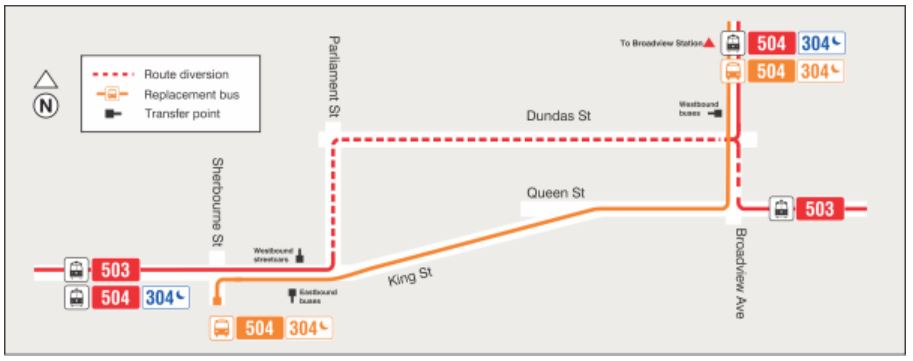
501/503/504/508/301/304 Don Bridge Diversion
From Monday, April 22 at 4am to Monday, April 29 at 4am, all streetcar service will divert via Dundas between Broadview and Parliament to bypass expansion joint replacement on the Queen Street bridge at the Don River. The work finished early and normal routings across the bridge were restored on April 27.
Shuttle bus service will operate on Queen between Carlaw and Sherbourne, and on the King route between Broadview Station and Sherbourne.
As of 7am on April 20, the TTC has posted a Service Change notice for King Street services (503, 504 and 304), but has not yet posted one for 501/301 Queen or 508 Lake Shore although these are also affected. The 501B bus service between Broadview and Bathurst should continue on its normal route. There is also an item on their News page describing this change.
Although not shown on this map, the diversion should not affect the 504A Distillery service.
Expansion joint replacement on this bridge occurs from time to time as this is a high traffic area, and the bridge can be damaged if the joint is in poor condition from vibration of passing streetcars.
The City of Toronto has announced that the planned replacement of track at the intersection of King & Dufferin Streets will not occur in 2024 due to “supply chain issues”. Instead this work will be included in the 2025 construction schedule which already included reconstruction of King from Dufferin to Close.
The intersection replacement was originally planned for June-July with full closure of both streets. That will not happen and routes will stay on their current diversions pending reopening of King Street east of Dufferin. That was planned for year-end, but has now been moved forward to November 2024.
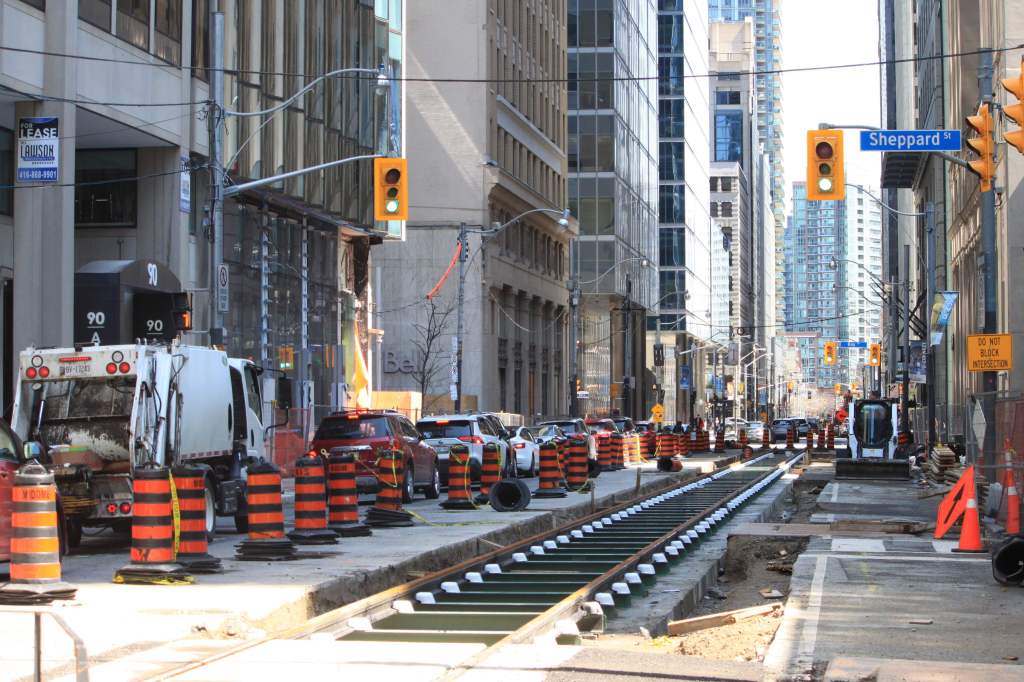
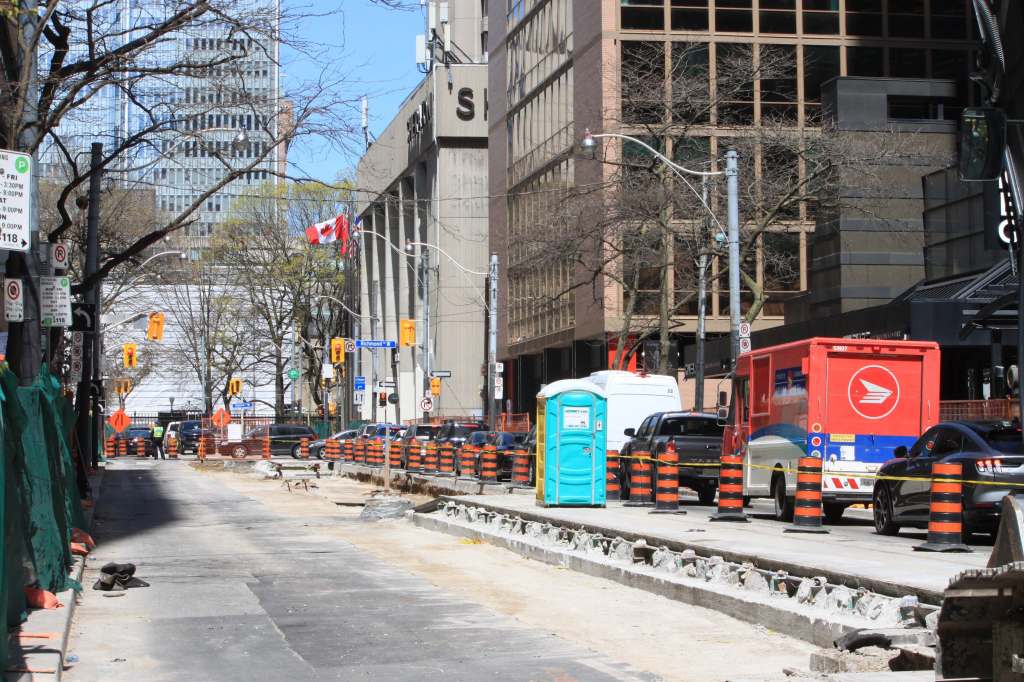
Adelaide Street track almost finished! New traffic signals on King! Almost no work on York Street. And some really appalling track.
All photos in this article were taken by me on April 10 and 14, 2024.
Updated April 17, 2024: Photos showing pavement patching at King & Church added.
Updated April 21, 2024: Photo showing rail gap and pavement patch on westbound rail, west side of the intersection added.
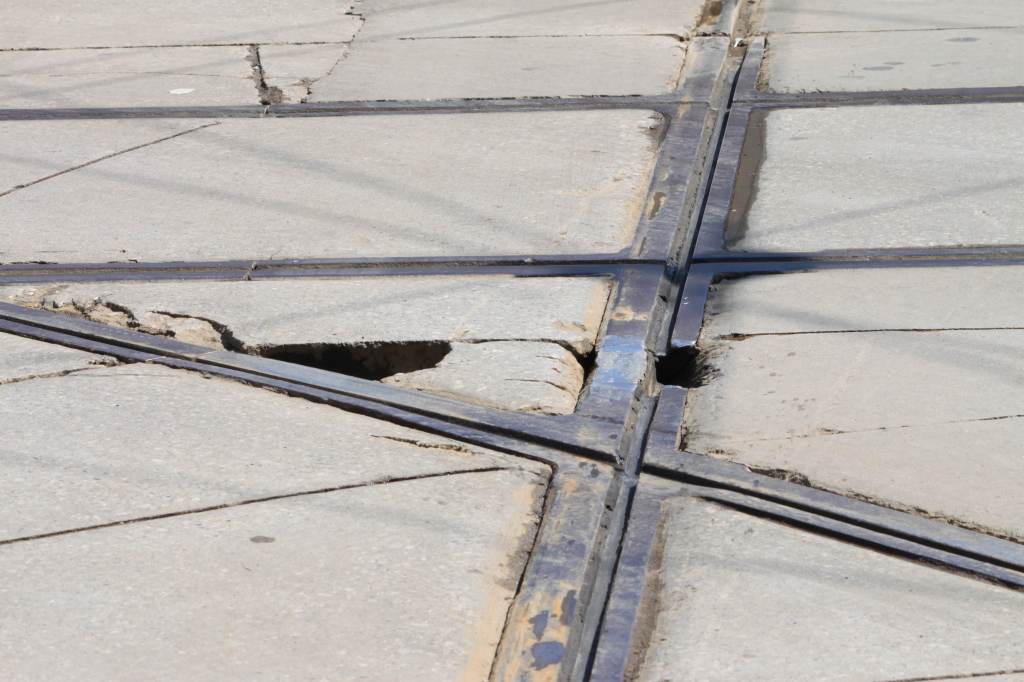
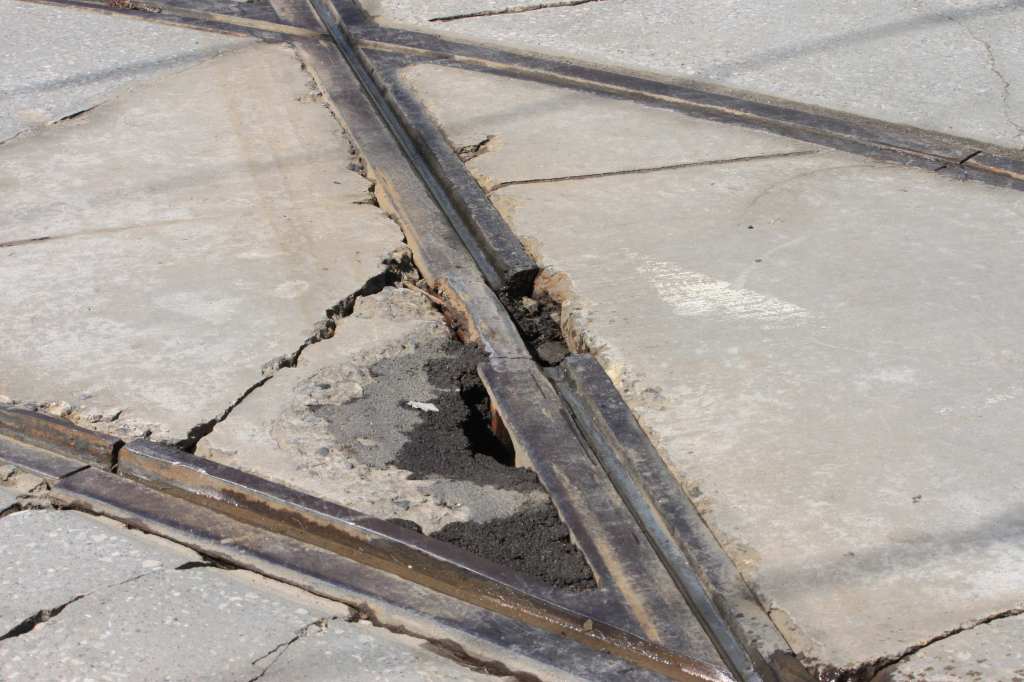
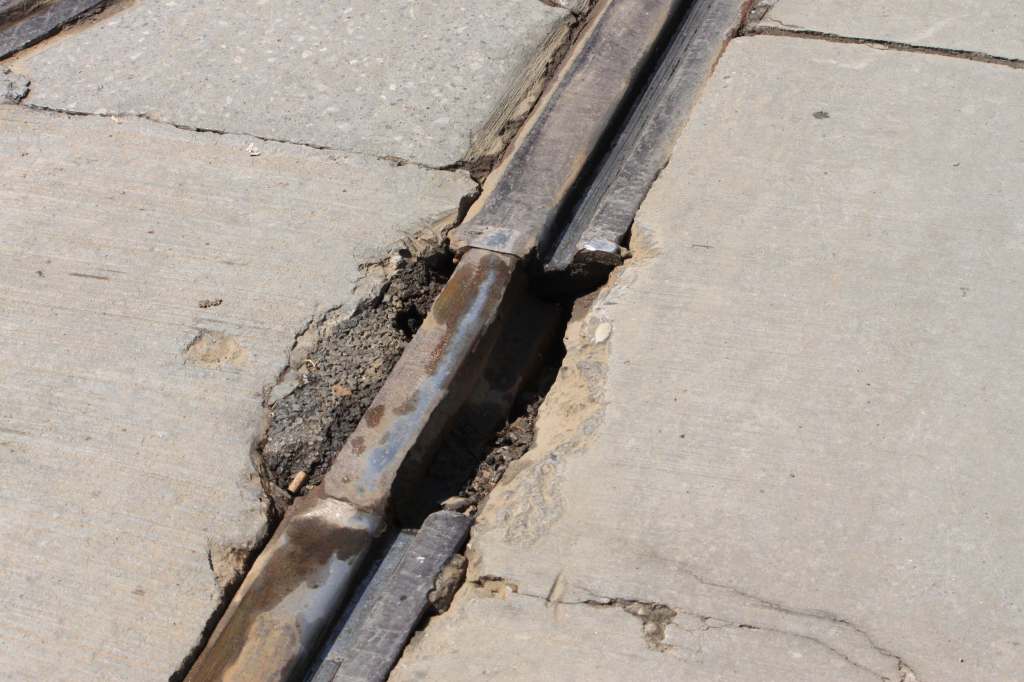
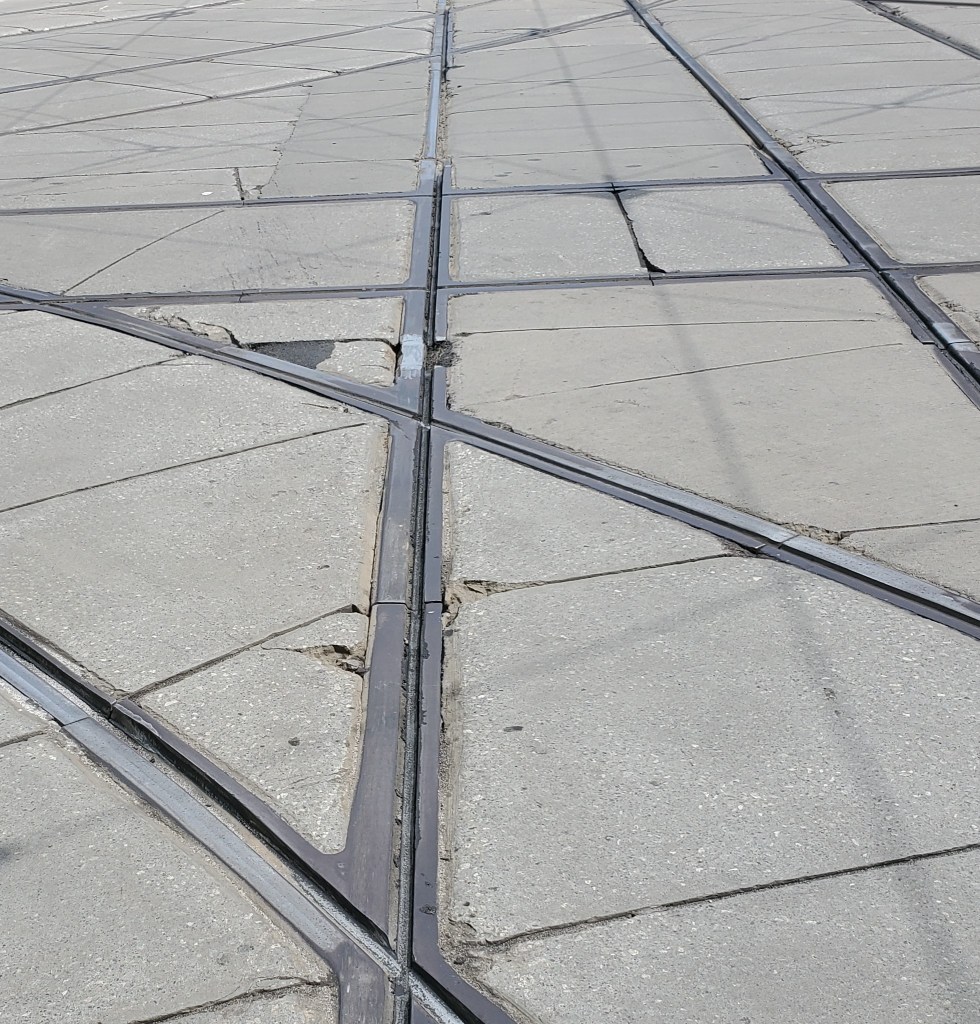
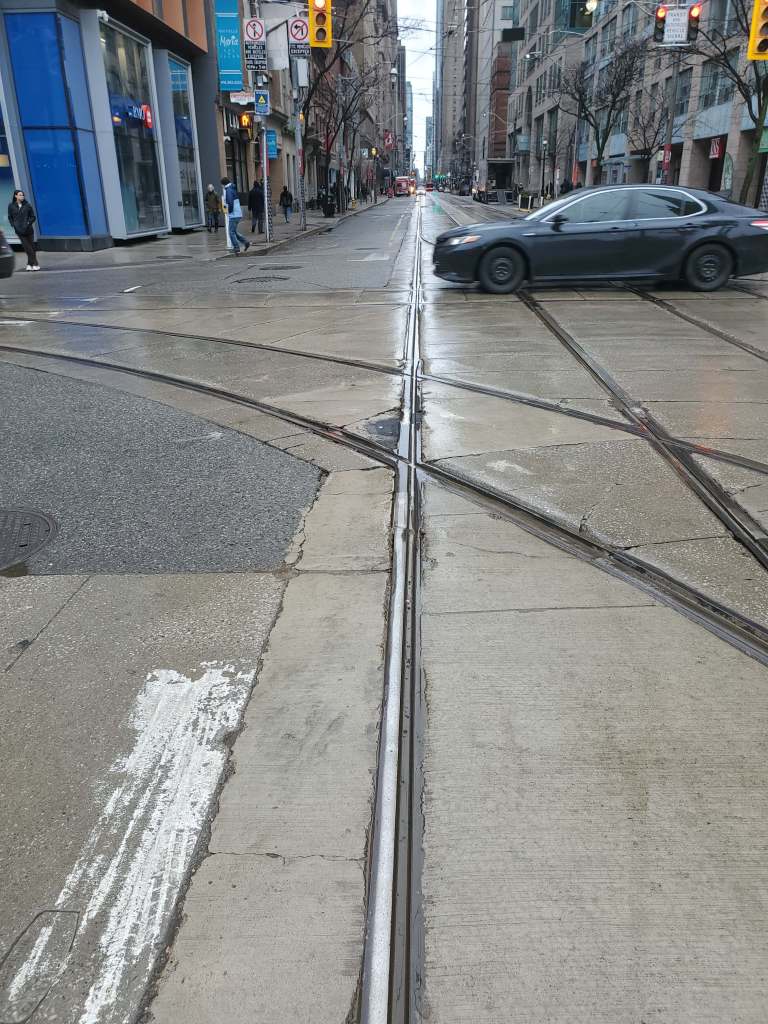
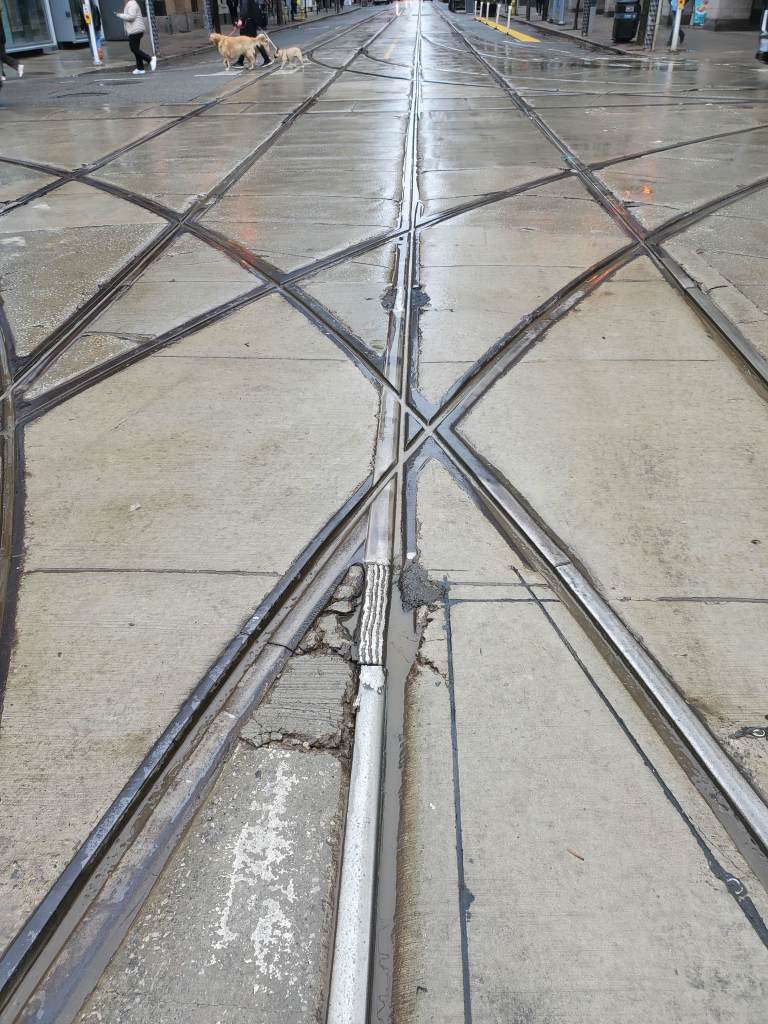
The basic problem with some of the repairs is that they do not necessarily provide a continuous surface for streetcars. The reason for this is that the diamonds are designed to carry cars on their flanges so that the main part of the wheel does not produce the familiar “thunk” where at the crossing of two tracks. Some of the breaks shown here are within the diamond, and the flange way has completely broken off. As streetcars pass, their wheels fall off of the adjacent intact flange way into the gap even though the main rail head is continuous. This is particularly evident on the northerly westbound rail (see photos at the end of the article).
Updated April 26, 2024: Photo of work in progress on York Street south of Richmond added.
Adelaide Street
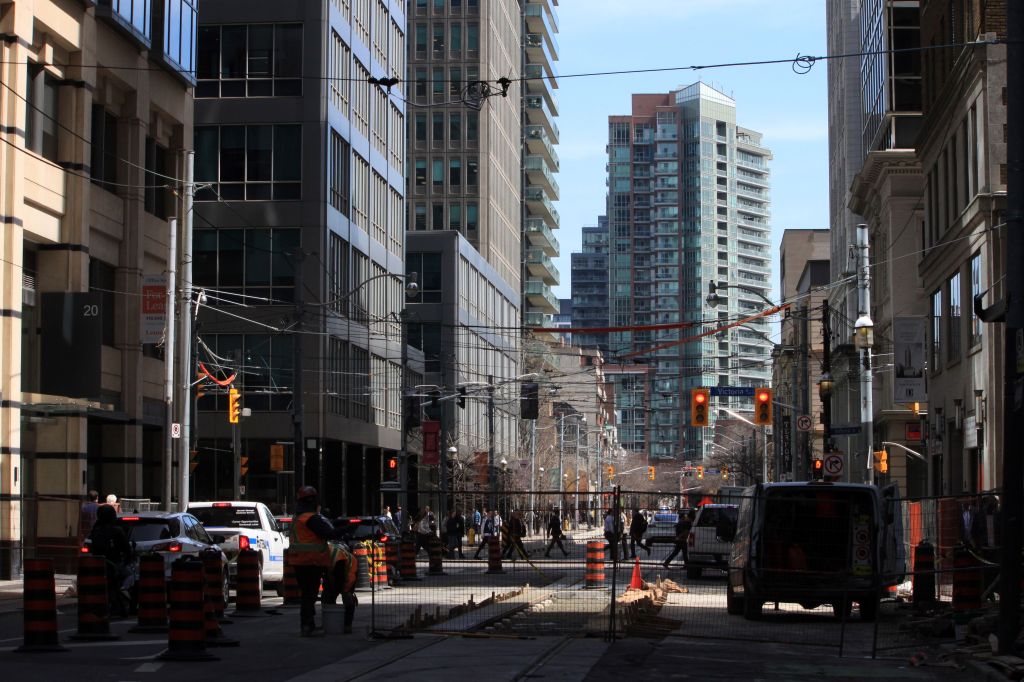
The two remaining chunks of new/replacement track are finally being installed on Adelaide Street, and some work is underway for new overhead. This will be the eastbound 501 Queen diversion for the Ontario Line construction.
Adelaide W from Bay 2024.04.10Adelaide W. to York 2024.04.10Adelaide E. to Victoria 2024.04.10Adelaide E. from Sheppard to Bay 2024.04.14
York Street
Almost nothing has happened with the new track to be installed on York south from Queen. There is a pile of rail on Queen west of York, and some pavement cuts prior to excavation, but that’s all. Metrolinx is not exactly rushing with their part of the project.
Updated April 26, 2024
Excavation for a new trackbed appears to be complete between Richmond and Adelaide Streets.
Looking north from Adelaide toward Richmond on York. Apr. 26/24
King Street Signals
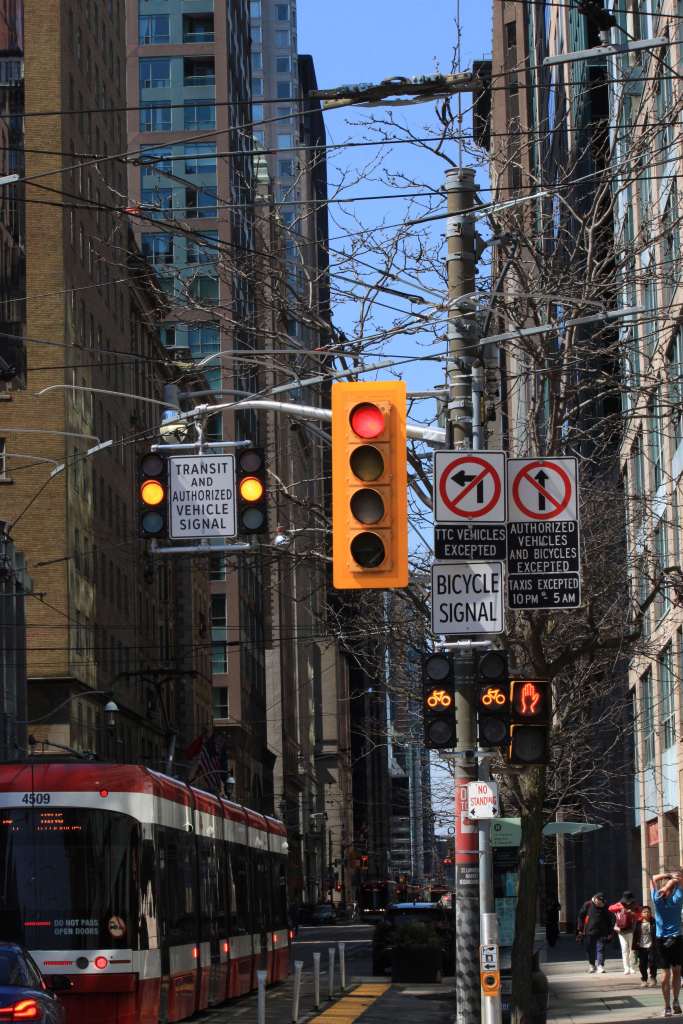
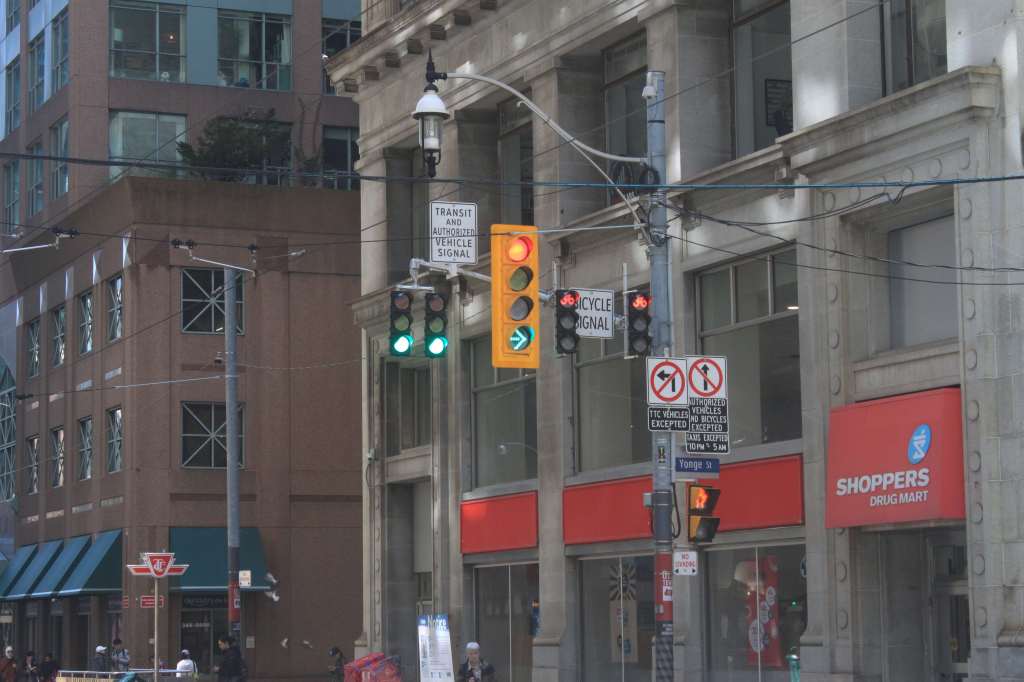
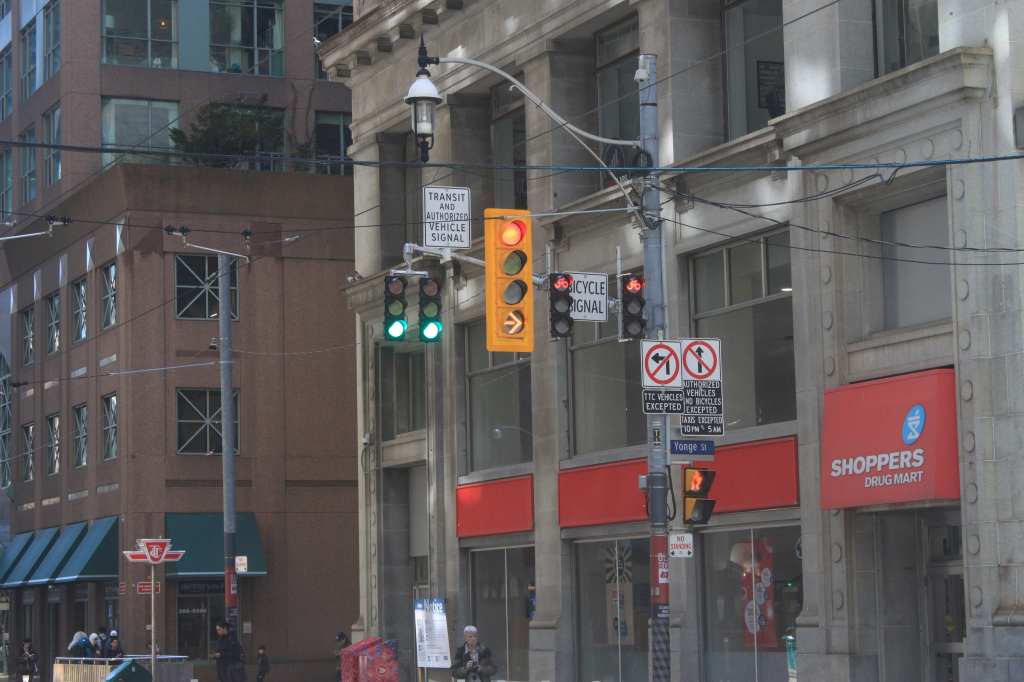
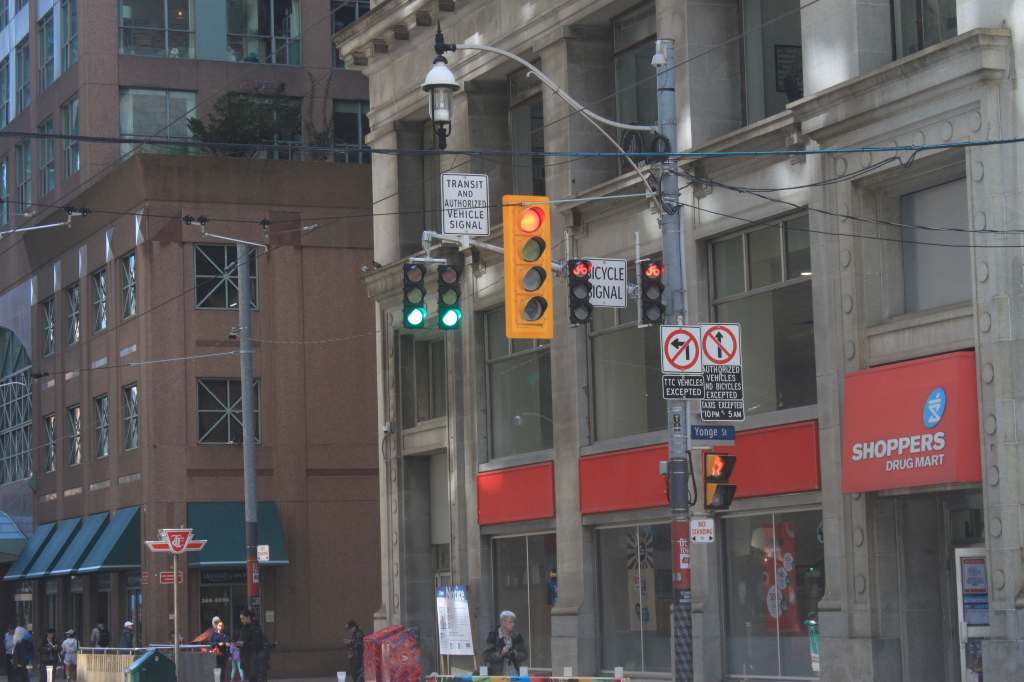
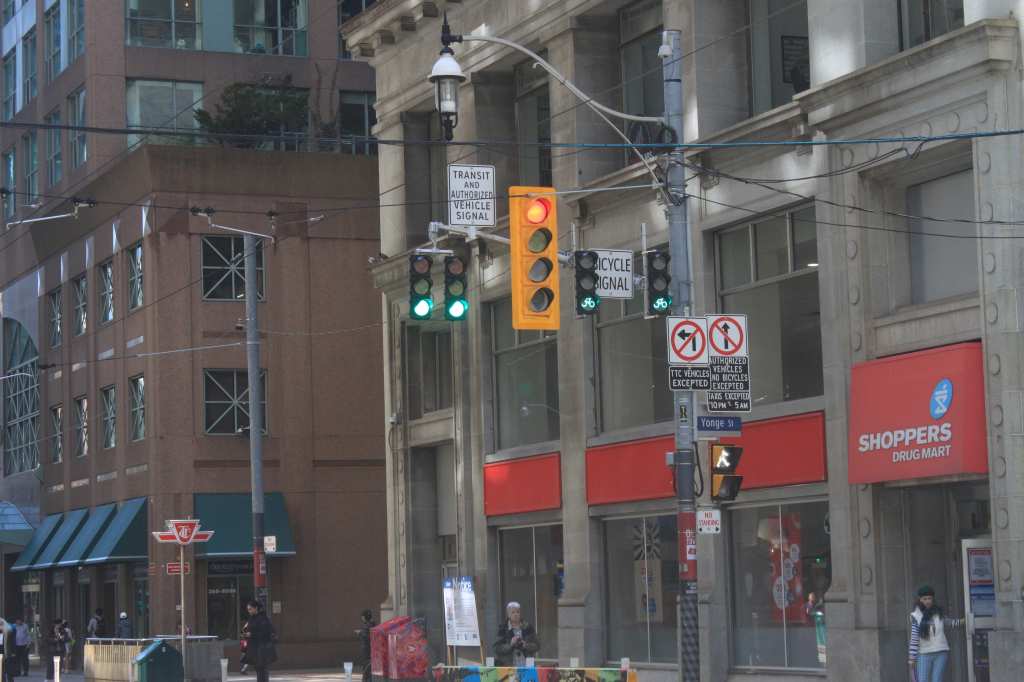
New signals intended to deter straight through auto movements have been activated on King at Church and at Yonge. The intent is to make a straight through movement one that must drive against a solid red signal. If the City ever installs red light cameras, there will be a bonanza in tickets.
The design provides separate signals for pedestrians, cyclists and authorized vehicles (mostly transit, but also taxis from 10pm to 5am). The signage, already complicated, is now more extensive and guaranteed to confuse any motorist. Indeed, during my visit, a 501 Queen bus created a traffic jam waiting for a conventional green signal while ignoring the transit signal.
Here is the collection of signs westbound at King and Church Streets. The signals are in the process of turning red for King, and they show an amber aspect for transit and cyclists.
An important point about signals is that they do not only tell people what they can do (for example, the red hand tells pedestrians not to walk, a green bicycle tells cyclists they can proceed). This gives some hint to everyone of how all traffic is expected to behave.
Nobody knows what an “authorized vehicle” is, and this is especially tricky for unmarked “cabs” like Ubers. If a car drives through a full red signal, is it allowed or not?
The large red aspect on the main signal (with the yellow backboard) never changes, but it will on occasion be joined by a green arrow in the bottom aspect.
Here is the cycle of displays eastbound at King and Yonge as east-west travel gradually opens up.
1. Transit and right turns allowed2. Transit allowed, right turns ending3. Transit allowed4. Transit, cyclists and pedestrians allowed5. Pedestrian cycle counting down. Next comes the amber phase for others.
This confusion shows how important the establishment of simple, clear barriers like a few short transit malls with planters and other physical limitations. Send motorists a clear message: “Don’t even think about driving here.”
All photos taken on April 14, 2024.
King & Church Track
Although the TTC told a good story recently on their subway track maintenance, the situation on the streetcar network is not quiet so rosy. A low point is at the intersection of Church & King, long overdue for complete reconstruction, where there are three separate pavement gaps and ad hoc rail repairs.
Westbound north rail 2024.04.14Eastbound south rail 2024.04.14Westbound south rail 2024.04.14
It is hard to take TTC claims that they value safety highly and repair faults promptly with conditions like this.
Updated April 17 & 21, 2024: The photos below show recently applied pavement patching.
Westbound north rail 2024.04.21Eastbound south rail looking west 2024.04.17Westbound south rail looking west 2024.04.17
For those who have been wondering where my usual wrap-up of coming service changes is, it seems to be stuck in the managerial bowels of the TTC. A few weeks ago I was led to believe that its release was imminent, but as of the evening of February 11, crickets.
There is an online public event on the evening of Thursday, February 15 for which you can register via the City’s site. You can also subscribe to updates on the City’s page (the link is at the bottom).
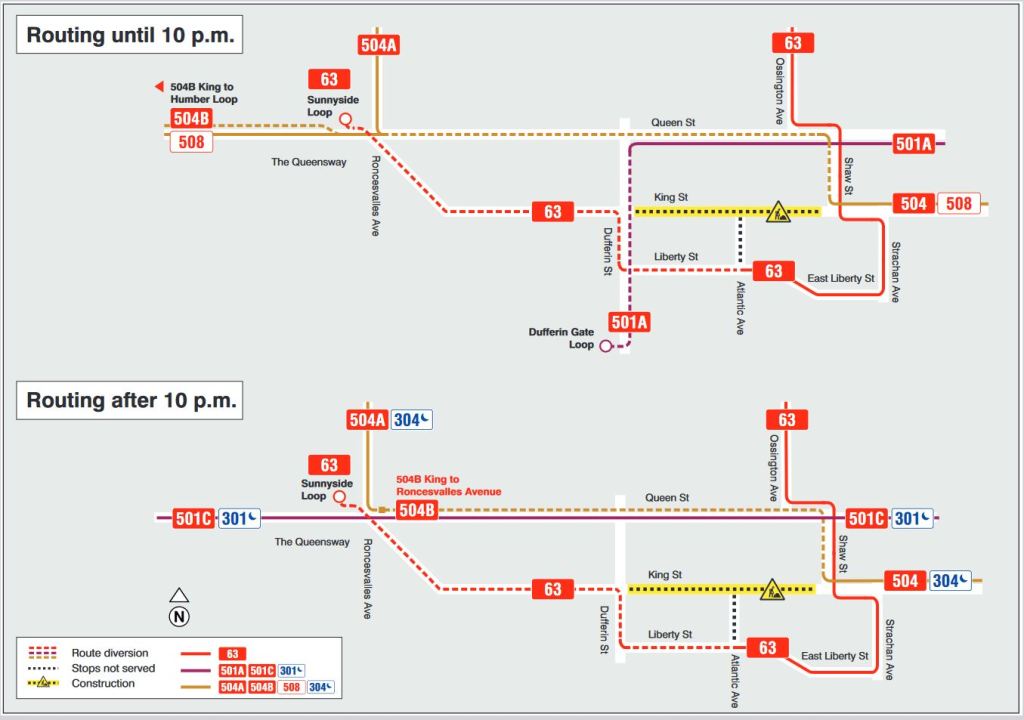
Major changes to routes in the Parkdale and Liberty Village area are coming on February 18, and the details have been posted for a while elsewhere. Time for me to catch up. When the service memo comes out, I will flesh this out with service frequency details. Here is a map showing the wandering routes in the west end.
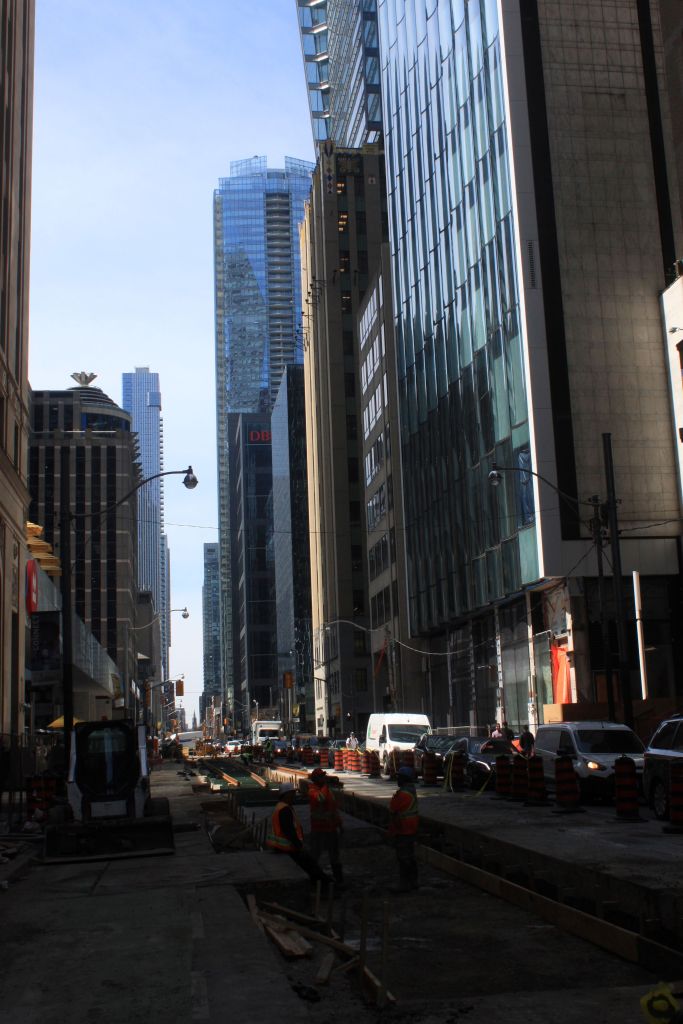
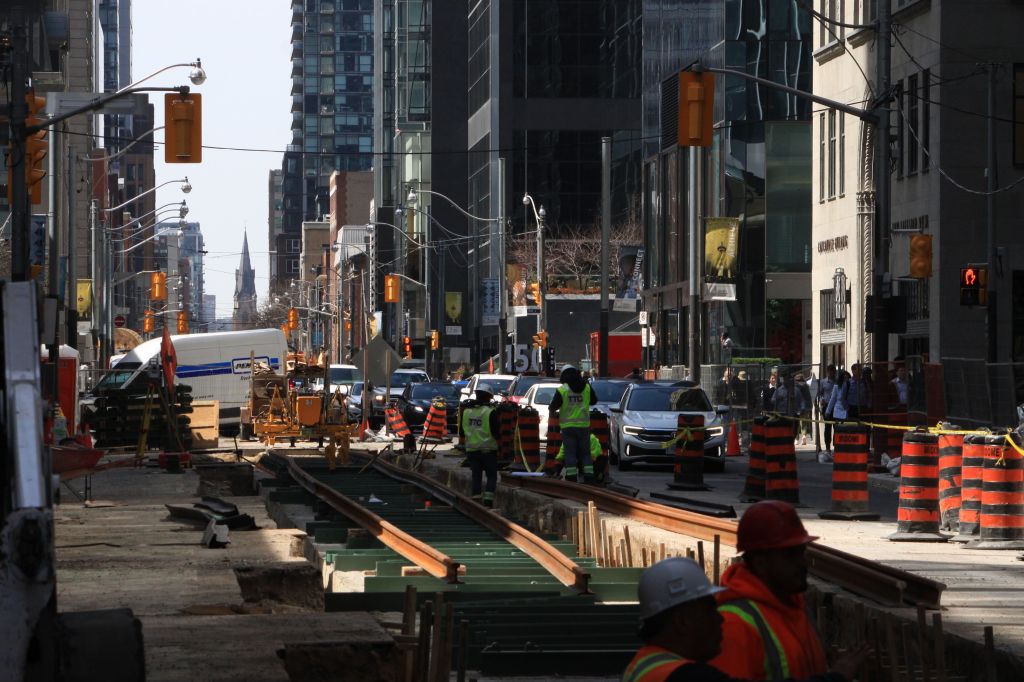
King Street will be closed between Shaw and Dufferin for water main and track work. This is a multi-stage project, although from a transit point of view it will have two configurations.
Effective February 18, 2024:
King Street will close between Shaw and Dufferin. Various routes will change to provide service, such as they can.
63 Ossington will no longer loop northbound via Atlantic and King to Shaw, but will be extended west via Liberty, Dufferin and King to Sunnyside Loop west of Roncesvalles.
29/929 Dufferin routes are not affected at this stage of the project.
501 Queen will vary by time of day. The eastern terminus remains at McCaul Loop, but the western terminus will change.
Until 10pm, all 501 Queen cars will run only as far west as Dufferin Street, and they will turn south to Dufferin Loop (CNE Western Gate).
After 10pm, all 501 Queen cars will run through to Long Branch as they do now replacing the 507 Long Branch car.
301 Queen night car bus service will continue to operate between Neville and Long Branch.
504 King cars will also vary by time of day:
Cars on both the 504A and 504B branches will divert via Shaw and Queen to Roncesvalles.
504A Dundas West cars will run north to Dundas West Station at all times.
504B cars that would normally run to Dufferin Loop will run west on Queen.
Before 10pm, 504B cars will run through to Humber Loop replacing the 501 Queen service which will divert to Dufferin Loop.
After 10pm, 504B cars will terminate at Roncesvalles.
Note that streetcar service to Broadview Station will be restored and so the 504B cars will no longer end at Distillery Loop, but will run to their normal east end destination.
304 King night service will operate between Broadview and Dundas West Stations diverting via Shaw and Queen. [Updated Feb. 12 at 11:40am] The TTC media release confirms that the night service will operate with streetcars.
507 Long Branch service is not affected.
508 Lake Shore cars will divert via Shaw and Queen, but will otherwise operate on their normal route.
Effective Late June 2024
Note: The work at King & Dufferin has been postponed to 2025.
The intersection of King & Dufferin will close for complete reconstruction of the track. This will require changes in the 501 Queen and 63 Ossington diversions, as well as a revised south end for the 29/929 Dufferin services, but details have not yet been announced.
Effective August 2024
With the completion of work at King & Dufferin, routes should revert to the February configuration, but nothing is definite about TTC plans as riders know well. Stay tuned.
The work is supposed to continue until “early December” according to the TTC site, but until “November” according to the City site. Normally, the schedule change would occur in late November, and so it is not clear just what date they are aiming at. The usual December change is for the two-week holiday schedules just before Christmas.
Updated February 11, 2023 at 1:45 pm: In response to a reader comment, I have added illustrations from the City’s presentation deck showing the technologies used for traffic monitoring and analysis at the end of this article.
On February 9, 2024, Mayor Chow held a press conference to announce various changes coming to King Street and the success of the Traffic Agent program in taming congestion downtown, particularly on King.
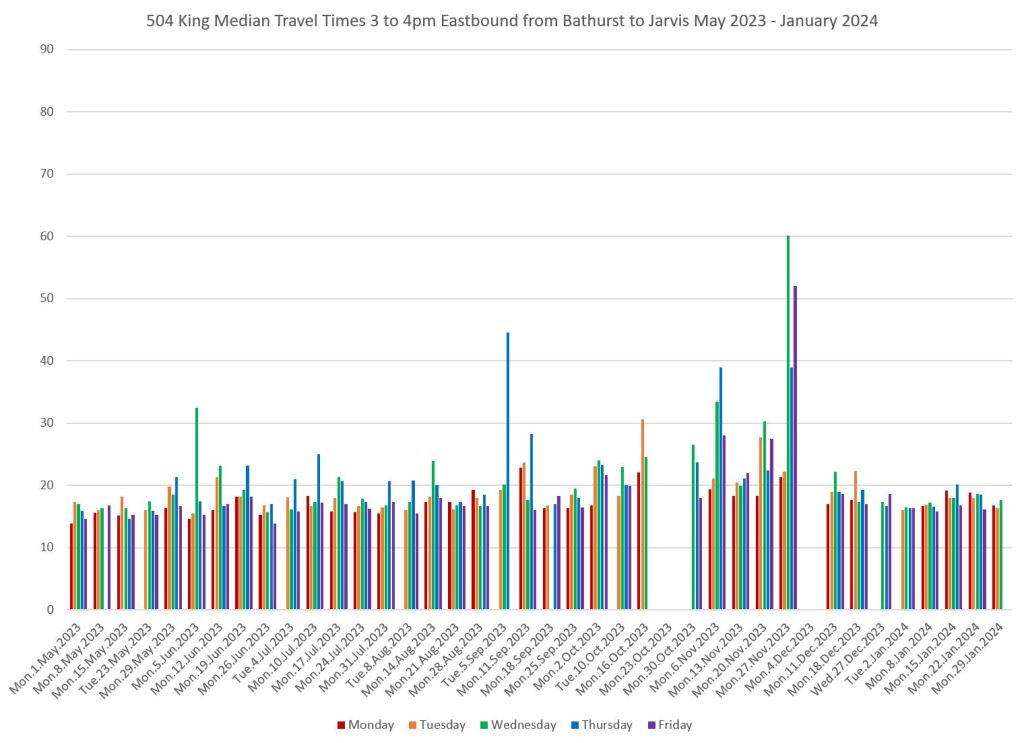
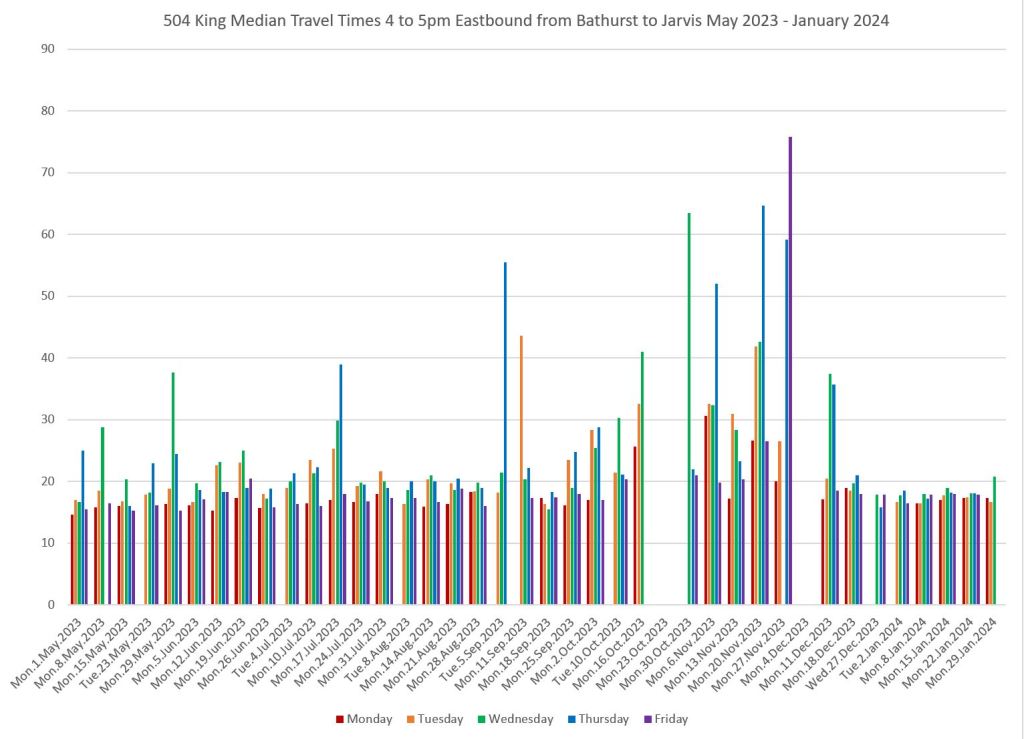
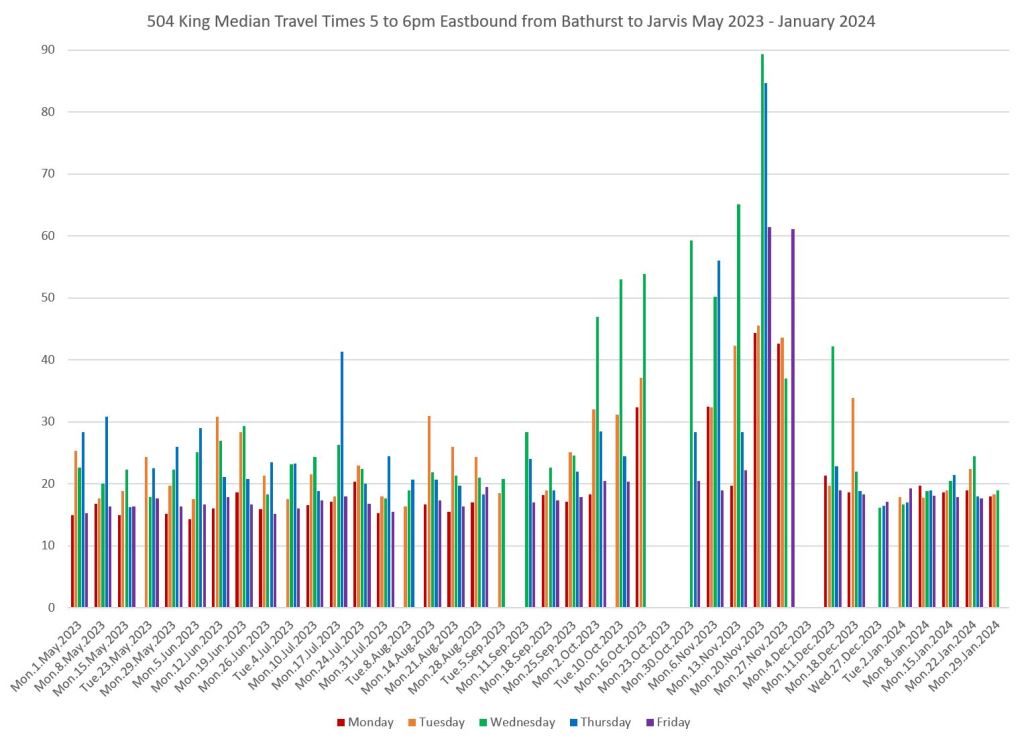
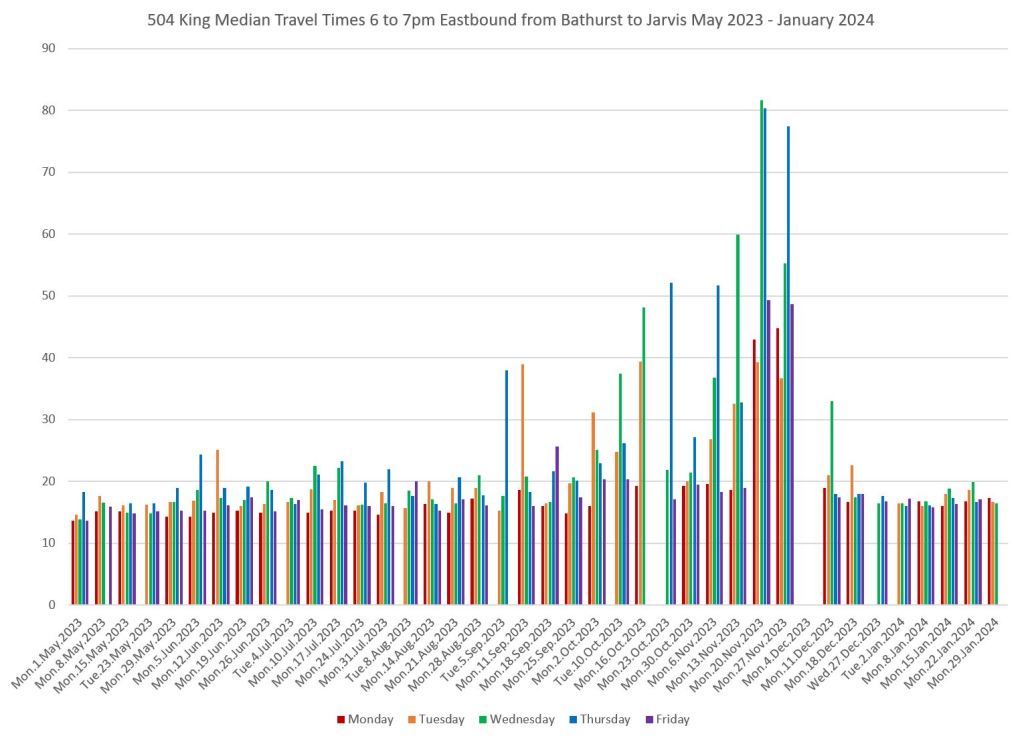
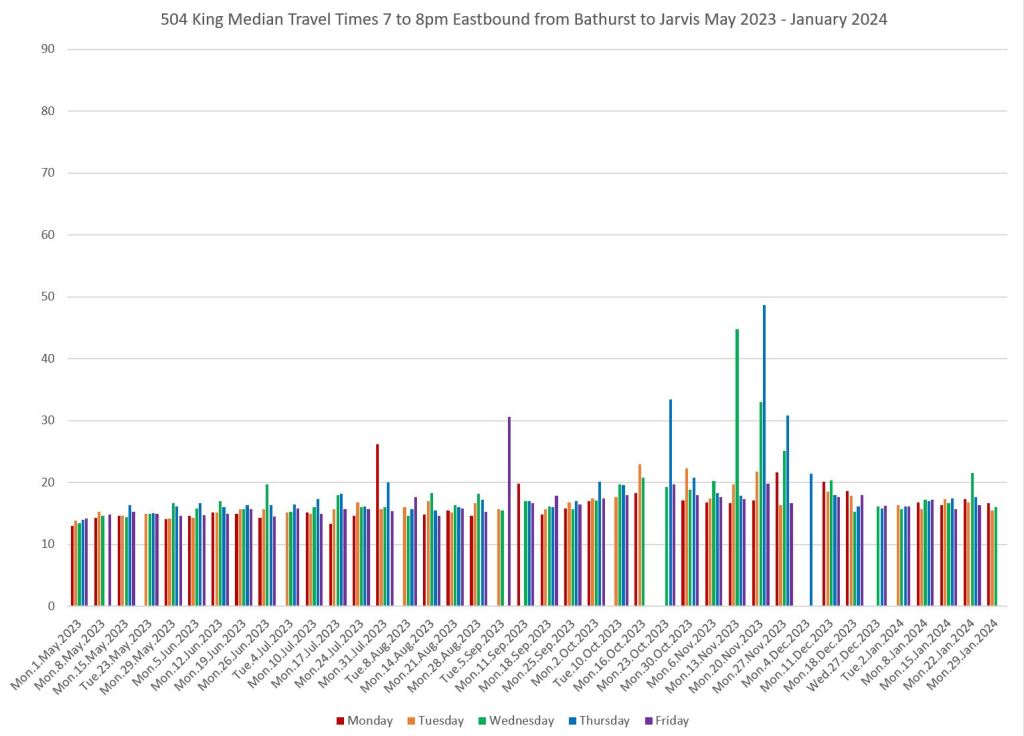
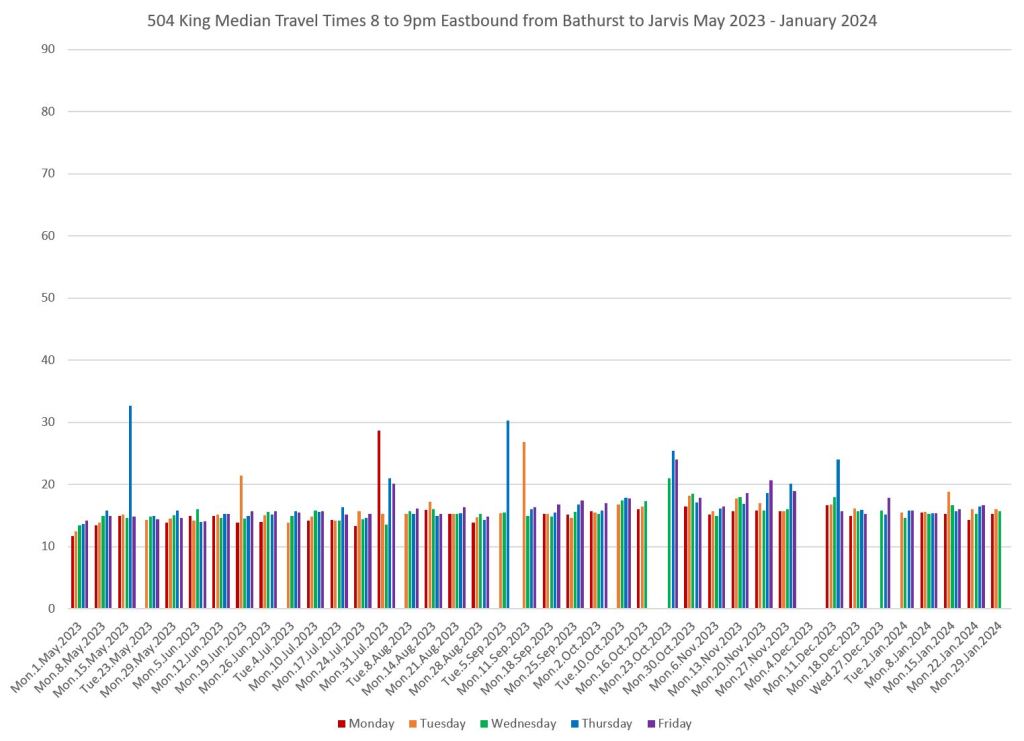
Regular readers will know the graphs below showing day by day travel times eastbound from Bathurst to Jarvis by hour from 3pm to 9pm. These charts have been updated with January 2024 data. (Note: Gaps in the charts in mid October and early December correspond to diversions via Church and Queen for water main repairs east of Jarvis. No streetcars covered the full Bathurst-Jarvis segment during these periods.)
The graphs illustrate the change in congestion levels peaking in the 5-6pm hour, but still quite evident in 6-7pm and to a small extent in 7-8pm. The build-up through the fall was caused by construction on Adelaide coupled with a complete lack of enforcement of the transit corridor and of “box blocking” at major intersections where cars enter but cannot cross in the allotted green time. With the introduction of Traffic Agents to enforce the rules on November 27, 2023, the street ran much more smoothly and the peak in congestion vanished.
At its November 2023 meeting, Council passed a motion proposed by Councillor Chris Moise whose ward covers the east side of downtown, and who also sits on the TTC Board:
1. City Council direct the General Manager, Transportation Services, in consultation with the Toronto Transit Commission, the Toronto Police Service, and the City Solicitor to review and report back to the Executive Committee in the second quarter of 2024, including: a. an update on streetcar performance over the last five years; b. suggested improvements to the public realm along King Street until the permanent capital project can be delivered; and c. the feasibility of implementing automated traffic enforcement on the King Street Transit Priority Corridor, including details on what legislative amendments would be required to provincial legislation including, but not limited to, the Ontario Highway Traffic Act.
This article addresses point “a” with a review of streetcar lines over the past five years. It is important to go back to 2019 before the pandemic fundamentally shifted traffic and transit patterns downtown as a point of reference.
From time to time, there are calls to expand a “King Street” redesign to other parts of the network, but there are two “cart before the horse” issues to address first:
Figure out how to make King Street operate as it was intended and return at least to its pre-pandemic behaviour, if not better, as a model.
Understand how other streets operate including where and when problems for transit performance exist.
An update on transit priority will come to Council in February 2024, although this will look more widely at the city, not just downtown. In previous articles I have reviewed the growing problem of transit travel times as traffic builds on the proposed RapidTO corridors, some of which exceeded pre-pandemic levels some time ago. In future articles I will refresh these analyses with data through to the end of 2023.
An important distinction between most RapidTO bus corridors and the downtown streetcar system is the design of suburban vs downtown streets. In the suburbs, the streets are mostly wide, have relatively few points of access (e.g. driveways) or pedestrian oriented uses (e.g. shops), and travel distances tend to be longer. In the core, streets are narrow, mostly four lanes with no possibility of widening, access points are more frequent, there is a strong pedestrian orientation, and trips tend to be short. Even if buses were running, express operations would be almost impossible and would save very little time on the downtown routes.
There are exceptions such as some older parts of the inner suburbs that bring physical challenges for transit priority, but also the political challenge that the transit share of road use is lower as one moves outward from the core. King Street is a very different place from Steeles, and Dufferin is somewhere in between depending on which section one considers.
An important message in all of this is that “congestion” (put in quotes because it is so often cited as a get-out-of-jail-free excuse for all transit woes) varies from place to place and time to time. Simply putting transit priority everywhere will not solve all problems and could even be overkill (even assuming that it is true “priority” and not a sham to keep transit vehicles out of motorists’ way). It is simple to colour a bunch of key routes end-to-end on a map, but much harder to identify changes that will actually make a difference. Meanwhile, a focus on “priority” could divert attention from badly-needed improvements in headway reliability and more reliable wait times.
This article begins with a comparison of scheduled travel speed on each route, and then turns to actual travel speeds by route segment. In the interest of length, I will leave a discussion of headway reliability to future articles. This is an important component of total travel time, especially for short trips or trip segments.
I have also included tables showing the constant change in route configurations on the four major east-west corridors thanks to a never-ending procession of track and water main work, rapid transit construction, and overhead changes for pantograph operation. Some of this work was accelerated to take advantage of lighter traffic conditions during the pandemic, and some to bring forward work to keep staff employed.
However, the rate of route changes persisted well beyond the heart of the pandemic and threatens the credibility of transit service on major corridors leaving riders constantly wondering where their streetcar or replacement bus might be. Some changes occurred without the planned work actually taking place, or work started and ended later than announced (sometimes much later as in the never-ending KQQR project).
An important change over recent years, separate from the pandemic, has been the move to larger streetcars on wider headways. What might have been a tolerable unevenness in service when streetcars arrived every 4 or 5 minutes simply does not work for scheduled headways of 10 minutes with much wider swings. Bunching when it occurs leaves much bigger gaps between vehicles. A laissez faire attitude to route management, and especially the assumption that routes under construction cannot be managed, has led both to unreliable service and basic questions of how or if the TTC can recover the quality riders expect.
For all the talk of project co-ordination, the last people who seem to count are the riders. Simply studying raw travel times be they scheduled or actual does not capture the frustration, delay and despair from the ever-changing and unreliable services, be they by streetcar or bus.




 Steve Munro