This article includes reviews of the 29/929 Dufferin local and express services to the end of 2025. The major item of interest is the introduction of “red lanes” south of Bloor Street and their effect on the bus service. Detailed charts are included here for:
November and December travel times in both directions between King and Bloor.
January 2024 to December 2025 historical stats on travel times.
The segment between Lawrence and Wilson that does not have transit priority, but which has much more congestion than at the south end of the route thanks to Yorkdale Mall.
General observations:
The benefit of the red lanes is more pronounced for northbound than for southbound trips, and only at certain times of the day.
There is much more severe disruption of service northbound near Yorkdale Mall, but no transit priority measures are proposed there.
Headways on Dufferin remain widely scattered near terminals (northbound at King, southbound at Transit Road just outside of Wilson Station).
Even on Christmas Day when weather was relatively benign and travel times were lower than normal, headways were not reliable.
Part of the improvement in travel time in December 2025 could be due to seasonal effects. When the data are in for early 2026, we will see how long-lived the saving actually is. I will publish an update to this article in a few months when the pattern is clear.
There are a lot of charts in this article, and I have put them all after the “more” break. Those who are interested in the details can open the full article.
I will turn to a review of 511 Bathurst streetcar and 7 Bathurst bus which both saw recent changes in future articles.
Update: For clarity, the red lanes currently extend only as far north as Dundas. After work up to Bloor is completed in the Spring, I will publish an update showing the effect.
The TTC has a pilot program underway on several routes with increased supervision in an attempt to improve service quality by addressing service gaps and bunching. These are complementary effects in that a gap is often followed by a bunch, although gaps can also occur due to missing vehicles and short turns. See:
The pilot evolved over the year as some of the challenges and resource needs to manage service became apparent.
March 2025
Pilot launched on 7 Bathurst, 24 Victoria Park, 924 Victoria Park Express, 25 Don Mills, 925 Don Mills Express, 29 Dufferin, 929 Dufferin Express, 100 Flemington Park, 165 Weston Road North, 506 Carlton, 512 St Clair. Dedicated staff to manage each route were not used initially and results were poor.
June 2025
The pilot was scaled back to 7 Bathurst, 24 Victoria Park, 924 Victoria Park Express, 506 Carlton, and 512 St Clair. One route supervisor was assigned to each route.
September 2025
100 Flemingdon Park and 165 Weston Road North were added.
October 2025
Pilot “refined” to focus on the weekday peak periods.
The TTC recognizes that delays leading to gaps can be caused by several effects: “including including Operator behaviour, customer incidents, traffic congestion, city events, construction, and operational factors, such as door/ramp operations.” [p. 2]
Later in the report, there is mention of the effect of passenger loads and long traffic signal wait times.
If vehicles are crowded either because service is inadequate for demand, or because a gap creates an extra load, they will take longer at stops. Filling vehicles to the brim can be counter-productive and inefficient. Space limitations onboard can delay passenger movement especially for those with large objects (e.g. strollers, luggage) and mobility devices. Although ramp operations are mentioned, there are many other types of passengers with extra space and boarding time needs.
Transit signal priority is also mentioned, but there is no indication of where or what priority measures were added on the pilot routes.
The remainder of this article reviews the metrics used by the TTC to track the success of the pilot project, as well as problems and actions that might be taken to resolve them.
The City of Toronto has announced that work at King & Dufferin is finished and the intersection will reopen to traffic on Wednesday, October 29 after 7pm.
Regular service will be restored on 29/929/329 Dufferin, and the 503 Kingston Road bus will be extended west from Joe Shuster Way (east of Dufferin) to Roncesvalles at 5am on Thursday, October 30.
TTC will test the new track and overhead during the week of November 3 and will restore 504 King and 508 Lake Shore services from their current Shaw/Queen diversion when the intersection is cleared for streetcar operation.
Meanwhile, the TTC CEO’s Report notes that six minute or better service will come to 505 Dundas and 511 Bathurst from 7am-7pm 7 days/week starting November 16.
There are many diversions coming up in the Fall for streetcar routes. Information on these appears in various places on the TTC site, mainly but not exclusively under Service Advisories. As an aid to riders, this article consolidates the available information in one place.
Updated November 28, 2025
***** This article is only for archival purposes. It has been replaced by a new one picking up from mid-November 2025. *****
Major events pending and in progress include:
Construction on Queen between Davies (just east of the Don Bridge) and Broadview.
Reconstruction of the intersection of College and McCaul, and of overhead in the vicinity.
Reconstruction of track and overhead at and near Parliament and Carlton.
Other short term diversions will last only overnight or for a weekend.
Many of these are complicated by the ongoing Ontario Line work at Queen & Yonge forcing some diversions to be more complex than they might be otherwise.
This article will be updated when changes are announced.
November 21: The 501 diversion via Broadview, Dundas and Parliament around water main and track work west of Broadview will begin on November 22.
November 20: Equipment and material mobilization is underway on Queen west of Broadview.
November 17: The 506 diversion has been changed today to avoid the intersection of Church & Dundas where construction blocks the northeast corner. Maps have been added from the TTC’s site.
Effective November 16: The 503 Kingston Road bus will be cut back from Dufferin, and will now loop at York Street via Richmond and University.
November 15: Diversions announced for two projects on 506 Carlton at Parliament & Carlton, and on Gerrard east of Broadview.
November 9: King & Dufferin reopened for streetcar service. 503, 504, 508 will operate via their normal routes.
October 30: King & Dufferin reopens for general traffic and buses. Streetcars to return following track testing.
October 20: Water main reconstruction on Queen west of Broadview has been delayed until early November. 501 Queen streetcars will continue to operate on Queen Street until further notice.
October 13: 504 King is operating with streetcars today over its full route except for the King/Dufferin diversion.
October 9: Maps for 504 King and 506 Carlton diversions added.
October 8: Construction at Queen & Broadview will not start on October 12, and so some diversions will not be required immediately. Information for 501 Queen and 503 Kingston Road has been updated.
October 5: Nuit Blanch & Run For the Cure info moved to the archive section.
October 1: Diversions of 505/305 Dundas and 506/306 Carlton for Nuit Blance and for the Run For The Cure added for October 3/4/5.
September 23: The King/Dufferin start date has been changed to Sunday, September 28.
September 12: King/Dufferin start date pushed back to September 29 or later. The project will now extend to mid-November.
September 9: College/McCaul and Queen East details added.
August 26: King/Dufferin Project
The start date for this project has been changed to mid-September with the exact date to be confirmed. Although new schedules will be in place providing for diversions, service will continue to operate through on King Street until construction actually begins. This likely means that the project will extend further into October than the originally planned Thanksgiving weekend end date. The delay also means that the Tiff diversions will end before the King/Dufferin diversions begin.
Branch lettering for 504 King A/B corrected.
August 25: King/Dufferin Project
Information about Kingston Road night service added.
304 King and 329 Dufferin confirmed to be diverted on the same routes as the 504A and 29 daytime services.
Several routes in the TTC network are scheduled to operate partly or completely with 18m articulated buses in place of the standard 12m varieties seen on most of the system. A problem commonly found on some of these routes is that although the schedule assumes an 18m bus, what actually shows up is a 12m bus with less capacity.
On some routes, the proportion of shorter buses grows later in the day suggesting that for some reason the longer buses were replaced. The number of buses per hour is fairly consistent from day-to-day, and generally matches the scheduled level of service. This means that few extras (or “run as directed” buses) served these routes even though the capacity was reduced by substitution of smaller buses.
This post looks at how often this problem arises on several routes through the month of July 2025.
The TTC has announced its services for the CNE for 2025 to operate from Friday, August 15 to Monday, September 1.
CNE Express buses will operate non-stop between Bathurst Station and Exhibition Loop, and between Dufferin Station and Dufferin Loop.
Extra service will operate on the 29 Dufferin and 929 Dufferin Express bus routes, and on the 509 Harbourfront and 511 Bathurst streetcar routes.
Other routes will change to accommodate the CNE services and traffic conditions.
63 Ossington buses normally loop at King via Strachan, East Liberty, Liberty and Atlantic. This will change so that buses loop via Fraser, Liberty and Atlantic.
503 Kingston Road streetcars will be extended west from Dufferin to Sunnyside Loop between 2pm-1am weekdays and 9am-1am on weekends.
510 Spadina streetcars will terminate at Queens Quay Loop until 7:30pm daily, and will run to Union Station afterward.
This is the second part of a series showing details of travel times in the Bathurst and Dufferin corridor.
For introductory remarks and a discussion of general issues, please refer to Part I.
The main part of this article contains the charts for the local and express bus services on Dufferin Street in June 2025.
Although the focus of recent debates about transit priority for Dufferin was from Eglinton south, data here show that there are issues with extended running times, particularly in the afternoon, over the full route with northbound trips taking the lion’s share of the delay. Express trips are faster than local trips, but by varying amounts over the route. The least benefit is on the southern portion of the route where red lanes will be installed, and where staying in those lanes could prevent express buses from leap-frogging the locals.
There are some areas where traffic slows in advance of an intersection, but more common is a general slowing down of bus speeds over the route representing overall traffic speed and longer stop service times when the route is busy.
Data shown here are from June 2025 with both the local 29 and express 929 services plotted together for comparison. In many times and locations their speeds are comparable, while in others the express buses have higher speeds than the locals.
The main article contains all of the charts including PDFs with all day sets.
This article continues the analysis of service on routes where the TTC claims to be implementing mid-route headway management. The routes included here are:
24/924 Victoria Park
25/925 Don Mills
29/929 Dufferin
See Part I for a general introduction and details of 7 Bathurst, 100 Flemingdon Park, 165 Weston Road North, 506 Carlton and 512 St. Clair.
A common factor evident in the charts for these routes is that service near the origins of routes is barely within the target range for headways, and more commonly well beyond it. AM peak service might squeeze within the target, but service falls apart from midday onward and does not recover in the evening.
Although the TTC reports performance based on “on time” departure from terminals, they actually have a headway standard, but never report on how well routes meet it. Note that the standard actually is very generous and allows a wider range of headways than the “on time” standard. For example, a bus operating every 10 minutes is allowed a 50% headway deviation either way meaning that the actual headway could be anywhere from 5 to 15 minutes, and 40% of the service can be even worse. This is a standard designed to make management look good to those who don’t peer “under the covers”.
For services that operate between 5 and 10 minutes, passengers do not rely on printed schedules, but expect vehicles to arrive at prescribed headways. Therefore, on-time performance for frequent service is measured by how well actual headways correlate to scheduled headway intervals. Trips are monitored at a location based on arrival time, without regard to whether the trip that arrived was scheduled for that time slot. The vehicle is considered on-time when the headway deviation is less than 50% of the scheduled headway. For example, a service that operates every 6 minutes is deemed on-time if the headway deviation falls between 3 minutes and 9 minutes. TTC’s goal is to have 60% of all trips operated within +-50% of the scheduled headway over the entire service day. [Service Standards at pp 15-16]
The TTC plans a review of its Service Standards in coming months. That review and much-needed reporting on service quality are long overdue.
Express routes can have very wide ranging headways making their benefit to riders dubious. The wait for an express bus can be longer than the travel time saving from skipped stops. Meanwhile riders at “local” stops cannot benefit from the express vehicles. The TTC plans a review of its Express Network later this summer, and service reliability should be a major issue. It is not enough to advertise a faster trip, but the network must actually provide it, including waiting time, reliably.
Another factor that appears in some of these charts (as well as in Part I) is that for some periods there is more service on a route than is scheduled. This is due in part to the assignment of the “run as directed” buses to supplement regular routes. However, the base schedule is not adjusted, and the RADs do not create a uniform combined headway. They can even contribute to bunching by running close to a scheduled run.
TTC still has not deigned to release detailed data from their APCs (Automatic Passenger Counters) and only coarse information (corresponding to the three levels of loading shown on their real time info) is publicly available. I have asked many times, but this request goes nowhere. Without detailed data it is impossible to know the loads on buses or to differentiate between a modest seated load and a partially standing one. Considering that the Service Standards call for at most a few standees in the off peak, this distinction is crucial to evaluating how service matches the standards.
When the use of RADs to supplement service began, the intent was to soak up spare bus operators (not to mention spare buses) without committing to a permanent service improvement. There has been no external report on whether the added service improved ridership, or the effect of its withdrawal.
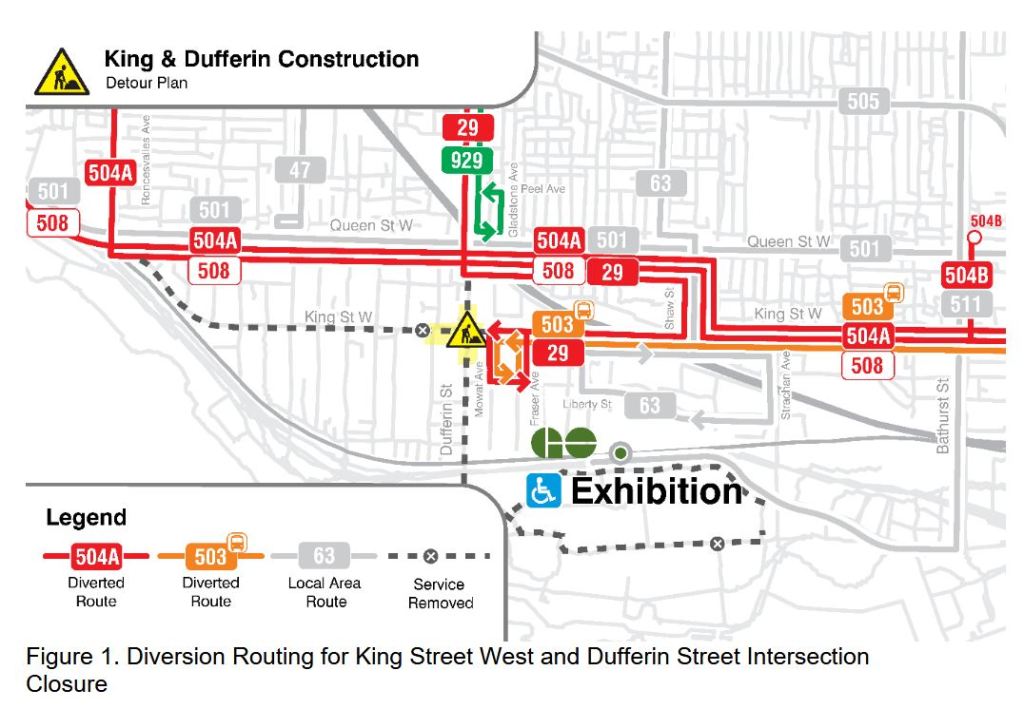
Starting after Labour Day in September, the TTC will rebuild the track at the King-Dufferin intersection. This work is expected to take about six weeks.
The project is left over from work on King West in 2024 when it could not be completed as planned due to supply problems. It was erroneously reported that the 2024 project finished “early” when in fact this was due to the scope change.
Transit services will be significantly changed in this area.
Source: City of Toronto Report at p. 5
Note that the diversions for King-Church construction are expected to end before King-Dufferin work begins, and transit services on the eastern part of King will be back to normal.
Route changes at King-Dufferin:
Routes diverting east of Roncesvalles via Queen and Shaw to King:
504A King streetcars from Distillery Loop to Dundas West Station
304 King night cars from Broadview Station to Dundas West Station
508 Lake Shore streetcars from Long Branch to Broadview Station
No service on King between Mowat and Roncesvalles
504B King streetcars will operate from Broadview Station diverting from King via Bathurst to Wolseley Loop (at Queen).
Kingston Road services:
503 Kingston Road converted to bus operation and cut back from Dufferin to loop via Mowat and Fraser.
303 Kingston Road night service suspended (it is not yet clear what will replace the 303 on Kingston Road)
Dufferin bus services:
29 Dufferin buses will divert via Queen, Shaw and King looping via Mowat and Fraser.
929 Dufferin Express buses will terminate at Queen looping via Queen, Gladstone and Peel.
No service on Dufferin south Queen nor through Exhibition Place to Princes’ Gate.
Parking and stopping provisions will change on Queen from Roncesvalles to Shaw, and on Shaw between Queen and King. Stopping will be prohibited on both sides of these streets seven days/week from 7:00 to 11:00am and 2:00 to 7:00pm.
Left turns will be banned from Shaw northbound at Queen and southbound at King. Left turns are now banned from King eastbound onto Shaw weekdays from 7:00 to 10:00am, and from 3:00 to 7:00pm. This will be extended to a ban from 7:00am to 7:00pm on all days.
Some existing parking spaces will be removed to make room for transit vehicles on Dufferin north of Queen, Peel, Mowat, Liberty, Fraser, and King. Details are in the report.
These changes will only last for the duration of the construction project.
The TTC plans to “conduct comprehensive targeted engagement to inform and educate customers, residents, local businesses, and other partners of the pending changes.” However, major changes are unlikely as this project is only two months away and temporary transit routes are already decided. The TTC does not yet have a page on its own site for this project.
This issue will be at Toronto & East York Community Council on July 8, 2025.
This article begins a series to review the TTC’s overnight services, aka the Blue Night network. Most of these are bus routes, but a few of the older lines still operate with streetcars.
The overnight network is designed so 95% of the population and employment is within a 1,250 metre walk (15 minutes) of transit service. Consequently, overnight services may be provided on different routes than the base network in order to meet these requirements. Where possible, however, overnight routes will follow daytime routing and be identified in a manner consistent with the daytime route. The overnight network is an important part of the TTC’s commitment to maximizing the mobility of people in the City of Toronto and meeting all of their diverse travel needs.
Hours of service: 1:30am to 6:00am (8:00am Sunday)
% of population and employment served: 95%
Within walking distance: 1250 metres
Within walking time: 15 minutes
Minimum service frequency: 30 minutes
Headway performance: Service is considered to be on time if it is no more than 1 minute early and no more than 5 minutes late. TTC’s goal is to have 60% of all trips meet the on-time performance standard.
The one minute early standard was informally dropped in early 2025 and on time performance is now measured by TTC against a -0/+5 scale. That applies to on-time departure at terminals, but not to headways. The standard allows a swing of headways between 25-35 minutes for a half-hourly service as shown below. The service is “on time”, but unreliable, especially when the compounding effect of the swings is considered at transfer points.
Moreover, the “standard” need only be achieved 60% of the time, and then only at terminals. Almost half of the service is held to no standard at all.
Trip
Scheduled Time / Headway
Actual Time / Headway
1
2:00
2:00
2
2:30 / 30m
2:35 / 35m
3
3:00 / 30m
3:00 / 25m
4
3:30 / 30m
3:35 / 35m
5
4:00 / 30m
4:00 / 25m
The TTC does not have any planned meets in its night network, and these would require scheduled, protected departure times enroute, not the current catch-as-catch-can arrangement. On a half-hourly base and with long routes, the gaps between buses can vary a lot, and riders cannot count on their arrival. This is a common annoyance on the daytime network, but on the night routes where a missed bus can make a large difference in trip time, this should be unacceptable.
Most night services operate every 30 minutes, although there are exceptions on both the bus and streetcar networks. That service level is provided generally from 2am onward to about 4am, later on some routes depending on when demand begins to build up for the morning. There is also some overlap of daytime and night time route number usage, although the TTC has been sorting out its schedules for consistency in past months.
Some routes do achieve a narrow band of headways around 30 minutes for terminal departures, although this band widens along the route just as it does with daytime service. However, some routes have erratic headways even near their terminals, but the standards are lax enough that these still can count as mostly “on time” in reports of service quality.
For all that the night services are supposed to be for shift workers and the night economy, reliability leaves much to be desired because, like so much TTC service, the time a vehicle will arrive is unpredictable. The situation varies from route to route as the sample in this article will show. Some routes are not too bad, but still leave riders vulnerable to missed trips and connections. Others are a real mess with 307 Bathurst taking the prize here. (There are likely competitors for that title, but I have not worked through every route yet. Be patient, gentle reader.)
May is an ideal month usually free of major storms, hot or cold, and conditions are about as good as one can expect. Service in February will not be as good as the examples shown here.
The TTC’s common bugbear/excuse for erratic service, traffic congestion, does not apply to these night services. Uneven headways are caused by lack of line management, the absence of a policy to maintain on time performance along routes, and in a minority of cases by schedules that are too tight to allow for terminal recovery time.
Through this series, I will review the quality of night service provided on the TTC system. This will take a while, and the articles will appear as time permits in between other topics.
Note: This is a long article with a lot of charts. I don’t expect most people to read every word or review every route. For some, this might validate their own experience. For others, it will show the variations across the network. Happy reading.

 Steve Munro