King/Church Diversion Observations May 12, 2025

Today was the first weekday of the King/Church construction diversions. I watch things evolve via NextBus through the morning peak, and then visited King/Spadina during the PM peak. A caveat: Mondays are light traffic days. There was no Gardiner backlog at all on Spadina. Later in the week will likely be more challenging.

During the AM peak, the service on 504 King and 503 Kingston Road did not load properly, and many vehicles were clumped together. This took quite a while to unscramble, and there were big service gaps. The 504 buses also ran in packs and huddled together at Wolseley Loop, at one point six of them representing about 20 minutes worth of service at the scheduled headway. The peak period did not encounter queueing frequently at points where streetcars turn because of many wide service gaps. When a bunch of cars arrived, they queued one by one awaiting their turn, but then the intersections would open up again even though in theory there should always have been transit service waiting.

In the PM peak at King/Spadina, the major sources of traffic were pedestrians, cyclists and transit in that order. I observed that the traffic signal cycle time was 110 seconds (1’50”). This means that there are 32.7 opportunities (3600/110) per hour for a turn to/from Spadina. The nature of the intersection is that only one streetcar can make the turn per cycle.

The combined scheduled service trying to make the EtoN turn per hour at King & Spadina in the PM peak is 23 streetcars.

RouteHeadwayCars/Hour
503 Kingston Road8′7.5
504 King Car10′6.0
508 Lake Shore20′3.0
511 Bathurst Car9′6.5
Total23

Stir in 12 510 Spadinas straight through northbound on a 5′ headway. When there is a 510 (or any other car) serving the farside NB stop it blocks any car waiting to turn off of King. In a 45 minute visit, I saw this happen four times, and one car missed two turning opportunities because of closely-spaced Spadina cars blocking the stop.

Depending on arrival times and bunching, more vehicles can queue up here than there are cycles to accommodate them. This was under probably the best general traffic conditions we will see.

There were traffic wardens, but they left just before 5pm. The biggest problem was pedestrians blocking turning streetcars which do not have a protected turn phase EB on King. There is a WB advanced green because autos are forced to turn off King here, but there is no advanced green for eastbound streetcars.

The large volume of riders transferring from eastbound streetcars to buses adds to the already substantial pedestrian volumes at this intersection.

The Traffic Wardens did not reliably ensure that streetcars got “first dibs” on turning, and after they left, pedestrian interference became worse.

I boarded a 504 King eastbound at about 5:10. There was congested traffic over the route across to Church especially on Adelaide and it took over 15 minutes to get from York to Church. Some people complain about space “wasted” by bike lanes, but it was the left turn lane that was almost always empty. Some traffic used it to scoot around stopped streetcars!

The severe congestion can be seen in the TransSee maps of service for 504 King and 503 Kingston Road below. The tracking lines for the diversion area are almost horizontal for an extended period. Note that the problem is mainly eastbound (lines reading bottom to top).

I rode a King car east from Spadina and it took a very long time to emerge from the diversion. The car went from 6 minutes early at King on Spadina to 11 minutes late at Queen and Church. Note the length of time spent approaching King and Spadina inching along the street about one carlength at a time. Other locations where the car crept along are also clear in the tracking data.

Tracking data for car 4634. Source TransSee.ca.

Among the problems enroute were:

  • Congestion on Queen thanks to stopped vehicles and construction in the curb lanes.
  • Autos infilling Adelaide Street eastbound leaving no room for a streetcar to merge from York Street onto Adelaide. We were eventually rescued by a Traffic Warden.
  • Extremely slow progress across Adelaide thanks to a traffic backlog from Church Street.
  • Extremely slow progress on Church Street thanks to a traffic backlog from Queen Street. My car actually fouled the Church/Adelaide intersection as it was unable to complete the EtoN turn in more than one traffic signal cycle.

Ridership on the car was very light and most people got off when the car turned off King onto Spadina. They transferred to the King shuttle buses which were running irregularly and often bunched. These buses were also trapped in the traffic queue eastbound to Spadina of streetcars waiting to turn. (In the chart below, the size of the dot represents the degree of crowding on the vehicle.

Tracking data for 504C and 504D shuttle buses May 12, 2025, 4pm to 7pm. From TransSee.ca.

For those who want to watch the wandering streetcars and buses on NextBus, here is a link. This will open a combined display of routes 501, 503, 504, 510 and 511. The map can be scaled to zoom in to the area of interest. Displays of operating charts on transsee.ca are free for TTC streetcar routes.

Over coming days I will keep an eye on service performance over the diversion, and once a few weeks’ data have accumulated will delve into the details.
King-Church Construction and Traffic Effects

Updated May 5, 2025 at 12:50pm:

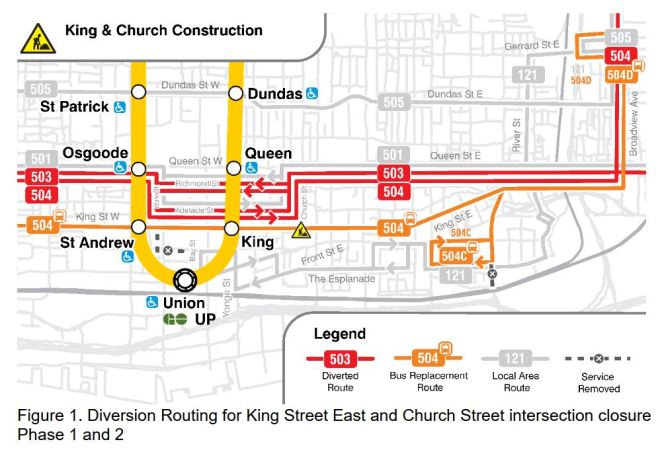
The TTC now has a web page with details of the changes for the first phase of the construction and diversions. This includes a map showing the diversions to west of Bathurst rather than just downtown. I have added this in the body of the article.

May 5, 2025 at 1:40pm:

Information about the 304 King and 303 Kingston Road night services has been added.

May 5, 2025 at 1:55pm:

The TTC has confirmed that overhead upgrades on King Street East and on Sumach/River will be completed before the King/Church track work end, and streetcar service will resume in September.

May 5, 2025 at 4:30pm:

I asked the City if it thought the intersections used by diverting streetcars and buses could handle the volume of traffic. They replied, but didn’t add much. See the end of the article for the exchange.

Major changes are coming to downtown streetcar routes on May 11 with the next schedule change. This will accommodate a combination of water main replacement, track reconstruction and streetcar overhead upgrades mainly at King and Church. Work is expected to require diversions until the October schedule change on Thanksgiving weekend. Streetcar service is expected to return with the September schedule change on Labour Day weekend.

The effects of work an King and Church have been known for some time through the Annual Service Plan and through a City report on the project. (The original report and recommendations were amended at the recent Council meeting to lessen the effect of various proposed lane closures.) Service levels have been published via the electronic version of schedules used by trip planning apps. The information about vehicles/hour at various locations is taken from those schedules.

(As an aside, the TTC website has still not been updated to include the 2025 Service Plan even though it was approved by the Board in January.)

With the concentration of transit service through various intersections, and the added complexity that most vehicles will make turns at these locations, there simply will not be enough capacity even under ideal conditions. It is no secret that “ideal” is a word rarely appropriate for transit operations downtown thanks to the lack of robust traffic management and real transit priority.

In past years, the diversion of services from King Street around the TIFF street fair created problems for transit travel times and reliability, but this lasted for a brief period. The planned diversions for King/Church will last through the summer.

Many of the water mains in the “old” city have been in service for over a century. Other parts of King Street have seen renewal, occasionally on an emergency basis following a break and sink hole.

The special trackwork at the King/Church intersection has been in bad shape for some time, and was overdue for replacement. Previous reconstructions were in 1983 and 2003. Other competing construction projects got in the way, and the track conditions have worsened year by year. There are many patches, and a well-deserved slow order unlike the standing practice even at freshly rebuilt junctions.

This intersection is also old enough that it predates the era of panel track construction where pre-welded sections are trucked in and assembled on site. This replaced the older style of tracks assembled piece-by-piece and often not welded robustly if at all. TTC has not yet been through its entire inventory of “old” track given the 20-30 year cycle depending on the level of service, wear, and disintegration at intersections.

Other work planned for this period of suspended streetcar service is the reconstruction of overhead on King and on the Distillery branch for pantograph-only operation.

Closing King & Church for an extended period concurrently with the Ontario Line construction at Queen & Yonge will add to the traffic snarls downtown. The City talks about using Traffic Agents to manage key intersections, but whether they provide enough people at enough places at enough times remains to be seen.

Routes Diverting off of King Street

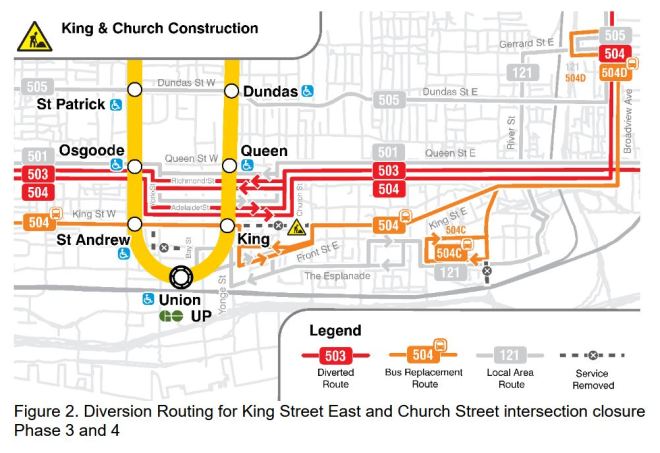
Three routes are affected: 504 King, 503 Kingston Road and 508 Lake Shore.

The 504 King service will be broken into three sections:

  • A 504 streetcar service between Broadview to Dundas West Stations operating via the same route as 501 Queen between the Don Bridge and Spadina.
  • A 504C bus shuttle from Wolseley Loop south on Bathurst and east on King terminating at Broadview & Gerrard.
  • A 504D bus shuttle from Wolseley Loop south on Bathurst, east on King and south on Sumach to Front & Cherry. Buses will loop via [to be announced] and will not serve Distillery Loop.

The 503 Kingston Road service will be changed so that its western terminus shifts from York Street to Dufferin Loop. Cars will follow the same route as the 504 King via Queen from the Don Bridge to Spadina, then shift south onto King to follow the pre-diversion 504B route to Dufferin.

508 Lake Shore cars will follow the same route as 504 King.

Night Service Changes

  • The 304 King night car will operate every 20 minutes over the same route as the daytime 504 service diverting via Queen and Spadina.
  • A 304D night bus will run every half-hour over the same route as the 504D bus from Wolseley Loop to Broadview & Gerrard.
  • The 303 Kingston Road night car will operate every 20 minutes over the same diversion route as the 304 King night car, and will operate as it does now to Sunnyside.

The maps below are from the City Report about this project originally published in February. An updated map for the first phase has been added later in the article.

Source: City Report at p. 5

For part of the construction period, King/Church will be impassible even to the replacement bus service and it will divert south to Wellington and Front.

Source: City Report at p. 5

These maps do not tell the whole story because another set of construction diversions will overlap the King/Church changes until the next schedule change in late June.

Although water main work at Bathurst/Fleet/Lakeshore is now complete, track work continues there and on Bathurst Street further north. 511 Bathurst streetcars will continue to divert east via King to Spadina looping via Adelaide and Charlotte. The 511B shuttle bus will be shortened from Wolseley Loop at Queen to an on-street loop via King, Portland and Richmond to Bathurst Street.

509 shuttle buses continue operating between Exhibition Loop and Queens Quay Loop at Spadina. 510 streetcars continue operating to Union Station.

The combined effect of the diversions will be greater than during the total meltdown of King service in 2024 when all cars diverted north via Church to Queen because volumes of other routes (510 Spadina, 511 Bathurst and 501 Queen) will be added to the King services, and more intersections will be affected over a wider area.

Updated May 5, 2025 at 12:50pm:

The TTC’s project webpage has a consolidated map of the diversions for the first phase of the work.

Continue reading

RapidTO Dufferin and Bathurst Streets: Public Consultation May 2025

In anticipation of transit demands for the FIFA games in June 2026 as well as general route reliability, Toronto proposes to install transit-only lanes on Bathurst (Eglinton to Lake Shore) and Dufferin (Eglinton to Lake Shore) Streets. Consultation sessions for these projects will be held through May 2025 both online and in person.

Updated Apr 28, 2025 at 1:40pm: Corrections to the Bathurst Street info have been added thanks to responses from the project team.

Updated May 7, 2025 at 10:10am: Links to the presentation decks and maps have been added for both projects.

Bathurst Street

  • Virtual public meeting on May 12 from 6:30 to 8:30pm
  • Drop-in events at
    • Harbord Collegiate on May 10 from 11am to 3pm
    • Humewood Community School on May 14 from 4:30 to 8:30pm
  • Consultation materials:

Dufferin Street

  • Virtual public meeting on May 13 from 6:30 to 8:30pm
  • Drop in events at
    • Stella Maris Catholic School on May 15 from 4:30 to 8:30pm
    • St. Mary Catholic Academy on May 20 from 4:30 to 8:30pm
  • Consultation materials:

Additional details and registration links for the online sessions are on the project web sites linked above.

The consultation sessions will be interesting, especially to see whether the FIFA games will be used to bulldoze transit proposals that might not otherwise be approved.

Implementation is planned for fall 2025 subject to Council approval.

Only overviews of the proposals have been posted at this time, but I will update this article when more details are available. The overviews are summarized beyond the “more” break below.

Continue reading

TTC’s Service Changes for the Swift Eras Tour

The TTC has announced several service changes to accommodate crowds expected at the Taylor Swift Eras Tour concerts at the Rogers Centre on November 14-16 and 21-23. For full details, see their site.

On concert nights, subway service will be improved between 5-8pm and 11pm-1:30am with Line 1 trains operating about every 3 minutes, and Line 2 trains every 4 minutes.

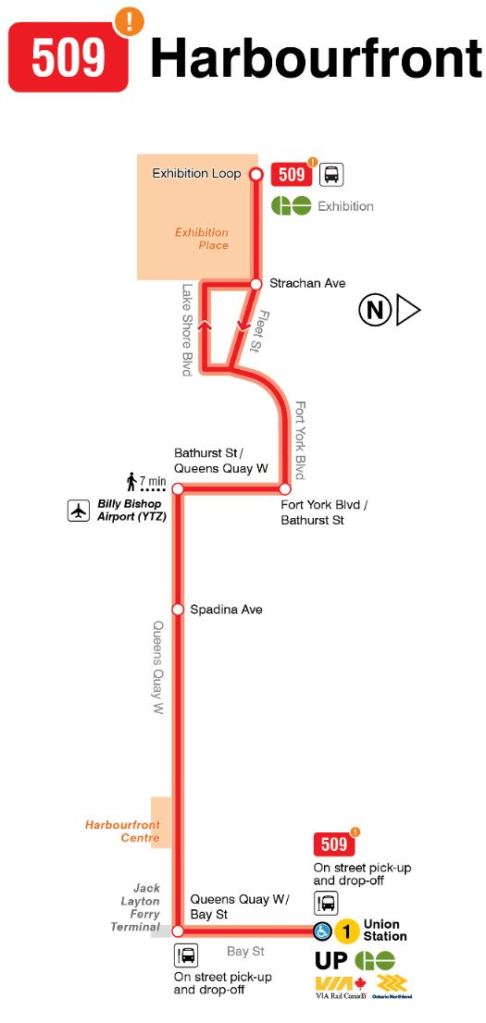
509 Harbourfront service will be restored between Union Station and Exhibition Loop from November 1-24 with at least 11 cars, up from the usual 7 on the line, on concert days .

511 Bathurst cars will operate from Bathurst Station to Union on November 14-16, and starting on November 17 on a scheduled basis.

19 Bay, a normally infrequent service, will have 10 extra buses. Post-show they will operate express northbound stopping only at King, Queen, Dundas and College enroute to Bay Station.

510D Spadina bus will similarly provide an express service stopping at the same intermediate destinations as 19 Bay enroute to Spadina Station.

The express services will be styled as “Swiftbus”. Extra service on 504 King will be styled as “Swiftcar”.

Access at Union Station will be monitored and controlled to prevent the overcrowding that occurred on past occasions with large events.

Harbourfront Overhead Reconstruction

The TTC has announced that streetcar service will be suspended, in part, over the 509 Harbourfront and part of 511 Bathurst at various times between Tuesday, September 3 and January 2025. This will allow the reconstruction and upgrading of the overhead system between Union Station and Exhibition Loop to be fully pantograph-compliant.

Information is posted in three separate items on the TTC site with the first being the most extensive.

The work will be done in three stages:

  • Stage 1: September-Early October 2024
    • Overhead work will concentrate on the area from Spadina eastward.
    • 509 Harbourfront cars will be replaced by buses between Union Station and Exhibition.
    • Buses will use the streetcar right-of-way eastbound between Spadina and York, stopping at the curb at other locations, and at all stops westbound.
    • At Queens Quay Station, buses will serve the existing surface stops used by other routes.
    • At Union Station, buses will drop off on the southeast corner of Front & Bay, and pick up on Bay south of Front.
  • Stage 2: Early October to Late November 2024
    • Work will shift to the section between Spadina and Bathurst.
    • 509 Harbourfront streetcars will operate between Union Station and Spadina.
    • 510 Spadina buses will be extended west to Exhibition Place.
  • Stage 3: Late November 2024 to January 2025
    • Work will move to the section west of Bathurst.
    • 509 Harbourfront streetcars will continue to operate between Union Station and Spadina.
    • 510 Spadina buses will continue to run to the Exhibition.
    • 511 Bathurst streetcars will operate to Union Station instead of to the Exhibition.

In theory, based on the planned end date for work on 510 Spadina, everything should be back to normal just after New Year’s.

Reserved Bus Lanes for Spadina?

Updated July 11 at 4:20 pm: The TTC has confirmed that planned overhead replacement on Bathurst shown on TOInview will not occur. They also confirmed that 2025 work on the west half of 506 Carlton will be done in stages, but have no further details at this point.

In response to the snafu with Spadina bus operations and traffic backlogs for the Gardiner Expressway, Toronto & East York Council has approved a proposal to implement a reserved bus lane between Queen Street and Queens Quay southbound. This must go to the full Toronto Council at its meeting of July 24.

The west curb lane would have all parking and cabstand space removed south of Queen. It would be reserved for transit vehicle and bicycles except for areas 30.5 metres north of King Street, Front Street and Fort York Boulevard which would be south-to-west right turn lanes. Between Richmond and Queen, stopping would be permitted outside of peak periods.

Speaking on CBC’s Metro Morning, Deputy Mayor Malik, sponsor of the motion, noted that planning for this type of event must substantially improve. The TTC was clearly caught out by the level of congestion on Spadina, something anyone who ventures downtown would know about. This did not appear overnight. A further question about the reserved lane proposal, which will be in effect at all hours, not just for the PM peak period, is how it will be enforced and what effect it will have on traffic feeding into this area.

A larger problem remains with the TTC’s planning for construction projects, and especially for streetcar replacements. In recent years, they have seemed quite willing to suspend service for extended periods in the interest of getting a lot of work done with a single closure. In practice, some of these have gone on far longer than they should have, and there have lengthy periods without any visible work.

The work on Spadina between King and Queens Quay, and later between College and Bloor, involves rebuilding the streetcar overhead to be fully pantograph compliant, as opposed to a hybrid pole/panto system. Some streetcar track repairs are likely during the streetcar replacement. This work should not take six months, the planned Spadina closure. This was originally announced as running only to October, but now to December. At Spadina Station the first stage of streetcar platform extension will occur taking advantage of excavation for a nearby condo project.

The City’s infrastructure plan viewer, TOInview, shows two other pending overhead replacement projects.

  • In 2024, Bathurst Street from Fleet to St. Clair
  • In 2025, College Street from Dundas to Yonge

Updated July 11 at 4:20 pm:

I asked the TTC if/when these projects will occur, and they advised that Bathurst will not be done in 2024. TOinview will be updated. College will be done in sections in 2025, but no further details are available yet.

It is not clear why at least the north end of Bathurst was not rebuilt while the St. Clair line was shut down for its own conversion and other projects along that route. This would have allowed streetcars to be based at Hillcrest as they were during previous roadworks on Bathurst. Do riders on St. Clair face another round of bus substitution?

College Street went through its own gyrations with substitute bus service during track replacement not long ago.

Many years have passed since the TTC streetcar system was entirely operating with streetcars, and the TTC seems to be happy to have some part of the network out of service almost all of the time. It certainly is not a question of vehicle availability, although their staffing is probably at a level where they could not field full streetcar service. This has implications for streetcar service levels generally, and for the resources more-or-less permanently “borrowed” from the bus network.

Consultation for the TTC’s 2025 Service Plan is about to get underway, and one topic planned for this is “construction”. Indeed, “doing diversions differently” is one goal of the current plan. On Spadina, that looks like an “own goal”.

How Slow Is My Streetcar: Part I

At its November 2023 meeting, Council passed a motion proposed by Councillor Chris Moise whose ward covers the east side of downtown, and who also sits on the TTC Board:

1. City Council direct the General Manager, Transportation Services, in consultation with the Toronto Transit Commission, the Toronto Police Service, and the City Solicitor to review and report back to the Executive Committee in the second quarter of 2024, including:
a. an update on streetcar performance over the last five years;
b. suggested improvements to the public realm along King Street until the permanent capital project can be delivered; and
c. the feasibility of implementing automated traffic enforcement on the King Street Transit Priority Corridor, including details on what legislative amendments would be required to provincial legislation including, but not limited to, the Ontario Highway Traffic Act.

This article addresses point “a” with a review of streetcar lines over the past five years. It is important to go back to 2019 before the pandemic fundamentally shifted traffic and transit patterns downtown as a point of reference.

From time to time, there are calls to expand a “King Street” redesign to other parts of the network, but there are two “cart before the horse” issues to address first:

  • Figure out how to make King Street operate as it was intended and return at least to its pre-pandemic behaviour, if not better, as a model.
  • Understand how other streets operate including where and when problems for transit performance exist.

An update on transit priority will come to Council in February 2024, although this will look more widely at the city, not just downtown. In previous articles I have reviewed the growing problem of transit travel times as traffic builds on the proposed RapidTO corridors, some of which exceeded pre-pandemic levels some time ago. In future articles I will refresh these analyses with data through to the end of 2023.

An important distinction between most RapidTO bus corridors and the downtown streetcar system is the design of suburban vs downtown streets. In the suburbs, the streets are mostly wide, have relatively few points of access (e.g. driveways) or pedestrian oriented uses (e.g. shops), and travel distances tend to be longer. In the core, streets are narrow, mostly four lanes with no possibility of widening, access points are more frequent, there is a strong pedestrian orientation, and trips tend to be short. Even if buses were running, express operations would be almost impossible and would save very little time on the downtown routes.

There are exceptions such as some older parts of the inner suburbs that bring physical challenges for transit priority, but also the political challenge that the transit share of road use is lower as one moves outward from the core. King Street is a very different place from Steeles, and Dufferin is somewhere in between depending on which section one considers.

An important message in all of this is that “congestion” (put in quotes because it is so often cited as a get-out-of-jail-free excuse for all transit woes) varies from place to place and time to time. Simply putting transit priority everywhere will not solve all problems and could even be overkill (even assuming that it is true “priority” and not a sham to keep transit vehicles out of motorists’ way). It is simple to colour a bunch of key routes end-to-end on a map, but much harder to identify changes that will actually make a difference. Meanwhile, a focus on “priority” could divert attention from badly-needed improvements in headway reliability and more reliable wait times.

This article begins with a comparison of scheduled travel speed on each route, and then turns to actual travel speeds by route segment. In the interest of length, I will leave a discussion of headway reliability to future articles. This is an important component of total travel time, especially for short trips or trip segments.

I have also included tables showing the constant change in route configurations on the four major east-west corridors thanks to a never-ending procession of track and water main work, rapid transit construction, and overhead changes for pantograph operation. Some of this work was accelerated to take advantage of lighter traffic conditions during the pandemic, and some to bring forward work to keep staff employed.

However, the rate of route changes persisted well beyond the heart of the pandemic and threatens the credibility of transit service on major corridors leaving riders constantly wondering where their streetcar or replacement bus might be. Some changes occurred without the planned work actually taking place, or work started and ended later than announced (sometimes much later as in the never-ending KQQR project).

An important change over recent years, separate from the pandemic, has been the move to larger streetcars on wider headways. What might have been a tolerable unevenness in service when streetcars arrived every 4 or 5 minutes simply does not work for scheduled headways of 10 minutes with much wider swings. Bunching when it occurs leaves much bigger gaps between vehicles. A laissez faire attitude to route management, and especially the assumption that routes under construction cannot be managed, has led both to unreliable service and basic questions of how or if the TTC can recover the quality riders expect.

For all the talk of project co-ordination, the last people who seem to count are the riders. Simply studying raw travel times be they scheduled or actual does not capture the frustration, delay and despair from the ever-changing and unreliable services, be they by streetcar or bus.

Continue reading

TTC Subway & Streetcar Infrastructure Projects 2023-24 (Updated)

The TTC has published its planned schedule for various streetcar infrastructure inspection and repair projects for 2023, and a look-ahead to 2024.

See: Subway Closure and Streetcar Diversions – 2022 Review and 2023/2024 Forecast

This article was updated on January 19, 2023 at 8:45 pm with additional illustrations from a staff presentation to the TTC Board.

See: Board Report Briefing Subway Closure & Streetcar Diversions – 2022 Review and 2023/2024 Forecast

Subway

The full list of closures begins on p 13 of the report. There is a variety of full weekend, early closing and late opening events (check the legend to the chart).

There are fewer Line 1 closures in 2023 due to ATC (Automatic Train Control) than in 2022 because the main work is complete. However, there is a follow-up phase that will require some weekend closures for testing and implementation. Other work affecting Line 1 includes repair of station finishes on the University subway, elevator installation at Lawrence, various track replacements, and preliminary work at Finch for the Yonge North Subway Extension.

On Line 2, there will be work at Kipling to add a new storage track, preparatory work at Kennedy for Scarborough Subway Extension, preparatory work on the east end of the line for ATC installation, and some track replacement work. As usual there will be several late openings of service on Sundays for beam replacement on the Prince Edward Viaduct.

Many closures involve only an early shutdown of subway service to give a longer overnight maintenance window than would be possible with normal hours of service.

Streetcar

There is a long list of events for the streetcar system, but many of them are short interruptions of overnight/weekend work for inspections or minor repairs.

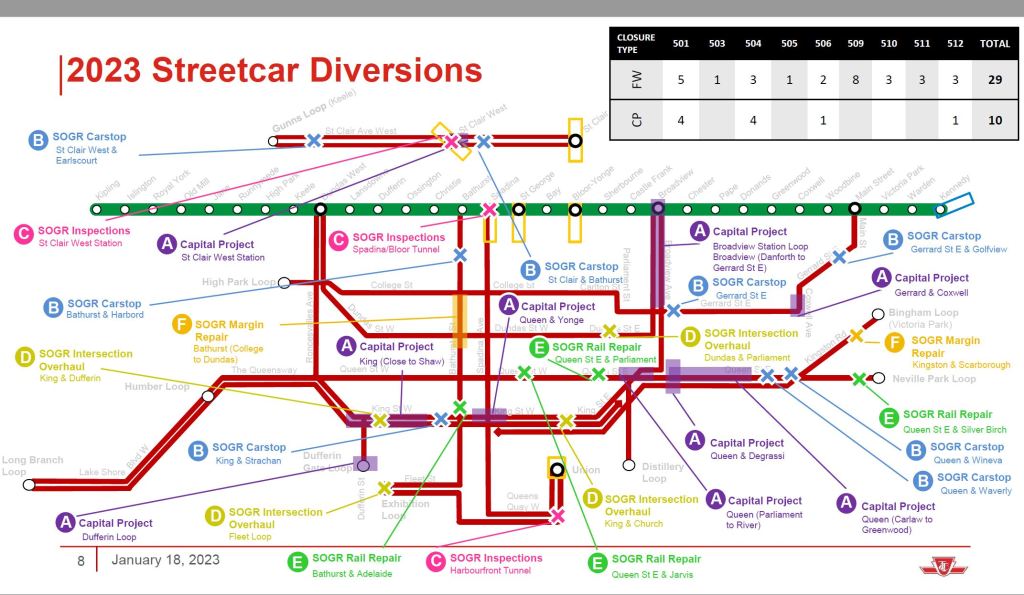
The major trackwork planned in 2023 is listed both in the report (starting on p 19) and on the TOInview map of City construction projects. The schedule implies that a good chunk of the streetcar system will be shut down at various times during the year. The Ontario Line contributes some of this to the Queen car, but the long-suffering riders on King do not get a break either after years of work at King-Queen-Roncesvalles. Note that Adelaide from York to Victoria is a Metrolinx project and so does not appear in this list.

Some of the dates in the TTC list do not align with info on TOInview. This is very common.

Parts of the schedule simply do not make sense. Some projects have far more time reserved than they should take based on past experience. Some projects will block the routes from carhouses in the east end to the rest of the network either via Queen Street or via Coxwell and Gerrard Streets, and times for these overlap.

Update: The TTC confirms that planned work on Gerrard Street will not occur at the same time as projects on Queen will block access to Leslie Barns and Russell Carhouse. See the map at the end of this section for a graphic view of the planned work.

Details of the Broadview Station Loop expansion are not yet available, nor is it confirmed whether this will actually occur.

I hope to get clarification of what is going on from the TTC.

  • Feb 27-Mar 26: King Street West from Close to Strachan
  • Mar 10-Oct 29: Dufferin Loop
  • Mar 24-Nov 28: Queen Street East from Carlaw to Leslie & Leslie to Greenwood
  • Mar 31-Apr 7: Intersection of King & Church
  • May 1-Nov 29: York from Queen to Adelaide (Ontario Line diversion)
  • May 6-July 8: Intersection of Lower Gerrard & Coxwell
  • May 6-Nov 21: Russell Yard
  • May 14-Nov 8: Broadview from Gerrard to Broadview Station
  • June 18-July 29: Intersection of King & Parliament
  • July 30-Nov 18: Metrolinx work at Queen/Degrassi overpass
  • Sept 3-Oct 2: Broadview Station Loop
  • Sept 7-Oct 29: Queen from Parliament to River & Davies to Broadview
  • Oct 8-Dec 16: Oakwood Loop
  • Oct 16-Feb12: St. Clair West Station Loop

The report does not list specifics for 2024, but info already appears on the TOInview map. It is not clear how some of this work will interact with Metrolinx Ontario Line construction at King & Bathurst. There is a proposed track and lane realignment at Bathurst & Fleet, but it is not clear whether this will actually occur, or if the planned work is simply replacement of existing special work as is. Details of the Spadina Station streetcar loop expansion are not yet available.

  • St. Clair & Yonge
  • St. Clair & Bathurst
  • Queen St. W from O’Hara to Triller
  • King St. W from Strachan to Spadina
  • King & Queen (Don Bridge)
  • Bathurst St. from Queen to Front
  • Bathurst & Queen
  • Bathurst & Fleet
  • College St. from Bay to Yonge
  • Main & Gerrard
  • Russell Yard (continuing from 2023)
  • Expansion of the streetcar platform at Spadina Station Loop

Update: The following map was included in the staff presentation to the Board on January 19, 2023.

This map contains several geographic errors:

  • The project labelled Queen & Yonge points at King & Spadina.
  • The project for St. Clair & Bathurst is shown east of St. Clair West Station rather than west of it.
  • The project for St. Clair & Earlscourt is shown well west of Lansdowne rather than east of it.
  • Carstops on Queen East at Wineva and at Waverley are shown as west of Kingston Road rather than east of it.
  • The project for Queen & Jarvis is shown well west of Yonge.
  • The project for Fleet Loop actually points to Exhibition Loop.

There are a few more, but my point in cataloguing them is that this is sloppy work and it speaks to the quality of information presented to the Board by management.

Pantograph Conversion

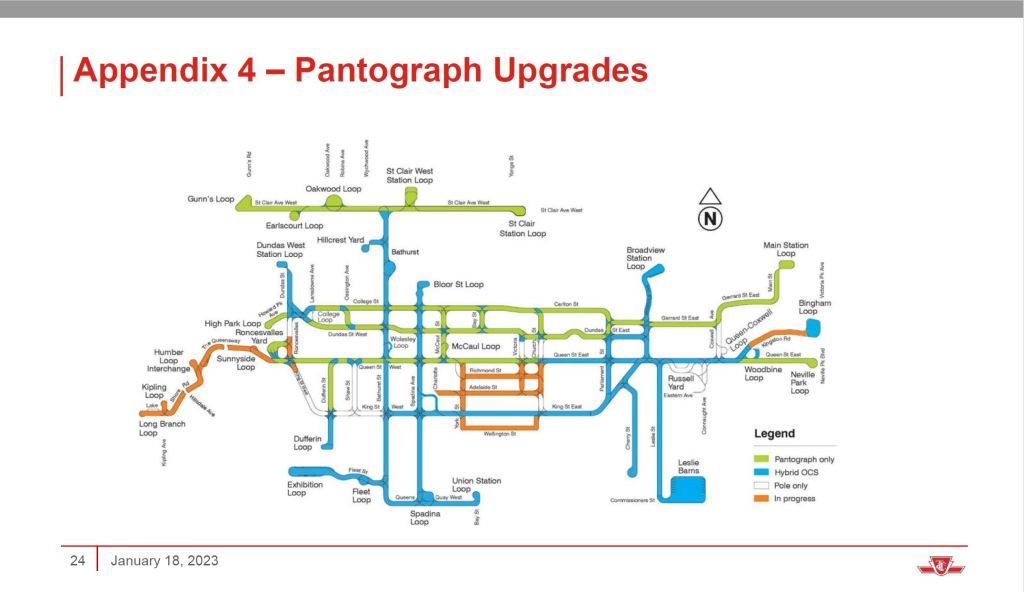
Gradually, and several years behind the original target date, the TTC has converted overhead wiring designed for trolley poles first to a hybrid pole/pantograph configuration, and then to pure pantograph style. A map of the current status was included in the staff presentation.

There are some problems with this map which is based off of a track plan that is itself out of date. “Wrong way” track has been removed from the one-way streets downtown, although it still appears here. Also, some work is underway on King West even this is not shown with the orange “in progress” colour. The intersection of King & Shaw had already been converted to Hybrid format when I visited it a month ago. (There are other errors in the map, but please don’t bother commenting with fixes.)

One amusing relic is the legend “Hillsdale Ave” on Lake Shore Blvd West. This was the site of a long-removed wye, the last in the system, and the street is called “Hillside Ave”. “Hillsdale” is in North Toronto.

Again, this is an unfortunate example of how the “official” records of the system are out of sync with actual conditions in the field.

Spadina vs Bathurst: The Great Race Revisited

Back in August 2021, I published an article about running times on the 510 Spadina streetcar including comparisons with the nearby 511 Bathurst car. Despite being on its own right-of-way, the Spadina car is almost always slower than the Bathurst car.

There are various reasons for this including double stops at signalled intersections and longer stop service times due to the demand level on Spadina.

That article used May 2021 data which reflected mid-pandemic traffic conditions. With demand and traffic rising in past months, I return to the subject using October 2022 data.

The situation has not changed much in the intervening year and a half. 511 Bathurst cars still win the race during most time periods, although on a few occasions the 510 Spadina cars take the prize.

Comparing Travel Times

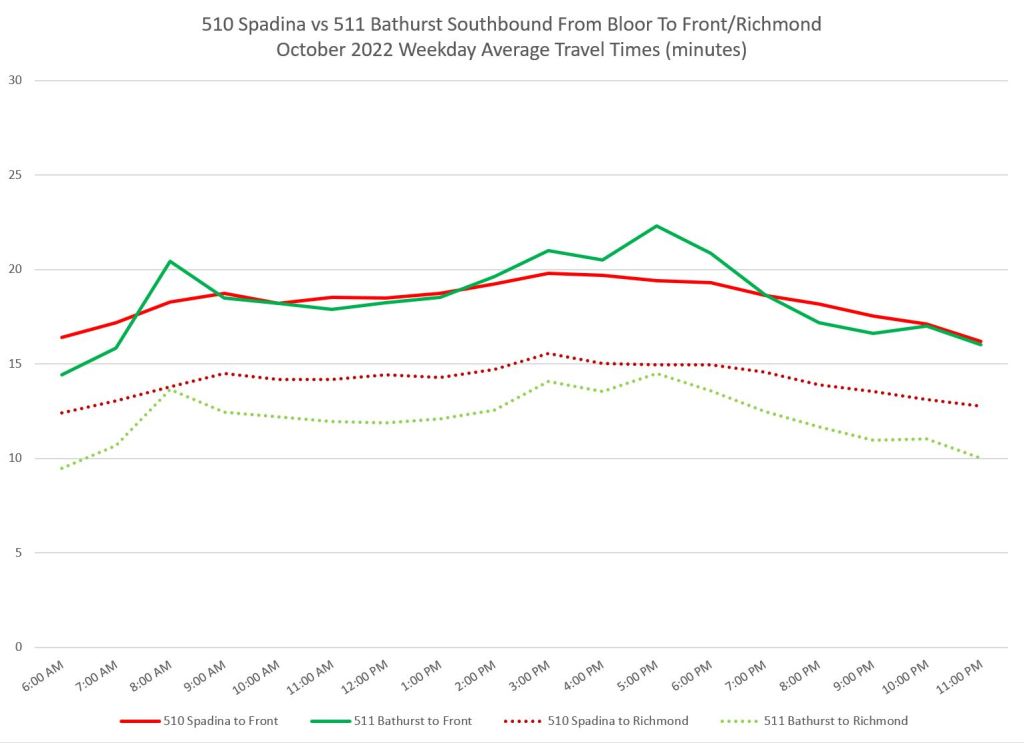
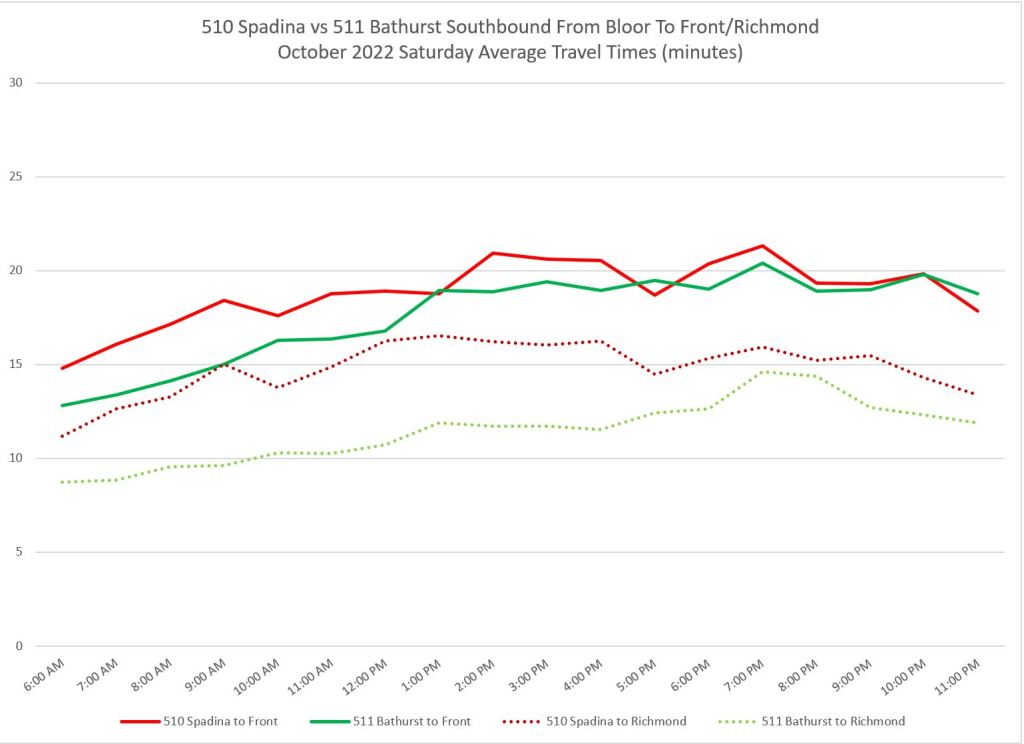
Here are comparative running time averages for October weekdays on the two routes. Two sets of values are shown here:

  • The solid lines show average travel times between Bloor and Front each way.
  • The dotted lines show the average travel times between Bloor and Richmond each way avoiding problems with congestion and enroute layovers at the south end of these lines.

Throughout these charts, data for Spadina are plotted in red while data for Bathurst are in green.

During most weekday periods, Bathurst cars have the lower average travel time between Richmond and Bloor, but the results are mixed between Front and Bloor.

Here are the comparable charts for Saturdays and Sundays. Bathurst almost always wins out.

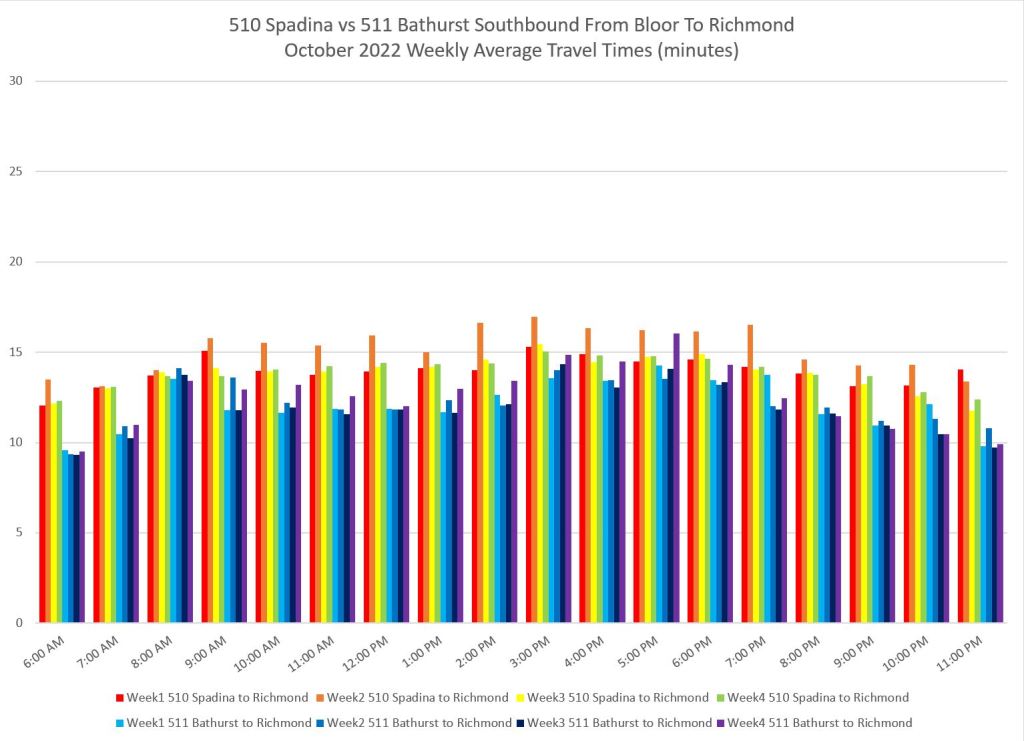
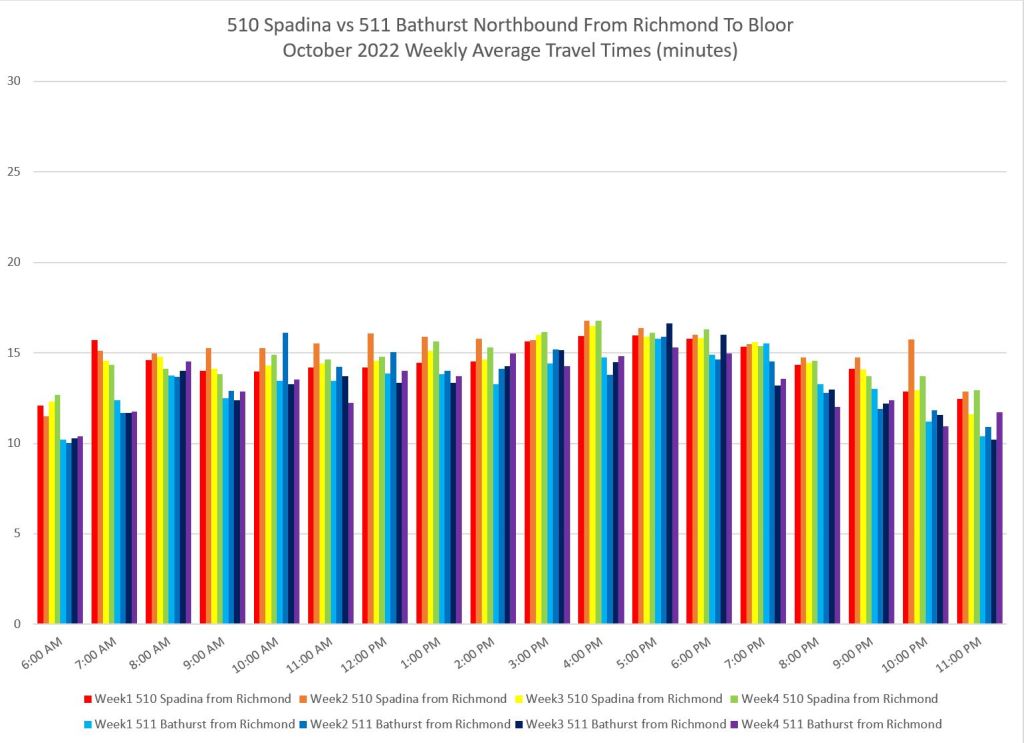
The charts below subdivide the weekday data by week to show that the numbers are not always exactly the same. There is even more variation on a day-to-day basis. I include these to illustrate the importance of not taking averages over long periods at face value because this can hide variations.

In these charts, the warmer colours (red through light green) show data for the Spadina car while the cooler colours (blues and purple) show the Bathurst car.

These charts show the general shape of average data, but more a more detailed view is needed to compare the routes’ behaviour.

Continue reading

TTC Service Changes Effective September 4, 2022

Updated:

  • The spreadsheet detailing all of the changes has been added at the end of this post.
  • The number of the Mimico GO shuttle has been corrected to 176.
  • Transfer arrangements at Queen & Dufferin for the 501 bus and streetcar services have been clarified.
  • Transfer arrangements at Queen & Roncesvalles for the 501 and 504 bus services have been added.

Updated September 5, 2022:

  • The spreadsheet listing all of the changes has been corrected for route 504 King. The original version included a description of the route carried over from the August version. This has been changed to reflect the September arrangements.

The TTC will make many changes to its scheduled service on September 4, 2022 with restorations of previous service levels on many routes. This will not get the system back to 100% of pre-pandemic levels.

An important distinction is between three values:

  • The amount of service scheduled before Spring 2020
  • The amount of service budgeted for 2022
  • The amount of service scheduled for 2022

The TTC plans to be back to 97% of budgeted service for bus, 84% for streetcar and 92% for subway. The overall numbers are compared below.

Hours/WeekRegularConstructionTotal
January 2020 Scheduled185,8257,068192,893
September 2022 Budgeted186,3796,398192,777
September 2022 Scheduled177,9304,965182,895

In the original 2022 service budget, the TTC planned to be back to roughly the same level of service as in January 2020 by September 2022. However, slower ridership recovery coupled with staffing constraints produced a lower scheduled service expressed as hours/week.

There are further caveats:

  • The distribution of hours by time of day might not be the same in 2022 as in 2020 because of changing demand patterns.
  • Changes in running times to deal with congestion or service reliability can mean that the same service hours are stretched over wider headways. Not all vehicle hours are created equal.

All that said, there are many changes in service levels, and with the bus network being back to 97%, the schedules for September 2022 are often based on old versions before service cuts were implemented. Another change for this month is the reintroduction of school trips on many routes.

Continue reading