Queen’s Quay Track Construction (Updated November 15, 2012)

Updated November 15, 2012 at 7:00am:

Demolition of the trackbed has progressed eastward to Rees Street.

With the eastbound road lanes now closed, passengers looking for the replacement bus service have a considerable challenge as there is no signage anywhere at the former eastbound stops indicating that buses are now operating on Lakeshore and Harbour.

Continue reading

TTC Rediscovers the Downtown Relief Line (Update 4)

Update 4 October 21, 2012 at 8:30 pm:

It’s intriguing to look back at coverage of the DRL the last time this was a major issue.  Mike Filey passed along a clipping from the Star from December 2, 1982 that makes interesting reading.  My comments are at the end in Postscript 2.

Update 3 October 20, 2012 at 3:20 pm:

A postscript has been added discussing the various demand simulations as a group rather than individually.  Charts of total demand southbound from Bloor Station as well as pedestrian activity at Bloor-Yonge are provided to consolidate information from several exhibits in the background paper.

Update 2 October 19, 2012 at 11:00 am:

This article has been reformatted to merge additional information from the background study as well as illustrations into the text.

At its meeting on October 24, 2012, the TTC will consider a report on the Downtown Rapid Transit Expansion Study.  The full background paper is also available on the TTC’s website.

A study by the City of Toronto and TTC, including consultations with Metrolinx, concludes that transit demand to the core by 2031 will grow at a rate that exceeds the capacity of all of the current and planned transit facilities.  Ridership will be 51% higher than today.  The residential population south of College from Bathurst to Parliament will grow by 83%, and employment by 28%.

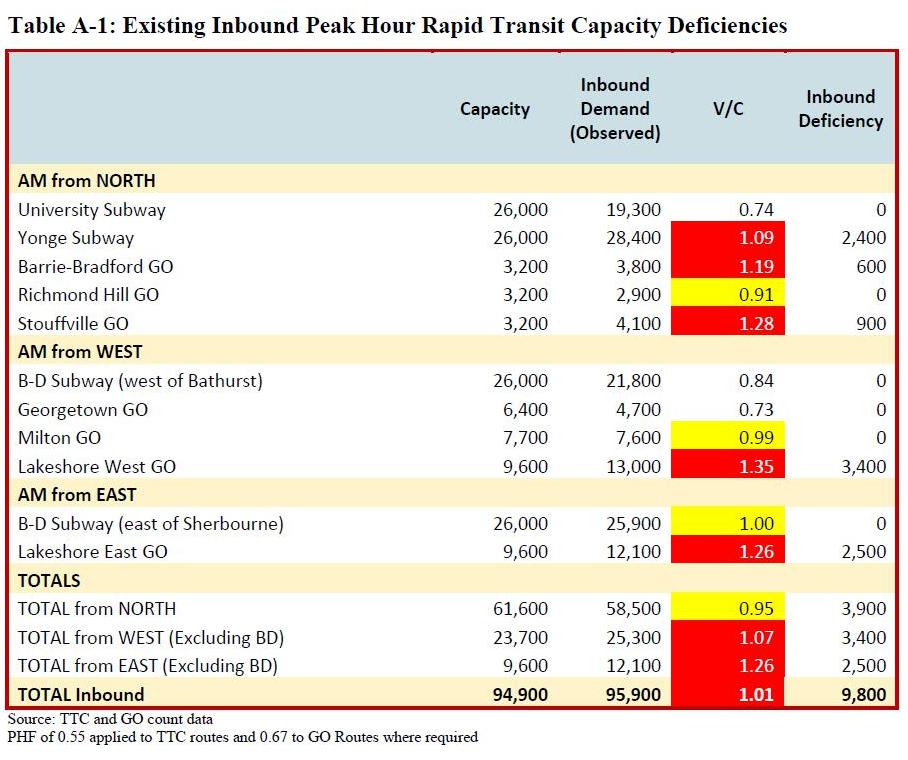
Capacity is an issue today as Table A-1 in the background paper shows.  Several corridors into downtown are already operating over their design capacity.  This is particularly the case on GO where the target is to have few standees, and there is more room for additional passengers in the design capacity than on the TTC subway services.

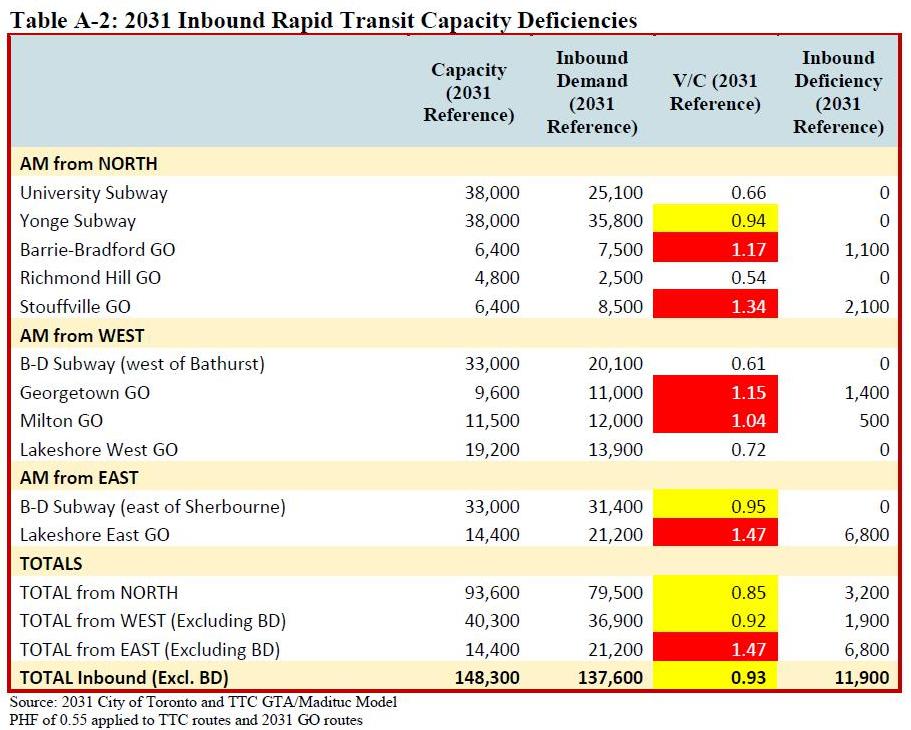
Table A-2 shows the projections for 2031.  All of the shortfalls are on GO, but the TTC lines are close to saturation.  This presumes a considerable increase in the capacity of various lines.  For example, the YUS goes from a design capacity of 26,000 to 38,000 passengers per hour (pphpd), an increase of 46% which may not actually be achievable.  Similarly, the BD line goes to 33,000 pphpd, an increase of 27%.

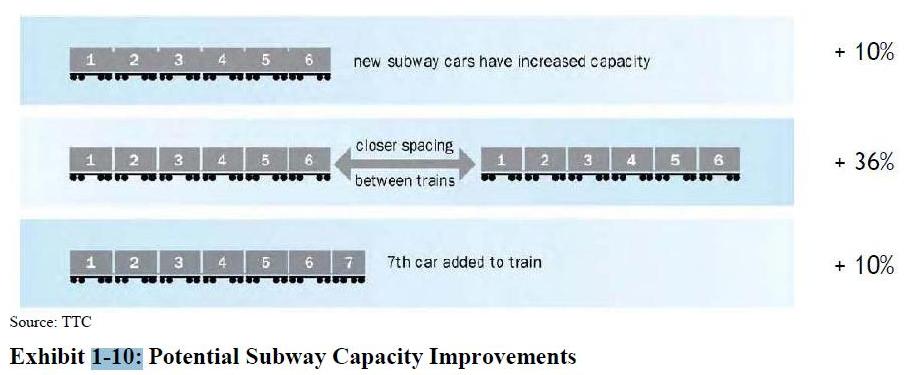
Exhibit 1-10 shows the components of projected capacity increase including 36% from running trains closer together.  As discussed at some length on this site previously, the constraints on headways arise at terminal stations.  A 36% increase in trains/hour implies a headway of about 100 seconds as compared with 140 today.  This cannot be achieved with existing terminal track geometry, not to mention the leisurely crew practices at terminals.

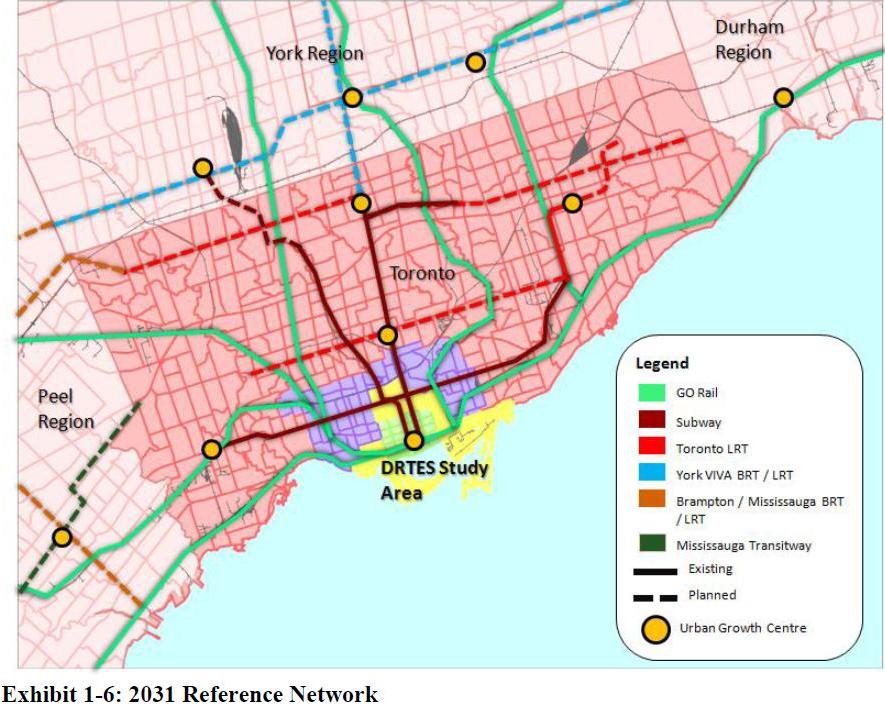
On the GO lines, the projected capacity on Lakeshore West doubles, and smaller increases are seen on other routes.  It is worth noting that the projected capacity of the north-south corridors to Stouffville, Richmond Hill and Barrie are nowhere near the level of service implied by The Big Move, probably because these lines are not targets for early electrification.  This contributes to the capacity shortfall in the northern sector.  Recommendation 1 of the study includes encouragement that Metrolinx review the possibility of increased capacity in those three corridors.

The full list of lines included in the modelled network can be found in the background study at section 1.2.1.

Continue reading

Waterfront East LRT: Will This Ship Ever Sail? (Updated)

Updated September 4, 2012:

The full set of Waterfront Toronto reports and the City Manager’s recommendations arising from them are now available in the Executive Committee Agenda for September 10.

I will not attempt to summarize all of the material in these, but a few critical points deserve mention.

  • Although the revitalization of the mouth of the Don River is a central theme in this entire project, and illustrations showing the effect abound in the reports and publicity, in fact this work has been relegated beyond the 30-year timeframe of the financial projections.  The river mouth changes are in “phase 4” which is beyond the 30-year line.
  • Similarly, transit improvements to the area beyond the level of bus service, possibly but not necessarily as BRT with dedicated rights-of-way, are pushed off to phase 3 and beyond.  Transit is now described as “demand led” rather than the “transit first” policy around which much of the East Bayfront and Port Lands were being planned.
  • The connection to Cherry Street under the rail corridor is not even costed in the report and lies off in the vague future.

The fundamental problem for Waterfront Toronto and for the City is that the economics of a self-financing project simply do not work.  In the City Manager’s report, some shuffling of components allows the scheme to show a “profit” in the short term, the first decade, by the expedient of delaying or dropping expenditures to future years.

The City Manager’s Report shows the evolution of the costing model.  The first cut (page 4) used conservative assumptions and produced a net cost of $189.2m for the first 30 years.  This was reworked (page 5) with more generous assumptions to achieve a positive cash flow in the first decade, and a reduced net cost of $118m over 30 years.  Note that the tables are clearly titled “phases 1 and 2” and therefore omit costs associated with the river mouth and with the upgrade of transit services to LRT.

As someone who has been involved in many of the public discussions of these plans, I am deeply disappointed on three counts:

  • The shift of “phase 3” beyond the 30-year line was not made clear by Waterfront Toronto in its recent public meetings.  This verges on dishonesty from an organization previously well-known for plain dealing with the public.
  • The idea that Toronto would pre-build a good network of transit lines into the waterfront districts has been abandoned, and we are back to the standard TTC approach of running a bus, now and then, once a few people start to complain about service.
  • The myth that private sector development will somehow relieve the City (or other levels of government) from funding the Port Lands revitalization is exposed for what it is.  If Toronto wants to reinvigorate this huge tract of land, it will have to invest money in the process.  This issue — how to actually pay for the waterfront and what staging strategies could be taken — is completely absent.  Council is asked to approve the proposed scheme without knowing what alternatives might be available or what financing strategies would be needed to achieve them.

Building new neighbourhoods of this scale requires major investment in infrastructure and in the operating cost of providing services.  If Toronto is not prepared to pay these costs, then the Port Lands will sit empty for a long time.  Someone may propose they be rescued with a special project such as an Olympic Games or a World’s Fair.  That’s wishful thinking, and simply playing the slots at a race track may prove a better investment.  We cannot make the future of the waterfront dependent on the world’s desire to let us put on a big party.

The original article from August 12 follows the break …

Continue reading

Service Changes Effective September 2, 2012 (Updated)

September 2012 will bring the restoration of “winter” service levels on routes across the system as well as many service improvements.  Most of these occur in the off-peak period thanks to constraints on the size of the fleet and of the operator workforce.

The bus fleet is constrained in the peak period by the many construction projects now underway.  These require either bus/streetcar substitutions, or additional vehicles on bus routes to deal with congestion.  Some of these will end as the fall progresses.

Updated August 26, 2012:

A fare policy experiment will begin on the 38 Highland Creek bus on September 1 and will run through until April 27, 2013.  Riders with GO fare media will be allowed to ride free between Rouge Hill GO Station and University of Toronto Scarborough Campus.

Summer Services

Seasonal services will end after Labour Day on the following routes:

  • 101 Downsview Park weekday service
  • 29 Dufferin to Princes Gates (the limited service that would remain will not operate to the CNE due to a construction diversion)
  • 30 Lambton service to High Park
  • 72B Pape service to Cherry Beach weekday daytimes and weekend evenings
  • 86 Scarborough to the Zoo (extended hours weekday evenings, weekend route extension)
  • 85 Sheppard East to the Zoo (extended hours weekends)

Rapid Transit Changes

The Yonge-University-Spadina subway will see improved midday service, and the transition between the AM peak and midday will be smoothed.

Running times on the Scarborough RT will be extended and headways will be widened.  This change is intended “to better reflect actual operation”.  How it will affect the SRT’s ability to actually operate all of its scheduled service (the target now is to operate at least 80% of planned trips) is a matter for conjecture.

Waterfront Changes

Service on 511 Bathurst will be cut from the summer levels, but will remain above the normal winter schedules to compensate for the construction on Queen’s Quay and on Spadina.

Service on the 509 Harbourfront bus will be cut slightly from summer levels.  However, all 509 buses will now operate to Exhibition and this will recover the time now wasted by many of them laying over in Spadina Loop.  Service west of Spadina will be greatly improved.

The 6 Bay bus will be restructured to provide somewhat improved service to the eastern waterfront and the new George Brown College campus.  In August, the Dundas branch of the route was extended south to Queen’s Quay.  Beginning in September, a new 6C Union to Queen’s Quay service will be added.

The combined service south of Front will see considerable improvement:

  • AM peak from 6’30” to 2’27”
  • Weekday midday from 12’00” to 6’40”
  • PM peak from 10’20” to 3’20”
  • Weekend afternoons from 15’00” to 7’30”

The 75 Sherbourne bus will also see improved service for the George Brown campus:

  • AM peak from 9’00” to 7’30”
  • Weekday midday from 12’00” to 9’00”
  • PM Peak from 10’00” to 8’30”
  • Saturday afternoon from 20’00” to 11’00”

Construction Route Changes

Dufferin street trackage will be rebuilt north from Dufferin Loop to Queen (skipping over the intersection at King) beginning in September.  The 29D Princes Gates service will divert to operate southbound via the “old” Dufferin routing of Peel and Gladstone to Queen, then east to Shaw, south to King, west to Mowat, south to Liberty, east to Fraser and north to King.  The northbound buses will follow the route via Shaw and Gladstone back to the regular route.

The temporary service arrangements for the routes operating on Queen Street will remain in effect with streetcars diverting between Broadview and Coxwell via Gerrard.

2012.09.02 Service Changes

How Can Transit Serve a Revived Ontario Place?

Today a Ministerial Advisory Committee headed by former Ontario PC leader John Tory released its analysis and recommendations for the future of Ontario Place.

For those readers who are not familiar with Toronto, Ontario Place is a park opened in 1971 with then-futuristic architecture on the shore of Lake Ontario west of downtown Toronto and immediately south of the Canadian National Exhibition grounds (now known as Exhibition Place).  Over the years, its attractiveness faded and much of the site was recently closed pending a review of its future.

Access to the site has always been a problem because the transit loops are at the north side of Exhibition Place over 600m from the entrance bridge to Ontario Place, provided that events within Exhibition Place itself do not block off a straight route south.  The recent Indy car races and the annual CNE itself are two good examples.

Forty years ago, the Ontario Government toyed with a magnetic levitation train under development by Krauss Maffei.  A trial installation of a one-way loop around the grounds was proposed, but all that was ever built was a few foundation slabs and pylons for the elevated guideway.  This project ran out of steam when the German government, a partner with KM, withdrew its funding.  Technical problems also arose, and a simplified version of the technology appeared roughly a decade later as the Scarborough RT replacing the originally proposed LRT line in that corridor.

Many years later, the Waterfront West LRT proposal included a route turning south (and underground) from current point of entry to Exhibition place, under Princes Boulevard (the main east west street in the park), and emerging into the land now occupied by the Ontario Place parking lot.  This scheme was strongly opposed by Ontario Place management who preferred to cater to motorists coming to their site rather than transit riders.

Within Transit City, there is also a Waterfront West LRT.  Its alignment through Exhibition place included various options differing mainly in whether the route followed the north or south side of the park.  Because the WWLRT was seen as an “express” route to southern Etobicoke (a dubious claim at the best of times), a southern route was seen as taking passengers “out of their way”.  Sadly, there has been no recent examination of transit to Exhibition Place as opposed to through it.

The Advisory Panel’s report includes a short section on transit to Ontario Place on pages 45 to 47.  This includes:

ONTARIO PLACE IS UNDERSERVED BY PUBLIC TRANSIT.  TTC streetcars and the GO Train do not go to Ontario Place. Streetcars go as far as Exhibition Place, and the commuter GO Train service provides access at the GO Exhibition station that is adjacent to the streetcar loop. The only mode of public transportation that goes directly to Ontario Place is the Dufferin Street bus — but this is only in the summer season.

Well, no, the Dufferin bus does not GO to Ontario Place per se, only to a loop along Princes Blvd provided that it is physically possible to operate buses on this route.  This service is infrequent presuming that it is not short-turned.  (Some of the Dufferin buses did run south to Ontario place in 2011, but this operation was dropped for 2012 because Ontario Place closed.)

The Advisory Panel recommends that parking for Ontario Place be provided in either a parking structure (under of above ground) or by Exhibition Place which has a vast amount of parking most of the year long.

Among the options proposed by the Panel are:

WE SEE A NUMBER OF OPTIONS TO IMPROVE THE ACCESS REQUIRED to generate the crowds Ontario Place needs to attract:

First extend Dufferin Street further south to provide direct bus access to the area and extend the streetcar loop from Exhibition Place.

Second, create more north south pedestrian and cycling paths.

Finally, bicycle storage and rental locations must grow — to encourage riders to bring their own bicycles, and to link to the growing network of bicycle rentals.

Notable by its absence is any mention of the implications improved north-south access through Exhibition Place will have for events that now take over the entire park.

This brings us to a recommendation:

RECOMMENDATION 18

Working with the PRIVATE SECTOR and PROVINCIAL and MUNICIPAL PARTNERS, Ontario Place should explore NEW PUBLIC TRANSIT OPPORTUNITIES to better access the western lakeshore area. [Caps are in the original text]

It is unclear what exactly is meant by a private sector role in “new public transit opportunities”.  The fundamental point in any transit scheme is that only with very high, sustained demand is there any hope for profitability and hence attractiveness of any scheme to the private sector.

Possibly Queen’s Park hopes to recycle the bits of infrastructure dating back to the Mag-Lev scheme, or hopes for someone to propose a monorail loop around the grounds as an alternative to extending the streetcar/LRT trackage.  This would impose a needless transfer for riders trying to reach any development on the south side of Exhibition Place.

Finally, Metrolinx has its own scheme to bring the “Don Mills / Downtown Relief Line” west from a proposed GO terminal at Bathurst Street into Exhibition Place.  If that’s a goal, and it will happen quickly (not very likely), then this will compete with other proposals that would be termed “short term”.

As with the eastern waterfront, planning for transit to the western waterfront has been a slipshod affair between the TTC, the City, Waterfront Toronto and Metrolinx.  If we are serious about redeveloping Ontario Place and the lands along Lake Shore Blvd., we must include good transit as an essential part of any plan.

Updated July 28:  The Globe & Mail weighs in with an article (the print version includes a large map).

The Fate of OneCity (Updated)

Several postmortems have appeared on blogs about the supposed death of OneCity and what might follow:

Updated July 19, 2012 at 7:00 am:

Updated July 16, 2012 at 11:15am:

My own take on OneCity’s fate together with the original article detailing proposals for dealing with transit planning follow the break.

Continue reading

OneCity Plan Reviewed

The OneCity plan has much to recommend it even though in the details it is far from perfect.

The funding scheme requires Queen’s Park to modify the handling of assessment value changes, and they are already cool to this scheme.  Why OneCity proponents could not simply and honestly say “we need a 1.9% tax hike every year for the next four years” (not unlike the ongoing 9% increases to pay for Toronto Water infrastructure upgrades) is baffling.  A discussion about transit is needlessly diverted into debates about arcane ways of implementing a tax increase without quite calling it what it is.

On the bright side, Toronto may leave behind the technology wars and the posturing of one neighbourhood against another to get their own projects built.  Talking about transit as a city-wide good is essential to break the logjam of decades where parochialism ruled.  Couple this with a revenue stream that could actually be depended on, and the plan has a fighting chance.  Ah, there’s the rub — actually finding funding at some level of government to pay for all of this.

Rob Ford’s subway plan depended on the supposed generosity of Metrolinx to redirect committed funding to the Ford Plan (complete with some faulty arithmetic).  Similarly, the OneCity plan depends for its first big project on money already earmarked by Metrolinx to the Scarborough RT to LRT conversion.  If this goes ahead, we would have a new subway funded roughly 80% by Queen’s Park and 20% by Toronto.  Not a bad deal, but not an arrangement we are likely to see for any other line.

On the eastern waterfront, there is already $90m on the table from Waterfront Toronto (itself funded by three levels of government), and OneCity proposes to spend another @200m or so to top up this project.  Whether all $200m would be City money, or would have to wait for other partners to buy in is unclear.

Toronto must make some hard decisions about a “Plan B” if the Ottawa refuses to play while the Tories remain in power.  Even if we saw an NDP (or an NDP/Liberal) government, I wouldn’t hold my breath for money flowing to Toronto (and other Canadian cities) overnight.  A federal presence is a long term strategy, and spending plans in Toronto must be framed with that in mind.

Sitting on our hands waiting for Premier McGuinty or would-be PM Mulcair to engineer two rainbows complete with pots of gold landing in Nathan Phillips Square would be a dead wrong strategy.  Bang the drum all we might for a “one cent solution” or a “National Transit Strategy”, Toronto needs to get on with debating our transit needs whether funding is already in place or not.  Knowing what we need and want makes for a much stronger argument to pull in funding partners.

In some cases, Toronto may be best to go it alone on some of the smaller projects, or be prepared to fund at a higher level than 1/3.  If transit is important, it should not be held hostage by waiting for a funding partner who will never show up.

The briefing package for OneCity is available online.

My comments on the political aspects of OneCity are over at the Torontoist site.

To start the ball rolling on the technical review of the OneCity network, here are my thoughts on each of the proposals in the network. Throughout the discussions that will inevitably follow, it is vital that politicians, advocates, gurus of all flavours not become wedded to the fine details. Many of these lines won’t be built for decades, if ever, and we can discuss the pros and cons without becoming mired in conversations about the colour of station tiles.

Continue reading

“One City” To Serve Them All

Updated June 27 at 5:20pm:  I have written a political analysis of today’s announcement for the Torontoist website that will probably go live tomorrow morning.  A line-by-line review of the plan will go up here later the same day.

TTC Chair Karen Stintz and Vice-Chair Glen De Baeremaeker will formally announce a new plan called “One City” on June 27 at 10:30.

The plan already has coverage on the Star and Globe websites.  Maps:  Globe Star

I will comment in more detail after their press conference, but two points leap off the page at me:

  • The proposed funding scheme for the $30-billion plan presumes 1/3 shares from each of the Provincial and Federal governments.  This money is extremely unlikely to show up, especially Ottawa’s share.  From Queen’s Park, some of the funding is from presumed “commitments” to current projects such as the Scarborough RT/LRT conversion which would be replaced by a subway extension.  The rest is uncertain.
  • The “plan” is little more than a compendium of every scheme for transit within the 416 that has been floated recently in various quarters (including this blog).  What is notable is the fact that glitches in some of the existing ideas (notably the fact that the Waterfront East line ends at Parliament) are not addressed.  The whole package definitely needs some fine tuning lest it fall victim to the dreaded problem of all maps — once you draw them, it’s almost impossible to change them.

For those who keep an eye on political evolution, the brand “One City” surfaced in April 2012 in a speech made by Karen Stintz at the Economic Club of Canada.  This idea of a new, unifying transit brand appears to have been cooking for some time.

Queen’s Quay West Construction Schedule Announced

Waterfront Toronto has announced the schedule for reconstruction of Queen’s Quay between Spadina and Bay based on the long-awaited design by West 8 + DTAH.

Stage I: Summer 2012 to Summer 2013

The first stage concentrates on utilities and on the streetcar right-of-way.  Works include:

  • Bell will install new duct banks and cabling during June and July 2012.
  • Toronto Hydro will install new splicing chambers and cabling to replace existing worn-out infrastructure.  This work begins in July 2012 and will run for a year.
  • A new sanitary sewer will be built in three stages (Rees to York, Bay to York, Lower Spadina to HTO West), and new storm sewers will be built in two areas (York to Bay, 350 Queen’s Quay to Rees).  This will replace existing aging sewers.
  • The TTC right-of-way will be completely rebuilt from the portal west of Bay to just east of Spadina.  The new alignment is slightly different from the existing one, and will include wider platforms (2.4m).  Streetcar service will end on July 29, 2012, but demolition of the right-of-way will not start until the fall with the new corridor to be completed by late spring 2013 when the line will be electrified and streetcar service will resume.  The TTC will also be replacing the track in the Bay Street tunnel (new rails are already in place in the tunnel).
  • During construction a replacement bus service will operate for route 509.  The service will run westbound on Queen’s Quay and eastbound on Lake Shore Blvd.  The connection to Union Station will be via north on York, east on Front, south on Yonge.  While Front is impassible due to construction, the route will be via York, Adelaide, Bay and Front to Yonge.
  • Also in 2012 (as previously reported), there will be interim improvements to the pedestrian and cycling infrastructure from Bay to Jarvis to better link the eastern waterfront to the central portion.

Stage II:   Summer 2013 to Early 2014

The second stage concentrates on the north side of Queen’s Quay to reconfigure the roadway, rebuild the sidewalks and install tree pits ready for planting (which will be timed to benefit the trees even if the civil works are ready earlier).

The TTC will rebuild the intersection and loop at Spadina & Queen’s Quay over three weekends (one each for the intersection, the loop exit on Spadina and the loop entry on Queen’s Quay).  Streetcar service will be suspended for these weekends.

During this work, all road traffic will use the south side (existing eastbound) lanes on Queen’s Quay.  When the new north side is ready, traffic will be switched to the new lanes.  A new traffic crossover with signals will be installed west of Spadina so that eastbound cars can get from the existing lanes south of the streetcar right-of-way to the new north-side alignment.  Eventually, when it is time to rebuild the section from Spadina to Bathurst, this crossover will be eliminated because all motor traffic will be north of the streetcar lanes.

Stage III:  Early 2014 to Late 2014

The south side lanes and the sidewalk will be demolished.  They will be replaced with a new expanded promenade and with the Martin Goodman Trail (bike path).  Planting of the new double row of trees planned for this part of the street may be deferred to spring 2015 to ensure that the trees will survive.

General

The cost of this project is about $110-million of which $90m comes from Waterfront Toronto, $10m from the TTC and the balance from various utilities.  Waterfront Toronto will lead the construction work so that all sub-projects are co-ordinated and the disruption to any one part of Queen’s Quay is kept at a minimum.  There has already been extensive consultation with business and residents, and this will continue through the project to head off problems as they arise.

Sidewalks on both sides of Queen’s Quay will be laid with granite cobbles in a two-tone mosaic with a maple-leaf outlined in the pattern.  The total number of cobbles will be about 2.3-million with about 40% on the north side and 60% on the wider south side promenade.  Granite curbs will be used at the sidewalk edges.

Two public meetings will go into this project in more detail.

Wednesday, June 6 at Harbourfront Centre, Brigantine Room, 7-9 pm.  This meeting will include presentations on many projects underway in different parts of the waterfront.

Saturday, June 9 at Waterpark Place Lobby, 20 Bay Street, 10am-2pm.  This meeting will show detailed construction plans for the various phases and is intended for residents and businesses who want to see the final design and ask detailed questions.

Some information and images are available on Waterfront Toronto’s website.  The Fact Sheet contains details additional to the summary above.

Streetcars in the Eastern Waterfront (Well, Track Anyhow) (Update 3)

Updated May 25, 2012:

Port Lands

Waterfront Toronto’s public meeting on May 24 drew an audience of about 300.  The presentation droned on for well over its allotted time, and consisted mainly of reading through a Powerpoint deck without benefit of a working laser pointer to highlight items of interest on the screen.  Oh well.  No marks for Management Presentation 101.

The content was more important than the style, and what came through loud and clear was that planning by bean counters has replaced planning with a vision for a great waterfront.

Council may have stopped the Fords in their tracks last fall, but Waterfront Toronto is clearly working to a penny-pinching agenda.  This shows up in two major ways.

First, although the most recent plan (see page 12 of the presentation, right side is the newest) attempts to create more greenspace on the water’s edge, it has lost the magic of the revitalized mouth of the Don.  The drawing still shows a river meander, but you have to read the text to learn that the outermost part of this, west of Cherry Street, would not actually be built until and only if the Lafarge Concrete plant decides to close up shop.  Until then, the mouth of the Don will be the Lafarge slip.  In the original plan, the river mouth was north of the slip and could be built independently of the plant.

Second, transit seems to have fallen off of the map.  Something will be built, maybe, eventually, although for the near term we must make do with buses, possibly on a right-of-way.  Waterfront Toronto is obsessed with the problems of connecting to Union Station (and associated costs as discussed elsewhere on this site), but seems to forget that an alternate option from the east end of the harbour, certainly from the Port Lands, is to go north via Cherry to King.  Some of the staging of upcoming projects could support this, but bits are missing, and there is little sense that anyone really is looking beyond a bus route here and there.

Neither of these situations went down particularly well with the attendees.  Examples of “transformational initiatives” (for which you absolutely positively must not ever dream they might mean “casino”) from other cities are included (Page 18), but as one speaker remarked, it is the river that is the “transformation”, the jewel of the project.  Indeed, Waterfront Toronto can hardly stop themselves from talking about the international recognition the design received, a design which depends on the river mouth, now relegated to a “phase 5, maybe” status.

Many spoke about the need for good transit to the site.  The staging (Page 25) could support a through LRT service, but only partly in the early years.  Stage 1 includes realignment of Cherry and Queen’s Quay, but it does not include a new Cherry Street bridge over the Don (essential for an LRT line running south to the Keating Channel), nor does it include widening of the Cherry underpass at the rail corridor (essential for connecting north to the Cherry Street streetcar tracks to be installed later this year).

Adrian Morrow in the Globe wrote about the Tiny Perfect Streetcar Line in today’s Globe including the general problem that transit to real development in the waterfront is not on most politicians’ agendas while transit to phantom developments in the suburbs gets no end of attention.  One big problem is that Metrolinx wants nothing to do with waterfront transit and regards this as a local initiative to be paid for on the City’s dime.  I cannot help wondering just how Queen’s Park justifies its investment in many proposals for the 905 that will serve far less development than the waterfront LRT network, but leaves Toronto high and dry.

I may seem unduly harsh on Waterfront Toronto given the pressures they are under from the Monorail Mania at City Hall, but there is too much of a sense of making do, of a loss of emphasis on what will make the eastern waterfront a great place, not just an OK suburb of downtown.  Particularly notable in the presentation was the absence of any explanation of how these lands would relate to nearby existing and future developments, a sense of place in the larger city.  A big problem was that the presenter, a senior Waterfront Toronto exec, didn’t seem really thrilled about what he was showing us, but instead focussed on how the plan saved money, how it addressed the Ford’s desire for more and faster development.  He was playing to the wrong crowd.

The new overall plan for the Port Lands is broken into three stages based on gradual expansion of flood protection that would allow a wider set of land uses in various areas.

Phase 1 (Page 20) creates a spillway parallel to the Don Roadway so that a flood from the river would not inundate lands west of Cherry Street.  This frees up the first set of lands for redevelopment.

Phase 2 (Page 21) raises the Don Roadway itself to create a berm that protects the Film Studio district.

Phase 3 (Page 22) builds the new river mouth and associated parkland/spillway so that land between Cherry and the Don Roadway can be developed.

The presentation notes that the amount of land available for development is larger in the revised plan, but a number of speakers pointed out that by Waterfront Toronto’s own admission, the real estate industry cannot absorb all of the available lands for decades.  Whether there is any value from the “new” land is unclear, although if this falls within, say, Phase 1, it would accelerate revenue from the overall project.

The whole issue was to go to Council imminently, but this has been put off until the fall so that details of how the financing might work can be figured out, and the plan can undergo an external review.  The next public session will likely be in August with the, in effect, final version of the proposal that will go to Council.  If Council approves the new scheme, this will trigger a roughly 18-month process to amend the approved Environmental Assessment.

Central Waterfront

The Waterfront Toronto Board has approved a project to rebuild the sidewalk and bike path (Martin Goodman trail) from Bay to Jarvis Street this summer.  The work will also  include reconstruction of the aging Jarvis Slip’s dock wall and revision of its anchoring system to provide clearance for new telecomm and hydro ductwork that will serve the eastern waterfront.  Some road refinishing will be done to tidy up Queen’s Quay if the budget permits.

The intent is to provide a link to the new developments on Queen’s Quay east that have been isolated from the stylistic changes further west and especially the major redesign of the road to begin this summer.

Governance

The CEO’s Report includes updates on all major projects at Waterfront Toronto (I tend to focus on transit and related issues).  One of the most important notes in this month’s report is:

The province has indicated that it is tracking for a spring/summer approvals process for Waterfront Toronto’s long-standing request for increased operational governance. A scoped consent package has been negotiated with the three orders of government which would provide Waterfront Toronto the ability to borrow, create subsidiaries, receive revenues and encumber its assets. Once provincial approval has been obtained, the federal government will seek its respective approvals likely in the late summer/fall.  (Page 6)

Several projects, including the transit infrastructure for the eastern waterfront, will require new funding sources among which may be new mechanisms within Waterfront Toronto itself.  At the Board meeting, CEO John Campbell was optimistic that senior governments would agree to proposed changes, although he noted that Queen’s Park was particularly sensitive on the matter of creating subsidiaries in the wake of the ORNGE scandal.

Continue reading