Construction That Never Ends (Update 4)

Updated November 14, 2013 at 6:20 pm:

According to the TTC CEO’s report for November, the date for resumption of streetcar service on Queens Quay has been changed to June 21, 2014.  Brad Ross of the TTC advises that their website will be updated to reflect this new target date.

Updated October 26, 2013 at 4:32 pm:

According to the TTC CEO’s report for October (at page 20), service will not resume on Queens Quay until August 2014, not the end of June as previously reported.  I have asked the TTC to verify this date and explain why completion has slipped yet again.

The TTC memo listing service changes for the November and December schedule periods came out today, and it contains a few startling items:

  • The Yonge Subway tunnel liner program, originally expected to wrap up at the end of 2013, will now run an additional year to the end of 2014.
  • The loop at the foot of Queens Quay will not be available for service as expected in November, and service on the 510 streetcar will not resume until mid-February 2014.
  • The track on Queens Quay itself will not be available for service as expected in December/January, and service on the 509/510 streetcar will not resume until the end of June 2014.

Updated October 2, 2013 at 10:25 am:

Waterfront Toronto has posted a Construction Update for the Queens Quay project.

Updated October 1, 2013 at 6:00 pm:

Yonge Subway Tunnel Liners

I have received a note from Brad Ross at the TTC explaining the current situation.  The work has proven more extensive both in complexity and scope than originally thought.  In reply to one comment in this thread, I gave the opinion that all of the asbestos had been removed from the tunnels, but according to Ross, there is still some present and this adds to the slowness of the work.

The tunnel liner project involves the inspection of some 10,000 tunnel liners. To date, 4,000 liners have been inspected, 950 identified in need of repair, and 850 of them repaired. The process is not a speedy one as many of the liners are covered in material, including asbestos, which needs to be removed before a liner can be inspected. Add to that the time it takes for crews to get to the work location, set up, clean up, and return to the yard. As we examine liners, we’re identifying more and more that need to be repaired, mostly due to water damage. In short, the project timeline increases as the work involved increases. We are now working to determine what a reasonable completion date might look like and what the overall impact to subway service north of Eglinton will be over the next 12-18 months. Once we have that, we’ll communicate it widely.

[Email from Brad Ross, Executive Director, Corporate Communications, TTC, October 1, 2013]

Waterfront Toronto Queens Quay Project

I met with Waterfront Toronto staff to discuss the status of the project.  They have issued a construction update detailing the current situation.

Because the lanes occupied by the TTC right-of-way are essential as extra space into which construction or temporary road lanes can be shifted for utility work, the new trackbed cannot be laid down until all utility work requiring traffic diversions in an area is completed.

This work has been affected by a number of factors notably:

  • A late start by Toronto Hydro who did not receive funding approval for their Capital Program from the Ontario Energy Board in time to meet the original schedule.
  • Ground water conditions that at some locations were more challenging than expected.
  • Subsidence and resulting damage to existing utilities when areas were de-watered for construction access.  This was anticipated, but the extent of the problem is hard to gauge before the work is actually done.

The area around Spadina and Queens Quay has many utilities competing for space and for construction access.  Some planned work has been complicated by new, more stringent provincial labour safety standards for work near live hydro lines.

Most of the splicing chambers for the new track are complete, but one critical one that will feed Queens Quay Loop is inaccessible at present due to competing work in the same area.  This has slowed installation of the grounding cables for the loop which will tie back to that chamber.

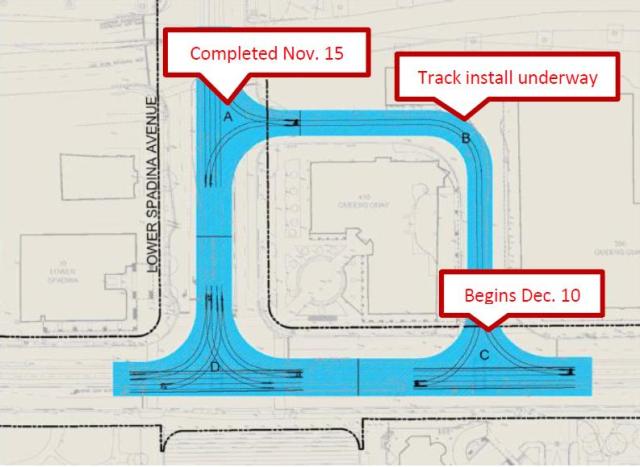
The intent is to have the trackwork in the loop finished by yearend.  TTC would then install its overhead in preparation for service at the start of the February 2014 schedule period which will fall in the middle of the month.  The track installation will likely be done mainly in November, and partial shutdowns of the streets around the loop will be required.

There are three sets of special work (loop entrance from Queens Quay, loop exit to Spadina and the Spadina & Queens Quay intersection).  A preliminary plan for this might have broken the work into three stages, but Waterfront Toronto hopes to consolidate this into two.

A further complication will be the partial closing of Lake Shore Blvd. to complete the track connection south from new rails on Spadina.

Waterfront Toronto expects to publish details of the work schedule soon.

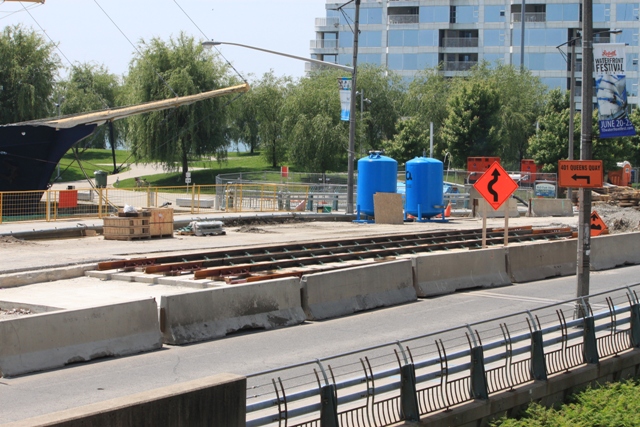
As for the tangent track on Queens Quay, the major constraint is that the space cannot be given up until utility work in a section is clear.  The intention is to build the foundation slab in pieces as various sections of the roadway become available.  Track installation would be completed in spring 2014, followed by overhead catenary, with a target date for streetcar service in late June.  (If the schedule periods for 2014 follow the same pattern as in 2013, this would be Sunday, June 22, 2014.)

Waterfront Toronto’s work plan for summer-fall 2014 will concentrate on the area south of the streetcar right-of-way which will contain the new cycling path, an expanded pedestrian area, and many trees.  Some finishing work will occur in early 2015 in advance of the Pan Am Games.

What is frustrating about all of this is that the delay in Hydro’s approval at the OEB was well known a year ago, and Waterfront Toronto has maintained rather hopeful dates for resumption of service that strained credibility as the construction wore on and on and on.

TTC Board Meeting October 23, 2013 (Update 3)

Updated October 26, 2013 at 5:20 pm to reflect discussions at the meeting.

The TTC Board met on October 23.

Update: The 2014 Operating and Capital Budgets are still not public, and they may now  appear in November (this has yet to be confirmed).  This is unusual because under Mayor Ford, the budget process for the City has been moved up so that the overall budget can be finalized early in the new year.  In 2012, the TTC budgets for 2013 were on the September agenda.

Will the TTC roll over again and accept a flat-lined subsidy placing the entire burden of extra costs on riders through fare hikes and compromises on service quality, or will they finally argue for better subsidies and force Council to debate just what transit should be doing – aside from building one subway line – for Toronto?

The CEO’s report (below) offers a hint in this statement:

“… discussions with the City continue regarding the TTC Operating and Capital Budget submissions for 2014-2023.  I am resolute in expecting an increase in subsidy to accommodate and service ever increasing customer numbers.”  [page 5]

Does this represent a strategic position on the TTC’s part, or division among the Commissioners about the direction the organization should take?

The City of Toronto will launch its 2014 budget process formally on December 2, 2013.

New Wayfinding Standards

Recent reports in other media have talked of a proposal to rename the subway lines with numbers to simplify wayfinding information for riders.  The details of this and other schemes to overhaul information will be presented at the meeting.

Updated October 23 at 10:55am:  The presentation is now online linked from the title above.

Updated October 26 at 5:00pm:  This topic will be split off into a separate thread given the volume of comments, and the accumulated comments will be moved to the new thread.

CEO’s Report

The CEO’s report has little new relative to the September edition.  Riding continues to be above 2012 but below budget.  For reporting period 8 (mainly the month of August), riding was up 3.5% over 2012.  On an annualized basis, riding is up 2.8%.  These results are 0.1% below budget for the period, and 0.5% below budget for the year to date.

Total ridership for 2013 is projected to be 527m, 1m below the budget projection.  This shortfall, coupled with higher-than-expected sales of passes versus token/cash fares, will mean revenue will fall $7.6m below budget.  This will be counterbalanced by various swings plus and minus on individual expense lines (details on page 24).

Update:  According to CEO Andy Byford, the lower ridership and revenue numbers for 2013 are mainly attributed to the severe weather and floods earlier in 2013.  Major shutdowns planned for 2014 will definitely affect ridership and this will be built into the budget estimates.

Subway punctuality on the Yonge-University line remains a problem particularly in off-peak hours.  It is unclear how much this is a side-effect of the yardstick of headways within ‡3 minutes of scheduled values.  During peak periods, it is much easier to meet this goal because there are more trains on the line, and entire trips can be missing without headways going beyond the 3-minute rule.

The BD line problems occasionally from the transfer of trains to the Yonge line to “cover shortages”, although this is not explained.  Are there simply not enough working trainsets to operate the Yonge service, or are BD trains poached to fill major service gaps?

Update:  I have asked the TTC to clarify what this section of the report actually means.

As if the wait hasn’t been long enough already, the CEO’s report states that the Harbourfront line will not return to streetcar operation until August 2, 2014.  No reason is given for the further slippage between the July date given by Waterfront Toronto and the TTC’s new August date.

One major issue that the CEO’s report does not address is the fleet availability in Toronto.  Only through the shutdown of substantial chunks of the streetcar system has the TTC managed to field enough cars to cover what remains in operation.  It is in their interest to prolong construction projects until they can get the first of the new fleet on the road.  What was originally touted as a “spring” startup of LFLRV service may now well slip to at least “summer”.

Production deliveries of cars are supposed to start later this fall.  What is the status of this order?

Service reliability is supposed to be reported quarterly for all surface operations, but the third quarter report has not yet appeared (it is expected to show up sometime on October 21).  When it does, I will be reporting separately on comparisons of the numbers over the past three quarters of 2013.

Update:  The quarterly report was published on October 23 and has been discussed elsewhere on this site.

I will follow up on questions raised here with TTC staff at the meeting and will update the article when further info is available.

TTC Fare Policy – Requests For Fare Discounts

This is a compendium report on various proposals/requests the TTC has received for reduced fares for various groups.  The staff position is that any additional subsidies for various classes of riders must be funded through a policy decision at City Council with adequate funding through the subsidy stream to offset the projected revenue losses.

This has been the TTC’s stock position for such requests for years, but at least we now have a consolidated report listing the projected cost for each option.  If Council wants to fund new discounts, the expected cost is known presuming that we accept the TTC’s estimates (some of which are dubious).

  • Extending “Family Pass” (6 people, maximum 2 adults) pricing to the entire week.  This is projected to cost only $2.2-8.6m per year, although I am suspicious of the figure because it is based on existing pass sales.  If the pass is more attractive, then more of them will be sold, but the estimate does not take this into account.
  • Free off-peak trips for seniors.  The cost is estimated to be at least $22m per year based on the number of non-pass trips by students/seniors today (45.2m), subdivided by the proportion of seniors (40%) and then the proportion of off-peak trips (65%).
  • Off-peak only pass for seniors.  The technology to handle time-of-day passes does not exist on turnstiles today, and so this option would best be left until Presto is rolled out across the system.  The estimated annual cost is $1.0-2.1m, but this depends on various assumptions regarding pass pricing, trip counts and conversion rates from the existing all-day passes.
  • Lower age for “senior” passes to 60 from 65.  The estimated cost is $3.3-4.9m, but this includes only the lost revenue from existing Metropass holders switching to the lower-priced pass.  No provision is included for token users for whom the senior’s Metropass would be more attractive than continuing to pay single adult fares.
  • Extend senior/student fare pricing to ODSP and OWP recipients (these are the Ontario Disability Support and the Ontario Works programs).  This is projected to cost $6.3-12.6m, but the mechanism for administering these fares is not discussed.  Of particular note, the calculation is based only on the actual recipient numbers within Toronto, not on their dependents and spouses.

Any special fare regime will be easier to administer once automatic fare collection is in place.  Time-of-day discounts and special fares associated with a rider’s status can be build into the fare structure, and the actual amount of discount provided for each target group can be tracked.  This will be important if special subsidies are involved so that they remain separate budget lines rather than simply merging into the overall TTC revenue stream.

Advisory Committee Activity

An interesting read in recent TTC agendas has been the meeting minutes for the Advisory Committee on Accessible Transit (ACAT).  This is a very active group whose discussion cover a wide range of issues with TTC staff, and the minutes report their activities in detail.

One might wish for the Customer Liaison Panel to be as forthcoming with information on its activities.  It is unclear whether the CLP has done anything since its formation, or what its areas of focus might be.  If the panel is intended to represent “customers” as part of TTC activities, why doesn’t it show the rest of the world what it is doing?

Supplementary Agenda

Yorkdale Fatality of September 14, 2012 – Final Investigation Report

This report contains the detailed findings regarding an accident last year in which a work car struck two employees during overnight maintenance near Yorkdale Station.

[New] York University Station Construction Status

Councillor Perruzza addressed the Board on the issue of York University Station where, as reported in the National Post, the station excavation is a lake, and no work appears to be in progress.

According to TTC staff, the tunnel construction contractor, Obrascón Huarte Lain and FCC Construcción, has handed off the site to the station contractor, Ellis-Don, but this process has taken longer than expected.  Meanwhile, Ellis-Don did not take over pumping of water even though they were now responsible it.  This is to be corrected, and Ellis-Don will begin active work on the site in 2-3 weeks.

Construction at this location was substantially delayed due to a worksite fatality in 2012.

[New] Time-Based Transfers for Eglinton West

Commissioner Colle requested a report from staff on the implementation of a time-based transfer arrangement on Eglinton West during the Crosstown tunnel construction similar to the setup still in use on St. Clair Avenue.  The TTC will ask Metrolinx to contribute to the cost of this if it is implemented.

[New] GO/TTC Fare Integration at Dundas West and Exhibition Stations

Chair Stintz requested that staff report on the provision of a joint TTC/GO fare between Union Station, Dundas West and Exhibition Stations as a way of relieving demand on the system, notably on the 504 King car.  The report should be on the November agenda.

Moving People Downtown: The Gardiner East Is Only The Beginning

On October 16, 2013, the second public meeting in the Gardiner East Environmental Assessment presented additional information and refinement of the options for dealing with the expressway’s segment between the Don River and Jarvis Street.

The purpose of the meeting was to report on the options that would receive further analysis in the next step of the EA and to provide comparative information about costs and benefits of the various schemes.  Broadly, there are four families of options:

  • Maintain the existing expressway with necessary repairs to make it sound for several decades’ more service.
  • Replace the expressway on a new structure either above or below ground.
  • Improve the existing expressway by selective reconstruction to open up space under the road deck.
  • Remove the expressway and create an at-grade boulevard.

Some options have been dropped from further study:

  • An underground alignment 1km long transitioning to/from existing elevated structured at the Don and at Jarvis.
  • An elevated alignment over the rail corridor.
  • A surface alignment on a berm abutting the south side of the rail corridor.

For any tunnel option, an important consideration is that most of the traffic arriving from the DVP and Lake Shore East is bound for the core area rather than as through trips to the western side of Toronto and beyond.  Therefore, access ramps are essential to any option that is not at grade so that traffic can actually get to downtown.  (By contrast, the “Big Dig” in Boston provided a link between the north and south sides of the core area on a route where 80% of the travel is through traffic and does not create demand for local ramp structures.)

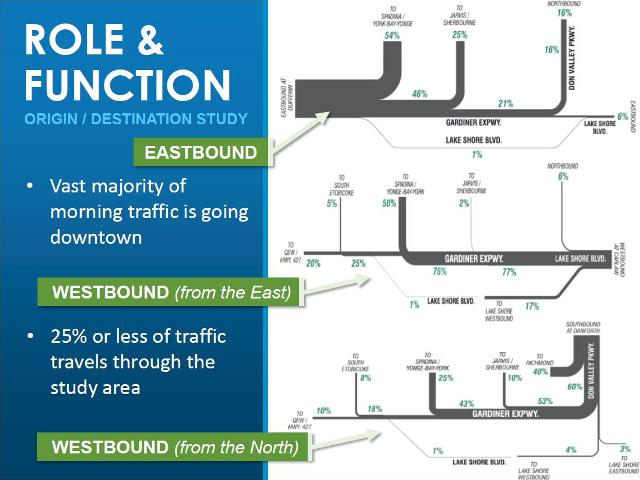
The study claims that 80% of inbound trips have downtown destinations and this argues against a tunnel from which access would be difficult.  However, consider the origin-destination charts on page 15 of the presentation:

GE2P15

Of the traffic arriving from the DVP:

  • 40% leaves at Richmond Street
  • 7% exits to Lake Shore
  • 53% continues onto the Gardiner East, subdivided as
    • 10% exits at Jarvis/Sherbourne
    • 25% exits at Spadina/York/Bay
    • 18% travels beyond downtown.

If we were contemplating a tunnel across all of downtown, the argument about ramps and O-D patterns would be valid, but in this case, from the point of view of such a tunnel, most traffic is “through” traffic.  Only 10% of traffic that would enter a tunnel westbound at the Don leaves at Jarvis, and even this would be served if an off-ramp were incorporated in the transition from tunnel to elevated.  Similar arguments apply to the other O-D maps above.

The real problems with a tunnel are its cost and the barrier effect created by ramps linking the tunnel to the elevated structures at the Don and at Jarvis Street.

The schemes involving the rail corridor have both been dropped because they cannot be fitted into the space available.  In the case of an elevated, there is no room for the support structures needed (not to mention access ramps), and in the case of the berm, the area is reserved for future expansion of rail operations.

A far more important issue hinted at by the presentation but not explored in detail is the wider context of transportation into the core area.

Continue reading

Cherry Street Track Construction (Update 3)

Updated September 17, 2013 at 4:25pm:

According to earlier plans I had heard through Waterfront Toronto, Cherry Street Loop was not to be completed until after the Pan Am Games because the site is part of a parking lot for buses.  Contrary to this story, the loop is under construction, albeit surrounded by a parking lot.

IMG_4450w

The now-inactive Cherry Street tower that once controlled the eastern approach to Union Station sits at the south end of the loop.  In the left background, behind the trees, is the GO Don Yard.

The terrible irony about this, our possibly newest streetcar line, is that it won’t actually see service until Spring 2016, and the proposed extension under the railway to connect with a Queens Quay East line isn’t even in the current list of projects awaiting funding.

Continue reading

Waterfront Transit Update July 2013

Many projects affect the development of Toronto’s waterfront and transit services.  It is easy to lose track of how everything fits together, and this is an attempt to put updates for the various parts in one place.

For an overall map of the waterfront, go to Waterfront Toronto’s site and click on “View Map”.

Construction progress photos can be found on pages for individual projects, and a good overview is available in the minutes of the Waterfront Toronto Board meetings under the CEO Reports and Construction Updates.   (Scroll down to the bottom of the linked page, click on “View Details” for a meeting, and select the report you wish to view from the pop-up menu.)

Waterfront Toronto will hold a public meeting on Wednesday, July 24 from 6:00 to 9:00pm at the Toronto Fire Academy, 895 Eastern Ave (at Knox) with updates on the Don Mouth Naturalization and Port Lands Flood Protection, and the Lower Don Lands Master Plan.

Continue reading

Development Charges and Transit Expansion

The City of Toronto Executive Committee will discuss the matter of a new Development Charges Bylaw at its meeting on July 3, 2013.  This is a statutory requirement as the current bylaw expires in April 2014, and it must be replaced in order for the city to continue collecting these charges.

Already press reports show a real estate industry apoplectic at the possibility that these charges will double.  With all the concern over a possible softening of the market for new units, the last thing they want is yet more cost added to the purchase price.  However, what we are seeing is a combined effect of the rising population and the exhaustion of surplus capacity in existing infrastructure, notably transit and water.  Much of the new development is concentrated in the central city in former industrial areas that do not possess the infrastructure needed to support their coming new populations.

(Chief Planner Jennifer Keesmaat observed at the “Feeling Congested” session earlier this week, about 70,000 people will call places like Liberty Village and the waterfront neighbourhoods their new home over the coming decade.)

There is bound to be lively debate, especially from the “no new taxes” brigade on Council, but the simple fact is that the city cannot have new development without some way to pay for the supporting infrastructure and services.  In this article, I will talk only about the transit component which is the single largest piece of the new DCs rising about 150% from the previous level for residential development.  (DCs overall will go up 86% because other categories have lower increases.)

Continue reading

Feeling Congested Part 2: Setting Priorities

The City of Toronto’s Planning Department is consulting with the public for the development of an updated Official Plan.  The plan’s transportation component falls under the rubric of “Feeling Congested” with a website devoted mainly to transit issues.  In the first round of meetings, the focus was on “what is important”, what goals should the new plan try to achieve.  In the second round, the topic is the prioritization of goals and how these might drive out different choices in a future network.

This parallels work that Metrolinx is doing on their Big Move plan, but it includes additional options for study that are city initiatives such as transit to serve the waterfront.

A survey now in progress (until June 30) seeks feedback on the evaluation criteria for transit projects, and also for the goals of the cycling plans.  Some of this makes more sense if one first reads the toolkit, but even then the presentation will leave skeptics unhappy because there is no link to the detailed study explaining how the proposed criteria have been measured for each of proposals.  (A summary chart on page 14 does not include the subcategories within each of the eight criteria that generated the total scores .)

Even with this background, an exercise asking whether the methodology is sound seems to be an odd way to survey public attitudes without a stronger discussion of the implications for a preferred network.  This is rather like discussing the colour of a magician’s hat rather than the effect this might have on the rabbit he pulls out of it (or if there’s even a rabbit at all).

Continue reading

Waterfront West Update (Revised June 15, 2013)

Updated June 15, 2013 at 4:20 pm:

The shortest streetcar line in the world exists, albeit without service, as the first piece of new surface track appeared on the 509 Harbourfront route at the Peter Street slip.

IMG_3828w

On June 11, the eight expansion joints for the future bridge crossing were set more or less in place on the new bridge deck.

IMG_3830w

By June 13, the tangent rails had been added, although the expansion joints at the west end of the bridge (below) …

IMG_3834rw

… had not yet been attached.

Note that, like subway track, the rails are mounted directly on the bridge deck, not on ties.  This approach is needed because the bridge design does not include the depth needed for the layer of ties normally found in TTC streetcar track.

IMG_3833w

The view below shows a close up of a test section of track built just west of the corner of Bay and Queens Quay.  The use of the rubber sleeve to mechanically isolate the track  is quite clear.  Under the plastic covers (with duct tape on them) are Pandrol clips holding the track to steel plates in the slab below.  The slab containing the track is separate from the base slab so that only excavation of the top layer is needed for track replacement.

IMG_3776w

The original Harbourfront track did not have the rubber layer and was quite noisy because the whole trackbed vibrated as cars passed.  This is one of the last pieces of mainline “thunder track” to be replaced on the TTC network, a process begun 20 years ago.

Continue reading

TTC Meeting May 24, 2013 (Update 3)

The agenda for the TTC meeting on May 24 contains a few items of interest, but also a troubling sign that matters of public interest are being debated behind closed doors.

Items included in this preview:

Updated May 23 at 12:10 am:

Links to the TTC construction pages for the York Street, Ossington Avenue and Kingston Road reconstruction projects have been added.

A reference to a statement about the New Streetcar Implementation Plan attributed to Andy Byford at the April Commission meeting has been corrected to reflect that it was made by Chris Upfold, Chief Customer Officer, who was standing in for Byford at that meeting.  TTC’s Brad Ross has confirmed that this plan will be presented in the public session of the June Commission meeting.

Updated May 23 at 9:15 pm:

The Kingston Road construction project info has been updated to reflect the early replacement of streetcars by buses effective June 3.

Updated May 25 at 1:30 pm:

This article has been updated to reflect events at the Commission meeting.

Continue reading