Thoughts on Taking Down The Gardiner East

On Friday, Waterfront Toronto announced a plan to relocate the Gardiner Expressway from Jarvis to the DVP into a surface road parallel to the rail corridor.  For reasons that are unclear, the Environmental Assessment for this project will take four years — even longer that the infinitely tedious transit EAs for simple lines like Cherry Street through which many of us have suffered.

(The issues about how long or short an EA should be are complex in their own right and I won’t dwell on them here.)

In brief, the scheme replaces the elevated road with an at-grade eight-lane divided street, with  University Avenue cited as the prototype.  The new road would be north of the existing expressway structure allowing all of the land south of the rail corridor to be reconfigured and redeveloped.

Traffic projections indicate a slight rise in travel times for trips through this area.  Not unexpectedly, the motoring lobby already predicts at least doom and gloom, if not fire and brimstone for good measure.  I have no sympathy for them at all. 

The eastern part of the Gardiner is lightly used.  Even during the AM peak, the traffic flowing south on the DVP past my apartment (just north of Bloor) is rarely bumper-to-bumper because so many cars leave the road further north.  Jammed traffic means there has been an accident, not that there is no capacity.  Northbound backlogs on the DVP are inevitably caused by accidents much further north, by early closings downtown on long weekends, and by the end of major sporting events.  The queue rarely reaches to Dundas Street.  Lowering the capacity west of the Don will have little effect on overall travel times because the main areas of congestion lie elsewhere.

The new configuration will simplify the work on rearranging roads at the Don Mouth where a knot formed by Lake Shore, Cherry, Parliament, and Queen’s Quay (not to mention the Gardiner) is a very pedestrian-hostile environment.  Moreover, with the new “Waterfront Boulevard” being a street, not an expressway, connections with local roads will not require ramp structures, only traffic lights.

Why we have to wait eight years for this wonderful new arrangement is a mystery, but I am sure that many consultants will retire, or at least buy a nice house in the country, on this project.

Mixed in with Friday’s announcement are two other items of more than passing interest.

The York Street Ramp

Although we don’t have any details, there is a plan to realign the York Street off ramp, the corkscrew that occupies much of the northeast corner of Queen’s Quay and York.  When I can find out what exactly is involved, I will publish details here.

The neighbourhood groups along Queen’s Quay have been pushing for this for some time, but until we know the details, we won’t see whether all we get is a larger parkette but also a new off-ramp fouling up some other intersection.

The Front Street Extension

This road is now about as dead as it can be without  the requisite wooden stake through its heart.  Even Councillor Joe Pantalone, long an advocate for this road, says it is something for another generation, according to media reports.  Meanwhile, former Councillor Dominelli, a landowner in the Liberty Village area long reputed to be pushing for the FSE, has actually stated he just wants a local road, thank you, so that he can get on with his redevelopment.

Considering how long many people have tried to get just that proposal on the table and been rebuffed at every turn, this is a very strange development.  Finally, we can get on with properly designing and building roads to serve the community from Bathurst to Dufferin, rather than an off-ramp to the expressway serving commuters from Burlington.

In deference to his long battles on this front [you can groan here], I propose that the new road be called Hamish Boulevard.

New Carhouses for New Cars (Updated)

The TTC Supplementary Agenda for May 21 includes a report on the Master Plan for new carhouses.  These will be needed both to house the replacement fleet for the existing downtown network and for the far-flung Transit City system.

In brief, the proposed scheme involves the building of five new carhouses:

  • One in either the Portlands or in New Toronto to house the downtown network’s fleet.  The New Toronto option is mentioned only once in the text  (with “new” in lower case), and the map shows only the Portlands location.  This would be the primary carhouse for the core area routes, but Roncesvalles and Russell would continue to have a role as regional yards for new cars once the CLRV fleet starts to retire.
  • A Sheppard East carhouse would initially operate the Sheppard line, but later take on the Scarborough/Malvern and part of Eglinton once the Malvern link was in place.
  • A Finch West carhouse would serve that line and, eventually, part of the Jane line as well.
  • An Eglinton West carhouse would serve the Eglinton line initially, and later the Jane and, possibly, the St. Clair line.
  • A Don Mills carhouse would serve the Don Mills line and possibly part of Sheppard.  By the time we get this far into the plan, there will no doubt be more Transit City proposals on the table and it’s anyone’s guess what the real carhouse needs will be.

The four Transit City carhouses are estimated at about $770-million (reference year not stated), while the new downtown carhouse is estimated at $330-million due to the larger fleet it must house.    It’s clear that the long-term status of the existing Russell and Roncesvalles buildings is dubious both because they are not suited to house and maintain the new cars, and because of building code issues if they were to undergo major changes.  However, these properties provide a few advantages over a consolidated operation in the Portlands.

  • If they are used as yards with basic servicing facilities, the dead-head time for cars entering and leaving service will be shorter than if everything funnels back to a Portlands carhouse.
  • As riding grows on the existing system, the TTC needs somewhere to store more than the initial 204 low flow cars they plan to order this year.  The existing yards will provide an overflow.  Whether both of them are needed once all of the existing CLRVs and ALRVs are retired is another question, but that’s almost a decade away.

Note that the map used in this report is the original Transit City map and does not reflect any of the optional changes that have cropped up in discussions about some routes.  It also doesn’t show the new Waterfront East lines, nor the Kingston Road project.  With luck, one of these days, the TTC will start using a new base map for all of its surface rail project reports.

Updated May 21:

The dates for new carhouse availability are driven both by the expected arrival of the new fleet for the downtown system and for the opening dates of the Transit City lines.

The demonstration prototype cars are to arrive at the end of 2010, and it is likely they will be temporary stored and serviced at Hillcrest.  The first 20 production cars will arrive by the end of 2012, and they will need a carhouse and shops.  This sets the date for the Portlands carhouse to be available.  The complete replacement fleet arrives by the end of 2017.

There are seven Transit City lines (not to mention other plans such as Waterfront East and Kingston Road).  The startup dates and estimated fleets for each of these lines are:

  • Sheppard East:  2012 / 35
  • Finch West:  2013 /37
  • Eglinton:  2015 /129
  • Waterfront West:  2015 / 23
  • Don Mills:  2016 / 46
  • Jane:  2017: /41
  • Scarborough Malvern:  2018 / 53

At least 90% of this fleet, possibly with the addition of cars for the St. Clair line, will be housed in the four new carhouses all of which should have room to accommodate growth in requirements.

Sheppard East LRT / Scarborough RT EA Meetings in June

The next round of meetings for the Sheppard East LRT and Scarborough RT Extension Environmental Assessments have been announced.

The Sheppard East LRT meetings are on June 3 (Agincourt Collegiate) and June 4 (Malvern Community Centre).  They will include presentation of:

the recommended design for the Sheppard Avenue East LRT, including stop locations, the proposed grade separation of Sheppard Avenue at the Agincourt Go Line and the preferred option for making the LRT/subway connection.

The Scarborough RT Extension meetings are on June 4 (Malvern Community Centre, jointly with the Sheppard EA) and June 5 (Scarborough RT Station).  They will include:

The rationale for selecting the preferred network: an SRT extension to Malvern Town Centre, and SRT alignments to be considered for detailed evaluation.

Sheppard East LRT Preliminary Design

Now that the TTC and City have held the first open houses for the Sheppard East project, it’s time for a few comments on the design so far. 

The presentation materials are available online.

This study is proceeding under the new, accelerated schedule for Environmental Assessments and it will be important to stay on top of what is happening.  Adam Giambrone’s office has advised me that there will be a third iteration of the open house at Scarborough Town Centre (details to be announced).  Following that, the next opportunity for public input into the overall design will come in late May. Continue reading

Sheppard LRT Environmental Assessment Meetings (Updated)

The City and TTC will be holding two EA meetings for the Sheppard LRT line on Tuesday and Thursday, April 15 and 17, 2008.

These will also include discussions of the proposed extension of the Scarborough RT.

The FAQ linked from the EA notice page includes a variety of intriguing items giving an idea of how the project team views what they will implement.  Apropos of discussions in other threads here about stop spacing and vehicle speed, we learn that

there is normally a much greater distance between stops, relative to a typical bus route.

It should be interesting to see how the TTC and City reconcile this statement with the actual layout of streets and stops on the existing bus route, not to mention the Official Plan goals for Avenues with medium density development along transit lines rather than concentrated at major intersections.

Update: The presentation materials from the meeting are now available online.

Service Changes for March 30, 2008

Updated March 30, 2008: The attached spreadsheet has been updated to include information on the projected changes in vehicle loads and the list of outstanding changes that are awaiting sufficient resources to be implemented.

One of my readers, Brent, sent in a long note with a summary of service changes that will take place in one week. His introductory comments were:

I see the service summary is out early like usual this time (as opposed to the top secrecy back before the February improvements) and it shows most of the main service changes. (Searching the PDF for “Mar-08″ and “Apr-08″ highlights all the adjustments.) I have compiled them below (I have no life!!), except for cases where there is no noticeable change and it may relate to minor trip adjustments.

Note that the Bathurst streetcar has service reductions on Saturday what with the replacement of CLRVs with ALRVs…

The St. Clair service sounds interesting. With tracks to the carhouses cut off, they’ll just run the same 7 streetcars at 3-minute intervals all day until the late evening, when presumably they’ll just park them somewhere on the ROW and run buses instead (since of course we can’t run the buses on the ROW anyway…)

One service change that doesn’t show up as a change in the schedule is the decoupling of the Evans bus from the Prince Edward bus on weekends, which means that the Evans bus will end up with a 15-minute layover (plus 45 minutes round trip traveling) to maintain a 30-minute headway.

Special arrangements for St. Clair are required because track from Bathurst Station Loop north to St. Clair will be replaced, and a captive set of cars will remain on St. Clair for the duration. These will run a three-minute headway between the two subway stations until mid-evening when the full route will switch over to bus operation.

The TTC has not posted a service advisory for this project on their site yet, but I suspect that this arrangement will carry through until June given the speed of track construction jobs of this size. Even then, until the reconstruction from Vaughan to Dufferin is completed, streetcars will be limited to serving the east end of the line.

One notable problem that the TTC has not addressed is overcrowding in the AM peak period on 509 Harbourfront. With the construction diversions, this seems to have fallen off of the radar, but there was a deputation at the TTC last year from people complaining that cars were full eastbound before they reached Bathurst Street. The new service is actually slightly worse than what was there a year ago in the AM peak, although some off-peak headways have been shortened.

As we know both from riding experience on the 509 and the analysis of CIS data for this line I published earlier this year, the schedule for service on Harbourfront is often more creative writing than reliable fact. In an analysis of the 511 Bathurst route now in preparation will confirm, layovers at Exhibition Loop are quite generous and eastbound service on Fleet is quite erratic. The TTC really needs to start treating the new residential neighbourhoods on Queen’s Quay and Fleet to good, reliable service, not as a seasonal tag end of a route serving an amusement park.

Fleet Street Overhead and Other News of Changing Streetcar Infrastructure

The TTC plans to resume streetcar service on Fleet west of Bathurst with the 509 Harbourfront and 511 Bathurst routes on March 30. Trackwork, except for Fleet Loop, is in place, and the overhead construction is underway working west from Bathurst Street.

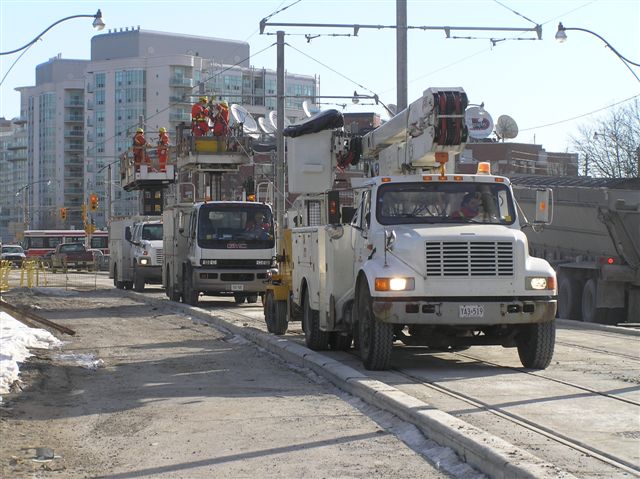
One of my regular readers, Harold McMann, sent me a few photos of overhead installation on Fleet Street and I am including one of them here because it shows a very recent change in the TTC’s standards for streetcar overhead.

Look closely at the hangers and you will see they are different from those commonly seen on Toronto’s system. These hangers are designed so that the contact wire will be held below the span wire and so that both pantographs and trolley poles can navigate them. If you look closely, you will see that hangers on alternate spans face in opposite directions so that there will be a slight meander to the overhead to avoid groove wear on pantographs.

Another change not as obvious from a photo is that the TTC is now using 4/0 gauge wire rather than 2/0. This is a larger cross section, but not twice as big even though the number might imply this. You can read about the arcane world of wire on Wikipedia. The larger cross section allows more current to be delivered by the wire in anticipation of the power demands of the new larger streetcars planned for Toronto.

The TTC Capital Budget contains a project to convert the entire overhead system by 2012, but it’s sad to note how long it took the TTC to accept that this would be necessary.

Further west on Fleet beyond the loop we find a forest of closely spaced poles marching down the centre of the right-of-way. These appear to be much closer together than the normal span wire spacing. This design leaves a lot to be desired if it is an indication of what we will see on future routes because the poles will dominate the visual landscape. I have already written here extensively about the shortcomings of centre poles on downtown streets and will not belabour the point.

Another project in the works is the complete replacement of the automatic track switch system. The current switch machines and their electronics date from the arrival of the ALRV fleet when the distance from the trolley shoe to the front of a car ceased to be constant. This meant that the old contactor-based switching had to be replaced, and a new system with pavement loops was installed.

This has been no end of trouble to the extent that some switches on the Spadina project have switch machines, but have never been activated. Many regularly used switches around the city sport “out of service” signs because they are no longer reliable or their parts have been raided for other more important locations. Because these switches are so unreliable, streetcars must come to a full stop at all facing point switches (including, amusingly, manual switches that cannot leap open in front of a car).

This practice makes for slow and jerky operation at intersections, and the TTC has not bothered to deal with this problem of reliability for quite a long time. Design of a new track switch system is underway and is expected to complete this year with procurement and installation to follow in future years.

Over the next four years, we will see a gradual transformation of the streetcar infrastructure in anticipation of the new fleet. Let’s hope the TTC gets it right this time. We cannot afford another fiasco like the CLRVs and their inability to deal with a system that PCCs had navigated for decades.

Transit City Update

At the TTC meeting last week, there was a long presentation about the status of the various Transit City projects. The TTC’s website contains only the two page covering report with absolutely no details, but lucky for you, my readers, here is an electronic copy. As and when the TTC actually posts this report on their own site, I will change the link here to point to the “official” copy.

Warning: 7MB download: Transit City February 2008

While there may be individual issues to prompt kvetching in this report, overall I am impressed by what is happening. For the first time in over 30 years, we have not only a unified plan, but a unified set of studies. I may be naïve to expect all of this will actually be built, but we are in far better shape knowing what might be than if only one or two lines were on the table.

Here is an overview of the report along with my comments.

Overall Priorities

Of the various Transit City proposals, three have been selected as the top priority for design, funding and construction: Sheppard East, Etobicoke Finch-West and Eglinton-Crosstown. All lines were scored against various criteria, and those coming out on top overall got the nod. This doesn’t mean work stops on the others, but at least we know the staging.

Projected total ridership is highest for Eglinton, Finch and Jane, with Sheppard East in 5th place. Partly, this is due to the length of the routes and their catchment areas. Note that Waterfront West brings up the rear, unsurprising given the area it draws from.

The lines rank roughly the same way for the number of car trips diverted to transit and the reduction in greenhouse gases. There’s something of a compound effect here as several measures all vary more or less as a function of ridership.

Transit City, again with the exception of Waterfront West, touches the City’s priority neighbourhoods where better transit is needed to increase mobility and economic opportunities for the residents.

What’s Missing

Notable by their absence are the Waterfront East lines (Queen’s Quay, Cherry Street and Port Lands) as well as the Kingston Road line in Scarborough. EAs are aready in progress for these, but they don’t make it onto the overall status report.

This is a shame because we must stop making distinctions between “Transit City” itself, and other related transit projects that will compete for attention and funding. Continue reading

Analysis of Route 509 Harbourfront: Laissez-Faire Mismanagement

In a recent post, I looked at the time needed for 509 Harbourfront cars to make their way between Union Station and the CNE. These times are extremely well-behaved and show the benefit of having a line both in its own right-of-way and on a route where traffic congestion is almost unknown (at least in December).

What this analysis didn’t talk about was headways.

There is no way to put this gently. The service on Harbourfront is appallingly bad because some operators treat the schedule as little more than wallpaper, and nobody in Transit Control seems to care about the quality of service. It’s a little shuttle, it will look after itself. Meanwhile, as we have seen in the Spadina car analyses, the attitude seems to be that short turns of Union-bound cars are just fine, maybe because that wonderfully reliable 509 will handle the demand.

These lines are supposed to show what the TTC can do when we get traffic out of the way. What they demonstrate is that the TTC doesn’t give a damn about running proper service in an area where the population is growing and the transit system hasn’t got long to establish its attractiveness before they all buy and drive cars.

Where will this leave us in the eastern waterfront? What does it bode for Transit City? Continue reading

Getting From Union to the CNE — How Fast Is Our “LRT”?

Last week, as I was polishing up my comments on the Waterfront West LRT Environmental Assessment, I started to wonder about the comparative running times between the CNE grounds, the comparable location on King Street, and the core. How much time does one route save over another? What benefits do we see from the “LRT” operation on the 509 compared with mixed traffic on the 504?

We have already seen service analysis data from the King car in the original series of posts last year, and the Harbourfront line was in my sights as a companion analysis to the Spadina car. I will turn to the 509 in a separate post, but for now, let’s look at the two routes between roughly Strachan Avenue (the east end of the CNE) and downtown.

In my previous analysis of the King route, I used Crawford Street as a “time point”. This is one block west of Strachan and stands in for the “CNE” on King Street. The downtown time point is Yonge Street.

On the Harbourfront route, the CIS times at Exhibition Loop are not reliable for departures, but the arrival times are. At Union, the times are reliable. Therefore, I have used the link from Union to CNE westbound, but from the Bathurst/Fleet intersection to Union eastbound.

[“CIS” is the TTC’s vehicle monitoring system. Data from this system for December 2006 has appeared in many other posts here. In this analysis, for reasons I will detail in the Harbourfront post to follow, all points at Exhibition Loop from Strachan through the loop are considered as one location because of data limitations.]

509 Westbound from Union to CNE
509 Eastbound from Bathurst to Union

504 Westbound from Yonge to Crawford
504 Eastbound from Crawford to Yonge

In the Union to CNE charts for the Harbourfront route, there are consistent running times in a band 4-5 minutes wide clustered around the 15-minute line with a slight rise in the late afternoon on weekdays. Saturday data is flat at the 15-minute line, and Sundays have a bit more scatter possibly due to slightly longer layovers that have not been eliminated from the data.

The Bathurst to Union charts show a bit more scatter as well as evidence of a morning peak that slightly extends the running times. Running times cluster fairly reliably around the 13-minute line.

On the King route, the westbound times from Yonge to Crawford show a greater scatter as well as the clear effects of peak period congestion and stop dwell times. On Friday, December 22, the early rush hour before peak period traffic restrictions are in effect causes running times to more than double the usual values.

The band of data ranges from five to over ten minutes in width and lies generally around the 15-minute line with a rise and fall through the pm peak.

The eastbound times from Crawford to Yonge show strong effects in the peaks, especially the afternoon when congestion through the financial district causes much delay to service. The width and location of the band of data is roughly the same as for westbound trips, but with a much worse pm peak spike in times.

Comparing the two routes, the broad averages in times are in the 15-minute range for both lines. King is much more affected by peak conditions, but outside the peak its behaviour is similar to Harbourfront. Any benefit in speed the 509 might get from its right-of-way is negated by the close stop spacing, winding route and traffic signal delays. The big difference between the routes is that the 509 does not have to deal with traffic congestion, only with unfriendly traffic signals.

Indeed, this is one reason the WWLRT proposes to take an alternate route to Union via Fort York and Bremner Boulevards. This will save some time, but even a 1/3 reduction would only get the average time from the CNE to Union down to about 10 minutes. Considering that the Bremner service will handle demand from the many condos lining the route, such a reduction may depend as much on all-door loading with new vehicles as on the “faster” alignment.