Transit City Bus Plan: Surface Routes Matter (Update 2)

Updated August 28, 2008 at 8:15 pm:

At its meeting on August 26, the TTC adopted the Transit City Bus Plan with a few amendments:

  • There will be a 6-month communication and consultation period  regarding the proposed plan.
  • Staff will report back on criteria for inclusion of routes in the plan so that these can become part of the formal Service Standards policy.
  • Staff will report back on headway-based rather than schedule-based management of routes with frequent service including those in the Plan.

As I was out of town for this meeting, my comments were submitted as a written deputation.

Updated August 23, 2008 at 8:45 am:

I have added information at the end of this article about streetcar and bus route headways illustrating some of the issues raised here.

Original article:

Today, the TTC published its Transit City Bus Plan, the next step in an ongoing attempt to focus attention on the transit system overall, not just the subway projects.

I would like to report wild enthusiasm about this plan, but we will have to drop the “wild” part, and think of enthusiasm tempered by disappointment.  The TTC is headed in the right direction, but with compromises.  In a constrained economy, compromises are necessary, but so are the bolder strokes giving politicians and the public at least the option of moving faster should they wish to.  That was the whole concept of the Ridership Growth Strategy (RGS) to which the bus plan is a successor.

The report linked above contains both an Executive Summary and a detailed set of proposals.  I will skip over the summary and comment on the main report. Continue reading

Why Streetcars?

Tom Jurenka sent in the following note, and it raises questions that deserve a debate.

Hello Steve

As a non-native Torontonian (grew up in Winnipeg, but have lived in Toronto for 24 years now) I have always been puzzled — and often infuriated — by streetcars (and the absolutely terrible traffic light timing in Toronto, but that is another story).

My question is an honest one — WHY? All I can see is the negatives of streetcars:

  • they tear up streets (I’ve lived through Queen Street E, Gerrard, now St. Clair, being torn up utterly to undo the damage of streetcars pounding the rails)
  • they are slow as molasses (as a bicyclist, I routinely pass 5 or 6 streetcars on Queen Street heading from AC Harris to downtown)
  • because of their slowness and immobility they delay traffic all the time, causing snarls and the attendant idling pollution
  • they are super expensive (witness the recent funding mess)

So I’m really curious why streetcars are a better alternative to trolley buses or just plain old buses, which move fast, are mobile, and are less expensive per unit to buy. Would you be able to point me at some links/articles/studies/whatever to help me understand this issue?

Thank you for your time.

Best regards,

Tom Jurenka

This is a far more complex question than just the list above, but I will use this as a jumping off point. Continue reading

Service Changes Effective August 2, 2009

For mid summer, there are only a few schedule changes on the TTC network, and they take effect at the start of August running through to Labour Day weekend.

Changes for September are much more extensive, and I will deal with these in a separate post.

Bingham Loop Reconstruction

Due to the reconstruction of Bingham Loop, routes 502 Downtowner and 503 Kingston Road Tripper will be replaced by buses.  Combined streetcar service of 7’30” will be replaced by bus service of 6’00”.  The off-peak 20’00” headway is unchanged.

Diversions at Bingham Loop will change from time to time as construction progresses.  This also affects the 22A Coxwell, 12 Kingston Road, 322 Coxwell and 324 Victoria Park Night Buses.

Roncesvalles Reconstruction

Running times on the Roncesvalles shuttle bus will be increased at some times to compensate for actual start of construction and the diversion of southbound service via Dundas, Lansdowne and Queen.

501 Queen

The test of a modified step-back crewing operation will end, and normal crewing will resume on this route.

77 Swansea & 71 Runnymede

Running times on these interlined routes will be increased.  In the AM peak and midday, this will be done by reducing recovery times scheduled at terminals.  In the PM peak and evening, headways will be increased.  PM peak headways on the common section of the route will go from 10′ to 11′ with a change from 20′ to 22′ on the Runnymede branches.  A similar change will occur in the early evening, but at that time only half of the service runs south of Bloor.

Caribana

Additional service will operate for the parade on Saturday, August 1 on 511 Bathurst, 509 Harbourfront and 29 Dufferin, as well as express buses from Keele, Dundas West and Lansdowne Stations.  The 329/316 night routes will divert around the CNE grounds as described in the next section.

Additional service on 509 Harbourfront, 510 Spadina and 6 Bay is also planned for the Sunday, August 2 events on Toronto Island.  Whether these will actually occur given that the civic strike has shut down the ferries remains to be seen.  All of the added service is operated “at the divisional level”, meaning that the work is easily cancelled or reassigned if the party ends up at a new location.

Canadian National Exhibition

Additional service will operate on all of the usual routes including 511 Bathurst, 509 Harbourfront, 193 Exhibition Rocket and 29 Dufferin.  Overnight service on interlined routes 329 Dufferin and 316 Ossington will not operate through the CNE grounds, but will connect via Fraser and Liberty.

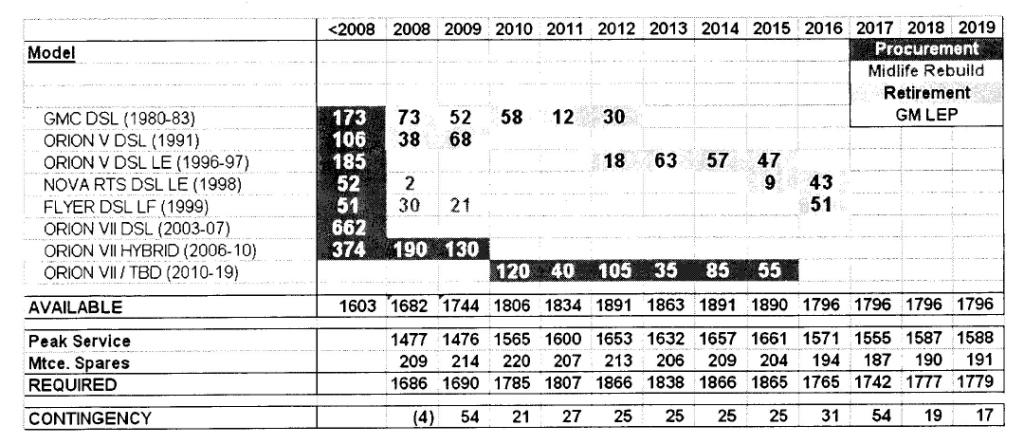
How Many Streetcars Do We Need?

Recent comments by Adam Giambrone, Chair of the TTC, suggest that 30 to 40 percent of the streetcar fleet is out of service in the shops, and that bus substitution will be required on some routes come the fall.

Those of us who follow the TTC have been waiting for a definitive fleet plan for some time, and hope to see one, finally, in the July Commission Meeting Agenda.  Meanwhile, I thought that I would set the stage by reviewing the current scheduled service to see how it may evolve over coming months.

The fleet contains 195 CLRVs (one of the original 196 has been scrapped) and 52 ALRVs.  The scheduled service beginning June 21 is 123 CLRVs and 38 ALRVs.  This is 63% of the CLRV fleet and 73% of the ALRV fleet.

Peak AM requirements by route are:  Bathurst (9), Carlton (32), Dundas (14), Queen (31 ALRV), Lake Shore (3), Downtowner and Kingston Road (11), King (27 CLRV + 7 ALRV), Spadina (15), Harbourfront (6), St. Clair (6).

What we don’t know is the number of cars that are permanently out of service with problems that cannot be or are too expensive to fix.  In effect, we don’t know what the true size of the available fleet might be.  A CLRV overhaul program is in progress (the affected cars are those with the new entrance layout and revised rear seating), but this is not as extensive as the original plans to replace major subsystems such as the electronics package.  This program takes some number of cars out of the pool, but should gradually replenish the fleet.  We don’t know how quickly this is happening, nor how reliable the “new” cars are.

In August, peak requirements will drop by another 11 cars when the 502/503 routes are converted to bus operation, although this will be offset in the fall when the 505/506 routes revert to their standard arrangement in the west end.  The May schedules for these routes required 53 cars in the AM peak compared to 46 today.  A further 9 cars will be needed to restore the 504 King line to its May schedule.

Late in 2009, the 512 St. Clair line’s service will be restored at least to Oakwood, later to Lansdowne.  However, this route is now using a captive pool of cars trapped north of the underpass work at Dupont and Bathurst, and there are, I believe, enough cars in that pool to handle this extension (combined with appropriate schedules where cars spend more time in motion than laying over at terminals).

The TTC needs to explain how it plans to manage streetcar service over the next three years, not to mention service improvements for capacity and the commencement of service in the eastern waterfront.  How long will new streetcars simply make up for failing CLRVs and ALRVs rather than contributing net new capacity to the network?

Service Changes Effective June 21, 2009 (Updated)

Updated:  The Service Summary is now available online.

The June/July schedule board period will bring many seasonal cuts to transit service on the TTC.  I will not list all of them, but the real issue will be to see whether they are reversed in the fall.  A few cuts in this round are identified as a response to budget concerns (see my previous article about Metropass use and its effect on revenues).  If this is just reasonable belt-tightening, that’s just good management.  If this is a return to the bad days of stealth service cuts even while riding grows, the TTC is in for problems. Continue reading

Some Things Take A Little Time

Oh dear, oh dear!  That poor old overworked, underappreciated TTC!

The Spadina car opened in July 1997, and one thing immediately obvious to anyone who bothered to look was that “transit priority signalling” was simply not working the way that phrase might imply to mere mortals who ride the service.  Indeed, a newspaper article by Stephen Wickens has taken on legendary status with the claim (valid under some circumstances) that a trip down Bathurst to Western Hospital in mixed traffic makes better time than the Spadina car and its right-of-way.  I’m not going to revisit that debate here .

In June 2005, I spoke to the issue of non-priority for Spadina cars at a Commission meeting.  At that time, then Vice-Chair Olivia Chow moved that staff take the necessary action to implement priority signalling by September 2005 where it is not already active and report back by September 2006 on the impact; and that the recommendations in my submission be forwarded to TTC and City staff with a joint report to fall meetings, presumably in 2005.

The due date for this report has always been a few months away, and I have had the honour of holding the longest outstanding report request at the TTC for some time.  I was expecting the report in April, but that month came and went.  Now, according to this week’s agenda, the report will be at the Commission meeting of December 16, 2009.

That is at least still “fall”, by a few days, albeit not the one Olivia Chow had in mind.

My Ride on the King Car

A few days ago, my travels took me to Parkdale for a presentation near Jameson Avenue in the early afternoon.  The obvious route for someone like me living near Broadview Station was the King car.  That journey gave several examples of how service can be delayed that have nothing to do with traffic congestion, and illustrate the changes that will be possible when the TTC moves to low-floor cars and all-door loading.

Just south of Danforth, we picked up a load of students from Moncrest School on their way to Thomson Hall.  They filled up the back half of the car.  Just loading them all took a while, and I wondered to myself how the TTC will handle fare collection for this type of group when they move to self-service.  Now we were slightly late.

By the time we were westbound on King, the car was filling up.  A man had boarded with a shopping buggy, and he took a single seat just ahead of the rear vestibule on the left side of the car.  This started a plug in the aisle that worsened when a group of five boarded.  There were not enough seats for all of them, and they wound up partly seated and partly standing right across the aisle from the shopping buggy.  Needless to say they were not going to “move to the rear”.

At Sherbourne, we passed up the first group of would-be customers even though there was still room in the rear vestibule.  This continued at Jarvis, Church and Victoria.

At Yonge, the crowd turned over, but the car was now quite late and we still didn’t manage to fully use the capacity.  By University we were again leaving people at the stops.  The students piled off the car at Simcoe, and by Spadina the car had cleared out reasonably.  All the same, we left an unhappy customer running for the car at Bathurst because getting back on time was more important than waiting, and the next car was only a block behind us.

While this may have been a particularly bad example of how service can be screwed up by loading delays, it’s not uncommon.  The combined effect of many factors interferes with the travel time of TTC vehicles, and this has nothing to do with whether they are in a private right-of-way.

Loading delays caused by inadequate service can cause a downward spiral where line capacity drops even as ridership grows because cars spend longer at stops and onboard crowding slows or blocks movement of passengers.  We hear far too much about traffic congestion as the root of all evil.  Yes, it exists, but it’s not the only problem.

Service Changes for May, 2009

Effective May 10, 2009, several service changes, mostly seasonal, will occur.

In addition to these:

Subject to vehicle and operator availability, a PCC will operate as an extra on 509 Harbourfront on Sundays from May 10 to September 6 between 11:30 am and 7:30 pm.

Fare collection eastbound on Queen’s Quay for the 509 and 510 Spadina routes will be handled at Union Station, not onboard vehicles, as in previous years to reduce loading times on weekends after 3 pm.

Continue reading

Bus and Operator Shortage Hits Service

On Sunday, February 15, new schedules will be implemented on many routes.  Across the system, many of the peak period improvements from last November are rolled back to reduce the demand for buses and operators.

The bus shortage is easy to understand thanks to the battery problems with the hybrid fleet, but the shortage of operators is more troubling.  Does this represent a problem with recruiting, a higher turnover of staff, a jump in retirements, or some combination of these?  The TTC owes us an explanation if only to temper expectations of service improvements that are practical later in 2009 and beyond.

The cuts will be in place from February through, probably, June 2009 when we would normally see summer service reductions.  The real challenge will come in September when “full” service should return to the system.

February 2009 Service Changes

Where’s My Streetcar?

Tess Kalinowski, writing in today’s Star, tells us of the job that TTC Route Supervisors have in managing service.  We learn of great hopes for vehicle location technology so that supervisors will actually know where cars might be up and down their lines, but the telling comment comes here:

Frequent mechanical problems mean supervisors have to scramble to find another car. These days, the 30-year-old Rockets are failing so fast the TTC expects to be running buses on some routes by the end of the year to keep service levels up.

“There are days when you’re constantly scrambling to find a piece of equipment,” says [route supervisor Doug] Smith.

This is the reality of TTC operations at a time when the St. Clair line is partly shut down for reconstruction.  A report on fleet plans is due later in 2009 for all modes including streetcars.

Toronto needs to know how its service will be provided, and the streetcar system needs an infusion of confidence.  The last thing we need is the feeling that “streetcars mean bad service” just as we are trying to expand LRT into the Transit City network.