This report is covered in a separate article. Additional comments arising from the meeting have been added there. See The Troubled State of TTC Green Buses.
On January 10, 2025 as part of the budget process, the TTC Board approved:
Establish a Strategic Planning Committee to assist the TTC Board in managing strategic planning and priorities, including through a Ridership Growth Strategy and other existing strategic documents, and direct the Director, Commission Services to report back to the February 24, 2025 TTC Board meeting on a proposed structure and meeting schedule after canvassing Commissioners’ interest in committee membership;
Amend the 2025 Schedule of Meetings to add a Special Meeting of the Board in September 2025 to consider recommendations from the Strategic Planning Committee, receive an update on the 2026 Budget, and discuss budget priorities informing the development of the 2026 TTC Operating Budget; 2026-2035 Capital Budget and Plan and 15-Year Capital Investment Plan and Real Estate Investment Plan Update;
Direct the Director, Commission Services to include a Special Meeting to consider recommendations from the Strategic Planning Committee, receive an update on the next year’s budget, and discuss budget priorities informing the development of the next year’s budgets in future year’s recommended annual schedule of Board and Committee meetings for the Board’s approval, in accordance with Section 20 of the By-law to Govern Board Proceedings;
TTC Staff conduct public consultations and develop a Ridership Growth Strategy 2.0, building upon the Ridership Growth Strategy 2018-2022 and report back to the Board in July 2025;
TTC staff develop a hiring strategy on the basis of the approved Ridership Growth Strategy 2.0 and report back to the Board by October 2025; and TTC staff use the approved Ridership Growth Strategy 2.0 and associated hiring strategy to inform the 2026 TTC Budget process.
I began writing this article before the meeting took place as background based on the then-posted materials. After attending the meeting, I found that it was more productive than I had expected thanks in part to two presentations that were not in the original published agenda.
TTC Chair Jamaal Myers praised Councillor/Commissioner Alejandra Bravo who chairs the Strategic Planning Committee for the work she did in producing a focused agenda that made for a useful meeting. Past attempts by the Board to engage in general policy debates have been rare.
There was much more meat on the presentations than we have seen in a long while at the TTC. Heavy going in places, and some hard truths about the options available. This type of briefing is long overdue, and will provide the foundation for informed discussions at the TTC Board and eventually at Council.
The actual establishment of a committee contemplated in point 11 did not actually occur until the Board meeting of April 16, 2025, and the first meeting only now happened, six months after the original motion. It is not clear how much influence the committee will have on the 2026 budget process considering the length of delay.
Although the next meeting date is currently shown as October 25, 2025, Chair Bravo indicated that she does plan to schedule one in time to feed into the budget.
As for consultations on a Ridership Growth Strategy, these have not yet begun, and the TTC is now only in the first round of its Annual Plan consultations. By extension, any service improvements flowing from a new RGS including hiring required to staff buses and streetcars do not yet exist. How much would be done in the 2026 budget remains to be seen.
The delay in the committee’s initiation places the Board in a familiar position. Actual discussion of policy options is pushed off, if it occurs at all, so late in the year that the next budget is “more of the same” because there was no time to consider alternatives. Options for significant growth are never presented to Council because the TTC Board never discusses what might be done.
“Value for Money”
Almost at the end of the meeting, Chair Bravo made a comment about advising the budget process. She posed two questions about funding:
Is it the best value for money?
Does it create the most value for transit users?
This slipped by quickly, but a vital issue here is that these are not the same question, but two separate issues depending on what one assumes as the role of transit. Best value for money for whom? For taxpayers asked to subsidize transit? For riders awaiting a bus that never comes?
That distinction lies at the heart of every transit funding debate I have heard, but the actual question is never asked, and “value for whom” rarely starts with riders. This can be an important change in budget planning and in advocacy for financial support from the City and Province.
The TTC “Annual Service Plan” has been rebranded as the “Network Plan” in the interest of clarity, but based on the 2026 edition’s meagre content so far, this is an infinitesimal network. In particular, it really does not deal with the transit network as a whole, but only small tweaks at the edges. Big decisions such as long range, city-wide plans, budgets, service levels and the future of transit as part of Toronto are all made elsewhere.
Issues such as strategies for improving ridership and budget reviews which bear directly on the amount of service riders see are not in this plan. Nor is any discussion of basic service quality and management, nor of the fractured nature of TTC information for and communications with its riders.
Round One of the Network Plan consultation addresses only a handful of proposed route changes. More substantial work including an Express Bus Network review and discussion of construction-related service changes won’t appear until Round Two in August.
The Network Plan presentation lists several parallel studies under development parallel to but not included in the Annual Network Plan consultations. Only those keen transit watchers know about all or most of these, and it is a hard slog keeping up. The table below is from the Round One presentation deck.
2026 Annual Service Budget
Sets service levels for each board period in 2026
Includes number of vehicles, service hours and distance
2026-2028 Ridership Growth Strategy (RGS)
Cost-benefit analysis of service, fare, infrastructure and customer experience initiatives
Could achieve ridership growth over the next 3 years (if funded)
RapidTO Transit Priority Lanes
Completed: Queens Quay East
Next: Dufferin St and Bathurst St corridors (pending July 2025 Council approval). Target: ready for 2026 FIFA World Cup
Feasibility and design studies are on-going for the Jane Street, Finch Avenue East, and Lawrence Avenue East roadways
FIFA World Cup Transit Service Plan
Increased service on key downtown routes
Additional service on match days and during Fan Festival
Reducing bunching and gapping
Efforts to reduce bunching and gapping on 10 of the most problematic routes with enhanced on-street presence as well as scheduling related changes
This may suit the TTC’s fragmented internal structure, but it drives people outside of the TTC mad. One does not have to be a seasoned transit advocate, merely a daily rider, to rail at the frustration of “consultation” on a handful of minor route changes. Basic service issues across the system must wait for the budget (no public consultation there at all), the Ridership Growth Strategy (budget limits again) and a Board that, until recently, actually believed (or chose not to challenge) management claims about quality.
Two burning issues are service quality (with associated crowding and unpredictable waits), and the effect of construction projects on routes (not to mention abjectly poor and inaccurate communications to riders). We will have to wait until Round Two in August to address at least some of these problems.
Consultation
An online survey opens July 7-16. There are separate consultations with the Advisory Committee on Accessible Transit (ACAT) and the TTC’s Planning Advisory Group which after many years now has a formal name. (Full disclosure: I am a regular contributor to that group.)
Pop-Ups will be held from 4-6pm at the following dates and locations:
July 9th: University of Toronto Scarborough Campus
July 10th: St. George Station
July 15th: Sherbourne & Rosedale Stations
July 16th: Lawrence West Station & Sunnybrook Hospital
A major item on the agenda was the subway platform edge doors study. This is covered in a separate article.
There were overlapping threads in discussion of current results, the financial update, and the non-fare strategy all stemming from the 2025 shortfall between budgeted and actual fare revenue and ridership. Although some shortfall was expected thanks to the severe winter, ridership has not climbed to the budgeted level. An unanswered question is whether the TTC aimed too high in its expectations for 2025, or if there is an inherent limit in system growth that will occur over the year.
Midweek rides (Tuesday to Thursday) in Period 4 (roughly the month of April) were about 2% over the corresponding period in 2024, but overall ridership is about 5.1% below the budgeted level.
Fare revenue follows a similar pattern, although it is down by only 4.6% to budget because the average fare/ride is slightly higher than expected.
The use of various payment methods continues to evolve toward Presto with either a Presto card, app (“virtual card” below), or bank card (“open payment”). This chart only goes to week 17 of the year, and legacy media were still accepted for another month although they have dropped to 0.2% of all fare payments. In Period 4 about 46,000 tokens and 12,000 tickets were collected (about 2,000 fares/day).
Boardings continue to be below pre-pandemic levels across the system.
Note that a “boarding” is one link of a trip on a single route, with the exception that transfers are not counted as new boardings on the subway. A “ride” is one or more boardings paid for with one fare or card tap.
The lower recovery level on the rail modes is attributed mainly to the work-from-home pattern which is still felt by the transit system with the average day on Tuesday to Thursday being 6% higher than Monday and Friday.
Weekend demand is important and stands at about 60% of the weekday level (1.53 million/day vs 2.54 million/day). By extension weekend service is also important, although the demand is less concentrated in peak hours, and the high point falls in the afternoon rather than the classic AM and PM “rush hours”.
The main CEO’s Report contains more current data than the Metrics Report and states:
For the week ending May 30, the overall weekday boardings stood at 2.5 million per day and increased by one per cent from the same week last year. Weekday boardings by mode continue to be highest on the bus network at 1.2 million, followed by subway at 1.1 million, and streetcar at 245,000. Compared to a year ago, subway and streetcar demand, respectively, increased by six and four per cent, mainly due to an increase in downtown office commutes, while bus demand declined by three per cent.
There is no analysis of the degree to which ridership growth is constrained by the quality and quantity of service. Those of us who remember back before the pandemic will recall that the TTC was in a period of constrained growth. All surplus capacity had been consumed by new riders, but budgets, fleet size and subway capacity limited the amount of service and its attractiveness for new and increased riding.
Rider complaints continue to rank timeliness of service, missed stops, and vehicle operation as the top three concerns, and these outrank safety by a wide margin. This is not to downplay safety issues, but the TTC has severe problems with the dependability of its service which are probably depressing ridership recovery.
An updated Ridership Growth Strategy is expected later in 2025, and the mix of complaints indicates where they should concentrate efforts to woo back riders.
In a recent article, I detailed the headway reliability of night buses on several routes. In a comment, a reader asked if I could relate that data to “on time” performance.
There are a few problems with that concept, not least that the TTC’s own standard is so lax. The charts presented here are an attempt to show the degree to which departure times on two routes are scattered (307 Bathurst) or more closely bunched in a more-or-less reliable group (335 Jane).
Depending on reader feedback, I will include these charts, or possibly a modified version of them, in future articles about night services.
Updated June 20, 2025: The charts for 307 Bathurst Night Bus have been modified to show the advertised times of buses to show the degree to which service is “on time” or not.
A separate set of charts has been added to show the evolution of departure times northbound over the route from Front to Steeles.
The TTC will modify service on several routes on June 22, but the majority of these changes are for seasonal reductions or improvements. Seasonal changes will affect:
508 Lake Shore suspended for the summer
11 Bayview
15 Evans
29 Dufferin service to Princes’ Gates Loop removed due to activities within Exhibition Place
329 Dufferin Night Service routed to Princes’ Gates Loop via Liberty & Strachan
34 Eglinton East
36 Finch West
41 Keele
54 Lawrence East
60/960 Steeles West
61 Avenue Road North
62 Mortimer
66 Prince Edward
76 Royal York South
83 Jones
84/984 Sheppard West
90 Vaughan
92 Woodbine South weekday evening service improved
96/996 Wilson
107 York University Heights
108 Driftwood
112 West Mall
114 Queens Quay East
134 Progress
161 Rogers Road
165 Weston Road North
200 Toronto Zoo weekday service added
201 Bluffer’s Park weekday service added
900 Airport Express
924 Victoria Park Express
927 Highway 27 Express
989 Weston Express
All extra school trips are removed from schedules
Service reliability changes will affect:
15 Evans
48 Rathburn
135 Gerrard
With the completion of water main and track work at Bathurst & Lake Shore, various routes will return to their standard configuration:
509 Harbourfront will operate from Union Station to Exhibition Loop.
510 Spadina will operate from Spadina Station to Union with half of the service turning back at Queens Quay Loop.
511 Bathurst will shift from its temporary terminus at Charlotte Loop to serve Exhibition Loop.
See the spreadsheet linked below for service design details on affected routes.
[The original version of this file still had the May 2025 date in its heading, but the information was for June. This has been fixed.]
Some routes will be adjusted so that day and night services blend properly in the late evening and early morning.
501/301 Queen and 507 Long Branch
505/305 Dundas
15/315 Evans, 123 Sherway
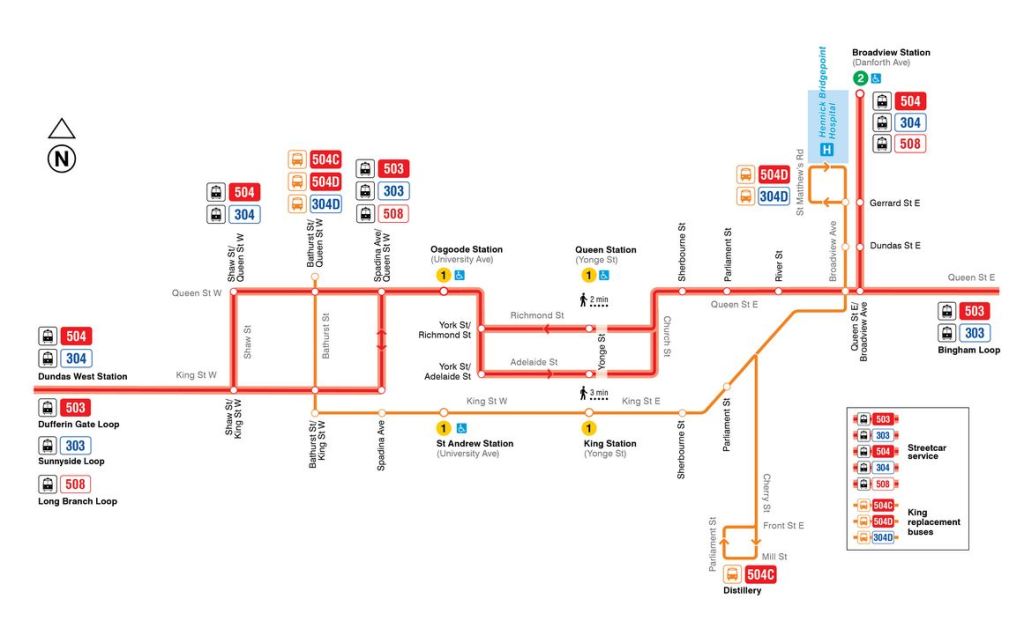
The modified diversion for track work at King and Church with buses operating via Jarvis, Front/Wellington and Yonge will be officially in the schedule. It was actually implemented on June 2 because of a change in the City’s project plans.
New Routes:
203 High Park from High Park Station to Colborne Lodge, weekends daytime only, every 20 minutes.
406 Scarborough Guildwood is a new Community Bus that will operate every 60 minutes during the midday and afternoon peak periods (9:30am – 6:00pm) on Tuesdays, Wednesdays, and Thursdays.
Bus bay allocations will change at Main Street and Scarborough Centre Stations.
Recent newspaper articles and editorials extol the virtues of the RapidTO projects on Bathurst and Dufferin Street, and portray those who object in a less than flattering light.
The urgency of transit priority action for the 2026 FIFA games combines with portrayal of transit priority as an absolute good before which all objections must fall. The word “NIMBY” is thrown about to denigrate residents and businesses in the affected areas, but this is no substitute for hard data proving, or not, that the RapidTO proposal really is “the better way”.
For decades, I have advocated for better transit service in Toronto. Transit priority measures are one, but not the only, factor that can improve transit for riders. Quality and quantity of service are also key, and yet the TTC has a tendency to place most blame for their shortcomings on external factors. To be sure traffic congestion is an issue, and Toronto is already at a point where in some locations and times there simply is not enough capacity to go around. This is not a case of some omniscient transit god or AI bot “parting the waters”, but of a recognition that this can only happen by restricting or eliminating competing demands for road space and time.
Another major factor is financial. Even pre-covid, the TTC faced limits on its operating funds and only grudgingly added service on routes. Recent announcements of “improvements” often hid the fact that the added vehicle hours left scheduled frequencies unchanged, but only offset the effects of congestion.
Service reliability and vehicle loading are key factors from a rider’s perspective, but the TTC uses metrics that bury day-to-day conditions in averages and give a generous interpretation to the concept of reliable vehicle spacing. It is no secret that TTC service management leaves a lot to be desired, and some transit “priority” schemes are are really more about keeping transit out of motorists’ way than they are to speed rider journeys.
The problem is compounded by motorists who regard attempts to corral them as an affront to their virility, but whose actions only recently have been reined in through the use of Traffic Wardens.
The City Transportation Department’s outlook is that if they make cars move faster, transit benefits too – a rising tide lifts all boats. This model collapses when there simply isn’t enough room or time for all vehicles. Some must be able to go first, and some will simply have to go away.
The King/Church construction diversions illustrate another aspect here: the concentration of transit service and traffic in locations that cannot sustain it, especially when transit, running in bunches, overwhelms intersection capacities with many closely-spaced arrivals and turns. TTC has redirected part of the diverting service (504 King) away from Spadina to Shaw so that left turns are spread out, and King/Spadina will further improve on its own when the 511 Bathurst cars return to their usual southern terminus at Exhibition Loop in late June. The east end of the diversion, at Church, does not have the same options for spreading out routes and turning issues.
In the FIFA context, we do not yet know what sort of service the TTC plans to operate, and how it will manage both the vehicle and passenger volumes at major transfer points including not just Dufferin and Bathurst but at other locations such as Union Station and major intersections enroute.
Updated May 16, 2025 at 3:50pm: The TTC has now published a map of the revised diversion routes.
In response to congestion problems for streetcars turning on and off of King and Queen Streets at Spadina, the TTC has modified the route of 504 King.
Instead of running west via Queen, Spadina and King, the 504 will now divert via Queen, Shaw and King. The 503 Kingston Road car will continue to operate via Spadina and King to Dufferin Loop.
The TTC has not yet updated the information on its King-Church diversion page as of 1:30pm May 16, but plans to do so. On-street signage will also be changed. The diversion map and information appear on several different pages, and it will be interesting to see if the TTC changes all of them.
Updated 3:50pm with revised diversion map for routes 504/304, 503/303 and 508. Not shown are routes 501 Queen and 511 Bathurst.
This reduces the peak streetcars/hour attempting to turn east-to-north at King and Spadina from 23 to 17, and west-to-south at Queen and Spadina from 13.5 to 7.5 (plus occasional 508 Lake Shore cars). Off-peak service is almost the same as peak service and so these numbers do not change much during those hours.
Numbers eastbound at King will be further reduced in late June when the 511 Bathurst cars, 6.5/hour, resume their normal route to Exhibition Loop, and 508 Lake Shore cars, 3/hour at peak, are suspended for the summer.
Updated: Now that the map has been published, it is clear that the 504C/D buses will continue to loop at Bathurst, and service on King from Bathurst to Shaw will only be provided by the 503 car.
Problems remain further east on the diversion with all of the 501 Queen, 503 Kingston Road, 504 King and 508 Lake Shore cars making turns to and from Church, Richmond, Adelaide and York, a total of about 23 per hour. There is also severe traffic congestion on Adelaide, but it is not clear how much of this is caused by queuing streetcars, and how much due to traffic volume and road capacity.
The option of using Victoria Street for the link between Queen and Richmond/Adelaide is not available because of Ontario Line construction, even though this would have separated the streetcar diversion from the busier Church Street.
This article is the final part of a review of route 7 Bathurst where the City of Toronto and TTC are currently studying the implementation of reserved bus lanes from Eglinton to Bathurst Station north of Bloor Street.
Data presented here are from all weekdays from January 2024 to April 2025 for three screenlines on Bathurst:
Barton Street just north of Bathurst Station
Just north of Eglinton Avenue
Just south of Steeles Avenue
These show headway behaviour at terminals and at the dividing line between the portion of Bathurst proposed for RapidTO bus lanes (south of Eglinton) and the portion that will not change. Travel time behaviour is shown for the entire route, as well as for the segments north and south of Eglinton.
In each chart, both the median value (50th percentile) and 85th percentile are shown. The latter value shows, generally, the degree to which the peaks lie above the median, while filtering out the worse case values in the top 15 percentiles.
Median headways over the 16 months are fairly consistent and lie near 10 minutes, the scheduled level of service. There value drops only in the period from November 2024 to March 2025 when additional unscheduled service operated during the morning.
The 85th percentile of headways stays close to the median during most off peak-periods and at terminals, but it drifts higher at Eglinton both ways showing how small variations leaving the terminals can grow enroute. In peak periods and directions, the 85th percentile is often well above the median value showing erratic departures from terminals.
Travel times along the route vary substantially from about 35 minutes in late evenings to over an hour in the peak periods. Although the length of the trip varies a lot by time of day, the 85th and 50th percentiles stay close to each other indicating that the travel times are consistent within each period. There is a day-of-week effect visible in repeating peaks in the values on midweek days. This is seen on several routes across the system, and shows how a formal schedule does not face the same conditions every day.
Not included here are the weekend data which, as shown in Parts I and II, are not as “well behaved” because of schedule shortcomings, very wide variation in the spacing of departures from both terminals, and a high level of short turning in an attempt to keep buses on time.
Although Toronto proposes reserved lanes on part of this route, this will not improve behaviour outside of the target area. Travel time savings would occur in the peak period primarily south of St. Clair.
Updated May 14, 2025 at 6pm: A section is added at the end of the article showing the time spent at both the Steeles and Bathurst Station terminals.
In Part I of this series, I reviewed headway reliability on 7 Bathurst during April 2025. This article turns to travel times along the route, an important issue relative to claims made for the potential benefit of reserved bus lanes.