How (Un)Reliable Is My Service

This article updates my ongoing compendium of TTC route performance statistics to include the first quarter of 2015.

Route_Performance_Summary_15Q1

The numbers reported by the TTC represent performance relative to the planned headways (time between vehicles), not to scheduled arrival times on routes:

The percent means that proportion of vehicles that were within +/- 3 minutes of the scheduled headway. More specifically that when each vehicle passes a ‘timing point’ it is compared to the vehicle in front of it that last crossed that same point. [From TTC Route Performance report]

In my version of the table, the TTC data are arranged in route number order with values for each quarter. Where there are blanks in the table, there was no data in the corresponding TTC quarterly report.

Also shown are the maximum, minimum, average and standard deviation values for each route’s statistics. This gives a sense of how much these values have moved around. A high standard deviation flags data that have widely varying values.

Of the 179 routes reported, 87 have higher ratings in 15Q1 than their averages for the nine quarters reported to date. To put it another way, about half of the routes did better than average for the first part of 2015, while about half did worse. If the extremely bad winter were a factor overall, one would expect a less balanced situation. On the streetcar lines, only three of eleven routes bettered their averages in 15Q1 (King, Lake Shore and St. Clair), but many of the differences are small with five of eleven falling within one standard deviation.

Headway reliability numbers are consistently bad on the 14x Downtown Express routes, and this implies that these infrequent services have a problem with running on time. What is not known is the measurements times and locations used to produce the stats for these routes and whether the service is at least on time where it collects passengers.

Similarly, headway measures for the 3xx Blue Night services are unimpressive, and what matters much more for these routes is on time performance and reliability of connections between routes, such as they exist.

The TTC claims that it will be introducing new “Journey Time Metrics” later in 2015, but there are as yet no details of what exactly these will measure. In parallel, there are moves to change the service reliability standards so that they look at routes end-to-end, not simply at their central points. (This was described in a presentation at the TTC board meeting in March 2015 (see p7 of TTC Modernization).

The TTC has yet to settle on a reporting mechanism that takes into account the difference in rider needs depending on the nature of a service. When a route is supposed to provide “frequent service”, the important point is that it be reliable. A 5 minute headway is not “frequent” if this actually means three buses every 15 minutes. When service is less frequent, then waiting times for off-schedule vehicles are a huge annoyance and on time performance is key. Short turns, of course, play havoc with both of these measures for riders who need a route beyond its common turnback points. Plans to measure the proportion of service that actually arrives at termini will highlight these problems.

Underlying all of this is the absence of a clear goal, a definition of what constitutes “good” transit service. Too often the goal has been to constrain cost increases and make the best of whatever resources the TTC has at hand.

Ontario’s 2015 Budget and GTHA Transit Projects

To no great surprise, Ontario’s budget for 2015 included a lot of transit spending, although the degree to which this is new money rather than old repackaged announcements is a tad vague.

The transportation portion of the budget, “Moving Ontario Forward”, begins on page 42 of the main budget document (which is page 74 of the linked pdf). The financial information can be confusing because projects are grouped in various sections depending on their source of funding.

To support Building Together, Ontario’s long-term infrastructure plan, investments of more than $100 billion over 10 years are underway, including $50 billion for transportation infrastructure. This is above the commitment to make $31.5 billion in dedicated funds available through Moving Ontario Forward.(p. 38)

In other words, there are now two pools of funding: the original $50b announced for the first parts of  The Big Move, and a further $31.5b for recently green-lit projects. The original $50b is going toward various projects including:

  • UP Express
  • Mississauga Transitway
  • vivaNext Rapidways
  • Eglinton Crosstown LRT
  • Finch and Sheppard LRT projects.

On the Finch and Sheppard projects, the Budget has this to say:

The Finch West and Sheppard East LRT projects, which will provide reliable and improved transit service on these busy corridors. The Finch West LRT will run along Finch Avenue between Humber College and Keele Street, and the Sheppard East LRT will run along Sheppard Avenue from Don Mills Station to Morningside Avenue. The procurement process for the Finch West LRT project is expected to begin later in 2015. (p. 39)

Additional investments not tied to specific project groups of funding streams include:

  • The PRESTO fare card.
  • Region of Waterloo’s ION LRT/BRT rapid transit project.
  • Ottawa’s Confederation LRT line.
  • Toronto’s streetcar fleet renewal.
  • The Scarborough Subway Extension.
  • Various highway projects. (pp. 40-41)

Moving Ontario Forward: Asset Optimization and Dedicated (Redirected) Taxes

This process began with the 2014 budget and, basically, involves land sales to fund infrastructure costs. In 2014, the target amount was $3.1-billion, but this has now been increased to $5.7b. The projects supported from this source include:

  • Accelerate service enhancements to the GO Transit network, which will lay the foundation for Regional Express Rail (RER);
  • Launch a new Connecting Links program, which provides funding for municipal roads that connect to provincial highways;
  • Develop a new program to expand the natural gas network, which would help more communities generate economic growth; and
  • Enhance regional mobility by investing in Metrolinx’s Next Wave projects of The Big Move, such as the Hurontario–Main Light Rail Transit project in Mississauga and Brampton, and rapid transit in Hamilton. (p. 43)

A further $25.8b (unchanged from the 2014 budget, see list on pp. 44-45) comes partly from tax revenues that are explicitly directed to the Moving Ontario Forward program. Some of this money is not yet in hand, notably contributions expected from the Federal Government.

A big chunk of Moving Ontario Forward is the GO Regional Express Rail (RER) scheme that has already been announced. The map in Chart 1.7 (at page 47) shows RER service to Oshawa, Unionville, Aurora, Bramalea and an unnamed point somewhere east of Hamilton, as well as service improvements on the Milton and Richmond Hill lines, plus the portions of the Stouffville, Barrie and Kitchener corridors beyond the RER limits. This is similar to information in the recent RER announcement, but with a notable difference regarding electrification:

The Province is also enhancing train service on all lines, including fully electrifying the Barrie, Stouffville and Lakeshore East corridors. (p. 47)

The description of RER service is also intriguing:

Regional Express Rail will deliver electrified service, at about 15-minute frequencies, along the following routes:

  • Lakeshore East and Lakeshore West corridors, between Oshawa and Burlington;
  • Union Station to Unionville on the Stouffville corridor;
  • Union Station to Bramalea on the Kitchener corridor, including UP Express; and
  • Union Station to Aurora on the Barrie corridor. (p. 47)

Given that the UPX will itself operate on a 15-minute headway, I hope that this description is merely a drafting error that has conflated two separate services in one corridor.

The Budget goes on to say that beginning in 2015-16, trains will be added on all corridors during various periods. This is an operating cost, not (in the main) a capital cost, and it is unclear whether this is coming from the “Moving Ontario Forward” pot or from general budgetary allocations to Metrolinx/GO.

Funding Partnerships

The budget is quite clear that Ontario is not going to build every project solely with provincial money.

The GO system, strengthened by the Province’s investments in RER, including on the Stouffville and Kitchener lines, will provide the backbone for a regional network. This network will also be the foundation for the SmartTrack proposal in the City of Toronto. Additional funding is needed to support key elements of this proposal, such as new stations along the route and an extension along Eglinton to the busy airport area. The SmartTrack funding proposal entails contributions of about $5.2 billion in new funding from partners, including the City of Toronto and the federal government. (p. 49)

At this point, Queen’s Park is not getting into a technology debate about the Eglinton West branch of SmartTrack and still describes this line as an airport service. However, as we will see later, the “Eglinton Extension” has been hived off as a separate budget item, and it is to be entirely funded with “partnership” money.

Another role for “partnership” funds lies in improvements to the Richmond Hill corridor with flood mitigation. It appears that Queen’s Park regards this as part of the larger bundle of projects that relate to core area capacity relief that should have money from more than one government. Whether Ontario would contribute anything is uncertain, and probably the subject of a future budget announcement if others come to the table.

The Next Wave

The Metrolinx “Next Wave” includes several projects that have not proceeded beyond lines on the map, but for which the province will continue planning and design work:

  • Dundas Street Bus Rapid Transit, linking Toronto, Mississauga, Oakville and Burlington;
  • Durham–Scarborough Bus Rapid Transit;
  • Brampton Queen Street Rapid Transit;
  • Toronto Relief Line; and
  • Yonge North Subway Extension. (p. 51)

Moreover:

In addition to RER, the Province will work with related municipalities to move towards implementation of the Hurontario–Main Light Rail Transit project in Mississauga and Brampton, and rapid transit in Hamilton. (p. 51)

Exactly what “rapid transit in Hamilton” might be is not specified.

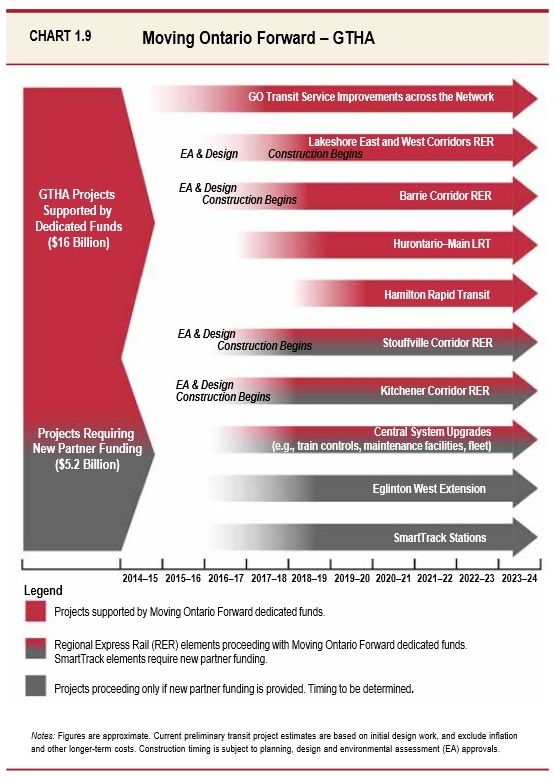
The status of various projects is summarized in the following chart (p.52).
OntarioBudget2015Chart1Dot9

As noted above, the SmartTrack elements of this plan at a cost of $5.2b are left for others to finance, and the Eglinton Extension is shown separately with 100% “new partner” requirements. An obvious place where Mayor Tory might save substantially would be to return to the Eglinton Crosstown LRT option for this segment, but we are unlikely to see any shift in his position until evidence from studies now underway shows just how impractical his SmartTrack scheme is in this regard.

What’s In and What’s Out

Notable by its absence is any reference to Waterfront transit which appears to be left in Toronto’s (or the tripartite Waterfront Toronto’s) hands. There is a generic reference to the proposed works at the mouth of the Don River, but nothing specific.

The status of route and technology selections in Scarborough is not touched both because this is a hot potato, and because legitimately Queen’s Park can point to studies now in progress that will sort out the potential role of various lines. Any move away from the subway option will not happen without a shift in Toronto Council’s position, and that is only likely if the project’s cost escalates well beyond the currently projected level.

Further enhancements to GO, notably on the Milton and Richmond Hill corridors, are topics for another day. In particular, Richmond Hill is unlikely to get serious attention until Queen’s Park and Metrolinx wrestle with the combined issues of routes serving the core area from the north and which infrastructure improvements make the most sense as a package.

No other Toronto rapid transit schemes are listed including perennial pet projects such as the Sheppard West and Bloor West subway extensions, nor is there any talk of enhancing the ongoing funding via gas tax revenue that contributes, in part, to the operating subsidy. Moreover, the question of funding accessibility is still clearly in Toronto’s hands.

The Budget doesn’t give Toronto everything it wants, and puts the City on notice that it has to come up with its own funding to address various problems, even if there might be a bona fide call on Queen’s Park for some areas.

At a minimum, there is more definition to what the government claims it will do in coming years. The challenge will be actual delivery, something for which the Liberals at Queen’s Park don’t have a good track record.

Ottawa’s 2015 Budget Transit Funding: Smoke and Mirrors

The federal government has announced a transit fund for coming years and given the impression that this is new money over and above whatever cities might receive today. It’s not, and folks like Mayor Tory who see this “fund” as a way to underwrite their pet projects like SmartTrack will come up short.

The detailed budget paper shows where the transit money actually comes from (jump down to page 187 of the linked pdf), and includes the following chart.

Budget2015Transit

Of the $53b promised over the 10 years 2014-2024, much of this already exists in the budget:

  • Gas tax: $21.8b. Toronto already receives about $150m annually from this source and has built the funding stream into its future capital spending projections.
  • Existing infrastructure funding: $6b. This is self-explanatory, and is not new money.
  • GST Rebate: $10.4b. This is another existing program, and it’s not really a payment to municipalities, merely a foregone source of federal revenue.
  • P3 Canada Fund: $1.25b. This is an existing program, although some of this may be new money. However, it is small change in the overall scheme of transit needs, and is subject to a “merit-based” allocation.

The new “Public Transit Fund” is not a block grant program, but will be based on “merit”, a concept with which Toronto is all too familiar thanks to the machinations of various transit  lobbies and politicians. Moreover, Ottawa looks to deliver projects through a combination of P3s and municipal financing backstopped by federal funding over the life of a project. This effectively defers the cash outlays to future years when a completed project would be paid for like a mortgage. This fund is expected to ramp up to $1b annually, but not immediately, and it is far from clear how much this would actually bring to Toronto or the GTHA.

Whether the private sector actually has the capital and wishes to invest, let alone whether they could do so at a cost competitive with crown borrowing, is a question best not asked. As for municipalities, the borrowing would still be on their books and affect their debt ratios, even with “guaranteed” federal funding to pay this off. To what degree those future debt payments would crowd out net new spending would depend on prevailing economic conditions at the time.

I am more than happy to see money flow from Ottawa to municipal projects, but the budget hype implies a much higher level of new spending than will actually occur. We are a long way from funding the many badly-needed transit projects in the GTHA, let alone seeing a reliable federal contribution on a par with provincial or local governments.

The Dubious Economics of the Union Pearson Express

In today’s Toronto Star, Tess Kalinowski writes about recently released Metrolinx reports concerning the Union Pearson Express (UPX).

The items of interest are down at the bottom of the Reports & Information page and they include ridership forecasts from December 2011 and May 2013. The latter report was cited as background to the Auditor General’s 2012 Report on Metrolinx [beginning on p. 6 of the pdf].

Given that the projection is almost two years old, one might be tempted to say “maybe things have improved”, but that’s a tad hard to believe in the absence of any newer studies from Metrolinx.

There are great hopes, and even greater hype, for the UPX, and getting some basic information on the table is certainly worthwhile. Continue reading

A New Way To Measure Service Quality?

At its recent Board Meeting, the TTC received a presentation [scroll to p. 3] from Chief Service Officer Richard Leary on plans to update management and measurement of surface route service quality.

The monthly CEO’s report includes a number of “Key Performance Indicators” (KPIs) intended to track various aspects of the transit system. However, the methodology behind some of the KPIs, notably those related to service quality, leaves a lot to be desired. Moreover, information that could track basic issues such as vehicle reliability is not included. This begs the question of whether the indicators exist more as a security blanket (“we have KPIs therefore we are good managers”) than as meaningful management tools, not to mention as reports to the politicians and public.

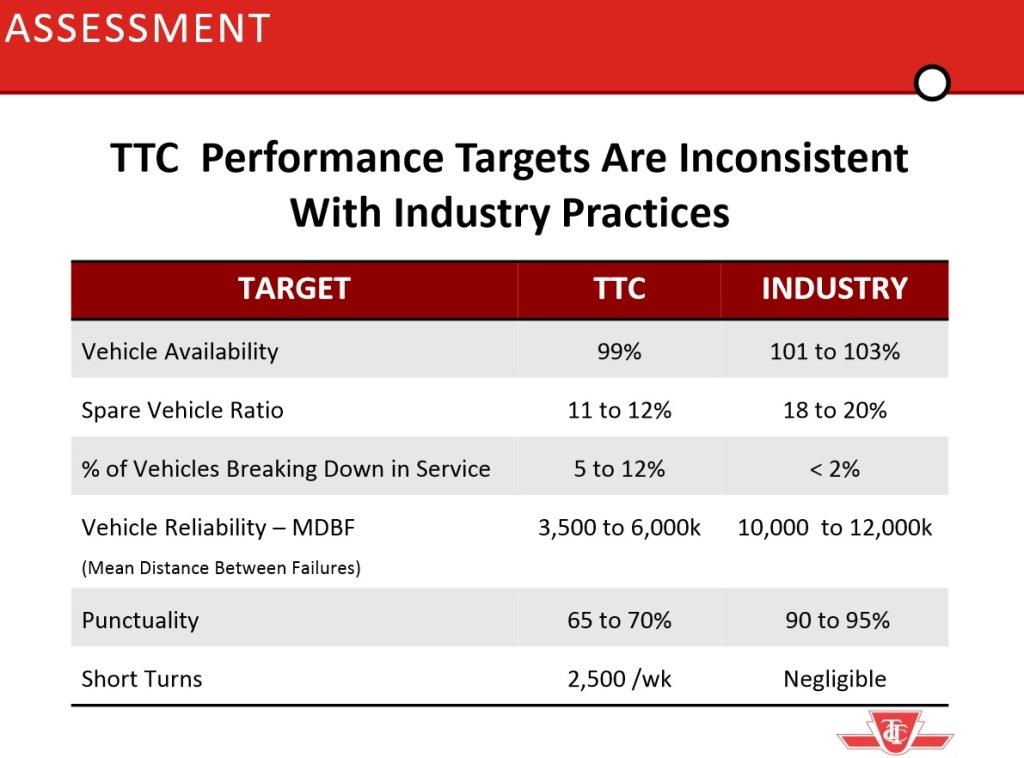
A telling chart on page 6 of the presentation shows how badly the TTC has drifted from transit industry norms:

ServiceKPIsAssessment

The TTC aims to have almost enough vehicles available for service relative to actual needs, and operates with a lower spare ratio than the industry overall. This has two effects.

  • When unusual demands for service arise, there is no cushion to roll out extras.
  • Vehicles are not maintained often enough to prevent in service breakdowns. This shows up in a mean distance between failures that is very much lower than the industry average.

The situation is actually compounded by an internal measure of service delivery: a garage counts a bus as “entering service” if it makes it across the property line onto the street. Whether the bus runs for an entire day or breaks down a block from the garage, it counts toward service provided. This is complete nonsense, but shows how the construction of a metric can induce behaviour that is counterproductive. Actually keeping the bus in the garage could allow it to be repaired and improve reliability, but that’s not what the garage is measured for.

Moving to a higher spare ratio and more frequent routine maintenance on vehicles is expected to yield better service with fewer in service breakdowns. Late in 2014, the TTC began this shift by slightly increasing spare ratios at each garage, and the MDBF for the bus fleet has risen to 7,000km. This will have to be tracked over a longer time, however, to ensure that the improvement is permanent and can be linked to further increases in spares and maintenance work.

This has a non-trivial cost for the TTC. With a total scheduled service of about 1,500 buses, a 6% increase in spares represents 90 vehicles, or a substantial portion of a typical yearly bus purchase, not to mention a fair amount of garage space.

Continue reading

TTC Board Meeting March 26, 2015 (Update 2)

The TTC Board met on March 26, and considered a meaty agenda that begins to address some important policy issues.

Updated March 29, 2015 at 3:45 pm: The presentation on One Person Train Operation (OPTO) given at the meeting has been added along with comments.

Updated March 24, 2015 at 8:10 am: After this was published, the TTC posted the CEO’s Report.

In a previous article, I wrote about the Spadina subway extension project update. This will undoubtedly be the main attraction both for board members and the media. Other items of interest include:

  • An overhaul of system key performance indicators (KPIs)
  • A door monitoring system for Toronto Rocket trains and one person train crews (Updated March 29)
  • Revision and consolidation of the resignalling contract for the Yonge-University line
  • A study of express bus routes
  • CEO’s Report

Continue reading

How Much Will The Spadina Extension Cost? (III) (Update 3)

Updated April 13, 2015:

The TTC has issued a press release regarding the management of the Spadina subway extension project:

The Toronto Transit Commission has entered into an agreement with Bechtel Canada Co. for project management of the Toronto-York Spadina Subway Extension (TYSSE) for up to $80 million.

The contract value to Bechtel is based on staffing costs, management fees and incentives to open the subway extension by Dec. 31, 2017. Bechtel staff begin work today and will form an integrated team with existing TTC personnel. The Bechtel contract will expire March 31, 2018. Bechtel’s project director will report directly to TTC CEO Andy Byford.

On March 26, the TTC board approved a report from staff that recommended TTC enter into a sole source agreement with a project manager with a proven track record of delivering similar-sized projects on time, and with experience working with multiple contractors, in order to have the TYSSE in service by Dec. 31, 2017.

Toronto City Council subsequently authorized the expenditure of $90 million, while the Regional Municipality of York authorized the expenditure of $60 million, for a total of $150 million (third party contractor, plus in-house project costs), to fully deliver TYSSE by the end of 2017.

The release is silent on the issue of what might be done with the remaining $70m of Toronto/York’s $160m authorization.

Original article of March 29, 2015:

In a previous article, I reviewed information from a media briefing by Andy Byford on the status of the Toronto York Spadina Subway Extension (TYSSE) project. At the TTC Board meeting on March 26, 2015, further information was made public both in Byford’s presentation, and in additional material appended to his report.

Updated March 30, 2015 at 1:30 pm: The slides from Byford’s presentation are now available starting at page 58 of the linked pdf.

Updated March 30, 2015 at 11:30 pm: A new report from the Toronto City Manager to Council advises that the interest earnings on the “Move Ontario Trust” (the repository for provincial contributions to the TYSSE project) have not achieved the target rate of 4% resulting in an $85m shortfall. Oliver Moore reports in the Globe that Ontario has refused to make up this amount as per the original agreement between the funding partners. Toronto and York Region are on the hook for this additional cost estimated at $51m for Toronto and $34m for York Region. This expense is over and above the cost overruns on various contracts, but at least Council cannot blame the TTC because the trust fund is not under TTC control.

Appendix F (beginning at page 33 of the linked PDF), is a presentation given to the Executive Task Force who oversee the project on behalf of the sponsoring governments on July 28, 2014. The presentation was given by Parsons Brinkerhoff who had been retained by the TTC to review the project.

Appendix G (beginning at page 56) is a two-page summary of Bechtel’s work reviewing PB’s original study and a subsequent APTA (American Public Transit Association) peer review. APTA concluded that an earlier completion date would be possible than PB had projected, but only with major changes to the project management structure. Bechtel concurred in these findings.

It is abundantly clear from this material that the TYSSE’s problems were known at the top level of the project in mid-2014 at the latest. At the time, their severity was so great that the project would still be incomplete by the time of the next municipal and provincial election cycles, and that considerable additional cost could be facing the funding partners. This very serious issue did not arise in public discussion until six months later, notably after Toronto’s 2015 budget cycle was complete.

Continue reading

How Much Will The Spadina Extension Cost (II)?

In a previous article, I reviewed the history of the Toronto York Spadina Subway Extension (TYSSE). This project has been widely reported to be both late and over budget, but details only began to emerge on March 20, 2015 when TTC CEO Andy Byford fired two senior members of the engineering staff.

On March 21, 2015, Byford presented a briefing to the media as a preview of a report to be discussed by the TTC Board on March 26, 2015. This report includes both current information on the project and an October 2012 update that was issued when the TYSSE deadline was shifted to fall 2016.

The key points of the briefing were:

  • The earliest possible opening date for the TYSSE to Vaughan is the end of 2017.
  • Relations between TTC project management and the various contractors working on the TYSSE are badly strained, and this cannot be remedied by those now in charge.
  • Byford recommends that the TTC “retain a third party project-management firm as an incentivized project manager” (the terms of the proposed arrangement are confidential pending execution of the agreement).
  • Alternate schemes for continuing the TYSSE project with TTC staff in part or all of this role will extend the period needed to resolve outstanding issues and reach project completion, and will increase total project costs.
  • Additional funding to keep the project active to the end of 2017 of $150-million is required with Toronto paying $90m and York Region paying $60m. Toronto’s share could come from a TTC operating surplus in 2015 (mistakenly cited as “2014” in the report), property sales and/or deferral of projects. There is no word on how York Region might fund its share of the extra costs.
  • The project is subject to many claims by contractors against the TTC, and some counterclaims on the TTC’s part. The eventual value of settling these is unknown, and this is a potential additional cost beyond the $150m. Whether this can be accommodated by the existing project budget remains to be seen.

Continue reading

TTC Service Changes Effective May 10, 2015

The schedule changes for May 10 will bring the first wave of improvements from the recently adopted City of Toronto budget and increased transit subsidy.

  • Many routes will gain service to begin implementation of the “Ten Minute Network” on core routes across the system. This stage mainly affects weekend service. Weekday changes to some of these routes will follow with the June schedules.
    • 192 Airport Rocket
    • 506 Carlton
    • 25 Don Mills
    • 36 Finch West (to Humberwood)
    • 191 Highway 27 Rocket
    • 504 King
    • 44 Kipling South
    • 47 Lansdowne (Queen to St. Clair)
    • 129 McCowan North (to Steeles)
    • 116 Morningside (to Finch)
    • 63 Ossington (to St. Clair)
    • 86 Scarborough (to Sheppard)
    • 24 Victoria Park (to Steeles)
  • The implementation of “All day, every day” service will begin.
    • 108A Downsview to Jane via Grandravine on Sundays late evening.
  • Expansion of express bus services will begin.
    • 196 York U Rocket to Sheppard-Yonge Station on weekends daytime.

The Scarborough RT will now be officially known as “3 Scarborough”.

Branch name changes will continue the move to use of the “A” designation for the primary branch of routes:

  • 6A Bay Dupont to Queens Quay & Sherbourne (formerly 6)
  • 38A Highland Creek to Rouge Hill GO (formerly 38)
  • 24A Victoria Park to Steeles (formerly 24)
  • 165A Weston Road N to Steeles (formerly 165)
  • 165C Weston Road N to Canada’s Wonderland (formerly 165A)

The 102D Markham Road contract service in York Region will be extended to Major Mackenzie Drive.

At the request of York Region Transit, the 102D (Warden Stn-Mount Joy GO Stn) service will be extended to Major Mackenzie Drive via Bur Oak Avenue and Mingay Avenue. Service will be removed on Castlemore Avenue, Anderson Avenue and Bur Oak Avenue, and from Mount Joy GO Station.

Retirement of the 7200-series Nova RTS buses at Arrow Road will continue through the spring. These vehicles have been used on 96 Wilson and 165 Weston Road North, but they will be confined to peak-hour runs if any remain in service for the May schedule period.

Reconstruction of the south ladder track at Russell Carhouse on Eastern Avenue will require significant operational changes. Some runs will be reassigned to Roncesvalles Carhouse, and the use of Exhibition Loop to store cars overnight will increase. Cars remaining at Russell Carhouse will be backed into the yard from the north entrance.

Various seasonal changes reflecting the decline in school-related travel and the increase in demand for recreational trips will be implemented. However, due to the timing of the Pan Am Games and the Indy car race, the seasonal expansion of 29 Dufferin service to the Princes’ Gates will not occur (weekday midday and evening, Saturday late evening, Sunday/Holiday evening).

The split operation of 72 Pape and 172 Cherry was planned to end with the May schedules. However, construction on Front Street at Union Station continues and a date for resumption of the unified route has not been settled. The TTC advises that, except for Pan Am Games, no other changes are planned until at least September.

With the completion of construction at College & Spadina and at Spadina Station, streetcars will return to 510 Spadina. Other changes this triggers include a reduction of service on 509 Harbourfront and resumption of buses for peak extras on 504 King. Two runs on 509 Harbourfront will be scheduled and crewed for LFLRV operation in anticipation of vehicle availability.

Details of individual route changes are in the spreadsheet linked below.

2015.05.10 Service Changes

TTC 2015-2024 Capital Budget: Streetcar Infrastructure

Updated March 15, 2015 at 8:40 pm: An example of a vintage tram adapted for pantograph operation in Munich has been added to the end of this article. Thanks to John F. Bromley for the photo.

The TTC’s Capital Budget includes ongoing programs to replace worn streetcar rail as well as to upgrade the overhead power distribution system for compatibility with the new Flexity LRVs.

Replacement of streetcar track with infrastructure built to new, robust standards is almost complete on the main lines used by all routes. What remains are sections used for diversions and short turns.

Tangent track on Spadina south from College that was installed for the resumption of streetcar service in 1997 is scheduled for replacement in 2018. The table and the map differ on whether this work will end at Queen or at King. In any event, this will be the first major track replacement over a section constructed to new standards, and only the surface layer (track down to the tie attachments) should have to be removed.

Replacement of overhead contact wire with thicker 4/0 gauge is also well underway, as is the replacement of feeder cables, some of which are very old and are shedding their insulating covering. Intersection and yard upgrades will, together with the new tangent wire, make the system 100% pantograph compatible. When the last of the cars using trolley poles has been retired, the overhead can be further adjusted to remove pole-specific hardware and simplify future maintenance.

This article contains lists and maps of the work planned for 2015-2019.

Continue reading