No Time For Panic on TTC Ridership Numbers

The TTC’s Ridership Update report will be discussed at the March 23, 2016 Board meeting. Its publication triggered an unwelcome round of hand-wringing about transit service and financing that could well undo momentum seemingly regained by the Tory regime at City Hall. How did we get so quickly from a pro-transit stance to one where just avoiding cuts will seem a victory?

Fun With Budgets at City Hall

During the Ford years, TTC ridership continued to climb despite the best efforts of Council to throttle the TTC budget, but a good deal of that growth came at the margins, filling up less crowded routes and time periods, and stuffing the busier ones to the extent any new riding was possible. John Tory ran on a platform that SmartTrack would fix absolutely everything, but once in office acknowledged that day-to-day service had taken a hit and needed fixing. Improvements to date have not addressed peak capacity for the simple reason that there were no spare vehicles, and that is only now being addressed.

Some of the new buses bought by the TTC will not directly address capacity shortfalls, but instead will be used to bolster the pool of spare buses so that maintenance standards can improve and fewer vehicles will fail in service. The streetcar system remains hobbled by a car shortage thanks to Bombardier’s missed deliveries, and this cascades down into the bus fleet. On the subway it is physically impossible to run more trains, a problem that will not be eliminated until 2019-20, and then only on Line 1 YUS. Riders might be forgiven for wondering if things will ever improve, especially for peak period travel.

Schedule adjustments have reduced the amount of short-turning on some routes, but gaps and bunching of vehicles remain a problem.

The TTC is far from out of the woods on service quantity and quality, and this situation cannot be fixed overnight.

Continue reading

A Few Questions About “Emerging Transit Plans”

At the February TTC Board meeting, Chief Planner Jennifer Keesmaat took the Board through the road show presentation she and her staff have been taking around Toronto with the proposed new Toronto transit plan. This issue was held over to the March Board meeting because, for procedural reasons, there were limited questions in February.

One major issue here is that the body actually charged with setting transit policy, the TTC Board, was being briefed on a plan they had not seen before, and to which they had given no input or direction. This is only partly explainable by the fact that any long-term transportation plan would form part of the city’s Official Plan, and the Planning Department “owns” that document. However, one would hope that members of the TTC Board would have at least a passing familiarity with what was in the works. This situation is complicated by the presence of “citizen” members who are not also Councillors and are not part of the information flow, such as it is, at City Hall.

The plan and supporting reports will go to City Council a week after the TTC meeting.

A major problem, of course, is that “planning” in Toronto consists of catering to the whims of the Mayor, influential Councillors, the Minister of Transportation (and his government), and senior members of the government caucus. To describe planning in this context as unbiased and purely “evidence based” is something of a stretch.

That said, the situation is better today than in recent years because, at least, all of the proposals are on the table at once, and it is more difficult to dress up a bad proposal when it must compete for attention and analysis with many others at the same time. This does not prevent Councillors from making the attempt at advancing their pet projects, but some degree of comparative evaluation might keep them in check.

Continue reading

TTC Board Meeting March 23, 2016

The TTC Board will meet on March 23, 2016 at 1:00 pm in Committee Room 1 at City Hall. The agenda includes many items of interest:

Continue reading

New Service for the Waterfront and King Street

At its meeting on March 23, 2016, the TTC Board will consider two reports on major revisions to transit service in the Waterfront and on King Street.

The changes will address a backlog of route and service issues in one package:

  • Through routing of the 72 Pape bus from Pape Station, suspended during construction at Union Station, will be restored, albeit on a different route.
  • Additional service will be provided on Queens Quay East by the 72C Pape to Union Station branch, although this is likely to be infrequent.
  • A new route, 121 Fort York – Esplanade will be created composed of the former Esplanade portion of the 72 Pape (later 172 Cherry) bus route plus an extension serving the Railway Lands and Fort York.
  • A new streetcar route, 514 Cherry, will operate as an overlay to the 504 King car replacing some or all of the supplementary bus service between Dufferin Loop and the new Distillery Loop on Cherry Street south of Mill Street. This service will operate with Flexity streetcars, subject to availability.
  • The conversion of 511 Bathurst to low floor operation will be delayed by about three months.

The changes will be implemented on June 19, 2016. The detailed service plans have not yet been published, but there is some information in the staff reports.

Continue reading

What Is The TTC Policy on Fares? (Updated)

Updated March 11, 2016 at 11:00 am: A section has been added commenting on the TTC’s claim that a two-hour transfer would result in a revenue loss of $20m/year.

Recent discussions about a proposed Toronto transit plan have included, almost as a minor sideshow, the Metrolinx study of regional fare integration. A basic tenet of this study is that “rapid transit” would be a separate fare zone or structure from everything else, but the exact mechanism by which this would be done is as yet unclear. GO Transit fares might be lowered and subway fares increased for certain trips, but there is no worked example to show how various trip types inside and outside the City of Toronto will be affected.

Although City and TTC staff are working with Metrolinx on this study, neither the TTC Board nor Council has been presented with a definitive proposal, and there is limited direction from either of them on guiding factors staff should use.

The only context in which Council has decided anything was for SmartTrack, and their wishes included lots of stations, frequent service and the ability to ride SmartTrack for a TTC fare. We know now that many stations and a good deal of service are no longer part of the package. As for fares, there has been some equivocating about this by staff as to just what a “TTC fare” might be by the time SmartTrack (or more accurately GO Regional Express Rail) begins operating.

As for the TTC Board, there has been a series of reports and decisions evolving over the last year. None of these sets a definitive policy, although the motions passed could be misread to imply this has happened.

Continue reading

When Is a GO Train not a GO Train? When It’s UPX!

Among the mysteries of the internal organization at Metrolinx is the presence of separate “divisions” for GO Transit (the commuter rail service), Presto (the fare card service) and UP Express (the premium fare airport shuttle service).  Rather than using the GO brand for the airport service and integrating its operation and fares, Metrolinx treats UPX as a completely separate entity, no doubt so that it could isolate the operation as a profit centre on the books. We now know that “profit” is the furthest thing from a UPX future where just finding riders now takes precedence.

Soon, fares on UPX will be much lower and this might encourage some to incorporate the UPX into their journeys. However, there are two glaring holes in the new arrangement.

UPX, being a separate operation, does not have fares integrated with connecting GO services at Union. Riders transferring between these services will pay separate fares for each leg of their journey. Presuming that UPX fares stay low, this should be corrected, at the latest, in the next annual review of GO’s tariff.

But the really bone-headed decision (or lack of decision) lies with the TTC. Although GO fares discourage “local” travel within the 416, there is a legal transfer move a rider can use called TTC Times Two. A trip can start on the TTC, transfer to GO, and then back onto the TTC again using the original TTC transfer.

With UPX moving to lower fares and the likelihood that it will attract commuter trade within the city, the question becomes “is TTC Times Two valid for UPX”? I asked the TTC’s Brad Ross and Chris Upfold this question at the recent TTC Board meeting. Their answer? “No” because (a) UPX is not a GO train and (b) a TTC policy change would be required.

The irony, of course, is that GO operates in the same corridor as UPX, and it would be impossible to distinguish whether a traveller with a transfer from the Lawrence 52 bus arrived at Union Station via GO or via UPX, except of course that GO service only runs in the peak period.

During the March 1 subway shutdown thanks to a power vault fire, TTC riders travelled on GO and UPX for no extra charge. The reverse courtesy has been extended to GO riders on occasion. This did not require a formal meeting and policy decision, simply the recognition that there is one transit network regardless of the logo on the train.

How riders get from one connection point to another should not matter. Between now and March 9 when the new UPX fares take effect, can someone at the TTC show a small spark of initiative and decide that a traveller on either a GO or UPX train can use TTC Times Two? Or will we continue to have an artificial distinction between two services provided on the same track by the same agency?

TTC Board Meeting Review: February 25, 2016

The TTC Board met on February 25, 2016. This article is a review of some of the reports and discussions at that meeting. For the full list, please refer to the agenda.

In this article:

As part of an update on cycling initiatives, the Board passed a motion asking staff to work together with the City on improved parking facilities for bicycles at subway stations. An article on this appeared on Torontoist’s website.

Continue reading

TTC Service Changes Effective Sunday, March 27, 2016

The major changes for the new schedules effective March 27 involve routes where new express services will be added.

25 Don Mills

A new service, the 185 Don Mills Rocket, will operate weekdays until mid-evening, and weekend daytime. The combined service at express stops will improve over current schedules, while service at local stops will decrease.

The stopping pattern for the 185 Don Mills Rocket will be:

  • Northbound: Buses stop only at Cosburn Avenue, Thorncliffe Park Drive (west leg), Thorncliffe Park Drive (east leg), Don Mills Road/Gateway Boulevard (south leg, north side), St. Dennis Drive (Ontario Science Centre), Eglinton Avenue East, Green Belt Drive, Lawrence Avenue East, York Mills Road, Graydon Hall Drive, Parkway Forest Drive, Don Mills Station, Van Horne Avenue, Finch Avenue East, McNicoll Avenue, Steeles Avenue East, Freshmeadow Drive/Don Mills Road.
  • Southbound: Buses stop only at McNicoll Avenue, Finch Avenue East, Van Horne Avenue, Don Mills Station, Havenbrook Boulevard, Duncan Mill Road, York Mills Road, Lawrence Avenue East, Barber Greene Road, Eglinton Avenue East, St. Dennis Drive (Ontario Science Centre), Overlea Boulevard/Don Mills Road (west side), Thorncliffe Park Drive (east leg), Thorncliffe Park Drive (west leg), Cosburn Avenue, Pape Station.

39 Finch East

Services on Finch East will be reorganized:

  • Route 139 Finch-Don Mills will be discontinued.
  • Route 199 Finch Rocket will be extended west to York University weekdays during the daytime and early evening, and east to Morningside Heights during peak periods.
  • The 39C Seneca College branch will be extended east to Gordon Baker Road.

The stopping pattern for the 199B Finch Rocket to York University will be:

  • Eastbound: Buses stop only at Murray Ross Parkway & Busway, Dufferin & Finch, Bathurst Street, Finch Station, Bayview Avenue, Leslie Street, Don Mills Road (farside stop), Seneca Hill Drive, Victoria Park Avenue, Pharmacy Avenue, Warden Avenue, Birchmount Road, Kennedy Road, Midland Avenue, Brimley Road, Finch & McCowan, McCowan & Sheppard, and Scarborough Centre Station.
  • Southbound: Buses stop only at McCowan & Sheppard, Finch & McCowan, Brimley Road, Midland Avenue, Kennedy Road, Birchmount Road, Warden Avenue, Pharmacy Avenue, Victoria Park Avenue, Seneca College, Don Mills Road (farside stop), Leslie Street, Bayview Avenue, Finch Station, Bathurst Street, Dufferin & Finch, Murray Ross Parkway & Busway, and The Common.

The stopping pattern for the 199C Finch Rocket to Morningside Heights will be:

  • Eastbound: Buses stop only at Bayview Avenue, Leslie Street, Don Mills Road (farside stop), Seneca Hill Drive, Victoria Park Avenue, Pharmacy Avenue, Warden Avenue, Birchmount Road, Kennedy Road, Midland Avenue, Brimley Road, McCowan Road, then all local stops east of McCowan Road.
  • Southbound: Buses stop at all local stops to McCowan Road, then stop only at Brimley Road, Midland Avenue, Kennedy Road, Birchmount Road, Warden Avenue, Pharmacy Avenue, Victoria Park Avenue, Seneca College, Don Mills Road (farside stop), Leslie Street, Bayview Avenue, and Finch Station.

44 Kipling South

A new service, the 188 Kipling South Rocket, will provide an express service to Humber College Lake Shore Campus weekdays during peak and midday periods.

The stopping pattern for the 188 Kipling South Rocket will be:

  • Northbound: Colonel Samuel Smith Park Loop, Colonel Samuel at Humber College Building M, Colonel Samuel at Lake Shore Boulevard, Kipling at Birmingham, Kipling at Evans, Kipling at The Queensway (farside stop) and Kipling Station.
  • Southbound: Kipling Station, Kipling at The Queensway (far side stop), Kipling at Evans, Kipling at Birmingham, Kipling at Lake Shore Boulevard, Colonel Samuel at Humber College Building M, Colonel Samuel Smith Park Loop.

24 Victoria Park

A new peak period express service will be added.

The stopping pattern for the 24E Victoria Park Express will be:

  • Northbound: Buses stop only at St. Clair Avenue, Eglinton Square, Eglinton Avenue (farside), Lawrence Avenue, Rowena Avenue, Ellesmere Road, Pachino Avenue, Sheppard Avenue, Finch Avenue, McNicoll Avenue, and Steeles Avenue.
  • Southbound: Buses stop only at Steeles Avenue, McNicoll Avenue, Finch Avenue, Sheppard Avenue, York Mills Road, Parkwoods Village Drive, Rowena Avenue, Lawrence Avenue, Eglinton Avenue, O’Connor Drive, St. Clair Avenue, and Victoria Park Station.

96 Wilson

The Wilson route will be broken into four separate designations to simplify scheduling (eliminating interlining between some branches).

  • The 96E Wilson Express to Humber College will be replaced by the new 186 Wilson Rocket. This route will operate during the peak periods and weekday middays (the 96E is peak only).
  • Route 118 Thistle Down replaces the 96C service.
  • Route 119 Torbarrie replaces the 96G service.
  • Both routes 118 and 119 operate from Wilson Station during all periods. The 96 services they replace operated from York Mills Station during peak periods.

The stopping pattern for the 186 Wilson Rocket will be:

  • 186 eastbound: Buses will stop at Humber College Bus Terminal, Westmore Drive, Martin Grove Road and John Garland Boulevard, Kipling Avenue and Brookmere Road, Islington Avenue and Elmhurst Drive, Armel Court, Albion Road and Weston Road, Walsh Avenue and Weston Road, Clayson Road, Jane Street, Julian Road, Keele Street, Dubray Avenue, Dufferin Street, Wilson Station, Bathurst Street, Avenue Road, and York Mills Station.
  • 186 westbound: Buses will stop at York Mills Station, Avenue Road, Bathurst Street (far side), Wilson Station, Dufferin Street, Dubray Avenue, Keele Street, Julian Road, Jane Street, Clayson Road, Walsh Avenue and Weston Road, Albion Road and Weston Road, Armel Court, Islington Avenue and Elmhurst Drive, Kipling Avenue and Brookmere Road, Martin Grove Road and John Garland Boulevard, Westmore Drive, and Humber College Bus Terminal.

Roncesvalles Carhouse Track Reconstruction

Reconstruction of the north ladder tracks will require that cars back out of the yard onto The Queensway, loop west through Sunnyside Loop, and enter service eastbound from that point. Schedules for all routes based at Roncesvalles will be adjusted with extra running time for their departure trips.

Charlotte Street Track Reconstruction

Track on Charlotte from Adelaide to King will be replaced. During this work, the 510 Spadina service that normally short turns there will be extended south to Queens Quay.

Service arrangements for 504 King during the reconstuction of the King-Charlotte intersection have not yet been announced.

Harbourfront Route

This route will now be designated as a 100% low floor route. In the event that Flexitys are not available, ALRVs will be used in their place. Schedules will be adjusted to remove some of the extra running time that had been added for Queens Quay construction.

2016.03.27 Service Changes Rev1

There’s A New Subway On The Way (6)

From time to time, the question of just what constitutes “subway demand” comes up in various threads on this site. As a matter of comparison, here is the TTC Scheduled Service Summary for April 7, 1964.

Headways on the Bloor-Danforth service itself were quite impressive. Two-car trains of PCCs, roughly the equivalent of the new Flexity cars, ran throughout the day until mid-evening, and the peak headways shown below are for trains.

                          AM Peak         PM Peak
                          Hdwy   Veh      Hdwy   Veh
Bloor route                      100             110
  Jane to Luttrell        2'30"           2'30"
  Jane to Bedford                         4'00"
Danforth route                    30              48
  Bedford to Hillingdon   3'20"
  Bedford to Luttrell                     3'00"
Combined                         130             158
  Bedford to Hillingdon   1'26"
  Jane to Bedford                         1'32"
  Bedford to Luttrell                     1'22"

Jane Loop was at Bloor & Jane.
Luttrell Loop was on Danforth between Main and Victoria Park at the old city boundary.
Bedford Loop was at St. George Station.
Hillingdon Loop was at the east side of Danforth Carhouse east of Coxwell.

The Bloor-Danforth streetcars could not carry all of the demand into downtown, and that work was shared with many parallel routes.

  • 2’00” Bathurst car from Vaughan Loop (at St. Clair) to Church & Adelaide
  • 1’30” Carlton car
  • 1’40” Dundas car from Runnymede & Dundas to City Hall
  • 2’30” Harbord car from Lansdowne & Davenport to Pape & Danforth via Dundas & Yonge
  • 1’20” King car
  • 2’00” Kingston Road car (now “Downtowner”)
  • 5’00” Kingston Road Tripper car (Victoria Park to Roncesvalles & Queen)

The streetcar system required 640 cars in the am peak, 684 in the pm peak.

A Rainbow of Rapid Transit

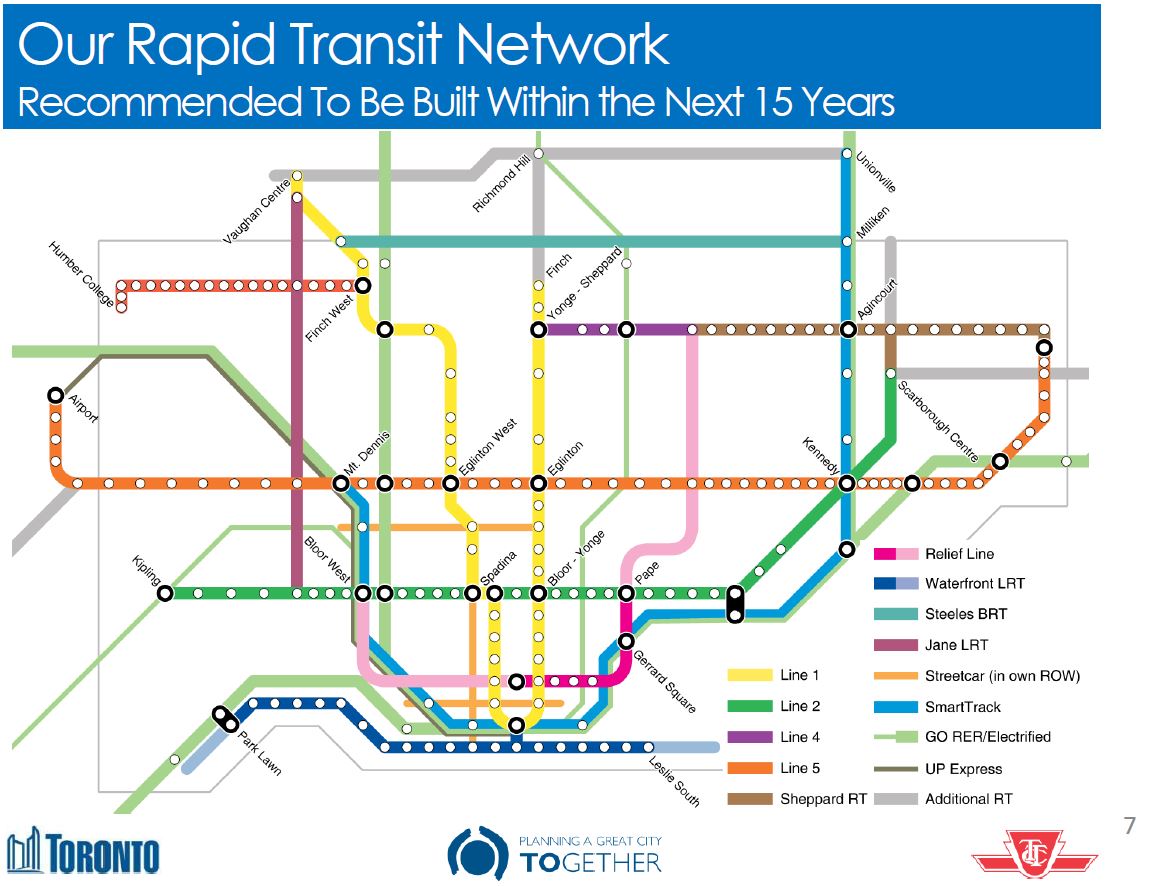
In Toronto’s never-ending fascination with new transit maps, the City Planning department has released a vision for our rapid transit network as it will be in 15 years.

201602_15YrPlan

Despite much talk of “evidence-based” planning, this is a very political map, and I cannot help remembering then-Premier David Peterson’s announcement of 1990 (not long before he lost an election and Bob Rae wound up as his much-surprised replacement) that amounted to a chicken-in-every-pot map.

There is nothing wrong with network-based planning, and indeed I have been beating a well-worn drum on that subject for years. But let us also remember that the Scarborough Subway exists because of the political clout of Brad Duguid, a former City Councillor, now Ontario’s Minister of Economic Development. Mayor John Tory, in Toronto Life, cites Duguid as saying that “if anyone tries to cancel the [Scarborough] subway, they’ll do it over his dead body”. “Evidence” apparently includes having a large cudgel to keep wandering pols in line.

The map also includes the Mayor’s pet project, SmartTrack, and it’s no wonder that he steers clear of the Minister’s position given the need for a provincial agency, Metrolinx, to accommodate SmartTrack on their network.

All of this is part of the “Motherlode” of public consultation sessions now running in various places around the City, and through Metrolinx in the wider GTHA. Background information and links to related material are available at Toronto’s TransitTO web site.

Continue reading