Recently I wrote a piece for the Torontoist site “TTC Budget Woes Deepen” to give an overview of the major issues facing the TTC and the City of Toronto as it goes into the annual round of budget talks facing a huge mound of transit spending.
This article is rather long, and is intended to go into more detail for readers who want to know how the budget works, and how the various reports and tables fit together.
There are three documents containing the initial version of the ten year plan:
Some of the information is not presented in the same format in each report, and this can be confusing even to a veteran budget reader. There are valid reasons for this, in some cases, because different information is excerpted to tell different parts of the overall story. Where this happens, I will try to sort out the numbers.
A major problem with the TTC’s budget and plan is the ever-growing list of “unfunded” projects. There are now at least five groups:
Projects that are officially in the “base budget” but for which no funding has been identified ($2.273 billion)
New projects that are not in the base, but which are shown in the chart of funding sources as a contribution to the shortfall ($1.05 billion).
Changes in scope of existing projects for which there is no funding ($128 million).
Additional projects that do not exist in any of the lists ($2.216 billion).
Projects listed in the detailed budget, but with spending planned (if it is shown at all) beyond the 2018-2027 plan’s window.
This backlog represents almost as much as the “funded” portion of the budget, and the absence of clear information on the need for, timing and priority of these projects is a huge gap in the information presented to the Commission and to Council. Changes in the timing of any of these projects and/or the need to move them into “funded” status will have a domino effect through the entire TTC and City budgets by bringing costs into years where funding is not now available.
This list does not include any major rapid transit projects such as the Scarborough Subway (SSE), the Relief Line (RL), SmartTrack (a City project separate from the TTC’s budget) or the LRT expansions on the Waterfront West or Eglinton East (once part of the Scarborough “package”). Only the SSE has “funding” in the sense that resources from three governments are earmarked to build it, but this project could still run aground if the costs at 30% design come in higher than the current estimate.
Note: In various places in this article, I quote the TTC’s responses to questions about details of the budget. These were supplied by Brad Ross, Executive Director of Corporate Communications, from TTC staff. Thanks to Brad for this.
When John Tory became Mayor of Toronto in the 2014 election, he quickly discovered that his transit briefings as a candidate were far from the truth. Service deteriorated under Mayor Ford, and although Tory opposed a plan to increase bus and streetcar service during the campaign, he had a change of heart. The then-new Mayor supported the purchase of more buses and a partial restoration of service standards, notably those affecting off peak service.
What has happened between the start of 2015 and fall 2017?
Over the past three years, TTC ridership growth has levelled off and is dangerously close to slipping into decline. Many factors are cited, including the “do nothing” option of “every other city is losing riders so we’re no different” approach. That is not exactly a call to restore riders’ faith in the TTC.
An important issue is the question of actual service levels. Looking at the service budget and actual operations, one might get the impression that service is growing.
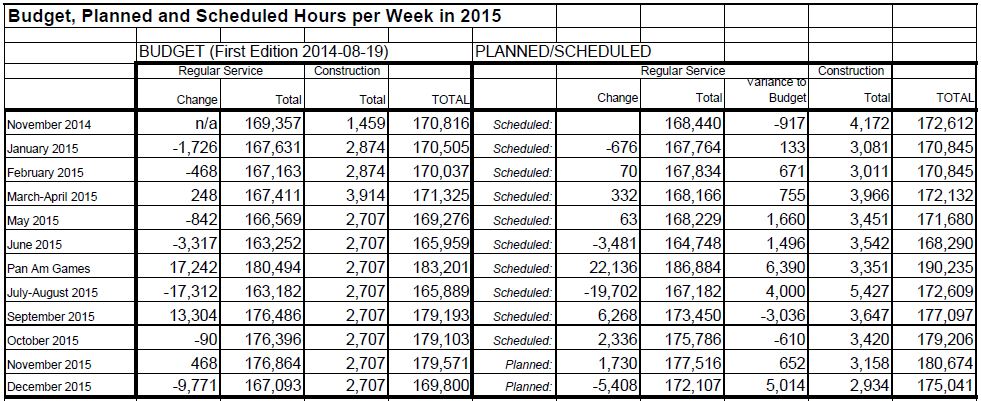
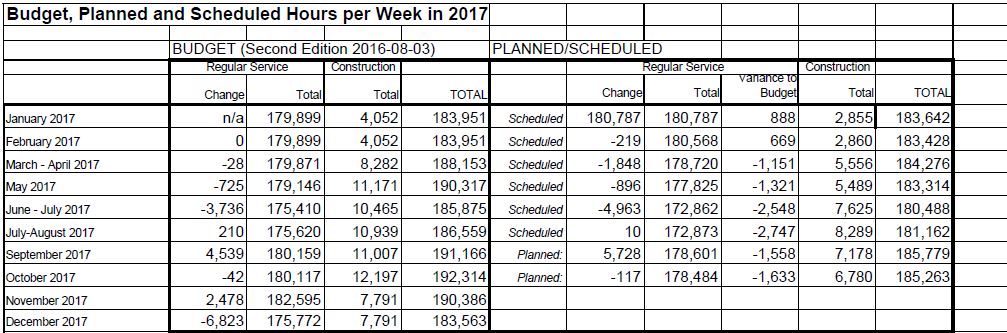
The budgeted service in 2017 is higher than in 2015, but the details are important:
The budgeted regular service in 2017 is only slightly higher than in 2015. For September, the budget is 2.1% higher in 2017. However, not all of the planned increase was actually operated in response to the ridership numbers and budget pressures.
More than half of the total increase in service hours is due to construction, not to actual improvements.
One can argue that without the extra construction service, riders would have even worse service than they do, but this does not change the fact that regular service has improved very little over three years.
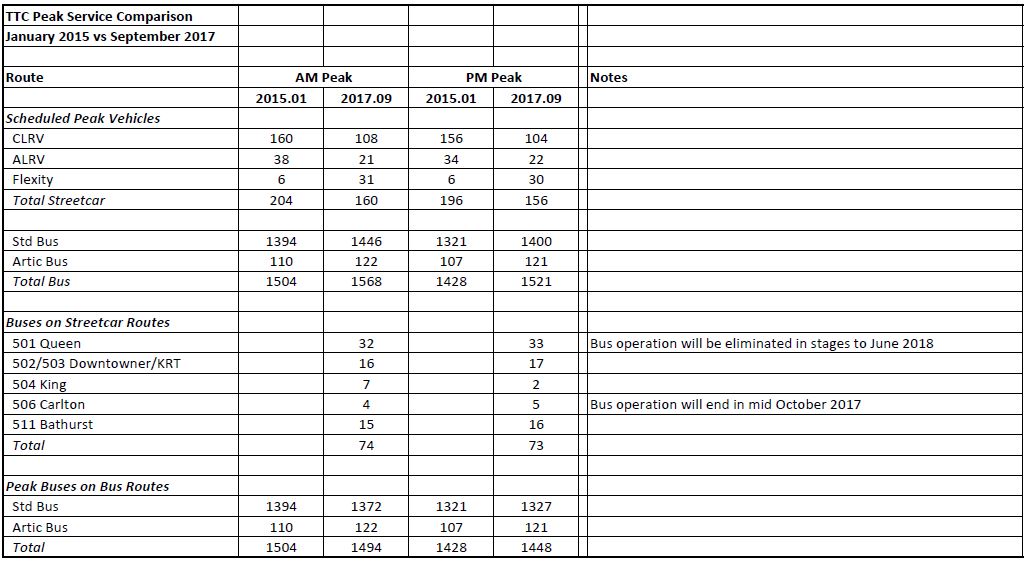
This can be seen in detail in the chart linked below which compares peak headways (the time between vehicles) for the January 2015 and September 2017 schedules.
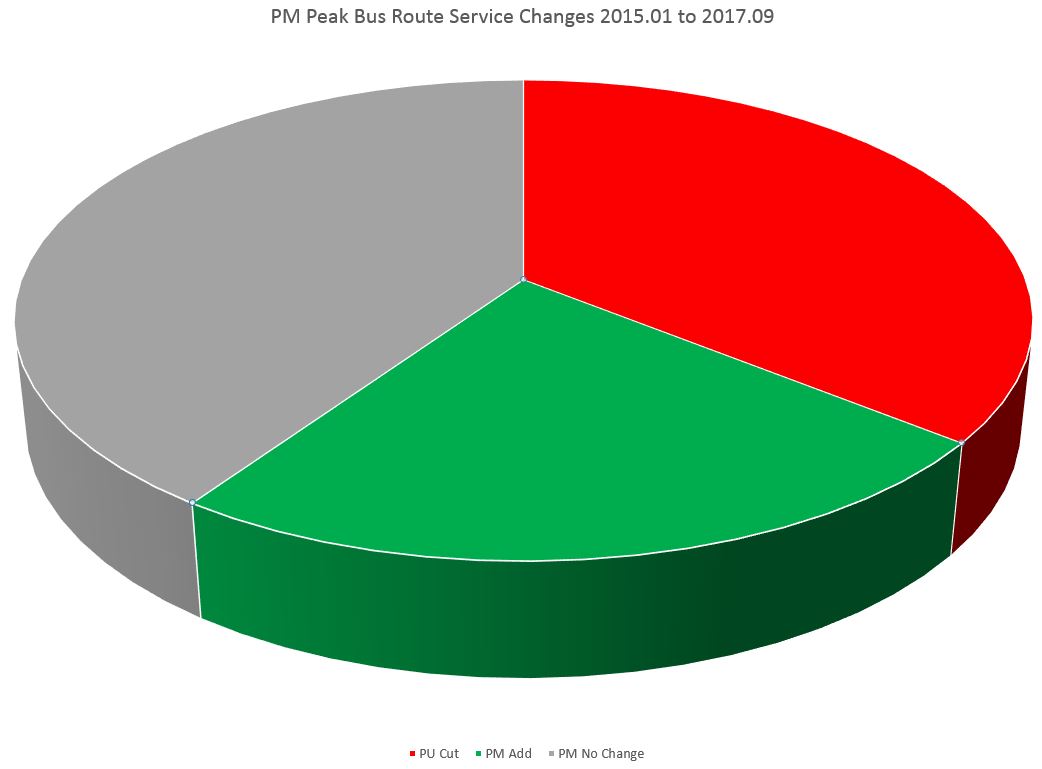
The bus changes summarized in pie form show the breakdown.
The total number of buses in service during peak periods is up from 2015, but this is entirely due to substitution of buses for streetcars either for construction projects or to offset the late delivery of Flexity cars from Bombardier.
When the total count of buses in service is adjusted for vehicles running on streetcar lines, the AM peak value is down slightly, and the PM peak is up only by 20 vehicles.
This does not account for extra vehicles dealing with congestion delays on the TYSSE project in 2015, nor the Crosstown project in 2017.
On a route by route basis, there are more routes with service cuts in 2017 relative to 2015, or with no change in peak service at all, than there are routes with better headways. Most streetcar routes have service cuts in both peaks.
This is hardly a system that is actively trying to attract ridership with better service and more capacity.
In coming months, the TTC expects to publish an updated bus fleet plan (October 2017) and a Ridership Growth Strategy (November 2017). A fleet plan requires not just buses, but also garages, operators and maintenance workers. Both of these reports will be vital inputs to the Capital and Operating Budgets. Good intentions alone will not bring more service to TTC routes.
An important component of the fleet plan will be the target spare ratio for vehicles. The TTC has increased this value in past years to ensure that its fleet gets the pro-active maintenance required to field revenue service every day. However, adding to spares makes the fleet larger without changing scheduled service.
Absent the details of coming budgets, it is unclear how much provision, if any, has been made for substantial service improvements. Capital subsidy programs such as Ottawa’s PTIF (Public Transit Infrastructure Fund) may let Toronto buy more buses, but if Toronto Council will not fund the operation and maintenance of the added vehicles, then this is nothing more than a make-work program for the bus builders and a way for the TTC to retire much of its fleet sooner than planned.
There is an inherent dishonesty in many transit funding announcements because they address only the initial cost of provisioning vehicles and building infrastructure, not actually running and maintaining them. The TYSSE alone will add about $30 million (net of new revenue) in costs to the TTC’s budget, and it is far from clear whether they will receive added subsidy, or be forced to trim service elsewhere to handle this. (Part of the increase was already digested in the 2017 budget as startup costs for the new subway, but most of the cost hits in 2018.)
Meanwhile, Bombardier is supposed to ramp up streetcar deliveries this fall reaching 7.5 cars/month by October. As of September 24, the second “September” car, 4446, is about to leave Thunder Bay, and it is clear that Bombardier will not make the target of four cars for this month (ending with 4448). It is hard to believe that they will actually ramp up to a much higher production rate, and this threatens service quality on both the streetcar and bus networks. Even if Bombardier does begin to deliver at the planned rate, there remains the question of whether the TTC will restore streetcar operations on all routes, or continue to retire older cars.
The TTC faces several difficult years in a political environment where added spending on transit operations will be hard to achieve in the face of “tax fighting” politicians. The one product they are selling is service. Without real improvements, not just marketing flim-flam, the TTC will lose political influence and, with that, the funding they so badly require.
Sources:
TTC Scheduled Service Summaries (copies available on this site)
Updated September 14, 2017 at 6:00 pm: An inconsistency in the opening date for the Finch West LRT between the Capital projects update and the project’s website has been flagged by a reader. Snapshots have been added to this article.
The Metrolinx Board met on September 14 to consider various reports. I have already written about the Fare Integration update, and will devote separate article(s) to the “Next Big Move”, the updated regional plan.
The roll out of Presto continues and TTC, even with a relatively low take-up rate to date, now accounts for more Presto taps than any other agency in the network. However, this only slightly more than one quarter of all Presto “taps” on a monthly basis (6.6 million for TTC vs about 24m for all systems). As the proportion of Presto-based TTC trips rises, TTC figures will dwarf all other agencies.
Status updates of note:
Readers are now performing well, but problems remain with the add value machines. A new generation of machines is now in testing and these will be rolled out across the system in the near future, including on the about-to-open Spadina subway extension to Vaughan.
There is no plan to introduce “open payments” (credit/debit cards, etc) on Presto in 2018 because Metrolinx is pre-occupied with the TTC roll out. Something might appear in the following year, but a related issue is that security standards for bank card transactions keep changing and getting tighter requiring ongoing design updates.
Presto sales and reload functions in Shoppers Drug Mart stores have been well received.
Presto supports “UPASS” programs. These are specific to each institution, not a system-wide standard implementation. Improvements coming in November:
UPASS program core functionalities enabled as part of PRESTO Vouchers solution.
UPASS program will provide discounted fares to university students in their respective districts through their local transit agency and universities.
Students will be able to electronically load discounted passes onto their cards through the PRESTO Customer Website, and universities can add eligible students through the PRESTO Vouchers portal.
Presto has negotiated a new agreement with various client agencies. There was no information in the presentation about how willing these agencies/cities were to accept higher service fees to fund the Presto system.
Presto is developing a new privacy policy for disclosure of data to law enforcement agencies. Public feedback on their proposals will be sought through a web survey, stakeholder groups and public sessions. The Information and Privacy Commissioner will review management proposals to ensure that they comply with applicable laws. A proposed policy update will come to the Board in December 2017.
Metrolinx’ large inventory of capital projects continues, notably the Crosstown LRT, but also expansion of GO corridors.
There was a lengthy discussion of Union Station capacity, and among the information that came out was that Metrolinx is considering a reconfiguration of the station with fewer tracks and wider platforms. This would provide more passenger handling capacity, a key requirement considering the anticipated rise in service on all corridors. A new layout would also imply that services would be “hooked up” east and west of Union rather than terminating there. This would considerably simplify operations. A study of Union’s future requirements will come to the Board in December 2017.
Metrolinx is planning to study the status and appropriateness of Hydrogen technology to their operations:
A feasibility study on the use of hydrogen fuel cells as an alternative technology for electrifying GO rail service and the UP Express is underway
Ontario is committed to running electrified trains on the GO rail network by 2025. Studying the feasibility of hydrogen rail technology is part of our due diligence to ensure that we choose the appropriate technology.
Metrolinx has had discussions with the Germany-based National Organization Hydrogen and Fuel Cell Technology (NOW) to learn directly about early experience
Metrolinx is committed to bringing industry leaders together for a symposium later this year to explore the potential application of hydrogen fuel cell technology
This will be useful if only to get a current view of the technology’s maturity and applicability, assuming that there are no Ministerial interests in forcing a conversion on Metrolinx. According to staff, they are operating on the basis that RER will be rolled out with existing electrification technology.
Updated September 14, 2017 at 6:00 pm:
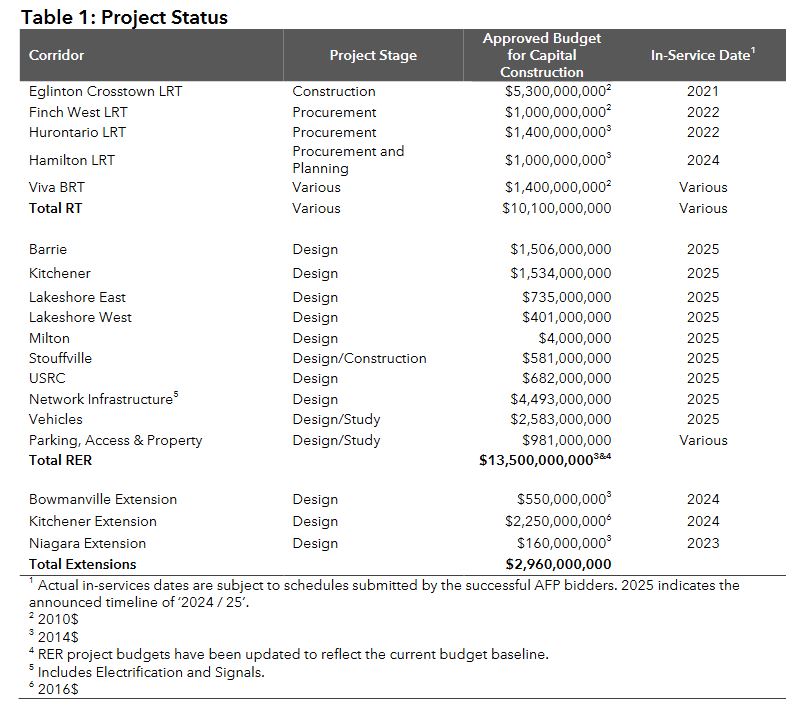
In the Quarterly Report, there is a status table for all of the projects. The Finch West LRT is shown with an In-Service date of 2022.
However, the project’s web page shows a 2021 opening. I have asked Metrolinx to clarify this discrepancy. Thanks to reader Kass Forman for catching this.
The Annual Report includes, under the heading of “Being responsive & accountable”, the following statement [p. vii]:
Metrolinx is:
Increasing transparency in its financial, labour, realty, freedom of information, support fleet, information technology and capital projects details, so that Corporate and Administrative Costs are easier to understand.
Increasingly relying on evidence-based cost drivers to strengthen the data used to allocate costs to capital and operating programs.
These are fascinating claims considering the degree to which Metrolinx is a secretive organization. Far too many background studies are published, if at all, long after the Board has made a decision and the time for public input which could have been informed by such studies has passed.
“Freedom of Information” should occur naturally (as it would for a municipal agency), not when it is forced on Metrolinx by a formal FOI request from the media.
Easy understanding of costs will be more challenging because of corporate restructuring to amalgamate former divisions (Presto and UPX) into the main body of Metrolinx.
The integration and consolidation of operations under one management structure will deliver core Metrolinx services to customers and allow us to leverage internal learning and skills so we can adapt quickly and respond to our dynamic and fast-changing region. While we will maintain the identities of each service brand externally, we will be looking for opportunities to help our customers and the public understand the connections between each service and product. Beginning next fiscal year, we will report on our consolidated transit operations division, which will combine data and statistics for GO Transit and UP Express. [p. viii]
This will make determination of the profitability or cost of individual segments that have been treated as independent divisions more difficult, along with the degree of cross-subsidy that might exist between various aspects of Metrolinx’ businesses.
I asked Robert Siddall about this during the press scrum after the meeting. Siddall is the Metrolinx CFO, but is also Acting President and CEO pending the arrival of a recently-appointed CEO in October. He replied that with UPX becoming operationally part of GO Transit, it did not make sense to attempt to break it out as a separate cost and revenue centre. He was silent on the question of Presto.
For 2016-17, Presto received $14.8 million in usage fees. Operating costs were not broken out. [See charts on pp 35 and 38 of the report.] Oddly, the Presto update earlier in the agenda treated the negotiation of the client agreement with UPX as if this were a completely separate agency rather than part of GO Transit. The degree to which there are cross-subsidies between GO and UPX trips and Presto is completely hidden.
To Kirby, or Not To Kirby
The line in the Annual Report about “evidence-based cost drivers” is particularly amusing given the situation at both the provincial and municipal levels.
Ben Spurr in the Star has reported on political interference with the stations selected to be part of GO’s coming expansion. Specifically, the Lawrence East and Kirby Stations were originally not to be included in the list recommended to the Metrolinx Board, but this changed after intervention by the Minister of Transportation.
During the press scrum, Metrolinx Chair Rob Prichard performed a not-too-elegant dance around repeated questions about just how the change in Metrolinx’ official position on these stations came about. Boiling many answers down to their core, he argued that although the Board had considered the matter of the station list on three occasions, they only actually voted on it once. Moreover, it is Metrolinx’ job, he argued, to provide advice based on information and analyses they have. Such decisions are a combination of technical analysis and art, he said. It was a performance not quite at the level of Swan Lake. [I will leave it to the reader to decide whether Prichard was auditioning for Prince Siegfried or Baron von Rothbart.]
An obvious question here is this: Metrolinx is supposed to give advice based on their expert technical studies (and whatever art they might muster). However, if the Cities of Toronto and Vaughan have new information about development plans for these two station sites, one must ask why Metrolinx staff and consultants did not have this as part of their study. How credible is any plan Metrolinx produces if “new information” can arise with clear political motives to swing decisions?
Fare Integration Update
As I previously reported, Metrolinx has rethought its approach to integration so that it can actually achieve something rather than endless discussion. Specifically, the Board approved:
The Metrolinx Board endorse the step-by-step strategy outlined in the Report and that staff report back on December 14th 2017 on means to advance the strategy which includes:
Discounts on double fares (GO-TTC)
Discounts on double fares (905-TTC)
Adjustments to GO’s fare structure
Fare Policy Harmonization
Staff undertake to engage the public and key stakeholders (including municipal elected officials) on advancing the step-by-step strategy
Staff post the consultant’s Draft GTHA Fare Structure Preliminary Business Case
After a long period when Metrolinx was attempting a “big bang” change in fare policy, they are now trying a “step-by-step” approach intended to deal with the most annoying inconsistencies in regional policy without actually tearing the entire structure apart. Although it is clear Metrolinx would like to reach an end-state based on fare-by-distance, they will settle for an interim configuration for “two to five years”, according to Leslie Woo, Chief Planning Officer. Politically, that is equivalent to saying that the matter is deferred sine die.
This would conveniently allow someone in, say, the midst of an election campaign, to promise added funding to cover the cost of bringing the TTC into a consolidated fare system, to rationalize GO transit’s fares, and to sort out some regional inconsistencies such as the TTC’s transfer policies.
If Toronto adopted the two-hour transfer, this would make a seamless cross-border trip simple to implement and administer for Presto users. With the 416/905 barrier out of the way, the “need” to completely reorganize fares would drop substantially, and the political leverage to go “all the way” to fare-by-distance would be reduced almost to vanishing.
One issue came up during the scrum, and it will be thrown into the hopper for December’s report: the integration of UPX fares with the rest of GO. It makes no sense to operate UPX effectively as a short turn service on the Kitchener line while charging different fares. Moreover, integration of UPX trips with the wider GO tariff, including any TTC co-fare, is essential if Metrolinx is to play by the same rules they expect of every other transit agency.
Particularly important to any discussion about alternative fare schemes will be an open revelation of how each arrangement would affect different types of riders. Metrolinx has always been silent on the effect of a distance-based fare and premiums for “rapid transit” (e.g. subway) on long-haul suburban commuters within Toronto. Failure to publish this information puts the “debate” in the ludicrous situation of asking for a faith-based approval rather than one based on actual evidence. This kind of “planning” and “consultation” at Metrolinx must stop if they are to achieve their goals for transparency.
As regularly as the seasons come and go, Metrolinx produces new reports on its long-running contemplations for a new regional fare system. Like the seasons, reports come and go, but there is little real progress toward an actual solution.
The root problem has always lain with Metrolinx. Although it bemoans the inconsistencies among fares in regional agencies, Metrolinx itself has clung to one fare model – fare by distance – as the Nirvana to which all should aspire. If there is something to be said for the current report, it is that at last there is a shift it focus and a recognition of two essential issues on the provincial side of the discussion:
Metrolinx’ existing fare structure is not purely a fare-by-distance system, but contains many inequities and idiosyncrasies built up over the years. In particular it discriminates against short and medium distance travel, but that is only one of its problems.
Integration across the 416 boundary will not occur without some new type of subsidy. Previous attempts to craft a revenue-neutral fare scheme inevitably required pillaging from Toronto (where most of the fare revenue is actually collected) to provide a subsidy for the 905.
The Executive Summary includes the following points from a consultant’s study that led to a Draft Business Case (this document has not yet been posted online):
All fare structure concepts examined perform better than the current state, offering significant economic value to the region
Making use of fare by distance on additional types of transit service better achieves the transformational strategic vision than just adding modifications to the existing structure, but implementation requires more change for customers and transit agencies
More limited modifications to the status quo have good potential over the short term
Further analysis has been conducted on other aspects of the fare system such as concessions, products, and loyalty programs
Metrolinx and GTHA transit agencies continue to independently make decisions regarding fares that widen the gap that fare integration needs to bridge
At the risk of prejudging the outcome, it is quite clear where this is heading. There will be come sort of “limited modifications” to achieve the “good potential over the short term”, and we may never actually reach, nor need to reach, the end state.
Staff recommend that the Board approve the following:
The Metrolinx Board endorse the step-by-step strategy outlined in the Report and that staff report back on December 14th 2017 on means to advance the strategy which
includes:
Discounts on double fares (GO-TTC)
Discounts on double fares (905-TTC)
Adjustments to GO’s fare structure
Fare Policy Harmonization
Staff undertake to engage the public and key stakeholders (including municipal elected officials) on advancing the step-by-step strategy
Staff post the consultant’s Draft GTHA Fare Structure Preliminary Business Case
Metrolinx argues that an integrated fare strategy would require substantial standardization of fare policies notably the discount structures for concession and loyalty fares and rules regarding the validity of transfers. While the 905 systems use time based transfers, the TTC requires a new fare if there is a stop-over or doubling back on a journey. This and any other “local options” complicates Presto, and as we have seen in the case of the TTC leads to odd behaviours due to the difficulty of mapping trips and “valid” transfers under all circumstances. Although the report does not mention this, TTC management have already indicated tentative support for time-based transfers (this is to be part of a forthcoming Ridership Growth Strategy). The problem lies in the political arena where City Council will have to cough up funding to offset the cost.
Until the study is actually published, we should take the statement that “all fare structure concepts examined perform better than the current state” because an essential part of any new structure would be the elimination of the boundary between TTC and other fares. This does not necessarily endorse any of the alternatives.
Like a dog with a bone, Metrolinx simply will not give up on its preferred alternative:
Fare by distance should be a consideration in defining the long-term fare structure for the GTHA
The question here is what is merely “a consideration” and what is an unchangeable goal across the entire network.
Metrolinx acknowledges that it has to talk to people, and that it simply cannot impose its will on the region.
A formal and inclusive decision making process needs to be put in place to establish the longer-term GTHA fare structure vision
This is a rather odd statement considering all of the study this issue has been through, and the degree to Metrolinx has previously claimed widespread agreement. Moreover, it implies that someone might actually disagree, although the outcome of such a position is unclear. Would Queen’s Park welcome local political input (after demolishing the original Metrolinx that included local politicians) if it provided a way to impose unwanted policies on individual members of the region?
What is particularly galling about this summary is that after all this time we still do not see worked examples of possible fare structures and their effects on various types of trips, on groups of riders and on the revenue streams of each transit agency. Possibly this is in the as-yet unpublished report, but if it isn’t, Metrolinx will effectively admit that the real effects are not as rosy as their claims. The most obvious question any new scheme will encounter is “what’s in it for me” both as positive and negative issues.
Appendix 1 discusses “Key Fare Integration Challenges” and is somewhat more realistic than previous attempts at the topic. First up is the question of “tapping off”, a pre-requisite to fare-by-distance. The report acknowledges that tapping off is not the effortless addition to fare collection procedures:
Emerging technological solutions may allow tap on-only customer experience while maintaining compatibility with fare-by-distance or–zone structures
and
As GO fares require origin/destination information, any regional fare structure requires either:
acceptance that different customer behaviours will be required depending on service type,
moving all transit to tap on/off, or
new technological solutions
Other issues include the handling of cash fares and mobile ticketing.
With respect to distance travelled, there is a notable difference between GO and TTC subway fares because the former are distance based and skewed against short trips, while the latter are flat and provide free transfers to connecting services. The report observes:
As GO fares cannot feasibly be flat, any regional fare structure requires either:
acceptance of different approaches to distance based on service type, or
moving all services to fare by distance/zones
The problem with this statement lies in the term “service type”. Metrolinx has previously touted the idea of “premium” services that would include all rail-based modes, while leaving buses untouched. This arises from a flaw in a previous study that did not consider “bus rapid transit” because (it is claimed) there were no BRT services when it was undertaken. Such is the quality of Metrolinx “research”.
If we decide that some services should pay a premium fare, the obvious questions is “what is a premium service and why should I pay more for it”? This is easy to argue for GO rail because these are express services with widely spaced stops (although even that model is under attack thanks to SmartTrack and the Minister of Transportation’s love for extra stops), but much harder for subways, let alone LRT and BRT that are a much lower step up from local transit than a GO train.
Each municipality has its own local concession fares often in response to local history or to the perceived value of certain types of discounts. Toronto has free rides for children, while seniors’ and students’ fares vary around the region, and there are different approaches to discounts (if any) for disadvantaged groups. How all of these will be reconciled is a knotty question: does the most generous arrangement get implemented across the board, or do the outliers (e.g. Toronto with children’s fares) drop their concessions? What is the appropriate multiple for loyalty programs such as the Metropass?
Unless Queen’s Park is willing to sever the link between farebox revenue and local service costs by providing subsidies for a more generous (and “integrated”) fare system, this discussion won’t get very far. Indeed, it might still run into problems if municipalities that do not now offer “discount X” get a provincial subsidy when others who provide this out of local funds today are left with that cost.
The whole study of Fare Integration has bumbled along for quite some time without any clear answers, but with an attempt to preserve the status quo from Metrolinx’ point of view. This has wasted a great deal of time when a better-informed conversation might have taken place. With an election coming in June 2018, the current proposal adds to the consultation, but conveniently punts a decision beyond the end of the current government’s mandate.
The service changes for the October-November period are relatively minor.
On the streetcar network, provisions for construction diversions on 505 Dundas and 506 Carlton end, but for 501 Queen and related routes a new project at McCaul plus the ongoing streetcar shortage leave service in that corridor with temporary schedules:
501 Queen streetcars will operate from Neville to Roncesvalles, but they will divert via Church, King and Spadina for about three weeks during the reconstruction of the intersection at McCaul.
501L Long Branch and 501M Marine Parade bus service continues as it was in September.
Bus trippers have been shifted from King to Queen where they will operate between Woodbine and Sunnyside.
Kingston Road services 502 and 503 continue to operate with buses.
The 511 Bathurst route continues to operate with buses although the introduction of Flexitys on 512 St. Clair is releasing CLRVs that could be redeployed elsewhere. How quickly streetcars will return to temporarily bused routes remains to be seen.
Although schedules for routes at the Renforth Station (formerly “Gateway”) were altered in September, this facility is not yet complete and routes continue to operate to their former termini.
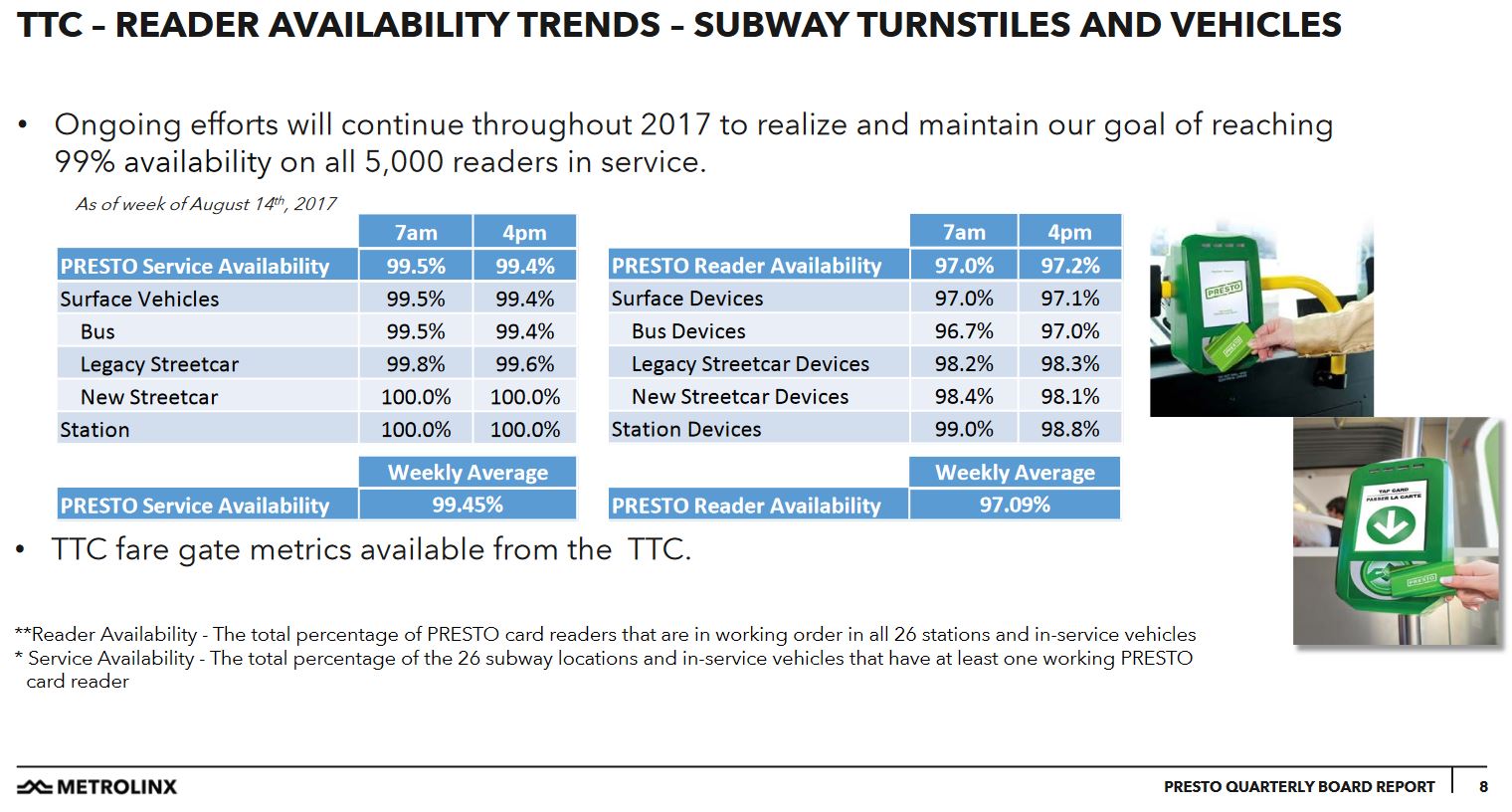
Through the fall and winter of 2017-18, the TTC will be converting all remaining stations and entrances to use fare gates and Presto card readers. There are station-specific notices, but for readers’ convenience I have consolidated all of the information here. The first two pages of the following pdf contain the information in textual format, and the remainder is a Gantt chart. The information is current as of September 9, 2017. Stations are in sequence by line. If a station is not shown, either it has already been converted or the TTC has published no information about it.
There are variations on the way the program will roll out depending on the station.
Some entrances/stations will not close for this project, but will be converted in stages with access maintained throughout construction for passengers.
Some entrances/stations will have only selective late night closings (generally after 11pm), and work will otherwise take place maintaining a pathway for passengers.
Some stations/entrances will close completely for some or all of the conversion project. There will be weekend closings for selected stations in the downtown “U” on Line 1 YUS, but many of the secondary entrances will close completely for over a month.
During construction, riders will not be able to purchase fare media from the station collectors while their booths are close.
Even after the shutdown periods, work will continue at some locations for an extended period.
Following the conversion, riders will still be able to pay with all fare media at the main entrance of stations, but the secondary entrances will support either a combination of Metropasses and Presto, or only Presto in some cases. Details are in the linked chart.
Postscript: Notices for the closing of stations on lower Yonge Street include the following info:
During the early and weekend closures subway trains will not stop at the station. Customers should use [nearby] stations to access the subway or board a northbound or southbound 97 Yonge bus.
Of course, the 97 Yonge bus does not run on lower Yonge Street except during weekday peaks when the stations will be open. The TTC has been advised of this and will, in due course, fix the affected pages. No need to kvetch here in the comments.
As part of the September CEO’s report to the TTC Board, management made two presentations on the evolution of service quality on the surface and subway networks.
For the surface routes, Rick Leary (Deputy CEO and Chief Service Officer) ran through an overview of two sets of statistics: on time performance and the numbers of short turns.
For the subway, Jim Ross (Deputy Chief Operating Officer) reviewed schedule versus actual capacity provided on Line 1 YUS as well as a breakdown of the types of incidents that produce most delays.
From time to time, readers mention in comments the common delays at Spadina Station caused by the manner in which streetcars unload and load at the platform.
Before the introduction of the new Flexitys, cars would enter the station, unload at the east end of the platform, then pull ahead to load at the west end. There was even enough room that three cars could be on the platform at once with one ready to move forward into the loading zone as soon as room was available.
However, with the longer Flexitys, two cars will not quite fit on the platform, and although there are still separate unloading and loading stops, in practice only one car can be on the platform at a time. When this is compounded with delays for crew changes and with the siestas some cars take while loading, delays to passengers waiting to get off of arriving cars are chronic and lengthy.
I asked the TTC’s Brad Ross why cars did not make better use of the space.
An option that comes up is for the loading car to pull slightly beyond the platform and not open its front-most door. This would allow the following car to come fully onto the platform and unload. The front of the loading car would not be in the tunnel itself, but adjacent to an unused area of the platform at the west end.
The reply from the TTC is:
It is not possible to isolate the front doors of the LFLRV. If the streetcar were to go past the glass barrier to allow a second streetcar to access the platform, we would not be able to open the remaining 3 doors, while keeping the first door closed. All doors would closed but enabled, and would require our customers to push the door button to gain access to the streetcar. In addition, we would not be able to prevent anyone from opening the first set of doors from the inside of the streetcar (or even from outside, should a customer go around the glass wall and push the button). This is a huge safety issue, as the front doors are not flush with the platform at that position, and customers would have to step down to the rail bed.
One obvious solution would be to extend the platform so that it does sit flush with the front doors, but that is not an option at this point. The issue actually lies with the structural pillars that support the station; they are too close to the streetcar to allow proper egress. This is where I am seeking clarification from the Construction group. I am unsure of which pillar is in the way and what the actual requirement is, but have heard that it would cost millions to relocate the pillar to allow us to extend the platform. That is why that section of the platform is not being used and the glass partition is in place.
This begs the rather obvious question of why it is not possible for an operator to selectively open doors on a car. It is not unknown for vehicles to be in locations where a physical barrier would prevent use of all doors. In the specific case of loading at Spadina Station, the loss of the comparatively narrow first door would be a good tradeoff for simply getting a car far enough into the loading area that its follower could unload behind it.
I await further feedback on the matter of the cost and practicality of modifying the station, but in the meantime, it is useful to look at this problem in the manner we normally see for evaluations of expensive rapid transit projects: the value of riders’ time. Billions in spending on rapid transit has been justified by the premise that people will move more quickly and thereby save time, time that has a value against which the capital investment can be offset.
(This is a dubious proposition because the public investment is “balanced” against a private saving in “money” that can never be recaptured, but stay with me for the purpose of the exercise.)
There are 15 cars per hour attempting to serve Spadina Station. If we assume that each car is delayed by an average of 2 minutes, and that it has an average of 50 passengers, this translates to 1,500 minutes of passenger delay per hour.
If this condition persists on average for 8 hours per day, that means there are 12,000 passenger minutes of delay, or 200 passenger hours.
The value of riders’ time is often quoted at about $30/hour, and this means a value of lost time of $6,000 per day. Scaling up to a year with a 300:1 factor (counting weekends as one day) gives us an annual lost time value of $1,800,000.
It is self evident that any of the variables used here can be tweaked up or down, but this gives the general idea of how the calculation would come out. Of course the City cannot “spend” that $1.8 million to offset reconstruction at the station because it is not real money, as I’m sure we would be told by the financial boffins.
In addition to any notional saving that riders might obtain, there is the real cost of, probably, one extra car on the Spadina route thanks to the extra running time needed to serve Spadina Station Loop.
There is a real need for the TTC to sort out operations at Spadina Station to minimize delays. This should include both figuring out how to use the loading area with a car projecting slightly beyond the platform and ensuring that crew changes happen as briskly as possible.
I will update this article when/if more information becomes available.
Updated Aug. 14, 2017 at 4:05 pm
Based on Twitter feedback, a few comments are in order.
In this article, I did not refer to explicit methods of crewing, but used the term “drop back” on Twitter. Some took umbrage saying that the term is “step back”. In fact both terms have been used over the years. It is the mechanism that counts, not the name. The idea is that operators get a break without the car having to sit there while they take it. To do this, there are more operators than cars, and an operator from car “n” “steps back” to car “n+2” (or whatever) so that they get a break of, in theory, two headways (the number can vary depending on how long a break is desired). This works fine as long as the operator who is supposed to take over an incoming car is actually available when it shows up.
At a location like Spadina Station, there is no stacking space to accommodate late crew changes whether they are part of a step back system or a regular shift change, and the problem can be compounded when the home division for the line is a long way away, and operators have to travel to pick up their cars in service.
Delays of cars getting on to the platform because of the loading techniques just make this worse by holding cars in the tunnel.
My aim in writing this article was twofold:
Everyone involved – TTC management, planners, line supervisors and operators – need to work together to find a way to improve operations at this busy station which have deteriorated noticeably since the new cars were introduced.
The principle of “value of riders’ time” is often used to justify big ticket capital projects, but it does not have the same clout in day to day operations.
In his continuing program of bribing the electorate with promises that the City cannot afford, Mayor Tory has asked the TTC to bring forth a 2018 operating budget containing no fare increase. This would come, of course, just in time for his re-election campaign where Tory could brag about all the transit wonders he has bestowed on our fair city.
Fare freezes are simplistic approaches to a “transit policy” not unlike fantasy subway maps and promises that tax increases will be held at no more than inflation. Can’t fit it all into the budget? There must be efficiencies, cost cutting that will solve problems, because as we all know public agencies like the TTC are rife with fat just waiting to be trimmed. That’s a great story, and it plays to the wing of Council whose only concern is to be re-elected for keeping taxes down.
The reality is not quite what it is made out to be.
TTC faces a shortfall in its budget for 2018 thanks to increasing costs and expansion of its subway service. The degree of this shortfall has probably been understated. There is no provision for improved service (net of the subway extension) because ridership is expected to remain fairly static. The cost increases cannot be wished away with an appeal to make the TTC more “efficient” both because of their scale, and the many cuts that have been made in recent years responding to subsidy constraints.
Several projects-in-progress are expected to bring efficiency savings to the TTC in future years, but not in 2018. Moreover, some “savings” are really an ability to do a better job with existing resources, not to cut costs.
“Fare equity” means different things to different people, and can be argued from viewpoints that trigger quite different outcomes.
“Poverty reduction” is a key strategy for City Council, but much more as a talking point than a real, financial commitment. TTC fares are part of this strategy, but there is a danger this will get lumped into overall transit costs rather then be recognized as a need for dedicated, separate funding in the City budget.
The inherent economic value of simply having good transit service at an acceptable price rarely enters the discussion even though billions in tax revenue and development opportunities hinge on transit’s existence.
Policy discussions consistently avoid complex issues regarding fare discounts and service quality, and there is little understanding of the menu of options available should Toronto and the TTC choose to pursue them. As in so many past years, the TTC enters its budget cycle in crisis mode – how will we find all the money – having studiously avoided the details of its budget and of revenue options.
Perish the thought that the TTC might actually suggest or even advocate for new fare and service policies without first getting the Mayor’s blessing and staging a press conference to announce his decision.



 Steve Munro