Meddling With Microtransit

Millions of dollars will flow to Toronto and other Ontario cities to support their transit systems through the COVID-19 emergency. A total of $2-billion will come from the federal and provincial governments with the first third, $666-million, in 2020.

For the balance, there is a catch. Ontario does not want to dole out subsidies next year without conditions that will affect how transit service is delivered and, potentially, what it will cost to ride.

Transportation Minister Caroline Mulroney wrote to Mayor John Tory on August 12 saying that cities will have to “review the lowest performing bus routes and consider whether they may be better serviced by microtransit.” Within the GTHA there will be mandatory discussions about “governance structures” — bureaucratese for who gets to make decisions — and integration of services and fares.

Metrolinx has contemplated fare integration schemes on and off for years, but could never reach a conclusion because funding was not available to reduce the burden of cross-border travel and simplify the regional fare system. This changed, for a time, with a discounted GO+TTC fare, but that ended on March 31, 2020 thanks to a provincial funding cut.

Metrolinx proposed a fare structure where riders would pay based on distance traveled, at least on “rapid transit” lines, but the effect would be to raise fares within Toronto, particularly for longer trips, to subsidize riders coming into the city from the 905 municipalities. That scheme sits on the back burner, but it has never been formally rejected. Even worse, Metrolinx CEO Phil Verster is on record musing that transit should pay its own way, a view completely at odds with the social and economic development role transit represents.

Governance brings its own problems. Metrolinx started out as a political board with representatives from GTHA municipalities, but these were replaced by provincial appointees who could be counted on to sing from the government’s songbook. The agency has evolved more into a construction company than a transit operator, and there is little experience with the needs and role of local transit on the board.

Who can cay whether a future consolidated GTHA transit governance model and provincial funding might bring its own service standards lower than those now accepted in Toronto and expected of the TTC, even with its problems?

Microtransit is a recent buzzword born of the assumption that there are efficiencies to be wrung from transit and it would not cost so much if only we would embrace new innovative ways to deliver service. Why run a full size city bus when an Uber or a van would do? Even Deputy Mayor Minnan-Wong has chimed in to defend taxpayer dollars against the cost of operating empty buses.

The TTC has service standards that dictate whether transit service should run at all and how much room should be provided for riders. During the pandemic era, these standards were relaxed to reflect the need for social distancing, but reports of crowded vehicles are common. Demand is growing, particularly on the bus network serving widely spread work locations in suburban Toronto.

Barring a major COVID-19 relapse and economic shutdown, transit could be back to a substantial proportion of its former demand by the end of 2021. Microtransit “solutions” that might appear appropriate for the depressed demand today could well be obsolete in a year or two.

The TTC has only thirteen routes that carry fewer than 1,000 riders per day. Five of these are the “premium express” lines, two primarily exist to serve TTC properties, and one is a peak hour shuttle to GO. Even the Forest Hill bus managed to carry 930 a day (in 2018), and that’s a lot of Uber trips.

Source: TTC 2018 Ridership and Service Statistics

Financially, offloading riders onto Uber sounds appealing, but this ignores the transfer of costs for vehicles and maintenance, not to mention the low effective wage rate, for Uber operator/drivers. Transit can be a great deal if someone else foots the bill.

An oft-cited example of microtransit is a scheme in Innisfil, Ontario, a town that is about forty percent bigger than Scarborough. Uber provides trips to local residents at a fare of $4 to $6 provided that one travels to or from specific locations. Otherwise, the deal is simply a $4 discount on Uber’s regular fare.

There is a 30 trip-per-month cap which Innisfil Transit implemented in April 2019 “to improve the Innisfil Transit service and make sure everyone can enjoy it”. In other words, to cap the total cost of the service. Low income residents can apply for a 50 percent discount, and they are not subject to a trip maximum.

These are not cheap trips for many riders, and the town’s subsidy for 2019 was about $8.25 per rider for just over 100,000 trips. To put this in a TTC context, the Forest Hill bus carries more than twice the ridership of the entire Innisfil system. [930 riders/day times 300 day-equivalents/year = 279,000]

Source: Innisfil Transit Update — April 22, 2020

Critics of buses running nearly empty through Toronto streets miss several key points including:

  • If demand requires a full-sized a bus for part of the day, there is no point in owning a separate smaller vehicle for the lightly-travelled hours.
  • No transit route has full vehicles over its entire trip, especially in the counter-peak direction.
  • Not all trips occur in peak periods, and off-peak service can make a full round trip by transit possible.
  • Riders who have to book a trip have less flexibility than if a bus just shows up on a reliable schedule.
  • The Innisfil model does not address a system where an Uber rider might transfer to a main line service to complete their journey and have to pay an additional fare.

In preparing this article, I wanted to understand the details of Minister Mulroney’s proposal to determine what the effect might be for Toronto and other cities, and I posed two questions.

What is meant by a “poor performing” route? What level of demand would determine whether a fixed route or demand-responsive service would be used?

The answer, from Christina Salituro, Senior Manager, Legislative Affairs and Issues Management in the Minister’s office was:

Our government will work with transit agencies across the province to evaluate low volume routes to determine whether there could be microtransit solutions, with the goal being to ensure similar or better service in a cost-effective manner, utilizing the best technologies available.

We also recognize that not every transit agency is the same, which is why we will work in a pragmatic way with agencies.

All proposals are subject to further discussions and engagement with municipalities as we explore a range of options to make transit systems more sustainable in Ontario.

What fare integration model is the government considering? Cross-border fare elimination? Fare by distance? Who would fund any new subsidies related to lower fares?

The government replied:

With the impact that COVID-19 has had on ridership, it is important to ensure we reduce as many barriers as possible to encourage the safe return of riders to public transit.

Transit is key to reducing traffic congestion, particularly in the GTHA.

Our government will be working with municipalities and transit agencies to ensure we are reducing fare and boundary barriers that may prevent some from choosing public transit due to cost, time, or unnecessary transfer.

It would be premature to speculate about the financial impacts of fare and service integration until we do further work with our municipal partners.

These are fine statements about government co-operation, but they give absolutely no sense of what the quid-pro-quo might be for cities to access the remaining $1.33-billion worth of pandemic subsidies.

Should provision of transit service depend on a business model that offloads costs onto vehicle owner/drivers and almost certainly does not pay a good wage compared to a transit company? Should demand-responsive microtransit service be operated by an Uber-like business, or as part of the local transit system in locations that already have one?

There may be a place for microtransit especially in areas of low population and dispersed travel demand, but operating this won’t be cheap for the cities and towns involved.

Microtransit, especially from the private sector, might fit Ontario’s political agenda, but it will not address transit’s much greater challenges to rebuild post-pandemic and to improve its market share for travel.

TTC Bus Service Frequency and Reliability in 2020 (Introduction)

One “benefit” of being cooped up at home more than usual is that I have a lot of time to devote to rummaging around in TTC data. This article begins a series that I am sure most people will not read in its entirety, but instead concentrate on routes of interest to them. I will not feel bad if you don’t read every word, and there is no test at the end.

A common complaint about TTC service in pre-covid days was that it was inadequate to demand and unreliable. Complaints like this go back decades, and one of my earlier advocacy projects was a review of streetcar service back in 1984 conducted jointly by the Streetcars for Toronto Committee, some members of Council and volunteers from local community groups.

The covid era brings its own challenges including reduced vehicle capacity for distancing, plus a scramble by the TTC to adjust service across the system on very short notice. On some routes, riders still complain about crowding and the inability to distance, and we are now in a period where higher load factors will be part of TTC service. The TTC neither has enough vehicles, nor enough revenue to operate a service with generous distances between riders as the demand slowly returns across the network. This build-up has been strongest on surface routes in the suburbs where work-from-home is not an option for many jobs, and where fewer trips can easily be taken by alternate modes such as walking or cycling. The TTC has reported riding on some routes at forty per cent of per-covid levels and growing.

Suburban routes pose a special problem because travel demand does not necessarily fit into the classic patterns of time and direction for core-oriented commutes, Service that is designed to get  people downtown (or at least to the subway) does not necessarily serve other demands well. In “normal” times, this problem can be masked, but when core-bound and academic travel patterns are stripped away, the mismatch between suburban demand and capacity, especially allowing for distancing, becomes evident.

Service designs have evolved over past months.

Through January and February 2020, there were few changes to scheduled service, but by the March 29 schedule changes, the effects of covid were showing up across the city with much lower demand and reduced traffic congestion.

There were actually two versions of the March 29 schedules, and the big difference in the second was the disappearance of almost all premium and express services. This allowed the TTC to reduce total service in response to increased employee absence, and to redirect some of the express buses as unscheduled supplements to local service.

By the May 10 schedule changes, further cuts were implemented, although many were on an ad hoc basis to avoid complete rescheduling of routes. Instead of writing new schedules, selective crews were cancelled leaving gaps in service that were supposed to be managed on the fly by route supervisors. A separate pool of standby buses and crews was allocated to be dispatched as needed as the TTC learned where services were overstretched based on new loading standards.

The TTC did not issue a “Scheduled Service Summary” for May 2020 because of the number of ad hoc changes, but some of the planned schedules can be inferred from the June-August summary where effective dates for some schedules are in May.

These standby buses did not appear in the published schedules for routes nor on the vehicle tracking apps, and they may or may not show up in historical tracking data depending on how operators “signed on” to the system. For example, a bus running on 35 Jane has to sign on to a run that exists in the schedule to show up in NextBus (and all of the apps using the NextBus feed), and it must at least sign on to the route to have any hope of being tracked after the fact to analyze the service actually operated.

A further problem is that the TTC does not publish information about where these unscheduled buses are used. They have issued a list of routes that are monitored for overcrowding, but no information about specific actions on these or other routes.

  • 300 Bloor-Danforth Blue Night
  • 320 Yonge Blue Night
  • 29 Dufferin
  • 35 Jane
  • 37 Islington
  • 39 Finch East
  • 41 Keele
  • 44 Kipling South
  • 52 Lawrence West – (Airport trips)
  • 96 Wilson
  • 102 Markham Rd
  • 117 Alness-Chesswood
  • 119 Torbarrie
  • 123 Sherway
  • 165 Weston Rd North

(The list above might be adjusted based on TTC’s monitoring.)

Regular readers might recall a series of articles about the 70 O’Connor bus and its erratic service. The TTC claimed that there were run-as-directed buses added to the service, but these do not show up in the tracking data. One could ask why, after the expenditure of millions on a new vehicle monitoring system, the TTC is unable to demonstrate where they operate this type of supplementary service.

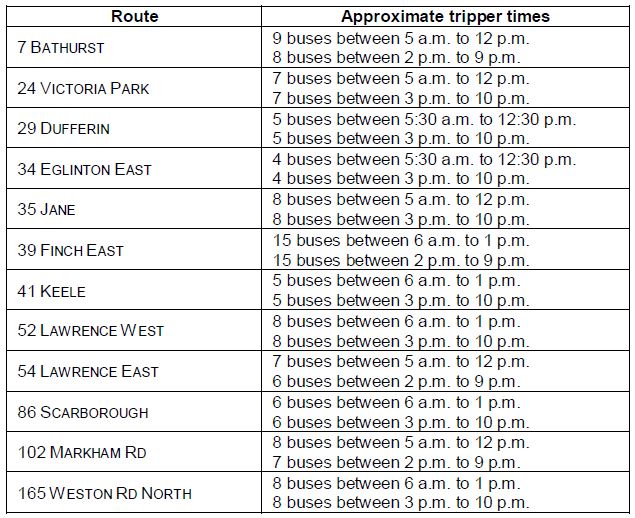
Finally, the June 21 changes returned some of the buses that had been cut in previous months to scheduled service, but on a different basis from the pre-covid arrangements. Instead of a roughly three-hour AM and PM peak period with added vehicles, the extra vehicles are scheduled for two seven-hour periods from the very early hours of the AM peak starting between 5 and 6 AM and running until noon to 1 PM. A second batch of extras enters service between 2 and 3 PM running until 9 to 10 PM. The affected routes are:

  • 7 Bathurst
  • 24 Victoria Park
  • 29 Dufferin
  • 34 Eglinton East
  • 35 Jane
  • 39 Finch East
  • 41 Keele
  • 52 Lawrence West
  • 54 Lawrence East
  • 86 Scarborough
  • 102 Markham Road
  • 165 Weston Road North

This has two effects on the routes where the extras are used:

One effect is that the headway (time between buses) for the block of extras is generally not the same as for the regular service. This can cause erratic headways and uneven loading. For example, if an 8 minute “A” service and a 10 minute “B” service are mixed on the same route, the pattern of departure times (minutes after the hour) could look like this. Sometimes the “B” service nicely splits the headway of the “A” service, but at others the two leave close together or at the same time.

TimeBranch
8:00A
8:04B
8:08A
8:14B
8:16A
8:24A
8:24B
8:32A
8:34B
8:40A
8:44B
8:48A
8:54B
8:56A

This sort of thing is unavoidable when headways on any mixed service are not the same. However, the TTC has a six-minute window (from 1 minute early to 5 minutes late) for a bus to be considered on time. When the scheduled headways are in single digits, bunched service is inevitable even if the schedule does not have built in gaps and bunching. However, if the scheduled headways are wider, but uneven, this builds uneven service into a route’s operation.

The other effect is that there is a two-hour period between each set of “trippers” on the affected routes where headways are much wider than at other times, and this can be compounded by uneven headways for the vehicles that do remain over the bridge period.

The cancelled runs cause scheduled gaps where one or more buses are missing, but the times of adjacent runs have not been adjusted to compensate. It is not clear how much effort the TTC is putting into fixing this problem, and the generally uneven level of service can make it hard to distinguish this from other problems with headway reliability.

The situations are unique to each affected route, and I will go into the details in the route-by-route review.

A Note About Data Sources

All schedules for the TTC are available in GTFS (General Transit Feed Specification). The current version is on the City of Toronto Open Data site, but archived version for the TTC and many other transit systems are available on the transitfeeds site. These data contain the same information that is published on the TTC’s timetable pages, but in a format that lends itself to analysis and presentation.

Tracking data for TTC vehicles is archived by the TTC from two systems: the 30+ year old “CIS” (Communications and Information System) and its replacement “VISION” which has more extensive capabilities for line management. As of early July 2020, most of the surface fleet has been converted to VISION with only a portion of the streetcars remaining to be completed.

[The tracking data are not published for general access, but are available to me and others by arrangement with the TTC. The data sets are very large and require substantial reworking to permit analysis and presentation. For a general discussion of analyses with these data, please see Understanding TTC Service Analysis Charts: A Primer .]

Route Analyses

In the articles to follow, I will divide the major routes into geographic groups. This is an arbitrary split both for reasons of size, and to allow readers to home in on specific routes of interest by area.

As an introduction, here is a review of route 54 Lawrence East.

Continue reading

TTC Board Meeting July 14, 2020 (Part I) (Updated)

The TTC Board will hold a virtual meeting on July 14 beginning at 10 am. This post reviews some of the issues that will before the Board, and I will update the article with any additional material of interest after the meeting. The items covered here include:

  • Ridership and financial updates
  • Service levels
  • Vehicle reliability
  • Reserved bus lane plans

In a second article to be published after the meeting, I will address several reports regarding accessibility and Wheel-Trans service.

Updated July 14, 2020 at 10:00 pm: Notes have been added at the end of the article regarding the Reserved Bus Lane proposal.

Continue reading

Reserved Bus Lanes: Eglinton East in Fall 2020, More to Follow (Updated)

Updated July 9, 2020 at 8:10 am: A table comparing existing and proposed stops has been added adjacent to the service plan map in this article.

Updated July 9, 2020 at 12:30 am: A section has been added at the end of the article examining headway reliability for 86 Scarborough and 116 Morningside just east of Kennedy Station, and at Guildwood. This section complements an observation by the City of Toronto about unreliable headways, and hence uneven loading, on buses running on Eglinton.

Headway management is at least as important as improved travel time for these routes. There is not much point in saving a few minutes riding a bus if the waiting time is unpredictable and the bus may be full when it arrives in a gap. This aspect of TTC service management has been a chronic problem that is always put down to “traffic congestion”. In fact the post-covid data show that even with the much less congested conditions, headways are still spread over a wide range of values. This is a problem that will not be fixed by painting the pavement red.

The TTC Board will consider a report on reserved lanes for BRT-lite operation on several corridors at its July 14, 2020 meeting. Although there was a political desire to get all of them up and running as quickly as possible at the June board meeting, the proposed schedule strings this out over a longer time.

  • Fall 2020: Eglinton East from Kennedy Station, Kingston Road, Morningside to UTSC
  • 2021: Jane from Eglinton to Steeles
  • 2022 and beyond:
    • Steeles West from Yonge to Pioneer Village Station
    • Finch East from Finch Station to McCowan
    • Dufferin from Wilson to Dufferin Gate
    • Lawrence from east of Victoria Park to Rouge Hill

A key point is that TTC expects to save money on reduced travel times. Whether this would be reinvested in service on the affected streets or elsewhere in the system is hard to know. Some of the reduction will come from the reserve lanes, but some will also come from the consolidation of closely-spaced stops.

Experience on King Street showed that the travel time savings, such as they were, were eaten up by operational changes that added more running and recovery time to schedules in an attempt to eliminate short turns.

Bus lanes on the Eglinton East corridor are anticipated to increase transit reliability and reduce transit travel time on average between two-to-five minutes per trip. These time and reliability savings present an opportunity to achieve operating budget savings of 500 fewer service hours per week, equivalent to about $2.5 million per year and a capital cost avoidance of seven fewer peak buses equivalent to approximately $6.3 million. [p. 4]

The problem here is that any kind of “savings” has an allure that is much stronger than service improvements. Buses will not run more frequently, although service might be more reliable if the worst of periodic “bad days” can be avoided with the reserved lanes. This is similar to the results on King where the reliability effect was much more important than the actual change in average travel time. Better reliability means shorter waits for vehicles and a better chance that loads will be evenly distributed.

However, King Street had the added advantage that the actual capacity of the route was increased by running larger vehicles as the new Flexitys replaced the smaller CLRVs, ALRVs and bus trippers on the route. A similar opportunity is not available, at least in the short term, on Eglinton. The TTC has no spare articulated buses, and only modest plans to acquire more in future years. (Note that changes in the overall fleet mix have effects on bus garages which must be modified to service the longer vehicles, or purpose-built with this in mind just as Leslie Barns was for the new streetcar fleet.)

Continue reading

Drifting Timelines on Metrolinx Projects (Updated)

Updated June 23, 2020 at 1:50 pm: The table of projects has been updated to include anticipated events, notably “financial close” dates, that were included in various project announcements by Infrastructure Ontario. Also Union Station Platform Expansion was described in the original version of this article as closing sooner than originally projected. This has been corrected to show a delay of roughly nine months.

Infrastructure Ontario recently released its Spring 2020 Update for P3 projects under its control including several Metrolinx projects. To date there have been three of these updates:

These updates include information on the project status, the type of procurement model, and the expected progress of each project through the procurement process. This provides “one stop shopping” compared to Metrolinx’ own site. As a convenience to readers, I have consolidated the three updates as they relate to transit projects to allow easy comparison between versions.

Some projects have evolved since the first version, and in particular the delivery dates for a few projects have moved further into the future. The “financial close” dates for some projects, in effect the point at which a contract is signed and real work can begin, has moved beyond the date of the next Provincial election. Whatever government is in power after summer 2022 will have a final say on whether these projects go ahead.

Subway Projects

Ontario Line

The Ontario Line was previously reported as a single project with a price tag of over $10 billion. In the Fall 2019 update, the intent was to have the financial close in Winter/Spring 2022 ahead of the election. In the Winter 2020 update, this changed to Spring 2022.

In the Spring 2020 update, the project has been split into separate parts to reflect industry feedback about the original scope.

  1. GO Corridor from Don River to Gerrard
  2. South Tunnels, Civil Works and Stations CNE to Don River
  3. Rolling Stock, System Operations & Maintenance
  4. North Tunnels, Civil Works and Stations

The GO corridor work will be done as a conventional procurement by Metrolinx and will be bundled with upgrades to GO Transit trackage.

The financial close for items 2 and 3 above is now Fall 2022, and for item 4 it is Fall 2023.

This means that an actual sign-on-the-dotted-line commitment to the project will not be within the current government’s mandate. Even the so-called “early works” comprising the southern portion of the route from Exhibition to the Don River is not scheduled to close until Fall 2022. The northern portion, from Gerrard to Eglinton will close in Fall 2023. This contract is being held back pending results for the south contract to determine the industry’s appetite for the work.

The southern portion, with a long tunnel through downtown and stations in congested street locations would start first. However, the line cannot actually open without the northern portion because this provides the link to the maintenance facility which is included as part of item 3 above although the actual access connection would be built as part of item 4.

An issue linking all of these projects is the choice of technology which, in turn drives decisions such as tunnel and station sizes, power supply, signalling and maintenance facility design. When the Ontario Line was a single project, Metrolinx could say that this choice was up to the bidders, but now there must be some co-ordination to ensure that what is built can actually be used to operate the selected technology. It is hardly a secret that Metrolinx is promoting a SkyTrain like technology, although which propulsion scheme (LIM vs rotary motors) is not clear. There are well-known problems with LIMs and the power pickup technology used on the SRT, and this would also be a consideration for the outdoor portions of the Ontario Line.

Scarborough Subway Extension

Like the Ontario Line, the Scarborough Extension has been split into two pieces. The first will be the tunnel contract from Kennedy Station to McCowan. This is now in the  procurement phase, and financial close is projected for Spring 2021.

The remainder of the project previously had a projected closing date of “Winter/Spring 2023”, but this is now just “2023”. With the tunnel hived off into a separate contract, it is reasonable that the remainder would have a later start date because the tunnel is a key component that must be in place first.

Metrolinx recently published a Preliminary Business Case for this extension. It includes the following text:

Kennedy Station Pocket Track/Transition Section

The Kennedy transition section extends roughly 550 metres from the east side of the GO Transit Stouffville rail corridor to Commonwealth Avenue and will include special track work and a pocket track to enable every second subway train to short turn to suit ridership demand and minimize fleet requirements, as well as lower operating costs. [p 24]

This turnback has been an on-again, off-again part of the project but it is now clearly included as a cost saving measure. With only every second train running to Sheppard/McCowan, the fleet required (as well as storage) would be within the system’s current capacity. This ties in with the timing of the T1 fleet replacement on Line 2 as there are enough T1s to run alternate, but not full service to Sheppard. This would be similar to the arrangement now used on the TYSSE where only half of the AM peak service runs north of Glencairn Station to Vaughan.

Richmond Hill Subway Extension

The Ontario government recently signed an agreement with York Region for the extension of the Yonge line from Finch to Richmond Hill. The status of this project is unchanged with an RFQ to be issued in Fall 2021, an RFP in Spring 2022 and financial close in Fall 2023.

Sheppard East Subway Extension

This project remains in the planning phase.

Continue reading

TTC Board Meeting June 17, 2020

The TTC Board met on June 17, 2020 with several items on their agenda. Chief among these was recovery plan for the transit system as the effects of the Covid-19 lockdown recede and transit demand builds.

Updated June 18, 2020 at 1:30 pm: Charts from the service recovery presentation that were originally taken as screen captures from the meeting video have been replaced with higher resolution versions.

CEO’s Report

Many of the usual metrics for system performance are meaningless in the Covid-19 era because service and ridership are completely different from original budget forecasts. Even the “on time” statistics fail because the TTC reports this relative to scheduled times, not as a measure of service reliability. Detailed ridership tracking was reported separately under the Covid recovery report (below).

CEO Rick Leary reported that modifications to the operator’s area on buses are in development including extension of the plastic barrier forward to the windshield and altering airflow within the cab to be a “positive pressure” area where air is always pushing out rather than being drawn in from the main passenger area.

As reported elsewhere, the TTC is taking advantage of lower demand to accelerate capital and maintenance programs. The northern part of the Yonge subway (Line 1) will be closed for various periods during coming weeks including:

  • Sat/Sun June 20/21 all day: Sheppard-Yonge to St. Clair for Metrolinx construction at Eglinton and track repairs elsewhere.
  • Thu/Fri June 25/26 all day: Finch to Sheppard-Yonge for maintenance including ATC installation.
  • Sat/Sun June 27/28 all day: Finch to Lawrence for maintenance including asbestos removal and ATC installation.

The TTC has not announced whether completion dates for the ATC project will be moved forward thanks to the extra work.

The rebuild of streetcars to correct welding problems and other retrofits will also be accelerated with 19 more streetcars available for maintenance. This will allow the entire fleet to come up to standard 18 months sooner than originally planned.

Reliability of the streetcar fleet continues to improve. There are two measures of this with one based on contractual requirements (failures due to manufacturing issues) and one based on operational behaviour (including all failures). The contractual measure is running at over 70,000 km mean distance to failure on a monthly basis with the 12-month average sitting just over 40,000 and growing. The operational measure is running just under the 35,000 km target.

In the subway, vehicle reliability is mixed. On Line 2 BD, the T1 fleet is running far above the target level with MDBF values in the millions of vehicle kilometres compared to a target of 300,000. On Lines 1 and 4, the TR fleet is not faring as well. The 12-month rolling average is above the 600,000 target for this fleet (which is younger and therefore is expected to perform better), but numbers for both February and April 2020 were below the target, particularly in April.

The reliability of the electric bus fleet is improving although it is not yet at the 24,000 km MDBF target. The BYD fleet was still not in revenue service within the period of the report, and so no reliability stats for these vehicles are available.

The hybrid bus fleet is running at or above 30,000 km MDBF while the diesel bus fleet is at or above 20,000. It is not clear how much of the improvement is due to inherent reliability as opposed to the sidelining of problem vehicles in the fleet.

Covid Recovery / Bus Priority Lanes

Please see my previous article TTC Preps For Covid Recovery for a review of the main part of this report.

The Board considered this report together with a notice of motion regarding proposals for five bus transit priority corridors. Please see my article Transit Priority Lanes Can Help, But They Are No Panacea and other related articles for background analyses of the potential benefits and limitations of priority lanes as a way to improve bus service.

Covid Recovery

New information was added to the original report showing how demand is building across the TTC network.

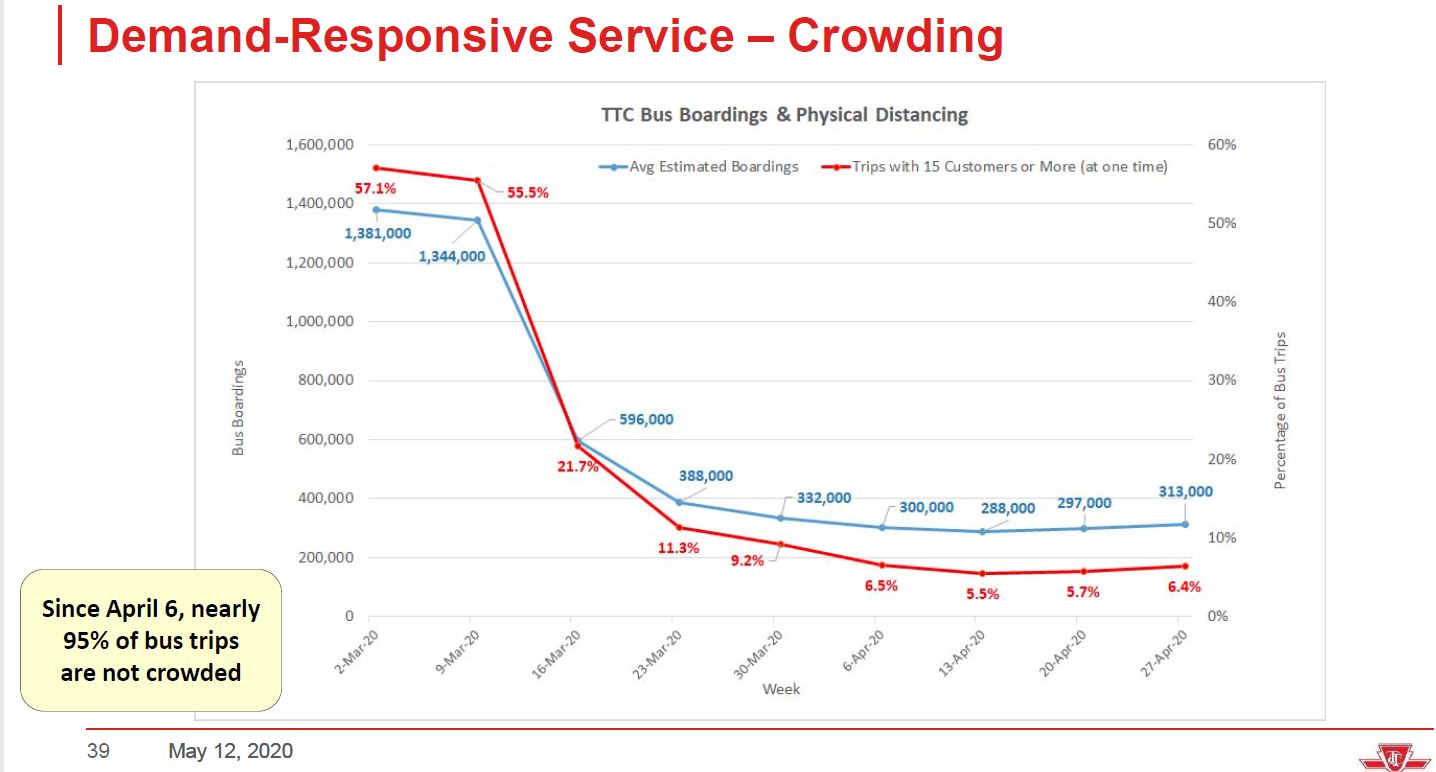
Bus riding has been growing from its nadir in mid-April. Although 70,000 more boardings per day may not be much on the usual scale of TTC operations, it is a very large growth on a base of 288,000 (blue line in the chart below). Across the bus network, the TTC is now carrying on average 30% of its former load, a key point in the recovery where capacity and distancing requirements vie with each other. There is a growing problem with overcrowding relative to the current standard with 12% of trips now running about 15 passengers per standard sized bus, and 1.5% above 25 per bus. The system cannot handle more growth without a combination of additional service and social practices, mainly masking, that will improve safety on more crowded vehicles.

More service on Jane today than in Feb

The map below shows where the “hot spots” were in the bus network in mid-May when total boardings were at 25% of normal, and 7.6% of trips exceeded the 15/bus loading standard.

By June, this had evolved with over capacity conditions on several major routes. Many extra buses built into the May schedules were dispatched to supplement regular service, and on the key routes shown below, the scheduled service will be improved effective June 22. The TTC plans to have more service on 35 Jane in late June than it did in February, although this claim does not take into account the 935 Jane Express buses in the “before” service.

Eventually, the TTC will return to “100% service”, but this will be based on the count of vehicles, not simply a return to original schedules. Some routes still have weaker demand, and buses formerly assigned to them will be used to add service on the busy lines. The express bus routes serving the core where demand is weakest will remain suspended.

The TTC’s plan does not address the issue of using its considerable pool of spare buses to push service beyond the 100% level, nor of the degree to which the streetcar network can be fully operated with that mode once various construction projects are out of the way.

Although TTC management did not say this explicitly in the discussion, the move back to 100% service appears to be contingent on funding from the provincial or federal government that will insulate the City from the extra cost.

Bus Priority Lanes

According to TTC management, “significant” work has already been done with their City colleagues on the bus lanes which were proposed in the Five Year Service Plan last December. Eglinton East is the top priority, and there will be a report on it in July 2020. It is unclear just how quickly we will see detailed proposals for other corridors, especially with a desire by some affected Councillors to have public consultation, and the very real possibility that opposition to these lanes will block their implementation.

The TTC does not help its own argument on this point.

Staff advised that the Eglinton-Kingston-Morningside lane would save 7 buses overall for the routes operating in this corridor, and spoke first of this as a budgetary saving, not as an opportunity for improved service. This is exactly the same position staff took in the early days of the St. Clair proposal where residents and riders were dismayed that after so much upheaval there would be no improvement in service.

This position does not align with the statements by Commissioner Brad Bradford who spoke of “flooding the street” with buses taking advantage of the new transit priority, and while that may be a great sound bite, it does not reflect what the TTC is likely to do, or can do with limits on its fleet and staff constraining bus network growth. Moreover, a 7 bus saving is not a huge change at the scale of the full network. This is unsurprising given that the likely change in travel time is not going to bring as much saving as many think.

Bradford asked how the transit priority scheme would help in the Covid fight, and again staff’s response was lacklustre claiming that shorter travel times would reduce the time spent on board, rather than speaking to improved crowding conditions through additional service.

There is a stark disconnect between the hoped-for benefits of transit priority for riders and the manner in which the TTC appears poised to scoop any savings in the budget, not for better service.

Bradford spoke of the importance of the bus  network and the “underserved” neighbourhoods where bus lines run. It is odd for a TTC Commissioner to openly talk of “underserved” areas while the very Board and Council he sits on refuses to address the problem of bus route capacity.

The hoped-for September 1 implementation will be a stretch for anything beyond one corridor, and that with little more than paint and signs.

Commissioner/Councillor McKelvie proposed an amendment that the study of future corridors also include Lawrence East from Victoria Park to Rouge Hill. The report with this amendment passed unanimously.

Rider Attitude Survey

The Covid recovery report includes an extensive section on rider attitudes and the potential recovery of transit demand. I will deal with this in a separate article.

Streetcar Track Noise at King and Sumach

An ongoing issue at the intersection of King and Sumach has been streetcar noise and vibration ever since the Cherry Street branch began operation. Several issues contributed to this problem including wheel squeal on curves and noise from track switches tongues “slapping” in their castings as cars passed over them.

Various changes have been made to address components of the problem, but more work is pending.

  • With the removal of CLRVs from Cherry Street service, the noisiest cars were no longer making turns at King and Sumach.
  • A wheel lubricator was installed at Distillery Loop, although this is of no benefit for cars turning east to south off of King.
  • Wheel vibration dampening rings have been installed on 10 streetcars and these reduced noise on curves by 5-7 dBA. A further 60 cars will receive dampeners over 2020, and the rest of the fleet will be completed in 2021. Cars with these devices will be assigned to the 504A King route to the Distillery.
  • On board wheel lubricators are already installed on the first half of the fleet, and the TTC plans to add them to the remainder.
  • Curve track geometry has been adjusted, and will be further refined as part of the 2021 Capital Budget plan for track repairs.
  • Switch tongues that did not sit flush have been ground to reduce the slapping effect as cars pass over them.
  • A new design for flexible switch tongues is under review with plans to install one on the trailing eastbound switch where noise has been a problem. A trial installation is already in place at College & Lansdowne eastbound.

Although King & Sumach has been the focus of complaints and testing, many of these changes will benefit the streetcar system as a whole.

Waterfront LRT Design

The TTC Board approved a contract for $15 million for design work on the underground portion of the proposed Waterfront East LRT/streetcar extension. This work is being done jointly with Waterfront Toronto who are responsible for the surface portion of the route from a portal near Yonge Street to Cherry Street including a connection to the existing Distillery Loop.

This contract will take the design of the underground portion to 30% with a project cost estimate leading to a request for Council approval in the second quarter of 2022. Whether this project will actually proceed remains to be seen.

Part of the work will involve staging plans to determine whether and how the project can be built to stretch out spending based on the rate of growth of demand in the eastern waterfront. This statement was a bit puzzling considering the scale of changes required at Union and Queens Quay Stations including lowering the track elevation to provide more space for air circulation to meet modern fire code.

TTC Preps For Covid Recovery

Toronto and its transit system face a long climb back to conditions before the Covid-19 pandemic and the shutdown of much activity across the city. On June 17, the TTC Board will act on a report with several recommendation for the recovery path. Like so much in Toronto, the future is uncertain, but the TTC has a range of options on the table.

Compulsory Masking and Safety on Board

Anyone within the TTC system will be required to wear a mask or facial covering effective July 2 with only a few exceptions:

  • Children under two
  • People with an underlying condition that prevents wearing of a mask
  • People who are unable to put on or take off a mask without assistance
  • TTC employees working in non-public areas, or behind a physical barrier or shield such as in a  collector’s booth
  • People who must be accommodated under the Ontario Human Rights Code

The TTC will have a supply of one million masks to be distributed free of charge. This will be concentrated in lower-income areas of the city. The TTC will not bar access to those without masks, although social pressure from other riders may have an effect.

All vehicles are cleaned and disinfected overnight. Surface vehicles are disinfected at mid-day, and Wheel-Trans buses have added cleanings after carrying Covid-19 positive riders. Stations are cleaned and disinfected, especially commonly touched surfaces, two to four times daily depending on usage.

Vehicle updates under consideration include hand sanitizers for passengers, as well as ultra-violet disinfection and improved air filters in the heating, ventilation and air conditioning systems.

Effective July 2, front door boarding on buses will resume including payment by cash, token or ticket. Riders will still have the option of using rear doors, although this practice may be discontinued eventually. Such a move has a “catch-22” because stop service times will increase if all riders are forced to load through one door.

The TTC will distribute free Presto cards in areas where usage to date has been low, although this does not address the problem of how riders will load their cards given the scarcity of suburban locations to do so.

Presto Credits for Monthly Passes

For those who bought a March or April 2020 monthly pass, there will be a refund based on actual usage between March 18 and April 30. This will be applied as a credit on the Presto account by August 21 where it can be used either toward the purchase of a September pass, or for pay-as-you-go rides. This option allows for riders who will not, by September, be using the TTC enough to justify buying a pass.

It is recommended that a pro-rated PRESTO credit be provided to March and April pass holders based on their daily usage from March 18-31 and April 1-30, 2020. The pro-rated credit for March and April will calculate the daily rate based on the entire value of the pass, and will provide the credit based on the days the pass was not used. This recommendation ensures that requests are being responded to fairly to our customers, while also considering the current financial constraints the TTC is facing. [p 36]

There will be no refunds for May and beyond as, by that point, riders would have been well aware of their changing travel needs and had ample time to cancel any pass subscriptions in effect.

Continue reading

TTC Service Changes Effective Sunday, June 21, 2020

There are comparatively few changes for the June-July schedules in 2020 because service is already operating at a reduced level due to the Covid-19 emergency.

Production of a table comparing old and new service levels with this change is tricky because the “before” situation included a lot of ad hoc operations by the TTC. I will try to pull something together and will update this article at that time.

During the May schedules, quick adjustments were made on many routes by removing previously scheduled crews rather than completely rewriting the schedules. This produced scheduled gaps which show up in the published timetables and in the data feed used by various trip planning applications. Many, but not necessarily all of these will be fixed for the June schedules.

Extra Service

On the bus network, there will be scheduled trippers overlaying the regular service on routes where there have been crowding problems. The table below is taken from the TTC’s memo detailing the new service arrangements. There are 90 AM and 87 PM trippers.

In addition to these trippers, a large number of crews will be provided for additional service as needed and to cover subway shuttle operations. There will be 180 weekday, 208 Saturday and 148 Sunday crews. Note that a crew is not the same thing as an additional bus because more than one crew is required to operate one vehicle if it is in service for more than 8 hours.

On the streetcar network, the current four crews for extra service will be expanded to eight. Half of these cover the morning and early afternoon period, while the other half cover the afternoon and evening

Bathurst Station Construction

The streetcar loop at Bathurst Station will be rebuilt, and all bus operations will shift to the surface loop at Spadina Station. This arrangement is planned to be in effect until the schedule change on Labour Day weekend, but if work completes sooner, service will revert to Bathurst Station earlier.

  • 7 Bathurst will divert both ways via Dupont and Spadina to Spadina Station.
  • 511 Bathurst (which is already operating with buses due to construction at Front Street) will divert via Harbord and Spadina to Spadina Station.
  • 307 Bathurst Night will divert both ways via Dupont, Spadina and Harbord. The route will also be changed to operate via Fort York Boulevard at the south end of the route so that the night bus route matches the one used by the 511 buses during daytime service.
  • 512 St. Clair will operate from Hillcrest as a temporary yard because the line will be physically isolated from the rest of the streetcar system while track work on Bathurst Street is underway.

Bathurst will remain as a bus operation until the end of 2020 while various construction projects along the line are completed.

Conversion of 506 Carlton to Bus Operation

Several projects will take place affecting 506 Carlton over the summer and early fall. These include:

  • Track replacement and paving at High Park Loop and on Howard Park Avenue west of Roncesvalles.
  • Replacement of the special work at Howard Park and Dundas.
  • Replacement of the special work at Dundas and College. Work at this location includes addition of traffic signals and reconfiguration for pedestrian and cycling crossings. There is a diagram of the new arrangement in an article I published earlier this year.
  • City of Toronto work on the Sterling Road bridge.
  • Modification of all overhead from High Park Loop to Bay Street for pantograph operation where this has not already been done.
  • Construction at Main Station.

506 Carlton buses will operate to Dundas West Station instead of to High Park Loop. The 306 Carlton Night route will also operate with buses on its usual route to Dundas West.

Through-routed 501 Queen Service to Long Branch

When the May scheduled were implemented, an inadvertent error did not provide enough running time for streetcars to make the full Neville-Long Branch trip as planned. Buses were substituted on the west end of the route. Effective June 21, through streetcar service will be provided all day long, rather than only at late evenings and overnight.

All Queen service will operate from Russell Carhouse.

Streetcar Service on 503 Kingston Road

With the removal of streetcars from 506 Carlton, the 503 Kingston Road line will return on Monday June 22 operating to Charlotte Loop at Spadina & King. The TTC plans to switch this back to bus operation in the fall when streetcars return to 506 Carlton. The 22 Coxwell bus will revert to its usual arrangement running only to Queen Street during weekday daytime periods.

Seasonal Services

  • 92 Woodbine South will receive additional service in anticipation of higher riding to Woodbine Beach.
  • 121 Fort York-Esplanade will be extended as usual to Ontario Place and Cherry Beach.
  • 175 Bluffers Park will operate during the daytime weekends and holidays on the same schedule as in March 2019.
  • 86 Scarborough will operate an early evening shuttle between Meadowvale Loop and the Zoo.
  • Planned service increases on 510 Spadina and 509 Harbourfront will not be implemented, but the routes will be monitored for crowding and extra service will operate if necessary.

Pantograph Operation on 505 Dundas Streetcars

With the conversion of all overhead on the 505 Dundas route to pantograph-friendly suspension, the full route will operate with pans. Previously, a switch to/from poles was required at Parliament Street, the eastern end of pantograph territory on this route.

506 Carlton will be the next route to convert to pantograph operation. 504 King and 501 Queen cannot convert until after the reconstruction of the King-Queen-Roncesvalles intersection planned for 2021.

TTC Ponders New Fare Options

At its recent meeting, the TTC Board approved a report launching reviews of fare policy and technology. These will run on an overlapped timetable beginning in fall 2020 with a goal of reporting to the Board in October 2021. The topics are linked in that policy choices can be held hostage by technology options. Nowhere is that clearer than in the TTC’s experience with Presto:

  • The range of options and capabilities specified by the TTC was constrained, in part, by the policy and financial framework in which Toronto operates, especially the avoidance of proposals that would increase costs.
  • The provider, Metrolinx and its partner Accenture, failed to deliver to the requirement knowing that the iron fist of Queen’s Park and threats to subsidy funding would overrule any complaints about functional problems. Metrolinx is on record now as refusing to meet all of the contracted requirements for the simple reason that they will not invest more development funding in a system that they hope to replace.
  • Any modifications to Presto functionality are treated as billable change orders, even if the TTC could argue that the “change” is a contracted feature. Metrolinx enforces its billings by withholding fare revenue from the TTC.

This poisonous relationship colours any discussion of the future of fare structures, levels, technology and subsidies not just in Toronto but across the GTHA.

A further problem, and this is common to studies of the future of TTC service design, is the pre-emption of options by the catch-all “we can’t afford it” line that pushes aside consideration of options that require more than small adjustments within existing funding.

Years ago, in the Miller-era Ridership Growth Strategy of 2003, the starting point was not “what can we afford”, but “what can we do, and how much would it cost”. This left the policy decisions where they belonged in the political realm where the TTC Board, Council and the public could balance investment in better transit with costs and expected benefits. Options were not swept off of the table by management second guessing the politicians, or, worse, protecting politicians from options they might not want to know about.

With fare policy, there is an added layer of the rivalry with Metrolinx and its role as a regional agency. If Metrolinx were actually doing its job, there would be little need for a TTC study because Metrolinx would look at fare and technology policy:

  • including the needs of local transit, not just commuter service, and how this will grow into a wider network;
  • without prejudice for the preservation of its existing technology investment in Presto nor its existing partnership with a service provider;
  • without attempting a zero-sum “solution” where no new money is committed, especially by Queen’s Park; and
  • without the doctrinaire belief that the private sector will magically pay for everything, and by implication that change can only happen with private funding.

We have been around this bush before with a previous TTC Fare Policy Study in 2015 that was itself hobbled by Presto limitations, the then co-existence of legacy fare media and policies, and utter paranoia about changing fare structures. Toronto could have had a two hour transfer years sooner but for political foot-dragging and the assumption that the revenue loss would severely damage the TTC (and by extension the City). Eventually the Mayor needed some good news beyond free rides for kiddies, and the two-hour transfer became a reality.

Continue reading

Toronto Takes A Financial Hit From Lost Transit Riding (Part II)

This article continues from Part I with additional information presented at the TTC Board meeting of March 13.

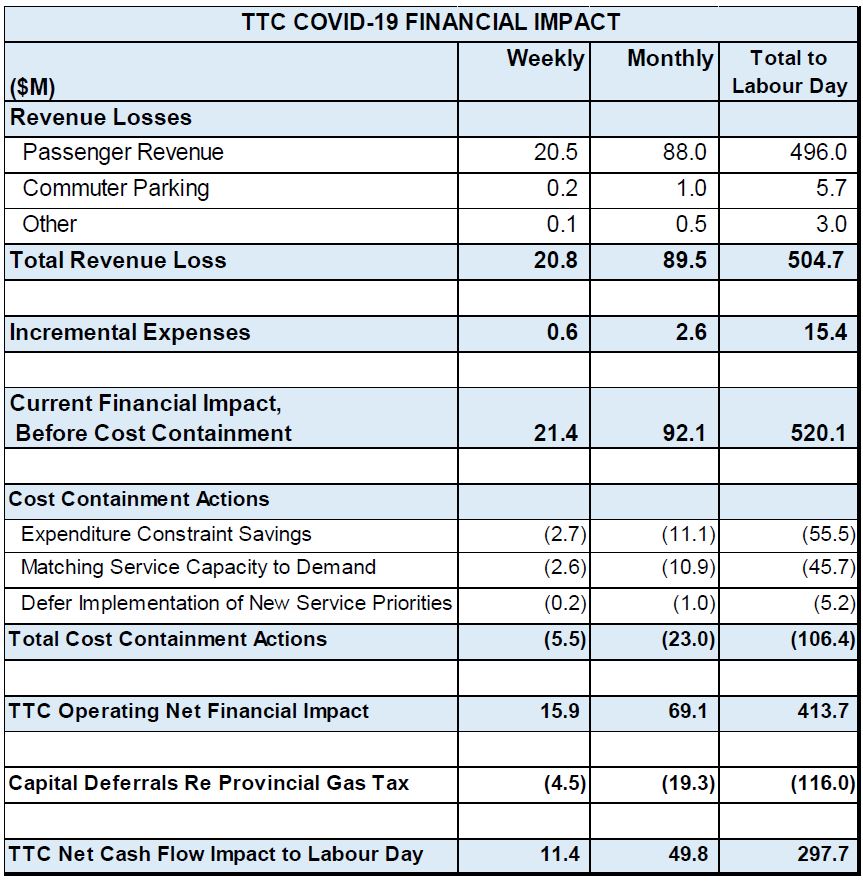
A widely reported number is the half-billion dollar shortfall in TTC revenues in the period up to Labour Day. Even with an offset of about $200 million in savings for a net deficit of $300 million, this is still not small change.

The TTC faces several challenges for service in the immediate future and then through any “recovery” period as restrictions are lifted on various types of activity and the need for travel grows.

The first problem is shown dramatically by this chart:

The TTC’s current service level accommodates the 20 per cent of normal demand they now have (although there exceptions, about which more below), but as long as riders must keep two metres apart, the system at full service could only handle about 30 percent of normal. That’s an average, and the situation varies by route and time-of-day.

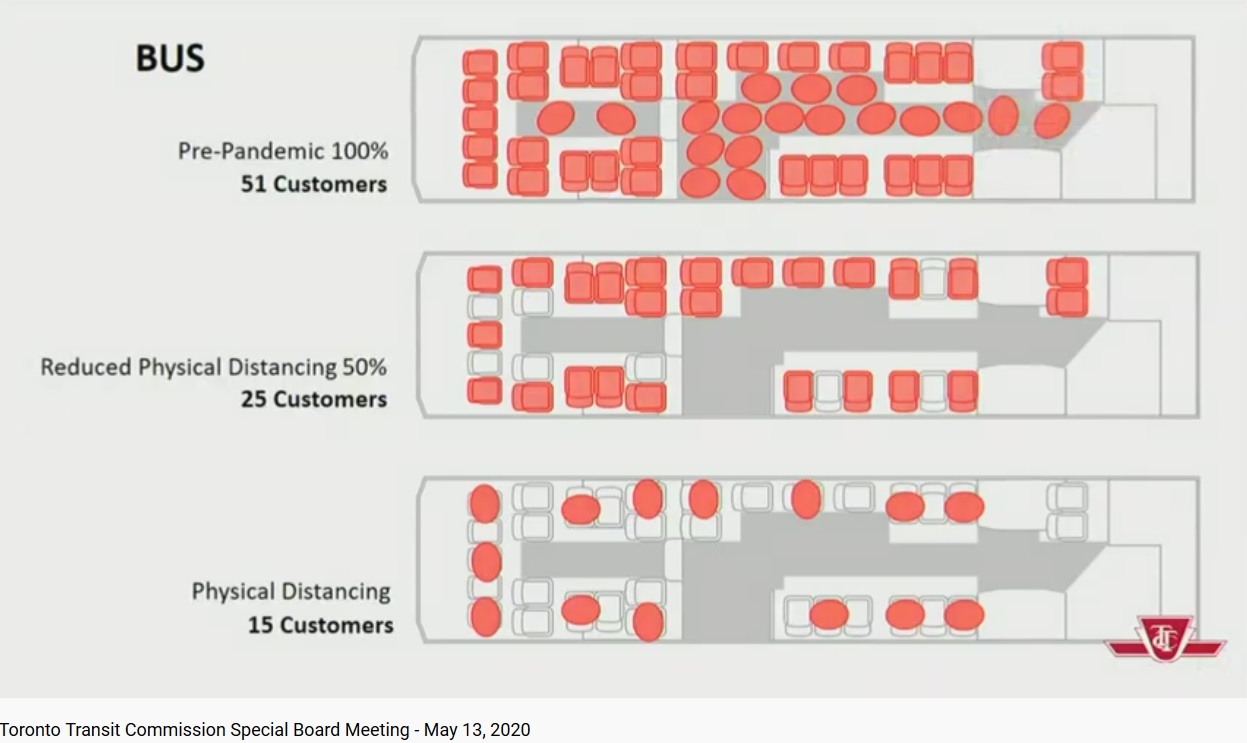
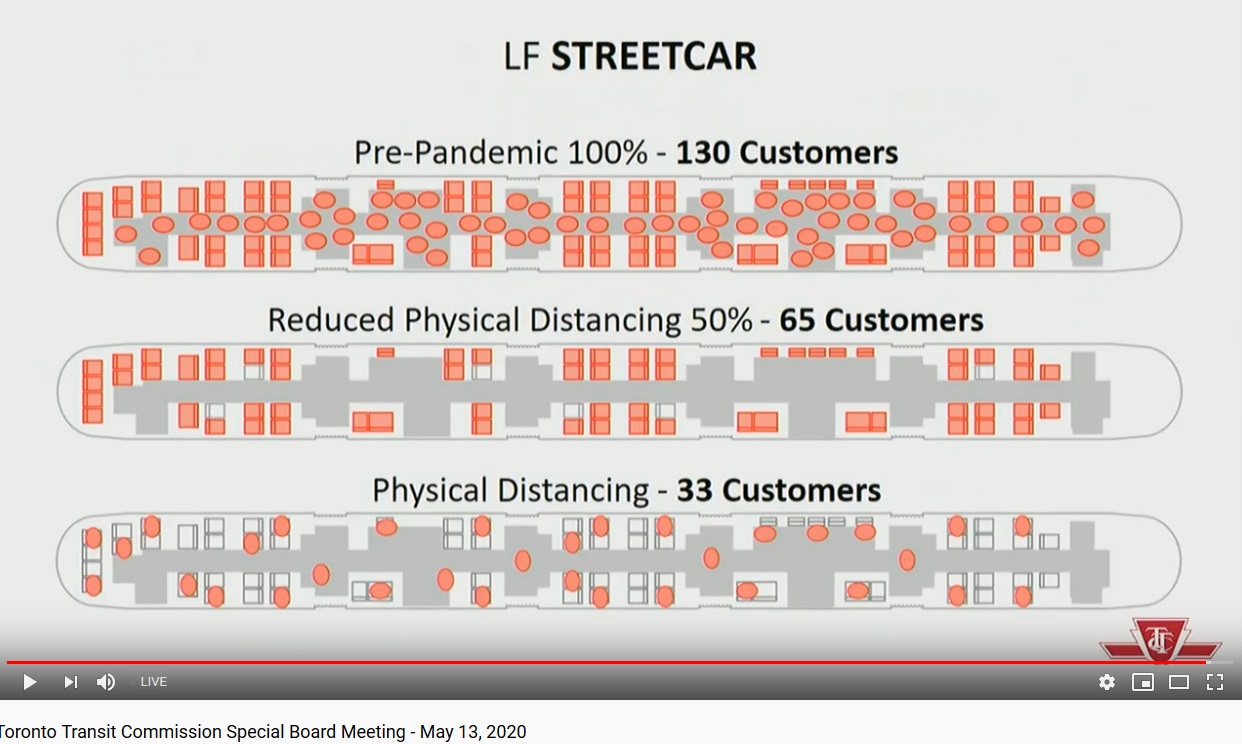
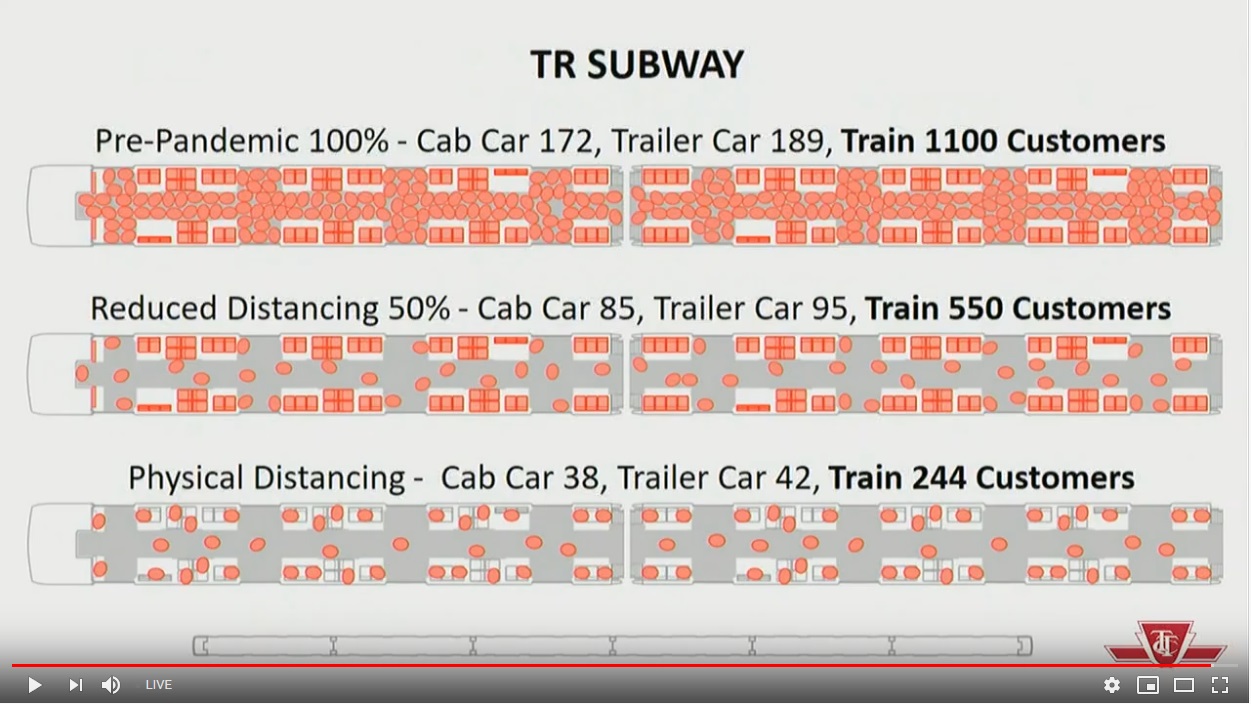
With distancing in effect, the practical capacity of vehicles is much lower than the usual level. In the charts below, three capacity levels are shown: normal service standards, 50 per cent load, and the load with a two metre rule in place.

The ratio of normal to current (two metre) capacities shown are 3.4 for buses, 3.9 for streetcars and 4.5 for subways. One might reasonably quibble that the spacing shown for some cases, notably at the rear of buses, does not meet the rule, but in any event, this shows the extent of lost capacity. The replacement factor for all modes lies somewhere between three and four vehicles in the fully distanced, two metre environment.

The 50 per cent example was included in the presentation as an indication of what the situation would be with relaxes rules, but this version has riders sitting in closer quarters than anyone other than close friends and family would reasonably accept today. Even at this level, twice as much service is needed to handle whatever demand shows up.

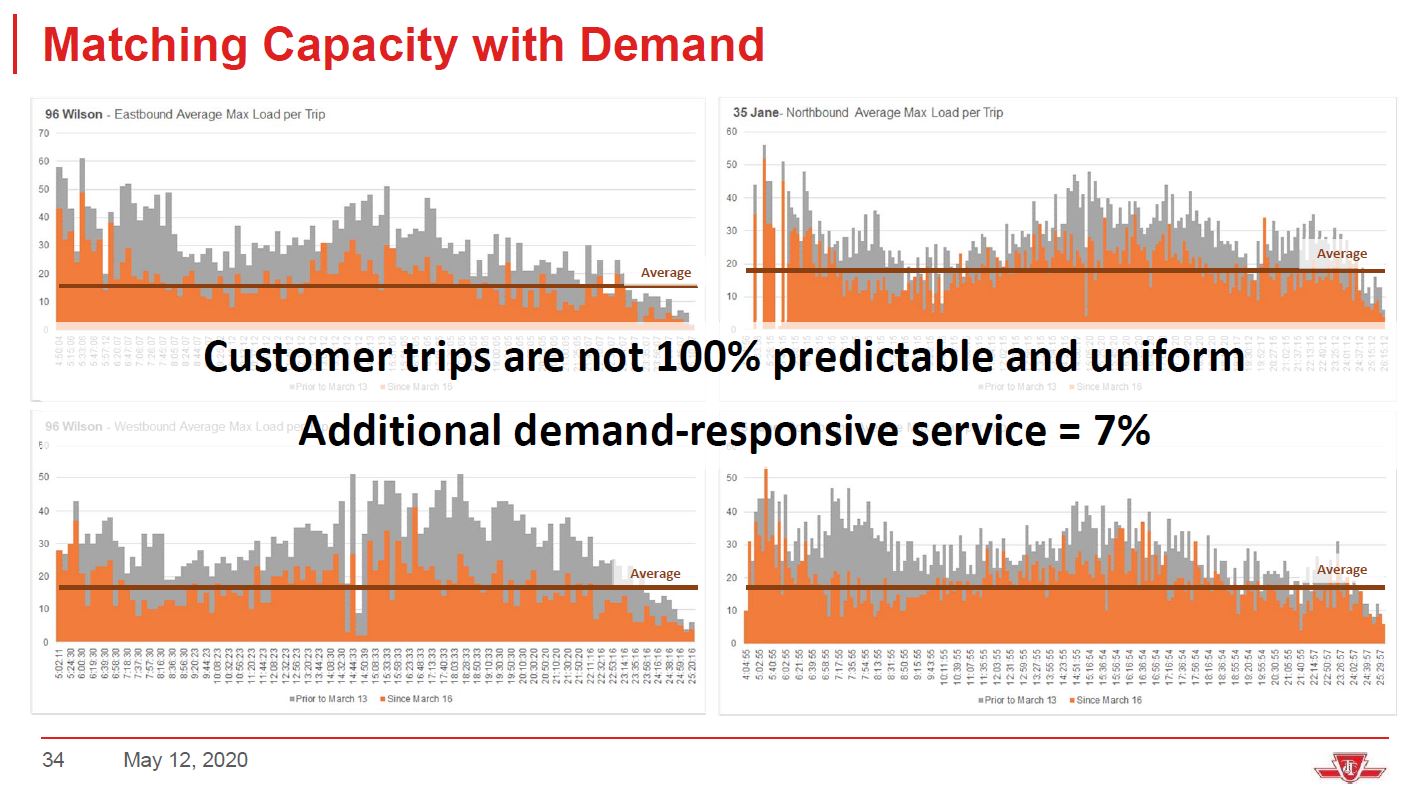
The problem is further complicated by the unevenness of demand (leaving aside irregularity in service actually provided). The charts below show the 96 Wilson and 35 Jane bus route maximum loads pre-and post covid. Note that the vertical scales are not all the same making visual comparisons between the charts difficult.

Although demand is down from pre-covid levels, it still regularly crests the target of 15 passengers per bus with the “average” line sitting above that level in all cases. Although the TTC talks of additional “demand-responsive” service at 7 percent, this would not pull the averages down to 15. At least the TTC is monitoring loading at a detailed level, but they need to demonstrate that the service they actually operate achieves the target level. Leaving riders at a stop because a bus is “full” has more serious consequences now than the usual griping about overloaded buses in pre-covid days.

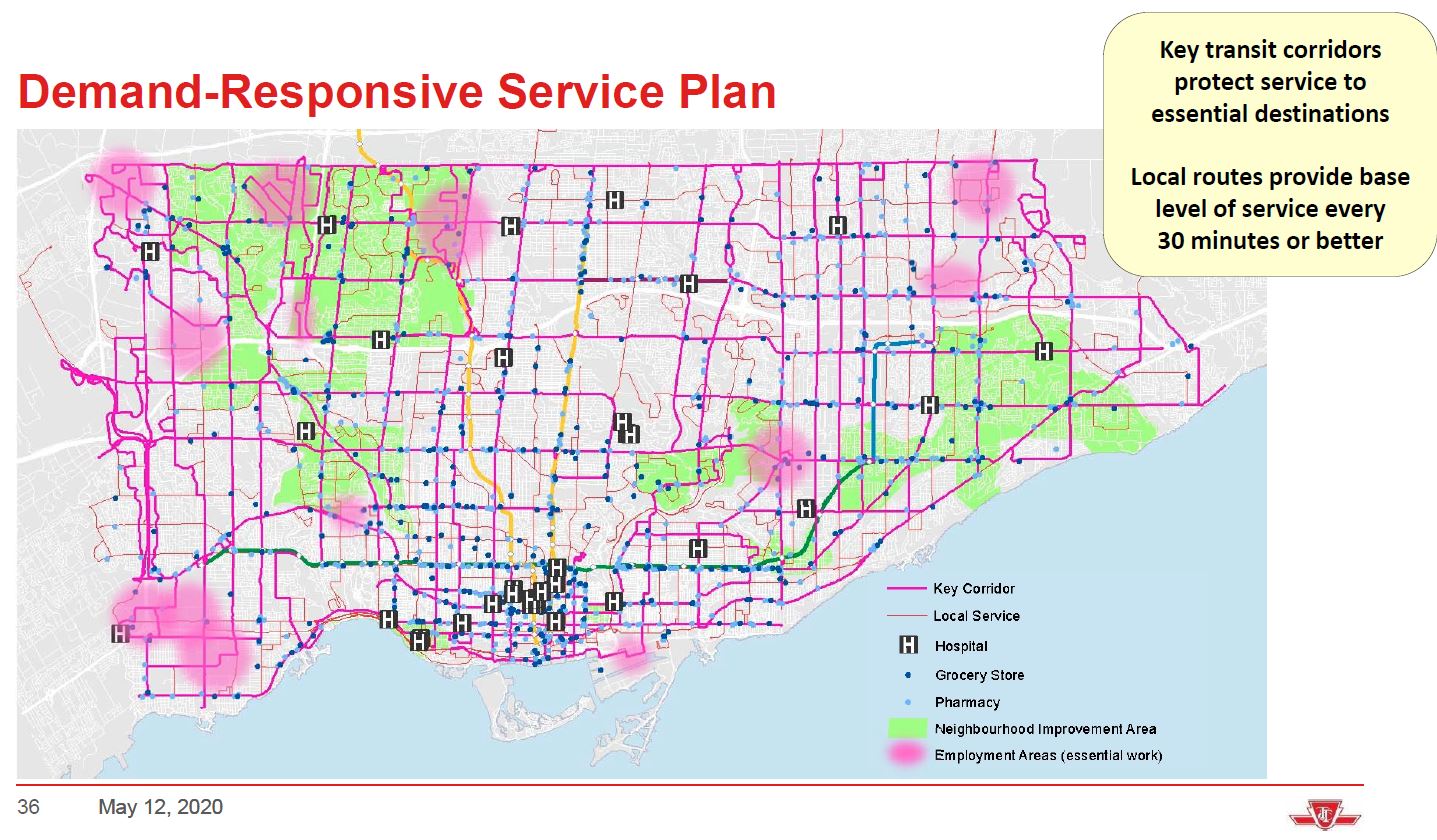
Demand is not uniformly distributed across the network. Although there is a cluster of hospitals downtown that is well-served by the subway, many health care and employment areas are scattered around the suburbs where bus service is essential for access. TTC reports that the bus network is the least affected by riding loss even though 4 in 5 bus riders have vanished.

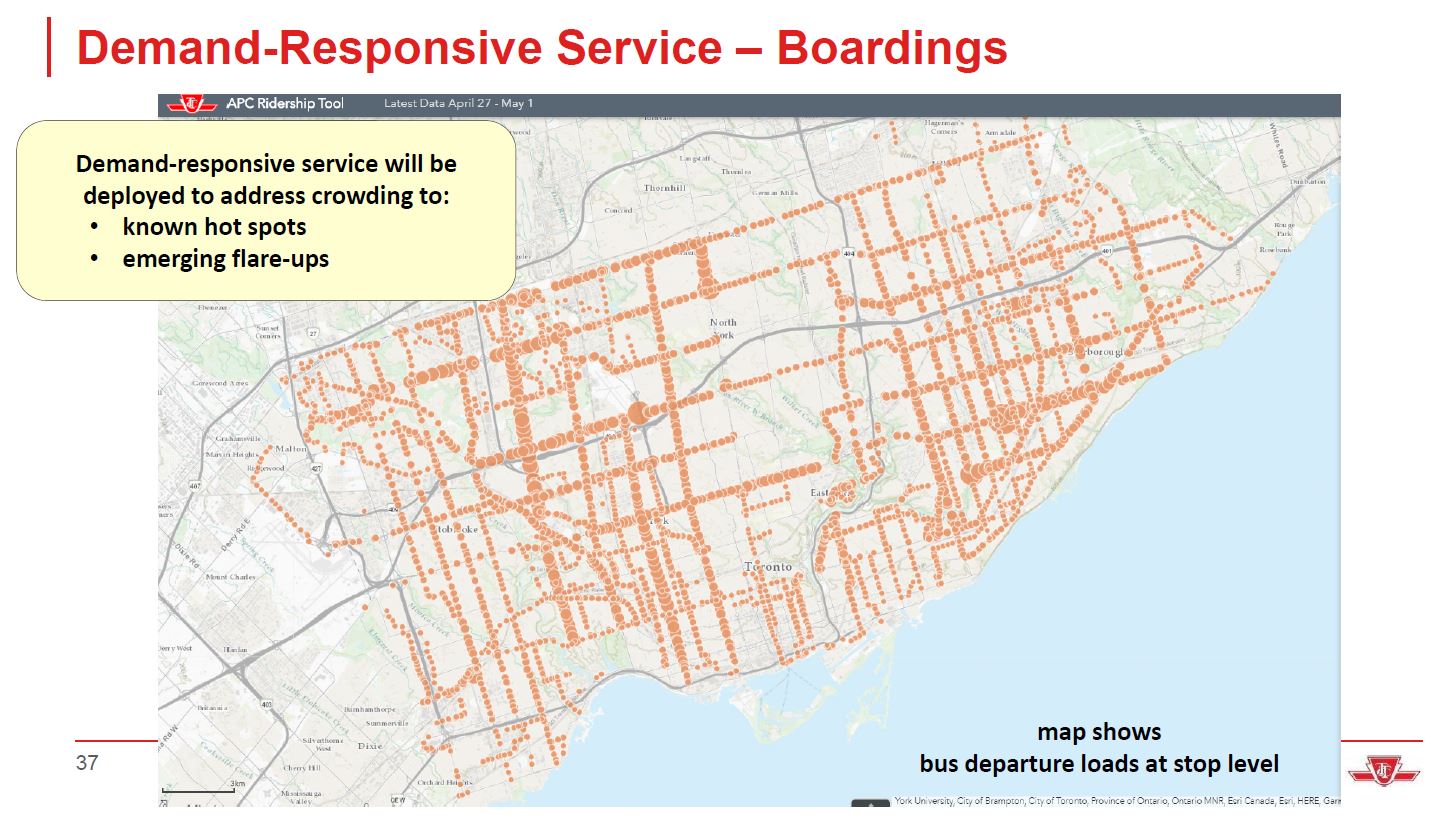
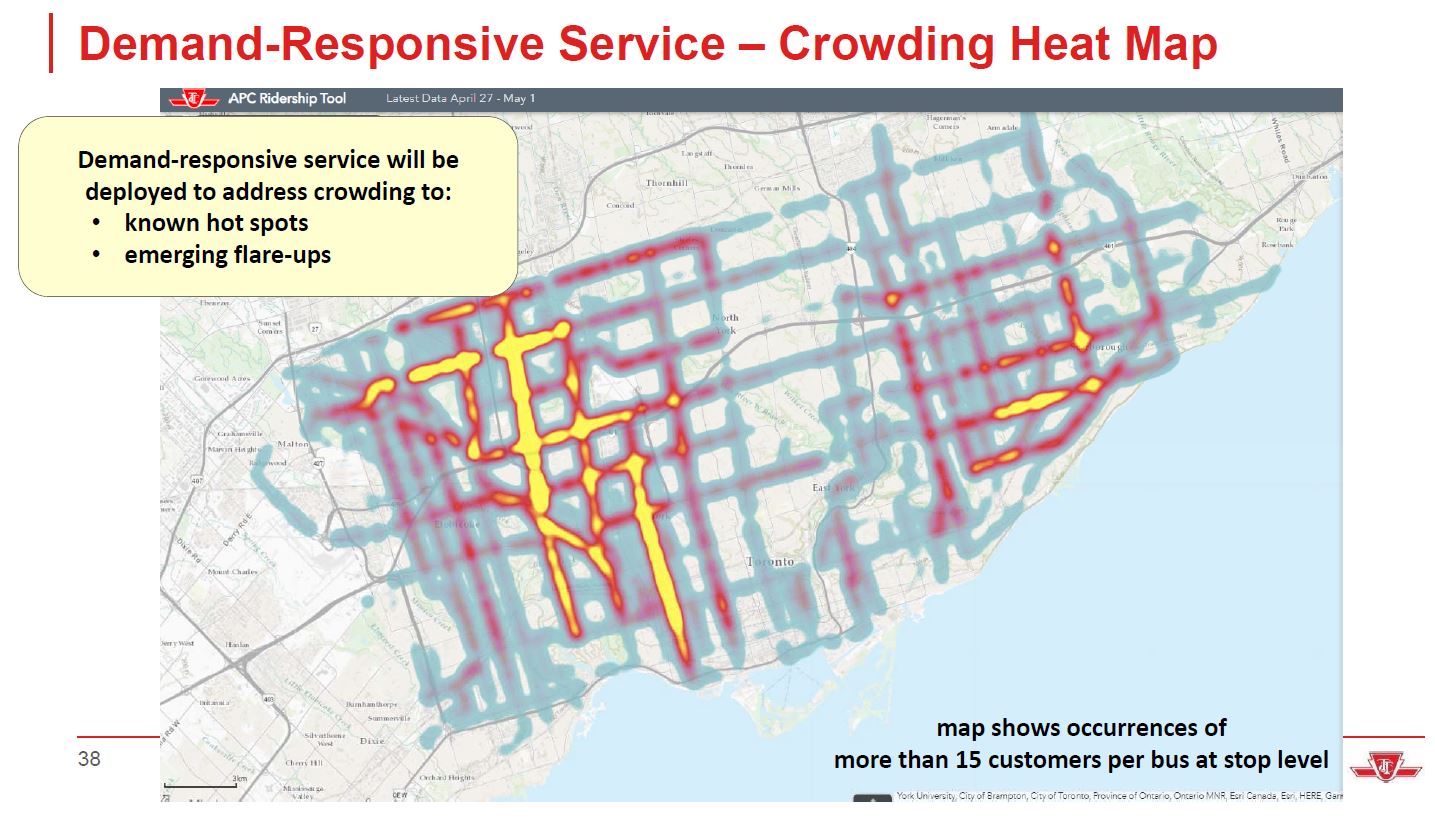
Busy stops on the network are concentrated along the bus corridors. This shows two important factors in considering service levels:

  • Heavy demand is not concentrated downtown but is spread throughout the city.
  • Busy stops are not located just where there are health care or work locations, but along routes where riders travelling to those locations live. This is a variation of the “last mile problem” where so much planning and hand-wringing looks at station locations, but not at how riders get to and from transit.

These factors make any move to further trim transit service to fit available budgets extremely dangerous over the entire city.

(Note that the map below shows only bus routes and so demand on the streetcar routes is not charted below. The reason for this is that the streetcar fleet does not yet have the same technology that is installed on bus routes to track demand and crowding.)

The TTC claims that overcrowded trips have been reduced to about six per cent by focusing service where it is needed. That is laudable, but the statistic shares with so many others published by the TTC that it is a system-wide, all-day average. A rider on a packed Dufferin bus takes little comfort from having their conditions averaged with lightly loaded times of day and routes elsewhere.

Crowding levels, plotted as a heat map, show where the problems are concentrated.

At this point I cannot help making an observation about how the TTC reports on its service quality. Clearly, they have the ability to review demand/capacity levels at a fine grained basis, but getting real data out of the TTC is almost impossible. And yet here it is. This sort of chart should not vanish after the emergency, but should be a fundamental and regular report on service quality. There is no longer an excuse that “we don’t have the data”, or “it’s coming soon”.

An obvious question about crowding levels is the metric used to count riders. The TTC has been using two of them, at least on buses;

  • Presto taps. This measures the number of people who “tap on” when they board and hence reflects “boarding” or “unlinked trips” (where each transfer counts as a new trip). This does not measure:
    • Boardings at paid areas in subway stations.
    • Trips where a rider does not pay.
    • Passengers leaving vehicles.
  • Automatic passenger counters. This technology counts people getting on and off of buses and is independent of fare collection.

The Presto data are useful for comparison with historical data, but it is the passenger counters that tell the full story. They have not yet been installed on the streetcar fleet. The subway network has no mechanism for counting all passengers and this depends on visual counts by TTC staff that are conducted periodically at various locations.

The financial implications for the TTC and the City of Toronto in coming months are considerable. In Part I, I included a table showing the financial effects and savings for the TTC up to Labour Day. Here it is again.

The table does not tell the full story because it does not show the gross operating costs. For 2020, the total budget (including Wheel-Trans) is about $2 billion, or about $160 million per month. The TTC shows savings of $10.9 million/month from the reduced level of service. Note that this is not proportional to a 15 per cent cut in service because some costs do not vary with the amount of service. This is not just administrative overhead, but much ongoing infrastructure and fleet maintenance is required even if less service operates.

If the TTC returns to full service, that saving will disappear.

Moreover, the capital deferrals are booked here as $19.3 million/month. However, the $116 million over five months will not exist from September onward because it is a fixed amount, the capital portion of the provincial gas tax allocation to Toronto.

Between the two factors, the monthly deficit will go up by $30 million in September if the TTC resumes full service offset only to the degree that fare revenue returns.

The big challenge comes in that mid-range where ridership is building, but service has to run flat out to provide enough space even with only half of the demand. Whether the system can handle this will depend greatly on how concentrated this demand is by location and time of day.

The map of current hot spots shows how important the suburban bus routes are. We may have lots of room on the subway, but that won’t get people to work on the bus lines. If a return to 50 per cent demand is unevenly distributed, the pressure for even more service in parts of the network will be severe, and it is not clear how much extra service the TTC can field due to both fleet and staff constraints.

Looking down the road, the TTC is planning for three separate time periods:

  • The remainder of 2020
  • January to September 2021
  • September 2021 and beyond

Different options will be needed depending on the expected demand patterns and financial support available. Without a return to near-normal demand and crowding, the fare revenue that represents and the better fleet utilization, transit cannot return to its former role.

Better transit funding cannot be a quick, one time payment to tide over for the short term. If the tooth fairy comes up with $300 million today, that only gets the system and the city to labour day this year, but the problem will persist and grow well into 2021. That year’s budget cycle will be brutal at every level as the need to actually pay the bills rather than shipping money out the door will hang over every government.