TTC Service Changes Effective Sunday November 19, 2023

The TTC plans many service changes for November 19 of which the largest group relates to the Line 3 replacement bus service. Other groups of changes include the restoration of service at Broadview Station, the return of streetcar service to Long Branch, and the closure of Lawrence Station bus loop for accessibility retrofits.

Notable by its absence is any change in subway service.

Although the list of routes affected is substantial, there is little change in the total number of vehicles in service. Bus service during the AM peak gains 3 vehicles, and in the PM peak loses 10. Streetcars gain 8 due to the restoration of 507 Long Branch service. This is only a rebalancing of resources across the system.

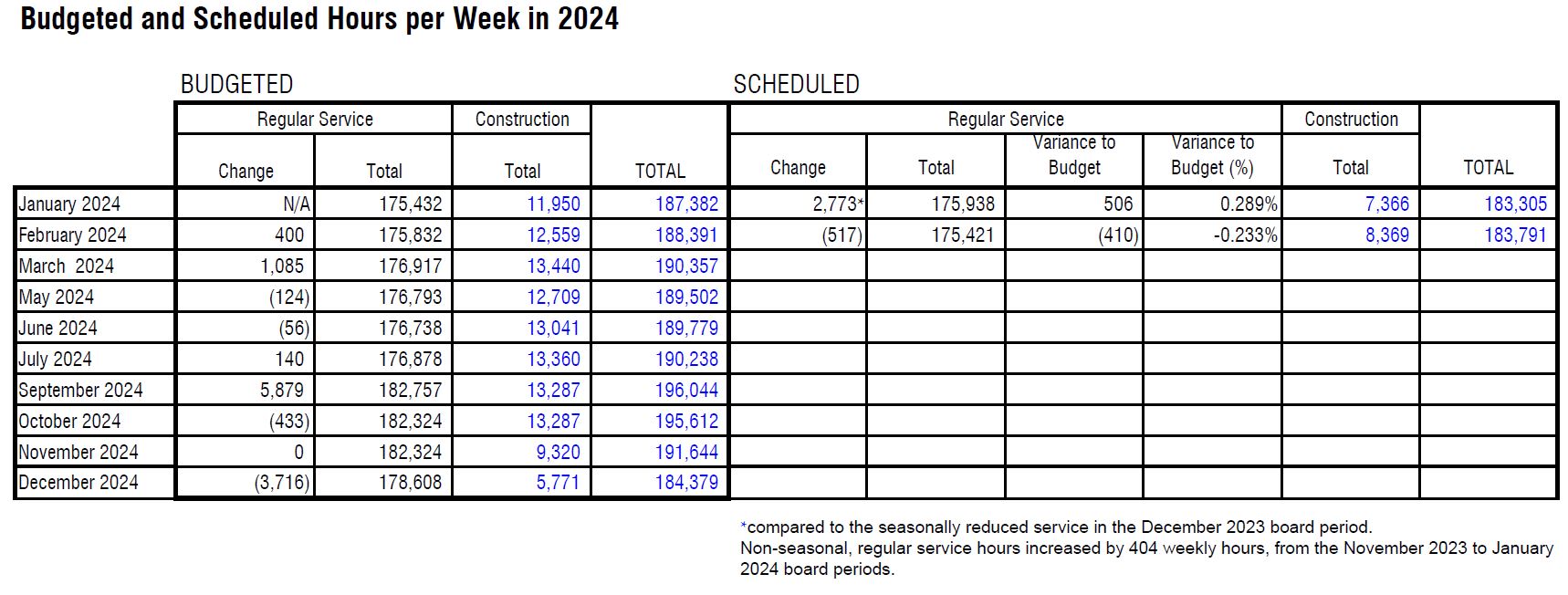
Much of the additional service operated in 2023 was due to construction projects, while the basic service level on the system did not change much until late in the year. We have yet to see budget proposals for the 2024 service levels.

Continue reading

The King Street Diversion Debacle

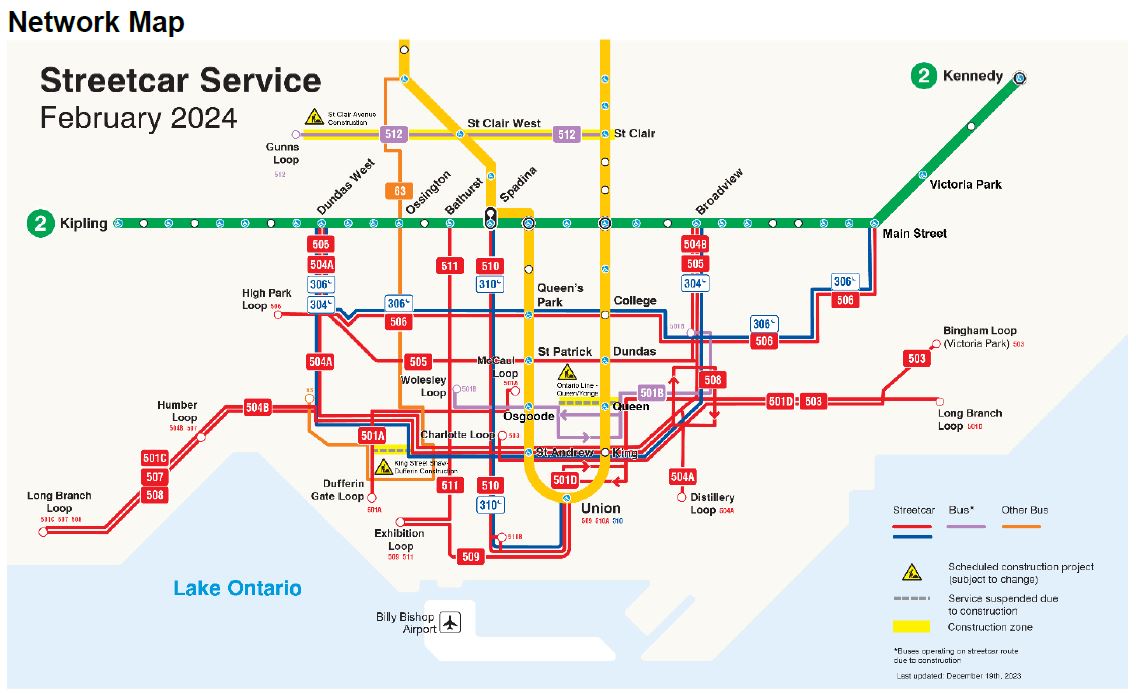
Starting on October 19 mid-afternoon, streetcar service on King Street east of Church was blocked by a sinkhole caused by a broken watermain. Streetcar service was diverted from King to Queen, and the 501B Queen bus was shifted south to King.

The sinkhole repairs completed a few days ago, and effective October 25, the diversions are only in effect until 7pm while water main repairs continue. While this arrangement does improve evening service, it perpetuates the operational problems caused by the total lack of transit signal priority and traffic management at key intersections.

Updated Oct 27 at 11:15pm: The modified routes will not be in operation over the weekend, but will resume on Monday morning, October 30 according to the @ttchelps X account.

A separate problem occurs at the transition back to “normal” service in the evening. The buses revert to normal or run back to the garage, but it takes some time for the congestion to abate and normal streetcar service to resume. This puts a large gap between the two services.

Diversion Announcement This diversion announcement linked below has disappeared from the TTC site. As the TTC updates their info, I will amend this article.

In summary, here are the normal (now evening only) and modified (daytime) routes through the affected area:

  • 501B bus: Bathurst to Broadview/Gerrard
    • Normal: Via Queen, Bay, King/Richmond (EB/WB), Church to Queen
    • Diverted: Via Queen, Bay, King to Queen at the Don River (Both ways)
  • 501D streetcar: Neville to York & Wellington
    • Normal: Via Queen, Church, Wellington/York/King loop
    • Diverted: No route change, but many Queen cars never get to York street and are short turned further east including to Distillery Loop during the most congested periods.
  • 503 streetcar: Spadina to Bingham
    • Normal: Via King, Queen, Kingston Rd
    • Diverted: Via King, Church, Queen, Kingston Rd
  • 504 streetcar:
    • Normal: From King West to Distillery Loop via King, Sumach and Cherry
    • Diverted:
      • Streetcars short turn at Church via Church, Richmond, Victoria, Adelaide, Church
      • Bus shuttle to Distillery looping downtown via Bay, Adelaide, Yonge to King

This arrangement has extremely severe effects on transit and traffic in general notably at locations where streetcars must turn. There is no Transit Signal Priority (TSP), no Traffic Warden (aka “Agent”), and no attempt to manage the conflicts between turning streetcars, other traffic and high pedestrian volumes at affected intersections. Concurrent work on Adelaide Street diverts traffic to Yonge Street and adds to congestion on streets used for the bus diversion.

Travel times of half an hour and more between Spadina and Church are common.

The situation makes total mockery of the City’s recent Congestion Management Plan by showing how they are utterly unprepared and unwilling to respond to an event that requires major reallocation of road space and time among various types of users, and active management in place of passive acceptance of chaos.

A fundamental part of traffic planning is to determine intersection capacity. This is not rocket science. If there are “N” green phases per hour, and in practice it is only possible for at best one streetcar to turn per cycle, this sets an upper bound on capacity. In fact, one per cycle is amazingly optimistic and could only likely be achieved with both TSP signalling (a “white bar” transit only phase) and a Traffic Agent to ensure the TSP was respected.

Service frequencies on the streetcar routes, and the equivalent cars/hour are:

  • 501D Queen/Neville service: 10′ / 6 cars/hour
  • 503 Kingston Rd Bingham service: 10′ / 6 cars/hour
  • 504 King Church service: 4′ / 15 cars/hour

This translates to the following demands by turning cars/hour:

  • King/Church
    • Eastbound left: 35
    • Southbound right: 25
  • Queen/Church:
    • Westbound left: 20
    • Northbound right: 20
  • Church/Richmond:
    • Northbound left: 15

A typical traffic signal cycle time is 80 seconds, or 45 times per hour. It is self-evident that attempting to turn 35 cars/hour would be a challenge. This is compounded by the fact that many cars will stop to serve passengers before turning and will almost certainly lose one cycle for that purpose.

Another source of delay is that the electric switches for turns do not always work requiring operators to manually set their route where some cars turn and others go straight through. This can also affect TSP signals where they do exist because the switch electronics “tell” the signals that a transit phase is needed.

This is a crisis-level example of why TSP should be installed everywhere that streetcars might need it, not just for standard scheduled movements (e.g. eastbound at Queen and Broadview, turns at King & Sumach). It is precisely during events where operations go off kilter that the best possible priority is needed. If the facilities were sitting there, they would benefit occasional diversions and short turns, as well as major service interruptions like this one.

The City’s plan is utterly silent on this need, and that must change. For its part, the TTC must insist on improved TSP for streetcar and bus routes. This is not a panacea, but an important contribution to transit reliability and credibility.

Toronto Considers Congestion Management, Again

At its meeting on October 25, 2023, Toronto’s Infrastructure and Environment Committee will consider a report titled Congestion Management Plan 2023-2026. With a familiar refrain, the report begins:

The City is facing an unprecedented amount of construction road closures creating congestion issues for motorists, cyclists and pedestrians and surface street transit. There has also been a significant demand for special events in the City post-pandemic with the needs for road closures and more comprehensive traffic management strategies to minimize the impacts. This situation emphasizes the demand for better coordination of access to the right-of-way and the need for improved traffic management overall to help mitigate the impacts of congestion while maintaining safety for all road users.

[Congestion Management Plan 2023-26 at p. 1]

It goes on to talk about “refocusing” on four key areas:

  • Leveraging Technology to Better Coordinate Construction on City Streets and expanding the Construction Hub program
  • Establishing a dedicated traffic management team that will work with stakeholders such as Toronto Police Services, Toronto Parking Authority, TTC, Metrolinx GO, the Office of Emergency Management and City Councillors to improve traffic management planning efforts around major events while also coordinating with ongoing construction
  • Providing increased traffic management support for surface street transit for both TTC and Metrolinx GO to help mitigate the impacts of construction related route diversions
  • Investigating Intelligent Transportation Systems (ITS), including Artificial Intelligence (AI) and Internet-of-Things (IoT) technology to better optimize traffic signal operations to help all modes move more efficiently and safely with less delay around the City.
[Congestion Management Plan 2023-26 at pp 1-2]

This appears modestly promising but for the fact we have heard many proposals before and, if anything, congestion becomes worse. If this is a “refocus”, one might ask what the City has been doing for the decade since the first Congestion Management Plan was adopted in 2013. In turn, that goes back to an October 2011 motion by Councillor Josh Matlow asking for “a report on the cost and feasibility of implementing a Synchronized Traffic Signal System”.

Looking back at years of reports, there is a common theme that changes are possible at the small scale with improvements of up to 10% in traffic flow at specific times and locations. However, these are one time effects in the sense that the improvement, once achieved, cannot repeated to cope with traffic growth.

Moreover, there is a finite capacity in the road system, and the major political challenge is to apportion this capacity among competing demands. Motor traffic, as the dominant use, inevitably must give up part of its share to give better service and space to others. This was a fundamental choice needed in the King Street Transit Priority Pilot scheme, and even there, the assumption was that some traffic could shift from King to parallel corridors.

[Full disclosure: I was a paid consultant on a project in 2014-15 to review the major east-west streetcar lines with a view to modifying traffic and parking rules to improve transit operations in the peak and shoulder-peak periods.]

Although Transit Priority is one topic in the report, there is no mention of the RapidTO program which appears to be stalled after the initial implementation in Scarborough on Eglinton-Kingston-Morningside. I am not counting the red lanes for the 903 Scarborough Express bus replacing the SRT as they came from a force majeure situation and would not otherwise have been implemented. Any of the RapidTO proposals will involve substantial change in allocation of road capacity, and they have not been well received in some quarters.

A related question is whether dedicated lanes can be justified in areas where TTC service is not as frequent as it once was on King Street, especially on a fully dedicated 7×24 basis.

In March 2020, the Covid lockdowns made a lot of traffic vanish, although as reported both here and elsewhere, traffic is now above pre-pandemic levels. This is particularly true in the suburbs where there are proportionately more jobs that are not suited to work-from-home arrangements, and where transit’s share of the travel market is hampered by service levels, route structure and trip distances.

The pandemic also triggered a move to accelerate construction projects both as a job creation program and to take advantage of the lower effect on traffic possible at the time. However, construction does not appear to have diminished, but the normal traffic level is back.

The basic problem of finite road capacity is made much more complex by the removal of significant chunks of that capacity for rapid transit construction, utility repairs, streetcar track maintenance (downtown), road and bridge maintenance, and curb lane occupancy permits for building construction. All of this might be “co-ordinated”, but the sheer number of affected locations and the duration of temporary capacity removal means that the road system is rarely at an optimal condition.

This also hampers schemes to reallocate capacity permanently for transit, cycling and pedestrians.

The current report includes only two recommendations:

  • the reconfiguration and expansion of zones served by “construction hubs” which are supposed to provide co-ordination between all projects by various parties in different sections of the city, and
  • expansion of the Traffic Agent Program (aka “Traffic Wardens”) by use of police officers and special constables.

Any other effects would come from continuation of work already approved or in progress, notably from the “Smart Signals” project which is already underway, but which is not yet fully funded.

Notable by its complete absence in this report is the recognition that some congestion cannot be easily “fixed”, and that active intervention in allocating road capacity will be necessary in the worst cases. That is dangerous political territory, especially in a City that has lived through both the Ford and Tory eras where transit did not rank first.

Moreover, there is a danger that a focus on “congestion” will reinforce the TTC’s typical behaviour of assigning all blame for poor service on external factors when their own scheduling and line management practices make a substantial contribution.

In the remainder of this article, I will review various aspects of the City’s plan and actions to date. This is mostly in the same order as sections of the report, with some consolidation to group related items.

Continue reading

Analysis of 512 St. Clair Service: Part II

This is the second part of my review of service quality before and after the substitution of buses for streetcars on 512 St. Clair in September 2023. Part I deals mainly with bus operations in September.

Until May 8, streetcars operated between St. Clair Station and Gunn’s Loop over the full route. Work on the GO bridge west of Caledonia was expected to start in May, and so on May 8 the streetcars were cut back to Earlscourt Loop and the 47A Lansdowne to St. Clair bus service was extended west to Gunn’s Loop.

The work did not occur as expected, and in response to problems with and complaints about service provided by the 47A, the streetcars resumed operation to Gunn’s Loop, but with no added running time, effective on July 4. That condition remained in effect until September 3 when buses took over the full 512 St. Clair route, and the 47A Lansdowne returned to its normal terminus at Earlscourt Loop.

The TTC has a lot to answer for here with the combined effect of service cuts and erratic operation of the service that remained while the line operated with streetcars. Buses look better by comparison because the streetcars, even with their dedicated lane, were so unreliable.

This was compounded by the effect of the long-running bus substitution on travel times discussed in Part I of this series, and by the inadequate preparation for transit priority as of day one of the bus replacement.

Continue reading

TTC Board Meeting Preview: September 26, 2023

The TTC Board will meet at Scarborough Council Chambers at 10:00 am on September 26, 2023. This will be the first meeting of the reconstituted Board under Mayor Chow’s administration. Among the reports on the agenda are:

The agenda also includes a report Update on TTC’s Partnership Approach to Community Safety, Security and Well-Being on Public Transit. I will address this in a separate article.

Continue reading

New Metrics for a New TTC

With the changing of the guard in the Mayor’s Office and a shift in the political balance of the TTC Board, it is time to blow the dust off of the metrics in the TTC CEO’s Report and elsewhere. I have written about aspects of this before, and will not belabour earlier arguments. However, in an era of recovery, we need to show what this is actually happening, and that we are getting good use out of the transit infrastructure, notably a large vehicle fleet, that we already own.

The areas of particular interest are:

  • Ridership, demand and crowding on routes
  • Service quantity and reliability
  • Fleet availability, usage and reliability

The CEO’s Report is replete with “Key Performance Indicators” (KPIs), a favourite tool of lazy managers to give the impression a complex organization and process can be reduced to a handful of simple numbers. Either “up” or “down” is considered “good”, and as long as the lines move in the correct direction, gold stars are handed out like confetti. Rarely, if ever, is the underlying process, the product, or the real meaning of the KPIs discussed.

A subtle, pervasive issue for TTC KPIs is the focus on top line numbers for ridership and revenue. This is akin to a restaurateur who counts the receipts and the number of meals sold without asking what brings diners to the door, or even worse, whether they will come back. The goal is to sell more meals, preferably at a low cost. Advertising, not word of mouth, generates new, if not lasting, trade.

Ridership is a rough measure of system use and a point of comparison for post-pandemic recovery, but it does not tell the whole story. Already we know that the bus network which is mainly based in the suburbs has recovered much of its pre-pandemic demand, although this is not distributed the same way with shifts in peak periods and in travel patterns. Off peak recovery is stronger than peak, in part because “work from home” affects less than half of the total demand, and non-work trips still occur.

Even “growth” can be misleading. In pre-pandemic times, the TTC routinely celebrated year-over-year riding growth even while the rate of growth slowed and eventually stalled. A problem flagged at the time was that growth occurred disproportionately in the off-peak where there was surplus capacity. That capacity filled up, but thanks to budget constraints service did not expand to match.

This shows the danger of looking at a single, simple number without understanding the detailed system behaviour, or even worse, of using the simple metric to hide a growing problem. Trimming capacity to demand can be a vicious cycle that prevents growth.

The phrase “subject to budget availability” is a standard caveat on any goals, and it has haunted TTC planning for years, well before the pandemic. That might be a basic part of corporate management, but over many years it has become the foundation of TTC reality. Aim low because aiming higher will cost too much.

This speaks to the split nature of TTC goals. It is supposed to provide transportation, and the motto “Service, Courtesy, Safety” is emblazoned on the TTC’s coat of arms. However, the TTC Board sees its primary role as serving its political masters at Council and especially the Mayor.

I wrote about TTC culture and that motto back in 2010. For context, this was before Andy Byford became CEO, let alone Rick Leary.

The common problem with many KPIs the TTC publishes is that they are one dimensional and report only average values of major variables. They do not necessarily reflect what riders see nor give a sense of the shortfall between what the system achieves and what could be possible.

I have said this before: riders do not experience “average” trips any more than diners in a restaurant experience an “average” meal. A four-star restaurant might outdo itself with a plateful of magic from the kitchen, but an off day could bring overcooked, lukewarm food and indifferent treatment by the wait staff. Getting it right most of the time doesn’t warrant four stars. Getting it right only some of the time doesn’t warrant any. The diners are paying for all four.

On occasion, I am asked how I would change the TTC’s KPIs to better show what is happening. My first response is that many aspects of a transit system cannot be reduced to one-dimensional metrics that compress all of the vital details into simplistic averages.

TTC needs to focus its performance metrics on service-related factors, direct measures of what riders experience. Average values will not do, and the Board needs to understand what these numbers mean. Providing tolerable service on most routes a good deal of the time is not an advertisement for “the better way”. Provide attractive, reliable service and riders will follow.

Continue reading

TTC Service Changes for September 3, 2023

The TTC did not release the detailed list of September 2023 service changes until the afternoon of September 1.

To get this information out promptly, this article is published without the usual spreadsheet comparing old and new schedules. I will add the spreadsheet here in a few days when I have built it. Check back later in the weekend.

Updated September 3 at 8:40 pm: The spreadsheet detailing all of the service changes with before:after comparisons is now available.

20230903_Service_Changes

Updated September 5 at 2:20 pm: The description of the modified 403 Don Mills South Community Bus has been corrected.

Continue reading

Yet Another Change to East End Streetcar Services

Further to my recent post about planned service changes effective September 3, the TTC has issued a revised set of route arrangements thanks to a change in the schedule for Metrolinx work at Queen & Degrassi.

There will be four stages to the service modifications:

  • Sunday, September 3 to Friday, September 22 at 10 pm
  • Friday, September 22 at 10 pm to Friday, September 29 at 10 pm
  • Friday, September 29 at 10pm to Monday, October 2 at 4 am
  • Monday, October 2 at 4am to Sunday, October 8

October 8 falls on Thanksgiving weekend which is the October TTC schedule change date. Service arrangements beyond that point have not been announced.

The information here is adapted, with corrections, from the TTC’s website Streetcar Service Changes page. As I write this (4:50 pm, August 29), there are several inconsistencies or errors on the TTC’s site. This article is an attempt to consolidate the available information.

Continue reading

TTC Announces Fall 2023 Service Increases

On August 28, 2023, Mayor Olivia Chow and TTC Chair Jamaal Myers held a press conference at Scarborough Centre Station, hosted by TTC CEO Rick Leary, to announce planned service improvements for coming months. The map below shows routes affected by plans for October and November 2023.

The routes in blue, the former SRT colour, are part of the restructuring for the Line 3 replacement service. Note that they are shown as running west from STC via Progress, Brimley and Ellesmere. This is the final routing, although the 903 express bus is now using Progress all the way to Kennedy. The reason for this is that a queue jump lane is planned for Brimey and Ellesmere, but it is not yet ready. When it is completed, the buses will shift to the originally announced route via Ellesmere.

Other routes will see improvements to service and/or to reliability. No details were announced.

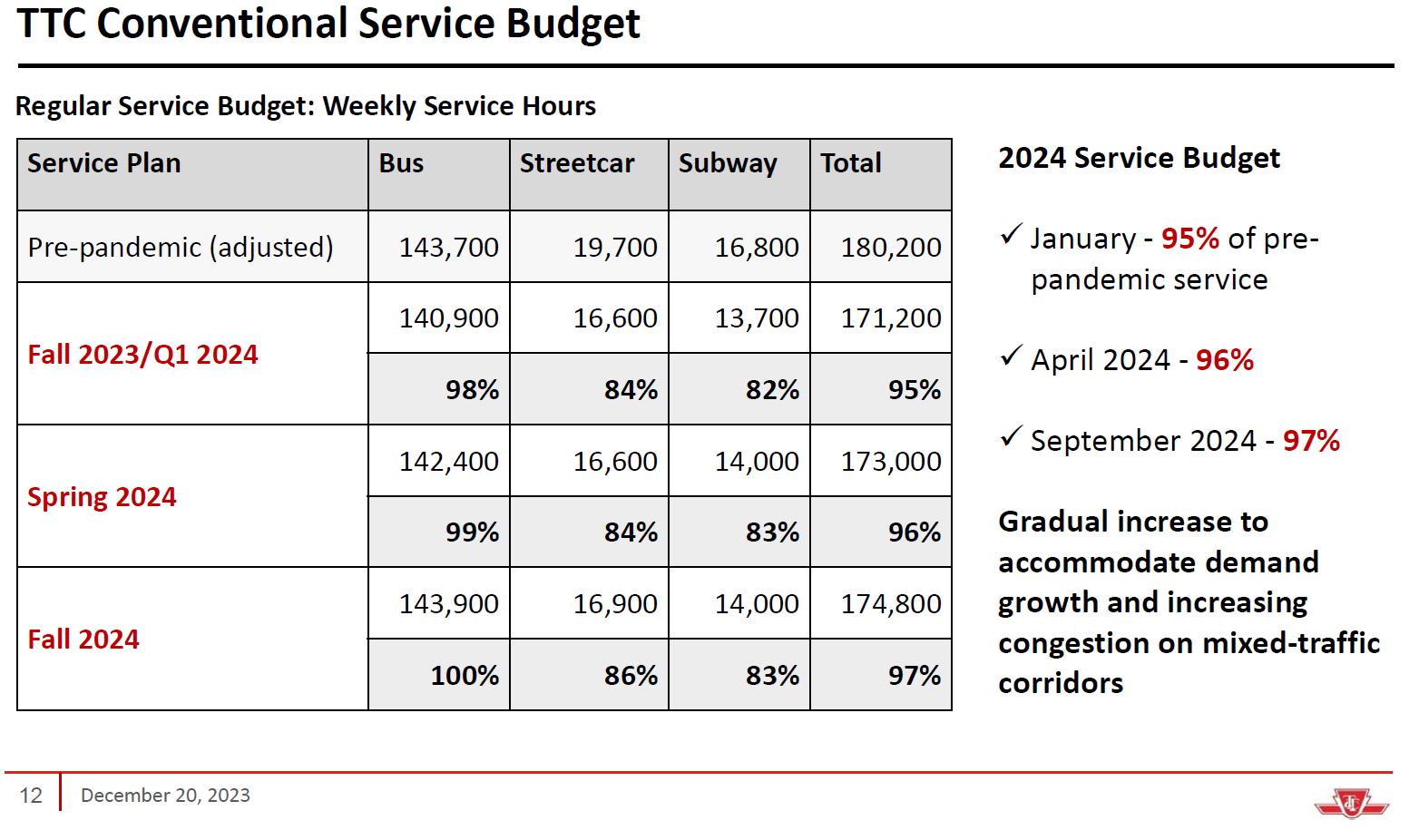
Service hours are planned to increase through the fall:

  • In September to 93% of prepandemic levels
  • By November to 95% of prepandemic levels with bus service rising to 99%.

Note that this does not mean that late 2023 service will be identical to early 2020, but that similar numbers of service hours will be provided. The bus network is especially important because it has the strongest ridership recovery rate.

The improvements planned include restoration of school trippers (a normal fall event), increasing service based on demand, reducing wait times by improving the Ten Minute Network, and adding unscheduled, Run-As-Directed service to supplement capacity.

Funding for the improvements comes from the unspent budget headroom created by the delay in opening the two Provincial LRT projects on Eglinton/Crosstown and on Finch.

I expect to receive the details of September service changes soon and will publish them when they are available.