TTC Operating Budget 2020 (Updated)

Updated December 16, 2019 at 5:30 pm

At its meeting today, the TTC Board approved the Operating Budget and fare increase without amendment. There were deputations on the subject of cash fares as well as the proposed expansion of the cadre of fare inspectors to reduce fare evasion. I have added a section at the end of this article address those issues.

Management’s presentation deck, which includes information on both the Operating and Capital Budgets is available on the TTC’s agenda page. It includes charts showing more detail about recent ridership changes, and these are now included in the postscript.

Introduction

The TTC has released its proposed Capital and Operating budgets for 2020. These will be discussed at a special meeting of the Board on Monday, December 16 at 9:30 am in Committee Room 1 at City Hall (across the corridor from the usual room, CR 2, that the TTC Board uses). Note the early start time as there is no private session in advance of the public meeting.

This article primarily addresses the Operating Budget, and I will turn to Capital in a separate piece.

There has been a lot of TTC-related news and reports in the past year including:

  • The TTC’s publication of a 15 year capital project forecast showing that the “cost of ownership” of the transit system is much, much higher than had been revealed publicly in past years.
  • The provincial decision to re-neg on a planned doubling of the gas tax allocation to municipal transit systems.
  • The provincial decision to retain ownership only of new rapid transit lines, and the concurrent removal from TTC’s financial projections of the need to contribute to new lines that the province will own.
  • The TTC’s 5 Year Service Plan and 10 Year Forecast that gazes ahead to how the system might evolve over the next decade.
  • Mayor Tory’s proposed additional levy to increase his City Building Fund, and related statements in the media about how the money this will finance might be used.
  • The 2020 budgets just released.

With proposals and plans popping up from various agencies and political levels, it was inevitable that there are inconsistencies. Most notable is an emerging issue with whether the TTC will buy new vehicles, and at what scale.

The Service Plan shows projected growth in the streetcar, bus and subway fleets, and Mayor Tory speaks of the need for new vehicles as something that the City Building Fund can pay for.

[…] I am proposing to extend the City Building Levy further into the future to raise approximately $6.6 billion to invest directly in our transit system – including new subway cars, new streetcars, station improvements, and signal upgrades – and in building more affordable housing across our city. [Letter from John Tory to Executive Committee, Dec. 11, 2019, p 2]

At its regular meeting on December 12, 2019, the TTC Board heard a deputation from Unifor, who represent the workers at Bombardier’s Thunder Bay plant, urging that the TTC commit to buying more streetcars while the production line for them is in place, and also reminding the Board that this plant also produced the Toronto Rocket subway trains which the TTC needs more of in coming years.

However, the Capital Budget explicitly notes that there is no money in the “funded” part of the Capital Budget for anything beyond vehicle orders already committed. There are two problems here.

First, projects are only moved “above the line” with official status on the approval of Toronto Council. This policy was implemented years ago to prevent the TTC from committing to projects for which no money was available and/or which did not have support at Council. Second, although the City Building Fund will make more capital available, it has not yet been approved by Council.

Moreover, there is no sense of what either the TTC’s or Council’s priorities for this money will be. The TTC Board has asked management to prioritize its capital projects on more than one occasion, but nothing has come of this. To be fair to management, “priority” is a concept that moves like leaves in the wind in the political environment, and these decisions must, at least in part, be made by politicians who cannot fob off such decisions on staff.

What is needed is a list of “must have” projects that have first call on any available funding after which Council can wrangle over whose pet projects get first crack at the leftovers. Even deciding what is “must have” is fraught with political battles such as whether expansion of the streetcar fleet will doom suburban drivers to forever be stuck on downtown roads rather than driving above sleek new subways, or at least around “flexible” buses.

I will turn to this in more detail in the Capital Budget article, but on the Operating side there is an issue of great concern: all of the new funding that seems to be coming transit’s way is for capital projects, not for day-to-day operations. The TTC’s ability to expand service is constrained by the level of city subsidy the Council thinks is “affordable” in the context of pressure on taxes, on the level of fare increase (if any) that is politically tenable, and the rise or fall in provincial operating subsidy (which comes out of gas tax revenue).

The 2020 Operating Budget projects a rise in subsidy from the City of Toronto and higher fare revenue, but does not really address the backlog in service deficiencies across the network. The Service Plan, released only a week earlier, foresees no significant service improvements until 2021. The Service Plan claims that all services are operating within the Service Standards, while the Budget claims that there is a need for more service to address crowding. This is the hallmark of a policy framework changing on the fly.

There is a ten cent fare increase proposed for March 2020 that would apply across the board to Adult and to most concession fares. This has provoked a common response that fares are already too high and subsidies are too low, and in turn that ties back to the absence of operating funding in the proposed City Building Levy.

However, freezing fares brings new costs year by year, but no new service. Whether fares change or not, the City needs to have a long-overdue debate about its target for “good” transit service that amounts to more than building a subway to every Councillor’s house. A big frustration with higher fares is that riders see every day how service does not meet their needs both in capacity and reliability. Charging more for an inferior product is not good marketing.

The TTC, ever alert to wresting more fare revenue from passengers, plans to hire 50 more Fare Inspectors. It would be amusing to compare the cost and benefits of these employees to the effect of hiring 50 more operators to drive buses and streetcars.

TTC management, possibly at political direction, consistently fails to produce future year plans that show what a “growth strategy” would look like, and they are content with a plan that barely keeps up with population and job increases. More transit will cost more money. We all know that, but we do not know what can be achieved and at what cost. That was the goal of Mayor David Miller’s Ridership Growth Strategy, and more recently the system improvements proposed by Andy Byford over bitter objections from John Tory’s campaign team. If we do not know what could be done, and how this might be achieved, we will never try.

Continue reading

Metrolinx Board Meeting: November 22, 2019

The Metrolinx Board met on November 22, 2019 with its usual mixed agenda of private session and public items. This article deals with the following public reports and mainly with the Kitchener and Niagara Falls business cases.

Continue reading

A Potpourri of TTC Items

Several items have languished unreported here for a while, and it’s time to push them all out of the door in preparation for the deluge of budget information and the new Service Plan that will come in December. My apologies for not keeping you as up to date as I might have.

The items covered here are:

  • Ridership and revenue
  • Vehicle reliability
  • Service quality (briefly)
  • Automatic train control
  • eBuses (electric buses)
  • Fare evasion

Continue reading

Presto’s Geographical Confusion

The CBC reports a problem from two Presto users who were billed wrongly for trips miles from their actual location on a different transit system. Specifically, riders who boarded the subway at Wilson Station, and then transferred to the 52 Lawrence West bus using Presto cards with TTC monthly passes were billed for a MiWay trip at Westwood Mall.

Source: CBC

Problems with Presto placing a rider or charging wrongly for trips have been known for quite some time. Some cases are due to GPS errors, and others due to limitations of a rule-based system for calculating fares.

Before the TTC moved to the two-hour fare in August 2018, riders could find they were billed for a new fare in cases where they made a legitimate transfer connection. This could occur for two reasons:

  • The connection occurred at a location that was not defined as a valid transfer point between routes within the Presto system. Typically this happened when vehicles were short-turned or diverted and the transfer happened at a location Presto was not programmed to recognize. Transfers between cars of the same route could trigger a new fare charge.
  • The vehicle did not accurately “know” where it was at the time a card was tapped because of a GPS error, and so Presto misinterpreted the transfer as a new trip.

Riders using passes on their Presto card were not affected by these problems because they paid a fixed charge, but pay-as-you-go riders would be charged a fare they should not have paid. Unless riders checked their transaction history, they would never notice the problem.

With the two-hour fare, the controlling factor is the time, not the location of the tap, and so the whole transfer point issue disappeared.

However, recently Presto extended its functionality so that TTC riders could use their card on neighbouring systems such as York Region Transit and MiWay, and this created a new way that Presto could fail. If a TTC bus reports its location in a “foreign” location, Presto could assume that they were on a different transit system, and charge for a trip there.

The specific case reported by the CBC is particularly interesting because Westwood Mall is a legitimate location on the 52 Lawrence West route. TTC buses run outside of the City of Toronto on some routes and riders can use their Presto cards to pay the outside-city fare on a TTC vehicle. However, it is clearly impossible that someone could get from Wilson Station to Westwood Mall in 6 minutes.

This brings us to the problem of how Presto deals with bad GPS data.

The plot below shows GPS data from the 52 Lawrence route taken from the TTC’s vehicle tracking system. There are 10,000 vehicle data points included here, and they clearly show the geography of the route, its branches, and the garage trips to and from Mount Dennis Garage. The blue dot at the northwest end of the route is at Westwood Mall.

However, the plot looks somewhat different if we zoom out to include all data. The cluster of dots in the lower central part of the plot is the main part of the route, but there are many dots far away from the route. When these are plotted on a map, locations range from Wasaga Beach to the middle of Lake Ontario. What does Presto do when it “sees” a tap at such a location? Does it try to map this to the nearest point that is legitimate for the route? Would a tap far northwest of Toronto be mapped to Westwood Mall, the nearest point on the 52 Lawrence West route?

There are two major issues for Metrolinx here, and this is not the trivial problem the agency presents.

First, GPS errors happen and Presto needs to deal with them. This is not a problem with the TTC, a favourite whipping boy for Metrolinx, but with GPS systems generally. This will become more important as riders whose “home” systems with local fare discounts such as monthly passes or two-hour fares regularly cross boundaries to other systems. Even with some sort of fare integration (a rat’s nest of policy and funding problems in its own right), there will be challenges if the tariff involves zones or some distance-based charge. There must be a reasonableness check built into the system to detect travel patterns that don’t make sense for a rider. Even so, things will go wrong.

The second problem is that Presto needs to acknowledge that these problems do occur and clean up its Customer Service practices. Only after this incident became a media issue did Presto actually do something, three months after it occurred. Indeed, their original advice to the riders was that they should contact MiWay to get a refund even though (a) they were on a TTC bus and (b) the fare system is Presto’s, not MiWay’s. Evading responsibility should not be the first response to a customer complaint.

Transit has a hard enough time fighting for riders. It should not be hobbled by systems and procedures that work against good service.

Toronto’s Auditor General Exposes Many Presto Problems

At the TTC Board meeting of October 24, 2019, Toronto’s Auditor General, Beverly Romeo-Beehler presented a detailed report on the problems faced by the TTC with the Presto farecard system.

For clarity: In this article, where text is directly quoted with an indented block and a page citation, these are the words of the Auditor General’s report. Where there is emphasis within a quoted section, this is taken from the original report, not added by me. Otherwise, comments here are my own with, in some cases, paraphrases of the report. Page numbers cited are within the linked PDF of the report, not necessarily the page numbers shown in the document because numbering restarts within it.

This is a long article, but nowhere as long as the 123 page report on which it draws. It begins with an overview and then continues with detailed reviews of various aspects of Presto and of the relationship between Metrolinx and the TTC. The sequence is slightly different from the Auditor General’s report in order to group related sections and comments together.

After the Introduction, the Audit Findings section delves into the detail. There is a lot of detail because there is a lot wrong with Presto. The Auditor General’s report is an indictment of a failed project and bad management primarily from Metrolinx, but the TTC does not go unscathed.

If anything is missing, it is a historical review of how the system came to be in its present state. However, that is beyond the remit of an investigation into whether the TTC is getting what it pays for from Presto, and whether shortcomings affect the revenue the TTC should receive through that system.

TTC management has accepted all of the Auditor General’s findings, and their remarks can be found in Appendix 1 beginning on page 110 of the report pdf.

Summary: TTC accepts all of the Auditor General’s recommendations. Most of the recommendations are consistent with TTC management and actions to date and ongoing efforts to address and resolve the issues as identified in the recommendations.

Metrolinx’ response to the findings are generally positive and acknowledge many shortcomings including missing or broken processes that should be in place by both parties. How well this will be sorted out remains to be seen. Probably the most important part of the letter is the view forward to the next iteration of the Presto system, and the recognition that what we have now can be improved for everyone’s benefit.

As you know, PRESTO is embarking on modernization plans that are enabling us to focus even more on delivering exceptional services. This work will result in new offerings that will remove customer pain points and give them new ways to pay, while offering transit agencies valuable features to drive ridership and fare revenue. Consultations with the transit agencies on new payment forms and other improvements included in the roadmap have been underway throughout the summer, including with TTC, and we look forward to their participation in shaping the future of PRESTO.

We are also preparing to retender our current supplier agreement with a view to opening PRESTO’s ecosystem to more market participants, which we will leverage to improve our overall performance. Recommendations stemming from your audit of the TTC will inform our future approach as we go to market for these services.

As with all reports from the Auditor General, there will be a follow-up in a year’s time to report on the progress achieved on her 34 recommendations.

Introduction

This is “Phase Two” of a detailed study of TTC fare collection that began with a review of fare evasion. I reported on this in February 2019. See Fare Evasion on the TTC: The Auditor General’s Report. That review raised questions about the unreliability of Presto equipment as a source of revenue loss and frustration for riders who could not always pay their fare properly.

A central issue here is the length of time Presto has been in place and the number of unresolved or even unacknowledged issues surrounding the system.

In November 2012, TTC contracted with Metrolinx to integrate and operate the PRESTO fare card on its transit network for 15 years, plus options for renewal. As of the end of 2016, PRESTO could be accepted for fare payment across the entire TTC network.

The Master E-Fare Collection Outsourcing Agreement (Master Agreement) stipulates that Metrolinx manage all PRESTO equipment on TTC’s properties, on board TTC vehicles, and where necessary on the street. This includes the design of the hardware and software, and the installation and maintenance of the machines. In return, Metrolinx is compensated with 5.25 per cent, inclusive of HST, of the gross revenue collected through the PRESTO system on TTC. [pp 33-34]

The Auditor General’s office conducted a field study of Presto equipment, looking at real machines on real buses.

In reviewing the functionality of PRESTO fare equipment, we conducted a bus device audit for two days in June 2019. Over 100 TTC operators representing all seven bus garages drove 168 buses and noted any PRESTO issues during their shift. Of the 330 PRESTO issues noted, nearly 300 (91 per cent) of them were frozen PRESTO card readers.

A frozen PRESTO card reader is when a passenger taps their PRESTO card but the reader is stuck and does not always accept the tap. Not only does this result in revenue loss if the passenger doesn’t tap on another reader successfully, but the device may be captured as “in-service” rather than “out-of-service” in the availability calculation and the availability rate could be overstated for this issue. [p 24]

They also dove into the murky world of contracts between the TTC, Presto and vendors who provide services within the Presto system. The results were not pretty, certainly not with the rosy confidence we often hear from Metrolinx/Presto spokespeople making claims of a robust, near-perfect system. Moreover, there is a wide gap between the services actually provided by Presto and those for which the TTC has contracted and is paying through its service fees.

There is a very long list of findings from the audit, and it reveals a complex web of ownership and responsibilities for provision, operation, monitoring and maintenance of the Presto system. One cannot help feeling that these arrangements grew like an unweeded garden where functions were cobbled together on an ad hoc basis to provide new or extended features. If Metrolinx has any desire to consolidate all of this into a new iteration of Presto (we already have “Presto Next Generation”, and so a new name is really required here), this will not be a simple process. Moreover, as noted by the Auditor General, both Metrolinx and its client transit systems must have a clear set of requirements for any new system rather than taking whatever Metrolinx management thinks they will accept willingly or not.

The appalling status of the entire contract is summarized in one paragraph in which we learn:

PRESTO card readers need to be available greater than 99.99 per cent as per the service level identified in the Master Agreement between TTC and Metrolinx. Given SLAs [Service Level Agreements] have not been set up, what goes into the calculation of the service level has not yet been defined or agreed upon. Metrolinx staff have advised us that “they do not have an agreement with TTC on the device service level commitment calculations, nor the consequences for non-performance”. [p 25]

One might reasonably ask why an SLA is not in place after all these years including a penalty mechanism, but given that it is Metrolinx who benefits from this situation it is hard not to assume that they simply do not want to take the responsibility and potential, publicly identified cost that might go with it.

There is more than a little irony that a report exposing bad project management and a difficult relationship between the TTC and Metrolinx should appear just before City Council was asked to approve a much more complex arrangement for the funding, expansion and operation of the rapid transit system.

The greatest problem between the two parties is the political aversion at the City to “rocking the boat”. The Provincial attitude is that they can more or less act as they please because they have the upper hand on funding and political control. The Liberal government threatened to withdraw Gas Tax funding from the TTC if it did not implement Presto, and the Conservative government was on the verge of stripping responsibility for at least the subway network, if not the entire transit system, from the City. This does not make for a level playing field nor honest, transparent public debates.

Quite bluntly, if Metrolinx were not a government agency with the power to do as it pleases, but instead a private vendor, it would have lost this contract years ago and faced claims for non-performance.

The first recommendation is the need for “Foresight” by both the TTC and Metrolinx. The contract has many unfulfilled requirements, but what does the TTC really want its fare system to look like? What are Metrolinx’ goals for Presto as it evolves? Are the various suppliers of parts of the Presto system delivering what Metrolinx and its clients really need?

Overall, and in our view, there must be a strategic refocussing at the top by both TTC and Metrolinx to tackle what matters most – the shared outcomes of customer experience and maximizing revenue.

For this to work, both parties also need to:

  • Define clear, agreed upon, and formalized outcomes and Service Level Agreement (SLA) targets
  • Seek a win/win for both parties, but acknowledge individual and shared accountabilities and responsibilities in this arrangement – several examples of which are outlined in this report. [p 2]

The second recommendation is the need for “Insight”.

To solve problems you need insight into the root cause. To gain such insight, the right level of information must be analyzed using the right data. Without that, you are solving what you think might be wrong without the evidentiary support to confirm you are addressing the true cause(s) and actual issue(s). [p 2]

One might cynically observe that this statement applies to a lot of what passes for “analysis” and “planning” for transit in Toronto, but that is entirely another article.

The Auditor General noted “fundamental” information gaps:

  • Service level agreements are not in place setting expectations and responsibilities for each party seven years after the contract was signed.
  • Key information that the TTC needs is either encrypted or purged in a short time-frame contrary to the Master Agreement.
  • The current analysis was limited by
    • problems with Presto readers including root cause analysis for frozen machines, problems with the device monitoring tool;
    • accurate monitoring of vending machines on streetcars and regular collection of coins from them to prevent out of service conditions;
    • manual practices for identification of out of service fare gates. [adapted and condensed from pp 2-3]

The third recommendation is the need for “Oversight”. Astoundingly, although the agreement provides for a Joint Executive Committee and an Expert Panel, these either do not exist or have not met for an extended time. One cannot help feeling that the TTC, in the face of an intransigent service provider, has simply given up and treats Presto as “broken as designed”. However, this could also mask resentment of a system forced onto the TTC compounded by little municipal political support to hold a provincial agency publicly to account.

Moreover …

… there needs to be the following to improve oversight of the system as a whole:

  • TTC, PRESTO and all vendors working together as one, sharing information, and diagnosing and solving problems together (e.g. coin collection issue on new streetcar vending machines needs to be resolved together despite all vendors staying within defined responsibilities)
  • Focusing, measuring and monitoring the desired outcomes
  • Controls over PRESTO revenue and assurance provided by PRESTO needs strengthening, including retailer network controls [p 3]

There are 34 recommendations in the report, and I leave it to dedicated readers to peruse the full list.

Looking back to Phase 1 of the study and the ongoing dispute between the TTC and Metrolinx over revenue losses due to Presto, the Auditor General concludes:

We prepared calculations to estimate a range for the overstatement of the PRESTO card reader availability rate and annual revenue loss. Based on the work performed with the information we could obtain, it is our view that TTC’s estimate of $3.4 million in revenue loss for 2018 due to malfunctioning PRESTO fare equipment does not appear to be overstated. TTC’s availability estimates may even be understated given the issues we identified in this report with availability of PRESTO card readers. We are not including revenue loss calculations in this report. It is our view that the information and data gaps identified at this time make it difficult to provide these important numbers with the required level of audit assurance. [p 9]

The two agencies are now going to arbitration over this and other issues, and it will be intriguing to see what effect the Auditor General’s report has on that process. A major problem for quite some time has been that there has been little field work to document how the system is actually behaving or to explore reasons behind the perceived unreliability of equipment. That neither the TTC nor Metrolinx undertook a definitive review says a lot about both organizations, but at least we now have the Audtor General’s work to show the kind of information that is available if only one makes the effort to collect it.

The high level summary of the audit occupies one page [click to enlarge].

Continue reading

Metrolinx Board Meeting September 12, 2019

The Metrolinx Board met on September 12, 2019, but there was not much of substance on the public agenda. Presentations consisted as much of rehashing old news (including he oft-announced service improvements on GO Transit), but almost no substantive policy discussions.

Links here to the Agenda and Video for the meeting.

Ontario Line Initial Business Case (Video at 23:35)

This report was presented by a team of four from Metrolinx:

  • Mathieu Goetzke, Chief Planning Officer (Acting)
  • Malcolm Mackay, Project Sponsor for the Ontario Line, and until 13 days ago an engineer at TTC with 13 years experience, now transferred to Metrolinx. His previous major TTC projects included the Relief Line and the Union Station second platform.
  • Duncan Law, Head Sponsor for the subway program
  • Becca Nagorsky, Director for Project Planning

As I have already reviewed the Initial Business Case (IBC) in some detail, I will not dwell on that here, but will flag comments during the presentation and discussion of particular interest.

There were two threads on which nobody remarked, but which were significant given the way that the Ontario Line was announced:

  • The project details are far less advanced than the bluster of the original announcement might have indicated, and Metrolinx acknowledges that significant technical challenges remain for the design.
  • Language implying the general incompetence of the TTC to build a “modern” rapid transit line is much reduced if not eliminated from the discussion.

These are welcome changes, but we now face the need to build something because the Premier announced it.

Mathieu Goetzke introduced the presentation saying that although the Initial Business Case (IBC) was published in July, they are now going into more details. The Preliminary Business Case (PBC), the next step in the process, must resolve some issues and Metrolinx needs to “activate all possible levels” to address project costs. (See video at 27:00.)

Duncan Law continued in this vein saying that it was important to recognize that the IBC is an early stage of the project. Both the Relief and Ontario Lines are underpinned by the recognition that more capacity is needed. With roughly 50 per cent of the Ontario Line being at or above grade, there would be cost savings. Moreover, with the line separate from the existing subway system, there is an opportunity for technology change that would not otherwise be possible. There is a big difference in this outlook from saying that the TTC uses out of date technology.

Becca Nagorsky echoed the remark that the IBC is a first phase saying that its purpose is to define the project’s goals that must be preserved through the life cycle of more detailed design. She continued what has become a standard Metrolinx comparison of the original Relief Line project to the Ontario Line considering only the Relief Line South. This works from the assumption that the Ontario Line’s technology change will save so much money that the Relief Line North, as a conventional subway, does not even come into the discussion. This precludes the possibility that future design work might discover that the Ontario Line could be more expensive than originally thought, but by then the idea of going back to a subway project will be difficult, if only for political reasons. (There are parallels with the now-entrenched concept of a Scarborough Subway.)

The capital cost projections include anticipated savings due to “risk transfer” to a private sector partner in a Design-Build-Finance-Maintain (DBFM) P3 arrangement, but as with so many P3 schemes, there is little explanation of how exactly this is achieved. In particular, there is always the possibility that circumstances and designs will change, and the private sector “partner” will not assume this risk.
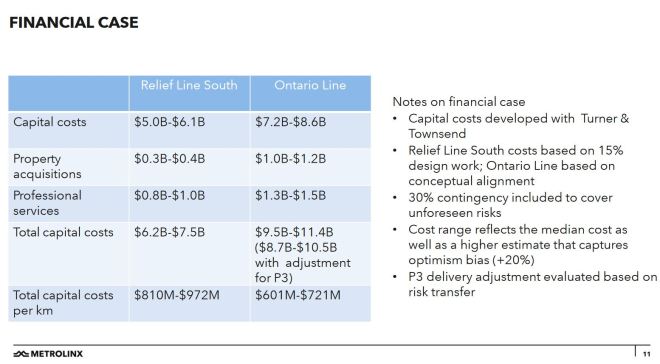
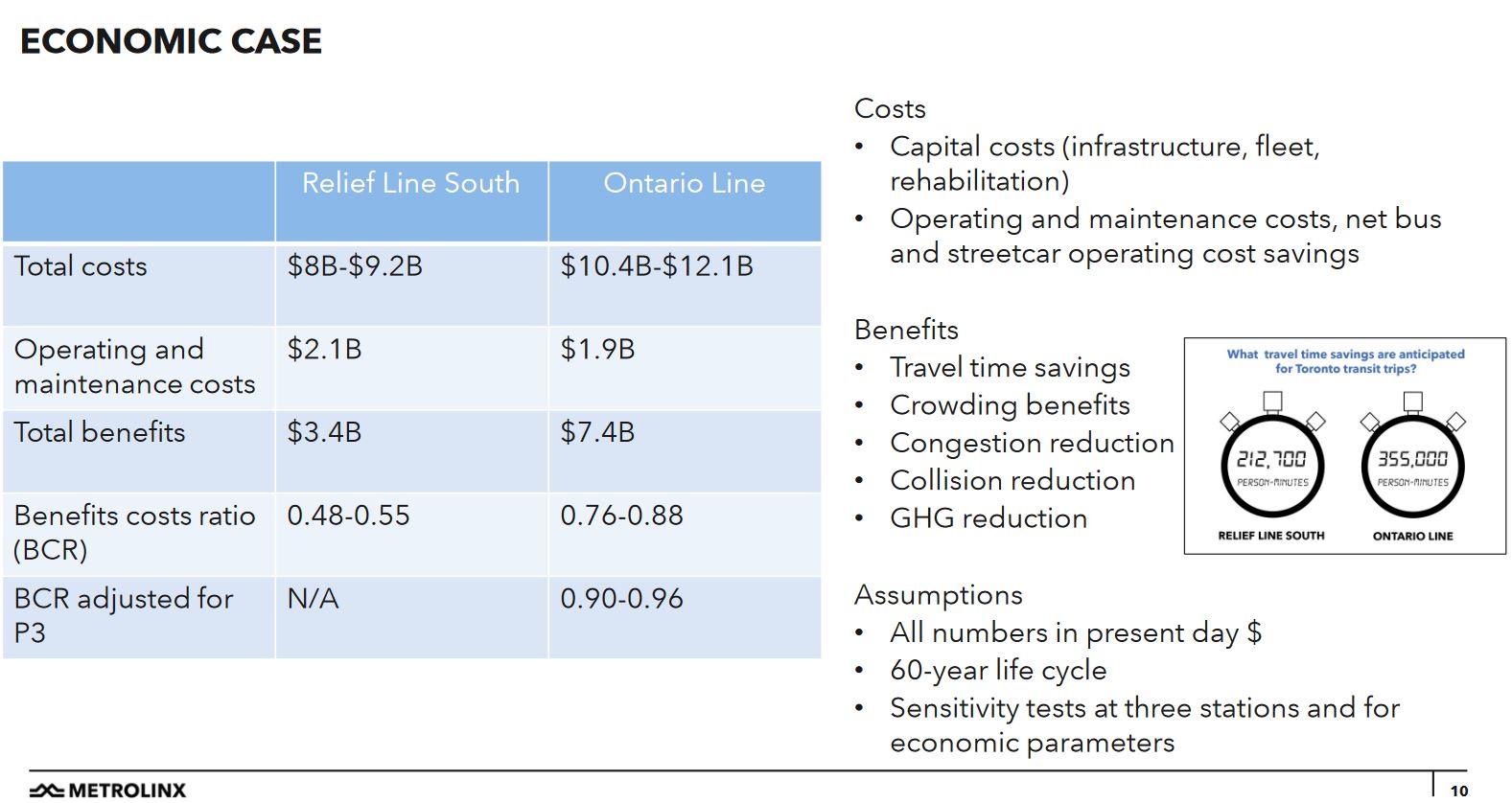
Note that none of the Benefit-Cost ratios exceeds “1” indicating that any version of the project does not produce a “profit” within the Metrolinx benefit-cost methodology. This came up in discussion a bit later (see below). The important issue here is that a large project such as the Ontario or Relief Line has benefits (and possibly costs) that the methodology does not capture notably the value of increasing resiliency in the rapid transit network by provision of alternate routes, and the enabling of projects such as the Richmond Hill extension that would otherwise overload the system.

A new addition to the discussion is a map showing the supposed benefit of the Ontario Line to residents of low income areas. It is no surprise that the OL (and the full RL to Eglinton that preceded it) benefit low income areas such as Thorncliffe Park and Moss Park, but there is a bizarre problem with the map which shows a reduced access to low-income jobs for residents between the Spadina Subway and the Barrie GO corridor south of Eglinton, far from the Ontario Line, not to mention Flemingdon Park north of Eglinton. There is something wrong here with the underlying model, but nobody at the meeting picked up on this.

Duncan Law bravely observed that “we are trained to challenge how things have been done” and this will lead to cost avoidance in the design (video at 38:00). He noted that early works on the route would be accelerated, although this is a tactic already in place (after much political fighting with Mayor Tory who eventually embraced it) for the Relief Line. At this point, Metrolinx is considering what their options for the OL design are before they take them to the public for comment, and they are still at an early stage.

In other words, they have a line on a map, but even that may change, and they fear alarming the locals with designs that are not yet definitive.

Malcolm Mackay spoke about the early works and the importance of co-ordination with large programs in the corridor to “leverage” contracts and consultants for other projects such as delivery of the (now) six track structure from East Harbour to Gerrard (four GO tracks plus two for the OL). There is also the potential role of Transit Oriented Development (TOD) works where some OL work could be combined with private development. However, it is not clear whether the likely construction timeframes of East Harbour and other projects would mesh with the schedule for construction of the OL.

In a marvellous piece of bafflegab, the presentation notes:

To demonstrate visible progress and to de-risk the schedule, a progressive works program is being contemplated with a ground breaking target of 2020 – 2021. [p 20 of the PDF]

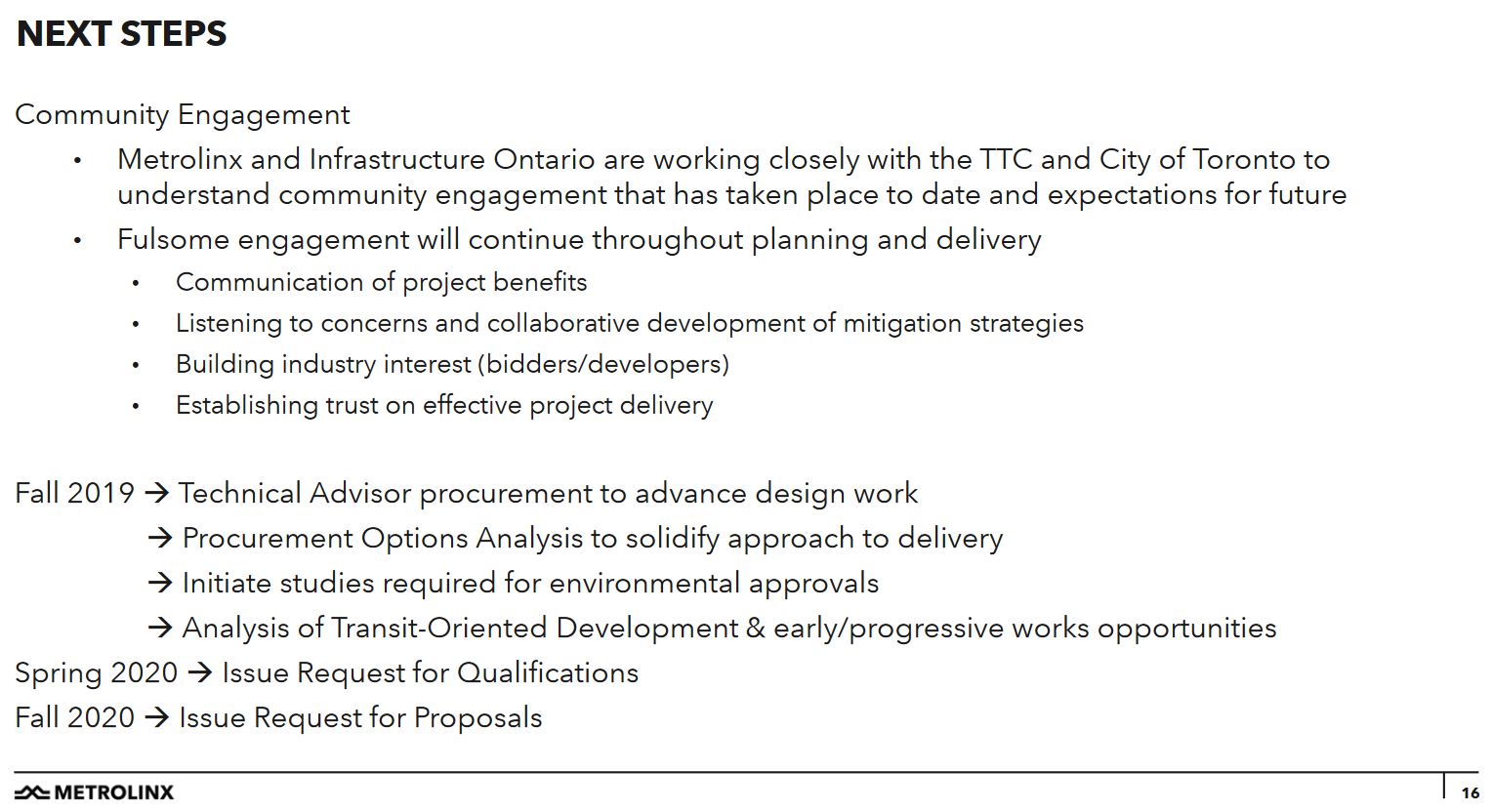
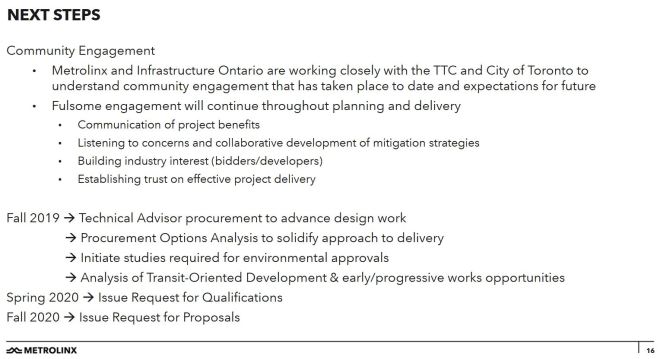
What this means is that if Metrolinx actually undertakes some work soon, there will be political benefits of “progress” (shovels in the ground) and would-be bidders for the larger project will see that it has progressed beyond a political slogan and a line on a map. It is unclear just how much will actually be achieved by 2020 when the requests for qualifications and proposals (see chart below) occur.

Among the potential early works is design work the Don Valley crossing and possible launch sites for tunnel boring machines (TBMs). The decision to place some of the OL at or above grade means that there are more transitions in and out of tunnels than would be the case with an all-underground line, and launch sites at the transitions are required. These have significant effects on their locations as recent experience on the Eglinton Crosstown shows.

Mathieu Goetzke observed that the Queen Street corridor has challenges, but of course that would also have applied to the RL at least as far west as Osgoode Station. There is the larger question of the choice by the RL project of Queen versus a route further south, and again that is both a technical and political decision that is now set in stone.

The Next Steps slide below contains the troubling observation that Metrolinx will work to “understand community engagement” as if somehow Metrolinx has been operating in the dark while the Relief Line project went through its assessment and consultation stages. In a telling, but common, misuse, Metrolinx describes what they will undertake as “fulsome” intending to imply “copious” or “substantial”, but the word can also mean “excessive and insincere”, the fawning behaviour of one who insults by being overly complimentary. Metrolinx and GO before them have a long history of insincere public participation.
Discussion by the Board raised various questions starting with one from Michael Kraljevic who asked how much of the work already done on the Relief Line can be used for the Ontario Line? Mathieu Goetzke replied that work on the Queen Street corridor “feeds in” to the OL project, and Queen is “incredibly complicated”. The northern branch of the OL was built in part on the Relief Line North study. Malcolm Mackay stated that all of the work done so far will still be used giving the example of an underground station where geological information would inform design for a nearby structure. Some strategies that were “not successful” will not be pursued for the OL.

Regarding the construction challenges listed in the IBC, Vice-Chair Bryan Davies asked about “showstoppers” in the project. Duncan Law stated that there are none in the project “at this stage”, and he claimed that the benefit is that we see the risks now. Undoubtedly there will be several challenges, but the team will work through them, he said. The objective is to get people to jobs and home. Integration with GO for local and regional travel is important, Low continued. Environmental Assessment amendments will be required including a review of technical options for the OL. There is a “significant mountain to climb”.

Consultants have been engaged for the EA process, but subways tend to be environmentally positive, said Mackay, Metrolinx claims, and challenges with the elevated sections will be overcome.

These comments really are a dodge of the main question about the ability to reuse work already completed. The basic fact is that the OL alignment diverges considerably from the RL in places, and the detailed RL work, including public consultation, does not reflect the OL plan as it now stands. Again, we hear that this is a complex, challenging project, a rather different characterization than the self-confidence of the line’s announcement.

Director Paul Tsparis asked how the OL project helps to alleviate pressure on Line 1, and how is the TTC helping on that front.

Malcolm Mackay trotted out the usual list of TTC efforts including:

  • Larger trains
  • Painted tiles on the platforms at St. George and Bloor-Yonge to channel waiting passengers
  • Automatic Train Control
  • Bloor-Yonge Station expansion

The reference to larger trains is getting tiresome whoever cites it because the “new” Toronto Rocket (TR) equipment has been operating for some time now, and their extra capacity was long-ago consumed by latent demand. The painted floor directions may have some effect, but the big problem at busy stations is that platforms become totally filled even with a slight delay and this prevents easy exchange of passengers with trains. As for ATC, Mackay despite his years working at TTC, was unsure of the dates when it will be implemented. He also neglected to mention that more service requires more trains and, eventually, more train storage when the TTC exhausts what it now has. If the province takes ownership of the subway, this problem will land in their lap.

This was capped off with an observation that going north to meet the Eglinton Crosstown is a “beautiful addition to relief” to Line 1. Well, yes, many advocates have been saying this for a very long time while others downplayed the importance of continuing north of Danforth. Even Metrolinx flagged the added relief of the northern extension, and this informed support for work on it by the previous provincial government.

Michael Kraljevic asked about the benefit cost ratio where the value is less than one, although the P3 arrangement is alleged to improve that factor. How does this line up against other subway projects?

Mathieu Goetzke replied that it is hard to get a ratio beyond 1 with brand new infrastructure. GO improvements have good numbers because they build on legacy infrastructure. Moreover other modelling techniques would pick up economic development issues that are not included in the Metrolinx model. Phil Verster explained that Metrolinx does not consider benefits outside of purely transit ones, and the wider economic benefits would make every transit business case a good one. A case will always be touch-and-go for tunnels to get to a ratio of 1. Goetzke added that the OL can enable other works [e.g. the Richmond Hill extension].

This is quite an admission for Metrolinx who have wrestled with their business case analysis for some time. In a political climate where projects must at least break even, the benefits that are balanced against costs have a huge influence on the results. This can include both the scope of benefits (how wide a net is cast to capture benefits) and what payback period is used in the calculation. If the scope is too wide, there is a risk that presumed benefits are not entirely due to the project itself. If the timeframe is too long (Metrolinx uses 60 years), there is a financial problem of substantial expenditure in the short term for savings that might or might not accrue over the very long haul. Moreover, a large proportion of the “benefits” do not capture revenue that can be used to pay off project debt, but rather accrue to transit riders in reduced travel time and increased mobility.

These approaches can be defended on the grounds of “city building” and the long term, cumulative effect of having more transit infrastructure. However, the attempt to make any one project “pay its way” can distort how it is evaluated for political reasons.

Footnote: The Metrolinx Blog includes an article which emphasizes that the Ontario Line will not be built on unproven technology. The ghost of the UTDC and the Scarborough RT still haunts provincial decisions.

Ridership Initiatives (Video at 1:13:19)

Metrolinx ridership for the second quarter of 2019 is up 4.1% over the same period in 2018. However, children did not ride free a year ago, and when they are removed from the “before” numbers, the remaining ridership rose by 5.2%. It is worth noting that the TTC attempts to count children even though they ride free on the system, and so ridership numbers for the two systems are not directly comparable, at least on that basis. There is also the challenge of defining a “ride” when trips can involve a series of transfers and the benefit of the two-hour fare on Presto. The whole question of reporting demand on the GTA network needs work, including granularity about when and where people actually travel.

Statistics reported by APTA show commuter rail up 2.1% among reporting agencies, and bus ridership down 1.0%. GO bus ridership is up 4.5%.

A detailed map (PDF) shows the ridership by station across the rail network. There is no data for the bus network where there has been some controversy about which services should be maintained and which should be cut. Moreover the rail network counts do not distinguish by time of day to break out growth, if any, in off-peak travel as GO moves beyond peak period, peak direction commuting service to downtown Toronto.

Ridership growth varies by corridor and station. The high roller is Barrie with a 10.6% growth in the corridor. Kitchener us up 5.6% and Lakeshore East is up 4.8%.

GO is doing a lot of online marketing which they report as being quite successful, and there is an uptake of e-Tickets as a way of purchasing fares. Many of the promotions are for attractions in the off-peak period and for casual users who would be new to the system.

GO regards riders in Toronto as “transit natives”, people familiar with what transit can offer, and markets to them differently than to potential riders in the 905. Whether this is valid all the way out to the 416/905 boundary is hard to say.

The lower base GO fares are driving ridership within Toronto, but there was no discussion of the effect that will occur if the GO-TTC co-fare arrangement ends thanks to lack of funding from Queen’s Park. This has already affected riders on the UPX who no longer get a UPX+TTC discount. All the marketing efforts in the world can be undone by fiscal policies that affect fares and service.

Presto Quarterly Report (Video at 1:28:08)

Director Janet Ecker asked about efforts to minimize TTC criticisms of Presto. From what she is reading, criticisms of the system way off base. She asked how Metrolinx is trying to deal with this.

Phil Verster replied that it is illuminating to see how some comments get headline status and do not reflect what’s happening on the ground. Things are challenging, he said, and Metrolinx continues to work closely with TTC. There are claims that Metrolinx feels are not valid, and they have encouraged the TTC “to put this behind us”, not to go to dispute resolution.

Annaliese Czerny, Executive VP, PRESTO, felt that it was a shame the story is not about new products and better experiences. Verster was optimistic about making progress with TTC to move to a better future – new devices, open payments – and that this will be the story rather than problems. Czerny noted that TTC is an active and positive partner in the process for future developments.

This was the usual positive Metrolinx spin on PRESTO, but it was undone by the TTC when they released their agenda for the Board Meeting to be held on September 24. In it, the CEO’s Report is quite clear that the TTC will pursue arbitration under their PRESTO contract in an attempt to obtain payment of lost revenue due to non-delivery of a working fare system.

With PRESTO readers on every bus, streetcar and fare gate, and with PRESTO fare vending machines and self-serve reload machines at every station, the provincially-led fare card system has given our customers many benefits, but also many challenges.

Over the summer, I met with Metrolinx President and CEO, Phil Verster, to discuss the outstanding claims between the parties and the status of the outstanding deliverables of the contract for the implementation of PRESTO on the TTC. It is clear from our discussions that Metrolinx considers the contract deliverables complete.

So, while these discussions were informative about the positions of each organization, we were not able to reach a common understanding and agreement. We did agree that the next step is to proceed with arbitration, which is the dispute resolution process provided in the contract.

We are working with external counsel to review the process and finalize material and submissions. As we outlined in our report to the Board in June, the TTC does not consider the contract closed. Rather, there are significant deliverables outstanding, including open payment and account-based technology (which includes equipment), equipment to provide PRESTO Tickets on buses and streetcars, an acceptable third-party distribution network and Service Level Agreements for all equipment.

[TTC CEO’s Report at p. 14]

A major problem with Metrolinx’ perception of a “working” system is that they assume that any rider who encounters a fare machine that is out of service will use an alternate just as they would at a GO station. However, on crowded transit vehicles getting to another reader, let alone another fare machine for tokens or cash, can be very difficult and many riders do not bother to try. If they have a Metropass on their card (or a two-hour fare from a previous tap), this really does not matter because they have already paid, but for other riders this represents lost revenue to the TTC. Credit card holders cannot pay at all because this function rarely if ever worked.

Regular riders are familiar with the situation and just shrug when their tap does not register. I personally encounter this problem at least once a week, and see others having the same problems with unresponsive machines even more often. Things may be improving, but perfection is some distance off and Metrolinx has a lot to answer for from the earlier days of their PRESTO implementation.

Metrolinx tests the availability of fare equipment by “pinging” each device (sending a signal to a machine that elicits a response simply saying “I am here”). However, that function takes place at a low level within the hardware and the application software could be hung even though the “ping” gets a positive response.

Metrolinx measures of PRESTO access are likely too rosy because of assumptions about how easily riders can access the machines and about what constitutes a “working” box when tested remotely.

TTC CEO’s Report: August 2019

Although the TTC Board takes a long siesta through the summer, the CEO produces a monthly report even in months when the Board does not meet. The August 2019 edition was recently posted on the TTC’s site.

This report continues a format established some time ago by CEO Rick Leary in which the focus is on measures of system performance. There is no financial information here, and only summary ridership numbers with no sense of the associated revenue. All of the financial reporting was hived off of the CEO’s report into a quarterly CFO’s report, but we have not seen one of those since April 2019, and that covered the year ending December 2018. One might have expected an update at the July Board meeting, but the abrupt and unexpected departure of CFO Dan Wright in early June appears to have iced the short-lived report.

I spoke with Wright at the Audit & Risk Management Committee meeting the day before he left the TTC, and he gave no indication of his impending departure. We spoke about the problems of counting “rides” in an environment where there is only a tenuous link between fare payment and the actual number of trips (or trip segments) taken.

The TTC has been wrestling with the possibility that ridership has been over-reported for some time, and the situation is further complicated by Metropasses, the move to Presto and the two-hour fare. Just what is a “ride” for statistical purposes? I had planned to follow this up with Wright for an article here, but alas he vanished like so many other senior TTC staff in the past year. The problem is summarized in the CEO’s Report:

Higher PRESTO adoption appears to have affected measured ridership in two ways. First, we now have more precise ridership data compared to counting tokens and weighing paper tickets. Second, more than 25% of our former monthly pass customers have converted to PRESTO pay-as-you-go e-purse each month in 2019, likely to take advantage of the two hour transfer and for some, the TTC/GO discounted co-fare. This would affect measured ridership to the extent that these customers may ride less often than the monthly average of 71 rides per adult monthly pass. [p 25]

Josie La Vita, the Executive Director of Financial Planning for the City of Toronto, replaced Wright on an acting basis pending recruitment of a new CFO, a process expected to take 12-24 months.

The CEO no longer reports financial data on operations or capital projects, and the absence of a CFO’s report leaves a major gap in information available to the TTC Board and Council on the system’s actual performance.

Moreover, riding counts (i.e. vehicle occupancy) are only rarely reported at a route level, and a “crowding report” has not recently seen the light of day. When crowding data are released, they are averaged and this gives no indication of the effects of bunching and gapping on individual vehicle loads. Performance metrics that do appear in the CEO’s Report do not fully describe the service quality actually experienced by riders particularly on surface routes.

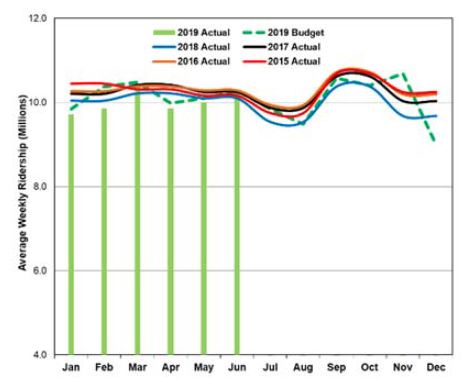
Ridership for 2019 to the end of June is reported as 267.8 million as against a target of 271.9m and a 2018 figure of 270.3m (down 1.5% and 0.9% respectively). For the month of June itself, ridership is on target. As the chart below shows, the shortfall in 2019 came primarily in the winter months which were unusually cold. June’s ridership was boosted by the Toronto Raptors Championship Parade without which the number would have been down 0.6% compared to 2018.

Weekend ridership is down, and this is thought to be due to various factors including the number of subway shutdowns. These are not going to end any time soon with the ongoing signalling projects and other infrastructure upgrades, and at some point the TTC cannot treat their effects as unexpected. A follow-on problem for the TTC is the perception by riders that “the subway is always closed” and this can affect ridership as much as the actual shutdowns.

Presto fare card usage continues to increase and by June 2019 the adoption rate reached about 80%. Presto ridership for the first half of 2019 was 214.2 million out of the total reported ridership of 267.8m.

Vehicle Reliability

The fleet benefits from improved preventative maintenance and from the retirement of older vehicles. Before the onset of hot weather, there was a concerted effort to get air conditioning systems in good order, and AC failures were rare even with the particularly hot weather in 2019. (Personally, I never encountered a “hot car” on the subway, a first for several years running.)

On the streetcar fleet, the decline in the proportion of service provided by the nearly 40-year old CLRVs and the disappearance of their ALRV cousins (of which a few are still officially active but never seen in revenue service) contributes to a reduction of in service failures. The Flexity fleet has its ups and downs for reliability, but even running below its target, these cars are much more reliable than those they replace.

On the bus fleet, the retirement of old buses and the recent purchases of hundreds of new vehicles has substantially lowered the average age of a bus and increased the proportion of buses that are “spare” relative to service needs. The fleet is over 2,000 vehicles, but the peak requirement in June was 1,641 including buses used on streetcar lines. This generous spare ratio has benefits in service reliability but also a cost in both capital and in garaging.

Continue reading

TTC to Presto: Deliver What You Promised

At its meeting of June 12, 2019, the TTC Board considered a report and presentation setting out the many shortcomings of the Presto fare card system.

Presto implementation has been underway since a 2012 master agreement between the TTC and Metrolinx, and they are now at the half-way mark in a 15-year contract. In spite of this, some functionality included in that contract has not yet been provided, and there are no service level agreements (SLAs) in place setting out basic issues for system performance and financial penalties to Metrolinx for failure. Indeed, although the TTC has claimed revenue losses thanks to problems with Presto, Metrolinx has not accepted that it owes the TTC anything.

Until quite recently, Presto, like so much that comes from Metrolinx and Queen’s Park, was a “good news story” where TTC riders switching to the fare card drove fast growth for that system. The convenience of Presto versus tokens and the disappearance of the Metropass shifted over two-thirds of TTC riding onto Presto. The chart below shows the breakdown for April 2019. The Presto share is expected to reach 95% when legacy media are withdrawn.

However, the good news hides problems with the system as it exists both for Presto users and those who might shift to that system in the future.

The heart of Toronto’s problem with Presto lies in the way the system was imposed. TTC was prepared to go with an alternative vendor for a new fare card system, but were told by Queen’s Park that failure to adopt Presto would put all of the provincial subsidy programs at risk. This was a very big, heavy stick for the government to use, and it shows just how desperate they were that Ontario’s largest transit system be a client (with associated revenue and prestige) of the Presto system.

During the ongoing discussions that began in the fall 2010, the Province and Metrolinx maintained that the common PRESTO Farecard system was their recommended approach to achieving the Plan’s inter-regional policy objective of increasing cross boundary travel. The Province and Metrolinx committed to upgrade the PRESTO system to meet the TTC’s distinct and forward-looking customer, business and financial needs, including advances in fare payment technologies using open payments. The Province and Metrolinx indicated that billions of dollars of funding for some existing TTC programs which had been promised publicly (Provincial gas tax, new streetcars, Eglinton and Scarborough transit initiatives) could be in jeopardy without PRESTO. The adoption of PRESTO was thus approved in June 2011, subject to developing acceptable operating and financial agreements and confirming the funding necessary to proceed. [p 7]

Despite a competing proposal from Xerox subsidiary ACS that would cost over $300 million less than Presto, the TTC was forced to accept the provincial system.

Presto did not perform as it needed to, and contracted functionality is still not available.

The TTC entered into the Agreement with Metrolinx on November 12, 2012. The base term is 15 years (2027), with an option to extend for one additional year at Metrolinx’s discretion and an additional four years by mutual agreement. Key elements of the Agreement include:

  • Metrolinx to make modifications and enhancements to the PRESTO system to allow for an e-fare account based payment system with an open architecture using industry standards to accommodate open loop financial cards, mobile applications and future technological innovations (“PRESTO NG”)
  • Metrolinx to finance, implement and operate the PRESTO NG system and provide a wide range of “managed services” (e.g. back office operations; customer services; revenue collection and maintenance of all system field equipment)
  • In return, TTC to pay a fee of 5.25% of TTC fare revenues processed through the PRESTO system [pp 7-8]

The TTC contemplated a variety of payment mechanisms years ago.

The TTC’s Business Requirements specified both open payment and an account-based architecture, which was to have been built alongside the existing PRESTO card-based architecture. In such a system, customer convenience and flexibility would be maximized. A customer could choose to have a PRESTO card with all its fare policy benefits (e.g. fare concession, 2-hour transfer), or to get some of those benefits using a non-registered open-payment card (e.g. Visa, Mastercard), or to get all fare policy benefits with a registered open-payment card. These concepts were an essential component of the Agreement and were fundamental to the TTC’s agreement in 2012 to accept the PRESTO system versus a competitive market-based solution. [p 11]

Two key capabilities – fares for travel between transit agencies such as York Region Transit and TTC, and the move to “open payments” and an account based system – have yet to be implemented. Regional integration is hoped for later in 2019, but there is no firm date for a change to the payment mechanism.

What Are Account Based Fares?

Account based fares and open payments are closely related, and they are fundamentally different from how Presto works today.

With Presto, fare calculations and validation occur between card readers and the cards themselves. Information about the account balance and any bulk purchase such as a pass is stored on the card. This allows a transaction to occur without any link back to a central system, an arrangement dating back to Presto’s early days when wireless links from their roving bus fleet were not reliably available. However, this forces all of the payment logic into the architecture of the readers and cards constraining the functions they can support.

This arrangement is responsible for the lag between an online account update and the appearance of new “money” on your Presto card. Until you tap onto a reader that “knows” you loaded more money online, you have money in the central system, but cannot use it because the fare machines don’t “see” it.

Imagine if software had to be loaded into every phone so that it could calculate the cost of a call and maintain your account balance. That, in effect, is the complexity Presto imposes, something that should have been designed out of the system years ago.

In the case of a credit or debit card, Presto cannot “write” information onto the card, and so distance-based functions such as GO fare calculations cannot be handled. Only a flat, standard charge is possible such as an adult TTC fare, and without a two-hour transfer privilege.

In an account based system, a rider has a transit account just as they would have one for their mobile phone or credit card, and activity (trips, transfers, border crossings) is accumulated as it occurs. At the end of a billing period, the cost of these trips is calculated with any appropriate discounts such as loyalty programs, time-of-day fares or special event promotions. A Presto card, any other smart card, or a smartphone app can be registered as the rider’s transit identification, but in all cases processing happens in the “back end” with monthly billing to a bank account or credit card. Riders who have not set up accounts simply use their credit cards for pay-as-you-go billing.

The important distinction is that the system needs only track a rider’s travel, not compute the fare in real time based on “today’s rules”. Those rules can be updated in the central billing system rather than having to be integrated in the reader software and pushed out network wide. There is no need for an electronic purse or “e-purse” on the card which must hold enough money (or some form of pass) to pay for any trip a rider might take.

Presto tickets (sometimes referred to as limited use media or “LUMs”) would still exist, but Presto readers would only have to verify when the ticket expires or how many trips are left on it.

Metrolinx plans to make account based fares available sometime in 2020 with open payments in 2021, but there are no firm dates, nor is there a specification of just what functionality Metrolinx will support.

Gaps in the Presto TTC System

Other gaps between the TTC’s Presto contract and current capabilities include:

  • Flexible and dynamic fare policies/products
  • Support for other than standard fares and environments such as
  • Presto tickets dispensed as receipts for cash fares on surface vehicles
  • Device availability/reliability
  • Service Level Agreements (SLAs)
  • Third-party sales network

Continue reading

TTC Board Meeting April 11, 2019

The TTC Board met on April 11 with a full agenda. Among the items discussed were:

  • The joint City/TTC “omnibus” transit report and the implications of the provincial intent to “upload” the subway system
  • Public Deputations at Board Meetings
  • Presto limited use tickets and the TTC/Presto contract generally
  • The Junction Area Study and proposed route changes
  • Subway Closures for 2019

The Board also discussed Line 1 (YUS) Capacity Requirements, State of Good Repair and Automatic Train Control. This is a complex enough issue to warrant an article in its own right, and I wil publish that separately.

Results of the King Street Pilot

The King Street Pilot report that was presented to Toronto’s Executive Committee on April 9 came before the TTC Board on April 11. There was a short discussion of the possibility of extension of the project further west. This review will be rolled into the surface transit network plan to come to the board in December 2019.

One item that may further complicate the taxi exemption for King Street was a proposal that Wheel Trans contracted vehicles be allowed to operate just like a transit vehicle when carrying Wheel Trans clients. This will come to Council when they debate the issue at their meeting of April 16.

The Board endorsed the report’s recommendations.

In future articles, I will update information about travel times, headways and line capacity on King street with data to the end of March 2019.

Continue reading

Toronto’s Omnibus Transit Report: Part II

On April 9, Toronto’s Executive Committee will consider a massive set of reports on the many transit projects at various stages of design and construction in Toronto.

In Part I of this series, I reviewed the financing scheme for four major projects as well as details of the Scarborough Subway Extension, aka the Line 2 East Extension. In this article, I will review the Relief Line, SmartTrack and the Bloor-Yonge Station Expansion project.

The reports applicable to this article are:

  • Main Report: Toronto’s Transit Expansion Program – Update and Next Steps
  • Attachment 1: A status update on all projects

There are related reports about signalling and capacity expansion of Line 1 Yonge-University-Spadina in the TTC Board’s agenda for their April 11 meeting. I will deal with these in a separate article.

After decades in which the focus of transit planning looked outward to the 905 beyond the bounds of Toronto, there is now a political realization that capacity into the core is a major issue for the region’s economy. Politicians and planners may show optimistic studies of suburban centres and growth, but the development industry, a bastion of free enterprise thinking, persists in building downtown because that’s where they can sell at the greatest profit.

The Relief Line, SmartTrack, Automatic Train Control, subway station expansions and even surface transit projects like the King Street Pilot all attempt to address the demand for travel to and through the core area. Looking beyond the city boundaries, there are subway and GO Transit extensions and service improvements. Some of these schemes are more successful than others, and some have very long lead times before any benefit will be seen. Political attention has shifted from the fights over which one project will be built each decade to the recognition that many projects must occur in parallel so that capacity can catch up with latent and growing demand.

Continue reading