What Would Fare By Distance Mean For Toronto? (Updated)

The Metrolinx Regional Fare Integration Study studiously avoids one of the most important questions any new fare scheme must face: what is the effect for various types of riders?

As a starting point in examining what might happen, this article looks at some of the basics of travel patterns and fares to see what various Metrolinx schemes might imply. Note that this is not a definitive, accurate-to-the-nth-degree exercise, but a general discussion. The detailed work should already have been done by Metrolinx, but if it has, they are not publishing the results.

My apologies to readers in advance as this is an article more technical than political. Some of the calculations are unapologetically “back of the envelope”, and are intended as estimates, illustrations, not definitive results.

Updated Feb. 14, 2016 at 2:00pm: Comparative information about GO Transit fares has been added at the end of the article.

Updated Feb. 14, 2016 at 4:45pm: A further observation on the relatively low fare by distance paid by GO riders has been added at the end.

Continue reading

Metrolinx Fare Integration Background Study: February 2016 Update

Recently, I reported on a staff presentation to the February 10, 2016, Metrolinx Board meeting in which it was quite clear that the provincial agency is moving inexorably toward some form of fare-by-distance not just for its GO Trains, but for all rail modes that operate on their own right-of-way including subways and LRT. Bus Rapid Transit, although a common part of The Big Move as a “solution” in the 905, is not included as “rapid transit” in their proposals.

Metrolinx has now published the background technical paper to this presentation. This is the second installment in the fare integration review. Part 1 came out in September 2015.

For background information, see:

In previous articles, I noted a strong inclination by Metrolinx toward distance or zone-based fares, and this continues into the most recent paper. What is also troubling, however, is the difference between the backgrounders which have some detail about the workings and effects of a new fare structure, and the staff summary reports where this is all treated as a complex issue to be reported on at some future date. “Have patience”, the Board is told by staff, even though answers to some of their questions can be found in the detailed reports.

A chart from the September 2015 report is worth looking at again.

201509_GTHA_Fare_BCE_QA

It is self-evident that any tests of fare effects, of the various sub-markets which might see higher or lower fares, and of revenue distribution models, could not possibly be conducted without an actual model with real numbers of riders and real fares attached to each type of trip they would make. However, even by February 2016, the staff presentation studiously avoids specifics and gives no hint of the degree by which fares might rise or fall. A related issue is that the tests used a “revenue neutral scenario”, one in which any reduction in one part if the revenue pie must be counterbalanced by an increase somewhere else.

This is the “we don’t want to pay more subsidy” view of fare integration where the “winners” are those who now face multiple fares, typically to use the TTC plus any other GTHA system, while those who now pay single fares within a system will be the “losers”. This fact has been hidden from public view throughout the exercise. We hear a lot about “fair” fares, but absent specifics, there is no way to decide which elements of “fairness” are included in the new formula.

An element that emerged from the 2015 study and now forms an important part of the 2016 update is the concept of “service class”. This is a simplistic division of all transit services into three groups and three trip lengths. The groups such as “local” and “rapid” transit are defined by mode (bus or rail), not by the actual quality of service they provide. Indeed one might argue that the higher speed of “rapid” transit can be offset by the severe overcrowding and unreliability of the service. For the purpose of the fare model, only the nominal speed and presumed comfort of rail services counts. This is very much a GO-centric view of transit service.

Even GO is having its problems with comfort and crowding. For some time, the goals for service quality included the idea that 80% of peak period riders would get a seat. GO never attained this and the metric sat at 66% the last time it was reported, September 2015. This goal appears to have quietly fallen off the service targets GO seeks to hit for the obvious reason that it is not attainable without massive expansion of service beyond the point where latent demand always backfills any new capacity GO provides.

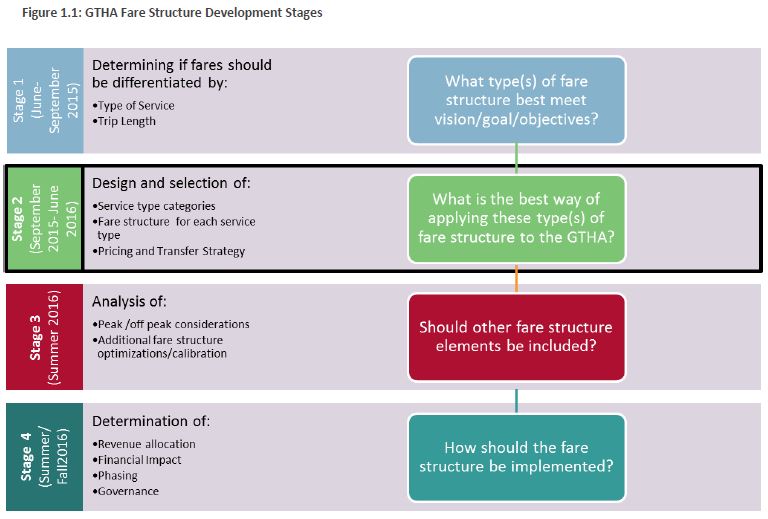
The overall fare integration study is expected to stretch into late 2016 according to the chart below. It is hard to ignore the absence of “rider effects” in the topics listed here.
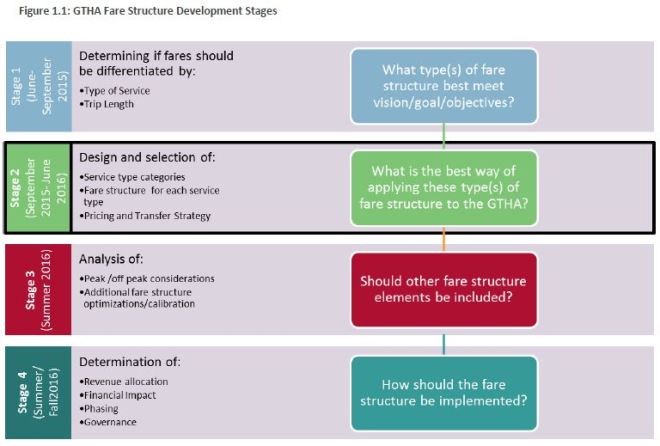
201601_FareStudyStaging

However, a more detailed chart (Fig. 1.4) clearly shows that a “Preferred Option” would be recommended by Spring/Summer with the implication that any chance to debate and influence the choice has a limited window of the next few months. The Metrolinx Board is not scheduled to meet again until June 2016. Will they be faced with a fait accompli where staff have made all the decisions and the Board’s role is merely to nod in agreement? When will local Councils and transit agency boards have their chance to be heard? In the rush to get a new fare structure, will Metrolinx management do an end run around meaningful consultation at both the general public and political levels?

Continue reading

TTC Replies to Fare Zone and Subway Premium Proposals

An obvious question about the Metrolinx Fare Integration Strategy update is whether the TTC has quietly adopted a new fare policy to suit Metrolinx.

I asked:

The Metrolinx Regional Fare Integration report on their board’s agenda for Wednesday clearly leads the way for fare zones at least on the subway within the TTC system.

There have been rumblings of this from management comments at TTC, but nothing definitive. However, the installation of fare gates with tap out capability is a clear preparation for such a change. While this might be part of the TYSSE roll out, the wider application of zoned fares (or some equivalent) within the TTC has never been a matter for public debate or decision as far as I know.

Has this matter been presented to the Commission for discussion, or are there plans to do so in the near future?

What is the TTC’s position on the Metrolinx fare integration proposals?

The TTC’s Deputy CEO, Chris Upfold, replied:

The TTC[s] sit on the various Steering Working groups for regional fare integration and I feel our voice is well heard there.

As per our report to the Board on Fare Policy TTC staff are not undertaking any more work on fare by distance or by zone within the boundaries of Toronto on service operated by the TTC. We do not feel it is an appropriate or useful policy direction in those circumstances but are working with Metrolinx on how it could work from a regional basis.

Our board has passed a number of motions, over just the few years I’ve been here, that any regional integration must not come at the expense of the TTC or our customers.

Faregates are being rolled out at subway stations for a number of reasons but primarily:

  1. The integration with a legacy turnstile with a new reader wasn’t the best technical solution and caused lots of other potential problems.
  2. The legacy turnstile (especially high gates) are nearing the end of their life and we were likely to need a wholesale replacement in the next 10 years or so.
  3. Overall the whole life cost (over 20 years) was much lower for installing new faregates.
  4. New faregates are higher capacity (and far more flexible) and do things like real time fault reporting etc.

Tap in and out functionality is necessary for the TYSSE in order to manage regional integration on how fare policy sits today. Faregates (with readers on both sides) would help to enable any zonal/distance based system.

Now it is up to Metrolinx to explain how their proposal meshes with the TTC’s stated position.

Metrolinx Fare Integration: Get Ready to Pay More For Subway Trips

One of the great mysteries surrounding the roll out of Presto on the TTC has been the whole debate about “Regional Fare Integration”. Now and then, discussion papers surface at Metrolinx, but folks at the TTC, especially the politicians, are strangely silent on the subject. “Wait and see” is the order of the day.

Well, folks, we have waited and now we are beginning to see the direction Metrolinx is heading in for a consolidated GTHA-wide fare structure. The results will not please folks in suburban Toronto or the inner 905 for whom long subway trips are a routine part of their commutes.

The Metrolinx Board will consider an update on this subject at its meeting on February 10.

The presentation is in a sadly familiar Metrolinx format: lots of wonderful talk about consultation and fairness, and philosophical musings about what a fare system should look like. One big omission is any evaluation of the relative numbers of riders who would be affected by various schemes, and even worse of any sense of calibration of the fares to produce different results.

This comes at a time when we know from SmartTrack demand studies the importance of fare levels in attracting ridership. It is important here to remember that we are not talking the relatively small differences between types of TTC fares, or year-by-year increments, but the much larger deltas between TTC fares and those on GO Transit.

The problem begins with the arbitrary segmentation of the travel market into “local”, “rapid transit” and “regional transit”.

201602_DefiningServiceTypes

This is a wonderful theoretical view of the world that might find a home in a sophomoric academic paper, but it ignores the very real world in which (a) “rapid transit” today only exists within Toronto and (b) Toronto decided over 40 years ago that “local” trips paid one fare regardless of the mode they used. The entire system is designed on this principle, one that has consistently evaded Metrolinx planners.

If only the world were so simple. Why is Bus Rapid Transit omitted from this list? Why is a streetcar (aka LRT) on right of way “rapid transit”, but not a bus? How close must subway or LRT stops be to each other for the service to drop back to a lower tier? Conversely, if someone slaps a “19x” route number on a bus, should it become “rapid transit”?

The basic problem with this world view is that transit modes, especially bus and streetcar/LRT, have a wide range of overlapping implementations.

Continue reading

TTC’s 2016 Customer Charter Reviewed

The TTC has released the 2016 version of its Customer Charter listing a number of areas in which they promise improvements through the year.

First Quarter:

  • Ensure that 510 Spadina is served by fully accessible streetcars: Mostly done already with a few of the high-floor ALRVs still in service but the majority of runs operated with low-floor Flexitys.
  • Apple Pay at collectors’ booths: In progress.
  • Reduce streetcar short-turns by a further 20% over Q1 2015: New schedules on 501 Queen effective January 3 make a big contribution to this coupled with the milder winter weather.
  • Start subway service at 8:00am on Sunday: Done effective January 3.
  • Add service to Line 1 (YUS) during off-peak: Not done yet, but the schedules going into effect at the end of March have not yet been announced. (Note 1)
  • Establish a Local Working Group for Donlands Station second exit project: Done.
  • Add five new express bus services: Planned for late March.

Second Quarter:

  • Wifi at 22 new stations (Note 2).
  • Roll-out of new fare gates with Main Station as a pilot: Work at Main in progress.
  • Improve bike parking at 5 stations.
  • Add 20 bike repair stops at subway stations: Subject to outcome of a pilot.
  • Install notice boards in 12 busy stations to inform passengers about planned/unplanned closures.

Third Quarter:

  • Ensure 509 Harbourfront and 511 Bathurst are served by low-floor streetcars: With delivery of new cars, Harbourfront is already planned to ramp up beyond two assigned Flexitys in mid-February. Delivery rates for new cars are supposed to be up to 1/week by the end of March and this should make conversion of 511 Bathurst an easy task provided Bombardier manages to stay on track.
  • Pilot high capacity bike parking at one station.
  • Replace T1 trains on Line 4 (Sheppard) with 4-car TR sets: The order for these cars is in progress at Bombardier with delivery expected later this year.
  • Improve 28 Bayview South and 101 Downsview Park routes to be part of all-day, every day service. This will bring services to two park-based areas. The Bayview South bus serves the Brick Works from the west (Davisville Station), but service from the east (Broadview Station) will still be operated by a free shuttle bus.
  • Add 3 trains to Line 1 (YUS) to improve AM peak service. It is unclear whether these will be “gap” trains used to supplement service when things go wrong, or an attempt to slightly shorten the average headway over the entire line. Gap trains generally make a bigger difference for situations where holes in service at peak times and direction need to be filled because the extra train is used specifically where it is most needed.
  • Add peak service to 25 busy bus routes.
  • New streetcar service on Cherry Street: (Note 1) This service could most easily be implemented by converting the 504 buses now scheduled from Dufferin to Parliament back to streetcars as a Dufferin to Cherry operation. Peak vehicle requirements would probably go down, but the off peak service on Cherry would be a net addition. This change is related to whatever modifications the TTC will make to the 72 Pape and 172 Cherry bus routes.
  • Begin revamping the east parking lot at Finch Station.

Fourth Quarter:

  • Widen 25 bus stop pads to improve accessibility: Locations TBA
  • Install external route announcement system on all vehicles: Work in progress.
  • Add two new elevators at Ossington Station: Work in progress.
  • Install customer info screens at Union Station mezzanine and platform levels: An overdue follow-up. This work should have been an integral part of the station renovation.
  • Install customer info screens at Dufferin, York Mills and Lawrence stations.
  • Install transit signal priority at 15 intersections: Locations TBA
  • Complete PRESTO roll out to the entire system: Bus fleet conversion in progress; new fare gates will finish PRESTO subway access as they are installed.
  • 10 additional WiFi stations: Locations TBA (Note 2)
  • Lengthen 10 bus pads for compatibility with articulated buses: Locations TBA
  • Start construction on a bus queue jump lane: Location TBA
  • Introduce a new Wheel-Trans qualification process: Details TBA
  • Install new, “more informative” stop markers at over 3,000 surface stops.
  • Review schedules on 32 bus and streetcar routes to improve reliability and travel times.
  • Reduce subway delays by 10% (counted as both incidents and minutes of delay). See What Causes Subway Delays?
  • Consult with riders and other stakeholders to revise service in three neighbourhoods around routes 40 Junction, 54 Lawrence East and 116 Morningside.

Note 1: Some items in the Charter are not yet funded in the City’s budget. Whether they will actually operate depends on the TTC’s ability and desire to squeeze money out of other parts of their operation.

Note 2: The WiFi rollout in the subway is limited to internet access only because the major telcos – Bell, Rogers, Telus – will not provide service over the incumbent provider’s network. Even the internet access has its problems due to login requirements recently introduced that require signon to a sponsoring site such as Twitter. This state of affairs can be traced to a bad system and contract design by the TTC who appear not to have contemplated the difficulties of the “big” players refusing to come onto, and thereby financially support, the network.

I cannot help feeling that a lot of this “Charter” is a shopping list of the low hanging fruit, things the TTC planned to do anyhow, but repackaged in a “look at us” format where green tick marks will gradually fill up the boxes. What is missing, and this is as much a political discussion as a managerial one, is a “what could we be” dimension and aspirational goals that might not be achieved, certainly not in a one-year timeframe.

Of course, when there are members of Council and the TTC Board who would rather count paperclips than address fundamental issues of just what  “good transit” really is, this situation is almost inevitable. Good news, but as cheaply as possible, and so we aim low.

Relief Line, SmartTrack, GO/RER, Scarborough Subway Consultations

Toronto City Planning has released a draft list of upcoming public consultations on various transit plans including:

  • The Relief Line
  • The Scarborough Transit Plan (Subway, SmartTrack, Crosstown East LRT)
  • The Western SmartTrack Plan (SmartTrack, Crosstown West LRT)

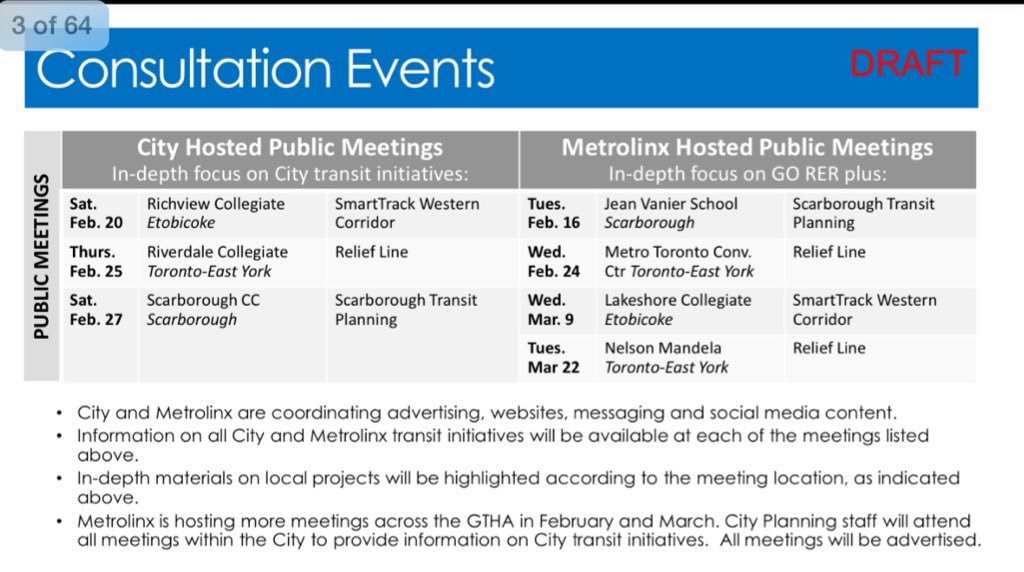
2016_ConsultationCalendar

Additional meetings and information about Metrolinx plans (GO Regional Express Rail) will be organized by that agency.

Even more information will be available in March 2016 when the City releases a compendium report on all transit initiatives currently under study. These will include items listed above as well as the “Waterfront Reset” study, TTC Fare Integration proposals and a review of how (or if) Tax Increment Financing can contribute to the many transit projects under review. The intent is that this report will form the basis for public consultation and debate leading to recommendations at Council in June 2016. This is a very aggressive schedule, and there is no indication how consensus will actually be achieved in so short a time, especially with the usually-secretive Metrolinx as an essential player. At least the discussion will be at a network level, not ward-by-ward with a “relief” line for every member of Council, and there will be some filtering of various schemes based on engineering and operational realities.

What is sadly missing from all of this is a discussion of day-to-day transit operations and the backlog in the state-of-good-repair budget. We can blithely discuss billions worth of subway building to Scarborough and a Relief line, but Council won’t fund the basics of running a transit system.

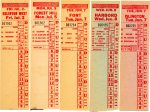
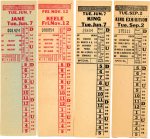
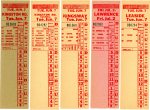
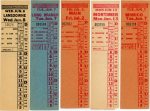
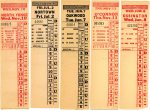
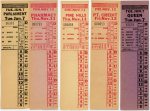
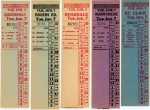
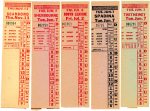
TTC Transfers: 1954/55

Transfers as a physical fare medium are set to disappear from the TTC in 2017 with the completion of the migration to Presto fare cards.

Here are the transfers as they existed in 1954 and 1955, the first year of the “Toronto Transit Commission” by that name. These include many suburban bus routes that were amalgamated into the TTC’s network with the formation of Metropolitan Toronto in 1954.

A few items worth noting:

  • Many of the suburban routes used red ink on white paper as a distinct colour scheme to identify cases where a check for a “zone 1” fare on a city route would be necessary. When coloured paper was abandoned for the older routes, Carlton was already using the “suburban” colour scheme and was missed in the conversion. For many years, it was the only “downtown” route with a red transfer.
  • There are two Yonge transfers. One is for the “Yonge T.C.”, the trolley coach operation from Eglinton to Glen Echo. The other, simply “Yonge” might suggest that the streetcars were still operating in 1955 over a year after the subway opened. This is for the night service.
  • Many route names are recognizable, but the outer ends of the suburban routes are a lot closer to the old city than they are today.
  • The text on the back of the transfer exhorting riders to only make their connections in the proper TTC way has not changed in years (it can be found on transfers from 1921). The use of the word “Conductor” is amusing considering that by 1955 two-man operation had ended. The term even appears on bus transfers.
  • “Up” and “Down” refer to directions of travel and correspond to the “U” and “D” cutoffs along the edge of the transfer. Generally, “Up” is westbound or northbound, but there are exceptions sometimes caused by route changes and amalgamations with segments in the “wrong” direction.

For a look at pre-TTC transfers, please refer to this article.

TTC Proposes New Fare Rules for Presto Roll Out

On December 16, 2015, the TTC Board will consider a report from management recommending several changes in the fare collection system. Some of these proposals are straightforward while others are likely to bring confusion and outright complaints from TTC riders.

On December 14, the TTC streetcar system goes to “Proof of Payment” (POP) on all routes and a few days later, Presto will be enabled across the streetcar system. In the short term, paying by Presto will be akin to dropping a token in the farebox on the “old” streetcar fleet. If you need a transfer, board at the front door and get one from the operator. Otherwise, rear door boarding is allowed. Transfers will be required if somewhere in your journey you will encounter a bus that is not Presto equipped. (The TTC is silent on how they will handle a route like 504 King that operates both types of vehicle if a Presto user discovers a non-Presto equipped vehicle is the first thing to show up.)

The roll out of Presto brings the opportunity to revise the fare system, for good or ill, as the TTC migrates away from its conventional model of tickets, tokens and transfers. (It is worth noting that a large number of riders have already made this migration by using Metropasses which are simple, if limited in the fare options they provide.)

The transitional period when both Presto and existing fare payment systems co-exist will be a difficult one. Indeed, there are strong incentives for riders not to shift to Presto until the system is fully functional unless their TTC usage is limited to that part of the network where Presto is active.

Continue reading

TTC Fare Increase For 2016

After a long, rambling, and less-then-well-informed debate, the TTC Board has approved increases in selected fares for 2016 at its meeting of November 23, 2015.

  • Adult cash fares will rise from $3.00 to $3.25.
  • Adult tokens will rise from $2.80 to $2.90.
  • Metropass prices (all classes) will not change.
  • Student and senior fares will not change pending the outcome of a study on Fare Equity that will report early in 2016.

The cash fare last changed in 2010, while the adult token fare, then $2.50, will have gone up $0.40 by 2016.

Freezing the Metropass prices will have the effect of lowering the “trip multiple”, the ratio of the pass price to the token fare from 50.5 in 2015 to 48.8. For monthly discount plan (MDP) subscribers, the ratio will fall to 44.7. The multiple is even lower for those who can claim the transit tax credit pulling it down to 38 for MDP users. This is only available to people with taxable income against which the transit credit can be applied.

This will make the pass more attractive to riders who now feel that it is priced beyond their normal transit usage level, and of course will provide a fare freeze for all existing pass users.

The gap between the adult and senior multiple will now be wider because seniors’ fares have not changed leaving the ratio between passes, tickets and cash fares as they were in 2015.

The unfocused debate can be blamed directly on the TTC’s own Budget Committee and its failure to actually discuss fare policy beyond producing a range of options for consideration by the full Board. Absent a clear idea from Mayor Tory or the City’s own budget process of subsidy that the TTC might receive in 2016, debates about “fares” turn into efforts to minimize the subsidy call against the City where “fighting taxes” takes priority.

When the issue reached the full Board, any idea that the TTC could magically survive without more subsidy had evaporated, but we still don’t know what will actually happen to fares or service if Council fails to deal with the TTC’s shortfall.

By the end of the meeting, there were several overlapping motions on the table, the product of many Board members each cooking up their own version of an appropriate new structure and policy framework.

  • By Vince Crisanti: That student and senior fares be frozen pending the outcome of the Fare Equity report in 2016. Carried.
  • By John Campbell: That a revised fare structure (see below) be implemented including a $0.20 jump in the adult token fare. Defeated 10:1 against.
  • By Shelley Carroll as amended by Glenn De Baeremaeker: That staff report back on a common fare multiple for adult, senior and student passes. Carried.
  • By Alan Heisey: That TTC and City Transportation Services work together on improvements to enhance transit service especially for special events such as subway shutdowns, and report to the Board in six months. Carried.
  • By Joe Mihevc: That all seven options for service enhancements be approved. Defeated 8:3 against.
  • By Joe Mihevc: That the three options not approved by the TTC Budget Committee (Subway service reliability, three minute service on Line 1 YUS, Cherry Streetcar) be referred to the City Budget Committee for consideration. Carried.
  • By Josh Colle: That the TTC and Toronto Parking Authority study means by which parking revenue can be maximized with a report to the Board in 3Q16. Carried.
  • By Josh Colle: That the TTC examine ways to increase non-fare revenue and reduce office space costs through consolidation, and that staff report by 2Q16 on annual and long term revenue targets. Carried.
  • By Ron Lalonde as amended above: That the TTC adopt fare scenario 7 with no Metropass, student or senior fare increase ($0.25 more on adult cash fares, $0.10 more on adult token fares). Carried.

The combined effect of these decisions leaves the TTC with a $41-million gap between its proposed budget and the 2015 subsidy level. Considering that they are not even sure of getting that much when the first cut of the City’s 2016 budget is launched on December 15, 2015, this leaves Council facing an 8.7% increase in the main TTC operating subsidy request and a similar increase (although a smaller dollar amount) for Wheel-Trans.

When the final text of these motions is published by the TTC, I will update this article.

Continue reading

TTC 2016 Operating Budget

On November 23, 2015, the TTC Board will consider its operating budget for 2016 including issues of fares and possible service improvements. The version of the budget before the Board was approved at the TTC’s Budget Committee meeting of November 9, 2015 with some amendments from the original staff proposal. The only recommendation related to fares was that the price of a Metropasses be frozen in 2016, but no other specifics. (I have already commented on the motions passed by the Committee in a previous article.)

The matter is complicated by the fact that the actual subsidy that will be made available to the TTC by City Council will not be set until early in 2016, and the TTC will compete with other agencies for available money.

(The 2016-2025 Capital Budget is also on the November 23 agenda, but it has not changed from the version discussed at Budget Committee.)

Although the Operating Budget report is long, it is better organized than the previous version with more detail, rather than depending on whatever questions might arise from a long PowerPoint slide deck and the skill (or lack thereof) of the presenter.

This budget is always a balancing act between competing forces and interests:

  • A political imperative to “keep taxes down” and limit the growth of the TTC’s call on City subsidies from the property tax base. This often manifests itself in calls for “efficiency” year after year in the hopes that the TTC can do more with less funding in constant dollar terms.
  • A political will to keep riders happy with benefits such as controlling growth in, or even freezing fares while providing more and better service. This includes targeted fare changes to benefit groups who are perceived to be more deserving of support through lower fares.
  • Annual increases in the cost of labour, materials and utilities.
  • The cost of additional service to handle demand from a larger population and a shift to transit from other modes.

In 2015, Council approved an extra $95-million for a number of improvements to service, elimination of the fare for children, and a capital-from-current purchase of 50 new buses to be used for new express routes in 2016. This increase only covered the part-year cost of the changes, many of which came into effect only in recent months, and additional subsidy will be needed in 2016 for the full 12-month cost. Additional improvements are on the table as part of the 2016 budget, and some of these were approved in the Budget Committee. The bottom line here is that improving transit has an ongoing cost and is not something to be done on a one year “feel good” program followed by a return to penny-pinching. Indeed, even that $95m might not have come to the TTC had Council been aware of unexpected costs from changes in Provincial funding arrangements for other programs that came to light after the extra transit money was announced by Mayor Tory and TTC Chair Josh Colle.

Continue reading