The Hidden Cost of Subway Capacity Relief

Two studies are underway for the so-called Relief Line:

The alignment for the southern segment has been settled for some time, but the northern segment is still in the exploratory phase of deciding the best route. Planning for the northern segment is under Metrolinx, and all publicly visible work on this stopped for the provincial election in 2018.

Every time either of these lines comes up, the inevitable reaction is “sticker shock” from the very high cost of building a new subway into downtown.

What is missing from the debate is the high cost of retrofitting the existing subway to handle more riders.

When the TTC first advanced its ATC (Automatic Train Control) project, it was to be the solution to all problems. There have been a lot of bumps along the road including:

  • Failure to include ATC signals in the design for the Vaughan subway extension.
  • An unworkable plan to run a mixture of ATC (Toronto Rocket) and non-ATC trains (the T1s now on the BD line) on Line 1.
  • Piecemeal contracts for new signal systems resulting in overlapping and incompatible work.

This was all sorted out, more or less, a few years ago as one of Andy Byford’s big successes as TTC CEO. For a history of the signalling contracts, please read my article here.

However, there is much more to providing added capacity on the subway system, as the TTC gradually discovered and acknowledged through additions to its Capital Budget. Several projects, many of which are not funded, now sit as proposals in TTC plans.

  • Additional trains for Line 1 (for more frequent service and for the Richmond Hill extension)
  • Additional storage for more trains
  • Platform Edge Doors (PEDs)
  • Expansion of Bloor-Yonge Station
  • Expansion of busy stations to provide better circulation for increased volumes of riders to and from trains

Additional Trains and Storage

The subway fleet plan, which I reviewed in detail in another article, includes a provision for more trains to increase the level of service and capacity on Line 1 Yonge-University-Spadina.

Current peak service requires 65 trains of which 4 are “gap trains” used to fill in where a delay would otherwise create a gap in service. The 61 regular trains provide AM peak service every 141 seconds (2’21”) with half of the trains short-turning at Glencairn. According to the plan, by 2029 there will be 79 trains of which 2 will be gap trains. The 77 regular trains represent an increase of about 26% and would bring headways down to roughly 112 seconds (1’52”). Allowing for some trimming of running time expected with ATC, this would result in Line 1 operating a 1’50” headway which is considered the minimum possible given physical constraints at terminals and the effects of dwell times at very busy stations.

However, the fleet of 76 TR trains will only get the TTC through part of this improvement, and there will be a deficit of 9 trains by 2028 as shown above. A 68 train service (70 trains total less 2 gap trains) corresponds to a headway of about 126 seconds (2’06”), an improvement of about 11.4%, and this is the limit of what is possible without more trains.

The plan shows trains under the headings of “capacity” and “ridership growth”. However, only part of the proposed procurement (the 18 “capacity” trains) is necessary to get to the 79 train service shown in 2029. The remaining 26 trains, some of which are spares, would not physically fit on the line without extension of all service on the Spadina leg to Vaughan. Whether the north end of the Spadina leg would actually require a 110 second headway is another matter.

With the price of a subway train sitting at about $36.5 million (mid 2020s), the 44 new trains proposed here would be worth about $1.6 billion plus the cost of future operation. This project is not funded.

A project to expand storage at Wilson Yard is part of the budget, but there is a limit to how many trains will fit there. As the chart above shows, the TTC would run out of storage for trains before all of the proposed new trains are delivered. Future storage depends on a new yard that is part of the North Yonge extension to hold them.

There is a catch-22 here in that some might argue for advancing the Richmond Hill project so that its yard would be available sooner. However, this would also advance the point at which more capacity on both the existing Line 1 and the proposed Relief Line would be needed.

Station Capacity

Much of the TTC’s focus for capacity has been on the signal system and on trains needed to provide more service. However, more service means more riders, and specifically a larger rate for passengers arriving at and leaving stations, and for transfers between lines 1 and 2. There are already problems at some locations with the crush of passengers. Bloor Station is best known, but St. George also has difficulties, and some stations south of Bloor encounter problems with backlogs of passengers trying to leave the platform before the next train arrives. This is particularly severe at locations with limited platform access which can include escalators that are not always in service.

There are three projects in the Capital Budget to address these problems.

Bloor-Yonge Station

The expansion of Bloor-Yonge Station includes the addition of a second platform to Yonge Station on the Bloor line much like the second platform recently added at Union. This would split demand for eastbound and westbound trains between two platforms. The project also includes additional circulation space on the upper (Bloor Station) level for the connections to the new platform. While this addresses some station capacity issues, it will do nothing to increase service and capacity on Line 2 to carry passengers away from Yonge Station even though increased service on Line 1 will deliver them at a higher rate.

This project has a $1 billion price tag, and is budgeted for the first half of the 2020s with completion in 2025. This project is not funded.

There is currently no proposal to expand the capacity of St. George Station, and this location is hemmed in by buildings.

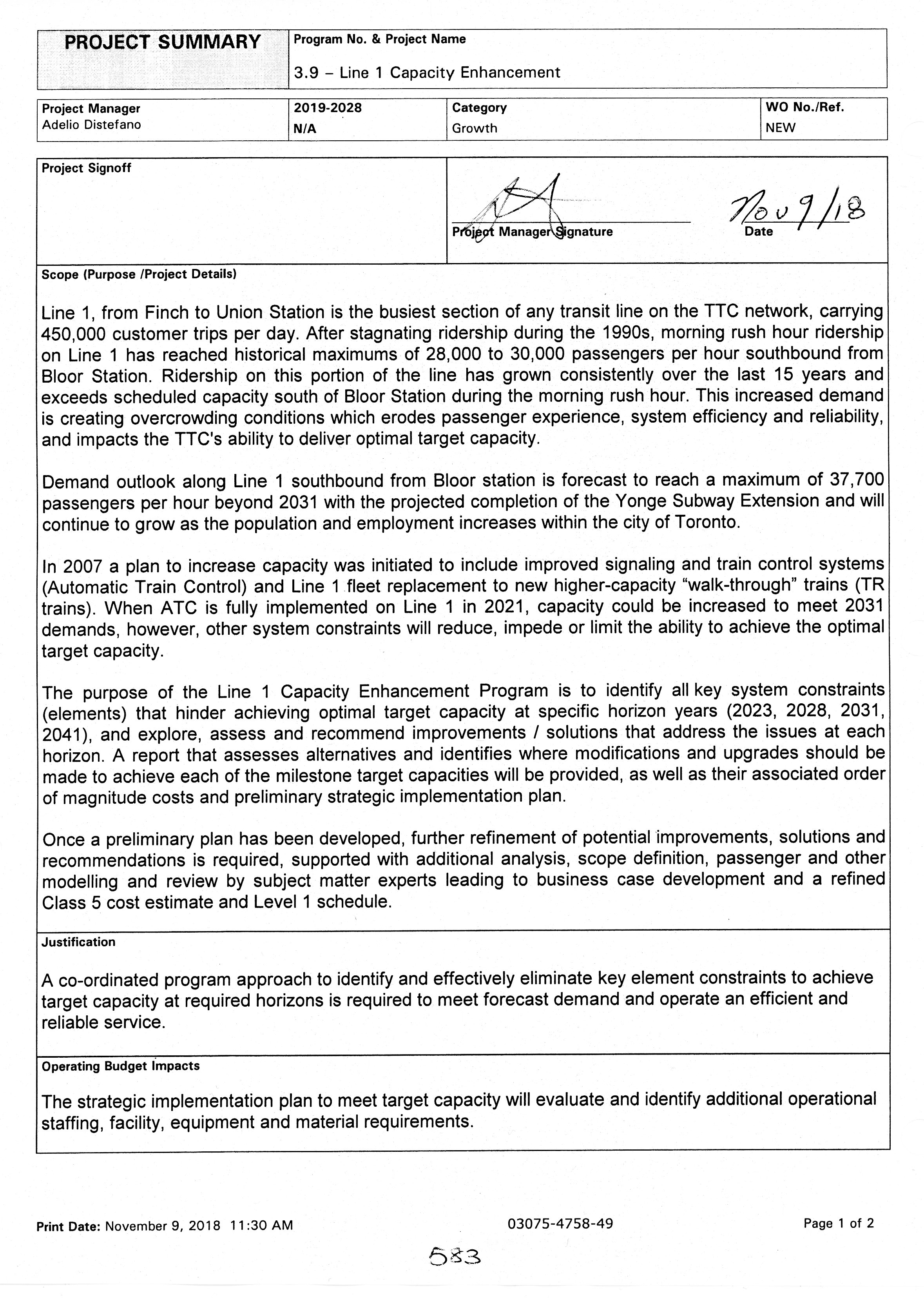
The project summary for the project is below.

Platform Edge Doors

Platform Edge Doors (PEDs) have been proposed for both Lines 1 and 2 for various reasons:

  • suicide prevention,
  • allowing trains to operate through stations without slowing to avoid passengers on crowded platforms, and
  • elimination of litter at track level which causes fire-related delays.

In various public statements, the TTC has been inconsistent about which of these goals is most important, and of course a decision to equip all stations, or only some, depends on what one is trying to achieve. Each is a noble cause in its own right, especially with respect to suicides, but the TTC needs to project a more consistent message on this.

Litter at track level varies with the station usage, and is worst at the very busy stations. Recently, a potato, or maybe it was a lemon, became notorious as it spent over a week wedged under the eastbound track at Yonge Station. Whatever it was, this was only part of an accumulation of debris that had built up over a month putting the lie to the TTC’s claim that it cleans stations frequently specifically to avoid the buildup of material which could cause “smoke at track level” incidents. Some problems do not require multi-million dollar solutions.

A more recent problem with passengers going to track level to retrieve lost objects, or possibly just as a stunt, is quite another matter.

Automatic Train Control (ATC) is an integral part of a PED roll out to provide precision stopping. For Line 1 YUS, the budgeted cost is $610 million with the project spanning the mid 2020s following the full cut over to ATC. In turn, the TTC argues that it will be difficult to achieve the planned 110 second headways with the expected crowding level at major stations unless trains are not slowed on their approach out of concern for hitting waiting passengers.

The cost of PEDs is budgeted at $651 million for Line 2 BD as a post-2028 project assuming that ATC will be in place by that time.

The PED projects are not funded.

The project description from the Capital Budget for the work on Line 1 is below. The Line 2 version is almost identical.

Proposed project schedule. In this chart “BTL” refers to “Below The Line”, that is to say, not included in the funded part of the budget.

Other Station Improvements

Big as many of the subway projects might be, the TTC now includes in its plans a $5.5 billion – yes, that’s billion – unfunded project for enhancement of its station capacity on Line 1. The timing of the proposed work is:

  • 2019: Preliminary strategic implementation plan, solutions and recommendations; business case and Class 5 cost estimate.
  • 2020: Program management plan and preliminary design.

The bulk of the spending for this project is shown in years 2023-2027, although some work might begin sooner depending on the timing of design, project approval and tendering.

The project description includes this warning:

Failure to identify and eliminate key element constraints to achieve target capacity at required horizons will result in increased overcrowding and congestion on Line 1 forgoing TTC’s ability to meet demand needs beyond our current capacity. [Capital Budget Blue Books, p. 584]

There is no indication of the scale of the problem of the locations to be tackled, but the price shows the cost of reworking station capacity in a busy and very constrained set of downtown stations.
And, no I am not making up the $5.5 billion estimated cost. Here is the page showing projected funding and cash flow. To put this in context, this one project is almost as big as the entire funded TTC Capital Budget for State of Good Repair. And of course, that $5.5 billion is unfunded.

Summary

The cost of providing more capacity on Line 1 Yonge-University-Spadina is far more than Toronto has been told in the past. When this all started, it was simply a matter of a new signal system, but that was only the first of many parts in this story. How much of the projected cost here can be trimmed is difficult to say, and that in turn would be affected by the capacity the TTC seeks to operate on Yonge Street. Moving to a full 37k/hour peak demand may not be practical, or could be quite challenging.

Meanwhile, the Relief Line project has, until comparatively recently in TTC history, been treated as something the city only needs as a last ditch effort, something to address a long-future problem, not a pressing need today.

Toronto has been ill-served by the attitude that the Relief Line is a project for another day, not to mention its characterization by some politicians that it is only a project for coddled downtowners. Tell that to people who cannot get on the Yonge Subway, many of whom live far north of Bloor Street.

The division of the RL planning into a south-of-Danforth segment separate from the northern extension means that the substantial benefit of intercepting riders east of Yonge well north of Bloor-Danforth is many years in the future.

The TTC owes Council a thorough discussion of capacity issues on the subway network including all of the interrelated projects needed to deal with present and future demand. For far too long, many projects have been discussed in isolation from each other, or simply have been ignored.

This is an issue for politicians at both Toronto and Queen’s Park who downplay the cost and complexity of a provincial takeover of responsibility for the subway and its funding. Even if the subway remains in Toronto’s hands, there are huge costs facing the TTC and its “funding partners”.

Nothing less than the credibility of transit as an engine for the city’s growth is at stake.
TTC 2019 Fleet and Capacity Plans Part I: Subway (Updated)

Note: At the time of publication (Noon on Monday, March 18, 2019), I await a response from the TTC to several questions on issues raised in this article. When the responses arrive, I will update the article.

Updated March 20, 2019 at 6:40 am: The spreadsheet of major project costs has been revised to show the correct final cost for the Line 2 Platform Edge Doors project. The value under “post 2028” was correct, but the EFC originally contained the value for the Bloor-Yonge project. This change does not affect the text of the article as PEDs were cited only in that table.

The TTC’s Capital Budget and Plan exist in a summary form in reports to the TTC Board and City Council, but there is a much more detailed version commonly known as the “blue books”. These are two large binders packed with information about capital projects.

For years, I have been reading them to sniff out issues that the general reports don’t cover or acknowledge. The 2019 edition became available at the beginning of March, and as I dove into it, many questions began to fill notes especially where there are direct conflicts between materials in the books themselves, and between these details and public statements and reports. Combing through this material may look like the height of transit nerdishness, but there is a crucial underlying issue here.

Cost-cutting politicians, not to mention ambitious transit managers, think that everything can be solved with a quick takeover of ownership and decision-making responsibilities. The temptation is to appear to do much while spending as little as possible. TTC and City practices chronically understate the capital needs of the transit system, and this makes a takeover appear cheaper than it really should be. Couple that with a government and its agency, Metrolinx, where detailed, long-range spending plans never appear in public, and we have a recipe for a system that will crumble from underfunding.

I cannot help but feel that project timings and overall plans for the system have been shuffled around without a thorough review of the effects especially where related plans overlap. Indeed, some project descriptions contain text that does not match the timing implied by the annual budget allocations. TTC management is supposed to be working on consolidated plans for both major subway lines, although the one for Line 2 was promised two years ago when Andy Byford was still the CEO.

A long-standing problem with capital budgets in Toronto, and not just at the TTC, is the overriding concern with the City’s debt ceiling. Toronto sets a target that the cost of debt should not exceed 15 per cent of tax revenue. Originally this was a hard cap for each year in a ten-year projection, but major projects in the near future made this impossible to achieve. Now the target is to stay at or below the ceiling on average. With a bulge in spending, and hence an increase in debt, in the mid 2020s, debt costs go over the line and this is “fixed” only by having years at less than 15% to make the average work out.

For a capital-hungry agency like the TTC there is a problem: future projects have requirements that simply do not fit into the City’s plans. The severity of this shortfall has been understated for over a decade by three simple expedients.

  • Project schedules in the budget are pushed beyond the ten-year mark where the related debt pressure would appear in City projections.
  • Projects are shown “below the line” in unfunded status with a hope that revenue sources such as new subsidies from other governments will appear.
  • Projects are omitted from from the budget completely.

The result is familiar to city-watchers with annual hand-wringing about the sky falling tomorrow, while somehow we manage to pay for today’s projects. In January 2019, the TTC knocked the legs out from this with the publication of a 15 year Capital Investment Plan revealing capital needs far greater than any numbers used in past projections. What had been a ten year, $9 billion plan that was roughly two-thirds funded (i.e. had known or likely monies available) went to a fifteen year, $33.5 billion plan with only one-third funded. This is just for “state of good repair”, and any system expansion sits on top.

In all of this lies a more subtle problem than simple financing. Years of shuffling projects made projected spending fit within City targets, and this served political needs to make key projects appear manageable. Overall planning, including the relationships between line items in the budget, took second place, if it was considered at all.

Capital planning requires a long-term view of the city and its transit system, and decisions made today have effects reaching more than a decade into the future. Toronto continues to suffer from delays in provision of new fleets for the surface system, including the garage space needed to hold a larger bus fleet, that go back at least to the era of Mayor Rob Ford. For years, the standard response to pleas for better transit service is that there are no buses and streetcars to provide more service, and even if we had them, we would have no place to put them. This flows directly from decisions to throttle spending.

Toronto faces the same challenge on its subway where decisions about the timing of spending, even of acknowledging the scope of requirements, limit the ability to address capacity problems.

This is a long article focusing on matters related to fleet planning, although there are related issues with infrastructure and facilities. Key points are summarized first, with details in following sections.

Continue reading

Metrolinx Board Meeting: February 7, 2019 (Updated)

Updated February 10, 2019 at 9:00 am: Notes from the Board meeting have been added at the beginning of this article.

Relief Line Business Case

When the agenda was released, the Relief Line report created quite a stir with an apparent shift in Metrolinx’ position on the staging of subway expansion projects. Where “relief” taking precedence over the Yonge north extension only referred to the southern section (Pape to Osgoode), Metrolinx now shows a shortfall in capacity if the northern section (Danforth to Sheppard) is missing from the network.

This prompted a letter from Frank Scarpitti, Mayor of Markham and Chair of the York Region Rapid Transit Corporation Board. The heart of Scarpitti’s objection is that the Metrolinx report uses a mixture of demand models and assumptions to arrive at its conclusion, and that this is out of step with previous studies and approvals.

The Relief Line Business Case Development presentation paints a flawed picture of the ridership modelling work being undertaken by Metrolinx, in conjunction with York Region and City of Toronto staff. The vague and contradictory information being used to update the public on slide 7 regarding Line 1: Ridership Demand and Network Effects has, once again, pitted two critically needed infrastructure projects against one another, namely the Relief Line against the Yonge Subway Extension. This positioning is not supported by the ridership modelling analysis and is at odds with the advice and information presented by Metrolinx at a recent meeting.

On June 25, 2015, Metrolinx released the results of the Yonge Relief Network Study to the Board. Supported by a Stakeholder Advisory Committee and a Peer Review Panel, the Board endorsed the finding that “With the Yonge North Extension, the Yonge Subway will still be under capacity.”

The Relief Line Update uses a blend of data and methodologies to make broad assumptions about future ridership. Each subsequent ridership model claims to have better information, more detail and more sophisticated analysis. Some models include independent findings and more recently, to our objection, some have been relying heavily on market driven employment and population data, contrary to the required obligation of all municipalities to follow the Provincially-mandated “Growth Plan” numbers.

The Relief Line Update being presented to the Metrolinx Board on February 7, 2019 has, according to Metrolinx staff, blended the findings of at least three different models and does not accurately represent any of the individual modelling analyses. Slide 7 suggests that, in 2041, Line 1 will be below capacity and then over capacity when the Yonge Subway Extension is added. This is completely inaccurate – current Metrolinx modelling shared as recent as January 21, 2019 demonstrates that the Yonge Subway Extension adds a relatively minor number of riders to the peak demand location and, in no case, is it the cause of Line 1 becoming over capacity.

The facts are that only 20% of the new riders on an extension of the Yonge Subway line would be headed south of Bloor. Ridership growth on Line 1 is directly related to population and employment growth in Toronto. In fact, models show that ridership on Line 1 will exceed capacity regardless of whether the Yonge Subway Extension is constructed. We believe that by promoting the shift of as little as 10% of people from peak hour travel from the Extension to the Richmond Hill GO Line, and by using fare structure and level of service incentives, that substantial relief on Line 1 can be achieved while the Yonge Subway Extension is being constructed.

Modelling also shows that the majority of riders (80%) on the Yonge Subway Extension are headed to Toronto’s uptown employment centres north of Bloor, including St. Clair, Eglinton and York Mills. Furthermore, the Yonge Subway Extension will also serve a large number of Toronto residents that work in York Region Other initiatives are underway, or should be underway, to alleviate Line 1 capacity problems. Metrolinx’s 2015 study concluded that a number of planned and funded initiatives such as Automatic Train Control, more Rocket Trains, GO Expansion, and the opening of the Line 1 extension to Vaughan Metropolitan Centre will add capacity and offload the Line 1 demand.

These are serious challenges to the professional quality of work presented by Metrolinx planners.

The June 2015 report cited here was the Yonge Relief Network Study and it contains the quotation about the subway remaining under capacity even with the Yonge North extension. However, this depends on a number of factors:

  • The model year is 2031
  • Then-current projections for population and jobs
  • Assumed diversion levels for ridership to TYSSE and GO RER, net of demand added by new projects especially the Crosstown LRT at Eglinton

The reported projected that the volume/capacity ratio would have been 96% (2031) over the peak hour meaning that the super-peak would be above the line. The claim that the subway would still have capacity is “true” only on average and with no headroom for growth. Metrolinx planners should have known better to make that statement in 2015.

Metrolinx staff pointed out:

  • They are modelling for 2041, ten years later
  • The 2016 Census shows that core area employment is growing faster than predicted
  • Modelling now includes factors for latent demand and safety considerations at stations and platforms
  • If there is no alternate relief in place by 2041, the Relief Line North will be required

Staff also reported that although the Relief Line South approved concept (Pape to Osgoode via Carlaw and Queen) has a positive Business Case, the value is only slightly above 1.0. All six of the options were close to 1 and so the distinction between them is not as strong as the simple over/under status in the report might imply. With only a small positive margin, factors such as cost control and encouragement of Transit Oriented Development along the line will be important to maintain the supposed benefit.

CEO Phil Verster argued strongly that building the Relief Line does not preclude building other projects. His concern is to build more transit and build faster. Metrolinx is looking at (unspecified) new technology and innovation from industry to speed up the process. More than one line could be built concurrently, but the critical point is to open them in a sequence that causes the desired redistribution of demand.

Verster admitted that Metrolinx has not done enough to look at the Richmond Hill GO corridor for its potential contribution to relief.

A Board member asked whether the staff have identified a “tipping point” in safety for their studies. There is not a single value, but rather a variation from one location to another depending on local demand, station geometry and passenger flows.

Unspoken through all of this was the years of delay in admitting that a problem even exists, let alone of doing something about it. GO’s ability to provide relief has been downplayed for various reasons including the need to regrade the south end of the line to make it flood-proof, the winding valley route’s limitation of travel speed, and operational conflicts with CN’s freight traffic that limit GO capacity to Richmond Hill. Meanwhile, candidate John Tory’s SmartTrack campaign claimed that his scheme would eliminate the need for a Relief Line, and TTC projections did not raise alarms about capacity and safety issues until the situation at Bloor-Yonge could not be ignored.

“Relief” will not come from any one line or project, but from the contributions of several.

Financing and deliverability studies will be reported in spring 2019 for the Relief Line South, and a preliminary business case for the Relief Line North will be available by year-end.

This entire exchange shows the problems brought on by oversimplified presentation decks for the Board. In their oral remarks, Metrolinx staff displayed a more extensive grasp of the issues and details than contained in the Powerpoint deck.

Continue reading

$33 Billion and Counting

A political tremour ran through the transit world in Toronto recently with the TTC’s release of a 15-year projection of capital spending requirements at $33.5 billion. This does not include funding for most system expansion projects beyond the already-approved Scarborough Subway.

That number is big, but it’s no surprise to those who have been following TTC budgets for years. A major issue has been that “unfunded” or “below the line” projects don’t get the attention they deserve and are deliberately kept off of the books to reduce the apparent size of the City’s financial problems. Common tactics included omitting projects from the overall budget, or projecting their spending in a period just beyond the rolling ten-year horizon of capital planning.

Transit planning in Toronto and at Queen’s Park is reckless when it downplays the backlog of spending and associated subsidies facing public agencies. New spending and the inevitable photo ops for grinning, back-patting politicians are easier to fit into plans when you can ignore the transit system crumbling in the background.

Several budget reports will be before the TTC Board (and later at City Council) at its next meeting on January 24, 2019.

There is far too much material here to review in a single article, and so I will break this up over multiple posts. Some of the details behind individual projects will not be available until I obtain the full version of the Capital Budget known as the “Blue Books” which expand the line items from the “Blue Pages” into project descriptions and schedules.

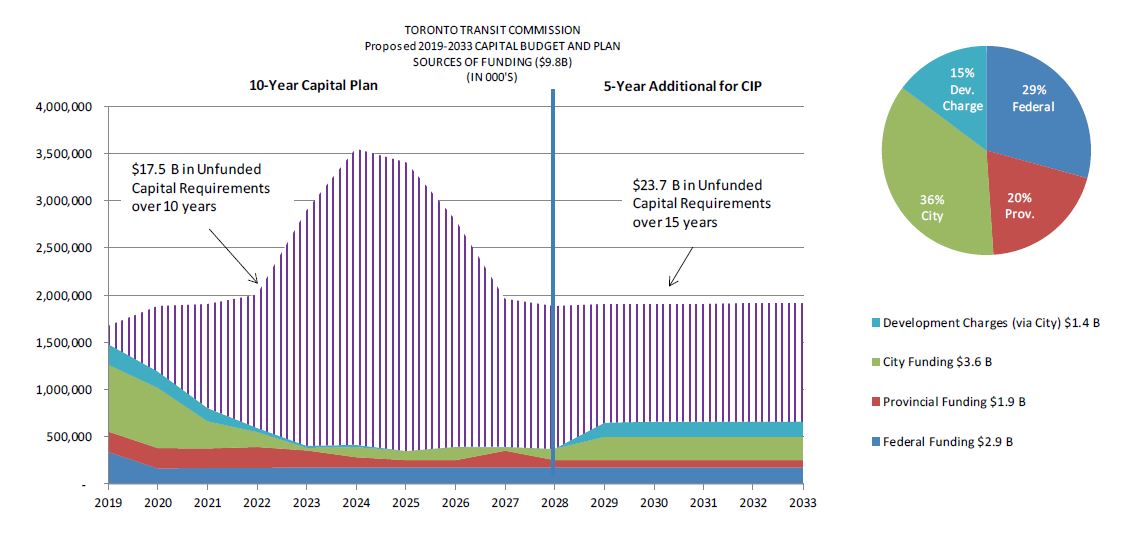
A vital part of the new reports is a shift to a longer time frame (15 years) and the inclusion of all projects in the Capital Plan whether they have funding or not. The extent of the problem is quite evident in the following chart. The purple hatched area shows the requirements for coming years while the sold areas show known funding amounts in the medium term and hoped-for income thereafter.

The big drop in the City’s funding share in the early 2020s arises from the lack of borrowing headroom in the overall City budget. A big problem here is the crowding by major projects such as the Scarborough Subway Extension and the Gardiner Expressway rebuild within the overall borrowing plan. Current City policy dictates that the average debt servicing cost should not exceed 15% of City tax revenue over a ten year period. Planned spending in the next few years will eliminate the headroom for additional borrowing. This exactly coincides with the bulge in TTC capital requirements beginning in 2022. To put it another way, if funding continued at 2019 levels across the chart, there would still be a shortfall, but against a much higher base.

Even this chart does not tell the full story because the Capital Plan continues to push major projects beyond the ten-year line, and the financial pressures from system expansion are not fully accounted for here. As things stand today, less than 30% of the ten-year program is funded. Beyond 2028, the level of assumed funding is still well below historical levels.

($ billion) 2019-2028 2029-2033 Total 2019-2033
Funded $6.4 $3.4 $9.8
Unfunded $17.5 $6.2 $23.7
Total $23.9 $9.6 $33.5

System expansion projects will add a further $3.8 billion over the first ten years of the plan:

  • Line 2 Extension (formerly known as the SSE): $3.4 billion (subject to revision when an updated cost report is presented to Council in April 2019).
    • “While the 10-Year Capital Plan includes $3.360 billion in funding for this project (between 2019 to 2028), this project has an overall budget of $3.560 billion. This estimate, which includes $132 million to extend the life of the SRT until the Line 2 East Extension commences operation and a further $123 million to decommission and demolish the SRT, was based on 0% design. The project budget and schedule will be re-baselined in Stage Gate 3 report to City Council in April 2019, factoring in delivery strategy and schedule risk analysis.”
  • Relief Line South: $385 million will be spent in 2019-20 to support early works on this project. Some of this is already funded, but $325 million is being advanced into the current ten-year budget. Of this, the City proposes to provide half and looks to other levels of government for a contribution. The actual RL construction project is a separate entity which is not yet in the budget.
    • “The 10-Year Capital Plan includes funding of $385 million to complete current work only, which includes completing the preliminary design and engineering to between 15% and 30% complete, including developing a project budget and schedule.”
  • Waterfront Transit: The ten-year budget includes only $27 million in 2019-21 for design work on the planned extension from Exhibition Loop to the Dufferin Gate. Design work on any other Waterfront projects, let alone any construction, remains beyond the ten-year window.
  • Spadina Vaughan extension: Outstanding work on this project including close-out costs amount to $60 million in 2019, but this will be funded within the existing project.

[Quotations above are from the 15 Year Capital Investment Plan and 2019-2028 Budget, pp 12-13.]

The Relief Line work includes tasks such as property acquisition, utility relocation and design for the tunnel boring equipment. Now that the line has political support, spending sooner rather than later is on the agenda, and about two years can be shaved from the original project schedule by doing the preliminary work now. This is a major change from the position taken by Mayor Tory during the election campaign, and the need to “do something” as soon as possible is now evident.

Continue reading

PTIF Phase 2: The Lottery Win Is Not As Big As It Seems (Updated)

Updated March 16, 2018 at 5:15 pm: The Fire Ventillation Project which includes second exits from several stations was omitted from the list of major projects in the original version of this post. It has been added.

Updated March 16, 2018 at 3:25 pm: The Ontario Ministry of Infrastructure has clarified that the Ontario funding for the Scarborough Subway is separate from the $4 billion in matching dollars shown in the table below.

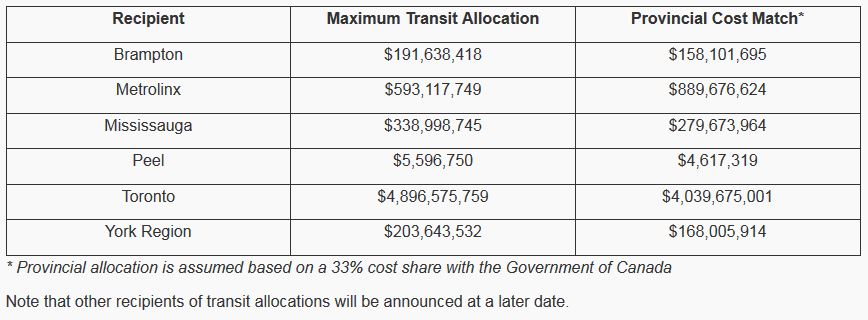
On March 14, 2018, the Federal and Provincial governments announced the scale of the second phase of the Public Transit Infrastructure Fund (PTIF) to be spent over the next decade. Some of the details are in a backgrounder.

Funding allocations for the Toronto area are summarized in the table below. The amounts are based on transit ridership, not on population, and so Toronto gets by far the largest share of the pie.

Source: Infrastructure Canada Backgrounder

If one believed the ecstatic response of politicians and some media, one might think that all our transit prayers have been answered.

Not quite.

An additional $9 billion is not exactly small change, but Toronto has a huge appetite for transit spending and a daunting project backlog. The new money will help, but with it comes the requirement that Toronto pony up about $3 billion for projects that are not in the city’s long-term budget.

Capital planning for many years understated the infrastructure deficit by hiding projects “below the line” outside of the budget, and even more by leaving important work off of the list completely. The infrastructure deficit is much larger than the TTC reports and city financial plans indicate.

That, in turn, affects the city’s financial planning, subject of a recent report from the City Manager. Despite assurances from city staff that all known TTC costs have been included in their projections, there is a long history of the TTC leaving significant projects out of funding lists to keep their total “ask” down to a politically acceptable number.

Much needed work is not the sexy, photo-op rich stuff of subway extensions, but the mundane business of buying new equipment to replace old cars and buses, and to increase system capacity.

The new plan is to run for ten years. The money will not all land in Toronto’s hands this year, but will be parceled out as projects are approved and actual spending occurs. There is no guarantee that a future government will stick to any commitments especially if the “funded” projects are not the subject of a binding agreement. Toronto has its share of cancelled projects including the Sheppard Subway, cut back to Don Mills, and the Eglinton West Subway (both victims of Mike Harris), not to mention Transit City and the pliable attitude of various governments to the worth of a subway in Scarborough.

Updated March 16, 2018 at 3:25 pm:

Before we even start into the possible projects to be funded, some money is lopped off the top based on a past commitment.

  • Ottawa will provide “up to $660 million for the Scarborough Subway extension project, pending submission and approval”.
  • It is unclear how much of the provincial commitment to the SSE of nearly $2 billion is included in the $4 billion under the new program.

This brings the available federal funding down to about $4.237 billion.

Whether the total available from Queen’s Park is $6 billion ($4b new plus $2b for the Scarborough Subway), we do no know. I have a question in to the Ontario Ministry of Infrastructure to clarify this. They have acknowledged the question, but have not replied as of 11:45 am, March 16.

Update: The Ministry of Infrastructure has clarified how the previous SSE funding fits with the newly announced program:

Ontario is committed to cost-matching federal funding for municipal projects at 33 percent. This equates to $4 billion from the province to match the City of Toronto’s $4.9 billion federal allocation. No previously committed funding for Toronto projects is included in this allocation.

Ontario’s commitment to match this new federal funding at a 33 per cent share is separate from and above the province’s previous commitment of $1.48 billion in 2010 to the Scarborough Subway. [Email from Alex Benac, Press Secretary to the Minister]

Continue reading

Toronto’s Transit Capacity Crisis

In recent days, Mayor Tory has announced, twice, a ten point program to address crowding on the TTC. The effectiveness of this program is limited by years of bad political decisions, and the hole Toronto has dug itself into is not one from which it will quickly escape.

This article is a compendium of information about the three major portions of the “conventional” (non-Wheel-Trans) system: subway, bus and streetcar. Some of this material has appeared in other articles, but the intent here is to pull current information for the entire system together.

Amendment February 15, 2018 at 5:30 pm: This article has been modified in respect to SmartTrack costs to reflect the fact that over half of the cost shown as “SmartTrack” in the City Manager’s budget presentation is actually due to the Eglinton West LRT extension which replaced the proposed ST service to the commercial district south of the airport. A report on SmartTrack station costs will come to City Council in April 2018. Eglinton LRT costs will take a bit longer because Council has asked staff to look at other options for this route, notably undergrounding some or all of it.

Continue reading

Honesty in Subway Planning

Toronto Council recently approved further study on both the “Relief” subway line, and the Yonge Subway Extension north to Richmond Hill. This approval came with several caveats about the timing of projects and the sharing of both capital and operating costs for the YSE.

Meanwhile riders who attempt to use the system as it is are expected to take hope from the fact that “Relief” might appear in only 15 years.

The entire debate about subway capacity in Toronto has, for many years, taken place in among incomplete information, policy directions that looked outward from the core to the suburbs, and in some cases blatant misrepresentation of the complexity of problems the City of Toronto faces.

A major issue throughout the debates has been that individual projects, or even components of projects, are discussed as if they are free-standing “solutions” to the problem when they are only one of many necessary components. Costs are low-balled by omission of critical parts of an overall plan, and the pressures on capital spending are understated by artificially planning major projects beyond the 10-year funding window used for City budgets. This gives the impression that money is “available” for other projects within the City’s financial capacity by stealing headroom in future plans to pay for things that, strictly speaking, should have a lower priority.

The situation is not helped one bit by the lack of strategic planning at the TTC and City where serving the political philosophy of the day often takes precedence over taking a wider view. Indeed the TTC Board, at times, almost prefers to be ignorant of the details because this would force a re-examination of cherished political stances. At Council, although Toronto now has its “Feeling Congested” study and an attempt at prioritization of projects, efforts continue to advance schemes near and dear to individual Councillors who simply will not accept that their wards are not the centre of the known universe.

What Toronto desperately needs is a thorough review of its rapid transit plans and the funding needed to achieve them. This must take into account, and modify where needed, the historical reasons we are in the current situation, and examine what can be done for the future, when this can be achieved and at what cost. The cost question must come second, in the sense that determining what the City needs is an essential first step. Only then can we examine possible alternative ways to address the issues, the cost this will bring and the funding mechanisms that might be used.

Continue reading

Inching Ahead on Subway Plans

Toronto’s Executive Committee will consider a report from the City Manager at its meeting of May 15, 2017 regarding the preferred alignment for the southern end of the “Relief Line” subway, as well as the current status of the Yonge Subway Extension to Richmond Hill.

This report has taken on a more political context with Mayor Tory’s recent statements that unless Queen’s Park coughs up financial support for the RL, he will block any further work on the YSE. Needless to say, this stance did not play well in York Region or at Queen’s Park.

The two lines, as they currently are proposed, look like this:

One might cast a though back only a few years to Tory’s election campaign in which he claimed that SmartTrack would eliminate the need for a Relief Line, that it would have frequent service with many new stops, that it would operate with TTC fares, and that it would be self-financing. Most of these claims were demonstrably false or impossible at the time, and the project scope has changed dramatically. Even the question of a “TTC fare” is tangled up in the Metrolinx Fare Integration study which could well bring higher rapid transit fares to the TTC as a way of “integrating” them with regional systems.

Tory’s convoluted evolution into a Relief Line supporter undermines his credibility on many issues not the least of which is an understanding of when money he demands might actually be spent. There is no point in getting a “commitment” from Queen’s Park when the government will be unrecognizable by the time the bills come due. Toronto has far more pressing demands in the short and medium term, and meanwhile there is $150 million of provincial money going into design work for the RL.

As for the YSE, it has been on York Region’s wish list for years, and is more advanced than the Scarborough Subway which is mired in debates about the alignment and number of stations. The problem for Toronto is that there is no capacity for additional riders from an extension on the Yonge line, and indeed it is already over capacity according to a CBC interview with TTC Deputy CEO Chris Upfold on May 10.

Continue reading

A Contrary View of Ontario’s 2017 Budget

With the release of Ontario’s budget for 2017, City Hall launched into predictable hand-wringing about all the things Toronto didn’t get with the two big-ticket portfolios, transit and housing, taking centre stage. Claims and counterclaims echo between Queen Street and Queen’s Park, and the situation is not helped by the provincial trick of constantly re-announcing money from past budgets while adding comparatively little with new ones.

There was a time when budgets came with projections of three to five years into the future, the life of one government plus some promise of the next mandate, but over time the amounts included within that period simply were not enough to be impressive. Moreover, in a constrained financial environment, much new spending (or at least promises) lies in the “out years” where “commitment” is a difficult thing to pin down, especially if there is a change in government.

Toronto has “out year” problems, but it has even more pressing concerns right now, today and for the next few years. Very little in the provincial budget addresses this beyond the authority to levy a hotel tax, and a gradual doubling of gas tax grants for transit over the next five years. These add tens, not hundreds, of millions to a City budget that runs at $12 billion.

The transit tax credit for seniors will cover eligible public transit costs beginning in July 2017 with a refundable benefit of 15 percent. Whether all seniors actually deserve this credit is a matter for debate, but an important difference from the soon-to-disappear federal credit is that Ontario’s is “refundable”. This means that even if someone does not have enough income to pay tax, they can still receive the credit. The devil is in the details, however, and the degree to which this will be available to casual, as opposed to regular transit users remains to be seen. The term “eligible costs” is key. (The federal credit includes restrictions on eligibility.) In any event, a tax credit does nothing for transit budgets because it adds no revenue either directly to the transit agency or to the City which provides operating subsidies.

There are two major problems with both Ontario’s support for transit and Toronto’s politically-motivated budgets:

  • In both cases, the focus is on capital projects, building and buying infrastructure, with little regard for the cost of operating new and existing assets.
  • Past decisions on transportation spending have locked billions of dollars into a few projects for short-term political benefit at the expense of long-term flexibility.

Toronto perennially assumes that there will be new money somewhere to backfill the shortage in its capital budget. The Trudeau economic stimulus plan was the most recent magical relief Toronto expected, but it came with dual constraints: Toronto gets a fixed amount over the life of the program, and Ottawa will not contribute more than 40% to any individual project. Toronto had hoped that Ontario would chip in, possibly at the 30% or even 40% level, leaving the City with a manageable, if challenging, task of finding money to pay its share for the backlog of projects. The Ontario budget is quite clear – Toronto is already getting lots of provincial money and at least for now, there’s nothing new to spend.

Ontario is hardly innocent in this whole exercise having meddled for years with Toronto’s transit plans, most notoriously in Scarborough where the whole subway extension debate was twisted to suit political aims. After leading Toronto down the garden path on the SSE, Ontario has capped its project funding leaving Toronto to handle the cost of its ever-changing plans.

Queen’s Park loves to tell Toronto how much provincial money is already spent for Toronto, if not in Toronto, and the distinction gets blurry. GO Transit improvements, for example, will bring more service into Toronto benefiting the core area business district, but they will also improve commuting options for people outside of the City itself.

Before the fiscal crash of 2008, when Ontario was running surpluses, the typical way to handle project funding was to hive off surplus funds at year end into a trust account. That is how the provincial share of the TYSSE was handled. By contrast, Ottawa operates on the pay-as-you-play basis, and only turns over subsidies after work has been done. Each approach suits the spending and accounting goals of the respective governments. In a surplus situation, one wants the money “off the books” right away, but in a deficit, the spending is delayed as long as possible. Further accounting legerdemain arises by making the assets provincial to offset the debt raised to pay for them.

To put all of this into context, here is a review of projects proposed or underway in Toronto.

Continue reading

Has John Tory Discovered Life After SmartTrack?

With all the flurry of transit funding and construction announcements lately, Mayor John Tory added his own contribution with a media statement at that busiest of stations, Bloor-Yonge. What prompted such a high-profile event? Rumour has it that Queen’s Park plans to fund the Richmond Hill subway extension in its coming budget, and Tory wants to be sure he defends the existing downtown system against overloading from the north.

(See coverage in The Star and The Globe & Mail)

Specifically, Tory wants to ensure that funding will be available for:

Building new transit lines including the Eglinton East LRT, waterfront transit and the downtown relief line

This is brave stuff, our Mayor rallying his city to the barricades [cue inspirational and very-hummable anthem here] were it not that Tory himself is responsible for much of the confusion and misdirection in transit plans today. His election campaign promoted “SmartTrack”, a single city-wide project that would solve every problem and magically be funded through taxes on new development the line would bring. A “surface subway” would speed riders from Markham to Mississauga via downtown with frequent service at TTC fares. Nothing else (except for a politically unavoidable subway in Scarborough) was needed, certainly not better bus and streetcar service to fill all those spaces in between major routes.

Things didn’t quite work out as planned. SmartTrack has dwindled to a handful of new GO stations to be built on the City’s dime, some of which Metrolinx might have built anyhow, and a few in locations of dubious merit beyond their soothing effect on local politicians. With the demise of a scheme to run GO trains along Eglinton from Mount Dennis to the Airport district, the Eglinton West LRT extension is also on the table, but it stops short of its necessary end, the airport, because Toronto lopped off the outside-416 segment to reduce the cost. Whether Mississauga and/or the airport authority itself will contribute to the LRT remains to be seen.

Tory discovered that surface routes suffered under his predecessor, and vowed more money for buses. Toronto bought the buses, but money to actually operate many of them is harder to come by. The only thing that saved the TTC from widespread service cuts in 2017 was a last minute City budget fiddle to bump the expected revenue from Land Transfer Tax.

Meanwhile in Scarborough, SmartTrack and the Scarborough Subway Extension vie for the same pool of riders, and it is only the comparatively infrequent GO service that preserves any credibility for the subway extension. Planners who once argued that an east-west line through the Town Centre precinct would better serve future development now compliantly endorse the supposed benefit of a single new north-south station between McCowan and the shopping mall.

Mayor Tory might now think of both ST and the SSE as “done deals”, although there’s a lot of ground to cover before the final cost projections and approvals by Council. Those extra GO stations and the express subway might still cost more than the preliminary estimates shown to Council, but there’s no more money coming from Queen’s Park. Indeed, the two governments cannot agree on how to calculate inflation in the provincial “commitment”, and Toronto thinks more money is on the table than is likely to be available. After all, Tory is in no position to tell a funding government how much they will pay out. Even those numbers are subject to change if the Liberals lose control of Queen’s Park to the Tories, as seems very likely in 2018.

Then there’s Ottawa and Trudeau’s huge infrastructure program, just the thing a politician who is desperate to make everything seem affordable could wish for. Except, of course, that the infrastructure pot isn’t bottomless. Once it is divvied up across the country, Toronto’s share is well below the level John Tory hoped to spend with his shiny new Liberal red credit card. Holding press conferences about the need for projects won’t change the amount of money available, and the federal program requires that municipalities, even big irresponsible ones, must set priorities. Tory’s plans also require Queen’s Park to come in with funding equal to the Fed’s contribution at a time when provincial budgets are tapped out, and Toronto’s ongoing game of holding down taxes rather than pay for its own services and infrastructure plays poorly beyond the 416.

What does the Mayor do? John Tory, the man who had a one-line plan to solve everything, now looks to a world beyond SmartTrack.

Continue reading