A Few Questions About “Emerging Transit Plans”

At the February TTC Board meeting, Chief Planner Jennifer Keesmaat took the Board through the road show presentation she and her staff have been taking around Toronto with the proposed new Toronto transit plan. This issue was held over to the March Board meeting because, for procedural reasons, there were limited questions in February.

One major issue here is that the body actually charged with setting transit policy, the TTC Board, was being briefed on a plan they had not seen before, and to which they had given no input or direction. This is only partly explainable by the fact that any long-term transportation plan would form part of the city’s Official Plan, and the Planning Department “owns” that document. However, one would hope that members of the TTC Board would have at least a passing familiarity with what was in the works. This situation is complicated by the presence of “citizen” members who are not also Councillors and are not part of the information flow, such as it is, at City Hall.

The plan and supporting reports will go to City Council a week after the TTC meeting.

A major problem, of course, is that “planning” in Toronto consists of catering to the whims of the Mayor, influential Councillors, the Minister of Transportation (and his government), and senior members of the government caucus. To describe planning in this context as unbiased and purely “evidence based” is something of a stretch.

That said, the situation is better today than in recent years because, at least, all of the proposals are on the table at once, and it is more difficult to dress up a bad proposal when it must compete for attention and analysis with many others at the same time. This does not prevent Councillors from making the attempt at advancing their pet projects, but some degree of comparative evaluation might keep them in check.

Continue reading

TTC Board Meeting Review: February 25, 2016

The TTC Board met on February 25, 2016. This article is a review of some of the reports and discussions at that meeting. For the full list, please refer to the agenda.

In this article:

As part of an update on cycling initiatives, the Board passed a motion asking staff to work together with the City on improved parking facilities for bicycles at subway stations. An article on this appeared on Torontoist’s website.

Continue reading

A Rainbow of Rapid Transit

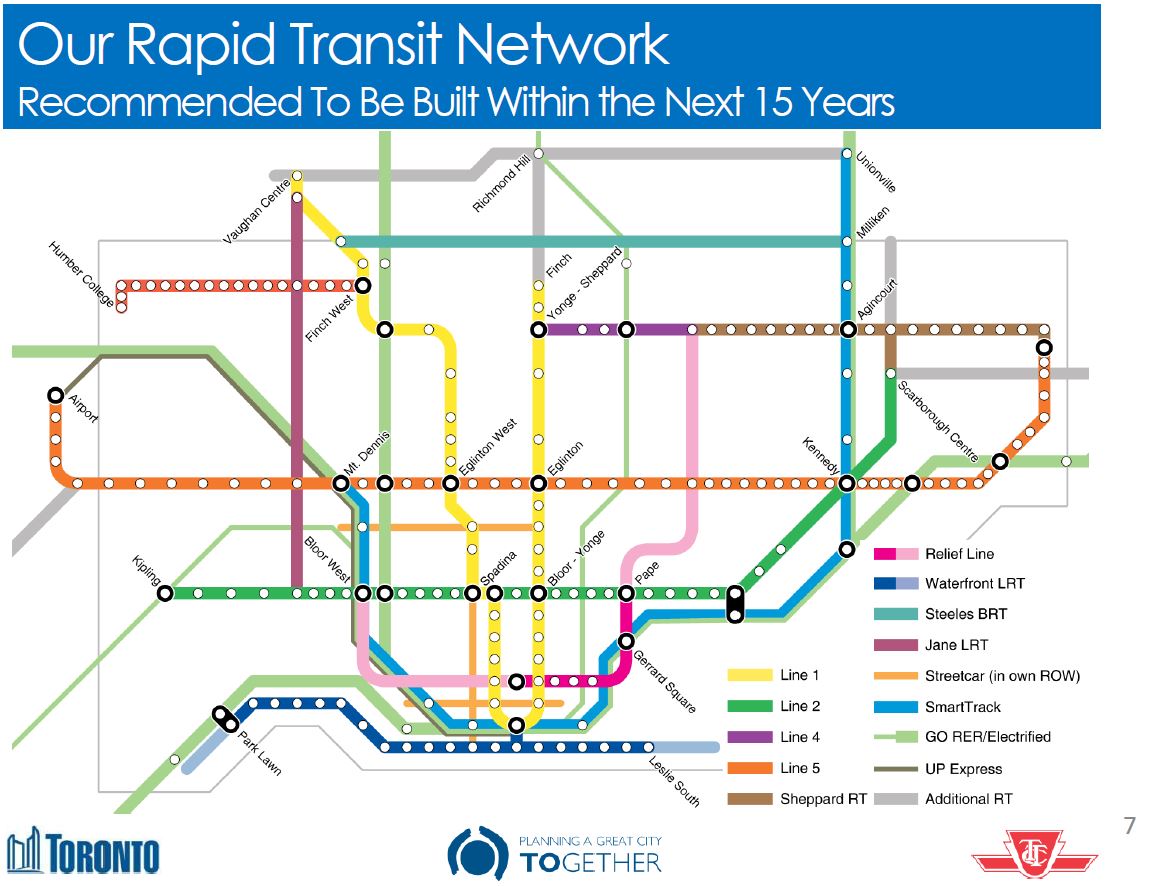
In Toronto’s never-ending fascination with new transit maps, the City Planning department has released a vision for our rapid transit network as it will be in 15 years.

201602_15YrPlan

Despite much talk of “evidence-based” planning, this is a very political map, and I cannot help remembering then-Premier David Peterson’s announcement of 1990 (not long before he lost an election and Bob Rae wound up as his much-surprised replacement) that amounted to a chicken-in-every-pot map.

There is nothing wrong with network-based planning, and indeed I have been beating a well-worn drum on that subject for years. But let us also remember that the Scarborough Subway exists because of the political clout of Brad Duguid, a former City Councillor, now Ontario’s Minister of Economic Development. Mayor John Tory, in Toronto Life, cites Duguid as saying that “if anyone tries to cancel the [Scarborough] subway, they’ll do it over his dead body”. “Evidence” apparently includes having a large cudgel to keep wandering pols in line.

The map also includes the Mayor’s pet project, SmartTrack, and it’s no wonder that he steers clear of the Minister’s position given the need for a provincial agency, Metrolinx, to accommodate SmartTrack on their network.

All of this is part of the “Motherlode” of public consultation sessions now running in various places around the City, and through Metrolinx in the wider GTHA. Background information and links to related material are available at Toronto’s TransitTO web site.

Continue reading

Relief Line, SmartTrack, GO/RER, Scarborough Subway Consultations

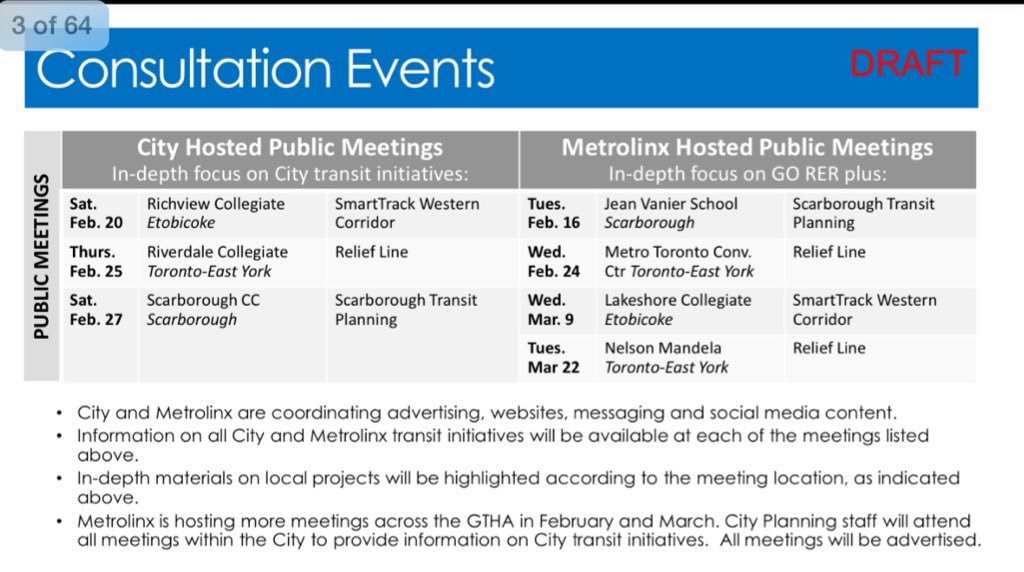
Toronto City Planning has released a draft list of upcoming public consultations on various transit plans including:

  • The Relief Line
  • The Scarborough Transit Plan (Subway, SmartTrack, Crosstown East LRT)
  • The Western SmartTrack Plan (SmartTrack, Crosstown West LRT)

2016_ConsultationCalendar

Additional meetings and information about Metrolinx plans (GO Regional Express Rail) will be organized by that agency.

Even more information will be available in March 2016 when the City releases a compendium report on all transit initiatives currently under study. These will include items listed above as well as the “Waterfront Reset” study, TTC Fare Integration proposals and a review of how (or if) Tax Increment Financing can contribute to the many transit projects under review. The intent is that this report will form the basis for public consultation and debate leading to recommendations at Council in June 2016. This is a very aggressive schedule, and there is no indication how consensus will actually be achieved in so short a time, especially with the usually-secretive Metrolinx as an essential player. At least the discussion will be at a network level, not ward-by-ward with a “relief” line for every member of Council, and there will be some filtering of various schemes based on engineering and operational realities.

What is sadly missing from all of this is a discussion of day-to-day transit operations and the backlog in the state-of-good-repair budget. We can blithely discuss billions worth of subway building to Scarborough and a Relief line, but Council won’t fund the basics of running a transit system.

SmartTrack: Now You See It, Now You Don’t!

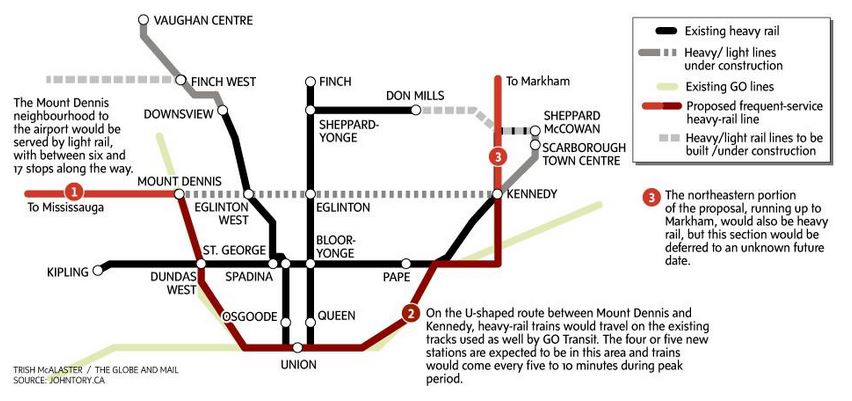
Oliver Moore in the Globe and Mail reports that there have been major changes to the SmartTrack plan, to wit:

  • The western branch of the service to the Airport district will be provided by the western extension of the Eglinton-Crosstown LRT as originally proposed.
  • “SmartTrack” per se will operate as a heavy rail service overlaid on GO Transit with the initial phase running from Mount Dennis to Kennedy Stations.
  • The northern extension of “SmartTrack” to Markham will be a separate phase of the project.

The map from the Globe & Mail is reproduced below.

GlobeSTLRTMap_20160114

According to Moore, the cost of adding SmartTrack to GO under this configuration would be much, much less than the originally quoted figure for the entire line. In turn, this would free up substantial capital spending headroom in City plans for other projects.

SmartTrack service at 15 minutes (the level proposed in Tory’s campaign) is far too infrequent to attract much riding, and especially to make a dent in demand on the existing subway interchange at Bloor-Yonge. We saw this in the June 2015 Metrolinx demand projections that were far more favourable to a Relief Line operating north to Sheppard and Don Mills. However, getting SmartTrack service down to as close a headway as every 5 minutes will be challenging for Metrolinx and for the corridors through which this would operate. There are no details yet on how this would be achieved.

The Eglinton West LRT has always been the superior way of serving this corridor compared to the heavy rail SmartTrack scheme. ST foundered on major problems with constructibility and neighbourhood effects, issues that were dismissed in a stunning display of cavalier “expert” knowledge during the campaign. Planning by Google Maps from an office in the UK has its limitations, but Tory’s campaign relied on this “expertise”. One shameless professor even rated ST with an “A+” in the CBC Metro Morning interview.

Keeping the first phase of ST confined south of Eglinton on both branches limits the operating costs the City must bear if this to be truly a “Toronto” project with “Toronto” fares, and it avoids the complexities of building into the 905.

Indeed, SmartTrack began as a real estate development scheme to make commercial property near the Airport and in Markham more accessible from downtown in a series of studies that actually claimed the market for downtown office space was static and falling. Yet another expert should be eating crow pie from his perch on the Metrolinx board. It was never clear why Toronto should shell out billions to improve property values in the 905, and this task now falls clearly to Metrolinx where it belongs.

The eastern leg of SmartTrack, north from Kennedy, obviously competes with the Scarborough Subway Extension, and there is no need for two routes serving the same demand, especially when GO already plans substantially improved service in the rail corridor. The long-standing issue of SSE demand may be clarified by the absence of SmartTrack as a competing service.

It is no secret that my own position would be to revert to the LRT plan in Scarborough, but that train has probably left the station, especially if the City can “save” a small fortune by scaling back on SmartTrack.

These changes could also foreshadow a revised schedule for the LRT projects at a time when “shovel ready” projects are in demand to soak up new federal spending. Eglinton West’s LRT extension is relatively easy to build, and it could be started soon enough to complete concurrently with the main Crosstown route. There is also the matter of the Sheppard East LRT including its proposed service linking to UofT Scarborough campus.

Coming weeks may bring many sputtering denials, or possibly, much improved clarity and acceptance of an – at last – realistic plan.


Development Charges and Politicized Transit Planning (Updated)

Updated November 26, 2015 at 11:00 pm: A follow up article by Jennifer Pagliaro includes reactions from Mayor Tory. My comments appear at the end of this article.

The Toronto Star’s Jennifer Pagliaro reports that the Building Industry and Land Development Association (BILD) will challenge Toronto’s planned increase in Development Charges for the Scarborough Subway Extension (SSE) at the Ontario Municipal Board (OMB).

[BILD is] challenging the planning foundation for the three-stop subway — which council controversially approved last term over a seven-stop LRT that was fully funded by the province. BILD is raising red flags about the city’s ridership projections.

Bryan Tuckey, BILD’s president and CEO, says homeowners across the city should not be on the hook for a “political decision.”

“The ridership numbers that we have demonstrate that what’s needed in that area is light rapid transit,” Tuckey, whose background is in city and provincial planning, told the Star.

“We want to have fair and accountable use of development charges.”

This action has implications well beyond the Development Charges (DCs) for the Scarborough Subway and touches on the whole question of transit financing and planning that for years has been more about political gamesmanship than about the actual needs of the City of Toronto.

We know that the development industry does not like paying one cent more than they have to, and preferably less, in taxes. In that sense they are no different than other taxpayers.

However, while homeowners can only express their opposition by voting for politicians with vague promises to fight waste at City Hall, and hope that their “champions” like Ford and Tory will “do right” by them, their only real recourse is at election time. Elections are fought on signature platforms like SmartTrack and “Subways Subways Subways”, and voters don’t get to cherry pick the platform lines they really want. Elected politicians claim they have “a mandate” when their victory may simply depend on “not being the other guy”.

Development Charges, on the other hand, have specific rules about how they are calculated and an appeal mechanism neither of which is available for general property taxes (or many other taxes Council can or could levy of which the Land Transfer Tax is one obvious example). As the Star notes, most of the City’s share of the SSE ($910m) will come from the subway property tax yielding $745m. This tax will rise to 1.6% in 2016 and then stay on tax bills for decades. The amount coming from DCs ($165m) is much smaller, but developers have an appeal option through the OMB.

Continue reading

TTC Budget Meeting: November 9, 2015 (Updated)

Updated November 10, 2015 at 6:00 pm:

The Budget Committee meeting was not the best-organized or well-informed of TTC meetings thanks to a combination of factors. It was held in the boardroom at TTC headquarters which is no longer configured suitably for such events and cannot handle a large presence by the media who were out in force anticipating a story about 2016 fares. Almost all of the material was presented by one person who, unfortunately, trusted to memory rather too often and got the odd fact wrong as the meeting wore on. Moreover, there simply was too much material to absorb in the manner it was presented.

Committee members, for their part, tended to view the situation through their personal lenses of which hobbyhorse needed attention. This did not necessarily make for a broad view of TTC issues, and many erroneous assumptions, often uncorrected, crept into the debate.

We will go through this and much more all over again at the November 23, 2015 meeting of the full Board when we can also expect a very long parade of deputations on the subject of fares.

The entire exercise of having a Budget Committee has been useful, up to a point, in that some Commissioners have been exposed to the gory details, but they remain confused, and we have yet to see an actual philosophical discussion of just what the TTC should be as a basis for the budgets for 2016 and beyond.

The following motions were approved by the Committee:

Continue reading

A Smarter SmartTrack

The SmartTrack scheme was born of an election campaign, but it was John Tory’s signature project, one he is loathe to relinquish despite its shortcomings.

What’s that you say? I am just being one of those “downers” who cannot see our manifest destiny? What’s that line about patriotism and scoundrels?

At the recent Executive Committee meeting, Tory actually had the gall to say that during the campaign, he didn’t have access to a squad of experts and had to make do with the people he had. Funny that. This is the crowd that estimated construction costs on the back of an envelope, who “surveyed” the line using out of date Google images, who ignored basics of railway engineering and capacity planning to make outrageous claims for their scheme.

When the dust settled and John Tory became Mayor Tory, I thought, ok, he will adapt his plan. Indeed, it didn’t take long for a reversal on TTC bus service and the recognition that Rob Ford had stripped the cupboard bare and then started to burn the lumber at the TTC. A campaign attack on Olivia Chow’s (far too meagre) bus plan changed into championing the restoration of TTC service to the days of the “Ridership Growth Strategy” and beyond. Good on the Mayor, I thought, he can actually change his mind.

SmartTrack is another matter, and what Tory, what Toronto desperately needs is a fresh look at what GO, SmartTrack and the TTC could be if only the fiefdoms and the pettiness of clinging to individual schemes could be unlocked. That would take some leadership. I wonder who has any?

Inevitably comments like this bring out the trolls who say “so what would YOU do” (that’s the polite version). Here’s my response as a scheme that bears at least as much importance as a way of looking at our transit network as the competing visions in the Mayor’s Office, Metrolinx, City Planning and the TTC.

Continue reading

A Frustrating Update on Transit Expansion Plans

The TTC Board received an update from City and TTC staff on the status of major transit expansion plans in Toronto at its meeting of September 28. The presentation was largely delivered by Deputy City Manager John Livey with backup from Mitch Stambler, TTC’s Head of Service Planning. Also at the table, but notable for her silence, was the Toronto’s Chief Planner Jennifer Keesmaat. A contingent from Metrolinx, another agency studying transit expansion, was in the public gallery, but they did not participate in the presentation or discussion.

This session was a prologue for a report coming to Toronto’s Executive Committee on October 20, 2015, but a great deal of detail remains to be fleshed out. This proved frustrating for the Board members on two counts. First, the lack of detail prevented the TTC from making informed comment on the plans, and second, the process itself has largely bypassed the TTC Board and concentrated work at the City and Metrolinx.

To some extent, the TTC has itself to blame for this situation. During the Ford/Stintz era, meaningful policy debates at the TTC were rare, and the TTC ceded responsibility for large scale planning to the City of Toronto under Keesmaat’s department. At the political level, staying informed about issues is a comparatively new desire by Board members (not to mention some members of City Council) when the issues are more complex than a dumbed-down subways-subways-subways mantra. They have a lot of catching up to do.

Detailed reports on four major projects will come before the TTC and Council over coming months, and these will inundate members with not only a great deal of information but force some hard decisions about just which projects, and at what scale, the City should pursue. These are:

  • The Relief Line
  • The Scarborough Subway Extension
  • Waterfront transit
  • GO/RER, SmartTrack and TTC service integration

ExpansionPlanMap_6

The situation is complicated by parallel work at Metrolinx, an agency with very different goals from the TTC and the City, and by the inevitable political wrangling over the relative importance of projects. Whether any reports coming forward from staff will be trusted, especially in an environment where Councillors and the Mayor routinely dismiss “expert” advice that does not suit their biases, remains to be seen. Equally difficult will be the question of whether the reports are spun, in advance, to suit specific outcomes rather than presenting “just the facts”.

One difficulty already lurking in the wings is the question of demand modelling. The University of Toronto together with City Planning is developing a new model for GTHA travel. This is much more ambitious than current models in that it covers the entire region and models travel over the entire day, rather than focussing on AM peak flows. The model also allows for route and mode choice by incorporating considerations of fares and line capacity (crowding). At this point, the model is still being calibrated and validated, a process that uses known historical data (from the 2011 Transportation Tomorrow Survey) to confirm whether the model generates flows that accurately mimic what actually happened. (The TTS is conducted every five years by UofT on behalf of municipal and provincial agencies, and the next set of data will reflect demands in 2016.)

Draft results for the new projects and network will not be available until October 2015, and a report on details will not come to Council until the first quarter of 2016. One suspicion is inevitable given this delay: is the “calibration” intended to produce a desired outcome? That’s a tricky question both because it speaks to the independence of the process and also to the way in which the model is used. For example, a model may well reproduce past behaviour perfectly, but that’s a known target and the context for it (then-existing transit, road and land use configurations) are a matter of record.

Future modelling depends not only on the nuts and bolts of the model itself, but of the assumptions put into its configuration. A well-known example of flawed modelling was for the Sheppard Subway in which unduly rosy assumptions about job numbers and locations gave the subway a projected demand well above what it actually achieved. The further one goes into the future, the cloudier the view becomes, and the presumed distribution of population and employment can involve political as well as basic economic dimensions. If, for example, the concentration of jobs in the core area and the polarization of high and low income housing concentrations continues, this has profound effects on future demand. Moreover, such concentration may not suit politicians who view their own turf as the rightful place for future growth.

Continue reading