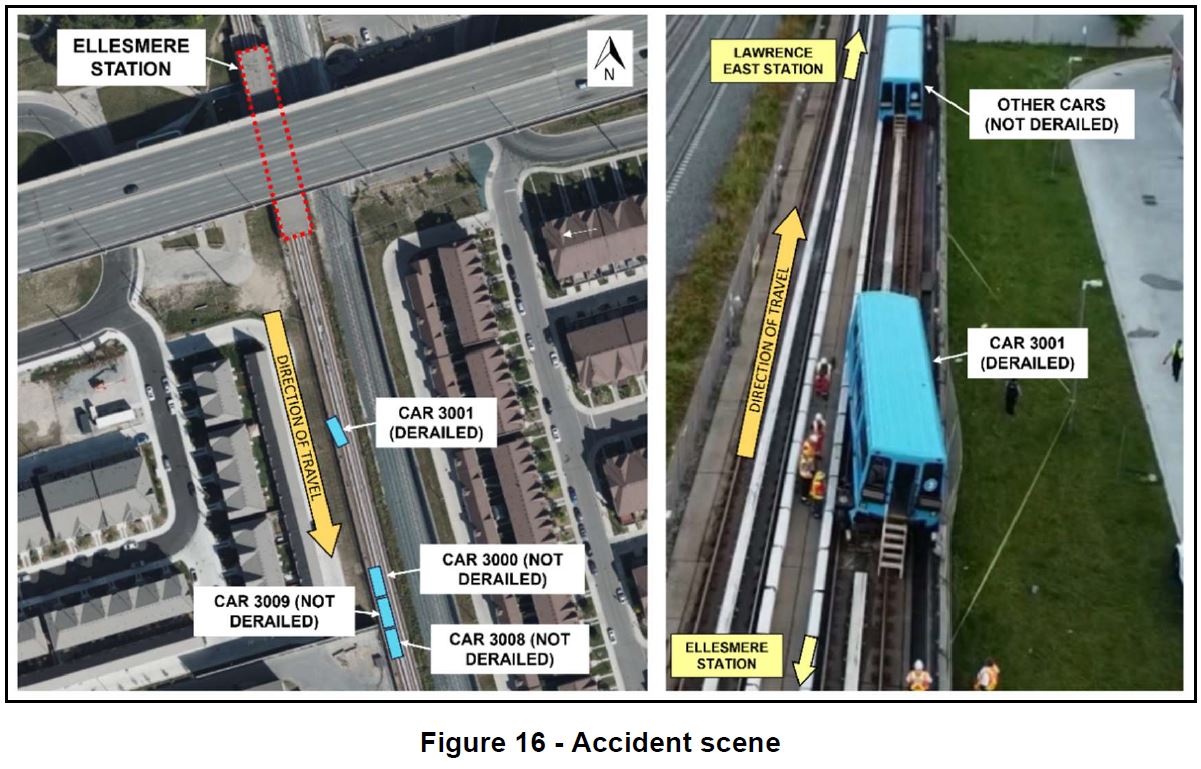
On July 24, 2023, at about 6:43 pm, a southbound SRT train derailed south of Ellesmere Station after snagging the reaction rail. This event lifted the rear truck of the car off of the track and also caused it to break away from the rest of the train.
The detailed investigation reports were quietly posted on the TTC’s website, and I wrote a summary of them at the end of January:
I filed a Freedom of Information (FOI) request with the TTC at the beginning of 2024 for “track inspection reports and work orders” for the SRT between June 1 and August 31, 2023. The reason for the extended cutoff date was to pick up any inspections and repairs that took place after the derailment.
On February 1, 2024, Mayor Olivia Chow announced her version of Toronto’s 2024 operating and capital budgets at Scarborough Town Centre Station. There are many parts to this budget, including a slight reduction in the proposed tax rate, but the location of the event was no accident.
After much hand-wringing, political gesturing and activism by would-be users, the uncertainty over the busway in the former Scarborough RT right-of-way is gone. Toronto will pay for the project, and the delaying tactic of waiting for provincial funding is over. The text below is from the Mayor’s proposed budget at pages 35-36.
This is a fairly common shuffle of funding allocations between projects, something that is relatively easy because:
the amounts involved are small on the scale of the overall capital budget,
some of the spending is beyond 2024, and
the primary source is a placeholder for future as-yet uncommitted work.
What is needed now is a sense of urgency by the TTC to make every possible change in their project timetable to get things moving now. This could include:
Identifying work that can proceed without the mini Environmental Assessment known as a “TPAP” that will consume six unexpected months. Obvious candidates for this are the removal of existing SRT infrastructure – track, power, lighting – and demolition work at Lawrence East Station so that buses can pass through the station.
Examining whether the project can be split into south and north stages with the Lawrence to Eglinton section opening first. This would give some of the busway’s benefit including direct access to Kennedy Station as early as possible.
A change in focus is needed from delay, a common tactic in the Tory era to sweep budget problems under the rug, to creating the most expeditious project plan.
Transit planning should be about ambition and what we can achieve, not endless excuses and the deadly words “Tomorrow and tomorrow and tomorrow …”.
At the time, detailed reports from the technical investigation were supposed to appear in “a few weeks”, but there has not been any public presentation of this material to the TTC Board.
To my surprise while hunting down reports about the Scarborough RT busway, I found the derailment investigation reports well hidden on the TTC’s site. To see them, you have to:
Go to the Projects and Plans page which is accessed through a footer menu on every TTC page. Yes, right down at the bottom.
Scroll down to The Future of of TTC’s Line 3 Scarborough (SRT).
Scroll down within that page to News Releases, Reports & Community Updates
Open that section and scroll down to November 16, 2023 (there is also one report listed under December 11, 2023)
Here you will find links to the following reports (which I provide here to save you the bother of chasing through the path above). The dates of the reports are shown together with those for earlier drafts in the change logs, where present.
Dated November 30, 2023 (Original version was dated October 10)
There is a lot of reading here, but the reports are more thorough and informative than the brief TTC overview since the accident. An important distinction the reports reveal is the degree to which identified issues were not at the single derailment site, but common to other parts of the line and to TTC maintenance practices.
Various reviews concluded that the problem lay with the reaction rail mounts and the ability of segments of this rail to move due to forces from the linear induction motors (LIM) on the SRT trains. Several factors contributed to this including:
The inherent tight clearances of the LIM design,
variations and errors in the selection and installation of reaction rail supports and rail components,
an inspection scheme that underrated the severity of problems and the necessity for prompt repairs,
the difficulty of inspecting reaction rail mounting hardware, and
the need for training of inspection and maintenance staff so that they understand the behaviour of track systems and the failure modes that they must prevent.
Of particular concern is that a reaction rail defect was reported two weeks before the accident at the derailment site, but it was assigned a low priority in the maintenance hierarchy likely because the severity of the problem was not understood.
There are lessons here for maintenance practices in general and I cannot help thinking that the recent detailed review of subway track geometry, resulting slow orders and repairs is partly in response to the problems discovered on the SRT.
I know that readers will not have time to plough through the full reports, but they contain details beyond what I have included here for those who are interested. This article is a summary of the main points together with an introduction to the SRT propulsion technology to put the other material into context.
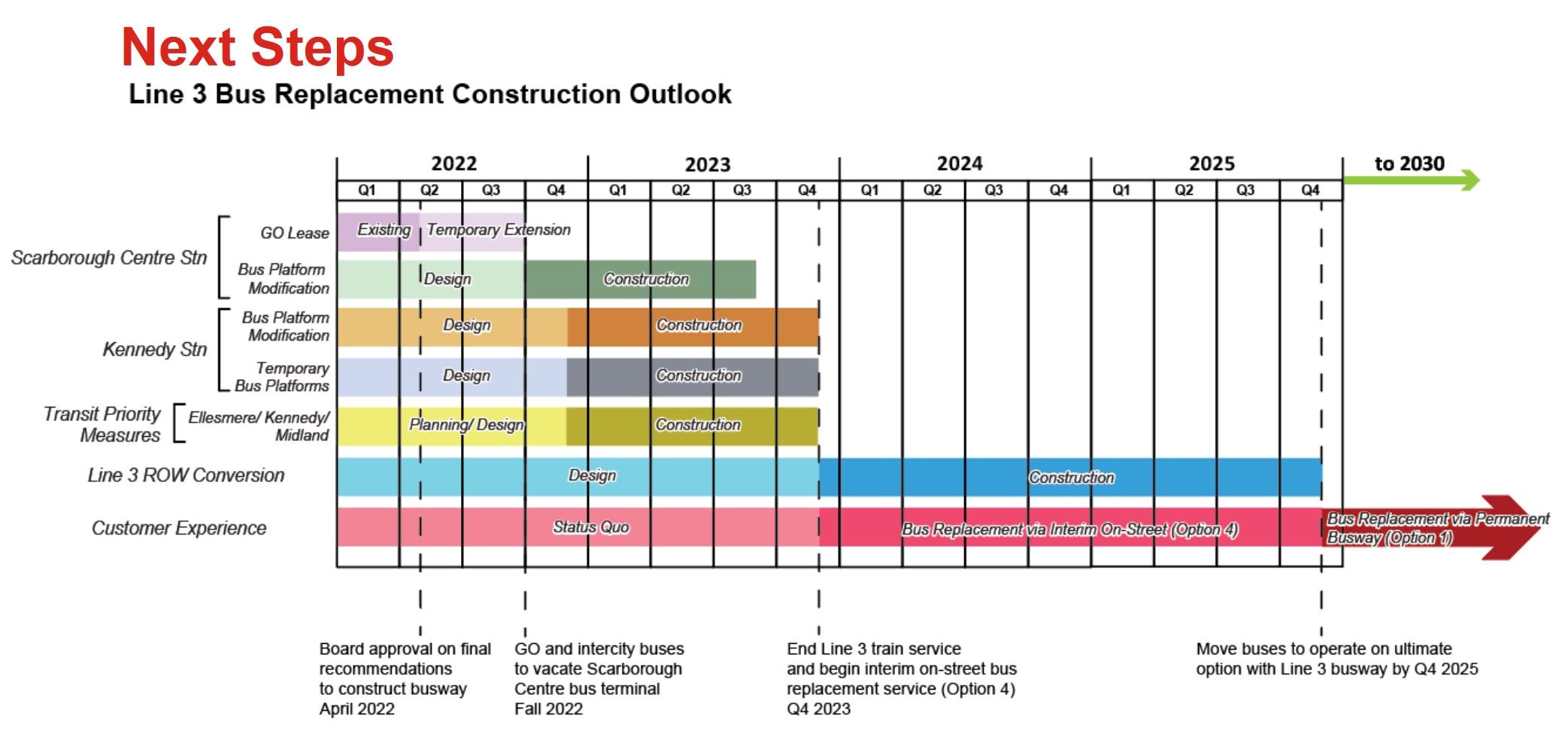
The news was not good. For various reasons, the opening date for this facility has slipped to 2Q2027. This is quite a change from the original plan for construction through 2024 and 2025 with a year-end opening, roughly 18 months sooner than the updated projection. Here was the plan back in April 2022 when the project was approved by the Board. At the time, the assumed shutdown date for the SRT was mid-November 2023.
TTC Project Chart for Line 3 Bus Replacement Construction, April 2022
The Board’s discussion was unusually heated, and much criticism fell on TTC Management for an unplanned delay required to conduct a Transit Project Assessment (aka TPAP) even though the corridor is not changing use. The problem lies with planned acquisition of new lands to provide station and corridor access, and they are subject to a review including for cultural/archeological purposes. (Detailed station plans appear later in this article.)
Construction will also require a barrier between the busway and the adjacent GO line because Metrolinx wants to protect from buses accidentally coming onto their corridor. This adds cost, but should not substantially affect the construction schedule.
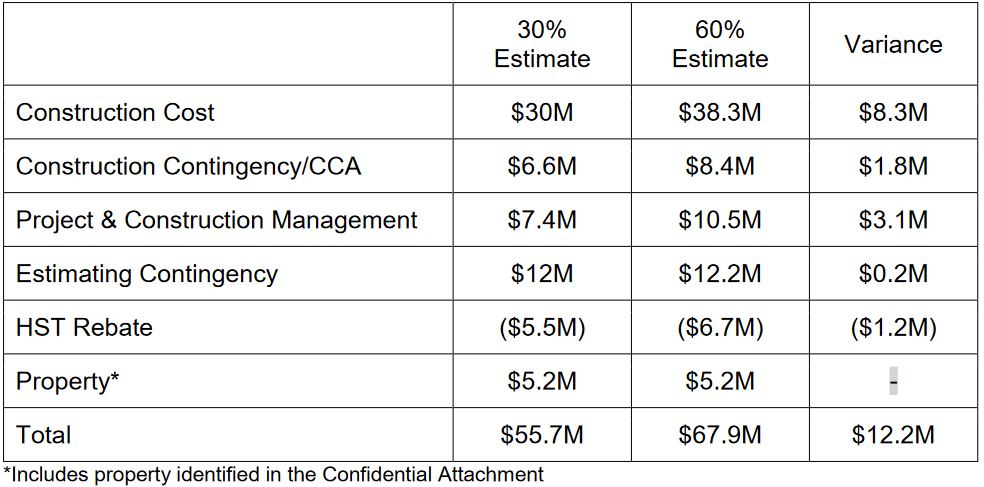
Total cost is now forecast at $67.9 million, up $12.2 million from the earlier estimate of $55.7 million which is part of the TTC’s 2024 Capital Budget. Of this, $4.3 million is due to the Metrolinx barrier, and $4 million goes for a grab-bag of items that appear to have been omitted in the original estimate. This increase is compounded by other cost lines which are calculated as a percentage of the base.
A far more important source of delay was the foot dragging by Council and the former Mayor about funding the design work which should have been finished by now, but sits at the 60% stage. Essentially Council sat on its hands crying out for Provincial money as part of the subway extension project, and the busway just sat waiting for aid that never arrived from Queen’s Park.
There has certainly been no sense of urgency to get design finished and construction underway as quickly as possible.
The delay, cost increase and a sense that travel time savings might be less than expected have combined to raise the question “why do it at all”. This can be a self-fulfilling prophecy if those responsible for the project, including the politicians, really did not have their hearts in the idea. There is no quicker way to sandbag a project than to deny critical funding, watch the price rise and the due date vanish into the misty future.
While awaiting a formal funding approval, the TTC will redirect $15.2 million from other capital projects to pay for enabling works and property acquisition. This can proceed in parallel with the remaining detailed design and TPAP.
Performance of the 903 service to Centennial College east of STC (Scarborough Town Centre)
Travel times between STC and Ellesmere & Midland
A review of terminal layover times at Kennedy Station
The screenlines for arrivals and departures at Kennedy Station have been moved from Eglinton at Midland and at Kennedy to points on Eglinton just east and west of the loop entrances. This ensures that any delays at the intersections are counted in travel time, not in terminal time. The change has been applied retroactively to charts for September through November.
Correction: References to a 934 Progress Express should have been to route 913. This has been corrected. Thanks to a reader for pointing out this gaffe.
This article is a preliminary look at the service offered by the 903 express bus which replaced Line 3 SRT.
Until Saturday, November 18, the 903 buses provided very frequent service between Scarborough Town Centre and Kennedy Station. On Sunday, November 19, eight other routes were extended from STC to Kennedy Station, the 903 was extended to Centennial College replacing the 134/913 Progress bus, and much existing service on route 903 was reallocated to the extended routes.
I will review the other routes serving this corridor in early 2024 when they have accumulated a few months’ experience.
Travel Times
The charts here show how travel times between STC and Kennedy Station have changed over the past three months. The screenlines for these measurements are located:
Leaving STC Loop
Just north of Eglinton on Midland and on Kennedy
Note that this excludes time spent navigating roads and construction near Kennedy Station, and any time spent in STC Loop. I will review terminal operations when more data for all of the routes in this corridor have accumulated.
The charts below show monthly data, by week and hour, with North/Eastbound service on the left and South/Westbound service on the right. Note that there are no data for September, Week 1 because the service was provided with untracked extras until the schedule change on Labour Day weekend.
The solid lines show the average headways, and the dotted lines show the standard deviation, a measure of the scatter in the values. The closer the SD values are to zero, the more reliable the service is.
In the early weeks of operation, the transit priority measures were not in place, and service was more affected by traffic sharing the road. This settles down by November, although some peak period effects are still visible.
The TTC had anticipated that a trip between Kennedy Station and STC would take 15 to 18 minutes depending on conditions. Considering that the times shown below do not include access time to and from terminals, the service is close to the TTC’s target.
Service from November 19 Onward
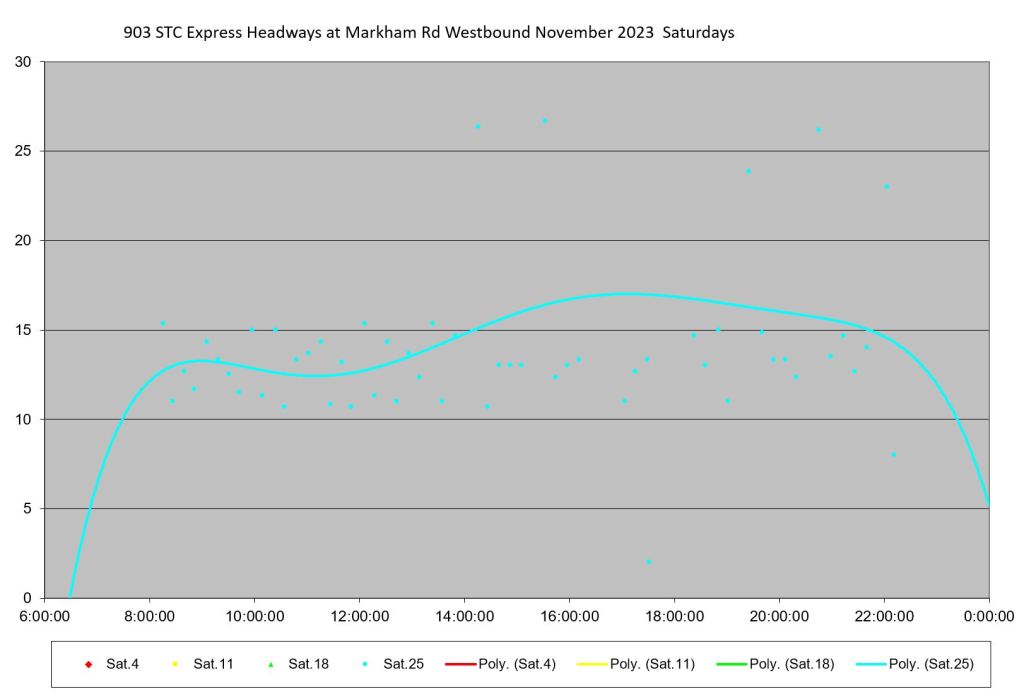
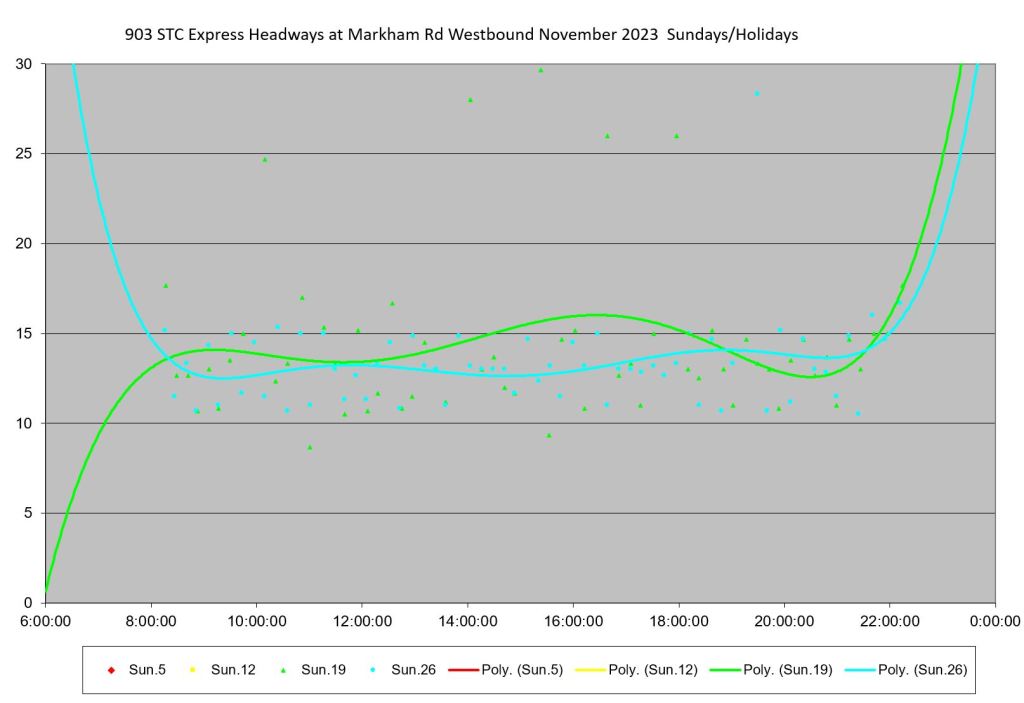
After November 19, the 903 STC Express became more typical of other routes with less frequent service. Variations show up that are similar to other parts of the system. The charts below show headways westbound at Progress and Markham Road, and northbound from Eglinton and Kennedy for the last two weeks of November. The scatter of data points shows the type of service that someone waiting for a 903 bus would experience.
Some data are missing on the morning of Friday, November 24.
Some of the wider headways (dots higher on the charts) have no correponding short headway (dot near the horizonal axis). This indicates that a bus was missing, as opposed to two buses running close together after a long gap.
The weekend charts at the south end of the line include data for the early part of the month when 903 service was much more frequent.
Although much of the weekend service stays close to the target headway, there are data points showing wide gaps where a bus was missing from the service. This is a concern for service east of STC to Centennial College.
The TTC is in a very difficult position for capital planning because for many years it understated the size of the capital backlog and also tended to treat related projects, or even components of the same project, as separate items. This led to low-balled estimates of total costs and, in some cases, piecemeal execution of projects. Now that we see “all in” costs, the problems facing the system are perceived more seriously, but just at a point when new money to invest in existing subways is hard to find.
Although the TTC called for proposals for a replacement of the Line 2 fleet of T1 trains, with add-on provisions for system expansion, this was cancelled in June 2023 due to lack of funding commitments from either the Provincial or Federal governments.
The report proposes three scenarios depending on when new trains and facilities would be delivered and built at total costs ranging from $8.5 to $10 billion including inflation. Very little of this has committed funding.
This is not just a question of buying new trains, but of building, or renewing, many facilities:
Greenwood Carhouse dates back to the opening of the BD subway and needs to be modernized and rebuilt to handle a new fleet.
The signal system on Line 2 dates to the 1960s and must be replaced both to maintain reliability, improve operations and provide for service growth.
Additional trains for both Lines 1 and 2 will require more storage including a major new maintenance facility for Line 1.
The funding sought by this report does not include companion upgrades that have been flagged in the overall capital plan:
Running more frequent service requires more traction power on top of state of good repair work needed for both subway lines’ power systems.
More service means more passengers, and some key stations cannot handle additional demand between the platform and street without additional circulation capacity.
Moreover, there are major projects beyond subway fleet renewal that are either partly or totally unfunded even at the City level, never mind its partners:
Ongoing replacement of the bus fleet including electrification
Any provision for service growth to improve transit coverage and encourage a shift to transit riding especially in areas where it is not competitive with auto
LRT lines in the waterfront or Eglinton East
Platform screen doors to prevent access to track level
Even if the fleet and signal renewal for Line 2 finds much-needed financial support, this is only the beginning of the TTC’s search for capital, and I have not even mentioned the need for ongoing state of good repair.
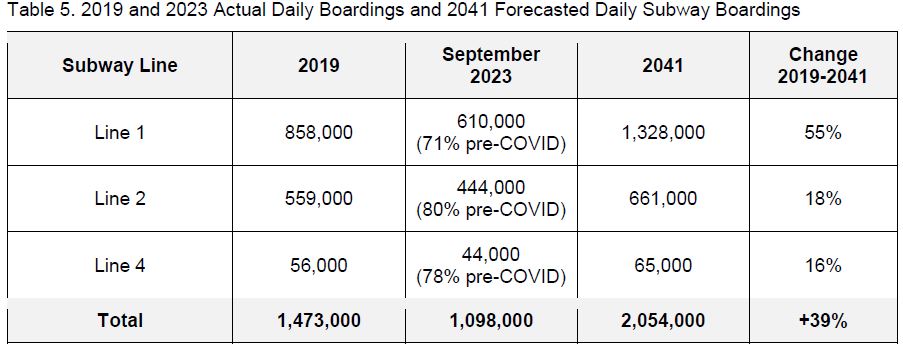
In the short term, the TTC has been “saved” from a capacity crisis by the covid pandemic and the loss of subway riding. Only a few years ago, the concern was not empty trains, but platforms full of riders who could not move. Although the subway is not back at full demand, recovery is well underway. Here are historical figures and projections for the future from the report.
2041 might sound a long way off, but in the scheme of subway fleet planning, it is fairly near given both the lead time to buy new trains and their 30-year design life. What we plan for today will affect the system for decades to come.
This forecast will be updated with results from the current Transportation Tomorrow Survey and other planning work to provide an outlook to 2051.
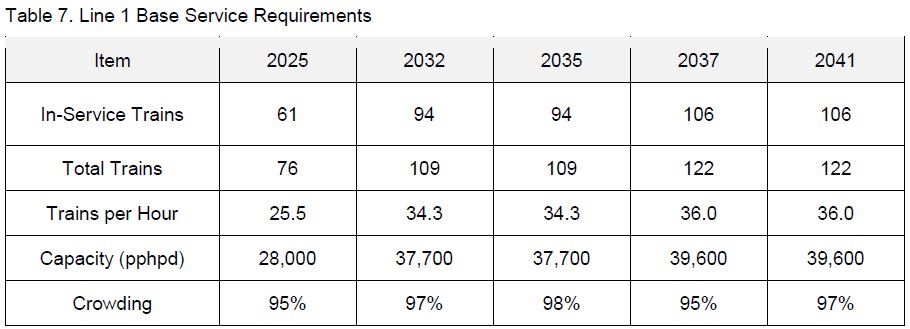
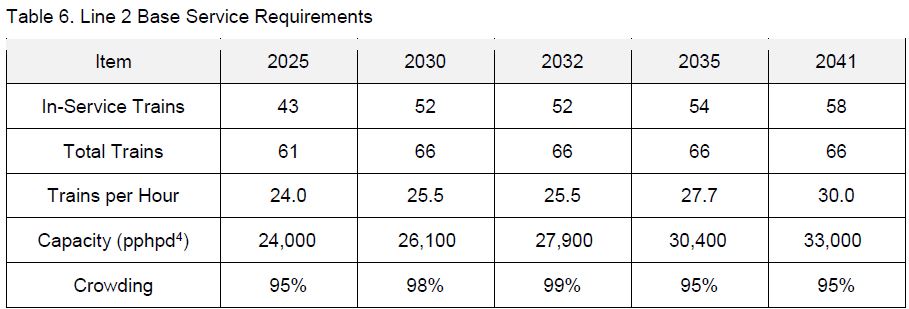
These projections translate to service requirements on the two lines. Note that this is likely based on the historical ratio of peak to all day demand. Although work-from-home may shift some riding away from peaks especially on Mondays and Fridays, this would still leave the midweek days facing crowding. It would be dangerous to make plans for lesser demand as a short-term cost saving measure.
Line 1 has already been converted to Automatic Train Control (ATC) with moving block signalling that can handle more trains/hour. Note that the projected Line 1 service is at 36 trains/hour, or every 100 seconds. This will be challenging to sustain especially at busy stations and terminals.
The current signal system on Line 2 cannot support headways below about 140 seconds, the pre-pandemic peak service level on that route. This is equivalent to 25.7 trains/hour which gets us only to the 2032 projected requirement.
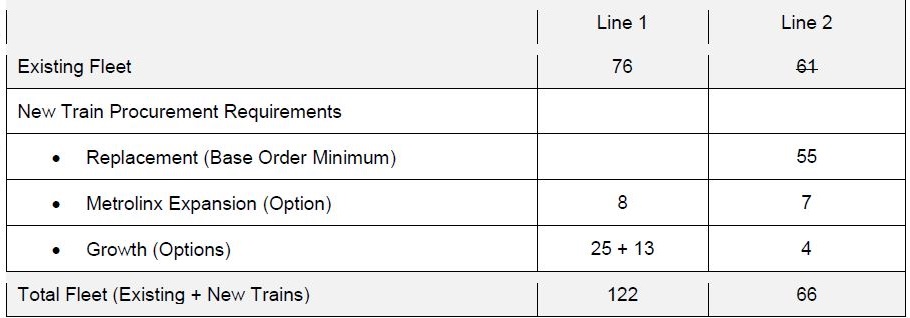
This translates into the following requirements for a larger fleet.
The 55-train replacement for Line 2 where there are now 61 trains is based on the capacity with new trains (similar to those now on Line 1) with about 10% more room than the old ones. This finally addresses the excess of T1 trains in the fleet ever since the TTC decided to run Lines 1 and 4 entirely with new “TR” trains and ATC, and relegated the T1 fleet to Line 2.
The Metrolinx options are for the Richmond Hill and Scarborough extensions. Growth trains are to permit the operation of more frequent service than the existing fleet can support.
Note that Line 4 Sheppard is not included here as it has a dedicated set of six 4-car trains that can handle projected growth on that line. Depending on the extension of Line 4, a future procurement of trains and storage facilities could be required.
In the remainder of this article, I will describe the scenarios and implications of choices the TTC, Council and its funding partners will make in the near future.
Recommendations
The report recommends that:
The TTC prioritize funding in the capital budget for:
New subway cars and related projects with a cost of $3.2 billion as the City’s share.
A 30-year state of good repair overhaul of the T1 fleet.
Risk mitigation activities for Line 2 related to fleet and signal system life extension.
Subject to confirmation of funding, the CEO issue an RFP for new trains needed on the existing Line 2 with options for extensions and demand growth on the system.
This will have effects not just for subway planning but for other TTC capital project funding and timing.
The TTC Board received a presentation at its September 26, 2023, meeting updating the information in the report published with the agenda. The first part deals with plans for the Line 3 bus replacement service and gives additional details beyond those previously announced.
The shift to using all of the Red Lanes on Ellesmere, Midland and Kennedy is planned for November 19.
The travel time today is considerably higher than when the RT was operating (second bar in the chart on the right below). This will be reduced with the elimination of transfers at STC between feeder routes and the 903 shuttle service together with the full transit priority implementation in mid-November. Further saving is expected when buses shift to a busway in the SRT corridor.
On November 19, eight routes will be extended to Kennedy Station to eliminate the need to transfer to the 903 shuttle.
The most disappointing part of the presentation is the timeline overview which shows the opening date for the busway in the SRT corridor as 2026. Design work is underway to be completed in 2024 with construction in 2025 aiming at a mid-2026 opening date.
This is a preliminary version based on GTFS data (the standard format for transit schedules used by online services) and some Service Advisories on the TTC site. I expect to receive the full list of September service changes early in the week of August 28 and will update this article accordingly including the usual detailed comparison of service levels.
Updated August 26 at 9:15 pm: 512 St. Clair updated to reflect complete bus replacement for work at various locations on the line.
Updated August 27 at 4:30 pm: At 10:30 am on August 28, the Mayor, TTC Chair and CEO will hold a press conference at STC Station to “outline how the TTC will increase service beginning September and into the fall.”
Updated August 29 at 5:30 pm: Due to changes in the Metrolinx schedule for work on the Lake Shore East Queen Street bridge, there has been a further revision of planned service. Please see this post for details.
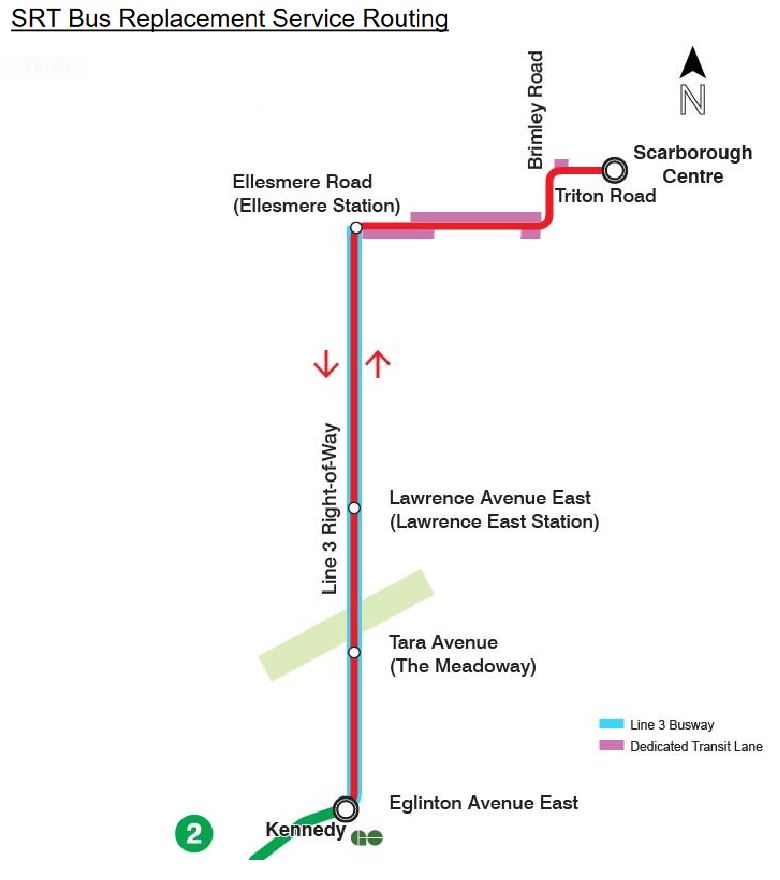
The TTC has announced that the SRT will not reopen and that the focus will now be on the replacement bus service.
The review of the July 24 derailment is still underway and is unlikely to complete with much time left for remediating the condition of the SRT and restarting service for a short period before the planned November 18 shutdown.
The initial operation with reserved bus lanes is under construction with painted lane markings southbound on Midland and northbound on Kennedy between Eglinton and Ellesmere. Other work including red painted lanes, queue jump lanes and signal priority will be implemented in the next three months.
One problem caused by the unexpected early SRT shutdown is that the temporary bus terminal facilities at Kennedy Station are not yet completed. A interim terminal north of Kennedy Station will be used. Once the station reconfiguration is done, eight routes that now terminate at STC will be extended through to Kennedy Station to eliminate transfers.
This was part of the original plan for the SRT replacement service. The list of candidate routes for transfer elimination is 38 Highland Creek, 129 McCowan North, 131 Nugget, 133 Neilson, 134C Progress, 939 A/B Finch East Express, 954 Lawrence East Express, 985A Sheppard East Express [source: FAQ within Future of TTC’s Line 3 Scarborough].
According to the press release, the TTC is working to remove the existing SRT infrastructure and build the replacement bus roadway sooner than the original plan that stretched out two years. An updated target date has not been announced, buy the TTC’s recognition that this roadway is urgently required is a welcome change.
A larger issue critical to review of TTC’s maintenance plans is whether the derailment is a “one of” event, or if there has been a general decline in TTC maintenance across the system. This is directly tied to capital and operating budget planning for 2024 and beyond.








 Steve Munro