TTC Confirms SRT Will Not Reopen, Plans Bus Improvements

The TTC has announced that the SRT will not reopen and that the focus will now be on the replacement bus service.

The review of the July 24 derailment is still underway and is unlikely to complete with much time left for remediating the condition of the SRT and restarting service for a short period before the planned November 18 shutdown.

The initial operation with reserved bus lanes is under construction with painted lane markings southbound on Midland and northbound on Kennedy between Eglinton and Ellesmere. Other work including red painted lanes, queue jump lanes and signal priority will be implemented in the next three months.

One problem caused by the unexpected early SRT shutdown is that the temporary bus terminal facilities at Kennedy Station are not yet completed. A interim terminal north of Kennedy Station will be used. Once the station reconfiguration is done, eight routes that now terminate at STC will be extended through to Kennedy Station to eliminate transfers.

This was part of the original plan for the SRT replacement service. The list of candidate routes for transfer elimination is 38 Highland Creek, 129 McCowan North, 131 Nugget, 133 Neilson, 134C Progress, 939 A/B Finch East Express, 954 Lawrence East Express, 985A Sheppard East Express [source: FAQ within Future of TTC’s Line 3 Scarborough].

According to the press release, the TTC is working to remove the existing SRT infrastructure and build the replacement bus roadway sooner than the original plan that stretched out two years. An updated target date has not been announced, buy the TTC’s recognition that this roadway is urgently required is a welcome change.

A larger issue critical to review of TTC’s maintenance plans is whether the derailment is a “one of” event, or if there has been a general decline in TTC maintenance across the system. This is directly tied to capital and operating budget planning for 2024 and beyond.

The Scarborough RT Derailment

On Monday, July 24 at 6:45, a southbound SRT train was leaving Ellesmere Station when its rear car derailed. This was not simply a case of slipping off of the tracks, but a more complex incident in which:

  • The rear car of the train broke away from the other three cars.
  • The truck (or bogie, the undercarriage holding the wheels and motor) at the rear of this car was detached from the car.
  • A section of the reaction rail which is part of the propulsion system broke away from the guideway.

The car came to rest with one end leaning against the guideway’s fence and a low sidewall. Fortunately, this is a location where a derailed car could not fall any distance.

Five passengers were taken to hospital with minor injuries.

The line remains closed with shuttle buses ferrying riders, and the TTC has announced that the line will remain closed for at least three weeks pending an investigation of the cause of this accident. That will take us until at least mid-August.

It is not certain if the line, which was planned to shut down permanently in mid-November, will ever re-open depending on the cause of the derailment, the amount and cost of work to remediate it, and the limited time during which this expense would have any benefit.

Updated July 27 at 10:20pm: The proposed schedule for the SRT right-of-way conversion to a busway has been added to the article to clarify that “Winter 2025” really means the end, not the beginning, of 2025.

For the convenience of readers, especially those out of town who might not have followed this event in detail, here are links to many articles which include a wealth of photos.

City TV

CP24

Global News

Toronto Star

Spacing

  • Technical Difficulties: The Scarborough RT accident was absolutely predictable as policy-makers and riders have been aware of it’s deterioration for almost 20 years

CBC

Continue reading

TTC Cancels RFP For New Subway Trains (Updated)

A Request for Proposals for new subway trains has been cancelled due to lack of funding. The following notice was sent to all vendors on Friday, June 23:

The Toronto Transit Commission issued a Request for Proposals (RFP) on October 13, 2022 for the procurement of New Subway Trains.

The RFP indicated that the TTC was in the process of actively pursuing additional funding from other orders of government (Provincial and Federal), and that contract award was subject to receiving full funding commitments by early 2023. As detailed in item 1.2.2 – Funding Status of Part 1 – Invitation and Submission Instructions of the RFP document: “Timelines associated with this RFP have been communicated to potential funding partners, and a request for confirmation of funding by early 2023 has been requested. In order to receive the NST deliveries in time for the legacy fleet replacement and to meet growth needs, the TTC has elected to commence the procurement at this time, however, contract award is subject to receiving full funding commitments.”

Unfortunately, the additional funding required has not been secured and as such, TTC is cancelling the RFP effective immediately, and the Bonfire Portal will be closed.

The TTC will continue to have discussions with the Provincial and Federal governments on funding requirements for New Subway Trains and evaluate the requirements for issuance of a future Request for Pre-Qualification and Request for Proposals in the future.

Where this leaves future projects for enhancement of Line 2 Bloor-Danforth, conversion to Automatic Train Control and provision of full service on the Scarborough Subway Extension is anyone’s guess.

This is a project which was initially delayed by CEO Rick Leary in favour of a fleet rebuild, then reactivated as his attitude to the worth of ATC warmed with the success of the Line 1 conversion, a project very much the work of his predecessor Andy Byford and his team. The focus on spending for new lines has left major state of good repair such as fleet renewal high and dry, and this RFP cancellation show where that shortsighted policy has brought us.

I have reached out to TTC Media Relations for comment. This post will be updated as more information becomes available.

Updated June 26, 2023 at 3:45 pm

The TTC replied to my query for comment with the following:

As the posting says (or should), the purchase of the cars is contingent on funding being secured.

That has not yet happened, although discussions are ongoing.

This was about being transparent with bidders and letting them know that once funding is secure, we would re-post.

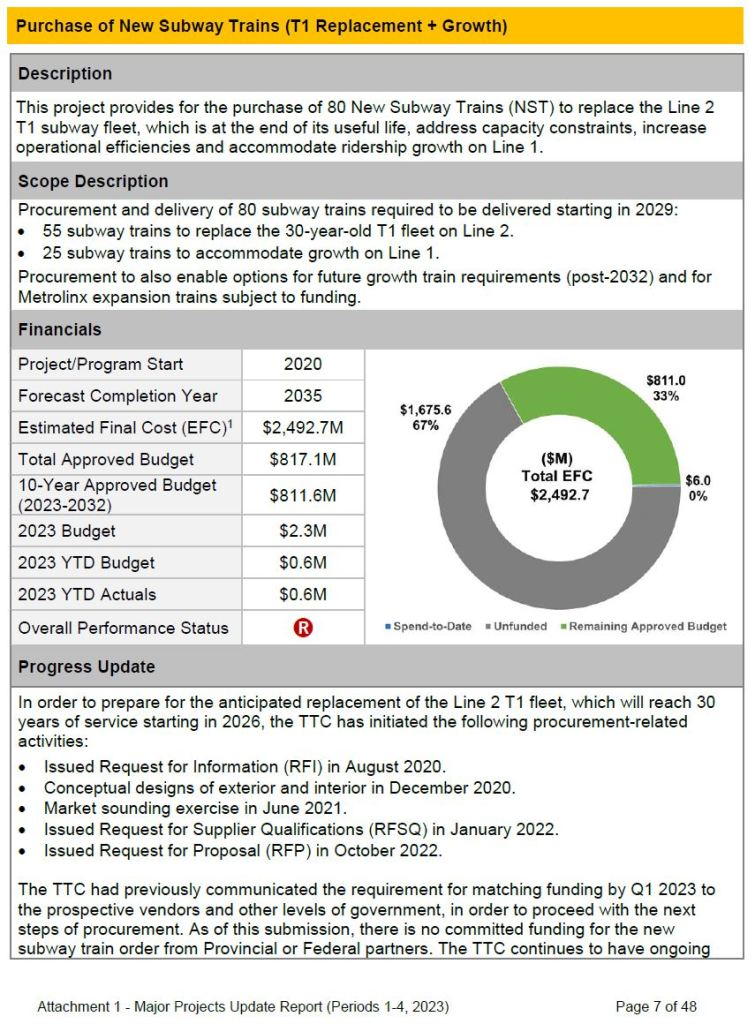
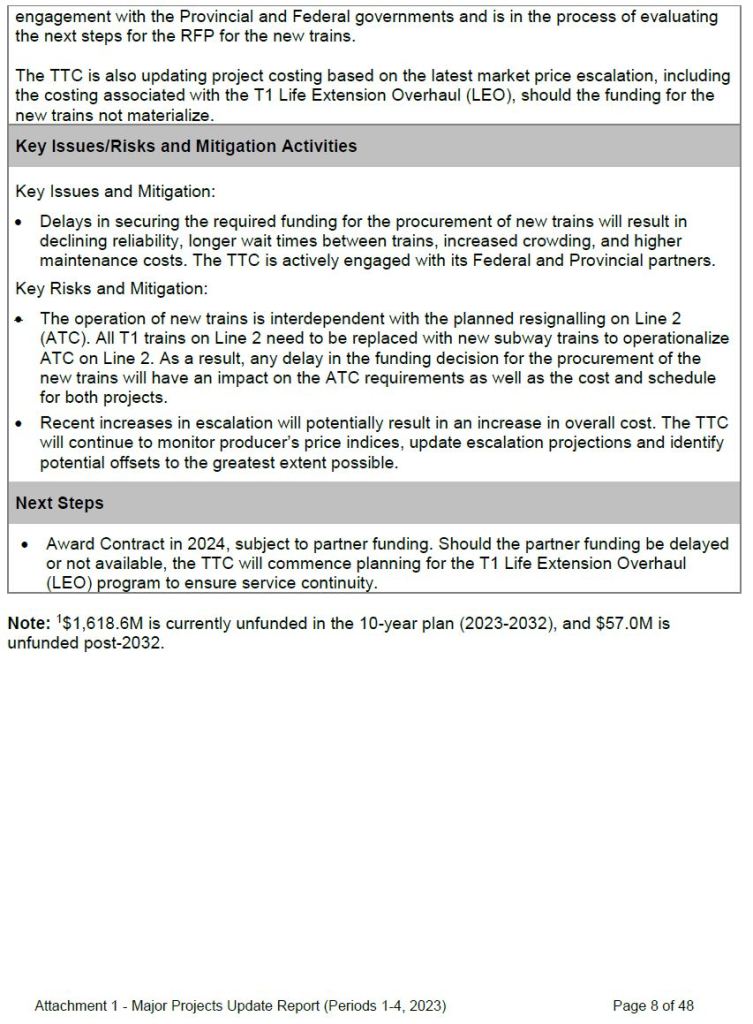
It is worth noting that as recently as the TTC Board meeting of June 12, 2023, there was no mention in the public session that this action was imminent. Here are the relevant pages from the Major Projects Update.

Updated June 26, 2023 at 5:00 pm

How many trains will the Scarborough Subway Extension require?

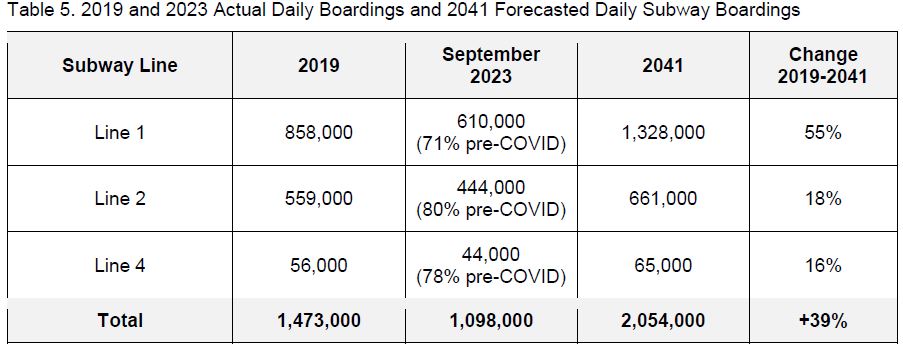
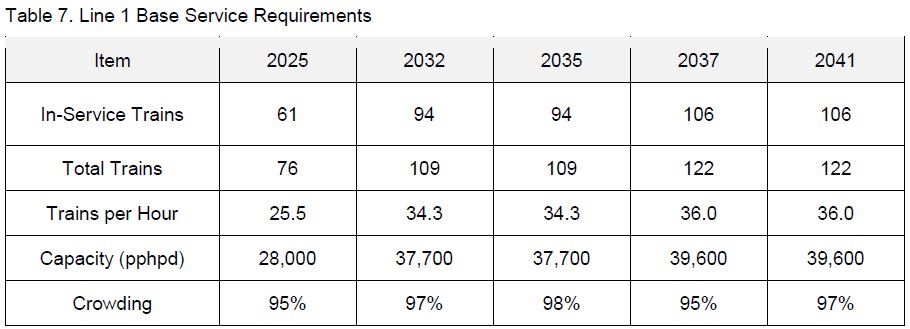
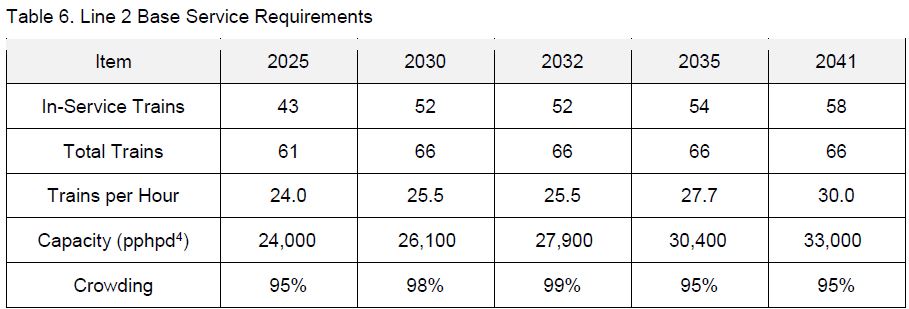
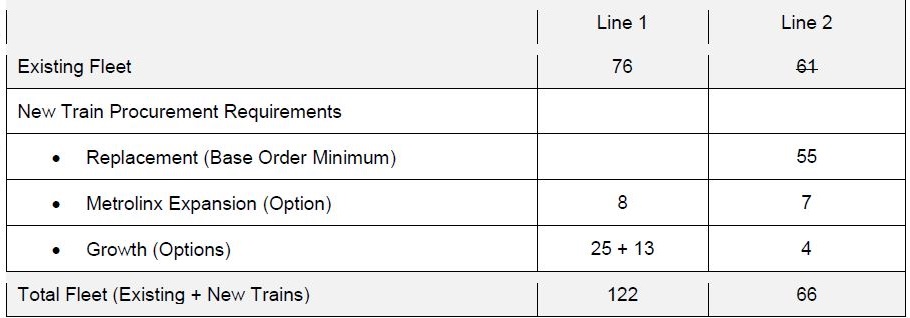
The TTC owns 370 cars in the T1 fleet which operates Line 2. That is equivalent to 61 6-car trains plus four spare cars.

The scheduled AM peak round trip time on the existing Line 2 is 105 minutes. For the maximum service possible with the existing signal and train control system, one train every 140 seconds, requires 45 trains. That was the AM Peak scheduled service in January 2020 before the pandemic-related service cuts. One additional train was on standby as a “gap” train for a total of 46. Allowing for spares at 20%, this requires a fleet of about 55 trains leaving only 6 spare for expansion.

The Scarborough extension is only marginally longer than the Line 1 extension from Eglinton to Finch with similar station spacing. A one-way trip on that part of Line 1 takes about 12 minutes, or 24 for the round trip. By analogy, that would make the round trip on the extended Line 2 about 129 minutes, and would required 55 trains with nothing left over for extras. Including spares at 20% would require a fleet larger than the TTC now owns.

Alternately, if every second train short turns at Kennedy Station leaving a 280 second service (4’40”) to Sheppard East, the line could probably operate with 50 trains which just fits within what is available.

One might argue that with a new fleet and the benefits of Automatic Train Control, overall speed could be improved and with that the fleet needed for full service to Sheppard could be reduced. But that is moot if TTC maintains the existing fleet.

When the SSE was planned, it had a pocket track east of Kennedy Station, but this was cut to save money, then it was restored. I wonder if someone is counting trains, or just hedging their bets on service levels beyond the existing terminus?

In any event, a failure to buy new trains has the double effect that it will condemn Line 2 to manual operation with an aging signal system for the foreseeable future, and will prevent the operation of full service beyond Kennedy in peak periods unless the Bloor-Danforth line never returns to the pre-pandemic peak service level.

TTC Transit Network Expansion: February 2023 Update

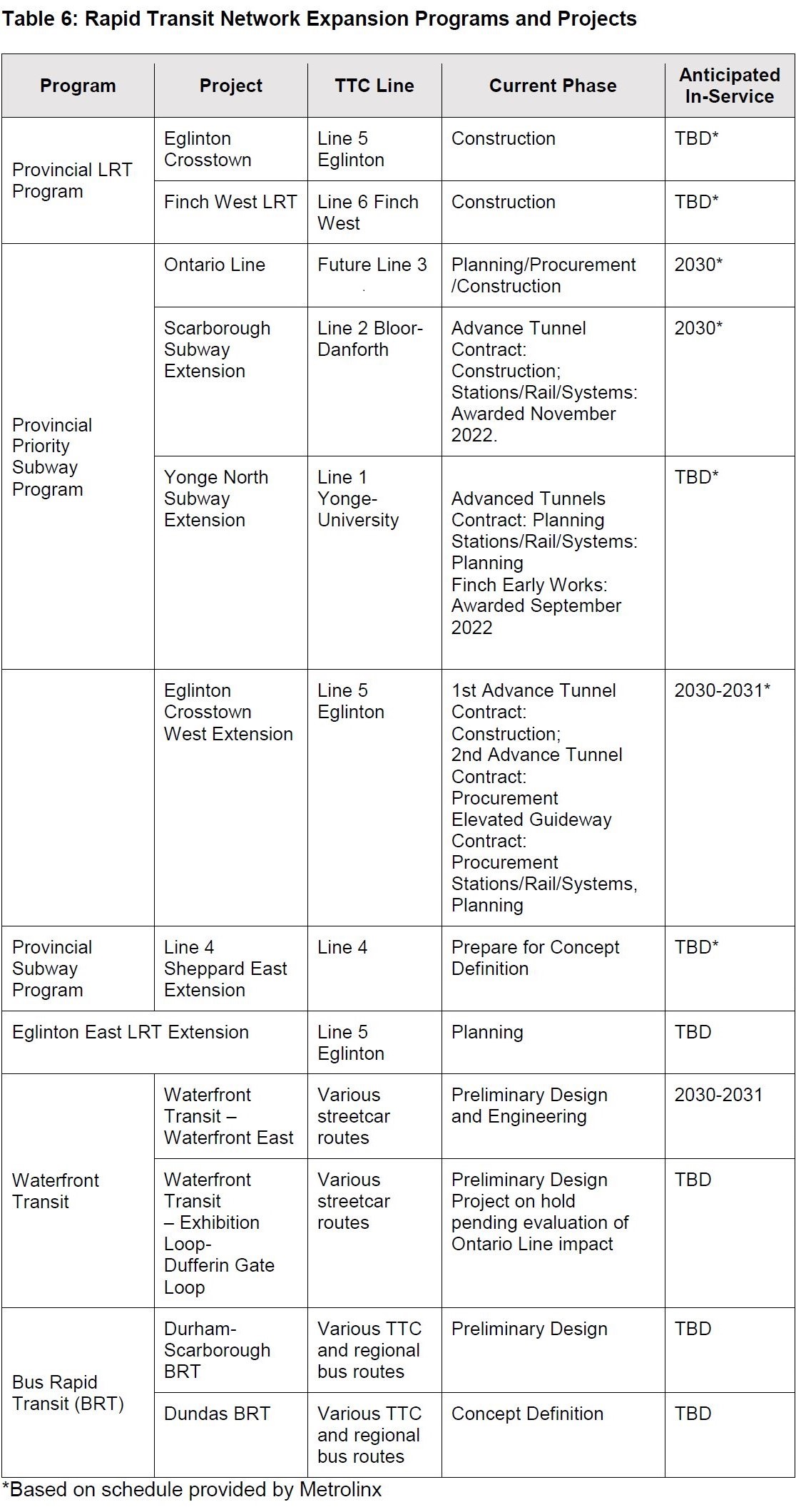
At its meeting on February 28, the TTC Board will receive a report summarizing the status of most of the rapid transit plans in Toronto. This article condenses the TTC report and reorders some sections to group related items together.

Dominant among many projects are, of course, the “big four” provincial projects: Ontario Line, Scarborough Subway, Yonge North Subway, and Eglinton West LRT extension.

Project Status Overview

The effect of major projects elbowing everything else aside is clear in the table below. Some projects do not have in service dates because they are not funded, and the timing of that (when and if it occurs) will determine when various lines can open.

Not shown in this table are several major projects that pop up from time to time:

  • Bloor-Yonge Station Expansion
  • Waterfront West LRT from Dufferin to The Queensway
  • Bloor West subway extension
  • New Line 2 fleet and yard at Kipling (Obico yard property)
  • Sheppard East subway extension
  • Platform Edge Doors

Of these, only the Bloor-Yonge project has funding, and some are only a glimmer in various politicians’ eyes.

Continue reading

Tracking Metrolinx Project Costs

The Province of Ontario is not exactly transparent when it comes to reconciliation of announced project costs and actual spending, let along the changes that might occur along the way. A project, or group of projects, might be announced with a value in then-current dollars, and without necessarily including all future contract costs. There are various reasons behind this approach including:

  • The government does not want to tip its hand on the amount of money “on the table” to prospective bidders who might tailor their bid to the perceived level of funding.
  • Some contracts include future operating and maintenance costs as well as capital costs. In some case the announced cost does not include the O&M component, only the estimated capital portion.
  • Provincial projects are typically quoted in then-current dollars with future inflation to be added as it occurs, at least to the point where there is a contract in place which includes that provision.

This approach hides the likely as-spent costs and makes provincially run projects appear cheaper, at least in the short run.

This is fundamentally different from the way the City of Toronto tracks projects and how TTC requirements are reported. Specifically:

  • City project cost estimates include inflation to completion because this is factored into future funding requirements.
  • City projects do not bundle future operating costs with capital, but report them separately.

Note that cost estimates shown in the Infrastructure Ontario market reports do not necessarily match values shown by Metrolinx because IO shows these values on a different basis. Future operating and financing costs are no longer included in IO estimates so that a project’s value reflects only design and construction costs, a value that gives potential construction bidders a general size of the project’s scope.

Infrastructure Ontario notes on the November 2022 Market Update that we have modified the methodology used to calculate the estimated costs as presented on the chart. In May 2022, and for Market Updates prior to that, we used the Estimated Total Capital Costs. For the latest update, and going forward, the costs listed only include Design and Construction costs.

These changes were adopted after feedback from our construction industry partners found that including only design and construction costs provided them with a better sense of the scope of the project and would assist in determining if they wished to participate in the bidding process.

Email from Ian McConachie, Infrastructure Ontario, Manager, Media Relations & Communications, November 24, 2022.

This can be confusing with “bundled” projects such as the Ontario Line RSSOM contract which includes both provision/construction of vehicles and infrastructure, as well as future O&M costs. This is probably the reason, or a good chunk of it, for the very large increase in the RSSOM contract value between the initial estimate cited by IO and the contract award. However, the way these contracts are handled generally makes it impossible to know how much of the change is simply due to inflation in materials and labour costs, and how much is due to underestimates or scope changes.

Continue reading

Infrastructure Ontario Procurement Update: November 2022

Infrastructure Ontario has issued an update on its various projects in procurement. I have been tracking the transit projects for some time, and the table linked below shows how they have evolved.

My last article on the subject was for the January 2022 update, but I skipped May because so little had changed. This article (and the table) reflect changes in the May and November bulletins.

Updated Nov 22/22 at 7:20 pm: The status tracking table has been updated to correct the date for the Ontario Line Pape Tunnel project.

IO Status Tracking November 2022

Some of the changes in this update are quite substantial.

Ontario Line

The North Civil, Stations and Tunnel contract previously included both the tunnel segment from Gerrard north to the Don River, the bridge over the river, and the elevated structure north to Eglinton. This has now been split into two separate contracts.

  • Elevated Guideway and Stations
  • Pape Tunnel and Underground Stations

Each of these projects is shown with an estimated cost of $1-2 billion, compared to $3 billion for the combined version.

In May 2022, the North Civil contract execution date was July-Sept 2024.

The Elevated Guideway and Stations contract is now shown in two stages with the Development Phase Agreement (DPA) in Jan-Mar 2024 and the Project Agreement (PA) in Jan-March 2025.

The Pape Tunnel and Underground Stations contract is now shown with a DPA of Jan-Mar 2024 and a PA in July-Sept 2026. [Corrected]

There is no indication of the effect these changes will have on the opening date.

The Rolling Stock, System Operations and Maintenance (RSSOM) contract was awarded in November 2022. In previous updates it was estimated at “>$2B” (greater than $2 billion), but was awarded at a value of $9 billion.

The South Civil, Stations and Tunnel contract was also awarded in November 2022, In previous updates it was estimated at “>$4B”, but was awarded at a value of $6 billion.

Line 2 (Scarborough) Subway Extension

The Stations, Railway and Systems contract project agreement (PA) date was previously cited as Jan-Mar 2024, but this has been changed to July-Sept 2024.

The tunnel contract was awarded in May 2021 and is already underway.

Line 1 (Yonge North) Subway Extension

The tunnel contract Request for Qualifications issue date has slipped from Jan-Mar 2022 in the January 2022 update to Jan-Mar 2023 in the November update. For some reason, the estimated cost has gone down from $2-4 billion to $1-2 billion. I have asked Infrastructure Ontario to clarify this.

The Request for Proposal issue date was supposed to be Jul-Sept 2022, but is now Apr-June 2023.

Contract execution has slipped from July-Sept 2023 to Apr-June 2024. It is not clear what effect this will have on the planned opening date.

Eglinton-Crosstown West Extension

This project has four components:

  • The tunnel contract for the segment from Renforth to Scarlett was awarded in May 2021.
  • The tunnel contract for the segment from Jane to Mount Dennis closed its RFP process in November 2022. Award is expected in Jan-Mar 2023.
  • The elevated structure between the two tunnels is in a separate contract now at the RFQ stage.
  • The Stations, Railway and System contract has not been issued yet.

Lines In Planning

Three lines are in the planning stage only with one added in the May 2022 update:

  • Line 4 (Sheppard East) Subway Extension
  • Hamilton LRT
  • Eglinton West Crosstown Airport Segment (new in May 2022)

GO Expansion

All of the contracts for the expansion program have now been awarded, and they will not appear in the IO updates.

TTC 2023 Annual Service Plan, Round 2

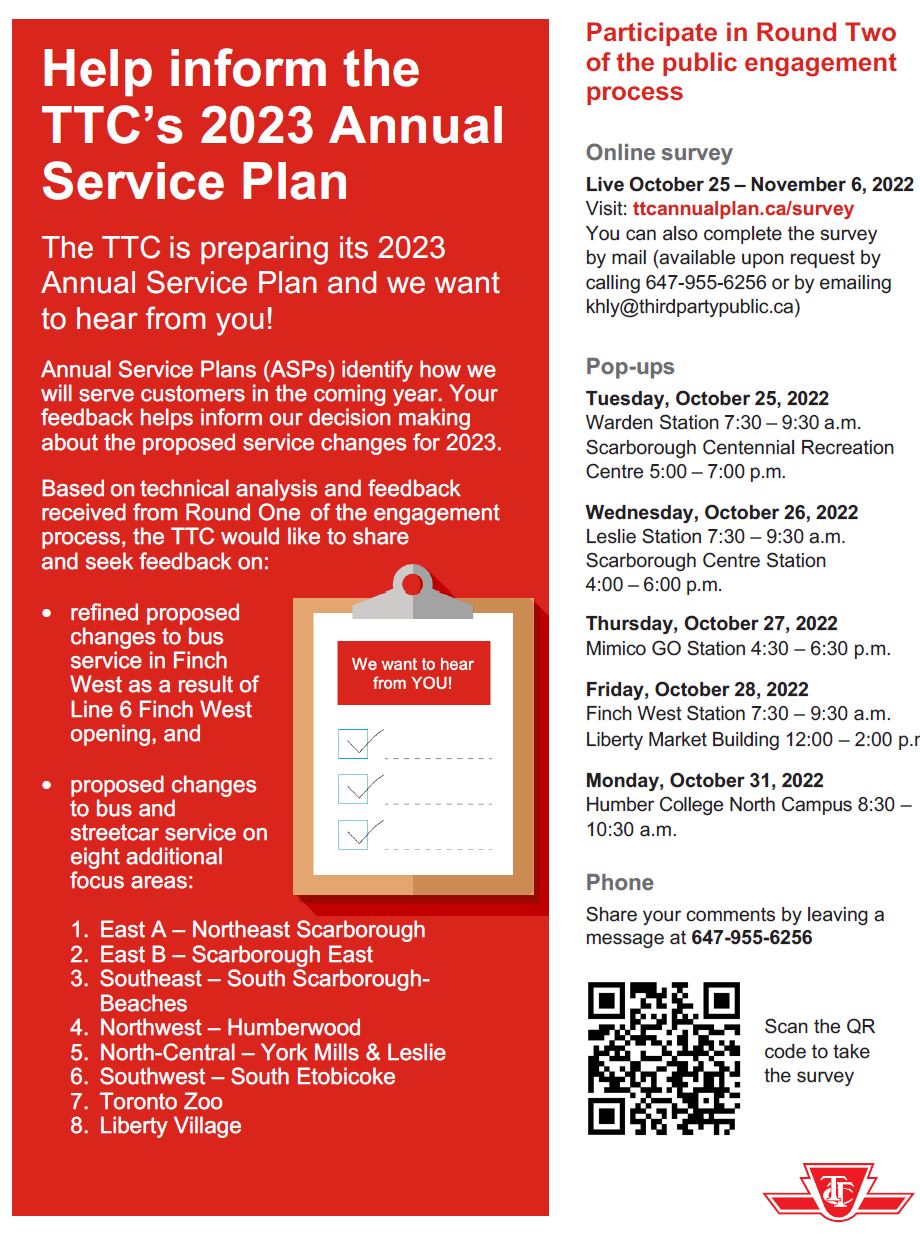
The TTC recently launched public consultation for its 2023 Annual Service Plan (ASP).

This is the second round following preliminary sessions in June-July. The planners reviewed overall goals in light of changing demand patterns and system-wide rerouting associated with the closing of Line 3 SRT and opening of Line 6 Finch West. (The network changes for Line 5 Eglinton Crosstown were dealt with in the 2022 ASP, although there has been slight tweaking.)

Some of the 2022 Plan’s proposals have not yet been implemented, although they remain on the books as “approved”:

  • 8 Broadview: Extension south from O’Connor to Coxwell Station
  • 118 Thistle Down: Extension northwest to Claireport Crescent
  • 150 Eastern: A new route from downtown to Woodbine Loop (on hold due to potential construction disruptions)

See also:

In 2023, there are considerably more proposed changes than in 2022, and for the purpose of consultation the TTC broke the system into segments. Each of these is detailed later in this article.

Consultation is now underway with the following planned schedule:

  • October-November: Public consultation. (See schedule above.)
  • Late 2022/Early 2023: Councillor briefings
  • February 2023: Final report to the TTC Board
  • Spring 2023: Implementation begins
  • Through 2023: Five Year Service Plan “reset” continues

The 2023 Annual Service Plan web page includes a deck of panels that will be used for the consultations. In this article, some maps are taken from that deck, and some from presentations to community groups.

An online consultation is available from October 25 to November 6.

One key point we will not know until late 2022 or even early 2023 will be the TTC’s budget target. How will this shape service changes, be they additions, re-allocations or cuts? Mayor Tory talks about supporting transit, but we will see just what this means when he tables the City’s 2023 budget.

Note: I have not included all of the information posted by the TTC here, and I urge readers to review the presentation panels and any other information the TTC publishes as this process goes on.

Although this article is open for comment, is you have specific concerns and wish to participate in the consultation process, be sure to complete the TTC’s survey or otherwise communicate your feelings to the TTC. I am not the TTC Planning Department, and grousing to me, or proposing your own maps here will not feed into the process.

Continue reading

TTC Board Meeting: July 14, 2022

The TTC Board held its last scheduled meeting of the current term on July 14. Barring an emergency requiring a special meeting, the next regular meeting will follow reconstitution of the Board after the municipal election in the Fall.

Some items on the agenda have already been covered in previous articles:

This article covers:

  • The CEO’s Report
  • Outsourcing of non-revenue automotive vehicle and equipment maintenance
  • Automatic Train Control for Line 1 Yonge-University
  • Five and ten year service plans
  • Transit network expansion update

I will review the Green Bus program update in a separate article.

CEO’s Report

The CEO’s Report contains many charts purporting to show the operation of the system. Unfortunately some of these hide as much as they tell by giving a simplistic view of the system.

I have already written about the wide discrepancy between actual short turning of vehicles and the reported number. A distortion this major calls into question the accuracy and honesty of other metrics in the report.

In a future article, I will turn to the appropriateness of various metrics, but here are some key areas:

  • Averages do not represent conditions riders experience. Data that are consolidated across hours, days, locations and routes hide the prevalence of disruptions. Service that is fairly good on average can be terrible for riders who try to use it at the wrong time.
  • Values for some metrics are reported with capped charts that show only that a target is met, but not by how much it was exceeded. This gives no indication of the room to improve the target value, nor of the variation that could make a higher target difficult to achieve consistently.
  • Reliability is shown only for vehicles that actually operate in service, but there is no measure of actual fleet utilization and the headroom for service growth using available buses, streetcars and subway trains.

In discussion of the report, Commissioner Carroll noted that the TTC still has a problem with on time performance for streetcars. CEO Rick Leary replied that there is an On Time Performance team who are looking at details including recognition that there are three types of routes: those that run well, those affected by construction and those with other problems.

Carroll replied that people are quick to complain about King Street and wondering why they are still waiting for the 504. The TTC says that construction is the reason, but do they have a strategy to deal with bunching and communicate with riders. Management replied that they have strategies for keeping riders informed during planned diversions, but for unplanned emergencies there are service alerts. Changes are coming and service should improve.

This discussion was frustrating to hear because, first off, the central part of 504 King between Dufferin and Parliament is not affected by construction. Only the outer ends in Parkdale/Roncesvalles and on Broadview have (or had until recently) bus shuttles. As for keeping riders informed, irregular service plagues all routes in the system as I have documented in articles here many times. The problem is line management, or the absence of it.

On another topic, Carroll noted that the TTC seems to have a lower standard for the condition of stations than it does for vehicles, or at least tracks the latter at more detail. Leary replied that a summer blitz using student workers will scrub down all stations to bring the system back to a better quality for riders returning in the Fall.

Continue reading

Scarborough RT Express Bus Replacement Plan

After extensive study and public consultation, TTC staff will present a plan for bus replacement of the Scarborough RT to their Board at its April 14, 2022 meeting. Although it is a long report, much of it has appeared before during the consultative process and in an interim report to the Board. Interested readers can browse the full version, and I will only touch on the major points here.

My apologies for the resolution on some of the drawings included here. The versions in the TTC report online are not good, but if better renditions show up in the future, I will replace the originals here.

The Scarborough RT is on its last legs and, frankly, should have been replaced years ago. Let us not get into the whole subway/LRT debate as that train has left the station. However, the constant delay in making any decision has now pushed the opening of any replacement service well beyond the reasonable lifetime of the existing SRT fleet, and even that will require work to keep it operating until bus facilities are ready.

Various dates for the SRT shutdown are proposed, and these depend on completion of alternate bus terminal facilities. Thanksgiving weekend would certainly be an ironic cutover date.

The candidate dates for Q4 2023 would mean the last day of train service could be: Saturday October 14, 2023; or, Saturday November 25, 2023. If construction is complete ahead of schedule, a September closure date could also be possible, on Saturday September 2, 2023.

TTC Report at p. 15

The Recommended Option

When the need to close the SRT before the Scarborough Subway Extension opened became apparent, the first thought was that riders would be consigned to buses plying the roads from Scarborough Town Centre to Kennedy Station for many years.

To no great surprise, there was a better idea that emerged during the consultations: use as much of the existing SRT right-of-way as possible for a bus roadway bypassing local street and intersection congestion and providing a direct access to Kennedy Station. That is the scheme that has been recommended, named in the report “Option 1 Hybrid Line 3 ROW” (Right-of-way).

As shown in the map below, the bus service will operate from STC station to Kennedy on street to Ellesmere Station and then on a new road in the existing SRT right-of-way to Kennedy Station. Stops will roughly match the existing SRT, except for McCowan. A new stop will be added at Tara Avenue, ironically a proposed station location decades ago when the SRT was to be built as a conventional LRT line.

The frequency of service is such that aggressive transit priority measures will be needed for the on-street portion.

Continue reading

Infrastructure Ontario October 2021 Update

Infrastructure Ontario (IO) has issued its project status update for fall 2021 together with an overview letter from their CEO, Michael Lindsay.

Little has changed in the transit projects, but IO and Metrolinx are shifting away from their original, much-ballyhooed model where public contract risk was minimized by a transfer to the private sector. Instead there is more talk about collaboration and mechanisms to make contracts more palatable to would-be bidders. It is no secret that a few years ago a major firm refused to bid on Metrolinx work on the proposed terms.

Building on the experience of the collaborative Alliance model in use for the Union Station Enhancement Project, IO’s partnership with Metrolinx to expand the GTHA’s network of public transit continues to advance and evolve. Last month, Metrolinx and IO launched the RFQ for the Scarborough Subway Extension – Stations, Rail, and Systems project, introducing a Progressive Design-Build approach. Like the Progressive P3 procurement strategy being introduced on hospital projects, the subway extension procurement includes the benefits of working with a partner on design work, addressing and avoiding considerable contract risk prior to signing a final contract to deliver the project. Following considerable discussion and consultation with industry, this complex, multi-billion-dollar project will be contracted as a targeted price versus the fixed price of our P3 models.

Like our contract packaging strategy for both Scarborough Subway Extension and Eglinton Crosstown West Extension, we expect to take a multi-package staged approach of delivering the Yonge North Subway Extension. That work would begin with an advance tunnels package that we expect to be procured using a classic DBF contract. Pending government approval, our hope is to have the RFQ for that procurement in market early next year.

Letter from Michael Lindsay, CEO of IO, October 14, 2021

The update contains projects from multiple ministries and agencies, and I have extracted the transit projects in the table linked below. This table shows the status of each project as it appears in the quarterly IO updates with the current changes highlighted in yellow.

Changes in this interation are:

  • The structure of the Scarborough Subway Extension has been changed from “TBD” to “Progressive Design Build” where first a partner is chosen with a Development Phase Agreement, and then a Project Agreement once design reaches the point of locking in the construction phase. Note that “Design Build” does not include operation and maintenance as the SSE will be part of the TTC’s subway system.
  • The Yonge North Subway Extension to Richmond Hill has slipped slightly for issuance of the Request for Qualifications and of the Request for Proposals, but this is offset by moving the contract award up from Fall to Summer 2023.

Several GO Transit projects are listed for award in 2021, but they have not yet been announced.

Beyond the works already in progress, no transit projects are up for award before Fall 2022. This means that if the Ford government is re-elected, they will have batch of ready-to-go announcements, but if not, there would be a last ditch chance to review some contracts either as to content (project details) or future operating principles (private vs public). Whether a Liberal or NDP government (or a coalition) would do this remains to be seen.