Another Scarborough Subway Boondoggle?

The Star’s Ben Spurr reports that the Glen Andrews Community Association in Scarborough has proposed yet another variant on the Scarborough Subway, and that this is supported by Councillor Glenn De Baeremaeker and provincial Minister (and former Councillor) Brad Duguid. City Planning staff are already engaged in reviewing this proposal without any direction to do so from Council, according to Spurr’s article.
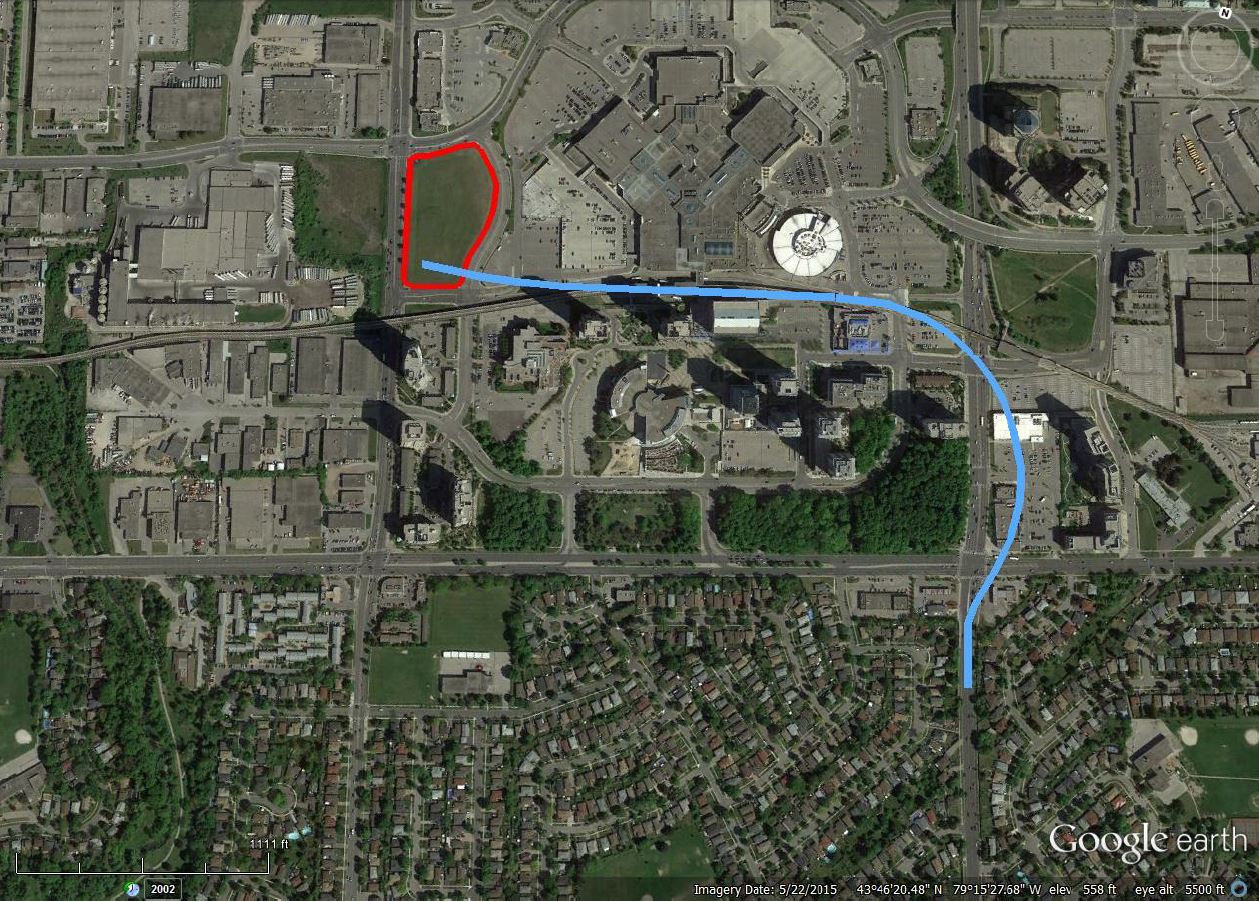
glenandrewcommassn_bigbendmap

The scheme, nicknamed the “Big Bend” would enter Scarborough Town Centre on an east-west axis rather than the north-south route proposed by the TTC. It would veer east at Ellesmere and then make a wide turn bringing the route under the existing RT through the STC station area and continue to vacant space on the east side of Brimley. This open area would be used as the staging area for the tunnel construction akin to the sites on the Crosstown project at Black Creek and at Brentcliffe.

This would avoid creation of a staging area for the subway tunnel near Ellesmere and McCowan and limit the need to expropriate lands for the subway and a new station, but it would also leave the subway aligned in a way that would allow eventual westward extension to link with the Sheppard line.

Although this has been reported simply as a revised alignment, much more is involved in this proposal. Instead of twin tunnels, the TTC’s typical construction method, a single 12m to 13m bore would be used, one that could accommodate station structures within the tunnel and eliminate (or at least reduce) the need for surface excavation such as we have seen on the TYSSE station projects. The technical side of this scheme was put forward by Michael Schatz, Managing Director of engineering company Hatch (a portion of the former Hatch Mott Macdonald) which shows up from time to time as a consultant to the TTC and GO Transit. Whether this is an official company proposal, or a personal scheme, or some sort of “business development”, is hard to say. There is no reference to this proposal on the company’s website.

As for the politicians, De Baeremaeker in Council and Duguid behind the scenes at Queen’s Park have been meddling in the LRT/subway debate for some time. De Baeremaeker’s initial motivation appeared to be avoiding an election attack by a Ford stand-in challenging his dedication to Scarborough’s manifest subway destiny. Duguid’s role raises questions about who sets transportation policy in Kathleen Wynne’s government and just how much real commitment there is to any of the LRT schemes in Toronto beyond the Crosstown project now under construction.

At yesterday’s TTC Board meeting, De Baeremaeker was noticeably silent on this proposal, but instead focused on the need to get construction underway and end the delays which push up the project’s cost. (For a $3.6 billion project, inflation at 4%, the rate used by the TTC, adds $144m/year, or $12m per month plus the sunk cost of having the project team sit around working on alternative designs until Council makes a decision.)

This is not simply a case of looking at an alternative design for the STC area, but of reviewing the entire line. The larger tunnel would be dug at a different elevation, and the manner in which it would link to the existing structure at Kennedy, not to mention how it will co-exist with the planned eastern extension of the Crosstown LRT, must be worked out. Terminal operations for a pair of stacked platforms at STC also need to be designed if the TTC intends to run all service through to that point.

This represents a considerable delay. It was intriguing that GDB did not mention this proposal at today’s TTC meeting and in fact held to the idea of getting politics out of the way and letting the project proceed.

The Community Association appears to have conflicting goals for their proposal:

And at the end of all this we have a ‘dead end’ subway.

  • A subway that can never be extended to the east if/when demand justified an extension to Centennial College or Malvern or U of T.
  • A subway that City Planners say ‘should not’ be extended north to the Sheppard.
  • A subway that cannot be turned north west toward the huge concentrations of potential TTC riders in the Kennedy-Sheppard area. [p. 2]

And if we are really into city building, true long term thinking, here’s a huge advantage: building The Big Curve means that the subway is not ‘dead ended’ at Scarborough Centre. It turns northwest. The ‘tail track’ points toward the huge concentration of potential TTC riders already in place and with more on the way in the Kennedy-Sheppard area. It points toward the Agincourt GO-Smart Track Station. It is in the approved alignment of the Sheppard Subway to our Centre. It has a future! [pp. 6-7]

It is self evident that if the subway is going to Agincourt and Don Mills, it is most certainly not going to Centennial College, Malvern or UofT. There may be Scarborough Subway Champions now at Queen’s Park (the Liberal’s Mitzie Hunter and the Tory’s Raymond Cho), but the proposed Big Bend line will never come near their ridings in eastern Scarborough.

The Sheppard connection proposal has been around for years, and is a leftover from Rob Ford’s mayoral campaign. De Baeremaeker’s recent comments disparaging the Relief Line take on a new meaning in the context of a politician looking to plunder the capital budget to suit his own ends. It is quite clear that with this outlook, the Sheppard LRT will never be built even though it still appears on official provincial maps. So much for Queen’s Park’s “commitment” to eastern Scarborough.

The single bore tunnel will be quite deep both for structural reasons related to its size and to stay out of the way of utilities. At STC station, the idea is that a deep station would be built within the tunnel under the existing bus loop thereby avoiding the need for a completely new terminal. However, the vertical difference would pose a transfer time penalty, an amusing situation when one considers the scorn heaped on the design of Kennedy Station’s SRT to subway link.

The tunnel option is presented as one that could proceed without the surface disruptions of conventional subway construction as practiced by the TTC. This is not entirely true.

At STC, it will be necessary to build large vertical shafts, at least two, linking from the surface down to the station itself. These must be long and wide enough to house emergency ventillation, stairs, escalators and elevators, and their surface footprint will be considerable. Whether such links can be built while the bus terminal remains in operation is hard to say, and more detailed design of this interface is needed

Similarly, if Lawrence East Station reappears, as the Community Association proposes, it will require access shafts from the surface down to the station. This is a difficult location because Highland Creek crosses McCowan here, but stations below the water table are not unheard of even in Toronto (see York Mills and Queens Quay for examples, although the latter is comparatively shallow). The press release argues that a Lawrence East Station would be cheaper with the single tunnel scheme than with a standard TTC cut-and-cover structure, but the real question is how much this station would add to the cost of a project which does not now include it.

Emergency exit shafts are required roughly between stations. Construction activity for one of these can be seen along Eglinton such as at Petman (east of Mt. Pleasant) where the access is dug down from the surface to tunnels that have already been built below the street. Just because there are no stations from Kennedy to STC does not mean that the space between them will be free of construction effects.

At STC, assuming that the existing bus terminal can remain in operation, there would be a saving on building its replacement. However, this is only one part of a more complex comparison that must be performed between the current TTC proposal’s design and whatever might develop from the Big Bend option. One cannot assume a “saving” until the relative cost and components of the two schemes are worked out.

The Community Association proposes that the tunnel launch site use existing green space on the west side of STC beside Brimley Road. By comparison with the sites on Eglinton at Black Creek and at Brentcliffe, this may not be large enough (especially considering its “long” dimension runs north-south), but that could be dealt with by temporarily closing an adjacent road and expanding into the existing parking lot.

The proposal includes a long list of items that could be avoided by the Big Bend option compared to what the TTC is likely to do, including ”

  • No need for a temporary bus terminal.
  • No need to buy a fleet of buses to carry SRT passengers.

Whether a temporary terminal can be avoided while construction of the links to a new station below it is underway remains to be seen. As for a fleet of buses for SRT passengers, that has nothing to do with the subway plan at all, unless the subway is built in the SRT corridor, an alignment the TTC has already rejected for other reasons.

It is ironic that this scheme only became possible once the City decided it could not afford to take the subway to Sheppard and cut the line back to STC. If there really were a desire to serve the area north of Highway 401 and east of STC, the subway would have gone there. Instead we are back to the Sheppard hookup proposal.

If Council really wants to reopen the entire debate, they need to be honest about what this will cost in time and dollars. Unless there is a change in funding from Ottawa and Queen’s Park, their contributions are fixed and any new costs are entirely on the City’s account. How many more years of the 1.6% Scarborough Subway Tax will be needed to pay for this? How will the return of the Sheppard Subway Extensions to the political field affect priorities for spending elsewhere in the City? How many more Councillors will cry that their wards “deserve” a subway?

Muddled into all of this is the status of SmartTrack which even though the brand name remains in use is really nothing more than a few local stops added to GO’s RER plans. Toronto will have to decide before the end of November (a Metrolinx imposed deadline) just how much it will shell out for additional “SmartTrack” infrastructure.

Councillors are quick to complain that transit project costs rise uncontrollably, but faced with the need to settle on a design so that it can be costed to a reliable level for budgets and construction, continue to pursue alternatives. No doubt the Big Bend proponents will want a cost estimate for their scheme in months so that a formal decision can be made.

If De Baeremaeker, Duguid and Tory have already decided that the Big Bend is the only scheme that will be acceptable, then the whole process of past years has been a sham. It is entirely possible that the Eglinton East LRT, the sweetener added to the Scarborough transit plan to make the subway more palatable, will simply fall off of the map and the money will all go to the subway project. This would be a brutal “bait and switch” for eastern Scarborough, but it would show the true colours of their “subway champions”.
Toronto Transit Plan Punted From Executive Committee

On October 26, 2016, Toronto’s Executive Committee was supposed to receive a report dealing with a wide range of transit issues.

… the City Manager will be providing a report to Executive Committee with recommendations on the Transit Network Plan, including information on cost-sharing discussions with the Province of Ontario on a range of transit projects, as directed by City Council in July 2016 (EX16.1). This report will also include an update on the planning and technical analysis for SmartTrack, Relief Line, and Scarborough Transit. Additional time is required to ensure proper consultation and coordination with relevant stakeholders including the Toronto Transit Commission, Province of Ontario and Metrolinx. [Placeholder item in the agenda]

This report is not yet available as discussions with Queen’s Park are ongoing. A deadline facing Council is that Metrolinx wants a commitment to specifics of SmartTrack work that will be bundled with the RER construction contracts that will go to tender early in 2017.

Given the time constraints, it is possible that the report will go directly to Council at its November 8 meeting. In theory, materials for the Council Meeting should be posted in advance, and for November 8, the usual deadline is only days away. Whether the materials are actually available in advance remains to be seen. This would put a major debate before Council with almost no advance briefing or public debate.

SmartTrack is not the only time constrained project as an updated transit plan and cost estimate for the Scarborough projects, not to mention a financing scheme for the entire package, needs to be dealt with so that work can begin. Any spending commitments will also affect the City’s budget which will be formally unveiled at the start of December.

As material becomes available, I will provide updates and commentary.


TTC Capital Program Review

Back in the early days of John Tory’s mayoralty, the 2015 budget discussions were overshadowed both by the legacy of the Ford administration and by major issues with project control at the TTC. From the Ford years, Tory inherited a mean-spirited attitude to transit spending and service cuts that the new mayor would come to reverse, for a time at least. A bigger issue, however, was the matter of runaway spending by the TTC on two major projects: the Spadina subway extension (aka TYSSE) and the resignalling contracts for the Yonge-University-Spadina subway (aka Line 1).

Even while the TTC’s CEO was coming to grips with these projects, Council passed a motion asking for a review of how the TTC was managing its business.

145. City Council direct the City Manager to issue a Request For Proposal to expedite a review of Toronto Transit Commission Capital program service delivery including:

a. a review of project management of Toronto Transit Commission Major Capital Projects in the past five years to determine actual project costs and completion dates relative to original schedules and estimated costs;

b. a review of staff reporting mechanisms to the Toronto Transit Commission and City Council related to capital project budget and completion date status; and

c. future organizational options for Transit project management and delivery of Major Capital projects related to Transit expansion and major State of Good Repair projects.

146. City Council direct the City Manager to co-ordinate the review in Part 145 above with the Chief Executive Officer, Toronto Transit Commission and to report to the Toronto Transit Commission no later than the November 23, 2015 Board meeting. [Item EX 3.4 Council meeting of March 10, 2015]

In the fullness of time, considerably later than the November 2015 date in the motion, a report from KPMG landed on the TTC Board’s agenda, the TTC Capital Program Review. This was supplemented at the meeting by a presentation from KPMG and a response from CEO Andy Byford.

The terms of reference for KPMG’s work were somewhat different from the Council motion.

KPMG’s scope was as follows:

  • review project management practices at the TTC with respect to the delivery of the Capital Program, and provide recommendations to staff that will assist the organization to improve capabilities for managing capital projects and programs. The TTC Capital Program Review seeks to achieve the following goals:
  • Improve the organization’s project and program management performance by learning from past experience;
  • Support continuous improvement efforts underway at the TTC, including the continued implementation of the TTC Portfolio Management Office (“PfMO”) established in 2014;
  • Assess project governance structure and protocols for reporting of project status, to ensure the appropriate level of transparency and accountability to project sponsors and stakeholders; and
  • Provide guidance on project delivery options and project management requirements for projects of varying size, scope, and complexity. [Presentation, p. 4]

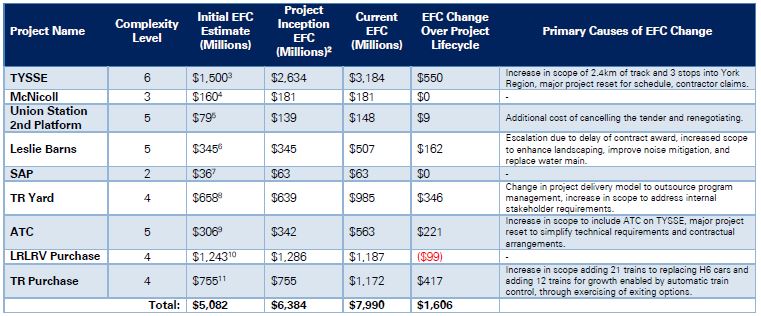
Item “a” of the Council motion asked for a comparison of actual costs and completion dates with original plans. KPMG does not provide this information, and even worse, included a table of selected projects that does not clearly explain their history (see below). There is no “deep dive” into any of the projects and, therefore, no specifics that could be tied to “lessons learned”, to practices that created the problem in the first place.

The table below is the closest the report comes to commenting on Council’s request, but read in isolation it can be misleading. It is ironic that in their presentation to the TTC Board, KPMG did not include this table and made no comment  on it. CEO Andy Byford was not so kind, and emphasized that most of the scope changes were perfectly legitimate.

kpmg_ttc_project_list

Other projects included in KPMG’s review but not in the table above were:

  • Fuel Storage Tank Replacements
  • Subway Station Easier Access Phase III
  • Surface Track
  • On Grade Paving

Of these, only the Easier Access program was flagged as “Challenged” with the others as “Successful”, but the reason for the EAP’s status likely has more to do with the complexity of later stages of the work and a lack of funding than with project management and controls. [See Table 1 at pp. 20-21 of KPMG’s report]

Two of these (track and paving) are the only “Ongoing” programs reviewed by KPMG. These are fundamentally different from “Finite” projects such as the construction of a line or the retrofit of elevators to stations. I will return to this distinction later.

This is a dangerous table in that it shows an apparent growth from $5 billion to almost $8 billion in project costs, a 60% increase.  That was the easy headline in media coverage of this report, and the sort of simplistic comparison that some members of Council would seize on as symptomatic of “waste” at the TTC. Scope change appears as a “primary cause” in five of these projects, but not all such changes arise from the same circumstances.

  • TYSSE’s cost grew due to inflation between the original estimate and the eventual approval of the project, and of course because the line was extended from York University to Vaughan Centre.
  • There was a considerable delay between the approval and actual start of work thanks to foot-dragging by senior governments in finalizing their contribution agreements. No adjustment to the completion date nor allowance for inflation was added to the estimate.
  • Politicians along the line wanted showcase stations, not the standard TTC boxes, and much of the contingency in the project’s budget was consumed by unexpectedly high bids for these structures.
  • The TYSSE project suffered from poor organization with many contractors on competing deadlines. This arose in part because the prevailing wisdom at the time was that work should be parceled out in small enough pieces that multiple mid-size contractors could bid. This arrangement was more a political decision than a technical one.
  • The original project did not foresee a conversion to Automatic Train Control (ATC) because that was not part of the TTC’s plans at the time. This item was added after the fact under a separate project budget, but this work added yet another layer of complexity to overlaps between many subsystem installation contracts.
  • The original fleet plan for TYSSE included the continued use of a portion of the older T1 fleet on the YUS with most, but not all, of the trains coming from the new TR order. After the decision to implement ATC, the T1s were no longer suitable because of the high cost of retrofitting ATC to them, and the TR contract grew accordingly. The TTC has a surplus of T1s, but no place to use them, including the proposed Scarborough subway which will also have ATC. The planned opening date for the SSE occurs well before the planned completion of the replacement of the T1s, a project that will have to be accelerated shifting spending into earlier years than planned.
  • The TTC now has a much larger subway car fleet than foreseen a decade ago thanks to the T1 surplus and cars for improved service under ATC that will not actually be used until 2019 and beyond when the ATC project completes. Additional space will be needed for the T1 replacements that will require concurrent storage space and a significantly different carhouse design from Greenwood Shops. These projects are not yet funded, and are not fully included in the cost estimates for the SSE.
  • The TR purchase, like all TTC vehicle contracts, includes a base order plus an option for additional vehicles. This is a standard arrangement for procurement because the TTC never receives full funding for its plans in one go, and circumstances change causing quantities to go up, or occasionally down. The complete order now includes enough trains for the complete replacement of non-ATC capable trains on YUS, conversion of the Sheppard subway from T1 to TR operation, the Spadina extension to Vaughan and additional trains to run more frequent service once ATC is in use on YUS.
  • The ATC contract evolved out of a dog’s breakfast of plans for new signalling on the YUS. Originally, the plan was simply to replace the aging block signal system on the original part of the line. However, funding for this could only be obtained by misrepresenting necessary maintenance work as something that would enable additional capacity. Eventually, the project grew to have at least two overlapping technologies being installed at the same time so that non-ATC operations could co-exist on an ATC line. This proved unworkable, and the contracts were consolidated into a single ATC project. The extra costs are a direct result of, first, underscoping the project for political reasons, and later from a failure to appreciate the technical complexity of what was being attempted.

The above are only the high points of a much more complex history (available in the linked articles), but what should be evident is that major projects interact with each other even though they are almost always discussed as if they are completely separate entities. This is a major problem in TTC budgeting and in the political context where such projects are debated. KPMG hints at this problem in its review, but does not drag any details out into the open.

The following discussion can only touch on the full report of 273 pages, and is intended to place the report more in the political context of the TTC Board and Council (and through them to the ongoing debates about TTC funding) than KPMG which tended to focus on internal issues of process.

Continue reading

TTC Service Changes Effective Sunday, September 4, 2016 (Updated)

Updated August 15, 2016: The detailed table of service changes has been added to this article.

September 2016 will see a return to the “winter” schedules on most TTC routes. Despite talk of service cuts in the budget process, the new schedules include some improvements to correct for operational problems on a few routes, and to better handle existing demand. The scheduled mileage for September is actually above the budget level due to greater than anticipated requirements for diversions and extra vehicles to deal with construction projects.

2016.09.04 Service Changes

Continue reading

Council Approves Tory Transit Plan, Attempts Pet Project Revivals

Toronto Council has approved the transit plan for Toronto featuring Mayor John Tory’s SmartTrack line and the Scarborough Subway after a long debate on July 14, 2016. Notwithstanding severe problems with financial pressures and the blind faith needed to expect that the entire package can actually be funded, Council added a few pet projects that never quite fade from view thanks to the efforts of individual members.

LRT proposals for Eglinton East and West survived the vote largely because they are part of larger packages – SmartTrack in the west, and the Scarborough Subway Extension in the east. The subway debate has so polarized camps that “LRT” is synonymous with third class transit simply because it was the heart of the “non subway” option. Without the bitterness of the SSE that required subway advocates to paint LRT in the worst possible light, its potential role in Toronto’s future network might not have been so poisoned while other cities embrace this mode.

Staff recommendations in the report were amended in some respects, and a few new clauses were added, notably one asking for City staff to pursue a co-fare arrangement with GO Transit.

The Waterfront Transit Reset report is a separate agenda item and, at the time of writing, Council has not yet dealt with it.

The Finch West and Eglinton Crosstown LRT projects are under Metrolinx, and they are already underway to varying degrees.

Continue reading

Brimley: The Station That Never Was

In all the discussion about options for service to the Scarborough Town Centre, an important factor is the superiority of an east-west alignment through the area (which is itself an east-west rectangle). One subway station serves a node in the middle of the STC precinct, but an east-west line, especially with a technology where multiple stations are comparatively inexpensive, can do a better job of serving a future, developed town centre.

City Planning’s own reports say as much, but because discussion of the LRT option has been expunged from debates, we don’t hear how this might perform.

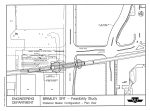
As a matter of historical interest, the original LRT proposal that predated the Scarborough RT by a decade included not only the three stations we have today – Midland, STC and McCowan – but also made provision for a future station at Brimley. The site would have been just east of the Bick’s pickle vats, for those who knew the area back when, on the west side of Brimley.

Some years later with the RT well established, local Councillors pressed for a Brimley Station. Council funded this and the TTC in due course produced a design. That’s as far as things ever got, and despite development near the station site, nothing more has ever come of the idea.

Brimley SRT Station Feasibility Study, January 2004:

Given its very light usage and difficulty of access, one might even argue that Ellesmere Station could be replaced by one at Brimley in any new design.

We will never know, because “LRT” in at least this corridor is a naughty word.

The Dwindling Capacity of the Yonge Subway

Yesterday’s launch by York Region of their Yonge Subway Now website brought to the fore the question of just how much room remains on the Yonge Subway for additional riders. Over many years, claims about capabilities of new subway technologies together with changing projections for future demand have left Toronto in a position where its subway is badly overloaded with little relief in sight.

This article traces the evolution of those claims and the reality of what can actually be provided to show that building a Relief Line is not a project for a future decade but one that must begin now.

Continue reading

York Region Wants a Subway, Overstates Available Capacity (Updated)

Updated July 6, 2016 at 5:10 pm: “Yonge Subway Now” has updated their website to remove the double counting of capacity improvements, and to clarify that their claims about subway capacity apply to the peak point south of Bloor Station. The revised text is included in the main article.

Although in theory there will remain 4% of free capacity on Yonge south of Bloor in 2031, this is hardly the sort of margin we should be planning for. The Relief Line’s demand projections show that it has a major effect if it runs north to Sheppard, and it will have to be in place sooner rather than later to avoid deadlock on the Yonge line.

A related problem is the question of station capacity to handle passengers with trains arriving about 30% more frequently than they do today.

York Region has wanted a subway to Richmond Hill for years, and there is even a completed Environmental Assessment and its Addendum for this project.

Today, July 5, 2016, a new website extolling the virtues of this project went live. It contains the usual things one would expect about the growing need for transportation and how a subway will improve the region’s future. Unfortunately, it also contains a misrepresentation of available and future subway capacity.

But what about overcrowding you say?

  • Metrolinx’s Yonge Relief Network Study analyzed options for crowding relief to the existing Yonge Subway line by examining new local and regional travel opportunities and improving mobility across the GTHA. Key findings include:
    • Significant relief to the Yonge Subway line will be achieved through already committed transit improvements, including:
      • TTC’s automatic train controls [adds 29% capacity];
      • New subway signals [adds 10% capacity];
      • New six-car subway trains [adds 10% capacity];
      • Toronto-York Spadina Subway Extension [adds 5% capacity]; and
      • Regional Express Rail/SmartTrack/DRL will add even more capacity.
    • With the above capacity improvements in place the Yonge Subway line will be running under capacity when it opens and beyond 2031.
    • The Yonge North Subway Extension only adds 9% demand at peak period.

Updated July 7: The text above was the original version. The page now reads:

But what about overcrowding you say?

  • Metrolinx’s Yonge Relief Network Study analyzed options for crowding relief to the existing Yonge Subway line by examining new local and regional travel opportunities and improving mobility across the GTHA. Key findings include:
    • Significant relief to the Yonge Subway line will be achieved through already committed transit improvements, including:
      • TTC’s automatic train controls [adds 29% capacity];
      • Toronto-York Spadina Subway Extension [diverts 1,300 riders to free up 5% capacity]; and
      • Regional Express Rail diverts 4,200 riders to free up 15% capacity.
    • With the above transit improvements in place the Yonge Subway line will be running under capacity when the extension opens in 2031.
    • The Yonge North Subway Extension has a projected ridership of 14,000 to 22,000, but is only expected to add 2,400 demand during the AM peak hour, at the peak point south of Bloor.

Let’s start off with the increased capacity for the Yonge Subway. The Metrolinx report cited here says (p 15) that the existing capacity is 28,000 passengers per hour per direction, and that by 2021 this will rise to 36,000.  That’s roughly a 29% increase, and is possible because of the new signal system which includes automatic train control. This will allow trains to run closer together, roughly every 110 seconds in place of the current 140 seconds.

Capacity of the new subway cars is already included in the 28k value as these trains have been exclusively providing service on the Yonge line for a few years. They no longer represent a marginal improvement that is still available. The design load for service planning (average loads over an hour, not peak loads on a train or car) for the new trains is 1,100 passengers. If trains run every 140 seconds, that is equivalent to 25.7 per hour or a capacity of about 28k/hour. Moving to a 110 second headway gives 32.7 trains/hour or a capacity of 36k/hour.

Traffic diverted to the TYSSE (Toronto York Spadina Subway Extension) at 5% of current capacity represents 1,400 per hour. This is in line with the value shown in the Metrolinx study (see chart below).

GO/RER has only a modest effect on the Yonge corridor because the Richmond Hill line is not part of the RER network, and other routes paralleling Yonge (the Barrie and Stouffville corridors) are too far away to have a meaningful impact. There is also the issue of the fare differential between GO/RER and the TTC which could discourage some riders from travelling on GO.

SmartTrack was originally claimed to be capable of subway-like service down to a 5 minute headway (12 trains/hour) that would serve Unionville and Milliken stations. However, we now know that “SmartTrack” will really be just a few more GO trains (part of the already planned RER improvement) stopping at a few more stations within Toronto, not the “subway like” operation some in York Region might have expected.

The Metrolinx study includes a chart showing the interaction of demand and capacity changes to 2031.

YongeNorthDemandProjection

The current 2015 demand is shown as higher than the actual capacity (31.2k vs 28.0k) based on the level of overcrowding now experienced on the line. The light blue dotted line shows the capacity before the new signal system is activated, and the solid blue line shows the added capacity. Even this will not be sufficient to handle the projected growth to 2031 absent other changes.

The TYSSE and other changes  are expected to shift 1,300 per hour from the Yonge line, and a further 4,200 would be attracted by GO/RER. This mostly, but not completely, offsets the anticipated growth so that by 2031 the “base case” demand is 32.3k, slightly higher than the demand today, but in less crowded conditions thanks to more trains/hour.

The Yonge North extension adds only 2,400 peak hour passengers and brings the line up to 96% capacity. Note that this is the peak hour average, and there will be some overcrowding due to variations over the hour.

This leaves no room for growth, but it also shows the paltry additional demand expected on a very expensive subway extension. Indeed, this makes the Scarborough extension to STC positively shine by comparison with 7,300 peak hour riders. The projected demand on the Richmond Hill line appears to be lower than the existing ridership of the SRT!

But things are really not that bad.

Those 2,400 are net new riders attracted by the subway in place of existing bus service. Total ridership will be a combination of then-current bus passengers feeding into Finch Station plus the 2,400 new riders.

Metrolinx shows that the “long” version of the Relief Line to Sheppard produces a sizeable reduction in projected demand on both the Yonge line and for the Bloor-Yonge transfer movements.

YongeReliefDemandEffects

If Metrolinx, Toronto and York Region are really serious about providing capacity for future extension and ridership growth on the Yonge Subway, then construction of a Relief Line is absolutely essential despite its cost.

Meanwhile, York Region should update its website to provide accurate claims about future changes to subway capacity. Blatant inaccuracy such as we see here are the marks of hucksterism designed to sell a project, not a professional representation of what is actually needed.

Update: The new version of the website addresses these issues, but I must wonder why the incorrect information appeared there in the first place.

Reviving the Scarborough LRT Proposal (Updated)

Updated July 5, 2016 at 8:00 am: Revised drawings for Kennedy Station have been added showing better detail of the the LRT lines and a temporary bus terminal. Minor textual changes have been made in the article including an observation that the scope of replacement costs for removing the existing SRT structures will vary depending on the timing of shutdown and the degree to which existing structures are adapted/recycled.

Updated at 8:45 am: The potential sources of cost overstatement for the updated LRT option have been summarized.

With the recently announced increase in the projected cost of the Scarborough Subway Extension, the question of reverting to the original LRT plan for Scarborough has surfaced again. It is no secret that I favour this plan, but the political environment has been so poisoned that discussion of the options is, mildly speaking, difficult. When the Mayor feels that he must imply racism in critics who are simply trying to advocate for their view of a better transit system, Toronto politics are at a new low. However, the implications of the LRT plan must be addressed on their merits, not on simplistic political comments unworthy of the Mayor’s office.

On June 29, the TTC issued a briefing note regarding the cost of the LRT option in the context of current events. The question here is whether the claims and assumptions behind this note are legitimate and represent what could be achieved with a “best effort”, as opposed to presenting a less attractive picture to give the impression that the LRT represents an unacceptable downside.

Continue reading

Property Taxes and Subway Financing

The financing of a new rapid transit project in Toronto is a complex business, and probably the most complex part of the whole thing is the effect this has on property taxes.

This article is intended as an introduction to how these taxes actually work. It is not an exhaustive review, and there are subtleties beyond my scope here.

This is an article for people who like the gory details, and so I will insert the break right here.

Continue reading