TTC Service Changes Effective Sunday, November 26, 2017

The November 2017 schedules bring only minor changes, with one big exception: trains on Line 1 will begin operating to Vaughan Metropolitan Centre Station, albeit as “ghosts” for training and testing. Revenue service will begin, using the same schedules, on Sunday, December 17, 2017.

The revised subway schedule preserves existing headways, more or less, including the AM peak short turn at Glencairn which is not being extended further north. Service beyond Glencairn in the AM peak will operate every 4’42”. In the PM peak, it will operate every 2’36” with no short turn.

Queen streetcars return between Neville and Sunnyside with no diversions. A date for return of service at least to Humber has not yet been announced. Service beyond Humber to Long Branch is planned for mid 2018 due to ongoing road reconstruction on Lake Shore Boulevard. Please see my article on the Queen West projects for more details on the status of this work.

2017.11.26_Service_Changes

The December 17, 2017 schedules will appear in a separate article. They include all of the surface route changes associated with opening the Vaughan subway extension, as well as plans for special schedules over the holiday period.

TTC Board Meeting October 16, 2017 (Updated)

The TTC Board will meet on October 16. Among items of interest on the agenda are:

Continue reading

SmartTrack Update: More Questions Than Answers (October 13 Update)

For the coming three evenings, October 10-12, the City of Toronto, Metrolinx and the TTC will host open houses to present and discuss plans for six new SmartTrack and two new GO Transit stations. Although material for all stations will be part of each event, stations “local” to each site will receive more emphasis than others.

Each meeting will run from 6:30 to 8:30 p.m., with a presentation at 7 p.m.

  • Tuesday, October 10, Scarborough Civic Centre, 150 Borough Dr.
  • Wednesday, October 11, Riverdale Collegiate Institute, 1094 Gerrard St. E.
  • Thursday, October 12, New Horizons Tower, 1140 Bloor St. W. (new location)

Note: The location of the Oct. 12 meeting has been changed and it is now across the street from the originally announced site (which was Bloor Collegiate).

Updated October 11 at 10:30 pm: There continues to be confusion about just what “SmartTrack” service will look like, and this is not helped by the City’s presentation. Details can be found in the June 2016 Metrolinx report. For further info, see the update at the end of this article.

Updated October 13 at noon: Metrolinx has confirmed that the Barrie corridor trains will operate through to Union Station, not terminate at Spadina/Bathurst Station as I had originally thought. However, the operational details have not yet been worked out. For further discussion, scroll down to the section on the Spadina/Bathurst Station.

I attended a media briefing that covered the materials to be presented and the following article is based on that briefing which was conducted by City of Toronto staff. Illustrations here are taken from the deck for the media briefing which is available on the City of Toronto’s site. Resolution of some images is constrained by the quality of data in the deck.

[In the interest of full disclosure: A “Stakeholder Advisory Committee” (or SAC) has already been meeting on this, and I was invited to participate, but declined given my concern with a potential conflict between “advisory” and “journalist/commentator” roles. It is no secret that I believe SmartTrack is a deeply flawed concept. Its implementation is compromised by fitting a poorly-conceived election promise into a workable, operational scheme for the commuter rail network. Any “debate” is skewed by the need to pretend that this is anything beyond campaign literature.]

The intent of these three meetings is to conduct the first detailed conversation about these stations with the general public. Early designs appeared in the “Initial Business Case” for the stations, but these have been revised both for technical and for philosophical reasons. Specifically:

  • The City does not want to build traditional GO stations dominated by parking.
  • The interface between the new stations and the transit network (both rapid transit and surface routes) should be optimized.
  • Strong pedestrian and cycling connections are required.
  • Stations should be close to main streets.
  • Stations should support other City objectives such as the West Toronto Railpath and parallel projects such as the St. Clair/Weston study now in progress.
  • Transit-oriented development should be possible at stations.

This is a list that to a typical GO Transit proposal in the 905 would be unrecognizable. GO Transit’s plan ever since its creation has been to serve auto-based commuting first and foremost with ever larger parking structures that poison the land around stations. Local transit was something GO, and later Metrolinx, simply “didn’t do”, and the idea that Queen’s Park might fund strong local transit as a feeder to GO services has been limited to co-fare arrangements.

The situation within Toronto is very different, and there are connecting routes on the TTC that individually carry a substantial proportion of the daily ridership of the entire GO network. Moreover, if GO (or SmartTrack, whatever it is called) will be a real benefit to TTC riders, then the process of getting people to and from stations must not depend on parking lots that are full before the morning peak is even completed.

The new stations will go into existing built-up areas, not into fields with sites determined primarily by which well-connected developer owns nearby property. Residents will be consulted about how these stations will fit their neighbourhoods, how they will be accessed, and what might eventually become of the community and future development.

A big problem facing those who would present “SmartTrack” to the public beyond City Hall insiders and neighbourhood activists is that almost nobody knows what SmartTrack actually is. This is a direct result of Mayor Tory running on a design that could not be achieved, and which has evolved a great deal since he announced it in May 2014. In brief, it is three GO corridors (Stouffville, Lake Shore East and Kitchener) plus an Eglinton West LRT extension, but this differs greatly from what was promised in the election.

Service levels for SmartTrack are described as every 6-10 minutes peak, with off-peak trains every 15, but this does not necessarily match Metrolinx’ announced service plans for their GO RER network onto which SmartTrack is overlaid. The idea that there would be extra SmartTrack trains added to the GO service was killed off in 2016 in the evaluation of possible operating modes for the corridor.

Fares on “SmartTrack” are supposed to be “TTC fares”, but this is a moving target. Voters understood the term to mean free transfer onto and off of SmartTrack trains as part of their TTC fare, but with all the talk of regional fare integration, it is far from clear just what a “TTC fare” will be by the time SmartTrack is operating.

Even that date appears to be a moving target. City Staff referred to 2025 when GO RER would be fully up and running as the target date for “integration”, but Mayor Tory still speaks of being able to ride SmartTrack by 2021 while he is presumably still in office to cut the ribbon.

At the briefing, many questions arose from the media, and the answer to almost all of them was “we don’t know yet”. It is clear that the Mayor’s plan has not proceeded beyond the half-baked stage, and many important details remain to be sorted out.

  • What is the status of Lawrence East Station and how does it fit with the recently announced review of this (and Kirby) stations by the Auditor General?
  • How will an expanded GO/ST presence at Lawrence East co-exist with the SRT which will operate until at least 2025, if not beyond to whenever the Scarborough Subway opens?
  • What are the arrangements for City/Province cost sharing on the stations, especially since Lawrence East was originally to be a GO station, but its future as such is unknown?
  • What will be the cost of the new stations once design reaches a level where the numbers are credible? The range of $700 million to $1.1 billion has not been updated since the matter was before Council.
  • Will all stations on the SmartTrack corridor honour ST fare arrangements regardless of whether this is a city-built station under the ST banner?
  • Why should GO riders who are not on the SmartTrack corridor pay regular GO fares, while those using the ST route have a “TTC fare” for their journey? The most obvious contrast in this case is between the existing Exhibition Station on the Lake Shore corridor and the proposed Liberty Village Station on the ST/Kitchener corridor, but there are many others.
  • What service levels will be provided, and how will they affect projected demand at the stations? Were previously published estimates based on more ST service than Metrolinx actually plans to  operate? How will constraints at Union affect the ability to through-route service between the Stouffville to the Weston/Kitchener corridors?
  • If the City wants more service than Metrolinx plans (assuming it would even fit on the available trackage), how much would Toronto have to pay Metrolinx to operate it?
  • Where are the residents and jobs that are expected to generate ST demand, and how convenient will access to the service actually be considering walking time, station geometry (stairs, tunnels, bridges, etc) and service frequency?

The stations under consideration are shown on the map below. A common question for all of these locations will be that of available capacity on the GO trains that will originate further out in the corridor. Without knowing the planned service design for “GO” trains and “SmartTrack” trains, it is unclear how often, if at all, there will be short-haul ST trains originating within Toronto as opposed to longer-haul GO trains from the 905. The availability of space on trains could affect the perceived service frequency if people cannot board at stations near Union (just as long-suffering riders of the King car complain about full streetcars).

Updated October 10, 2017 at 10:30 pm

After I posted this article, I realized that there was an important part missing, a commentary on the “consultation” process  itself.

A big problem with many attempts to seek public input is that the wrong question is posed, and factors are taken as given when they should be challenged. In the case of SmartTrack, the basic question is “why do we have SmartTrack at all”.

The original scheme was essentially a real estate ploy to make property in Markham and south of the Airport more valuable by linking both areas with a frequent rail service to downtown. Reverse commuters were a big potential market for this service. In the course of becoming part of the Tory election campaign, the focus turned inward, and SmartTrack became the line that would solve every transit problem. The claims about service frequency, fares and integration with other local and regional service were complete fantasies, but they gave the impression that Tory “had a plan” as distinct from the bumbling proposals of his opponent, Doug Ford, and the lackluster efforts of Olivia Chow. Tory even got professionals to declare his scheme a great idea, one giving it an “A+” on CBC’s Metro Morning, but this was for a version of SmartTrack that was unbuildable.

Now, over three years later, we are still faced with the myth that SmartTrack is a real plan, that it is anything more than what GO Transit would have done in the fullness of time. We are, in effect, being asked about the colour of tiles in stations when we should be asking whether the stations should even be built at all. There is no guarantee that service can be overlaid on GO’s existing plans to provide anywhere near what was promised in the campaign – a “surface subway”. Metrolinx has been quite firm on the subject, and going to the frequencies assumed by ST advocates would be well beyond the infrastructure we are likely to see on GO corridors.

The City will conduct its consultations, but the hard question – Why SmartTrack? – will never be asked.

For the October 11 update, please scroll to the end of the article.

Continue reading

How Clean Is My Station? (2017 Edition)

Recently, the Toronto Star ran an article with the headline “19 of Toronto’s 20 dirtiest subway stations are on the Bloor-Danforth line”. One could (mis)read that as implying that the BD line is some sort of cesspool of poorly maintained stations, while the YUS is a sparkling beacon. There is also an unfortunate echo of arguments made by some that the BD line gets second class treatment because of the people it serves.

Intrigued to learn what the details of station cleanliness scores actually looked like, I asked for a copy from the TTC, and this was provided by Stuart Green, a sidekick in TTC Communications of the better-known Brad Ross.

Green provided a few comments to flesh out the numbers:

You will see an obvious upward trend globally, notwithstanding a few peaks and valleys.

Andy [Byford] has made station cleanliness a priority and our customers have noticed. Our modernized station management model and the hard work of our frontline janitorial staff are making a tremendous difference.

In a subway environment, the TTC is one of the cleanest systems in the world (just visit NYC). Our customer satisfaction surveys also reflect customer appreciation for just how clean stations – and vehicles – are today over five years ago.

FYI, we are also in the process of procuring new equipment which can blast clean the terrazzo surfaces with much better results (see attached pic).

A few points…

The rating criteria is established by the TTC and provided to our external auditors.

The summary of it as follows:

  • The scoring for each component (glass, metal, platform edge markers, elevators etc) is rated on a low-high scale of 1-5.  The auditors assess the cleanliness of the components based on the criteria listed in the contract and scores it accordingly.
  • The audit report takes the score for each component and averages them together to come up with a station score.
  • Components of the stations are also averaged to see what specific items are problematic in a station.

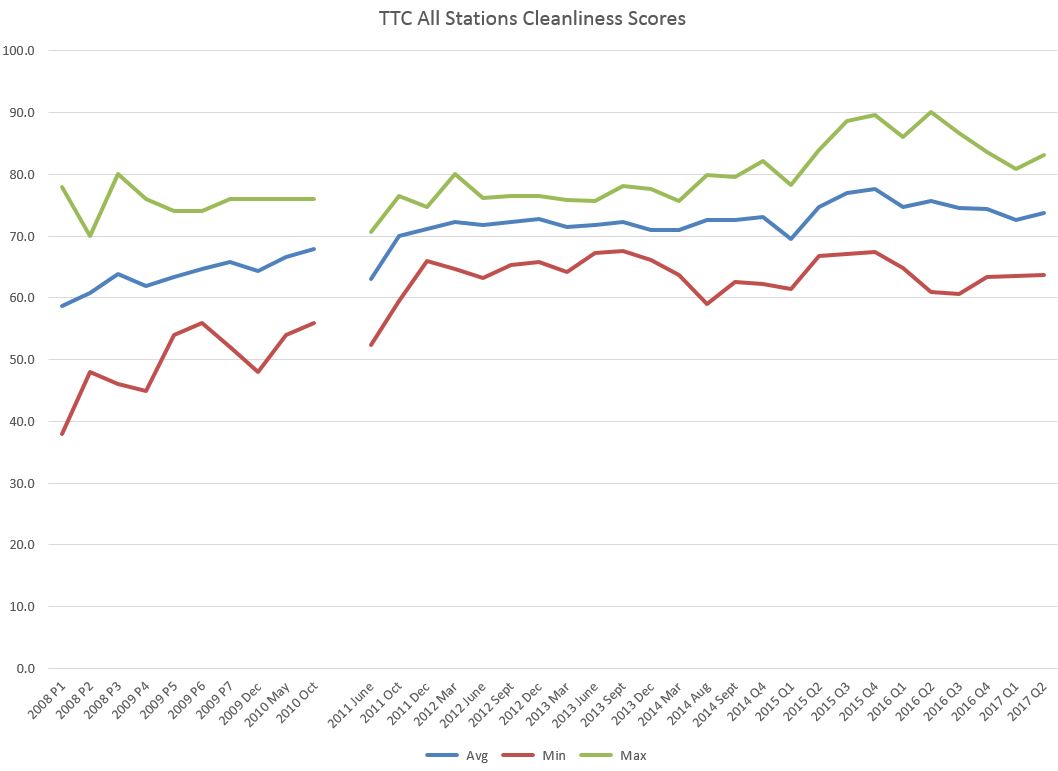
The data are revealing when they are split apart in various ways. First, the system average scores including the maximum and minimum values attained in each survey by individual stations.

As Green notes, there is an upward trend, although it stalled for a considerable period  from 2012-14, and after an improvement in 2015-16, values fell again in 2017. Quite clearly there was a wide range of scores back in 2008 when this process started, but a lot of the improvement over early years was to pull up the bottom performers (thereby increasing both the minimum score and the average). The maximum score did not start to rise substantially until 2015.

There are two obvious points where there are changes in the data:

  • The gap for the first part of 2011 was caused by a change in the contractors doing the condition surveys. It is intriguing that the first results from the new contractor showed a dip in values although this was quickly reset. Whether this was due to a change in TTC practices, or a re-calibration of the survey is hard to know.
  • There is a marked improvement starting in 2015, although more so in the maximum values. Much of this improvement fell away by 2017.

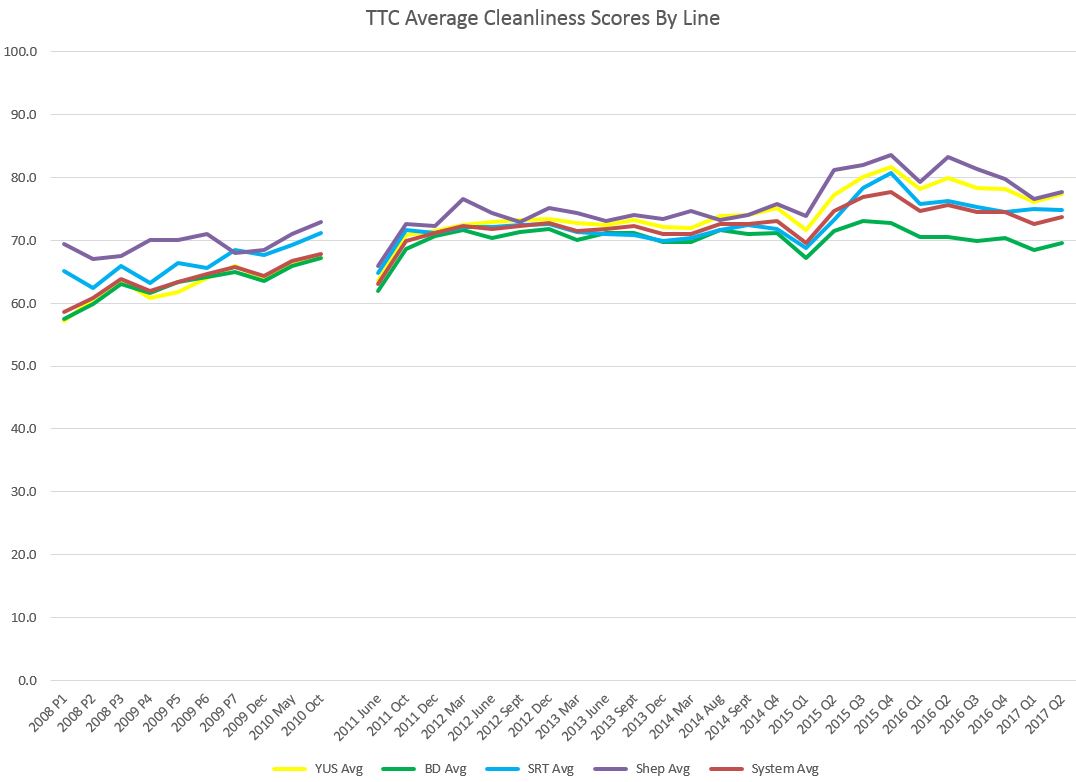
When the data are split apart by route, here is what we see:

The biggest jump for 2015 came on the Sheppard line with Yonge a close second and then the SRT. What is quite striking is that the improvement had little effect on the Bloor-Danforth line.

Another factor that stands out here are dips in Q1 of recent years probably due to winter conditions. This could well be a function of when the surveys were done as past years show data explicitly for December and March, but not for January or February.

Continue reading

TTC Board “Discovers” Cost of Bloor-Danforth Subway Renovation

The TTC Board met on July 11, and the public agenda contained little that prompted extensive debate. The entire meeting was over in 75 minutes, a quite unusual situation reflecting the onset of the summer break at City Hall.

The status of the streetcar order from Bombardier prompted a spin-off discussion of the subway. CEO Andy Byford had noted that reliability on the Yonge line’s fleet of TR (Toronto Rocket) trains has reached a world-class level, and it is quite substantially better than that of the T1 trains operating on Bloor-Danforth, although their performance is reasonable for cars of their age (about 15 years) and technology.

This prompted a question from Vice Chair Alan Heisey who asked when the TTC should be making plans to replace the T1 fleet. Chief Operating Officer Mike Palmer replied that “we probably had to order the cars last week”. (See YouTube video of meeting.) This came as something of a surprise to the Board thanks to the way that planning for the Scarborough Subway Estension (SSE) and Line 2 BD in general have been handled, with information dribbling out bit by bit, and with plans in the TTC Capital Budget not fully reflecting future needs.

I wrote about this in a previous article, but as an update, here is the status of various projects related to the BD line’s future.

Summary

There are four major components to upgrades facing the TTC for subway expansion on Line 2 Bloor Danforth. Here is their status:

  • Replace T1 subway car fleet
    • Estimated cost: $1.737 billion
    • “Below the line” in the City Budget (i.e. not funded)
    • Current replacement schedule is out of step with plans for other projects
  • New subway yard at Kipling
    • Approximate cost: $500 million
    • Only $7m for planning work is included in the Capital Budget, but nothing for construction
    • Carhouse and yard are a prerequisite for the T1 replacement fleet
  • Automatic Train Control
    • Estimated cost: $431 million
    • Only about $250m currently allocated in the City’s approved Capital Budget
    • Current signal system dates from 1966-69 when the BD line was built and it uses obsolete technology
  • Bloor-Yonge Station capacity relief
    • Estimated cost: $1.117 billion
    • Only $6m for planning work is included in the Capital Budget, but nothing for construction
    • Scope of work and feasibility have not been published

This is not simply a matter of TTC management providing a rosy view of capital needs, or of the City choosing to ignore the scope of the problem. When projects of this scale don’t appear in the “to do list”, they are not considered any time another government comes calling with a funding offer. Many projects that will receive money from Ottawa’s infrastructure fund (PTIF) are on that list because they were acknowledged as part of the TTC’s outstanding requirements.

Keeping the full needs of the Bloor-Danforth subway out of view short-changes the TTC system and the riding public, and politicians are surprised to find that the “ask” for transit spending is a lot bigger than they thought. Meanwhile new projects make claims on “spending room” that might exist only because needs of the existing system have been downplayed.

TTC management plans to bring a consolidated report on the renewal of the Bloor-Danforth line to the Board in September 2017.

Continue reading

Honesty in Subway Planning

Toronto Council recently approved further study on both the “Relief” subway line, and the Yonge Subway Extension north to Richmond Hill. This approval came with several caveats about the timing of projects and the sharing of both capital and operating costs for the YSE.

Meanwhile riders who attempt to use the system as it is are expected to take hope from the fact that “Relief” might appear in only 15 years.

The entire debate about subway capacity in Toronto has, for many years, taken place in among incomplete information, policy directions that looked outward from the core to the suburbs, and in some cases blatant misrepresentation of the complexity of problems the City of Toronto faces.

A major issue throughout the debates has been that individual projects, or even components of projects, are discussed as if they are free-standing “solutions” to the problem when they are only one of many necessary components. Costs are low-balled by omission of critical parts of an overall plan, and the pressures on capital spending are understated by artificially planning major projects beyond the 10-year funding window used for City budgets. This gives the impression that money is “available” for other projects within the City’s financial capacity by stealing headroom in future plans to pay for things that, strictly speaking, should have a lower priority.

The situation is not helped one bit by the lack of strategic planning at the TTC and City where serving the political philosophy of the day often takes precedence over taking a wider view. Indeed the TTC Board, at times, almost prefers to be ignorant of the details because this would force a re-examination of cherished political stances. At Council, although Toronto now has its “Feeling Congested” study and an attempt at prioritization of projects, efforts continue to advance schemes near and dear to individual Councillors who simply will not accept that their wards are not the centre of the known universe.

What Toronto desperately needs is a thorough review of its rapid transit plans and the funding needed to achieve them. This must take into account, and modify where needed, the historical reasons we are in the current situation, and examine what can be done for the future, when this can be achieved and at what cost. The cost question must come second, in the sense that determining what the City needs is an essential first step. Only then can we examine possible alternative ways to address the issues, the cost this will bring and the funding mechanisms that might be used.

Continue reading

Inching Ahead on Subway Plans

Toronto’s Executive Committee will consider a report from the City Manager at its meeting of May 15, 2017 regarding the preferred alignment for the southern end of the “Relief Line” subway, as well as the current status of the Yonge Subway Extension to Richmond Hill.

This report has taken on a more political context with Mayor Tory’s recent statements that unless Queen’s Park coughs up financial support for the RL, he will block any further work on the YSE. Needless to say, this stance did not play well in York Region or at Queen’s Park.

The two lines, as they currently are proposed, look like this:

One might cast a though back only a few years to Tory’s election campaign in which he claimed that SmartTrack would eliminate the need for a Relief Line, that it would have frequent service with many new stops, that it would operate with TTC fares, and that it would be self-financing. Most of these claims were demonstrably false or impossible at the time, and the project scope has changed dramatically. Even the question of a “TTC fare” is tangled up in the Metrolinx Fare Integration study which could well bring higher rapid transit fares to the TTC as a way of “integrating” them with regional systems.

Tory’s convoluted evolution into a Relief Line supporter undermines his credibility on many issues not the least of which is an understanding of when money he demands might actually be spent. There is no point in getting a “commitment” from Queen’s Park when the government will be unrecognizable by the time the bills come due. Toronto has far more pressing demands in the short and medium term, and meanwhile there is $150 million of provincial money going into design work for the RL.

As for the YSE, it has been on York Region’s wish list for years, and is more advanced than the Scarborough Subway which is mired in debates about the alignment and number of stations. The problem for Toronto is that there is no capacity for additional riders from an extension on the Yonge line, and indeed it is already over capacity according to a CBC interview with TTC Deputy CEO Chris Upfold on May 10.

Continue reading

Toronto’s 2018 Budget and Continuing Transit Austerity

In a report to the City of Toronto’s Budget Committee meeting for May 11, 2017, City Manager Peter Wallace makes two recommendations that will have a major effect on transit planning and operations in Toronto:

  • All spending for the 2018 Operating Budget would be frozen at 2017 levels. For the TTC, this would mean flat-lining the operating subsidy at its current level ($560.8 million for the “conventional” system, and $142.7 million for Wheel-Trans).
  • No new projects would be approved within the Ten Year Capital Budget and Plan until 2027 when there is borrowing headroom available to the City to fund additional works.

If a project is on the favoured list that is tagged for federal infrastructure subsidy, then finding a way to pay for the City’s share would be a priority in budgeting. However, it is not yet clear just which items in the TTC’s long shopping list will attain this status. Those that are excluded have only a faint hope of going forward.

A related problem here is that Toronto does not yet know how much, exactly, it will receive in Federal infrastructure grants, and it is quite likely that the money available will not stretch far enough to cover the entire list. Moreover, Queen’s Park is an uncertain partner because (a) the province feels it is already showering Toronto with money for projects now underway, and (b) the current government is unlikely to survive the 2018 election, and the policies of a successor regime could be hostile to large-scale transit spending commitments for Toronto.

Although there is much focus on Capital projects, the real challenge in the short term will be for the Operating budget. In the City’s report, the “opening pressures” for the TTC budget are substantial:

  • In 2017, $18 million was used from the TTC Stabilization Reserve fund to offset the budget shortfall and some new services. This was one-time money that must be replaced in 2018 and beyond. The reserve fund is now empty and cannot be used as a source to “fix” 2018 problems.
  • TTC ridership is forecast to come in below the budgeted level for 2017, and on a budget-to-budget basis, this represents a loss of $10 million in revenue. When the TTC Board passed its 2017 budget, it also decided that there would be no 2018 fare increase. Quite bluntly, that was a political stunt that simply cannot be implemented without new revenue or cuts to the operating budget. Fare revenue in 2017 is about $1.1 billion, and so each 1% increase would generate about $11 million, less whatever is lost to elasticity (riders lost by higher pricing).
  • The base operating costs of the TTC are forecast to rise by $102 million, not including the operating effects of Capital projects (see below). This covers wage and material cost increases, as well as the cost of any new service (none is currently planned thanks to the ridership situation).
  • The opening of the TYSSE to Vaughan will add $26 million to the TTC’s costs. Most of the riders projected for this line already pay a TTC fare, and so the marginal revenue will be much less than the operating cost. Riders transferring from York Region services to the subway for a journey to York University will not pay an extra TTC fare (this will be implemented via a Presto tap-out).
  • Other increases arising from past decisions (i.e. the full year effects of changes made in the 2017 budget year) add $6 million.
  • With more riders using Presto, fees to that provider will rise by $38 million. In the City Manager’s report, this is offset by a saving of $45 through the elimination of station collectors (about which more below).
  • Elimination of legacy fare gates and other old equipment will reduce costs by $5 million.

In summary:

Lost Revenue
  Stabilization Reserve          $  18 million
  Ridership Shortfall               10
  Subtotal                       $  28 million

Additional Costs
  Maintain Existing Service      $ 102 million
  Open TYSSE                        26
  Eliminate Station Collectors    - 45
  Presto Fees                       38
  Fare gate & other savings        - 5
  Other Increases                    6
  Subtotal                       $ 122 million

Total                            $ 150 million

The savings from Station Collectors arise because, from the City’s point of view, the TTC “Station Transformation Program” constitutes a new “service”, not a continuation of an existing practice. This includes conversion of the Collectors (or an equivalent headcount) into roving Customer Service agents. Indeed, there is reason to believe that the cost of this group of employees might have been included as a saving in the cost justification for Presto (or any other fare card).

I asked the TTC for the breakdown of savings and costs of the Presto transition, and received the following non-answer from Brad Ross:

The short answer from the TTC is that we continue to assess the timing of all of this – moving collectors out of the booth and transitioning to customer service agents, the costs associated continued fare collection and distribution, and the costs we will bear with being 100% Presto-enabled.

The 2018 budget process will flesh all of that out, but we’re not there yet. [Email of May 9, 2017]

That’s a rather odd state of affairs considering that the TTC based its criterion for Presto fees on what they expected to save in fare collection costs. Like so much about Presto, this is a very murky subject.

As for the Station Transformation project, the City Manager’s report states:

It is important to note that the projected 2018 net pressure or “gap” does not account for any additional service investments or priorities approved or identified by Council. For example, the $126 million forecasted pressure for TTC is based on maintaining current service levels. This excludes an additional $59 million identified by the TTC for initiatives such as Station Transformation which would be categorized as a new request and will be considered separately, subject to funding availability. [pp. 12-13]

[Note: The City’s total of $126 million does not match the total shown above of $150 million for reasons that are unclear. I have asked the City to reconcile this.]

One can well argue that the idea of getting rid of all Collectors is unworkable (even GO Transit, an all-Presto system, has station agents), and that the many duties the new Customer Service staff would take on are logically inconsistent (being available at a booth to answer questions and provide general directions, but also roaming the stations). Whatever the intent, the TTC has not yet produced a clear explanation of whether savings on Collectors were part of the justification for paying Presto to handle fares.

In any event, this $45 million is not included in the TTC base budget requirement for 2018 from the City’s point of view. If it is to be approved, that will be an additional expense on top of the other pressures.

Completely missing is any discussion of a Ridership Growth Strategy. Although the TTC tells everyone that ridership is down for various reasons, they also have stated that both the St. Clair and King streetcar lines are currently running over capacity during peak periods. This does not square with the claim that the TTC does not require more service, and suggests that one source of ridership “loss” is the inability of people to actually use the service.

An RGS report was supposed to come before the TTC Board earlier in 2017, but it was held back pending resolution of budget issues. Clearly this problem has not gone away, and yet if the report continues to be hidden, we will have no idea what might be possible and at what cost. Advocacy is not the TTC’s strong suit, and we have no idea of just how badly the system will be crammed thanks to the shortage of vehicles and the lack of sufficient revenue to operate them.

Not to be ignored is the status of Wheel-Trans where demand is growing very quickly thanks to improved eligibility requirements from the province. Freezing the Wheel-Trans subsidy (which provides almost all of its operating funding) will not allow growth, and the TTC could find itself in violation of accessibility targets if the City does not come up with the cash.

On the Capital side, the inability to add projects to the “approved” list could punch a big hole in plans for the Bloor-Danforth Subway’s revival. A collection of projects is to be presented to the Board for the renovation of Line 2 BD including:

  • A new signal system with Automatic Train Control
  • A new fleet replacing the T-1 trains which were built from 1995-2001
  • A new subway yard near Kipling Station

The ATC project is “funded” in the capital budget at an estimated cost of $431 million of which $131 million currently appears under post-2026 spending. Whether money for that is actually available in the City’s financial plans is unclear, but this will obviously be a case of “in for a penny, in for a pound”. The budgetary timing is odd because 1/3 of the total is post-2026 after the new system is supposed to be enabled and the old system decommissioned.

Neither the new fleet nor the new carhouse are funded projects in the budget. However, there is a timing issue for this project and a new fleet because the Scarborough Subway Extension will use ATC signalling, and this forces the issue because there is no point in retrofitting ATC gear to cars that will be at or near retirement age when the extension opens. There will be some cost offset in other budget lines including the SSE because storage for the new Line 2 fleet will be consolidated. (Greenwood’s layout is unsuited to the new unit trains now operating on Line 1 YUS, although it could be reconfigured and used for a future DRL with a track connection via Danforth.)

Another unfunded project is the purchase of an additional 60 new streetcars required to handle growing demand in the early 2020s, plus a further 15 (a placeholder number, probably) for the Waterfront transit project.

Putting any unfunded project “on hold” for 2018 might work as a way to avoid a capital planning crisis before the municipal election, but it will not do for the long term.

During the 2017 budget discussions, City Staff appealed to Council to set its service priorities as an integral part of building the budget:

Staff advised Council that it should first establish its collective vision for the City to determine the level and quality of services it wishes to deliver, determine and prioritize the City-building investments required to achieve this vision and consider the associated expenditures necessary to carry this out. In order to fund this expenditure level and any resultant gap, City Council would have to raise revenues and should look to all of its revenue-generating authorities and tools to do so, including property tax rate increases. This would be especially necessary if Council chose not to reduce its services and service levels. [p. 6]

For 2018, the City Manager warns:

Further expense reductions in 2018 will require strong action and a willingness to both reduce and sustain reductions in service levels if residential tax increases are to be kept at the rate of inflation. As recently made evident in the 2016 and 2017 Budget processes, there has been a reluctance by Council to embrace service level or service model changes; creating a mismatch between service aspirations and revenue generation. [p. 13]

There has been a fair amount of discussion by Council and input from the public (Long Term Financial Plan public consultation) that across the board budget targets do not reflect Council priorities, and therefore, should be differential. The current challenge to establish differential targets is the lack of stated relative Council priorities and implementation plans. A key issue is not that priorities are lacking but rather that there are many – many Council approved strategies, plans and service demand initiatives – some of which have been considered in relation to one another with their respective financial impacts within a priority-setting process that links service and policy planning to the City’s budget process and considered within the City’s financial capacity. [p. 14]

The priorities endorsed by Council for 2017 amounted to cherry picking a few very expensive capital projects, and demanding that staff find “efficiencies” with which to pay for any service improvements, indeed simply to keep the lights on. In the case of the TTC, a bit of last-minute hocus pocus avoided a large funding gap by boosting the assumed revenue from the land transfer tax. That particular hat does not have an endless supply of rabbits.

The overwhelming demand is to keep property taxes at the rate of inflation. That is an interesting concept as the City Manager explores in some detail both by reference to practices in other cities, and in the question of just what level of “inflation” should be used. Toronto has aimed at the CPI with a 2% increase in residential tax rates,but when the rebalancing effects for non-residential are factored in, the overall tax increase was only 1.39% for 2017. Moreover, there is a separate cost index measuring those items typically consumed by a municipal government, not by a private household. The municipal index has been running at over 3%, and it is no wonder that the City is unable to keep up with costs.

In addition to the “regular” property tax increases, there have been special levies to fund transit capital projects. The first, introduced during Mayor Ford’s term, is a 1.6% tax that will fund the City’s portion of the Scarborough Subway Extension. This tax will remain in place as long as needed to pay off whatever that share of the total cost is, eventually. The second, is a 0.5% tax building gradually to 2.5% to fund Mayor Tory’s capital projects. The situation is explained in the report:

Under current Council policy, debt servicing costs cannot exceed 15 percent of property tax revenues in any given year. In 2017, the 15% debt service ratio policy was relaxed to an average of 15% over the 10-year capital plan period as a result of the increased debt capacity made available to fund key capital priorities in 2017. $5.8 billion in new capital investments was made possible by adding $3.3 billion in increased debt capacity, based on the following actions:

  • $134 million debt room made available by better matching cashflow funding estimates to actual project timelines and activities
  • $2.2 billion in debt capacity was added in the latter 5 year years of the capital plan period by adding new projects that filled unoccupied debt room reflective of a 14.75% debt servicing ratio; and
  • $1 billion in additional debt borrowing capacity was made possible with Council’s approval of a 0.5% levy for each of 5 years as a contribution to a capital City Building Fund for transit and housing priorities.

The added debt capacity enabled the City to fund critical, unfunded capital priorities such as the added costs for the Gardiner Expressway Rehabilitation Project, the SmartTrack transit expansion project; Port Lands Flood Protection; the City’s required matching funds for TTC and non-TTC critical state of good repair projects eligible under the Public Transit Infrastructure Fund (PTIF); Toronto Public Library state of good repair and various transformation and modernization investments.

While this added debt capacity allowed the City to fund key projects included in the $33 billion of unfunded capital projects, doing so has maximized the City’s debt capacity based on its current, yet now relaxed, debt servicing policy. [p. 19]

In brief, if there is to be any new capital borrowing within the next decade for projects that are not already in the “funded” list, then these will require new revenue to service the debt. Even beyond 2026, the debt “mountain” will not recede quickly.

The only glimmer of hope within these recommendations is that:

Priority be placed on completing transit, transportation and social infrastructure projects funded through intergovernmental agreements in order to meet program conditions and deadlines to mitigate risk to the City, and

Should any funding become available, that capital funding priorities be limited to projects that address:

  • Critical State of Good Repair, including energy retrofits
  • AODA Compliance
  • Transformation, modernization and innovation projects with financial benefits
  • High-needs social infrastructure [p. 20]

Notably absent from that list is “rapid transit expansion”, or indeed transit expansion of any kind.

2018 will be a grim year for the City’s budget for all portfolios. Transit might get by, again, through some fiddling with figures, but that will not represent a real commitment to better transit, only to prevent its complete collapse while Councillors and the Mayor are trolling for votes.

A Contrary View of Ontario’s 2017 Budget

With the release of Ontario’s budget for 2017, City Hall launched into predictable hand-wringing about all the things Toronto didn’t get with the two big-ticket portfolios, transit and housing, taking centre stage. Claims and counterclaims echo between Queen Street and Queen’s Park, and the situation is not helped by the provincial trick of constantly re-announcing money from past budgets while adding comparatively little with new ones.

There was a time when budgets came with projections of three to five years into the future, the life of one government plus some promise of the next mandate, but over time the amounts included within that period simply were not enough to be impressive. Moreover, in a constrained financial environment, much new spending (or at least promises) lies in the “out years” where “commitment” is a difficult thing to pin down, especially if there is a change in government.

Toronto has “out year” problems, but it has even more pressing concerns right now, today and for the next few years. Very little in the provincial budget addresses this beyond the authority to levy a hotel tax, and a gradual doubling of gas tax grants for transit over the next five years. These add tens, not hundreds, of millions to a City budget that runs at $12 billion.

The transit tax credit for seniors will cover eligible public transit costs beginning in July 2017 with a refundable benefit of 15 percent. Whether all seniors actually deserve this credit is a matter for debate, but an important difference from the soon-to-disappear federal credit is that Ontario’s is “refundable”. This means that even if someone does not have enough income to pay tax, they can still receive the credit. The devil is in the details, however, and the degree to which this will be available to casual, as opposed to regular transit users remains to be seen. The term “eligible costs” is key. (The federal credit includes restrictions on eligibility.) In any event, a tax credit does nothing for transit budgets because it adds no revenue either directly to the transit agency or to the City which provides operating subsidies.

There are two major problems with both Ontario’s support for transit and Toronto’s politically-motivated budgets:

  • In both cases, the focus is on capital projects, building and buying infrastructure, with little regard for the cost of operating new and existing assets.
  • Past decisions on transportation spending have locked billions of dollars into a few projects for short-term political benefit at the expense of long-term flexibility.

Toronto perennially assumes that there will be new money somewhere to backfill the shortage in its capital budget. The Trudeau economic stimulus plan was the most recent magical relief Toronto expected, but it came with dual constraints: Toronto gets a fixed amount over the life of the program, and Ottawa will not contribute more than 40% to any individual project. Toronto had hoped that Ontario would chip in, possibly at the 30% or even 40% level, leaving the City with a manageable, if challenging, task of finding money to pay its share for the backlog of projects. The Ontario budget is quite clear – Toronto is already getting lots of provincial money and at least for now, there’s nothing new to spend.

Ontario is hardly innocent in this whole exercise having meddled for years with Toronto’s transit plans, most notoriously in Scarborough where the whole subway extension debate was twisted to suit political aims. After leading Toronto down the garden path on the SSE, Ontario has capped its project funding leaving Toronto to handle the cost of its ever-changing plans.

Queen’s Park loves to tell Toronto how much provincial money is already spent for Toronto, if not in Toronto, and the distinction gets blurry. GO Transit improvements, for example, will bring more service into Toronto benefiting the core area business district, but they will also improve commuting options for people outside of the City itself.

Before the fiscal crash of 2008, when Ontario was running surpluses, the typical way to handle project funding was to hive off surplus funds at year end into a trust account. That is how the provincial share of the TYSSE was handled. By contrast, Ottawa operates on the pay-as-you-play basis, and only turns over subsidies after work has been done. Each approach suits the spending and accounting goals of the respective governments. In a surplus situation, one wants the money “off the books” right away, but in a deficit, the spending is delayed as long as possible. Further accounting legerdemain arises by making the assets provincial to offset the debt raised to pay for them.

To put all of this into context, here is a review of projects proposed or underway in Toronto.

Continue reading