Ontario’s 2025 Budget and Transit

Ontario unveiled its 2025 budget on May 15. Although it speaks of “Approximately $61 billion over 10 years for public transit”, by far the lion’s share of this spending is for projects already underway in the construction and design stages.

All of this is for capital expansion and renewal, and nothing has been announced for day-to-day improvement of transit service.

GO Transit

The budget cites:

  • The Hamilton-Niagara through service connection at West Harbour Station which is already in service.
  • The proposed Bowmanville extension which has been announced before, but is only barely underway at the “early works” stage. This extension has physical alignment issues.
  • GO 2.0 includes “delivering all-day, two-way service to Kitchener and Milton, building new GO stations across the region and advancing planning to unlock potential new rail corridors through midtown Toronto, Etobicoke, York Region and Bolton.” There are no dates attached, and some of these have been on maps for a very long time. Notable by its absence is any mention of electrification.
  • A total of $850 million to refurbish GO Transit rail coaches at the Thunder Bay Alstom the North Bay ONR facility. This work is already announced. The cars may receive convenience upgrades such as “charging plug ports, cup holders and improved Wi-Fi”, but the long-term retention of these cars indicates that the operating model for GO electrification, if and when it occurs, will have a large component of locomotive-hauled trains rather than electric multiple units.

Subways

Subway projects in the budget are:

  • Ontario Line (under construction).
  • Eglinton-Crosstown Western Extension (under construction).
  • Yonge North to Richmond Hill (procurement underway).
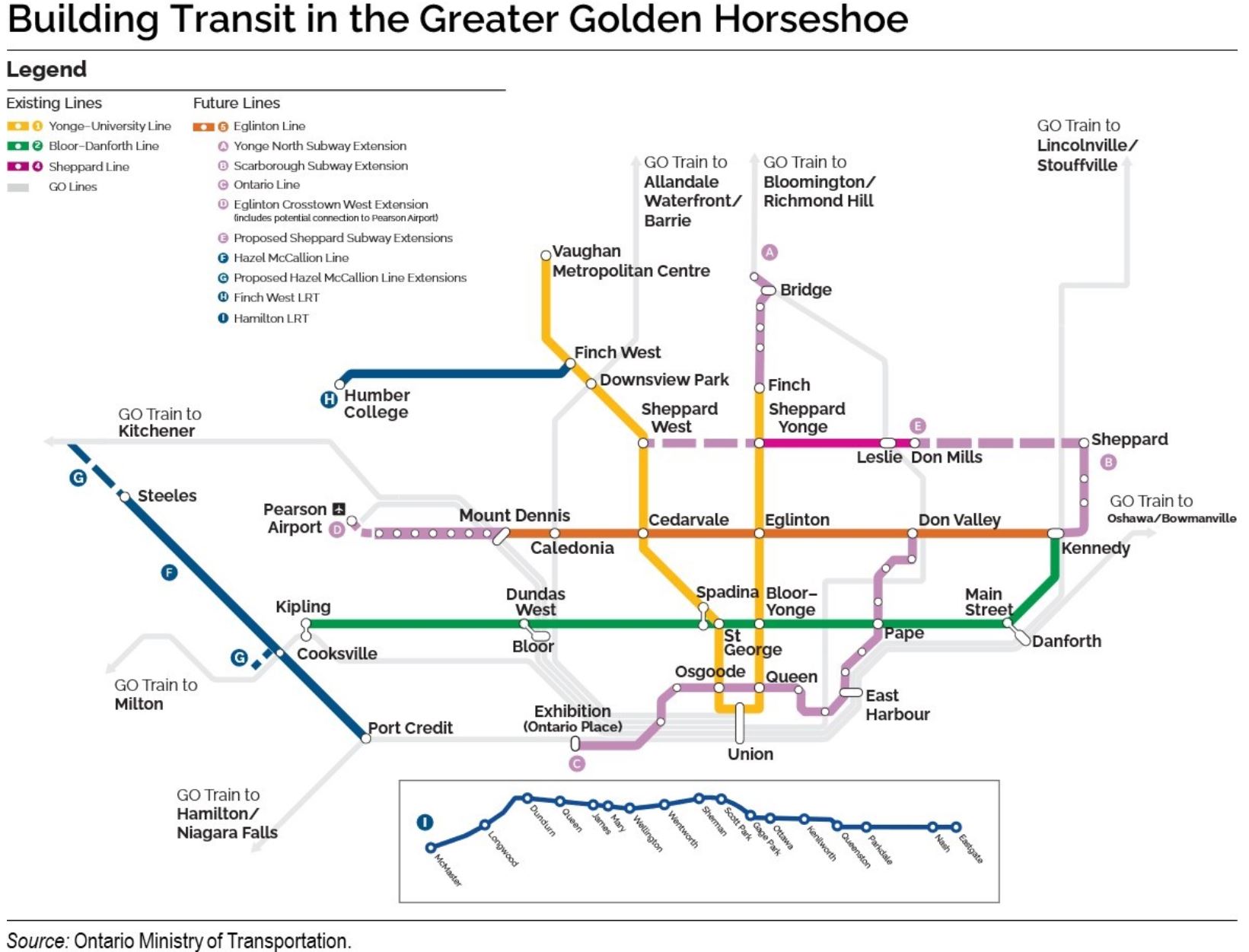
  • Sheppard Subway Extension (planning, consultation and business case preparation underway). Notable in the map below is the absence of a line east of McCowan where there is a conflict with the City’s Eglinton East LRT project and with maintenance yard property requirements.
  • New subway cars for Line 2. Provincial funding for these trains has been in place for some time. What is not yet funded are trains for service expansion beyond pre-covid 2019 levels. Trains for the Yonge North and Scarborough extensions are included in those projects. The TTC is in the Request for Proposals process for new trains, but this has been skewed by provincial statements that the work should go to Alstom’s Thunder Bay plant.

Yes, they seem to have forgotten the Scarborough Subway Extension (now under construction) in the text although it is included in the map below..

East Harbour Transit Hub

The hub at East Harbour Station, near the point where the Lakeshore East GO line crosses the Don River, will eventually serve GO Transit, the Ontario Line, and the local streetcar/LRT system via the Broadview Avenue Extension and a link west via Commissioners Street.

A substantial portion of this project is funded by the City of Toronto as a remnant of John Tory’s “SmartTrack” plan.

Light Rail Projects

  • Hamilton LRT: This is in early states with procurement underway for Civil Works and Utilities.
  • Hazel McCallion (Mississauga) LRT: Construction is well underway for the initial phase of this project, and the Province is studying whether the extension into downtown Brampton should be tunneled.
  • Ottawa LRT: The Province is studying a potential upload of the Ottawa LRT “to help reduce costs for Ottawa taxpayers”. What implications this might have for future network operation and expansion is not clear.
  • Eglinton Crosstown and Finch West LRTs: “Major construction for both projects is now complete. Metrolinx continues to focus on safety and operational readiness testing, as the projects advance toward revenue service.” There is still no commitment to opening dates, and we are getting close to the three-month lead-time required for a go/no-go decision for an early fall 2025 start of service. Meanwhile, TTC has begun the process to update subway train announcements and maps to reflect the new lines.’
  • There is no mention of the Eglinton East or Waterfront East projects. In a recent letter, Mayor Chow asked the Federal government to contribute 1/3 to these schemes, but there is no indication of support in the Provincial budget.
TTC Board Meeting April 16, 2025

The TTC Board met on April 16 with many items on its agenda. These include:

There are separate articles on this site covering other reports from this meeting:

Continue reading

The 2017 Line 2 Renewal Program

Back in 2017, there was a proposed renewal program for Line 2 that covered many aspects including fleet planning, extensions, future demand growth, signalling and maintenance yard requirements.

Most regular transit followers in Toronto will scratch their heads and ask “what renewal program”. The problem was that it was too rich for political blood at the time and most of it was ditched after CEO Andy Byford was replaced by Rick Leary.

A fundamental premise of the plan was that all of its components would be handled through one master schedule and common overall project management. The TTC had learned from experience on Line 1 that a piecemeal approach was fraught with conflicting timetables and specifications, not to mention the danger that each piece had to be funded separately with little appreciation for the big picture.

A Rail Amalgamation Study was conducted for the TTC by HDR and Gannett Fleming starting in 2015, and it was expected to finish in 2017. The intent was to review the line’s needs based on various future scenarios. For maintenance and storage facilities, it would consider:

  • The use of 2-car sets rather than the 6-car TR train configuration.
  • Possible line extensions
  • Expansion of the work car fleet to support expanding infrastructure
  • Implementation of ATC (Automatic Train Control) signalling

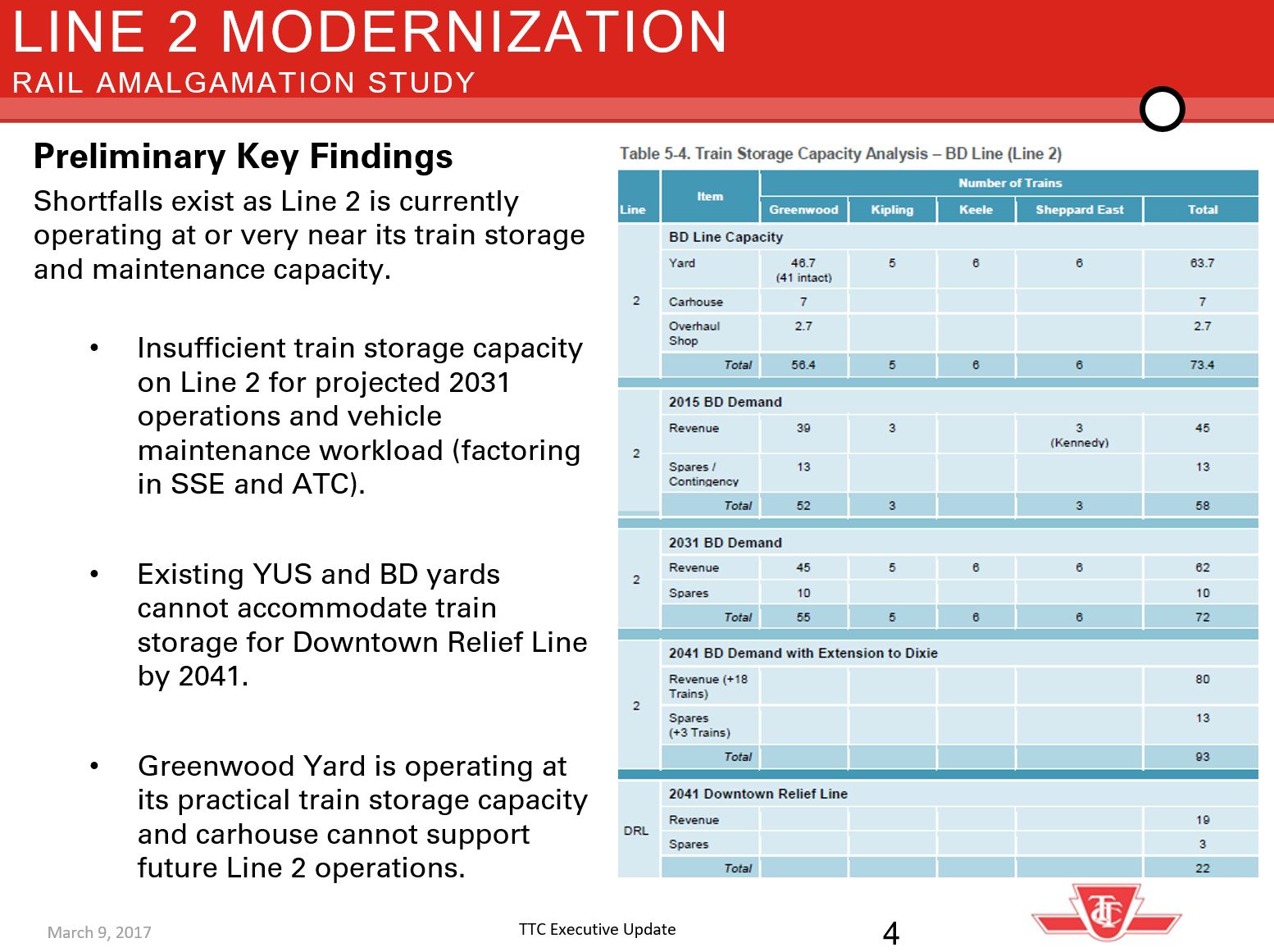
A preliminary report from the study showed that capacity would be a major problem. Note that in the context of this study, the Ontario Line did not yet exist, and the intent was that Greenwood Yard would host the Downtown Relief Line trains. Even without the DRL, Greenwood would not be able to handle expected growth in demand on Line 2.

The remainder of this article shows the details of the resulting plan, notably proposals for a new Line 2 fleet and expansion of the work car fleet that might have been set in motion had this scheme not been sidelined.

The TTC had a consolidated plan for Line 2 (and for the DRL), but this fell victim to budget cuts, the idea that we could “make do” rebuilding old trains and signal systems, and then the Provincial intervention with Metrolinx showing how they “knew better” how to plan and build rapid transit lines. We all know how that worked out.

Continue reading

TTC 2024 Service Plan Consultation Round Two

The TTC is part way through production of its 2024 Service Plan as well as a 5-Year Service Plan and Customer Experience Action Plan. In Round Two, consultation will focus on plans for service changes triggered by major construction projects. Five pop-up sessions are planned at Flemingdon Park, Union Station, Liberty Village, Finch Terminal, and Pape Station between June 29 and July 12, 2023. Details are available here.

Also available on that page is a link to a survey seeking feedback on various proposals. Please note that my site is not an official TTC conduit for feedback, although it is no secret that many at the TTC do read articles and comments here. Any specific feedback for the TTC should be submitted through their own survey.

Round Three in August-September will present draft concepts for the 5-Year Plan and Customer Experience Action Plan, and these will be refined into final drafts for Round Four in October-November.

The remainder of this article presents an overview of the survey and proposals for construction-related service changes.

There are no proposals for new routes nor of overall service levels in this round. The election of Olivia Chow as Mayor will no doubt bring a review of existing services, but that is not in the scope of this round.

An important issue left over from the 2023 Budget process and the recent service cuts is the question of Service Standards. These are described as “Board Approved”, but in fact the 2023 changes were implemented by management as part of the budget with only retroactive consent from the Board. Moreover, the actual effect of the changes was withheld from the Board and Council until well after the budget was approved.

Transparency in budgets and service planning will be an important change looking ahead to 2024. With a new Mayor I hope to see a much improved process.

Continue reading

Osgoode Hall Garden and University Park

Over past months, the Ontario Line’s effect on trees in various locations around Toronto has become something of a cause célèbre. Osgoode Hall was, in a way, the “poster child” for this because of its location and the historic buildings at Queen & University. However, this was far from the only affected location with tree felling on a massive scale elsewhere including Moss Park, Riverside, and now planned for the Don Valley at the Leaside Bridge and the crossing of Walmsley Brook north of Thorncliffe Park.

A common refrain from citizens along the Ontario Line and other corridors is that Metrolinx does not deal in good faith, but rather presents its positions as unchangeable and pressing. They look only for acquiescence so that “consultation” can be claimed for the record. There is no public record of these consultations, and no community is aware of what might be told to others except by information sharing among them.

I have written about the garden at Osgoode Hall before, most recently in a review of the report prepared for the City of Toronto by Parsons looking at various alternative configurations.

On February 23, 2023, Toronto and East York Community Council established a subcommittee composed of Councillors from Wards 10 Spadina-Fort York, 13 Toronto Centre and 14 Toronto-Danforth and “directed the Executive Director Transit Expansion Division to report to the first meeting in March 2023 regarding the current status of the Ontario Line, pedestrian and traffic management plans, and opportunities for City and resident involvement moving forward”.

That meeting will occur on March 22, 2023. The only report on the agenda is from the Executive Director, and a great deal of it is a rehash of information from earlier reports along with a claim that Metrolinx is engaging with communities along the corridor. The actual degree of consultation is a matter for some debate, and one cannot wonder whether the ED is parroting the official line from Metrolinx, hardly an appropriate tactic for a senior City official. I will address that report in more detail after the meeting, but turn here to a proposal for the new entrance to Osgoode Station.

Continue reading

501 Queen Diversions and Shuttles for the Ontario Line

This article is a follow-up to my earlier piece about the TTC’s Rapid Transit Expansion report including the effect of Ontario Line construction on the 501 Queen service.

Updated March 1, 2023:

  • The reason that track installation on Adelaide, which by itself is relatively straightforward, cannot proceed immediately is that nine Toronto Hydro and Bell vaults must be relocated. Metrolinx opted not to do this work, but the City has taken over.
  • Streetcars will remain on 501 Queen but will divert both ways via Broadview, Dundas and McCaul from May 2023 to March 2024. A bus shuttle will operate over the central portion of the route.
  • The list of track construction projects for 2023-24 has been clarified.

Back in December 2021, the City approved a report with a very long list of proposed road closures for Ontario Line construction.

I wrote about this report beginning with this article:

The construction at Queen Station will entail a multi-year diversion of 501 Queen service, and the plan was for streetcars to operate:

  • Eastbound via York, Adelaide and Church
  • Westbound via Church, Richmond and York

Track already exists for the westbound route, but new track is required on York and on Adelaide for the eastbound diversion.

Much of this work was supposed to have been completed in 2022, with the intent that the diversion would be available in May 2023. Various factors combined to foul up this schedule.

  • The contract to install new track on York and on Adelaide east to Victoria was, for some reason, to be a Metrolinx responsibility separate from City work on utility upgrades and relocation. This lengthened the potential timespan with two separate procurements, and inevitable delays as one contractor waited for the the other to finish.
  • Metrolinx was supposed to build the new track on York Street in 2022. This did not happen. According to a recent City report (about which more below), Metrolinx has been preoccupied with the Ontario Line.
  • Construction on Adelaide west from York to Spadina was done by the City to restore track inactive for many decades and to provide more flexibility for downtown diversions. This went quickly through the fall, and was performed by Midome Construction who were also working on utilities east of York.
  • For various reasons, notably discovery of unexpected underground Toronto Hydro and Bell plant, the work east on Adelaide from York did not complete in 2022, although it was substantially finished from York to Bay. Some water main connections were incomplete with pipes blocking the curb lanes, and this complicated traffic and transit diversions around a major sinkhole at King and University.
  • The City proposes to expand the Midome contract to include track replacement from York to Victoria. Work on this can begin immediately where utility construction no longer occupies the eastbound track lane (second counting from the south side). See: Non-competitive Contract with Midome Construction Services Limited for the New Streetcar Tracks on Adelaide Street

Queen Streetcars or Shuttle Buses

Until quite recently, if one ignored the incomplete work on the diversion trackage, it was possible to think that the streetcars would simply divert as planned beginning in May. This is obviously not going to happen, and it must have been clear to the TTC for months that the 501 Queen service would have to be modified.

The first hint of this was buried in the report under discussion at today’s (February 28, 2023) TTC Board Meeting.

Metrolinx has identified that the potential delay to complete the streetcar detour work will result in approximately 20 months of shuttle bus service commencing in early May 2023. The TTC is still working closely with Metrolinx and the City on exploring options to optimize the construction schedule of the Adelaide civil and streetcar track construction work to reduce the duration of shuttle bus service.

TTC Transit Network Expansion Update at p. 14

The words “shuttle bus” will send hapless TTC riders screaming from the room. There is a long history, particularly in recent years, of the TTC’s incompetence in operating construction shuttles including changing routes with little or no notice, conflicting information online and at stops, and erratic service with shuttles running in packs and taking long layovers at terminals. This was compounded by the number of planned and unplanned construction projects and the overlapped periods of construction on what should have been distinct route and road closures.

The grand daddy of them all is the King-Queen-Queensway-Roncesvalles project where all manner of delays including pandemic effects on work, unexpected utility relocations, slow work by affected companies such as Toronto Hydro, Bell and others, pushed the completion date out to, with luck, July 2023.

The idea that Queen would see 20 months of shuttle buses before the streetcar diversion would be ready is a testament to fouled up planning. The work should never have been divided between Metrolinx and the City but consolidated as a single contract with a goal of completion as fast as possible.

We now know, courtesy of the Star’s reporting that the delay will be only ten months instead of twenty thanks to the City’s contract consolidation. That’s an improvement, but it should never have been necessary.

For the TTC’s part, this continues a sad tale of communications and consultation foul-ups. The need for shuttles would clearly have been known months ago. How exactly they will operate is totally unknown because the TTC has issued no guidance on this. Will there be shuttles downtown? Over the entire route? Will the route be split to make it more manageable and give different routing options for eastern and western legs?

This should have been a public discussion months ago even if some details were still to be nailed down rather than a surprise landing on already-suffering riders who have dealt with many disruptions on Queen and other routes.

There are several planned track and road construction projects on Queen and King Street in coming years, and I learned recently that several of these have been deferred to reduce overlaps and conflicts. The revised schedule has not been published, and yet this will be essential to any discussion of transit service through the Ontario Line’s construction period. These include:

  • Scheduled for 2023, but deferred:
    • King West from Close to Strachan.
    • Queen East from Parliament to River.
    • Queen East from Carlaw to Greenwood.
  • Queen at Degrassi. Revision to streetcar power distribution for Ontario Line. 2023, date TBA.
  • Scheduled for 2024:
    • Queen West from O’Hara to Triller. 2024.
    • Queen East from Davies to Carlaw. 2024 (likely during Metrolinx work at Degrassi underpass).
    • King West from Strachan to Spadina. 2024.
  • Bathurst Street from Queen to Front
  • Scheduled for 2024, but deferred:
    • King East at Church (intersection).

The City, TTC and Metrolinx owe everyone an apology for this cock-up, and a commitment to resolve conflicting schedules and publish credible plans as soon as possible.

I will add to this article as the story develops.

TTC Transit Network Expansion: February 2023 Update

At its meeting on February 28, the TTC Board will receive a report summarizing the status of most of the rapid transit plans in Toronto. This article condenses the TTC report and reorders some sections to group related items together.

Dominant among many projects are, of course, the “big four” provincial projects: Ontario Line, Scarborough Subway, Yonge North Subway, and Eglinton West LRT extension.

Project Status Overview

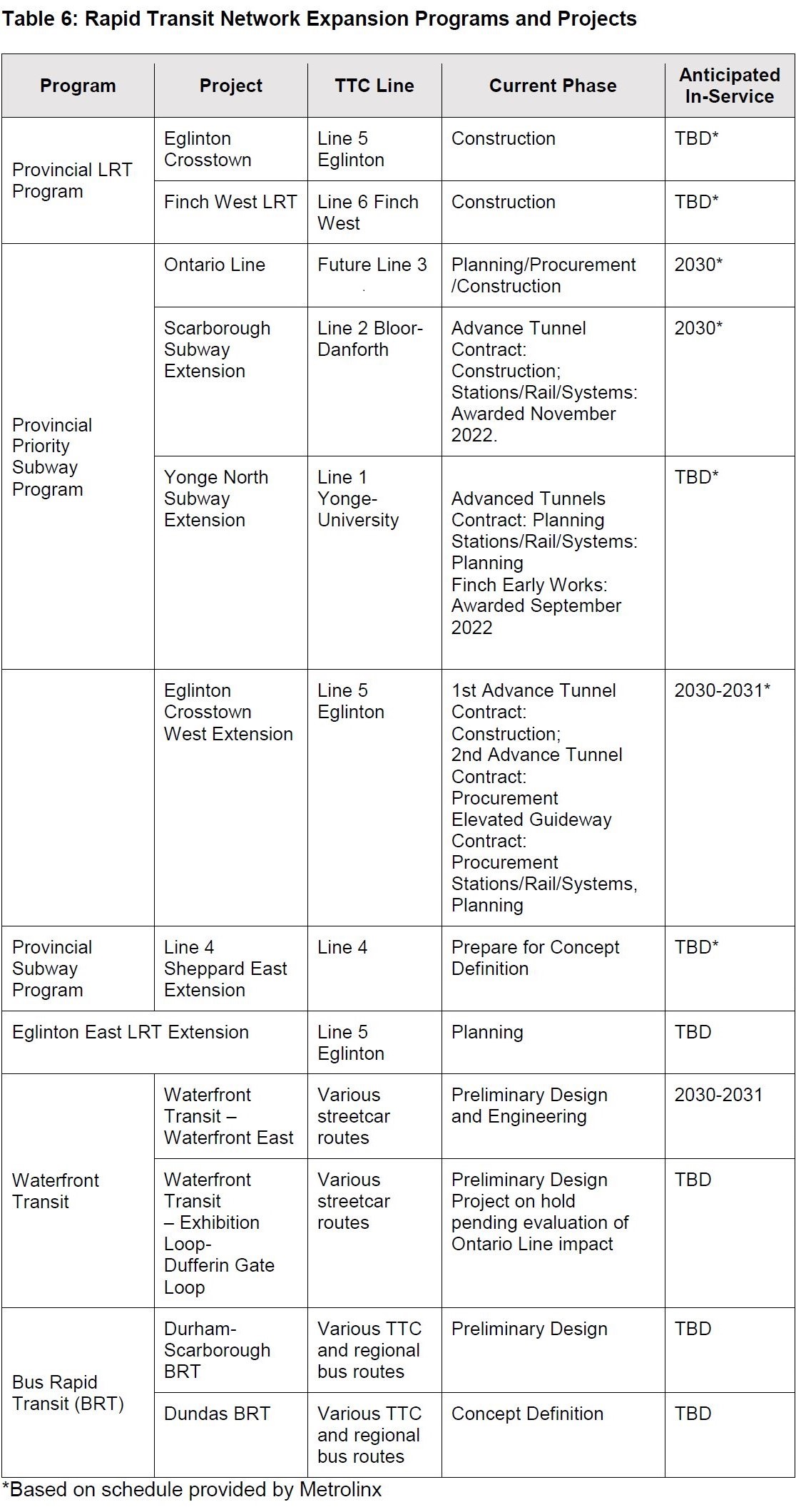
The effect of major projects elbowing everything else aside is clear in the table below. Some projects do not have in service dates because they are not funded, and the timing of that (when and if it occurs) will determine when various lines can open.

Not shown in this table are several major projects that pop up from time to time:

  • Bloor-Yonge Station Expansion
  • Waterfront West LRT from Dufferin to The Queensway
  • Bloor West subway extension
  • New Line 2 fleet and yard at Kipling (Obico yard property)
  • Sheppard East subway extension
  • Platform Edge Doors

Of these, only the Bloor-Yonge project has funding, and some are only a glimmer in various politicians’ eyes.

Continue reading

Toronto’s Board of Trade Contemplates Transportation

Prologue: When I started to write this story, John Tory was still Mayor of Toronto and the dynamics of City-Province relations assumed he was in charge. The context for these discussions was soon to change.

The Toronto Region Board of Trade holds a yearly “transportation summit”, and on February 8, 2023, this focused on the Greater Toronto Area’s transit, plans for the future, and the aftermath of the covid pandemic.

The TRBoT is no wild-eyed radical institution. The regional economy and businesses are at the heart of causes it advocates.

Both in the introductory remarks and in comments by speakers sprinkled through the day, the economic effect of traffic congestion was a mantra. This sets the framework for the importance of both transit and road projects, depending on who is speaking. The latest factoid describing Toronto’s problems is that we have the third worst congestion in North America and the seventh worst in the world.

CBC: Toronto ranks 3rd most congested city in North America. Here are the city’s worst traffic spots

A problem with this hand-wringing is that there is little acknowledgement that some particularly bad locations are related to major infrastructure projects such as the Gardiner Expressway rebuild and various rapid transit lines. Moreover, goods movement has severe problems in areas that historically have poor transit and show little chance of seeing any in the near future. No single project will solve the problem of many-to-many trips patterns that now depend almost totally on roads and private vehicles.

Continue reading

Osgoode Station Entrance Review

Metrolinx plans along several of its corridors have provoked community opposition and proposed alternative schemes, but Metrolinx has been quite intransigent about “just getting things built”, the mantra of the Ford government at Queen’s Park. Opposition is not merely steamrolled, but is painted as anti-transit, out of touch, and nimbyist in preventing the wider population from enjoying the benefit of new transit lines.

This does not endear Metrolinx to many groups (and they stretch well into the 905, not just central Toronto), but Metrolinx does not care. For them, it’s all about managing the message. Most communities just roll over and give in to an unstoppable force trying to make the best of a bad situation. “Consultation” amounts to picking the colour of the tiles for a bathroom reno, and hoping that the contractor actually installs the ones you selected.

Several sites along GO corridors and the Ontario Line have been subject to tree clearing either to open construction sites, or to remove trees that will conflict with electrification infrastructure. A small grove at Osgoode Hall, although far from the largest area Metrolinx has cleared, received much publicity because of its location. The northeast corner of Queen and University is a park beside one of Toronto’s oldest buildings, a green space complementing the square at City Hall just to the east and a more recent arrival, Campbell House, to the west.

Although the park was owned by the Law Society of Ontario, the portion Metrolinx requires was expropriated for the Ontario Line. The community around Osgoode Hall (a mix of the legal profession, the local BIA, residents and heritage advocates) convinced Toronto Council to undertake a review of Metrolinx plans in comparison with alternative designs that would preserve the treed parkland.

This report was produced by a consulting firm, Parsons, and was posted on the City’s website on February 4. It exists in two formats:

An interim injunction, in force until February 10, paused the felling of trees at Osgoode Hall for a time. Other locations have not been as lucky, nor have they had groups like the Law Society capable of taking on Metrolinx.

An important distinction for this site is that it also contains a heritage building, and there are concerns for potential damage Osgoode Hall might suffer from the overall construction plans. However, the injunction itself only applies to the trees, and it is not clear whether the wider issue of construction effects will form part of the broader argument when the application is heard.

Among the legal issues will be whether a heritage site with mixed ownership (the Law Society, Metrolinx and Ontario) can be treated as “indivisible” for the purpose of heritage preservation so that one owner, the LSO, can prevent changes on property of another owner, Metrolinx. There is also the question of whether Metrolinx can even be bound by an injunction as it is one of many agencies that are exempt from many provincial regulations.

In Brief

  • An interim injunction pauses work until February 10, with possible extension, pending further review.
  • The Parsons report commissioned by the City was published at the last moment, and was seized upon by Metrolinx to justify commencement of work on the same day as the injunction hearing.
  • Parsons concurs that the Metrolinx proposal is the best of those analyzed, but suggests that an alternative using the Campbell House site should be studied in more detail.
  • The Campbell House option would effectively displace the house from its location, and it is doubtful that it could return in as harmonious a setting as it has today.
  • Parsons does not afford the same treatment to the Osgoode Plaza proposal even though this is the major contender among the alternatives.
  • The City’s inaction on the proposed Osgoode Plaza is an (almost) missed opportunity to make the new station and the intersection into a major site downtown. If this is to be pursued, prompt action by the City is needed so that Metrolinx could adjust their construction plans accordingly.

If City Council, and most importantly Mayor Tory, are serious about an alternative to the Metrolinx plans for Osgoode Station, they should proceed as quickly as possible to endorse the Osgoode Plaza scheme and work with Metrolinx to adjust construction plans for Osgoode Station on the basis of road space on University Avenue that the plaza will free up.

In the presentation accompanying the report, the Osgoode Plaza option is shown first, and it is dismissed for various reasons notably the absence of detailed studies because the City has not yet embraced the proposed reconfiguration of University Avenue. Rather than recommending that the potential of this scheme be examined in greater detail, Parsons rejects it. This effectively prejudices the report to endorse the Metrolinx scheme as the only viable option, with a faint hope alternative that is worse than the original.

Continue reading

Tracking Metrolinx Project Costs

The Province of Ontario is not exactly transparent when it comes to reconciliation of announced project costs and actual spending, let along the changes that might occur along the way. A project, or group of projects, might be announced with a value in then-current dollars, and without necessarily including all future contract costs. There are various reasons behind this approach including:

  • The government does not want to tip its hand on the amount of money “on the table” to prospective bidders who might tailor their bid to the perceived level of funding.
  • Some contracts include future operating and maintenance costs as well as capital costs. In some case the announced cost does not include the O&M component, only the estimated capital portion.
  • Provincial projects are typically quoted in then-current dollars with future inflation to be added as it occurs, at least to the point where there is a contract in place which includes that provision.

This approach hides the likely as-spent costs and makes provincially run projects appear cheaper, at least in the short run.

This is fundamentally different from the way the City of Toronto tracks projects and how TTC requirements are reported. Specifically:

  • City project cost estimates include inflation to completion because this is factored into future funding requirements.
  • City projects do not bundle future operating costs with capital, but report them separately.

Note that cost estimates shown in the Infrastructure Ontario market reports do not necessarily match values shown by Metrolinx because IO shows these values on a different basis. Future operating and financing costs are no longer included in IO estimates so that a project’s value reflects only design and construction costs, a value that gives potential construction bidders a general size of the project’s scope.

Infrastructure Ontario notes on the November 2022 Market Update that we have modified the methodology used to calculate the estimated costs as presented on the chart. In May 2022, and for Market Updates prior to that, we used the Estimated Total Capital Costs. For the latest update, and going forward, the costs listed only include Design and Construction costs.

These changes were adopted after feedback from our construction industry partners found that including only design and construction costs provided them with a better sense of the scope of the project and would assist in determining if they wished to participate in the bidding process.

Email from Ian McConachie, Infrastructure Ontario, Manager, Media Relations & Communications, November 24, 2022.

This can be confusing with “bundled” projects such as the Ontario Line RSSOM contract which includes both provision/construction of vehicles and infrastructure, as well as future O&M costs. This is probably the reason, or a good chunk of it, for the very large increase in the RSSOM contract value between the initial estimate cited by IO and the contract award. However, the way these contracts are handled generally makes it impossible to know how much of the change is simply due to inflation in materials and labour costs, and how much is due to underestimates or scope changes.

Continue reading