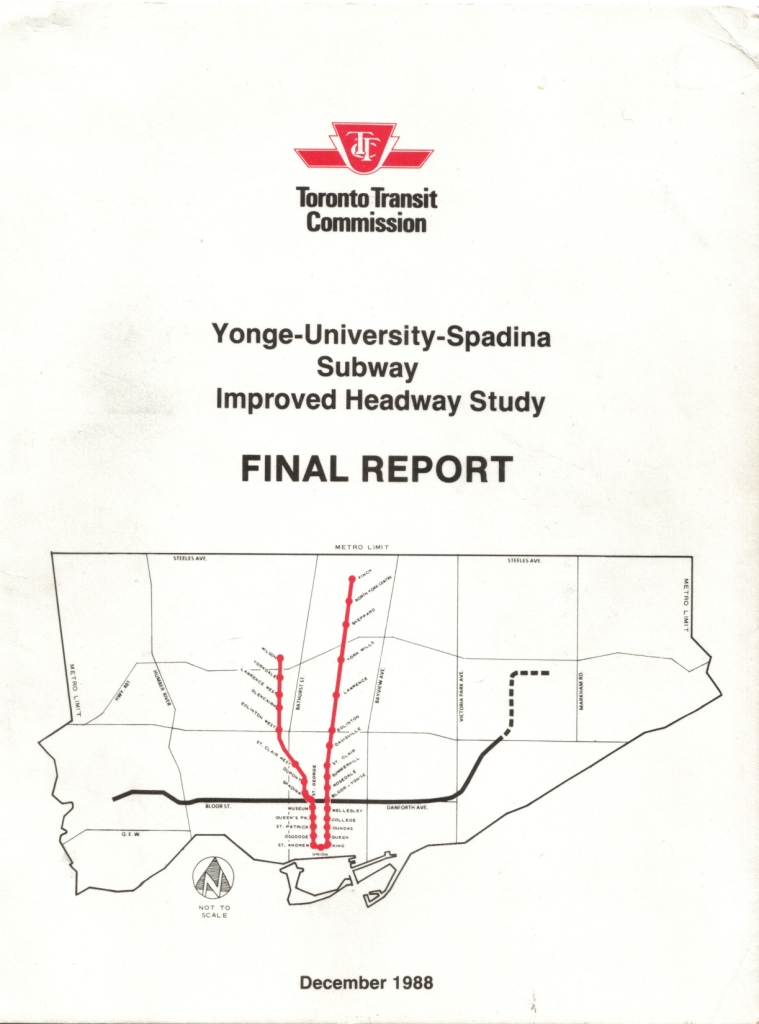
Yonge Subway Headway Study 1988 (Part 3)

This section presents considerations for the vehicle fleet and yards required to house these cars.  An important consideration for any decrease in headway is that the number of trains in service goes up.  This generates added capital and operating costs for an expenditure that addresses only peak period demand.

A proper comparison of lines would look at what happens if the fleet is expanded (regardless of the technology) elsewhere so that new off-peak service is available in a corridor that does not now have rapid transit.

As we will see later, the additional vehicles are a substantial portion of the total project cost for peak headway improvements on an existing line.

Continue reading

Yonge Subway Headway Study 1988 (Part 2)

This thread began with an introduction to the “problem” of capacity at Bloor-Yonge Station which dates back to the 1980s, an era when all expansion of capacity for travel from the suburbs to downtown was assumed to be on the subway network.  If you accept that premise, then it follows that massive expansion of subway capacity is absolutely required.  However, as we have recently seen from demand projections by Metrolinx, when there are good alternatives to the existing subway, people may find other ways to get downtown.

In this section, I will present another chunk from the long Chapter 3 in the TTC’s 1988 study.  This part includes descriptions of four ways to achieve shorter headways on the Yonge line through signalling changes.

Continue reading

Yonge Subway Headway Study 1988 (Part 1)

Recently, there has been a lot of discussion here about the practicality and desirability of adding capacity to the Yonge-University subway.  My position is clear:  there is more to be gained by adding new capacity in other corridors that can, in addition to relieving pressure on the Yonge line, provide alternatives in the transportation network to what now exists.

For twenty years, the focus has always been on beefing up the Yonge line, and this reflects the TTC’s long-standing tradition of looking only at their network when planning transit capacity.  Earlier subway expansion schemes completely omitted the GO Transit network from calculating potential regional demand and modelled all growth in riding on the subway system.  The effect of this shows up in the Network 2011 proposal that projected large increases in subway demand.  Those increases triggered a study in 1988 of what could be done to add capacity to the Yonge line, and we are still living with some of the fallout from that study today.

When I dug the report out of my archives, I thought that I would only scan, edit and post a few chapters. However, I soon realized that the arguments of 20 years ago are worth reading today because they are instructive both for the basics of transit operations, and because they show the origins of some current thinking.

For convenience, I have chopped up the document into sections.  The text, which was originally doublespaced typewriter (Courier) format, has been converted to single spaced Times Roman (yes, I know some of you just hate Times Roman).  Some exhibits that didn’t lend themselves to text-based conversion have been scanned separately as jpegs.

The first installment (this post) contains chapter 2 and the first parts of chapter 3 of the Final Report (chapter 1 was the Executive Summary) dealing with the problem of projected congestion and the various ways in which signal changes could be used to reduce headways.  In the next installments, we will see:

  • detailed descriptions of four schemes for signalling changes to achieve closer headways
  • a discussion of vehicle requirements
  • conclusions and recommendations for signalling
  • four schemes for a reconstructed Bloor-Yonge Station
  • evaluation of impacts at other stations and terminals, notably Finch and Wilson
  • options for the Yonge-Spadina loop
  • final summary and recommendations

Chapter 4 (the Bloor Yonge schemes) contains useful material to those of you who have been, figuratively speaking, drawing lines on maps for the past few weeks with possible alignments for additional tracks.  It helps to know the lay of the land both above and below ground.

Because we have already had quite a lot of discussion about routing alternatives, I will exercise my editorial prerogative to delete or severely cut repetitions of past discussions.  The main reason I am putting this material up is to show what was actually considered and how the history of past studies like this colours future projects.  That’s an important context for the current Regional Transportation Plan discussions — things that seem trivial today will take on the aura of historical received wisdom in less than a decade.  Maps drawn on stone tablets are hard to change.

Continue reading

Metrolinx Board Meeting October 2008

After all the other posts of the past week, here is one to catch up on bits and pieces from the Metrolinx Board meeting on October 24.  These are not trivial issues, and they relate to each other in ways that will become clear.

Status of the Regional Plan

There was considerable discussion of the timetable leading up to approval of a plan on November 28.  It turns out that there will be a Board “retreat” to consider the status of things on November 3, but this is nearly two weeks before the deadline for public comments.  This might suggest just how much impact public input might have in the process, but more to the point, some of that “public comment” includes reviews of the draft by regional planning staff.

Even assuming they all work a bit harder to hit the early November dealine, there remains the question of Metrolinx staff reviewing the comments, and the Board deciding what to do with them.

Rob MacIsaac, Metrolinx Chair, was clearly upset (as he has been on several previous occasions) with the idea that the plan will not be “finished” and approved on November 28.  His position, and by extension that of whoever is lighting fires under his butt, is fundamentally wrong on this.

From a purely political and process point of view, nobody plans to fund, much less start building, all of the Metrolinx plan out of the 2009 budget.  The Board has already identified projects that enjoy a quick start, and these will chew up the lion’s share of spending for several years.  Most projects that will generate spending at least for the next few budget cycles are already known, and that list can be nailed down in November. 

In fact, Metrolinx somehow got from selecting projects for advanced evaluation to approving them for implementation without benefit of detailed review, something that is only now starting.

Moreover, there is a legislative requirement to review the regional plan from time to time, and so we can expect changes long before work is started on building much of the plan, assuming we find money to actually build any of it.  Although a 10-year review is the current thinking, some members of the Board argue for a shorter 5-year cycle.

MacIsaac is creating unnecessary strain on the Board and bad feelings about what must be done in November to no good end.  Nobody casts a 25-year plan in stone on day 1, and it’s time MacIsaac stopped trying to force the Board, the municipalities, the regional transit agencies and the public down this path.  It is a manufactured crisis that has no place in this important discussion.

How Much Money Do We Have?

Another long discussion turned on the question of the $11.6-billion MoveOntario nest egg promised to us by Queen’s Park.  We are all taking it on faith that this is still money in the bank, but from a purely bookkeeping point of view, much of it won’t actually be spent from the next few budgets anyhow.

The Board got into a heated debate about what to do if this is the only money Metrolinx ever sees.  This brought on visions of the old regional “build my subway first” rivalries, and Mayor McCallion, among others, wanted nothing to do with it.  She argued that the Metrolinx role is to propose a network, to identify what is actually needed, not to get into political horse-trading and construction of pet projects.

This issue involves questions of additional revenue streams such as tolls, sales taxes and other ways to extract money for the greater benefit of transit systems.  The Board didn’t stop at capital funding, but is also very concerned with operating dollars because the local transit systems will be on the hook to operate all of the new services.  As if that isn’t bad enough, Metrolinx reports now speak of “eligible costs”, and the municipalities may find themselves on the hook for project costs everyone thought would be picked up by Queen’s Park.

It’s hard on one hand to publish glowing reports about mobility hubs and neighbourhood design, and then turn around and suggest that making a line look nice isn’t a Queen’s Park expense.  This sort of thing undermines the confidence of municipal leaders, and puts them in the ludicrous position of not being able to afford the new toys Uncle Dalton might give them.  The word is “downloading”, and it’s not a popular word around the Board table.

We don’t know yet whether we can even build the “top six” projects with the $11.6-billion, let alone anything else in the Regional Plan.  By the way, one slice has already been taken out of that pie — the Spadina Subway extension funding counts against Queen’s Park’s Metrolinx commitment.

Where Does the Growth Plan Fit In?

Brad Graham, ADM for the Ontario Growth Secretariat, gave a presentation about how Metrolinx’ plans fit so well with the direction of the Growth Plan.  Much back patting and kind words were heard.

There’s only one problem.

While Ontario is busy stimulating, regulating, generating new transit-oriented neighbourhoods out in the 905, what is actually going to be built by Metrolinx focuses much more on existing travel patterns and particularly core-oriented movements.  All that stuff about Mobility Hubs looks good until you realize that a lot of them (and associated services) it won’t be built soon.  This is partly related to funding, and partly to the pressing need for more capacity into the core.

Another problem is that the projected modal split in much of the 905 is still poor, and will take years to improve.  A lot of that will come from better commuter service to downtown, not from inter-regional travel.  How this is supposed to stimulate interest in transit-supportive neighbourhoods is unclear.  Yes, there’s a chicken-and-egg problem.  Without new neighbourhood designs, transit in the 905 is doomed.  But without transit in the 905, car oriented planning will be the standard.

Mayor McCallion raised the issue of infrastructure to support new population.  This is not just a question of transit capital, but of sewers and water, hospitals, schools and all the other bits and pieces that go into a city.  Without money to build and operate these facilities, there is no point in talking only about new transit lines.

The Mysterious Benefits Case Analyses

The process for getting a line built by Metrolinx is supposed to be:

  • Propose a line
  • Study the line for its benefits
  • Study the line for its financing options (including “alternative procurement”) (AFP)
  • Approve the line as part of the Regional Plan

However, the current process doesn’t work like this.  In fact, we have lines that already have, more-or-less, Board approval (the “top six”) that are (or are about to be) going through “Benefits Case Analysis” (BCA) by Metrolinx (actually, by their consultants).  Although nobody has actually said so, it appears that parallel studies for alternative procurement are already underway.  All of these threads will come together (or more likely collide) at a Metrolinx Board meeting that may or may not be in public.

The BCA for York Viva was supposed to come to the public meeting in October, but it was held until the private session.  Adam Giambrone raised a question of whether it could be made public, and in the course of discussion, Rob MacIsaac implied that parts of the report might include confidential commercial information that they wouldn’t want to (or couldn’t) release.  That smells a lot like an AFP study to me.

To further complicate things, the BCA process has already spawned many optional schemes for the projects under study.  Some of these make changes in the draft Regional Plan that have never gone through any sort of public review.  Ironically, some of them are alternatives that have been suggested by folks like me who, in the past, have been told to go play with their toy trains and leave the real work to the pros.

In practice, a line in the Metrolinx RTP doesn’t seem to mean much because it’s all subject to detailed study and alternatives analysis through the unseen BCA and AFP processes.  So much for the vaunted public input we hear so much about.

Metrolinx really needs to sort out its processes for project definition, investigation and inclusion in updated regional plans.  I understand the pressure to cut corners to get the first projects underway, but some very bad precedents are being set.

Studying Projects or Studying Networks

The draft regional plan is a network, not a set of lines that exist in complete isolation from each other.  Work toward the draft operated, we are told, by finding the correct set of lines to have the best effect in the 15 and 25-year timeframes.  All of the demand estimates are based on a fully built-out network.

However, the BCA process goes one line at a time, and this risks missing the links between projects, the possibilities of looking at alternatives that span project boundaries.

I will explore the question of subway capacity in a separate thread, but the analysis for the Yonge Subway extension to Richmond Hill is deeply troubling.  This extension triggers higher riding on the existing subway which the TTC has finally admitted cannot be handled by the existing infrastructure.  It’s not just a question of buying more trains, putting in new signals to run them closer together, and fine-tuning terminal operations.  Now we know that there are capacity problems from Bloor south with the stations themselves.

The TTC has resurrected a scheme for a third platform at Bloor, and it’s fairly easy to see that this is not the only location where more platform and circulation capacity are needed.  Moreover, if the Yonge line delivers more transfer passengers per hour to the Bloor line in the PM peak, this will trigger capacity and service issues on that line too.

The RTP itself includes alternatives both on the comuter rail network and the subway system to divert traffic off of the Yonge line.  Why aren’t any of these being studied at the same time as the Yonge extension?  Could we avoid the need for massive capacity expansion on Yonge by operating other parallel services?  What are the comparative costs and implementation issues?  Could we get better network coverage for comparable or modestly higher investment?

That’s the sort of thing Metrolinx should be doing, but it’s not.  We risk many of the mistakes of past decades by studying lines in isolation from each other.

A Few Concluding Words

Metrolinx is so fixated on the short term, on giving Queen’s Park a finished report and a “quick start” set of projects, that we risk an opportunity to do proper comparative analysis and planning.  The Board needs to seize control of the process and set out a few basics: 

  • a short-to-medium term plan that will give Queen’s Park enough to munch on for budgetary purposes,
  • a review even of that plan to ensure that project sequencing is appropriate and alternatives really have been considered,
  • a clear process that keeps debate in public fora as much as possible and ensures input by municipal and transit system staffs together with the public.

This is not the time to sit back and admire the map on the wall, but to treat it as a living, changing and challenging guide to our future transportation network.

Transit City — The Movie

Today’s TTC meeting brought us an update on the various parts of the Transit City plan.  You can read the full report yourself, and there is a quick review of the status of various lines and studies below.

Meanwhile, the TTC is starting a media campaign to tell people about Transit City and about LRT.  You can watch the video on the TTC’s website.  Although it is a breath of fresh air to see the TTC promoting LRT after all these years, there are a few oddities in this piece (the timings where they occur are included below).

  • (0:39) “Work on Transiy City is already well underway.”  Hmmm … a few traffic barriers does not make a construction project.  I wonder why they don’t show the upheaval on St. Clair?  Shortly later we see a new car mockup superimposed on the westbound stop at Yonge Street.
  • (0:55)  “What is Light Rail Transit?”  We learn that LRT is used around the world including, wait for it, in Vancouver!  Er, ah, there’s a heritage streetcar line running with a former BC Electric interurban car, but no LRT.  This is a howling error.  Other cities shown on the world map are many fewer than the actual inventory.
  • (1:15)  “LRT can operate in a street, but has the flexibility to operate underground like a subway.”  LRT advocates will be amused to hear that their chosen mode has the “flexibility” to be just like a subway, when the real issue is the inflexibility and cost of 100% grade separated modes.
  • (1:50) Light rail is bigger than standard streetcars, and allows level boarding from platforms.  It’s nice to hear how LRT is a streetcar, but not a streetcar.
  • (2:10) LRT cars don’t need loops!  Amazing what you can do with modern technology.  See also Kennedy Station Loop.
  • (2:20) All door loading … but wait .. it’s a subway car!
  • (2:38) LRT will be separated from the effects of traffic congestion, not to mention pesky “transit priority” signals if the animation can be believed.
  • (3:32) Streetscaping.  Aside from the gigantic, fast-growing trees (maybe they’re from Vancouver too), note the typical suburban layout with wide setbacks of buildings from the street.  Contrast this with later illustrations of dense suburban redevelopment.
  • (4:05) Transit will be an even better travel alternative.  With a new subway train?  What’s that doing here?

The map of projects reflects the original Transit City announcement because many possible changes are still under study by both TTC and Metrolinx.

Transit City project updates follow the break.

Continue reading

A Slightly Less Grand Plan

Ontario’s Finance Minister, Dwight Duncan, yesterday announced that the province will run a half-billion dollar deficit thanks to the international financial upheavals and declining economic outlook.  In this context, I spent the day at a Metrolinx “stakeholders’ meeting” where we discussed details of the Draft Regional Transportation Plan and Investment Strategy.  The whole discussion has a surreal air because nobody is quite sure where the billions to pay for this plan will come from.

There is reasonable agreement about the need for better transit, but much suspicion of whether this plan will join its predecessors on library shelves.

In the informal post-meeting chats, I was asked what I would do if the promissed $11.6-billion MoveOntario money didn’t materialize, if we had to cut back the scope of the “top priority” projects to fit a tighter budget.  This is too big an issue for a short chat, and it deserves a post of its own.

Any budgetary cutback discussion must first consider whether to make the “death of 1000 cuts” or to look hard at big ticket items.  If you need to defer or cut spending, there is more money to be found in large projects than small ones, but we may skip reviews of smaller items that really don’t belong at the top of the pile.

A major problem lies in the dearth of information Metrolinx has published about the detailed performance projections and roles of each component in the plan.  We have demand forecasts only for year 2031 where the combined effect of future job and population growth interact with a completed network.  The published data show only peak point counts, not the demands for each network link.  There is no way to understand which links are cost-effective, and there is no data for intermediate states (such as after the “first 15” are built) to show whether they are an appropriate use of whatever resources might be available.

Metrolinx must publish this information as soon as possible.  Meaningful discussions of cutbacks are impossible without it.

This brings me to the “Business Case Analyses” that are in progress already for some of these lines.  These analyses are proceeding in the old, worn-out style of looking at each project individually rather than collections of projects for their combined effect on the network.  From the 2031 projections, we can see that the regional express rail lines and other new major elements have a big impact on demand on the existing network.  Notably, the forecast overload of the subway system doesn’t materialize because there are other high-capacity lines where the demand can flow.

Meanwhile, the TTC’s report on the north Yonge extension to Richmond Hill raises an old, hare-brained scheme to add a third platform at Bloor-Yonge station for increased capacity.  I won’t go into a detailed discussion here beyond saying that this is horrendously complex and expensive, but at least the TTC finally recognizes that subway capacity involves more than new signalling and more trains. 

The real question, however, is whether the money would be better spent on alternate services to divert riding with new options for travel to the core area.  Should some projects — the Richmond Hill regional express and/or the east leg of the Downtown Relief subway — be moved up as alternatives or as key pre-requisites?  That’s the kind of comparative analysis Metrolinx and the TTC are not doing, but should.

Next we come to project phasing.  Do we really need a line all the way to Richmond Hill?  Is there a shorter “phase I” that will have significant benefits without the cost of the full line?  Analysis on an all-or-nothing basis doesn’t give us staging options.

We need to be open about “the untouchables”, the projects with political clout that soak up billions of dollars because someone wants to see them built.  There is no point in talking about fiscal restraint if billions in proposed spending can’t be reviewed.  A related question is how that “top 15” list came into existence in the first place. 

Some time ago, the Metrolinx Board approved this grab-bag as likely top candidates that should be analyzed in more detail.  However, that analysis isn’t even started for many of them, and there is every possibility that the analyses may show that some projects don’t pull their weight, at least in the short term.  I may be splitting hairs, but that “top 15” has gone from candidates for early study to the definitive list of first projects without benefit of formal approval.  If we are to have a spending review, we must stop assuming that this list has the force of detailed review and blessing.

Oddly, it’s almost an afterthought in the Draft RTP — Metrolinx doesn’t even include a map showing the network with only these lines completed.

The subway to Vaughan is a special case.  There is supposed to be a trust fund holding the funding from Queen’s Park, Ottawa, York Region and Toronto.  Is this money really sitting in a bank somewhere?  Does the provincial share come out of the $11.6-billion MoveOntario pot?  Can we step back and ask questions about why this line is so important?  For starters, someone has to reconcile demand projections in York Region’s own EA that would make the Sheppard subway look busy with the impetus to build this line.  Metrolinx does not break out the section north of Steeles as a separate project, and the published demand for the line gives only the peak point value (likely just north of Downsview Station).

The TTC is already studying alternatives to the SRT including LRT conversion of the existing line.  The original recommendation to keep Skytrain technology only made sense for a line that remained at its existing length or had a short extension.  The further north it goes (Markham is a mooted destination), the less practical and more expensive Skytrain is relative to LRT.  Keeping the RT was a bad recommendation skewed by a desire to preserve Bombardier’s showcase technology, and we cannot afford to avoid this debate.

On the Sheppard/Finch corridor, current thinking is headed toward an eastward extension of the Finch LRT to Don Mills (where it would connect to the Don Mills line) and a westward extension of the subway to Downsview.  These may be viable projects in the long term, but we have to consider them separately from the original Transit City proposals.  Indeed, the Don Mills LRT isn’t even in the “top 15”, and there isn’t much point building the Finch line east of Yonge until it has something to connect with.

At Finch Station, there are big problems with the bus terminal and with the design of a future LRT interchange.  What happens if the subway extension gets underway and much of the bus operation shifts north?

On Eglinton, a line whose projected peak ridership is similar to both of the subway extensions, but whose extent provides rapid transit service to a far larger area, we are faced with an expensive central tunneled section that cannot be avoided.  Indeed, the size of this project requires that it be started sooner rather than later so that its benefits as a key part of the overall network can be available.

In the Don Mills corridor, should the DRL end at Danforth or continue north to Eglinton with a major transit hub linking the Eglinton and Don Mills LRT lines to the DRL subway?  This won’t be part of the “top 15” list, but the Don Mills Transit City study would make a lot more sense if the TTC stopped trying to shoehorn an LRT right-of-way into Pape or Broadview.  That scheme (and related alignments) are holdovers from the days when this was a BRT study, and this nonsense has to stop.

On the Weston/Brampton rail corridor, why do we persist with the fantasy of the Toronto Air Rail Link (TARL, formerly called “Blue 22”) that will chew up track space for a premium fare service on the same route as a proposed regional express service to Brampton?  How much does the private sector-proponent of the line hope to make from this service?  Can they be bought off?  Is it cheaper to not build Blue 22 and devote the resources to upgrading GO in the same corridor?

What are the possibilities for the CPR North Toronto Subdivision?  What options do we have for cross-region service via this corridor especially as an alternative way for riders from the north-east to get into the city without using the RT/subway network?  Negotiating with CPR won’t be easy, but doing nothing may condemn us to building rapid transit capacity elsewhere we might not actually require.

If there is a common thread in all of this, it’s a simple message:  Metrolinx started off designing a network, and they must not lose sight of the network view of any solutions.  Look at revisions to the plan as a whole, look at where the benefits are greatest in the short term so that we spend what money is available on projects that will show real improvements for transit.

Toronto has decades of making wrong, expensive choices, and transit suffers a well-deserved reputation as an “also ran” thanks to those decisions.  Provincial belt-tightening is just the opportunity we need to focus on what really works, on what we really need.

TTC’s October Supplementary Agenda

The supplementary agenda for this month has now been posted, and it contains some reports of interest.

At this point, I am only posting links here for information, but will comment on these after the meeting on October 23.

Queen Car Update:  No route changes at this time.  Continue attempts to improve line management.

Transit City Update

Yonge Subway Richmond Hill Extension

Clean Subway Stations! Vintage Tiles!

The October TTC agenda includes a report on the Subway Station Appearance Improvement program.

Things are proceeding, but slowly.  One major change will come in stations that have/had ceiling slats over the track areas.  These are hard to clean, and it is simpler to remove them and spray paint the ceiling black.  A similar approach was taken on the walls of Union Station.

There is some irony in this tactic.  Originally, the ceilings were bare plaster, but this made for noisy stations.  Next came sound-absorbing foam, but it quickly turned dark thanks to the ever-present dust in the subway environment.  What to do?  Cover the foam with slats.  Now we have come almost full circle.

Where slats covered station ceilings, they will be removed to provide easy access to all of the conduits hiding underneath.  This will bring on a minimalist look in many locations.  Probably we could paint all of those conduits beautiful colours, but a few millions would be needed (via charitable donations of course) to grease the wheels, hire a prominent architect to select the paint chips, and then give us a half-finished project.  Nobody would think much about maintenance, but there would be a nice photo op.

Speaking of Museum Station, a similar tactic for the outside walls will be installed as a trial at St. Andrew.  An ilustration within the report (page 10) shows the process of removing the old slats.  What do we have underneath?  The original vitrolite tiles!  Catch them while you can!

Lest I appear to be unfairly carping about the TTC’s ability to look good while saving money, I must applaud the basic housecleaning practices they are using and hope that they will remain and improve, not fall victim to budget cuts.  However, we seem to be moving in the direction of dulling already functional, but not beautiful, stations down to a level of poverty.  As a temporary measure, this may do, but for the future, especially for new and rebuilt stations, we need to do better.

Metrolinx Backgrounders: Where Will They Ride?

From October 20 to 30, Metrolinx will host a series of public meetings for those interested in commenting on the draft Regional Transportation Plan.  Four background papers are now available on the RTP page providing additional information about various aspects of the plan:

  • Climate Change and Energy Conservation
  • Transit Technologies
  • Modelling Methodology and Results
  • Mobility Hubs

This article deals primarily with the modelling of ridership, likely the most important of the four backgrounders because it shows how the proposed network is hoped to behave and the impact it will have on travel in the GTAH.

There are many caveats in this process set out in some detail in the report, and I won’t replicate them here beyond the standard warning that any model is only as good as the data it is fed, that the likelihood that the real world will match the modelled one falls off as we move into the future, and the basic fact that models cannot project the effects of changes beyond the range of known circumstances.  We know what changes are expected in population, jobs and housing fairly well for a 5 to 10 year horizon, but the 25 year view is hazy.  We know how people react to comparatively small changes in the relative cost of travel, but we don’t know what happens when changes are large and sudden.  Metrolinx is quite open about these problems, as anyone publishing modelled data should be, and it is important that we view the projected network behaviour in this light.

From my own point of view, there is a much more profound problem.  The only data shown in the backgrounder are for a completed network of routes in 2031.  If anything is certain about Metrolinx, it is that the proposed network will not all be built, and will not be built when or where today’s draft plan suggests.  The draft RTP itself acknowledges that this is a conceptual plan and is subject to change.

Moreover, the primary discussion today is about what will be done with the $11.6-billion of MoveOntario money we hope to see from Queen’s Park, plus, if the gods smile on us, an additional $6-million from Ottawa.  That’s less than half of the total cost of the RTP, and does not cover any costs for local transit systems such as ongoing maintenance, fleet expansion and service improvements.

Whatever is built, the work will happen in stages.  From a simple marketing viewpoint, if nothing else, it would be useful to know what the situation will be in five, ten, fifteen years as new routes come onstream.  Will the public (and the politicians who depend on that public for support of large public works like the RTP) see significant change in a meaningful timeframe?  What will we have to show for all the money we will spend?

Metrolinx already has a short list of projects to start immediately, in effect a seven-year plan, plus a fifteen-year plan in the RTP.  However, the backgrounder only shows the situation on a 25-year horizon. 

How much of the demand projected so far in the future comes from existing or soon-to-be trips, and how much depends on building or rebuilding that is decades off?  If we only look at the 25-year timeframe, we will see projections skewed by populations and jobs that won’t exist for at least a decade.

How will travel patterns behave when only a third or a half of the network is in place?  Will we have temporary crowding problems caused by an inapt (or inept) sequencing of projects?

The second major flaw lies in the presentation of the projected data.  The backgrounder gives us figures for the AM peak and the peak point on each line, but does not show the volumes on links within the network or even identify where the peak points are (although in many cases they are easy to guess).  Evaluation of proposed routes is difficult if we don’t know the contribution each link makes to the network as a whole, or the impact addition of a new route has on links in the existing system.  Decisions about project staging, how much of a new route should be built when, depend on knowing the time periods when each stage would be most effective for the region as a whole.

Continue reading