What Mayor Ford Should Have Asked For

Wednesday, August 17, saw Rob Ford going up to Queen’s Park in a time-honoured Toronto tradition asking for money for the transit system.  I won’t go into much detail on this as you can (and already may have) read all about it in other media:

Marcus Gee in The Globe

Karen Howlett and Patrick White in The Globe

Daniel Dale in The Star (with a wonderful photo in which Ford appears to be channeling the subway gods)

Martin Cohn in The Star

Chris Selley in The Post

Natalie Alcoba in The Post

Mayor Ford’s dream of a subway paid for entirely by the private sector has evaporated.  Brother Doug Ford claimed on CBC’s Metro Morning in February that developers were just waiting to invest $5-billion in the line, but they’re not queuing up chequebooks in hand.  Desperation set in a few months back when even Ford’s hand-picked transit fixer, Gordon Chong, openly questioned the proposed financing.  Since then, any public sector funding that Ford could scrape together was thrown in the pot so that the private sector “ask” would drop by a billion or two.

Back in March, Mayor Ford signed an agreement with Queen’s Park (a document that has not yet been ratified by Council) in which Ontario takes over responsibility for an underground Eglinton line (at a cost of $8-billion or so, using up almost every penny of the Transit City money), and Toronto is on the hook for the Sheppard subway.  If there’s money left over on Eglinton, up to $650-million will be given by Ontario to Toronto.  Ford wants that money now, and fears that a Federal contribution of $330-million to the Sheppard LRT project will be lost if the Sheppard project doesn’t get on the rails soon.  He has also been after money from “PPP Canada”, a federal agency, but they’re a pesky bunch and want to see a business plan.

The Mayor came away from Queen’s Park empty handed, and Premier McGuinty made it quite clear that Ontario is in no position to advance funding for the City’s project until the true cost of the Eglinton line is known.

This has to be the biggest waste of a bilateral meeting in quite a long time. Continue reading

Budget Cuts Threaten Transit, Not Just Streetcars

The Toronto Star reported on July 30 that the TTC may defer its order for new streetcars in a move to free up room in the capital budget.

As I have often written here, the TTC’s capital plans badly strain the ability of the City of Toronto to carry the ongoing spending, and constant cutbacks in funding from Queen’s Park are a major problem.  Every chance they get, provincial Ministers tell us about billions “committed” to transit in the GTA.  The problem is that much of the actual spending won’t happen for many years, if ever, while current spending is a major problem.

Many programs that funded parts of the TTC capital budget have wound down, and the only provincial funding stream the TTC can actually count on is the gas tax.  That brings in about $150-million annually, and even this is partly split with the operating budget.  Meanwhile, the TTC has reached a point where it classifies almost every project as “state of good repair”.  That incantation, brought to us by former Chief General Manager David Gunn, is supposed to indicate the scope of work and funding needed just to keep the lights on and the trains rolling.

However, it has been abused in TTC budgets to include projects such as provisions for additional capacity on the subway.  This is not to say the capacity isn’t needed, but that’s a different class of spending, certainly one that should include regional, not just local funding.

The order for 200 new low floor light rail vehicles (LFLRVs) for the “legacy” streetcar system has a pricetag of about $1.2-billion including inflation, spare parts and warranty coverage.  Toronto gambled when it put this deal together that Ottawa would come in for 1/3, but they chose not to participate.  Indeed, Ottawa has always been selective in its spending on transit across the country preferring to drop money where there is a time limit to the spending, where funding is project-specific and doesn’t imply or create an ongoing commitment to all cities.  Ottawa’s only standing funding is from the federal gas tax, and even that falls in relative value over time because it is not indexed.

Toronto’s and TTC’s budgeting practices have not helped.  In a bid to keep the potential draw on the City’s borrowing capacity under control, at least on paper, TTC projects have been either shuffled off beyond the 10-year planning window, or simply ignored as a potential pressure.  Confusion about where and when funding might actually arrive adds to the problem.

Although the TTC produces multi-year capital and operating budget projections, there is never any explanation or discussion about the options that would shape future funding.  Every year, more projects appear on the list, some the inevitable result of decisions already taken (e.g. if you increase the size of the subway fleet, you need more carhouse space to store the trains, and more staff to operate and maintain them).

Adding to this mess is the Mayor’s desire to extend the Sheppard Subway.  Although funding for this might somehow arrive from the private sector or through links to future property tax revenue, if the project is going to launch, a considerable portion will be in public sector budgets.

In this context, the new streetcars are an easy and obvious target especially as they are not loved by the Mayor’s office.  The Star mentions a $1.5-billion shortfall in available capital over the next ten years.  Whether stretching out or delaying spending on new streetcars will make a big dent in this is hard to say.  A scheme for Metrolinx to pick up the cost and lease the cars back to the city is only an accounting trick — one way or another, we have to pay for them just as we will for anything purchased with borrowed money.  (The proposed financing of Presto is a similar piece of sleight-of-hand.)

The fundamental problem is that the revenue stream (be it operating or capital) dedicated to transit in Toronto and in the GTA is far too small for the region’s demands.  Queen’s Park refuses to address new “revenue tools” even though several analyses of the situation by such radical lefties as the Toronto Board of Trade flag the urgency of more spending on transit.

Once upon a time, we had a plan, no an announcement, called MoveOntario 2020.  It had lots of goodies in it including a network of LRT lines in Toronto.  That’s gone, replaced now by a single $8-billion project for an “LRT” subway across Eglinton and replacing the Scarborough RT.  Planned improvements of GO included electrification of the Lake Shore corridor, but what we actually get are small scale extensions dribbling out one announcement at a time.  Even as and when Metrolinx does produce its “Investment Strategy” with recommendations for revenue sources, along with “The Big Move 2.0”, the likelihood any government will have the stomach to raise new taxes is very low.

Meanwhile in Toronto, despite an $85-million hole in the TTC’s operating budget, Mayor Ford wants yet another freeze of transit fares.  This is madness.  Fare revenue totals about $1-billion and we know that the combination of strong riding demand and good service will minimize the negative effect of a fare hike.  The TTC projects a 10% increase (to $2.75 per adult token, with other fares adjusted proportionately) would bring $50-60m, but this is conservative.  It includes a considerable allowance for “elasticity”, the degree to which a price increase leads to a drop in demand.

Service cuts alone will not address that $85-million, and that approach would ignore both the overall growth in demand on the TTC and the close linkage between service quality and the system’s attractiveness.  Moreover, the $85m does not include the $25-$30m cost of an arbitrated labour settlement TTC workers will likely receive.

While it is tempting to blame everything on Mayor Ford, this is a case where many others must share the burden.  TTC financing has occupied a never-never land in Toronto and Ontario budgets for years.  Toronto is badly served when an agency appears to have an unlimited appetite for money, but a financial plan consisting of “let’s hope for better next year”.  The City is also badly served by doctrinaire budgeting that decrees funding and service cuts with no regard to their effect on system users, on the viability of an essential part of the City’s transportation network, and on the ability of Toronto to attract and serve its businesses and residents.

A 2012 TTC budget will probably show up on the agenda for the board meeting of September 20, although I suspect details will continue to leak out in coming weeks.  How many decisions will be made behind closed doors before those budgets formally appear?  What options will citizens or Council have to examine the details, to debate the options for the future of our transit system?

Instead of that debate, we have far too much focus on what we can do without, on what we can cut.  That is not city building, and certainly is not city leadership.

Will Nobody Stop Fords’ Folly?

The Toronto Star and Globe & Mail report that TTC Chief General Manager Gary Webster’s days may be numbered thanks to his failure to support the Sheppard Subway proposal.  Not only might we lose Webster, but we might gain a Ford cohort, a politician with no real transit experience, as his replacement.

I will leave readers to peruse the full articles, but here is a key section in the Star:

The plan to get rid of Webster “is in play now,” said former TTC vice-chair Joe Mihevc.

“(The Fords) are so committed to Sheppard they are actively contemplating getting rid of the entire streetcar system in Toronto,” he said, adding that the cost of the new streetcars could be applied to the subway.

“If Doug Ford bullies his way through on this, it truly will be the victory of extreme authoritarian ideology over good public transit policy and good business management,” Mihevc said.

Elsewhere, we learn that TTC Chair Karen Stintz who, as recently as yesterday morning praised Mayor Ford’s support for TTC customer service initiatives, is actually frustrated with the speed of implementation of changes.  The fact that there isn’t a penny for this program in the budget, and that the TTC faces a 10% cut in city funding for 2012, shows what the real level of commitment is in Toronto.

Meanwhile, the only project of any importance to the Brothers Ford is the Sheppard Subway whose “private sector” financing is a bubble of their imagination that burst months ago.  Every penny that can be scrounged from other projects, plus tax revenue from developments miles away on Eglinton, would be used to finance Sheppard and minimize the level of private sector participation needed to top up the budget.  This is financial trickery of the worst kind.

According to the Globe’s story, Stintz appears to be splitting from Ford’s all-or-nothing approach to the Sheppard line preferring instead to build to Victoria Park as a first step using money originally earmarked for the Sheppard LRT.

Queen’s Park struck a deal with the devil to preserve the Eglinton LRT as a subway while leaving Ford free to work his financial magic on Sheppard.  The streetcar system appeared safe if only because replacing it would be a long-term, difficult proposal.  However, the Liberals’ hold on power is tenuous, and a Ford-favouring Tory government would no doubt be happy to cancel the streetcar order (and probably the LRVs for Eglinton as well) with Bombardier, and the voters of Thunder Bay be damned.

In ten years, we would have a much reduced quality of transit service in the central city, we would choke streets with clouds of buses and limit the growth of major areas served by the present and proposed streetcar system.  In return, Sheppard Avenue would have its subway, and what started as Lastman’s folly and a Liberal campaign promise by former Premier David Peterson would become a full-blown monument to the stupidity of transit planning and politics in Toronto.

Has any of Rob Ford’s transit scheme gone to Council for review?  No.  Council, especially its “mushy middle”, is too busy currying favour with the Mayor to rein in his actions, leaving the Fords to dictate policy on the transit file and so many others.

How Many Riders Will Use The Crosstown?

[See also Part 2 of this discussion.]

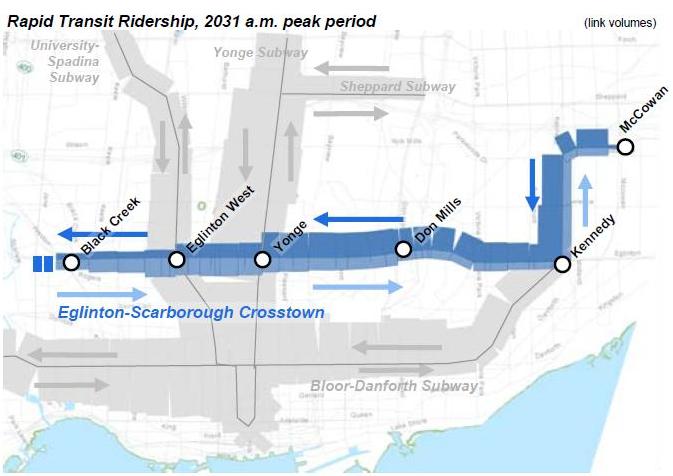
In a previous article and its long comment thread, readers and I have discussed the question of demand for the Eglinton-Crosstown LRT subway.  After the Metrolinx board meeting in June that started all this, I asked Metrolinx for more information about their projected ridership for the underground line.  In particular, I was interested in the numbers behind not just Eglinton, but the other routes on the demand map below.

Here is Metrolinx’ reply:

Under the previous Transit City plan, most morning Scarborough RT passengers arriving at Kennedy would transfer to the Bloor-Danforth subway. However, a small number of them would transfer to the Eglinton LRT, and bus riders would also transfer to the Eglinton LRT

Under the current Toronto transit plan agreement, many morning Eglinton – Scarborough Crosstown passengers arriving at Kennedy are not expected to transfer to the Bloor-Danforth line. Instead, we expect those passengers to stay on board the Eglinton – Scarborough Crosstown and continue west along Eglinton Ave.

It is important to note that the Eglinton – Scarborough Crosstown morning morning peak hour westbound ridership leaving from Kennedy station is roughly 6,500 higher than the Transit City plan forecast. In the Transit City plan, the forecasted behaviour of these 6,500 new Eglinton-Scarborough Crosstown passengers was as follows:

  • 60% rode the Bloor-Danforth subway out of Kennedy station.
  • 40% rode parallel bus routes or used different modes

We also expect an increase of ridership at the other stations along the Bloor-Danforth Eglinton-Scarborough line, but passenger behaviour at Kennedy is the dominant factor distinguishing the two plans.

Finally, below is a comparison of the anticipated 2031 morning peak demand points for the two plans:

SRT section (southbound into Kennedy)

  • Transit City (5 in 10 plan):  10,000 pphpd
  • Eglinton-Crosstown:  11,000 pphpd

Eglinton section:

  • Transit City:  5,000 pphpd eastbound into Eglinton West
  • Eglinton-Crosstown:  12,000 pphpd westbound into Eglinton/Yonge

[Corrections to the original text provided by Metrolinx July 26, 2011]

This is the entire reply, and there is no information on the following issues:

  • What are the numbers for other lines on the demand chart both for 2011 and 2031?  In particular, to what extent does the model show growth in demand on the existing subway system?
  • What other elements of a regional network exist in the 2031 model that could alter the growth pattern and future ridership flows?  In particular, there is no Downtown Relief Line even though it is part of The Big Move, and there is no indication of what GO services might also be in place.

My ongoing complaint about regional planning, both by the TTC and by Metrolinx, is that we talk a good line about networks, but we plan lines in isolation.  It is trivially simple to produce a huge demand on a new route simply by making it the only addition to an existing network — that’s how the TTC “justified” the Sheppard subway.

Ontario is spending $8-billion keeping Rob Ford happy by burying the Eglinton line, and they desperately need to justify this investment.  A 12k demand at the peak point is just the ticket!  Where else might the extra $4b have been spent to better overall effect?  We don’t know because Metrolinx has reverted from network planning to the traditional one-at-a-time methodology it was set up to avoid.

Metrolinx needs to be much more transparent about the way it projects ridership and the underlying assumptions of its models.  What routes are in the model network?  What frequency of service operates on them?  What is the fare structure?  What is the presumed future cost or practicality of using an automobile?  Where are the capacity constraints in the road and transit neworks?  How do these factors interact to shift projected demands?

This is the heart of regional planning, and Metrolinx is utterly silent on these issues.  Instead, they prefer to show us fully built-out networks decades in the future, networks we already know will be different thanks to various short-term changes and likely funding constraints, networks we will never see in actual operation.  We see simulations of the impossible, not the practical or the likely conditions we will have to live with.

This may serve short-term political needs, but the approach evades, no ignores, the vital debate we must have about what we might (or might not) build with the limited funding that our parsimonious, if not bankrupt, governments are likely to devote to transit.

How Many Trains Will Fit Through Union Station?

During the Metrolinx Electrification Study, those of us who attended various workshops became aware that there was a parallel study of capacity issues at Union Station.  The electrification plans are, among other things, in support of operating better service on GO generally, but if that service won’t physically fit through Union Station and its approach corridors, there’s a big problem.

That problem is independent of electrification per se because The Big Move from Metrolinx depends on substantially improved commuter rail service.  No capacity, no additional service.

At the recent Metrolinx Board meeting, GO’s President, Gary McNeil, presented an update on GO operations and construction activity.

GO President’s Report & Presentation Deck

The report includes a reference to Union Station capacity:

… Retaining wall construction is well underway to allow for an additional track in this corridor. The Union Station capacity study has been completed, with the result that in the near term, there is capacity at this station to meet needs. With the start of design of double berthing and new south platform, this will provide access required for service expansions. This work is anticipated to be completed in the next five years.  [Page 8]

After the meeting, I requested a copy of the study to learn what conclusions it might have reached. Various working papers from the study had been leaked, but they were neither definitive nor entirely coherent on how to deal with the problem.

Metrolinx has now replied that:

At this time, a detailed public component of the Union Station study is premature as we are undertaking on-going research. Specific information will most likely be available for the public when future potential projects develop from this study.

The purpose of the study is to assess the Union Station Rail Corridor (USRC) train capacity at four time points:

  • existing;
  • completion of planned infrastructure in 2015 and implementation for service improvements, including the ARL;
  • Electrification Reference Case (ERC);
  • and 2031 (Big Move planning document).

In doing so, we hope to identify opportunities to increase capacity by making more effective use of existing and planned infrastructure.  We also hope to identify the infrastructure needed to address any capacity shortfalls.  This study provided only a technical analysis, and Metrolinx will consider its opportunities after further assessment.

However, there is a good deal of material to get started on.

Continue reading

Spadina Subway Extension Update

The presentation from the Spadina update given at the TTC meeting on July 6 is now available online.

There’s nothing very surprising, but a few points are worth noting:

Station Names (p 3): There are still discussions in progress about station names.  The ones in the presentation are the working names that have been used for the project, but the final selection will occur probably in October.  Among the proposals in various stages of consideration are:

  • Sheppard West:  There are some who would rename this Downsview, or Downsview Park, although this would create a conflict with the existing Downsview Station which, just to spice things up, is actually at Sheppard.
  • Finch West:  There was a proposal to call this University Heights, although that is a neighbourhood name that doesn’t appear to have much currency among the local residents.
  • Steeles West:  This might become “Black Creek — Pioneer Village” to mark the nearby historical site.
  • Vaughan Corporate Centre:  Aside from being a name that would only inspire an accountant, it’s a rather long name that will be hard to fit on signage, literature, etc.  However, Vaughan wants it “Vaughan Metropolitan Centre” which is still rather long.  York Region is paying the municipal share for this part of the line, and I suspect that a long name will prevail, even if it’s rather pretentious.

Whatever names stations do eventually get, I hope that the major street names survive with a local neighbourhood name as a subtitle rather like “Bay Yorkville”.  Of course if we sell the station names to the highest bidder, neighbourhood and street names might vanish completely.

Budget (pp 4-5): The project is “fully funded”, but this has to be taken with a grain or two of salt.  First off, all of the project contingency has already been consumed in the design phase, and we still have four years of construction to get through.  The TTC hopes to make up any deficiencies through a combination of cost controls and the interest earned on the trust fund holding the provincial contribution to the project.

The project has repeatedly been described as “on time and on budget”, but whether this condition will hold through the remaining 4.5 years to opening remains to be seen.

Construction Schedule (pp 10-13): The schedule shows that the line will open at the end of 2015 taking us beyond one municipal election and two provincial elections.  Who knows which politicians will actually get to cut the ribbon.  Although the physical construction will finish in early 2015, commissioning of the line will take several months.  There has been no discussion of an early opening to York U or to Steeles West to serve the Pan Am Games.

Just as with the budget contingency, all of the “float” time in the project has already been consumed.

Automatic Train Control (p 14): When this project started, the TTC had not yet launched into an ATC conversion project, and the extra cost of ATC over a conventional signal system was not included in the approved, shared budget.  Strictly speaking, this is not required to open the line provided that a headway shorter than a conventional system can handle is not operated into non-ATC territory.

Earlier in the design stage, the TTC dropped Platform Edge Doors from the extension to save money.  At one station, this triggered a redesign because the wall containing the doors was planned as a structural element holding up the roof.

Bloor-Danforth Late Sunday Openings for Viaduct Beam Work (Updated)

Updated July 1, 2011 at 8:45 am: The slow order on the viaduct has been lifted both ways, and trains are running at normal speed between Broadview and Castle Frank for the first time since December 2010.

Original post from June 23:

This coming Sunday, June 26, and three additional Sundays through to late September, the Bloor-Danforth subway will not operate between Pape and St. George Stations until after noon.  A replacement shuttle service will be provided.

This will allow work on the bridge beams and track that has proceeded at a snail’s pace since the slow order, both ways, was imposed last December.

The full announcement is on the TTC’s site.

Brother, Can You Spare $500-million?

The board of Toronto Transit Infrastructure Limited (a TTC subsidiary) met today to consider various matters, among them the need for more money.

A report by TTIL President and CEO, Gordon Chong ends with the statement

“the existing budget is woefully inadequate to complete the tasks of the Working Group.”

Paul Maloney of the Star covered the meeting (I was unable to attend due to a conflict elsewhere).  Although it’s early days, we now know that the projected cost of the subway has gone up from $4.2 to $4.7-billion.  Just to pay for that increase would take over 10 years’ worth of development charges levied in Toronto.

Chong lists six possible revenue sources to finance the Sheppard line:

  • Tax increment financing in the Sheppard and Eglinton-Crosstown corridors
  • A special city-wide transit development charge
  • Development rights on city-owned land in the Sheppard corridor
  • Federal funding original destined for the Sheppard LRT project
  • New federal funding from PPP Canada
  • Left-over Metrolinx funds from the Eglinton project

It is amusing to note that a subway touted as a “private sector” undertaking would be funded largely by new taxes and public sector money.

The Sheppard subway fantasy will, no doubt, become even more bizarre as details unfold.  Chong plans a report to Council in fall 2011.  Meanwhile, he estimates that the preliminary work needed to determine the cost and feasibility will set TTIL back up to $300-million.

Maybe they can start pre-selling sponsorships for the stations.  After all, condo developers understand the concept of selling vacant land.  Buy early!  Get ’em cheap!

[Elizabeth Church in The Globe also reported on this meeting.]

A Mapnificent View of Toronto

An interesting tool for viewing transit travel times in many cities is available at Mapnificent.  Using schedule data published by many transit agencies, you can view the area to which someone can travel within a given time, on a specific type of day and day of the week.  Playing around with the parameters gives different views depending on available transit services, walking time to stations/stops, and of course, your location.

A few things I have noticed using this site for Toronto:

  • The route/schedule information appears to be a bit out of date because late night Sundays still show transit access via routes that no longer operate.
  • There doesn’t appear to be a provision for the effect of waiting time at stops.  If a bus runs half-hourly, and you want the “15 minute” travel boundary, then most of your average trip will involve wait time.  According to the comment thread on a post linked below, no wait penalty is assigned for the route at the start of a trip, only for transfers along the way.

All the same, it’s an interesting way of looking at transit travel and comparing the reach transit provides in different parts of Toronto and the GTA.  Something like this would be ideal for visualizing proposed transit networks if one replaced the transit system as it is today with “tomorrow’s” version.

Have fun playing with the site.  Note that this is a beta version, and some things may not work quite as advertised.  Also, note that this is a very cpu-intensive application, and changing the display parameters may take a while for the update to complete.

See also these articles on Jarrett Walker’s Human Transit blog:

mapnificent breaking through?

beyond transit scores

Subway Financing Falling Apart? (Update 3)

Updated June 4 at 10:20 am: The Star has published an article discussing road tolls and other ways to squeeze money out of drivers to pay for transit improvements.  David Gunn weighs in on the folly of a Sheppard subway, and Toronto’s transit woes in general.

Updated June 2 at 2:00 pm: Inside Toronto has published an article discussing the zoning increases needed to make the Sheppard Subway a reality.  This includes an illustration of the intersection at Victoria Park developed at the density likely to exist.  The drawing is from Tridel, a well-known developer, not from some wild-eyed lefty trying to frighten the locals.

Although Mayor Ford has disowned the concept of road tolls as a revenue source for subway funding, Gordon Chong continues to press the issue saying:

“I was hired to put all the options on the table and that’s what I’m doing. Road tolls are off the table for the Ford administration. But they’re still part of the toolbox. If you choose not to use that tool, that’s your choice.”

Honesty about the real cost of Ford’s obsession with subways is rare, but refreshing.

Missing from the discussion is the whole question of what development at this density will mean for suburbs through which subways are built, and by extension along Eglinton Avenue which may encounter the same fate.  Just because you have a subway (or underground LRT) doesn’t mean that the neighbourhood or the roads can accept the resulting traffic and population.  Many people who live in the new buildings along Sheppard do not travel by TTC, and they will simply add to congestion on the road system.

Continue reading