Toronto Contemplates Transit Funding / Reviews Transit Plans (Updated)

Updated October 9, 2012 at 5:30 pm

Toronto’s Executive Committee considered a report on transit funding mechanisms today.  In the following report, I have included only the most interesting or important of comments to give the flavour of the debate.

The proceedings were rather odd in that a presentation, cued up for City Staff, was never heard, but a “private citizen” managed to give a half-hour long deputation thanks to many friendly questions from Committee members.  That “citizen” was Dr. Gordon Chong, former head of Toronto Transit Infrastructure Limited, an all-but-bankrupt subsidiary of the TTC used to conduct a study of the Sheppard East subway extension for Mayor Ford.

Chong liberally drew on his transit experience including years as head of the Greater Toronto Services Board, a provincial agency predating Metrolinx.  Throughout his deputation, the highly misleading map of four cities’ subway system was projected to emphasize how little Toronto has done.  (That map purports to show how little Toronto has in comparison with London, New York and Madrid while ignoring the fact that these were much larger cities, much sooner.)

A “glaring omission” from the collection of transit plans in the staff report, Chong said, was his own Sheppard report and the information produced by KPMG about tax increment financing (TIF).  Chong clearly implied that the report was biased, but missed the fact that the Council motion directed the inclusion of “approved” plans for review, something Chong’s most emphatically was not.  As for TIF, it is mentioned, but rejected as a funding mechanism as staff argue that such revenue is needed for general support of city services and should not be earmarked just for transit capital projects.

Councillor Michael Thompson pursued the scheme of a Scarborough subway with a BD extension that would loop back along Sheppard to close the loop at Don Mills Station.  Chong replied that if Toronto could deal with the “money issue”, then there is no reason we can’t have the best in transit.  Thompson observed that a casino might bring in $75-100m annually and could fund transit projects.  The oddity here is that both treat any new money as a bonanza to be used for the best possible transit (where they want it) when fiscal conservatives might be expected to argue for careful husbanding of whatever loot might come their way.  There is also the small problem that the municipal share of projected revenue for a Toronto casino is probably an order of magnitude lower than the Councillor’s claim.

Various Councillors mused about a regional agency to dispense transit dollars and decide which projects should be built.  An underlying assumption was that, of course, the network of suburban Toronto subways would rank high on the list, and nobody seemed to contemplate that a 905-dominated agency might have other more pressing needs or think that the investment in all those subways was of dubious value.

Chong had only veiled contempt for the “expert panel” who reviewed his report and recommended, instead, for the LRT option on Sheppard.  He strongly supports subway construction presuming the money is available, supported by the best possible feeder bus network.  Councillor Norm Kelly asked whether the LRT plan was “an aberration”, and Chong replied that all previous TTC Chief General Managers had supported subways.  Although he invoked the name of David Gunn, he neglected to mention that Gunn boycotted the opening ceremonies of the Sheppard line.

Next the Committee turned to questions of staff. Continue reading →

Metrolinx Dumps TTC as LRT Partner (Maybe)

Updated October 4, 2012 at 9:20 am:

Mr reaction to the announcement yesterday that TTC would remain as “operator” of the LRT lines is on the Torontoist website.

Although the TTC sees this as a “good news” story, I am less impressed because Toronto is still very much the junior partner.  We get to drive the trains, and that’s about all.  With all maintenance remaining in the hands of Metrolinx private partner, whoever that will eventually be, this is a big step in outsourcing transit operations.

Updated October 1, 2012 at 10:00 pm:

The Toronto Star reports that discussions continue between Metrolinx, the City of Toronto and the TTC regarding the possible operation of the planned LRT lines by the TTC rather than a private contractor.

Exactly how much “operation” would entail is not mentioned, although the TTC is known to be concerned about responsibility for safety-sensitive systems such as vehicle, signal and track maintenance.

A related issue is the amount of detail that must be worked out before a master contract is let by Infrastructure Ontario.  If the private work ends when operation begins (with possible exceptions such as building and station maintenance), then this is a much simpler contract to draft than one that would require all of the details of future operations to be bundled with a design and construction contract.

Whether Queen’s Park and Metrolinx are aware of or care about the delay inherent in needing to specify so much detail so far in advance for a single contract remains to be seen.

September 21, 2012

My thoughts on recent announcements that Metrolinx would completely take over the LRT projects formerly part of Transit City are in an article on the Torontoist website.


CLRVs Visit Boston

Back in 1980, the Urban Transportation Development Corporation (UTDC) had suffered the demise of their planned magnetic levitation train system in Toronto, and the “Intermediate Capacity Transit System” (ICTS) we know as the Scarborough RT had not yet been foisted on Toronto.

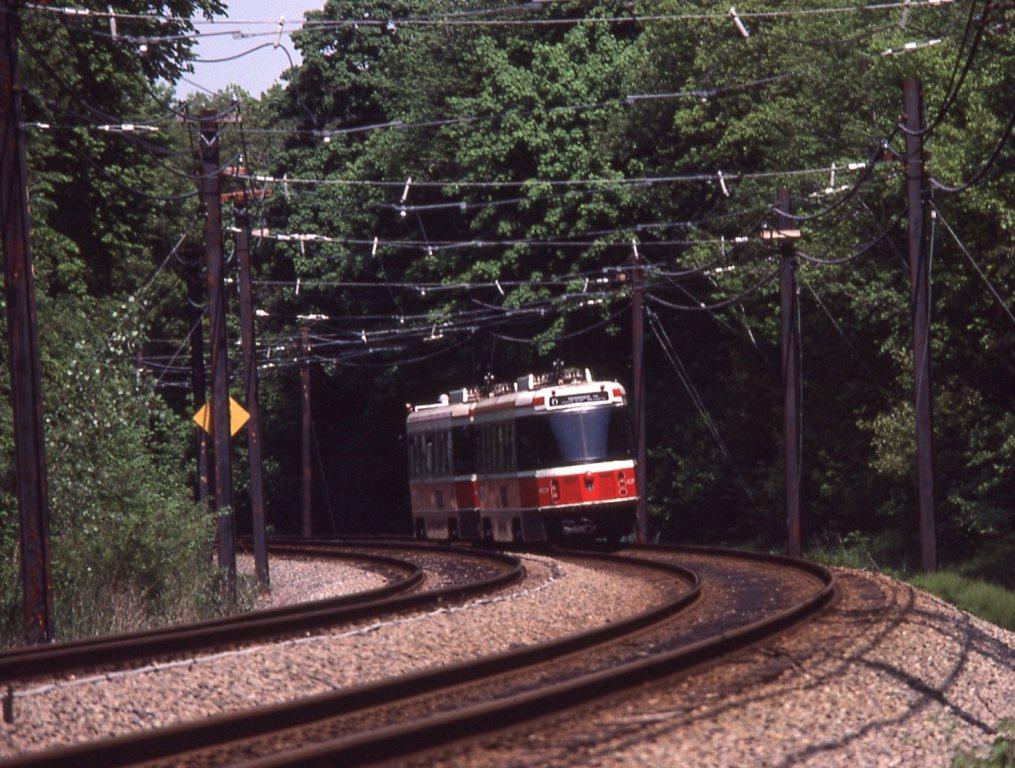
During a brief period when the only viable UTDC product was its new light rail vehicle, the CLRV, they shopped the design around to various systems.  The only taker they ever got was San Jose, California, for a small order.  Three CLRVs found their way to Boston for a demonstration, and I was lucky enough to catch them out on the Riverside line in May 1980.

A train of 4027 and 4029 prepares to leave Riverside Yard (the outer terminal of the line which includes a large parking lot and the carhouse/shops for the route.  A train led by Boeing car 3400 sits beside the CLRVs.  The overhead in Boston at this point was set up for operation by cars with either trolley poles (the remaining PCC fleet) or pantographs (the Boeing cars).

The CLRV train pulls out of the yard.

… and onto the main line.

The Riverside Line was build on an abandoned railway corridor, the Highland Branch, and opened in 1959.  A new connection into the existing central subway (a streetcar subway dating from 1897) was built to bring cars through downtown.

Here the CLRVs pass outbound through Reservoir Yard.  The larger part of this yard and an old carhouse are out of shot to the left, and they serve the Cleveland Circle line which terminates there.  Work cars in the yard include a PCC converted for use as a line car, and several “Type 3” passenger cars adapted as snow plows, essential equipment for a network with so much private right-of-way.

Outbound at Newton Centre station.

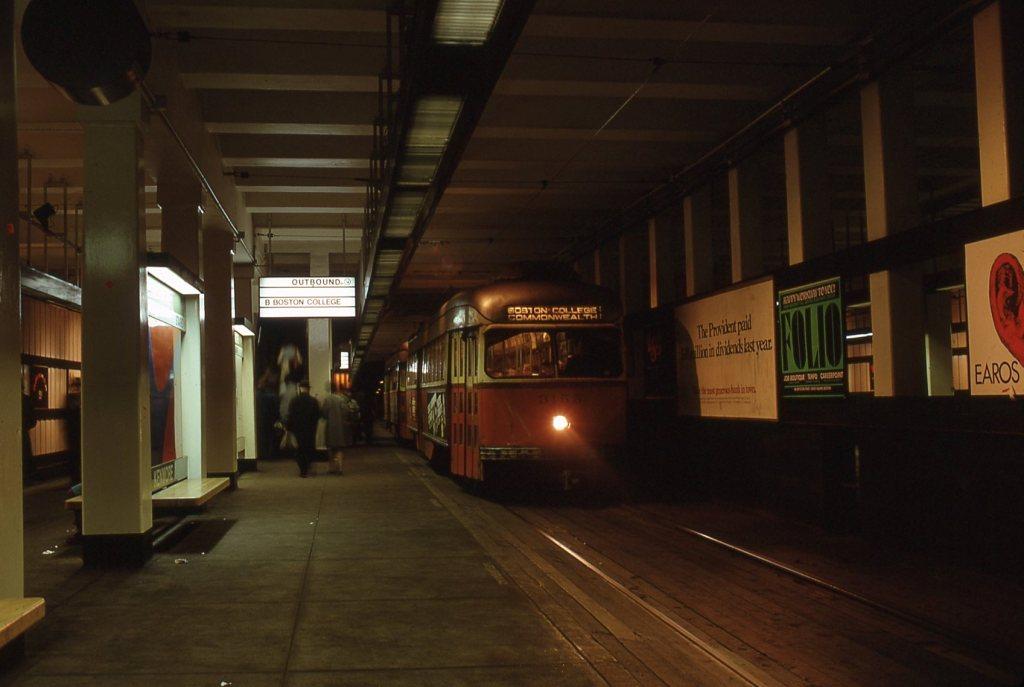
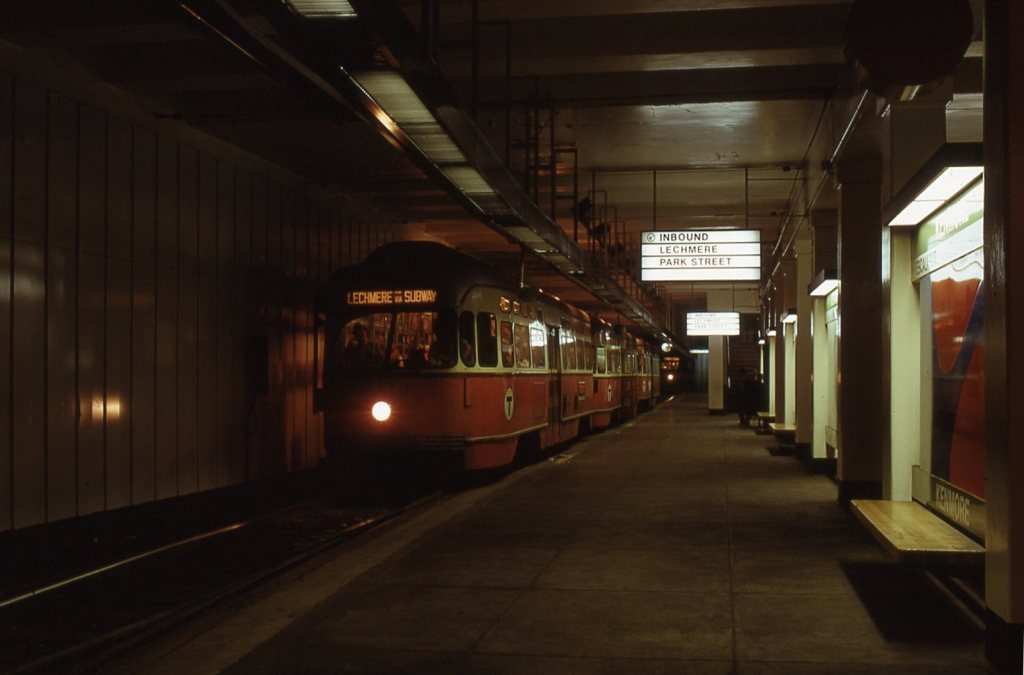
The shot below is from May 1972 at Kenmore Station which opened in 1932.  Readers with eagle eyes and long memories will recognize this shot which I loaned to the UTDC for inclusion in a brochure advocating the wonders of LRT which, at the time, the Ontario Government was actually pushing as a product, if not as a “solution” for Toronto.  It didn’t last long, and they went back to their old lies about how there was nothing to fill the gap, the missing link, between buses and subways — hence the need for an “intermediate” capacity system.

Kenmore Station is a busy place and has separate platforms for routes which diverge here.  Boston cars have doors on both sides so that they can serve island platforms like this.  Needless to say, the CLRVs served only stations with right-side platforms.  (The sign in the front window says “All stops except Kenmore” because the Riverside trains used the outside tracks at this station.)  Yes, that’s a three-car train of PCCs sitting at the platform.

Finally, a look outward towards Riverside terminal (off to the left behind the trees in the distance)  in October 1968.  The small building on the right is an abandoned railway station.  This line could have been a model for the Scarborough RT, an implementation of “LRT” at the high end of what this technology can accomplish with almost complete grade separation, rapid transit station spacing, and speedy operation.  (Although the CLRVs are capable of 70mph operation — itself a design excess by the UTDC — they were limited to 50mph operation on the Highland Branch.)

By the time the SRT and its expensive ICTS opened at a cost more than double the original estimate for LRT, the Riverside line had been operating for 25 years.

How Long Will Rebuilding The SRT Take?

When OneCity was announced with much, if short-lived, fanfare back in June, the centrepiece of the scheme was a proposal for a Scarborough Subway.  Toronto could have a full-blown subway to the heart of Scarborough at a small price, and without the disruption associated with a long shutdown of the RT.

  • A subway would be built from Kennedy Station east along Eglinton and then north on Danforth Road and McCowan to Sheppard with stations at Lawrence, Scarborough Centre (shown as McCowan and Ellesmere on the OneCity map) and Sheppard/McCowan. (OneCity presentation at page 15)
  • Once the subway opened, the RT would cease operating.  Users of existing stations would have to access the subway at its new location.
  • The cost of this option compared to the expected cost of the RT conversion to LRT was $484-million.

According to OneCity (at Page 16) an SRT shutdown would take over four years during which service would be provided by a fleet of 43 shuttle buses.

When I wrote about OneCity, I received an email from Jack Collins, Vice-President of Rapid Transit Implementation at Metrolinx in which he said:

Your recent blog posting implies that Metrolinx or the Province has increased the duration of the SRT shutdown period from 3 years to 3 to 4 years.

This is not the case. The first time we heard 3 to 4 years was during the City Council debate on Wednesday concerning the One City Plan.

This duration did not come from a Metrolinx representative and in all our discussions with the TTC staff the shutdown has been three years, and hopefully less if we put our minds to it.

I wanted to assure you and your readers that even with an AFP type contract, the current Metrolinx plan is:

  • SRT will stay in service until after the 2015 Pan Am/ Para Pan games
  • The AFP contract will have a condition that will limit the shutdown period to no more than 3 years
  • As part of the AFP contractor selection process, contractors will be encouraged to come up with plans to reduce the shutdown period to less than 3 years

One might be forgiven for a bit of confusion here.  When Queen’s Park confirmed funding recently for the Toronto projects, the announcement included:

The Scarborough RT replacement and extension to Sheppard Avenue: work will begin in 2014 and be completed by 2020.

[This announcement originally said “2015”, but this was corrected subsequently to “2014” to align with Metrolinx plans.  However, the end date stayed at “2020”.]

When the proposed staging for the rapid transit projects was before the Metrolinx Board on April 25, the report proposed:

… the Scarborough RT replacement and extension to Sheppard Avenue, with a construction start of 2014 and an in-service date of 2019, …

and further:

The previous plan included a construction schedule for the Scarborough RT of 2015-2020. The schedule allows for the SRT to be in service during the Pan Am/Parapan Games in the summer of 2015, after which the service would be shut down for construction. Planning, design and engineering work will be completed prior to construction in order to minimize down time.

The revised plan will move up SRT completion by one year from 2020 to 2019. This would be accomplished by starting work on the extension of the line between McCowan and Sheppard as a first phase, allowing the existing service to continue until after the Pan Am/Parapan Games are completed.

The presentation slides included:

SRT replacement is a priority

The SRT has high, established ridership, it is near the end of its economic life and in need of replacement. Project acceleration has benefits and staging can be done to avoid any disruptions during the Pan Am/Parapan Games period.

It is quite clear from these statements that a four-year shutdown from 2015-2019 was contemplated, and this no doubt led OneCity proponents to quote such a term in their plan.

Metrolinx now claims that the shutdown will be for, at most, three years.  This means either that:

  • The line will close immediately after the Games in 2015 and re-open in 2018, or
  • The line will close sometime after 2015, possibly as late as 2017, in order to reopen “by 2020” as per the Queen’s Park announcement.

Either way, Metrolinx owes the City a clear statement of its intentions given the frequency with which construction schedules for the “Transit City” lines have been adjusted.  The current situation, according to Collins, is:

We are planning one AFP contract for both Eglinton and SRT to optimize procurement time and contractor selection.

As indicated earlier, the contractor will be required to not exceed a 3 year shutdown period for the SRT and hopefully the contractor will be able to improve on the shutdown period.

The overall schedule of work will be determined once we have a contractor on board at financial close. It is premature to set a specific date for the shutdown of the existing RT, the construction of the new LRT and its opening for revenue service until we have a schedule agreed with the contractor.

It is quite clear from this that the start date for construction is not yet settled, but that it is intended to be at most three years whenever it happens.  If this drifts out beyond 2015, this raises a question of the cost of maintenance and reliability of the SRT which is already a delicate flower.

Any discussion of the future of Scarborough’s rapid transit network must proceed on an informed basis.  Queen’s Park is somewhat misleading in saying that work will begin in 2014 and complete by 2020 if the construction schedule has not already been decided.  Even the 2014 date for prebuilding the extension from McCowan Station north to Sheppard is really subject to whatever the prime contractor for the project proposes.  The words “by 2020” do not inspire confidence.

Meanwhile, the OneCity advocates will have to refine their cost proposal for the subway extension.  They claim a subway cost of $2.3b even though an estimate done for Mayor Ford’s transition team by the TTC pegged the cost at $3.3b including vehicles but not including a new or expanded yard facility.  Given that the TTC has more T-1 cars than it needs to serve the existing Bloor-Danforth subway, it may be possible to extend the line without buying more cars (that surplus is a long story in its own right) or building a new yard.

TTC owns 370 T-1 cars.  The BD line requires 43 trains for peak service (258 cars) and Sheppard requires 4 (16 cars) for a total of 274 cars.  Add in spares at 15% and this brings the fleet requirement to 316 at 2011/12 winter service levels.  If all BD trains ran through to Sheppard, this would require roughly 13 more trains plus spares, half that with a turnback at Kennedy.  15 trains would cost at least $240m.

The TTC’s cost estimate for a subway to Scarborough Town Centre is $2.6b including vehicles.  Adjusting for the T-1 surplus would bring this down to $2.3-2.4b, the number claimed by OneCity for a subway extension all the way to Sheppard.

The whole debate between OneCity and Metrolinx, between a Scarborough Subway and the RT/LRT replacement, needs to proceed on a much more informed basis than it has to date.  With luck, staffs of the various organizations will bring credible information to Council in fall 2012 and will not “cook” the comparison of various options to suit political aims at City Hall or Queen’s Park.

The Fate of OneCity (Updated)

Several postmortems have appeared on blogs about the supposed death of OneCity and what might follow:

Updated July 19, 2012 at 7:00 am:

Updated July 16, 2012 at 11:15am:

My own take on OneCity’s fate together with the original article detailing proposals for dealing with transit planning follow the break.

Continue reading →

The Missing Half of OneCity

Last week brought the excitement of the OneCity network announcement, followed by mildly supportive words from Queen’s Park and its agency Metrolinx, followed in turn by rather stronger provincial denunciation of a City that can’t make up its mind on transit.  Queen’s Park can hardly talk about consistency given their happiness to leap into bed with Rob Ford’s subway plan until Council gently reminded their provincial cousins that the Mayor had not bothered to ask for Council’s approval.  Meanwhile, delivery dates for provincial “commitments” drift off into the 2020s with the flimsiest of excuses about the limitations of an overheated construction market.  This is the same provincial government who talks about the power and capabilities of international companies just itching to work in the Toronto market.

All this kvetching detracts from two major issues.  First, once we get past the obvious conflicts created by proposals for the Scarborough Subway and the Scarborough/Etobicoke express services taking over the GO/ARL corridors, the rest of OneCity doesn’t step on any provincial toes.  As with so many of the debates here (and on other transit blogs), it’s the “I’m 100% right and you are 100% wrong” outlook that gets in the way of intelligent conversation.  There may be a role for the Scarborough Subway, although I am less certain about the proposed services taking on GO corridors.  At least we should get more information about the options and effects, not to mention defensible costs and demand projections (something neither the TTC/Toronto nor Metrolinx have been strong on in either Transit City or The Big Move).

Second, and at least as important, is the complete absence of money for improved service and maintenance, including a huge capital backlog on the TTC for vehicles and facilities.  The Ford era saw “savings” through cuts in presumed future growth.  A bus order for system growth was cancelled, and a new garage dropped from the plans.  The size of our future streetcar fleet was trimmed about 10%.  Who knows how many cars we really need given the strangulation of streetcar routes for service by the TTC.  Service growth in general was artificially depressed by changing loading standards to fit more people on each  vehicle.

These were all one-time fixes, fudges that got Toronto through two budget cycles while meeting the meddlesome demands of an administration for whom transit was just too much fat waiting to be cut.

The sad part is that thanks to two years of see-no-evil budgeting, nobody really knows what the true backlog in operations and maintenance might be, or what it will cost to put things aright.  Even if OneCity gets some sort of approval and funding, its projects won’t see a rider for years, and in some cases decades.  Should people who cannot get on the King streetcar or Finch West bus have to wait a decade for someone to address their problems?

OneCity is a plan for enhancing transit on major routes, but it’s only half of a network plan.  Most Torontonians will still ride on ordinary bus and streetcar routes for part or all of their journeys, and they are just as deserving of good service as those who will have new subway and LRT lines.  Indeed, even those who will, someday, see a new faster route should not have to wait for its construction.  “Coming in 2021” is cold comfort to someone waiting for a bus in February 2012.

If Council refers OneCity to staff for a report on costs and first-cut details of projects, we will learn more about the options for rapid transit in Toronto.  A long-overdue, informed conversation may actually happen rather than endless posturing for one neighbourhood or another.  But it will only be half a conversation.

Toronto needs to know what it will take to bring better service before we can build our rapid transit dreams, and what might come to many corners of our city that will never see a subway, LRT or BRT line.  What is our goal for these neighbourhoods?  What does “good service” mean to this newly enlightened Council?  How much will it cost?

These questions are just as important for transit’s future as contemplating the route of a new subway or the mechanics of a tax increase.  Council needs to ask them loudly and strongly as part of an integrated review of Toronto’s transit network.

Meanwhile, down the road at Metrolinx, a little humility might be in order.  This is an agency which, until fairly recently, did not even acknowledge the importance of local transit as part of the regional system, and still boasted about its high farebox recovery thanks to cherry-picking the most cost-effective services.  The provincial “investment strategy” must sustain not just the simplest, cheapest lines on the GO Transit map, but a wide range of services across the region including those provided by local carriers.

Is Toronto, is Ontario, serious about transit being a real alternative, about providing a “car-free” option to a much wider market of riders, or do they both simply prefer to hold press conferences with pretty maps?

The maps are nice, and the accompanying studies will fill yet more space in my library (or storage on my hard drive), but it’s the space and time in between that’s most important.  Riders will wait a very long time for some of these brave new transit lines to appear, and they deserve better than a walk to a crowded, infrequent bus route or a drive to a parking lot that fills before 7am in the meantime.

Toronto Council should demand that the TTC look not just at shiny new lines for the indefinite future, but that it address its real requirements today.  If the “new TTC” gets bogged down planning for the 2020s while transit continues to wither from overcrowding and underfunding through the 2010s, they are not doing their job.

OneCity Plan Reviewed

The OneCity plan has much to recommend it even though in the details it is far from perfect.

The funding scheme requires Queen’s Park to modify the handling of assessment value changes, and they are already cool to this scheme.  Why OneCity proponents could not simply and honestly say “we need a 1.9% tax hike every year for the next four years” (not unlike the ongoing 9% increases to pay for Toronto Water infrastructure upgrades) is baffling.  A discussion about transit is needlessly diverted into debates about arcane ways of implementing a tax increase without quite calling it what it is.

On the bright side, Toronto may leave behind the technology wars and the posturing of one neighbourhood against another to get their own projects built.  Talking about transit as a city-wide good is essential to break the logjam of decades where parochialism ruled.  Couple this with a revenue stream that could actually be depended on, and the plan has a fighting chance.  Ah, there’s the rub — actually finding funding at some level of government to pay for all of this.

Rob Ford’s subway plan depended on the supposed generosity of Metrolinx to redirect committed funding to the Ford Plan (complete with some faulty arithmetic).  Similarly, the OneCity plan depends for its first big project on money already earmarked by Metrolinx to the Scarborough RT to LRT conversion.  If this goes ahead, we would have a new subway funded roughly 80% by Queen’s Park and 20% by Toronto.  Not a bad deal, but not an arrangement we are likely to see for any other line.

On the eastern waterfront, there is already $90m on the table from Waterfront Toronto (itself funded by three levels of government), and OneCity proposes to spend another @200m or so to top up this project.  Whether all $200m would be City money, or would have to wait for other partners to buy in is unclear.

Toronto must make some hard decisions about a “Plan B” if the Ottawa refuses to play while the Tories remain in power.  Even if we saw an NDP (or an NDP/Liberal) government, I wouldn’t hold my breath for money flowing to Toronto (and other Canadian cities) overnight.  A federal presence is a long term strategy, and spending plans in Toronto must be framed with that in mind.

Sitting on our hands waiting for Premier McGuinty or would-be PM Mulcair to engineer two rainbows complete with pots of gold landing in Nathan Phillips Square would be a dead wrong strategy.  Bang the drum all we might for a “one cent solution” or a “National Transit Strategy”, Toronto needs to get on with debating our transit needs whether funding is already in place or not.  Knowing what we need and want makes for a much stronger argument to pull in funding partners.

In some cases, Toronto may be best to go it alone on some of the smaller projects, or be prepared to fund at a higher level than 1/3.  If transit is important, it should not be held hostage by waiting for a funding partner who will never show up.

The briefing package for OneCity is available online.

My comments on the political aspects of OneCity are over at the Torontoist site.

To start the ball rolling on the technical review of the OneCity network, here are my thoughts on each of the proposals in the network. Throughout the discussions that will inevitably follow, it is vital that politicians, advocates, gurus of all flavours not become wedded to the fine details. Many of these lines won’t be built for decades, if ever, and we can discuss the pros and cons without becoming mired in conversations about the colour of station tiles.

Continue reading →

Metrolinx Board Meeting, June 2012

The Metrolinx Board met on June 21 with a full agenda.  As is unfortunately the case with this quasi-public board, the fatter the agenda, the less time is spent on actual discussion of the material in it, at least in public.  Presentations were rushed, and there were few questions from the Board to staff.  Many issues on the public agenda have counterparts in the private session where, one might hope, there is more robust debate.

[This article has been in the hopper a bit longer than I had hoped while I chased some details from Metrolinx.] Continue reading →

“One City” To Serve Them All

Updated June 27 at 5:20pm:  I have written a political analysis of today’s announcement for the Torontoist website that will probably go live tomorrow morning.  A line-by-line review of the plan will go up here later the same day.

TTC Chair Karen Stintz and Vice-Chair Glen De Baeremaeker will formally announce a new plan called “One City” on June 27 at 10:30.

The plan already has coverage on the Star and Globe websites.  Maps:  Globe Star

I will comment in more detail after their press conference, but two points leap off the page at me:

  • The proposed funding scheme for the $30-billion plan presumes 1/3 shares from each of the Provincial and Federal governments.  This money is extremely unlikely to show up, especially Ottawa’s share.  From Queen’s Park, some of the funding is from presumed “commitments” to current projects such as the Scarborough RT/LRT conversion which would be replaced by a subway extension.  The rest is uncertain.
  • The “plan” is little more than a compendium of every scheme for transit within the 416 that has been floated recently in various quarters (including this blog).  What is notable is the fact that glitches in some of the existing ideas (notably the fact that the Waterfront East line ends at Parliament) are not addressed.  The whole package definitely needs some fine tuning lest it fall victim to the dreaded problem of all maps — once you draw them, it’s almost impossible to change them.

For those who keep an eye on political evolution, the brand “One City” surfaced in April 2012 in a speech made by Karen Stintz at the Economic Club of Canada.  This idea of a new, unifying transit brand appears to have been cooking for some time.

Congestion? Where’s the Congestion?

Recently we have heard a lot about congestion and its supposed causes.  The single largest ones, of course, are the lack of investment in transit and the continuation of building an auto-oriented GTA.  There are more people (and cars) hunting for space on a limited amount of roadway, and nowhere near enough capacity to handle all of the demand.

Transit will help, partly, eventually, but the sad fact is that development and travel patterns encouraged by auto-oriented planning cannot simply be reassigned onto a transit network.  There is no 905 equivalent of “King and Bay” to which we can conveniently funnel thousands of riders, let alone a network of routes focused on such a location from century-old travel patterns.

We can try, but there are limits, and the brave statements by Metrolinx about reducing congestion are at best optimistic.  Even Metrolinx acknowledges that their 25-year network, fully built out, will only keep congestion (or more accurately auto trips) at the current level, not reduce it.  Moreover, reductions in corridors where transit makes inroads will be offset by increases in travel where transit is not competitive.

In another thread, a discussion sprang up of problems related to congestion and to a list of the 10 worst intersections in Toronto.  Some have the temerity to point out that none of these has a streetcar line anywhere near it, and indeed a few are served by the Sheppard subway, that panacea for all our transportation ills.

To keep comments on this thread together, and to leave the original thread for its purpose  (Citizen Commissioners on the TTC), I will move the congestion-related comments here.