A Little Rant About Transit Fares

A recent article, The Flirtation With Fare By Distance, has sparked a debate in the comment thread about the relative merits of flat vs distance-based fares, and the whole issue of how we choose to subsidize some groups of riders versus others. In a recent reply, I took strong issue with some of the concepts advanced by writers, and the thread of my argument is strong enough that it deserves to be seen in an article of its own.

There are two related comments, and I will reproduce them here to set the stage:

Rishi (@PlanGinerd) wrote:

Fare-by-distance is a tricky one that I’m not yet firmly decided on. It clearly works on many large systems worldwide, and I have tons of friends and family who live in Zone 4 or Zone 6 in London who while they do complain the Tube is expensive, they still take it daily and never ever drive or take a cab or a regional train into the core. Perhaps it can only be coupled by changing the economics/costs of driving?

I am 100% sympathetic that FBD benefits those who can afford to live closer to the core, whilst disadvantaging those who live within the borders of Toronto but farther out. I haven’t done enough research yet, but I always think about why someone who lives so far from the City of TO core, would still choose to live within our borders vs. in Peel, York, or Durham regions. Is it really the cheap access to the TTC or is it other services? In other words, what incentives are there to convince them to live in “expensive” Toronto in the first place?

My friends deep within Metrolinx and TTC are also torn. They feel that it is not the role of the operator to handle the social equity, but the role of the province through transfers and tax breaks. I ask Steve and the community, if the province was to pair FBD for all GTA transit agencies and truly integrated fares, with a tax break to help those disadvantaged, would that change your mind?

It reminds me of a conversation I had last week on Twitter with Moaz RE how social programs that give out free TTC fares would cope without tokens. I see Presto tech. as enabling if done right, and it would be easy to give out cards with balances on them, or a periodic reload to help with fares, whilst also giving valuable O-D and usage data.

Maybe I’m too much of an optimist but things like this, and exiting fare gates are commonplace and the norm in cities everywhere. Yes local context is critically important, but I think we have to get away from the nay-saying that Toronto is always different and every other best practice could never work here.

Jonathan C wrote:

Flat fares are a very ineffective way to reduce inequality as the benefit is not well-targeted to those who need the help. There are plenty of people making long trips who could afford a higher distance based fare, and plenty who struggle to pay the flat fare for short trips or end up walking long distances because they can’t justify the cost. In most cases everyone would prefer better service. If you want to help those in need then push for an increase in the low income tax credits, don’t try to use the transit system as it is a very blunt instrument.

In a way the flat fare leads the poor to live further from the core as only those who are better off can afford higher housing costs plus the flat fare. The poor service to far-flung locales also pushes commuters into cars, while those who can’t afford to drive end up trading their time for a lower fare.

My replies:

This discussion seems to be taking place as if we were proposing to introduce flat fares as a net new subsidy that would benefit people who don’t need it. If that were the case, I could certainly understand arguments for targeted rather than broad-brush subsidies.

We are not. The discussion is of the potential effect on a wide range of transit users who now have a common fare no matter how far they travel compared to what they pay today. If you want to talk about actual need, then let’s expand the debate to free fares for all children, or reduced fares for all students and seniors. During the whole debate over cheaper fares for university students, I was struck by the absence of advocates for the truly poor saying “hey, what about us”, and the hand-wringing extended to a group that on the whole comes from relatively affluent backgrounds.

I have yet to hear a cogent argument for distance-based fares beyond “other people are doing it”. Well, no, throughout much of the GTHA, “local” fares are flat. Even London UK, that oft-cited bastion of fare-by-distance, uses flat fares for its surface system with time-based transfer privileges.

Correction: London does not have time-based transfers on its surface routes, with very limited exceptions. [July 2, 2015]

The question of flat fares vs fare by distance has nothing to do with “nay-saying” or “best practices”, it is a political and social choice the city has made. If we want to talk about fare collection technology, or the best way to operate a transit system, those are fair game for criticisms of the “not invented here” syndrome so common in Toronto.

“Equity” as Toronto defines it may well mean a flat fare. Don’t forget that the pesky border with the 905 is a comparatively recent phenomenon, and problems of low market share for transit within 905 systems (i.e. for local travel in York Region, or Durham, or Mississauga) have nothing to do with fare by distance, but with built form and the relative lack of competitive transit services. Fare by distance will only “solve” the problem for trips that are now cross-border by giving them a (presumed) discount. It won’t add better bus service unless there is a substantial jump in revenue to offset costs, net costs that are higher in the 905 because of the much richer per rider subsidies.

Where people choose to live is a product of many factors including income and service (broadly defined) availability. Try living without a car out in the 905 — the TTC for all its problems is a damn sight better, and it can certainly be argued that there is a stronger, longer history of community support services within Toronto than elsewhere even if these are stronger in the “old city” than in Toronto’s suburbs. Some of this is also historical — the 905 suburbs simply didn’t exist when many families moved to the outer 416, or they were aimed at a very different demographic. Markham is not noted for its large pool of social housing.

When we speak of transit discounts as a “social service”, this is usually in the context of truly disadvantaged groups who for mainly economic reasons are deemed worthy of additional social supports. There is a big problem with arguments that they should be funded through alternative means to transit fares such as tax rebates. Social subsidy programs are chronically underfunded and have exclusionary eligibility tests. Tax credits are a wonderful thing, but they are almost always structured to benefit those who have a taxable income in the first place, and can even disproportionately benefit the well off.

If we start talking of flat transit fares generally as a “social service”, we miss the whole point that encouraging people to use transit has an economic benefit for the city by avoiding pressure for more road construction, and a general benefit to all residents by reducing the need for one or more cars in their families. This is the sort of thing that would show up in any full accounting of costs and benefits. The hidden subsidies to motorists are not subject to the same scrutiny, nor are they regarded as some sort of social service. We also build roads for the economic benefit of the trucking industry and all of its clients. Maybe we should start thinking of that as a “social service” too because it is a form of job creation.

It is very easy to characterize things we don’t want to spend money on as “social service” or even worse “welfare”, while the things we prefer (often for political and ideological reasons) as “investments”.

Any scheme that discourages transit use relative to what is and has been in place for decades is the equivalent of a “disinvestment”, almost like asset stripping where dividends are more important than the health of a company.

If you want to call me a “nay-sayer” for that attitude, you have that right, but it’s a pejorative term, an artificial, ad hominem argument that does not engage in debate of the basic principles.

I would remind you that the “nay-sayer” epithet was used by John Tory during his campaign against those who criticized SmartTrack, and we now know what a bag of crap that proposal was.

The availability of vast amounts of travel data is routinely cited by those who would move us to fare by distance. Dare I remind readers that distance-based fares have existed for much, much longer than the ability to collect this data, and they are a product of political and business decisions about pricing service, not a means to collect O-D info.

The next time you go shopping and someone makes it harder for you to get through the store because they want detailed data about your buying habits, be sure to co-operate fully.

The TTC does not, repeat, not need a mountain of O-D data to provide better service. You can find out where the riders are simply by looking at the buses and streetcars, and broad network demands can come from O-D data in the TTS survey.

They already have a mountain of data documenting the behaviour of their vehicles, and after many decades are finally starting to analyze it in ways similar to the work I have published. Problems with vehicle bunching and poor headway management contribute a great deal to crowding on the TTC. Even with this documented in excruciating detail, little is done to fix problems of “TTC culture”. This is even a double-edged sword in that with all this data, some claim that all we need to do for more capacity is to improve management and schedules, not to actually operate more service. This is a variation on the “efficiency” argument that neatly avoids an actual commitment to better service.

Let us have a debate on fare structure by all means, but let it be a real debate, not simply a fait accompli that shows up because Andy Byford and Bruce McCuaig decide to impose fare-by-distance on us all as a matter of simplicity for Presto’s implementation. The technology should serve what we, collectively as cities and a region, want to help transit achieve, not get in the way or penalize riders who happen to live in the wrong place. Let’s talk about GO Transit’s uneven handling of short trip fares and the discount structure that makes travel from Kitchener to Union Station far cheaper, by distance, than travel from Rexdale. Let’s talk about what is needed to make transit service in the 905 truly attractive so that more people will want to use it, and transit will have political support for spending on more than a few subway extensions and GO improvements.

That would be a real debate. What we have today is an utter sham.

The Flirtation with Fare by Distance

Recent presentations by TTC CEO Andy Byford both to his own Board and at a recent Metrolinx Board meeting included an undercurrent of references to charging fares based on distance travelled or some form of zone system. This shows up in the description of new fare gates for subway stations that would be provisioned at the TTC’s expense as part of the Presto farecard rollout.

What, you ask, is this all about? Don’t we already have Presto readers on existing turnstiles? Well, yes, but they have two problems according to Byford:

  • The reader is not ideally located (“it is too low”) for customers, and
  • New fare gates can be designed with provision for future “tap out” capability that would be needed for a distance or zone based fare structure.

The cost of this change is projected to be $38.1-million, and this is a net addition to the TTC’s already bulging 10-year capital project list.

Oddly enough, the new fare equipment arises from a joint effort with Metrolinx/Presto and it would be no surprise if the same gates show up at stations on the Eglinton Crosstown line.

Continue reading

Toronto Polls Residents on Transportation Issues

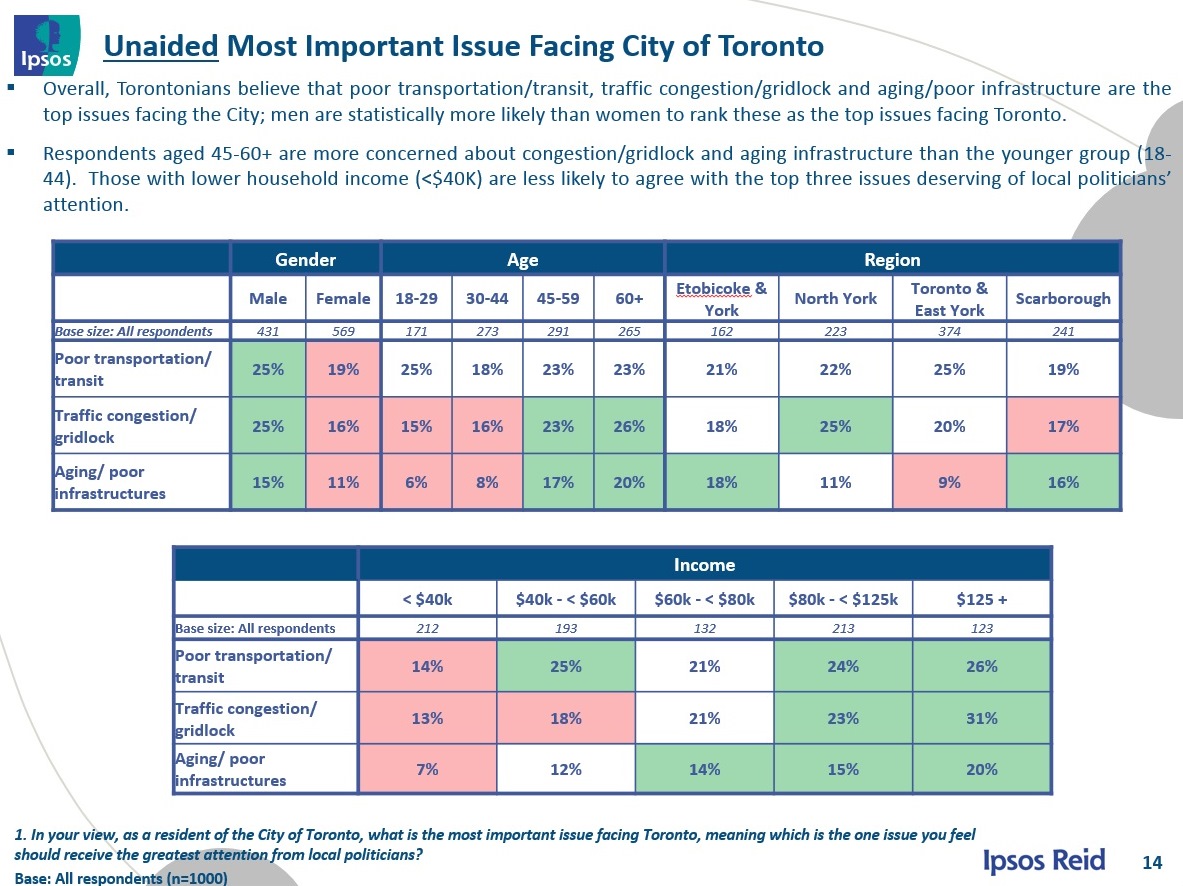
The City of Toronto recently polled residents on a variety of issues related to transportation, notably the effect of and attitudes toward construction activities, as well as the top issues facing the city. A summary of the results appeared in a press release on June 26, 2015. Although the survey focuses on road work, it also picks up an interesting view of transit users and of travel choices.

As the Globe’s Oliver Moore first pointed out on Twitter, the headline on the release misleadingly states:

Congestion and gridlock remain top concern for Toronto residents, according to City of Toronto survey

There is a fundamental problem with this claim.

Better transit actually appears under three separate responses: Poor transportation/transit (22%), Poor TTC (4%) and Building subway transit network (3%). This is not to dispute that congestion and gridlock are important, but that this response ranks well behind, collectively, transit-related responses.

P13_MostImportantIssues

In the detailed breakdown, only the top three responses remain, and there is some disparity between the rankings. What is unfortunate, quite obviously, is that the category “poor transportation/transit” does not distinguish between modes. We do not know what type of “transportation” most concerns each type of respondent.

P14_MostImportantIssues_Breakdown

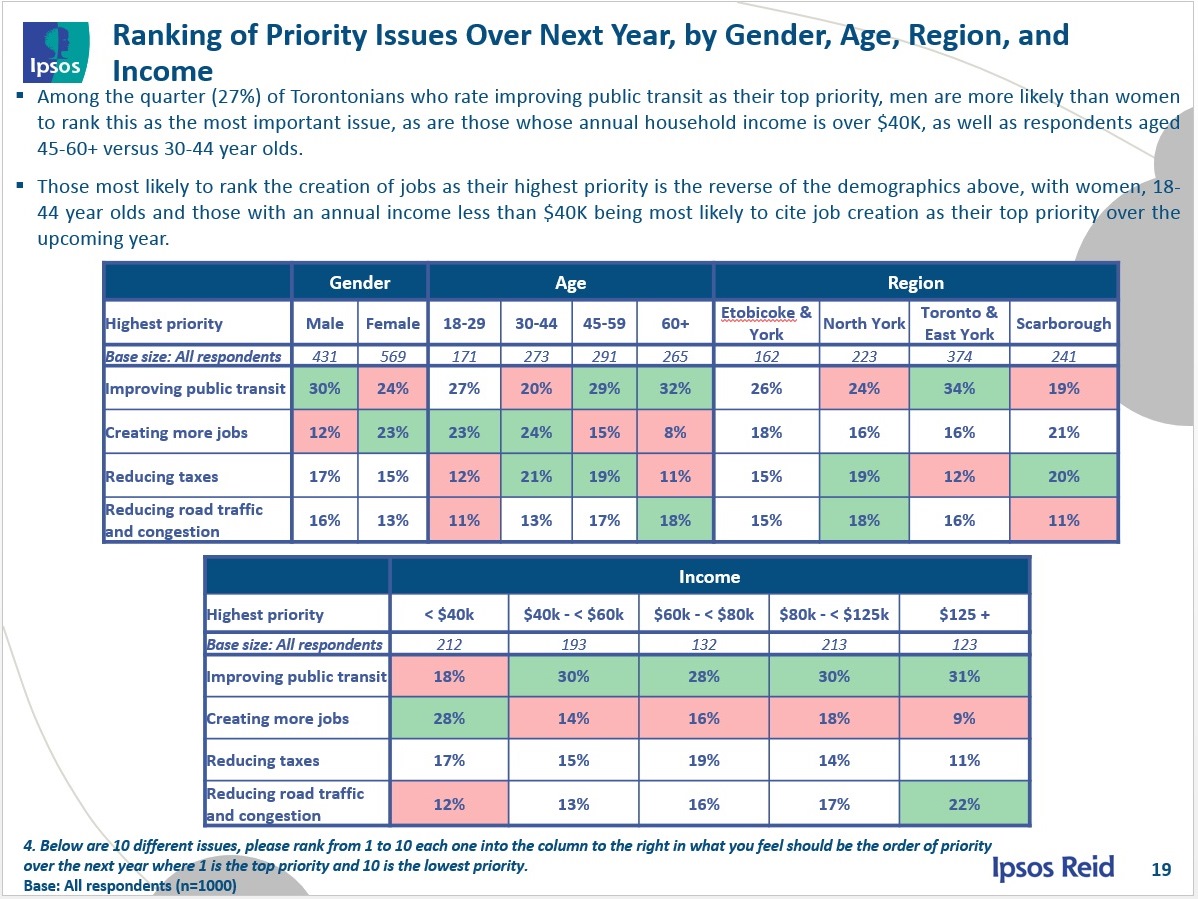
When the survey turns to the question of where Toronto should focus its efforts, transit comes out quite clearly on top as the number one pick of 27%, and in the top three for 61%.

P18_PriorityIssues

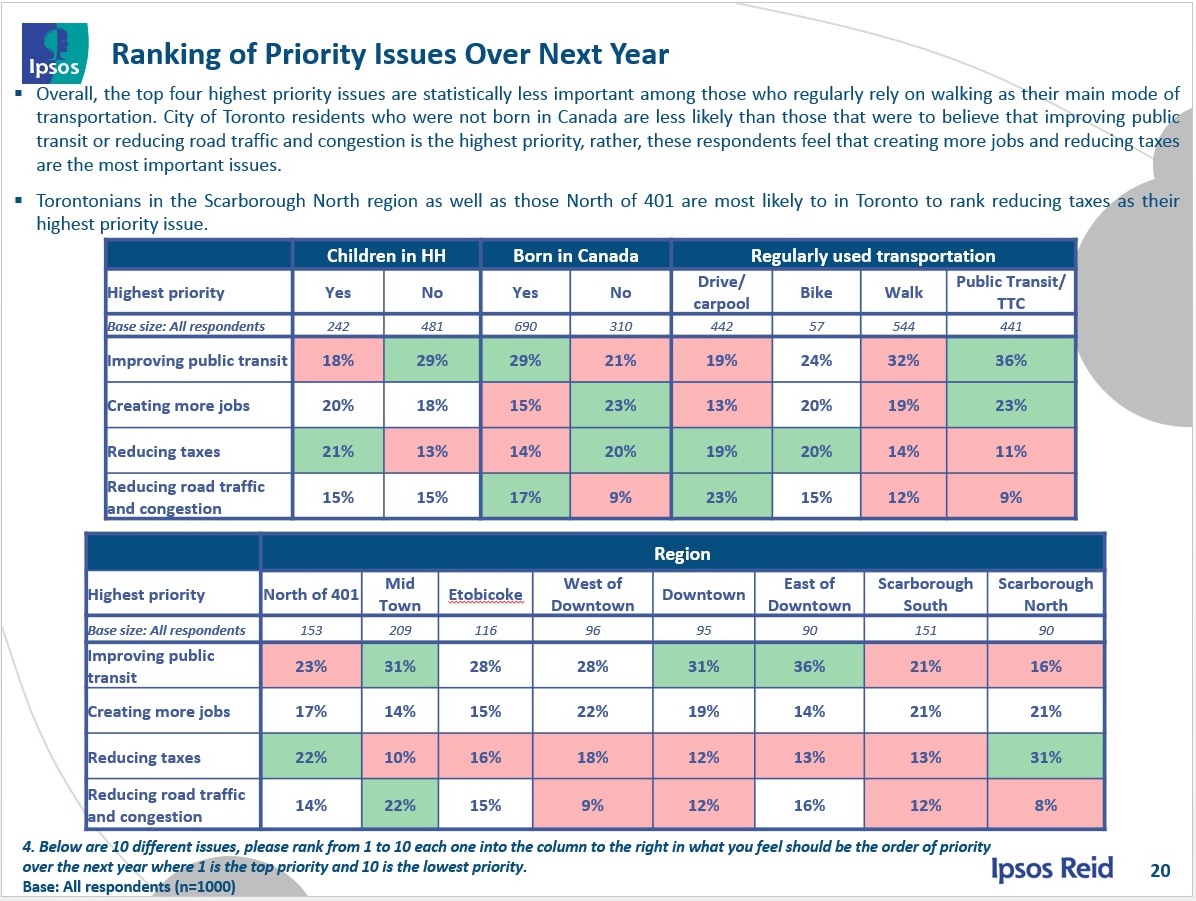
The breakdown is revealing because it shows that there is much stronger support for better transit among those living in more central areas, and this support falls off  notably in Scarborough, especially north of Highway 401. This begs a “chicken and egg” question: does improved transit get more support in areas where service is already relatively good and transit usage is higher, and can transit spending be politically competitive further from the core where it does not have as strong a presence?

P19_PriorityIssues_Breakdown_1

P20_PriorityIssues_Breakdown_2

Continue reading

The Vanishing Relevance of SmartTrack

The Metrolinx Board received a presentation today from their Chief Planning Officer, Leslie Woo, about the Yonge Relief Network Study. One item in this report raised eyebrows – the projection that GO RER and SmartTrack services would divert only 4,200 passengers during the peak AM hour from the Yonge corridor.

In the discussion, it was clear that service in the SmartTrack corridor would be every 15 minutes. Four trains per hour is hardly an inducement to change routes although at least if SmartTrack operates with TTC fares, it could still be atttractive.

However, I wondered just what that 15 minute headway meant, and so I wrote to Leslie Woo for clarification:

When you talk about 15 minute headways, does this mean an RER train every 15′ and an ST train every 15′ for a combined 7’30” headway, or is this 15′ for the combined service with a wider (e.g. 30′) headway on each one?

Her reply:

15 mins – combined.

Keep in mind that where Kitchener/Milton/and Barrie corridors converge we are already at less than 15 min headway in the peak.

This is a fascinating statement. SmartTrack is, among other things, intended to add stations along the GO corridors so that a more finely-grain service can be provided in Scarborough and at some locations along the Weston corridor such as Liberty Village. However, if the combined express GO and local ST services will only run every 15′, this implies a wider headway on ST, possibly every over train or 30′. With only a pair of tracks on the Stouffville corridor, and likely only a pair dedicated to GO+ST on the Kitchener corridor, it is impossible for express GO trains to pass local ST trains, and this limits how many trains per hour, in total, can possibly operate there.

During the press scrum, Metrolinx CEO Bruce McCuaig was asked about the equipment to be used, and he said that both GO and ST services would run with GO trains. It would appear that the only difference will be where they stop. Of course we already have this type of arrangement on the Lake Shore corridor, and didn’t need an election campaign to get it.

When candidate John Tory pitched SmartTrack, it was to be a “surface subway” using, mainly, existing GO rights-of-way but operating with quasi-subway service level, speed and station spacing. There were claims made for 200k/day in ridership, and the whole project was pitched as if it was the one line to solve every problem. Ask about the weather? SmartTrack will fix it. Out of a job? SmartTrack will speed you more quickly to job locations you never dreamed of. Why don’t we have more buses? Buses are a waste of money and what you really need is a shiny new fast train.

The problem with these claims is that they depended on SmartTrack actually being “like a subway” with frequent service, something it is quite clear that it will not be, at least not as Metrolinx sees things. The challenge here is that unless there is a very substantial investment in infrastructure by Metrolinx beyond what is planned for GO/RER, the network cannot handle the very frequent service contemplated for SmartTrack and this limits the effect it will have region-wide.

Even if SmartTrack did operate more frequently (a situation that was modelled by Metrolinx), it doesn’t attract much more ridership away from the critical Yonge corridor. The basic fact is that the west end of SmartTrack (wherever it might actually go) is so far from Yonge Street that it addresses a completely different market. Even the eastern branch on the Stouffville corridor is a fair distance from Yonge and, if anything, would bleed demand from the Scarborough Subway rather than the Yonge line.

A vital but missing piece of information in the presentation is the count of likely riders on various routes in the modelled networks. This report tells us how many riders are diverted from Yonge, but not how many riders would be on the other corridors and, therefore, the value of and need for more service in them. This information should come out in a technical background paper expected in July 2015.

Although the Metrolinx discussion did not get into SmartTrack costs, there are fundamental questions to be answered:

  • What are the comparative costs and benefits of serving the Eglinton West corridor with the proposed SmartTrack tunnel or with the planned westward extension of the Eglinton Crosstown LRT? (This should be answered later in the SmartTrack study of that corridor.)
  • Will SmartTrack share GO’s corridor through Union Station, or will it split off into its own tunnel downtown? Would the more frequent service a tunnel implies actually be able to co-exist with GO operations when the line rejoined the GO corridors?
  • What is the actual, likely cost of SmartTrack? For election purposes, this was estimated simply by taking the average costs of a few European “surface subways” or “overground” lines as London calls them, and scaling this to the length of the SmartTrack route. Originally, it was claimed that there would be no tunnels, but the campaign quickly learned that their research was faulty on that score. The cost is important because Toronto has volunteered to pay 1/3 of the total, whatever that might be.
  • Why should Toronto taxes be used to pay for a service which had among its objectives improvement of access to commercial properties in Markham and Mississauga?
  • Can a local service that operates considerably less frequently than a subway route be expected to generate much development as associated tax revenue?

As things now stand, SmartTrack has all the appearance of a line on the map that fades gradually under the harsh light of actual planning, operational constraints, and the degree to which Ontario is prepared to build infrastructure to enable it.

Yonge Relief Network Study: June 2015 Update

At its board meeting on June 25, 2015, Metrolinx will consider an update on the study of capacity relief for the Yonge Street Corridor in Toronto.

The report states that projected demand on the Yonge line can be handled for the next 15 years:

1.a. Significant relief to the Yonge Subway will be achieved with currently committed transit improvements underway including:

i. TTC’s automatic train control and new subway trains;

ii. The Toronto-York Spadina Subway Extension; and

iii. GO Regional Express Rail

1.b. Based on [the] above, more rapid transit service and capacity that is currently funded and being implemented will meet the future 15 year demand, assuming current forecasts on the growth rate of downtown employment and the implementation of TTC automatic train control on the Yonge Subway.

Continued work is recommended:

2. Direct the Metrolinx CEO to work with the City of Toronto City Manager and the TTC CEO to develop an integrated approach to advance the Relief Line project planning and development, incorporating further business case analysis and the findings of the Yonge Relief Network Study to:

  • further assess the extension north to Sheppard Avenue East to identify a preferred project concept,
  • inform the planning underway by the City of Toronto and TTC to identify stations and an alignment for the Relief Line from Danforth to the Downtown area
  • continue to engage the public in this work as it develops

3. Direct staff to work in consultation with York Region, City of Toronto and the TTC to advance the project development of the Yonge North Subway Extension to 15% preliminary design and engineering.

The emergence of a variation on the Relief Line that would operate north to Sheppard is quite a change from days when even getting discussion of a line north of Eglinton was a challenge. The context for this emerges by looking at the alternatives for “relief” that were considered and how they performed.

The next report to the Metrolinx Board will be in Spring 2016. The challenge will be to keep planning for a Relief Line “on track” in the face of the excitement and political pressures for GO RER, SmartTrack and a Richmond Hill Subway.

Continue reading

Infrastructure or Operations? A Big Debate?

On June 16, the Transit Alliance hosted a debate, of sorts, on the topic of which is more important: spending on transit infrastructure or on operations. The panel of six was arbitrarily divided into two camps although a few on each side felt it was a faulty premise – both are needed.

The audience was definitely pro-infrastructure. This is not surprising in an environment where the major calls are for building something, anything, new to “fight gridlock” by providing transit alternatives where they either don’t exist today, or are a poor substitute for driving. Only yesterday, we saw this attitude on a grand scale with Stephen Harper’s announcement at TTC’s Hillcrest Shops, of all places, that Ottawa would fund 1/3 of John Tory’s $8-billion SmartTrack scheme even though it has yet to progress beyond preliminary investigations. As a route crossing municipal boundaries, SmartTrack would be a “national” program, although if the Feds actually spend the full $2.6b share, it would take a huge bite out of the 10-year transit funding program, leaving almost nothing else for Toronto or much of Ontario.

Such are the problems of megaprojects. We see the same contradiction at work within Toronto where Queen’s Park regularly trumpets the Eglinton Crosstown line and its billions as an example of provincial commitment while other projects languish for want of funds at the municipal level. The Crosstown is always cited in “look what we’re doing for you” responses to calls for increased provincial funding. The same would no doubt be true if SmartTrack proceeds and Ottawa “buys off” its need to support other transit plans.

A Little Context

Before I get into the actual debate, a few comments about the panel overall, and about the topics that were completely missed.

Misinformation was no stranger to this “debate”, and the poor knowledge of the transit situation politically and at the technical level did little to enlighten the audience. Moreover, the format didn’t allow much scope for corrections even in the cases where the opposing groups might notice them.

The focus on gridlock inevitably meant that for the purpose of debate, commuting trips were almost exclusively the subject. Even then, the debate did not often look beyond the standard trips to and from downtown even though congestion is a pervasive problem in the suburbs where building and operating transit is a greater challenge, and the travel patterns are much more diverse. The “one line to rule them all” solution simply does not work when there are so many origins and destinations.

There was no mention of travel at times that did not match the standard workday commuting pattern, and little discussion of 416-905 cross-border travel including service levels remote from downtown. There was no mention of the large volume of travel by students whose “commute” is not to King & Bay, but to the many schools around the region.

The panel had no representation from any number of minorities, economic or racial, and Toronto’s Chief Planner Jennifer Keesmaat was the sole woman in the group. The audience had a strong professional tinge in light of the time of day (5:30 pm), location (near Bloor-Yonge) and entrance fee.

Most importantly, the debate took place absent any information about spending patterns today. The common assumption is that we’re not spending much on infrastructure, certainly not enough to overcome a decades-long backlog, and this area deserves more support. Panelists from the construction industry agreed wholeheartedly for obvious reasons.

In 2013-2014, Metrolinx spending [See Annual Report starting at p. 35] on capital projects totalled $1,894.6-million while operating costs consumed only $600m of which 2/3 was funded from the farebox. Metrolinx is very much a construction company, although in years to come the balance will shift to operations and will require a different corporate culture dealing much more with the day-to-day rather than the grand plans.

For 2014, the TTC spent about $1,200m on capital projects and $1,549.7m on operations (not including WheelTrans) with about 3/4 coming from the farebox [See Draft Financial Statement]. These projects include a substantial amount of capital maintenance on the existing system as opposed to expansion. About 3/4 of the capital subsidies received in 2014 came from the City of Toronto. It is important to note that the bulk of spending on widely-shared programs such as the Spadina extension is mainly in past years, and current projects have a far higher proportion of City money in them.

If we consolidate Metrolinx and TTC as the two major transit entities in the GTHA, the totals would be about $3.1b on capital and $2.1 on operations with the majority of the latter coming from the farebox. This puts the level of public spending on infrastructure and operations in context, a tiny detail that was completely absent from the debate.

Continue reading

Joint Metrolinx, City and TTC Consultation on Transit Studies (Updated June 21, 2015)

Updated June 21, 2015 at 12:45 am: SmartTrack alignment option 1C which was included in the presentation deck, but not in the individual illustrations on the project website, has been added to the consolidated set.

Updated June 12, 2015 at 6:30 am: Details of SmartTrack and Relief Line alignment options added.

The City of Toronto, Metrolinx and the TTC will conduct a series of eight meetings at locations around Toronto over coming weeks to present current information on studies now in progress regarding GO’s Regional Express Rail (RER) plan, SmartTrack, the Scarborough Subway Extension (SSE) and the Relief Line (aka “DRL”). Some of these meetings will focus on specific projects (noted below), while others are general overviews.

  • Sat. June 13 9:30am: Burnhamthorpe Collegiate Institute, 500 The East Mall
  • Mon. June 15 6:30 pm: Estonian House, 958 Broadview Avenue (Relief Line)
  • Wed. June 17 6:30 pm: Spring Garden Church, 112 Spring Garden Avenue
  • Thurs. June 18 6:30 pm: Archbishop Romero Catholic SS, 99 Humber Boulevard South (SmartTrack)
  • Sat. June 20 9:30 am: Hyatt Regency Hotel, 370 King Street West
  • Mon. June 22 6:30 pm: Winston Churchill Collegiate Institute, 2239 Lawrence Avenue East
  • Wed. June 24 6:30 pm: Scarborough Civic Centre, 150 Borough Drive (SSE)
  • Thurs. June 25 6:30pm: Riverdale Collegiate Institute, 1094 Gerrard Street East (Relief Line)

Consultation in Mississauga, Peel, Markham and York Region will occur in September according to the City’s press release.

Recommendations will be presented by TTC and City staff to the TTC Board and Council in Fall 2015 on SmartTrack, the SSE and the Relief Line.

Update June 12:

SmartTrack

The presentation boards and alignment options for the western leg of SmartTrack are now available online. For convenience, I have collected the illustrations in one file [PDF 2MB].

Broadly the study is considering three alignment groups for the link between Mount Dennis and the Mississauga Airport Corporate Centre:

  • A direct connection via Eglinton from the Kitchener rail corridor
  • A separate heavy rail corridor via Eglinton from Mount Dennis
  • A direct connection south from the Kitchener rail corridor through the airport

The “base case” for the study is the already-approved second phase of the Crosstown LRT.

The options include:

  • 1: Direct links with the SmartTrack alignment:
    • 1A: Swinging east of the KW rail corridor south of Eglinton, and then turning west to make a direct connection with the Crosstown line.
    • 1B: Turning west from the KW rail corridor south of Eglinton. This is the original SmartTrack proposal.
    • 1C: Continuing north of Eglinton, and then veering back south through a vaguely defined area west of Weston Road [illustration added June 21]
  • 3A: A separate line west from Mount Dennis.
  • 2: Links north via the rail corridor and then south into the airport lands:
    • 2A: To a point beyond the UPX airport spur, then south through the airport. The “Airport” station would be a connection to the UPX at Airport Road.
    • 2B: The same alignment as 2A at the north end, but following Dixon Road and Carlingview south to 427/401.
    • 2C: To a point east of the UPX spur with a station at the east side of the airport, then south via Carlingview as in 2B.

Some alignments require tight turns and tunneling will be needed for all of them contrary to the original claims that SmartTrack would be a “surface subway”. This will also force the issue of electrification without which a tunnel alignment is impossible, but Metrolinx plans now claim that the first electric operations will not begin until 2023.

The option 2 alignments will face technical challenges including curve radii depending on the exact details of the alignment and the equipment chosen for the route.

Headways for all option 1 and 2 alignments will be constrained by the need to share trackage with the UPX operation.

Relief Line

Four corridor options are under consideration. At its northern end, the corridor would start at either Broadview or Pape Station, and through the core area, the line would follow either Queen or King/Wellington. I have collected the four maps together in one file for convenience.

Detailed discussions of the pros and cons of these options are on the respective pages of the project site. The Pape alignment has clear advantages over Broadview, and a Wellington alignment through the core has advantages over King or Queen.

The Gardiner, SmartTrack and the Scarborough Subway

Three major projects face approvals at Toronto Council and Queen’s Park in coming months.

  • Should we replace the Gardiner Expressway with an at-grade boulevard between Jarvis and the Don River?
  • Should “SmartTrack”, John Tory’s signature campaign plank, form a U-shaped line from Markham to Pearson Airport providing both regional and local service in parallel with GO Transit?
  • Should the Bloor-Danforth subway be extended through Scarborough in place of the once-proposed LRT network, via which route and at what cost?

None of these is a simple problem, and they are linked by a combination of forces: polarized political views of what Toronto’s future transportation network should look like, very substantial present and future capital and operating costs, and competing claims of transportation planning models regarding the behaviour of a new network.

On the political front, Mayor Tory is playing for a trifecta against considerable odds. Winning on all three would cement his influence at Council, but it is far from clear that he will win on any of them. Council is split on the expressway options, SmartTrack has already sprouted an alternative western alignment, and the Scarborough Subway fights for its life with alternative route proposals and the threat of demand canibalized by the Mayor’s own SmartTrack plans.

Continue reading

UPX Was Never To Break Even

With all the hoopla surrounding the launch of service on the Union-Pearson Express (aka UPX or UP Express), it was refreshing to learn today from no less than the CEO of Metrolinx, Bruce McCuaig, that the line will never cover its costs.

Cast your mind back to the days of Prime Minister Chrétien and his Transport Minister, David Collonette (1997-2003). They had a dream of an express train from Union Station to Pearson Airport, a service that would be built, owned and operated at no cost to the government through the magic of private enterprise. SNC Lavalin was to be the lucky proprietor.

Things didn’t quite work out. SNC Lavalin discovered that the cost recovery for “Blue 22” as it was called in the early days simply didn’t pan out, and they looked for government support. When the Tories came to power, Ottawa’s love for this project waned, and they dumped it … right into the willing lap of Dalton McGuinty who embraced the scheme as a way for Ontario to show the world what we’re made of. Don’t be the last city without an air rail link! The matter was especially crucial as part of the Pan Am Games bid — there would be an express train to the airport.

Alas, the numbers still didn’t work, and SNC Lavalin looked to Queen’s Park for financial support. McGuinty showed them the door, and that might have been the end of things but for the usual Ontario hubris. The project became a public sector job 100%, but there was still the sense that it wouldn’t be a burden on the taxpayer.

On Friday, June 5, 2015, the Star’s Tess Kalinowski had an online Q&A with Bruce McCuaig, and it was quite revealing.

When will the line be electrified?

“The recent provincial budget set aside funding for Regional Express Rail, which includes electrification of the corridors, including UPX. We are folding the UPX electrification into the electrification of the Kitchener corridor as far as Bramalea, and we expect electrification to start being operational on five of the lines in 2023.”

There was a time when electrification was promised for only a few years after UPX began operation. Clearly, this is not going to happen even on a small scale for 8 years, let alone a full buildout. Whether there will even be a government left in office willing to undertake this project remains to be seen.

Back in September 2014, McCuaig claimed that the government’s promised electrification within 10 years was possible. Hmmm. Maybe a few kilometers here and there, but certainly not the full buildout if they’re only going to start in 2023. After a burst of election fever and enthusiasm for electrified GO services, Queen’s Park is getting cool, if not cold feet.

What about additional stations?

“We are building in plans for a new GO station and UPX station into the construction contract for the Eglinton Crosstown LRT. The Crosstown phase 1 ends at Mount Dennis and I think it would be a great place to have an interchange to give people more choice. At Woodbine, we have done what transit planners call “protect” for a potential future station.

“More stations connected in to the subway (like Dundas West/Bloor) and a future location at Mount Dennis means you can access the service at a lower cost. The trip from Dundas West/Bloor to the airport will have a fare of $15.20 if you use your PRESTO card”

It’s nice to know that Metrolinx still implies that the Crosstown will have a “phase 2”, although the almost certainly lower fare on this local transit service would make one wonder why one would choose to transfer off of the Crosstown and onto UPX, especially at a premium fare. As for the fare from Dundas West, it might just be a tolerable alternative to the 192 Airport Rocket from Kipling Station once Metrolinx builds a convenient link from the UPX station to the subway. The current arrangement is not exactly a “first class” link the fare would imply.

How many riders will UPX need to break even, and will it pay off its capital costs?

We plan to have the fare box for UPX cover its operating costs within three to five years. As you would expect, it will take a few years to build the ridership, just like any other system. We are not expecting fares to pay back the capital costs at this time. The province has invested the $456 million in the capital and it would be unusual in a North American context to expect customers to pay back the capital cost through their fares. I don’t know off the top of my head how many riders per day will be needed for cost recovery, but we do expect that level of ridership by year three to five.

So let’s get this straight: what started out as a sure thing for the private sector will take maybe three years just to reach a break-even state on operating costs. This also happens to be the period by which Metrolinx expects ridership to stabilize, and one wonders just how much room for growth in demand and revenue there will be beyond that. As for capital costs, oh we could never expect passengers to pay those. No wonder SNC Lavalin wanted a subsidy.

By the way, remember that phrase the next time someone tries to slip capital-from-current spending into an operating budget as John Tory did this year with the TTC’s bus purchase.

What we don’t know is the amount of subsidy the UPX will divert from other transit needs within GO or other transit systems. There will inevitably be pressure to bring fares on UPX down, especially if service in the corridor is combined with a route like SmartTrack. Then there is the small matter that UPX is a separate division complete with its own president. This is rather like having a President of the Scarborough RT except that Line 3 carries nearly 40,000 riders a day, more than UPX can physically handle if it were packed from 6am to midnight.

I will be magnanimous. Get the line open. Enjoy Balzac’s coffee in the station. Thrill to the glorious view of Toronto’s former industrial might along the rail corridor. Impress the hell out of those Pan Am visitors (although of course the officials and athletes have limos and buses and reserved lanes on expressways for their delicate sensibilities).

Once the games are over, let’s get serious about the money we have invested in the Weston/Georgetown corridor and figure out how to run an actual transit service that caters to more than the well-off who can afford to pay extra for a fast ride downtown.


Scarborough Subway Update: May 27, 2015

Updated May 30, 2015: The staff presentation is now available online. Some illustrations from it have been included in the article below.

At its May 27, 2015, meeting, the TTC Board received a presentation from Rick Thompson, the Chief Project Manager for the Scarborough Subway Extension (SSE). This presentation is not yet online.

During the presentation, Thompson noted that the process of winnowing down nine alternative routes for the SSE was nearly complete, and that a report on the three short-listed options would be issued fairly soon.

The original nine proposals included two major groups. The first would see the north end of the line continue east from STC on alignments similar to the proposed Scarborough LRT crossing Sheppard at either Markham Road or Progress. Three routes were proposed to reach the existing SRT corridor:

  • Via the SRT as currently constructed.
  • Via Eglinton and Midland, then swinging back into the SRT right-of-way north of Eglinton (this would avoid reconstruction of Kennedy Station on a north-south alignment).
  • Via Eglinton and Midland, joining into the SRT alignment near the existing Midland Station.

The second group takes a north-south alignment through or past STC and all arrive at Sheppard and McCowan as their terminus:

  • A Midland/McCowan option would swing into the Gatineau hydro corridor south of Lawrence to link northeast to McCowan and then follow the McCowan route north.
  • A Brimley option would travel east on Eglinton, north on Brimley and then swing northeast through STC to McCowan.
  • A McCowan option would follow Eglinton to Brimley, then swing north via Danforth Road to McCowan. This was the original proposal approved by Council.
  • A Bellamy option would follow Eglinton to Bellamy, turn north, and then swing back to the northwest to reach the McCowan/STC station.
  • A Markham Road option would follow Eglinton to Markham Road (although the exact alignment east of Bellamy is unclear), then turn north and eventually back west to McCowan. This is the most roundabout of the possible routes.

SSEOptions201505

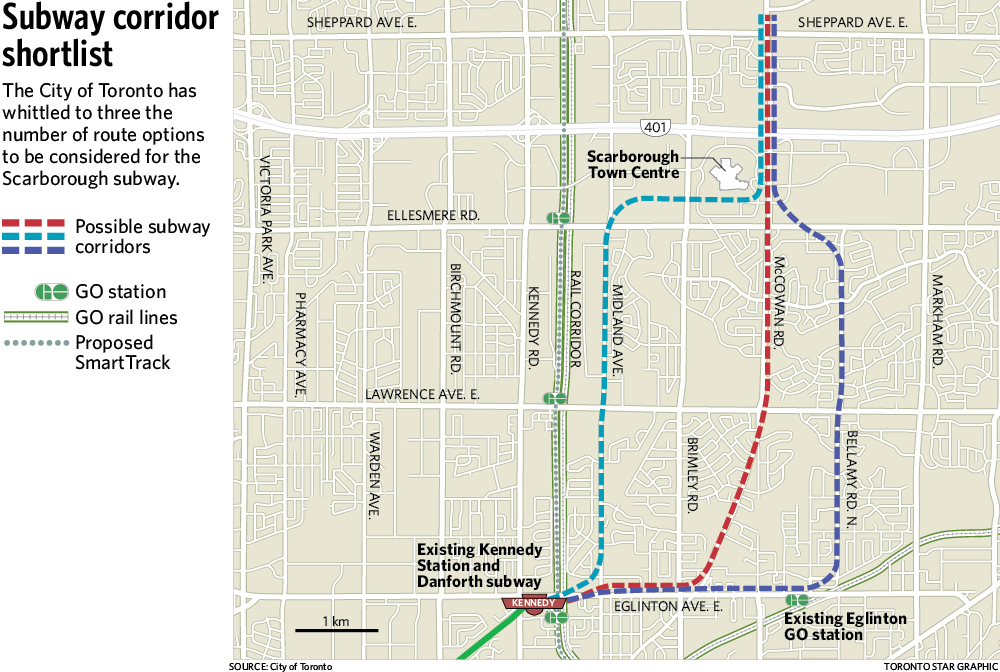
Events overtook the plans, and a report on the shortlisted options that had gone privately to Councillors made its way into the media. The Star’s Jennifer Pagliaro reported that the three remaing options were the original McCowan alignment, the Bellamy alignment and the Midland route running straight north to meet the SRT corridor.

ci-scarborough-subway-routes-shortlist-web

[Toronto Star, from City of Toronto]

Continue reading