My guest column for the Toronto Sun on the status of SmartTrack in the context of recent transit announcements is now online.
A much more detailed review of the Scarborough transit proposals appears on the Torontoist website.

My guest column for the Toronto Sun on the status of SmartTrack in the context of recent transit announcements is now online.
A much more detailed review of the Scarborough transit proposals appears on the Torontoist website.
The recently-formed Toronto Relief Line Alliance has just launched a campaign to showcase the benefits of a new subway line from downtown Toronto to Don Mills & Sheppard. Unlike the less-than-arms-length SmartTrack advocates, FAST, the Relief Line Alliance isn’t trying to make any politicians look good or prop up the remnants of an ill-considered election platform.
Of particular interest on their site is a map where readers can see travel time savings possible for various trips to downtown. All of the numbers they use are based on published reports notably Metrolinx’ own evaluation of such a route from June 2015.
Now that Toronto can finally discuss something other than John Tory’s signature project, the new Alliance can provide a voice and a forum for a much-needed part of our transit system.
City Hall and Queen’s Park must get their heads out of the sand and make the Relief Line an integral part of medium term, “see it in our lifetime” plans. The time for transit plans pandering to pet projects and political egos is over.
So much has been going on with the gradual disintegration of the SmartTrack plan and its replacement, at least in part, with elements from the Transit City network that it has been hard to keep up. I will write about this in more detail as reports and other information become available.
Meanwhile, there has been an interest on Twitter in the original EA documents for Scarborough-Malvern which vanished from view years ago in the anti-Transit City years.
I have created a repository for these files on my site.
Happy reading!
The TTC Board will meet on January 21, 2016. Unlike most meetings, the public session will begin at 10:00 am, although they may go into camera to discuss details of item 3 on the agenda, the cost overrun on the Spadina subway extension.
Items of note include:
This article has been updated with details on these subjects.
Oliver Moore in the Globe and Mail reports that there have been major changes to the SmartTrack plan, to wit:
The map from the Globe & Mail is reproduced below.
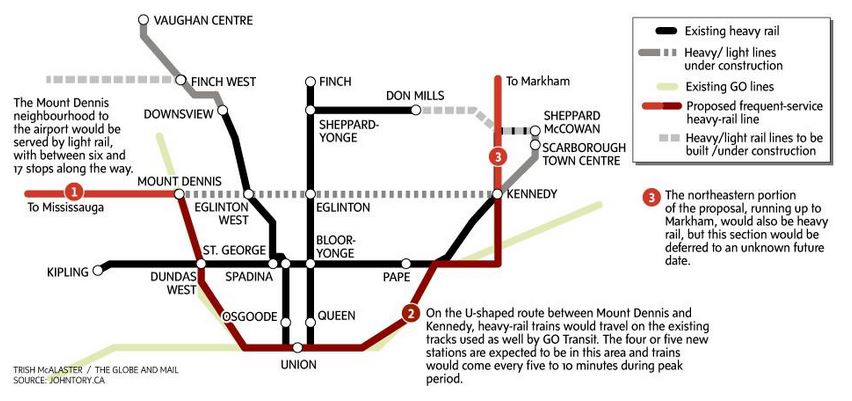
According to Moore, the cost of adding SmartTrack to GO under this configuration would be much, much less than the originally quoted figure for the entire line. In turn, this would free up substantial capital spending headroom in City plans for other projects.
SmartTrack service at 15 minutes (the level proposed in Tory’s campaign) is far too infrequent to attract much riding, and especially to make a dent in demand on the existing subway interchange at Bloor-Yonge. We saw this in the June 2015 Metrolinx demand projections that were far more favourable to a Relief Line operating north to Sheppard and Don Mills. However, getting SmartTrack service down to as close a headway as every 5 minutes will be challenging for Metrolinx and for the corridors through which this would operate. There are no details yet on how this would be achieved.
The Eglinton West LRT has always been the superior way of serving this corridor compared to the heavy rail SmartTrack scheme. ST foundered on major problems with constructibility and neighbourhood effects, issues that were dismissed in a stunning display of cavalier “expert” knowledge during the campaign. Planning by Google Maps from an office in the UK has its limitations, but Tory’s campaign relied on this “expertise”. One shameless professor even rated ST with an “A+” in the CBC Metro Morning interview.
Keeping the first phase of ST confined south of Eglinton on both branches limits the operating costs the City must bear if this to be truly a “Toronto” project with “Toronto” fares, and it avoids the complexities of building into the 905.
Indeed, SmartTrack began as a real estate development scheme to make commercial property near the Airport and in Markham more accessible from downtown in a series of studies that actually claimed the market for downtown office space was static and falling. Yet another expert should be eating crow pie from his perch on the Metrolinx board. It was never clear why Toronto should shell out billions to improve property values in the 905, and this task now falls clearly to Metrolinx where it belongs.
The eastern leg of SmartTrack, north from Kennedy, obviously competes with the Scarborough Subway Extension, and there is no need for two routes serving the same demand, especially when GO already plans substantially improved service in the rail corridor. The long-standing issue of SSE demand may be clarified by the absence of SmartTrack as a competing service.
It is no secret that my own position would be to revert to the LRT plan in Scarborough, but that train has probably left the station, especially if the City can “save” a small fortune by scaling back on SmartTrack.
These changes could also foreshadow a revised schedule for the LRT projects at a time when “shovel ready” projects are in demand to soak up new federal spending. Eglinton West’s LRT extension is relatively easy to build, and it could be started soon enough to complete concurrently with the main Crosstown route. There is also the matter of the Sheppard East LRT including its proposed service linking to UofT Scarborough campus.
Coming weeks may bring many sputtering denials, or possibly, much improved clarity and acceptance of an – at last – realistic plan.
Updated December 8, 2015 at 12:30 pm: I checked with the TTC about the termination of both the 509 Harbourfront and 511 Bathurst routes at Fleet Loop rather than simply running one route between Bathurst and Union Stations. Here is the reply from TTC Service Planning:
We considered running a 511 (Bathurst Stn-Union Stn) service but ruled it out for two main reasons. Firstly, stop usage on Fleet west of Bathurst has greatly increased in the last year, and serving these stops only with the shuttle bus would introduce a transfer or longer walk for too many people. Secondly, because of the road configuration and traffic patterns, it is not possible to have a northbound stop for through 511 cars on Bathurst at Lake Shore. The nearest stop would be the existing 509 stop on Bathurst farside of Queens Quay. This adds to the walking distance for customers heading to Fleet Street, and requires customers to cross an inhospitable intersection.
The original article follows below:
The new year brings changes to some routes, mainly on the streetcar system, to deal with the shortage of new Flexitys and a construction project while improving service on 501 Queen, 502 Downtowner and 503 Kingston Road to better reflect actual conditions.
At its Board Meeting on December 3, 2015, Metrolinx will receive an update on the ridership for the Union Pearson Express. Previous statistics released by Metrolinx to mid-September were not encouraging with a fairly flat ridership in the mid-2000 range once the initial burst of “try outs” and free rides passed.
The new report only extends the published information by about six weeks to the end of October, and the numbers are presented in a way that masks what is really going on.
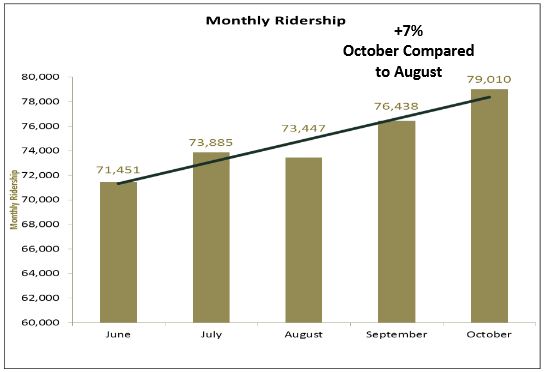
This looks like wonderful upward growth, but there are two problems:
Plotted as daily averages with a zero base line, things don’t look quite the same. There was a drop off in the summer with July and August relatively flat, and a slight increase for September and October, roughly 7% but over a two-month period. The real question is where do things go from here?
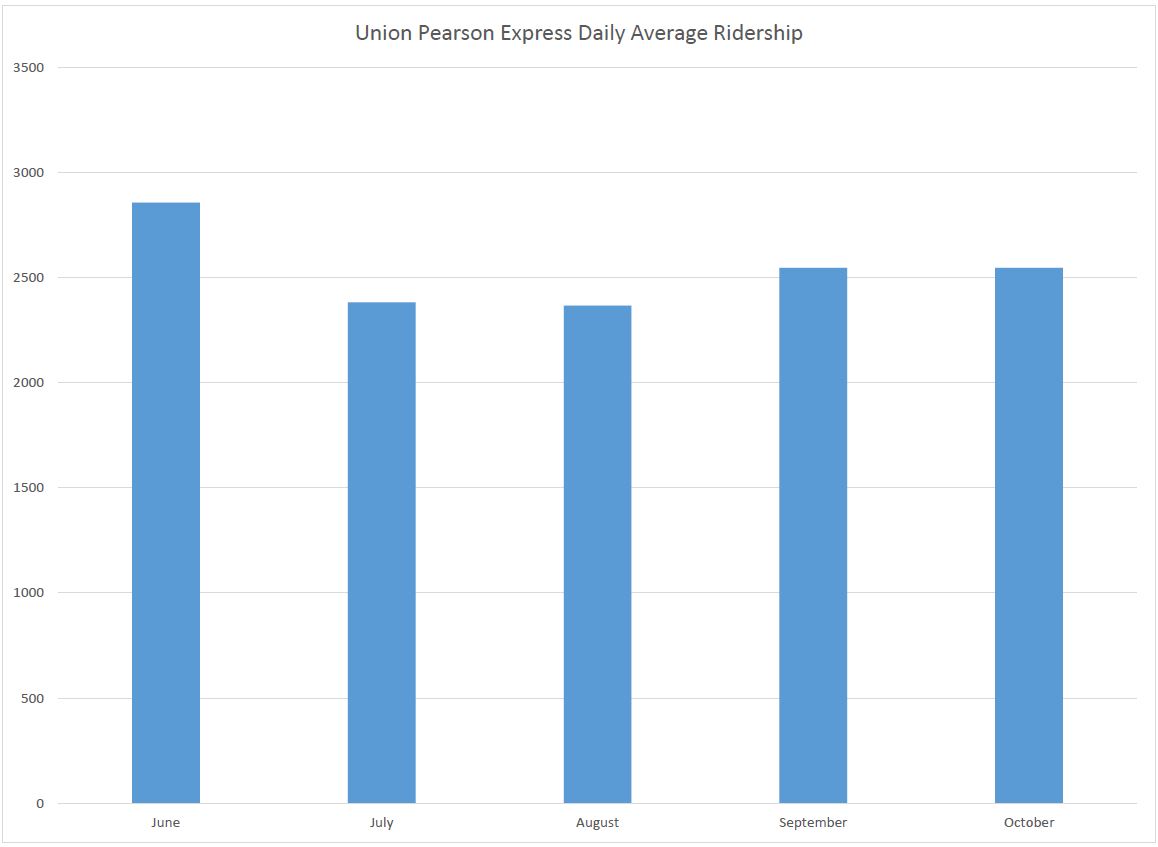
To reach the target of 5,000 riders/day at the end of the first year’s operation will require almost a doubling of daily ridership over the period from November 1, 2015 to May 31, 2016, or a sustained growth of about 14% each month.
After many rosy accounts of the initial reception of UPX, we now read of the problems of getting people to adopt a new mode of travel:
Metrolinx just completed an airport ground transportation survey this fall which found that 70% of all travellers make decisions about ground transportation modes based on past habits or they have the decision made for them. This is regardless of whether they are flying to or from a home airport. Only 20–30% of travellers did research or saw/heard information prior to departure and this was mostly related to the destination airport. The findings underscore how deeply engrained travel habits are and the significant work required to successfully change these behaviours. This is consistent with what we have been told by other international air rail links – changing entrenched travel behaviours of both local and visiting air travellers takes time.
Before UPX launched, Metrolinx did extensive reviews of the air-rail link industry, and yet somehow this basic principle, the difficulty of getting people to change habits, escaped their notice.
Marketing efforts include a UPX presence at the terminal stations, trade shows and special events.
Additional marketing initiatives over the past few months have included:
- Refreshed wayfinding & signage at Union and Pearson
- Installed additional ticket sales & servicing kiosks inside the Terminal 1 baggage claim area and the T3 counter
- Increased presence of UP Express Ambassadors at Pearson
- Revised on-site advertising to complement wayfinding
Metrolinx has tinkered with the fare structure on UPX, although the trips are still quite expensive. An appendix setting out the recently modified structure is missing from the online report, but the fares can be viewed by wandering through the website for standard, employee, and group/corporate tariffs (although the latter contains no information about the discounts actually available).
By listening to, and understanding our customer needs we are continually evaluating our suite of fares and investigating new structures to respond to demands including:
- Family Long Layover to complement the individual long layover
- Family Meeter & Greeter to complement the individual fare product
- Increasing the age for free child fares from 6 to 12 years of age, to align with other global air rail links
- Changing the return fare costs to attract repeat usage
In an article by Oliver Moore in The Globe & Mail, we learn:
The service was forecast to hit 5,000 passengers a day by next summer, about twice the current ridership. [UPX President Kathy] Haley suggested on Monday that the forecast might be flawed, because it predated Uber, and hinted that the ridership goal could be in flux.
The possible effect of Uber, let alone the idea that the goal of 5k/day in ridership, does not appear in the report to the Metrolinx Board. It is hard to believe that a service, routinely promoted as a premium quality line with fares to match, should be at the mercy of lowly Uber. Is the market is not quite so upscale and immune to price as we have been led to believe? Are there not enough of that class of traveller to make UPX pay?
Metrolinx has yet to release any financial data on the line’s performance, and we are unlikely to see this until their next annual financial reports (which subdivide results by operation division within the agency) due in mid-2016.
The explanations, the excuses, for poor performance of UPX have all the earmarks of a service that was over-hyped from the outset to justify its design and cost. One question Metrolinx must answer is why they need so many staff, so much marketing, to attract riders to a line that was supposed to have demand come to it so easily. This route is on a par with a minor TTC bus route. 126 Christie has roughly the same daily demand, but it does not command an army of greeters, let alone its own President.
Remember when the airport link was to be a private sector project with no public money?
Pearson Airport is a major regional hub, second only to Union Station for daily passenger volume. Transportation to the airport and surrounding districts should address travel from a wide variety of origins, not just downtown. Service and fares should reflect that the majority of this travel is a combination of ordinary commuting and air travellers, each with their own needs that the network must support.
Metrolinx should concentrate less on its showcase, premium fare service to Union, and more on making the airport a major transit destination for the GTHA.
Updated November 26, 2015 at 11:00 pm: A follow up article by Jennifer Pagliaro includes reactions from Mayor Tory. My comments appear at the end of this article.
The Toronto Star’s Jennifer Pagliaro reports that the Building Industry and Land Development Association (BILD) will challenge Toronto’s planned increase in Development Charges for the Scarborough Subway Extension (SSE) at the Ontario Municipal Board (OMB).
[BILD is] challenging the planning foundation for the three-stop subway — which council controversially approved last term over a seven-stop LRT that was fully funded by the province. BILD is raising red flags about the city’s ridership projections.
Bryan Tuckey, BILD’s president and CEO, says homeowners across the city should not be on the hook for a “political decision.”
“The ridership numbers that we have demonstrate that what’s needed in that area is light rapid transit,” Tuckey, whose background is in city and provincial planning, told the Star.
“We want to have fair and accountable use of development charges.”
This action has implications well beyond the Development Charges (DCs) for the Scarborough Subway and touches on the whole question of transit financing and planning that for years has been more about political gamesmanship than about the actual needs of the City of Toronto.
We know that the development industry does not like paying one cent more than they have to, and preferably less, in taxes. In that sense they are no different than other taxpayers.
However, while homeowners can only express their opposition by voting for politicians with vague promises to fight waste at City Hall, and hope that their “champions” like Ford and Tory will “do right” by them, their only real recourse is at election time. Elections are fought on signature platforms like SmartTrack and “Subways Subways Subways”, and voters don’t get to cherry pick the platform lines they really want. Elected politicians claim they have “a mandate” when their victory may simply depend on “not being the other guy”.
Development Charges, on the other hand, have specific rules about how they are calculated and an appeal mechanism neither of which is available for general property taxes (or many other taxes Council can or could levy of which the Land Transfer Tax is one obvious example). As the Star notes, most of the City’s share of the SSE ($910m) will come from the subway property tax yielding $745m. This tax will rise to 1.6% in 2016 and then stay on tax bills for decades. The amount coming from DCs ($165m) is much smaller, but developers have an appeal option through the OMB.
Metrolinx is running a survey of “fare integration”, whatever that might mean to you, until November 30, 2015.
This survey is striking in the way that it reinforces options and viewpoints commonly seen in Metrolinx analysis of fare systems. It is quite 905-centric both in the types of questions and options, and the view of how people might use a transit network.
The survey begins by asking about someone’s “typical trip” to establish an origin-destination pair. Of course, many riders within the city have many regular destinations, especially when their travel (like my own) is not dominated by commute trips to work or to school. After one gets through that section, another comes up asking about non-commute trips but with no attempt to quantify them or ascertain where they might occur.
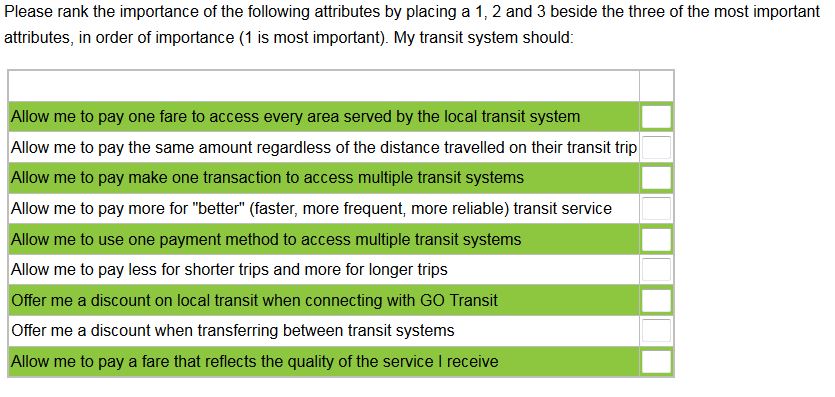
Cross-border and multi-carrier travel figure prominently in the survey, something by which, self-evidently, a regular TTC rider using only that system is not affected. The following list of fare options reappears in different guises elsewhere in the survey. As a piece of design, it fails because some questions are in the “I can …” format while others are “would” or “should” questions. It is unclear how an “I can” question can have anything beyond a “yes” or “no” answer. Does Metrolinx want our opinion on paying one fare for all of a local transit system, or asking if I can already do this?
There is a big problem in that some options interact, but there is no provision for this. Metrolinx is obsessed with the idea of paying more for “better” service which could mean anything from a GO Train or a Highway coach, to a local express bus, the subway or even a new LRT line. One might agree with a premium for the GO train (although that would also relate to distance travelled), but not for other types of service. There is no option to distinguish between these.
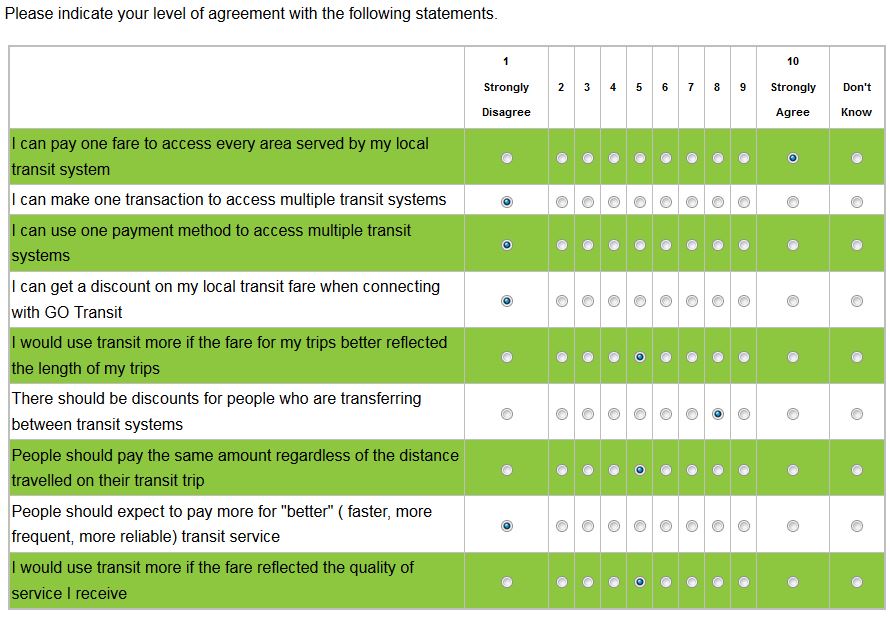
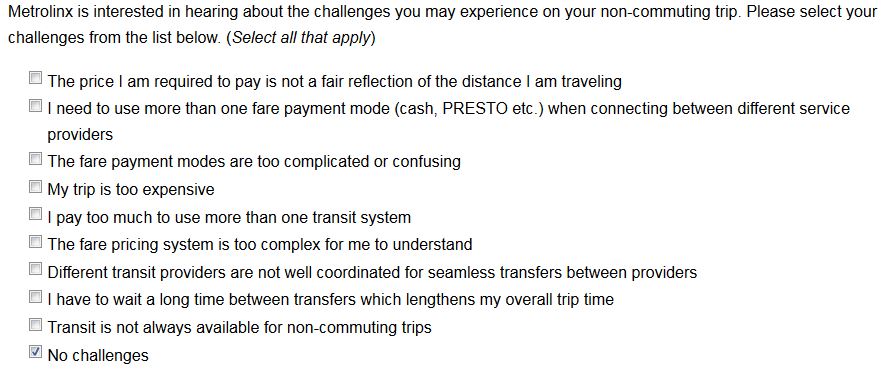
The ideas reappear as a list of challenges to transit travel. For a monthly pass holder, many of these options don’t really apply although one could certainly complain about the cost (high fare multiples) and the fact that on some parts of even the TTC, transfers can be a big headache thanks to unreliable service.
Another set of options requires the choice of a top three issues and ranking them rather than using the 1-to-9 scale for all of them.
Later the survey asks about co-fares between systems including local-to-GO and local-to-local transfers, but is silent on the question of how new co-fares might be funded, indeed on the whole question of regional fare revenue and subsidy sharing. Similarly, questions about distance or zone-based fares give no hint of what the effect might be for different journeys. Time based transfer and return trip privileges are nowhere to be found, typical for Metrolinx that only grudgingly acknowledges them as an option within local systems, not for the network as a whole.
No doubt the results from this survey will be trotted out to support whatever fare scheme Metrolinx comes up with, but it could be strongly biased to “typical” Metrolinx riders who have a very different view of the transit world and fares than their (much more numerous) “local” network cousins. It would be amusing to see what a similar survey carried out for the population within Toronto would yield. The survey includes a request for one’s postal code, and so at least there should be some idea of the distribution of responses across the GTHA.
Updated November 10, 2015 at 6:00 pm:
The Budget Committee meeting was not the best-organized or well-informed of TTC meetings thanks to a combination of factors. It was held in the boardroom at TTC headquarters which is no longer configured suitably for such events and cannot handle a large presence by the media who were out in force anticipating a story about 2016 fares. Almost all of the material was presented by one person who, unfortunately, trusted to memory rather too often and got the odd fact wrong as the meeting wore on. Moreover, there simply was too much material to absorb in the manner it was presented.
Committee members, for their part, tended to view the situation through their personal lenses of which hobbyhorse needed attention. This did not necessarily make for a broad view of TTC issues, and many erroneous assumptions, often uncorrected, crept into the debate.
We will go through this and much more all over again at the November 23, 2015 meeting of the full Board when we can also expect a very long parade of deputations on the subject of fares.
The entire exercise of having a Budget Committee has been useful, up to a point, in that some Commissioners have been exposed to the gory details, but they remain confused, and we have yet to see an actual philosophical discussion of just what the TTC should be as a basis for the budgets for 2016 and beyond.
The following motions were approved by the Committee:
 Steve Munro