Toronto Transit Plan Punted From Executive Committee

On October 26, 2016, Toronto’s Executive Committee was supposed to receive a report dealing with a wide range of transit issues.

… the City Manager will be providing a report to Executive Committee with recommendations on the Transit Network Plan, including information on cost-sharing discussions with the Province of Ontario on a range of transit projects, as directed by City Council in July 2016 (EX16.1). This report will also include an update on the planning and technical analysis for SmartTrack, Relief Line, and Scarborough Transit. Additional time is required to ensure proper consultation and coordination with relevant stakeholders including the Toronto Transit Commission, Province of Ontario and Metrolinx. [Placeholder item in the agenda]

This report is not yet available as discussions with Queen’s Park are ongoing. A deadline facing Council is that Metrolinx wants a commitment to specifics of SmartTrack work that will be bundled with the RER construction contracts that will go to tender early in 2017.

Given the time constraints, it is possible that the report will go directly to Council at its November 8 meeting. In theory, materials for the Council Meeting should be posted in advance, and for November 8, the usual deadline is only days away. Whether the materials are actually available in advance remains to be seen. This would put a major debate before Council with almost no advance briefing or public debate.

SmartTrack is not the only time constrained project as an updated transit plan and cost estimate for the Scarborough projects, not to mention a financing scheme for the entire package, needs to be dealt with so that work can begin. Any spending commitments will also affect the City’s budget which will be formally unveiled at the start of December.

As material becomes available, I will provide updates and commentary.


GO Transit Electrification Public Meetings

Metrolinx/GO has announced a series of public meetings through November 2016 dealing with some aspects of the electrification project.

GO Rail Network Electrification Transit Project Assessment Process (TPAP) (Hydro One as co-proponents):

• The focus of this round of public meetings will be to provide an update on the project and conceptual design of the Traction Power Supply and Distribution components.

Barrie Rail Corridor Expansion TPAP:

• The focus of this round of public meetings will be to provide an update on the project and seek feedback on the environmental impacts.

Lakeshore East-Don River to Scarborough Expansion TPAP:

• The focus of this round of public meetings will be on existing conditions.

Further information and a list of meetings is available in the Metrolinx announcement.

Does Toronto Owe Metrolinx Half a Billion? (2)

Two weeks ago, I wrote about the receivable on Metrolinx’ books for supposed “municipal contributions” that have not been paid, but instead have been funded temporarily by Queen’s Park. This has been going on for roughly a decade and the bills are piling up, now over a billion dollars.

I posed a series of questions to the Minister of Transportation’s Press Secretary, and received a friendly, sunny, but utterly uninformative reply.

Firstly thank you for your e-mail and questions – it is nice to e-meet you! I saw your blog piece from earlier this week and the Qs you submitted to Patrick re: the existing framework for municipal contributions to GO Transit growth and expansion capital costs, potential future municipal contributions to major transit initiatives in the region and the Province’s Dedicated Gas Tax Program.

There are two Regulations under the Metrolinx Act, 2006, which are intended to assist the Regions of Durham, Halton, Peel and York, and the Cities of Toronto and Hamilton, to collect development charges (DCs) to help offset their respective contributions to GO Transit growth and expansion capital costs:

1) O. Reg. 528/06, which sets an expiry date for GO Transit DC by-laws; and
2) O. Reg. 446/04, which prescribes the allocation of the expected municipal share of the GO Transit growth and expansion capital costs amongst the municipalities.

The municipal contributions to GO Transit growth framework were put in place to establish a fair and balanced approach to support GO capital expansion in communities across the region. All municipalities in the Greater Toronto and Hamilton Area benefit from an effective GO Transit network, and the Province remains committed to working with all of our partners to expand and deliver this network. Given the transformational $13.5 billion investment that the Province is making to strengthen the GO network through the 10-year GO Regional Express Rail initiative under the Moving Ontario Forward plan, we recognize that this commitment to working together with all of our partners to build and optimize an integrated, regional transit network is even more critical.

As you note in your email, the two Regulations permit GO Transit DC by-laws to help the municipalities offset their expected contributions – per the allocation formula set out in O. Reg. 446/04 – to Metrolinx for their share of GO Transit growth and expansion capital costs. The contributions made by municipalities are not directly linked to any specific expansion projects, but, rather, they are applied against the GO Transit growth and expansion capital program, as a whole.

With respect to your questions related to the Dedicated Gas Tax Program, the funding of two cents per litre of gasoline sold across the province was made permanent through the Dedicated Funding for Public Transportation Act, 2013. The Ministry of Transportation allocates these funds through the Dedicated Gas Tax Program based on a formula of 70% ridership and 30% population for eligible municipalities. All of the factors, including the funding envelope, ridership and population, are updated annually for each program year. The funding envelope for the 2015/16 program was $332.9 million, up from $321.5 million in 2014/15. The Province has provided the City of Toronto with more than $1.75 billion through the Gas Tax program since 2003, including $169.2 million for the 2015/16 program.

Thank you again for your questions.

[Email from Andrea Ernesaks, Press Secretary and Issues Manager, Office of the Hon. Steven Del Duca, Minister of Transportation, September 30, 2016]

Despite the reference to an “expiry date” for GO Transit Development Charge by-laws, this date has been changed every few years and currently sits at the end of 2016. Based on past experience, one might reasonable expect this will be extended again. The municipal allocations have not changed since this charge was introduced despite substantial shifts in population balance around the region and a change in the type of journey that the Metrolinx network serves, especially with planned expansion.

The concurrent mention of the $13.5 billion to be spent on GO RER and “working with all of our partners” suggests that Queen’s Park might include RER in the cost base for calculation of future contributions from the municipalities. If this is so, then the Minister should say so, and all announcements should have a little side bar, an asterisk to a footnote saying, “oh, by the way, your municipal taxes will help pay for this photo op”.

Nothing in the legislation (acts and regulations) explains how “capital requirements” are calculated, which projects would be included, nor how the proportional allocation should be assessed against municipalities. It just appears out of thin air as part of the GO (now Metrolinx) budget. The amount is a not linked to specific projects, but somehow it gets calculated.

The info about the Gas Tax program is not news, but the concern municipalities have legitimately is that an increasing portion of this grant might be clawed back by charges to support Metrolinx rather than their own local programs. This is complicated by the fact that Queen’s Park threatened to withhold the Gas Tax from municipalities that didn’t play ball with the selection of Presto as their fare card. Going forward, we know that back charges for operation of the Metrolinx LRT lines to the municipal level are likely, but the amount has not yet been settled.

The basic point here is that the provincial largesse and support for transit comes at a price, and that will be carved out of money that nominally flows to municipalities for their own use on transit. Toronto’s $169.2 million is now split between the operating and capital budgets. Other monies do flow from Queen’s Park for TTC projects, but they are earmarked to those specific works such as the subway extension to Vaughan.

Moreover, given the state of provincial finances, will this billion dollar “debt” become payable by the municipalities? Toronto’s half-billion share would take a huge bite out of the city’s budget, and an ongoing charge of roughly $90 million could more than halve the value of the gas tax grant.

The Minister might contemplate some of the background information to the Metrolinx Investment Strategy reports which includes a history of GO Transit development charges, a description of the wide gap between the amounts actually collected and the amount anticipated (25% of GO’s capital program). Specifically the Metrolinx Review of Development Charges at pages 6-7. Note that this report dates from January 2014 and therefore does not reflect all of the charges that have accumulated to date. It also speaks of $100 million in revenue from municipal development charges, but the chart below clearly shows that this is far short of the “expected” contribution.

gotransitdcs20062013

These are not trivial questions, and so I have asked, again, for an explanation. To date, nothing has come to my mailbox. My latest query follows below.

Continue reading

TTC Capital Program Review

Back in the early days of John Tory’s mayoralty, the 2015 budget discussions were overshadowed both by the legacy of the Ford administration and by major issues with project control at the TTC. From the Ford years, Tory inherited a mean-spirited attitude to transit spending and service cuts that the new mayor would come to reverse, for a time at least. A bigger issue, however, was the matter of runaway spending by the TTC on two major projects: the Spadina subway extension (aka TYSSE) and the resignalling contracts for the Yonge-University-Spadina subway (aka Line 1).

Even while the TTC’s CEO was coming to grips with these projects, Council passed a motion asking for a review of how the TTC was managing its business.

145. City Council direct the City Manager to issue a Request For Proposal to expedite a review of Toronto Transit Commission Capital program service delivery including:

a. a review of project management of Toronto Transit Commission Major Capital Projects in the past five years to determine actual project costs and completion dates relative to original schedules and estimated costs;

b. a review of staff reporting mechanisms to the Toronto Transit Commission and City Council related to capital project budget and completion date status; and

c. future organizational options for Transit project management and delivery of Major Capital projects related to Transit expansion and major State of Good Repair projects.

146. City Council direct the City Manager to co-ordinate the review in Part 145 above with the Chief Executive Officer, Toronto Transit Commission and to report to the Toronto Transit Commission no later than the November 23, 2015 Board meeting. [Item EX 3.4 Council meeting of March 10, 2015]

In the fullness of time, considerably later than the November 2015 date in the motion, a report from KPMG landed on the TTC Board’s agenda, the TTC Capital Program Review. This was supplemented at the meeting by a presentation from KPMG and a response from CEO Andy Byford.

The terms of reference for KPMG’s work were somewhat different from the Council motion.

KPMG’s scope was as follows:

  • review project management practices at the TTC with respect to the delivery of the Capital Program, and provide recommendations to staff that will assist the organization to improve capabilities for managing capital projects and programs. The TTC Capital Program Review seeks to achieve the following goals:
  • Improve the organization’s project and program management performance by learning from past experience;
  • Support continuous improvement efforts underway at the TTC, including the continued implementation of the TTC Portfolio Management Office (“PfMO”) established in 2014;
  • Assess project governance structure and protocols for reporting of project status, to ensure the appropriate level of transparency and accountability to project sponsors and stakeholders; and
  • Provide guidance on project delivery options and project management requirements for projects of varying size, scope, and complexity. [Presentation, p. 4]

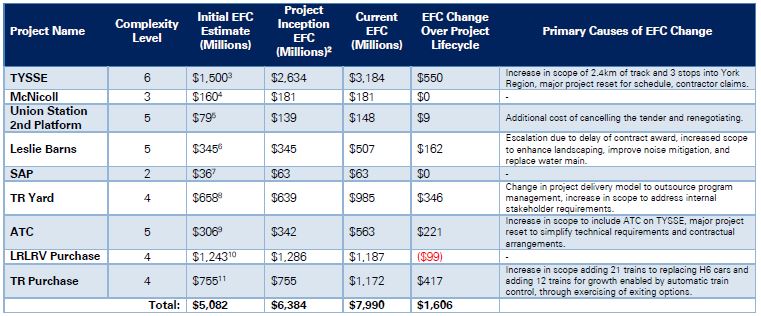
Item “a” of the Council motion asked for a comparison of actual costs and completion dates with original plans. KPMG does not provide this information, and even worse, included a table of selected projects that does not clearly explain their history (see below). There is no “deep dive” into any of the projects and, therefore, no specifics that could be tied to “lessons learned”, to practices that created the problem in the first place.

The table below is the closest the report comes to commenting on Council’s request, but read in isolation it can be misleading. It is ironic that in their presentation to the TTC Board, KPMG did not include this table and made no comment  on it. CEO Andy Byford was not so kind, and emphasized that most of the scope changes were perfectly legitimate.

kpmg_ttc_project_list

Other projects included in KPMG’s review but not in the table above were:

  • Fuel Storage Tank Replacements
  • Subway Station Easier Access Phase III
  • Surface Track
  • On Grade Paving

Of these, only the Easier Access program was flagged as “Challenged” with the others as “Successful”, but the reason for the EAP’s status likely has more to do with the complexity of later stages of the work and a lack of funding than with project management and controls. [See Table 1 at pp. 20-21 of KPMG’s report]

Two of these (track and paving) are the only “Ongoing” programs reviewed by KPMG. These are fundamentally different from “Finite” projects such as the construction of a line or the retrofit of elevators to stations. I will return to this distinction later.

This is a dangerous table in that it shows an apparent growth from $5 billion to almost $8 billion in project costs, a 60% increase.  That was the easy headline in media coverage of this report, and the sort of simplistic comparison that some members of Council would seize on as symptomatic of “waste” at the TTC. Scope change appears as a “primary cause” in five of these projects, but not all such changes arise from the same circumstances.

  • TYSSE’s cost grew due to inflation between the original estimate and the eventual approval of the project, and of course because the line was extended from York University to Vaughan Centre.
  • There was a considerable delay between the approval and actual start of work thanks to foot-dragging by senior governments in finalizing their contribution agreements. No adjustment to the completion date nor allowance for inflation was added to the estimate.
  • Politicians along the line wanted showcase stations, not the standard TTC boxes, and much of the contingency in the project’s budget was consumed by unexpectedly high bids for these structures.
  • The TYSSE project suffered from poor organization with many contractors on competing deadlines. This arose in part because the prevailing wisdom at the time was that work should be parceled out in small enough pieces that multiple mid-size contractors could bid. This arrangement was more a political decision than a technical one.
  • The original project did not foresee a conversion to Automatic Train Control (ATC) because that was not part of the TTC’s plans at the time. This item was added after the fact under a separate project budget, but this work added yet another layer of complexity to overlaps between many subsystem installation contracts.
  • The original fleet plan for TYSSE included the continued use of a portion of the older T1 fleet on the YUS with most, but not all, of the trains coming from the new TR order. After the decision to implement ATC, the T1s were no longer suitable because of the high cost of retrofitting ATC to them, and the TR contract grew accordingly. The TTC has a surplus of T1s, but no place to use them, including the proposed Scarborough subway which will also have ATC. The planned opening date for the SSE occurs well before the planned completion of the replacement of the T1s, a project that will have to be accelerated shifting spending into earlier years than planned.
  • The TTC now has a much larger subway car fleet than foreseen a decade ago thanks to the T1 surplus and cars for improved service under ATC that will not actually be used until 2019 and beyond when the ATC project completes. Additional space will be needed for the T1 replacements that will require concurrent storage space and a significantly different carhouse design from Greenwood Shops. These projects are not yet funded, and are not fully included in the cost estimates for the SSE.
  • The TR purchase, like all TTC vehicle contracts, includes a base order plus an option for additional vehicles. This is a standard arrangement for procurement because the TTC never receives full funding for its plans in one go, and circumstances change causing quantities to go up, or occasionally down. The complete order now includes enough trains for the complete replacement of non-ATC capable trains on YUS, conversion of the Sheppard subway from T1 to TR operation, the Spadina extension to Vaughan and additional trains to run more frequent service once ATC is in use on YUS.
  • The ATC contract evolved out of a dog’s breakfast of plans for new signalling on the YUS. Originally, the plan was simply to replace the aging block signal system on the original part of the line. However, funding for this could only be obtained by misrepresenting necessary maintenance work as something that would enable additional capacity. Eventually, the project grew to have at least two overlapping technologies being installed at the same time so that non-ATC operations could co-exist on an ATC line. This proved unworkable, and the contracts were consolidated into a single ATC project. The extra costs are a direct result of, first, underscoping the project for political reasons, and later from a failure to appreciate the technical complexity of what was being attempted.

The above are only the high points of a much more complex history (available in the linked articles), but what should be evident is that major projects interact with each other even though they are almost always discussed as if they are completely separate entities. This is a major problem in TTC budgeting and in the political context where such projects are debated. KPMG hints at this problem in its review, but does not drag any details out into the open.

The following discussion can only touch on the full report of 273 pages, and is intended to place the report more in the political context of the TTC Board and Council (and through them to the ongoing debates about TTC funding) than KPMG which tended to focus on internal issues of process.

Continue reading

Does Toronto Owe Metrolinx Half a Billion?

Rummaging in financial reports can lead to interesting discoveries, although we usually read about them when some financial hound exposes dubious accounting practices and drives down the value of a company’s shares. Indeed, the Globe’s David Milstead had a long article on just how pervasive the use of non-standard accounting has become in corporate reports.

In the public sector, various mechanisms are used to reduce apparent debt and exposure to future costs. Some of these involve judgements about just when bills and revenue will roll through the door, or of exactly who will pay these bills as they come due.

In a previous article, I wrote about the TTC’s newfound mechanism called “Capacity to Spend” which reduces future funding requirements by roughly as follows:

  • Project estimates show that the TTC will need about $9 billion to fund its “Base Capital Program” over the next ten years. This does not include special projects such as subway extensions, nor does it include a long list of “below the line” projects that have not yet matured to “approved but unfunded” status.
  • Yearly capital spending by the TTC is typically lower than the budgeted value, but the main reason is that work took longer than expected, or projects were rescheduled into future years. Only a few of the underspent accounts arise from actual savings thanks to lower than expected costs or project cancellations.
  • Nonetheless, the TTC has decided that its real funding requirement for 2017-2026 is now almost a billion lower than has been claimed for many years running.

This is a basic case of revaluing the exposure to future costs to make long term funding (including borrowing) needs appear lower than they really are. This year brings an extra incentive with federal funding that requires matching municipal contributions, money Toronto does not have. But hey, presto!, if we reduce the future spending, at least on paper, we have “found” money with which to pay the local share of the fed’s new program.

Meanwhile up the road at Queen’s Park, a lovely myth for the past near-decade is that there is a “municipal share” to the GO Transit capital program. Most people don’t know about this, and Toronto has refused to actually pay into that pot for several years.

The mechanism was set up back when GO Transit was a separate agency, and it has been passed down through successor organizations to its current home, Metrolinx. The amount of money outstanding is not trivial.

metrolinxmunicipalchargebacksto201603

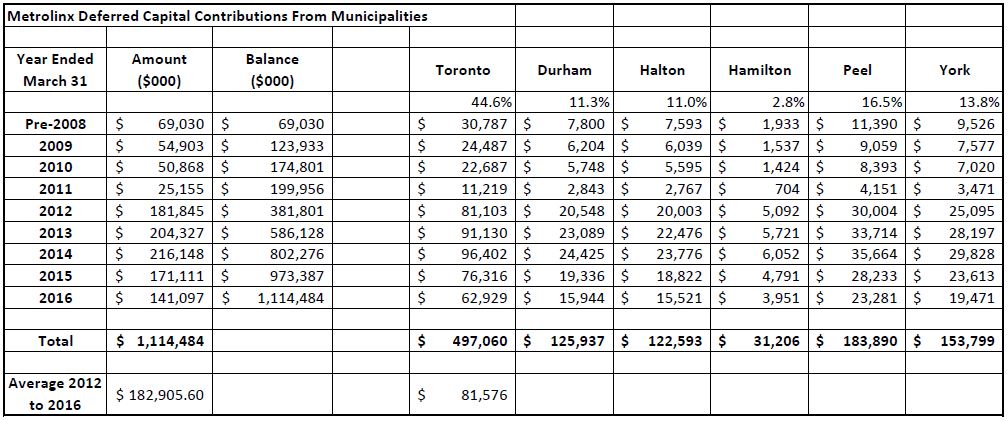
By the end of Metrolinx’ fiscal year March 31, 2016, the accumulated balance of deferred municipal contributions totalled $1.1 billion. The proportions owed by each municipality are set by regulation, and Toronto’s share is just under half a billion. The proportions assessed to each region have not changed since this charge was instituted although one could argue that population shifts and the focus of GO expansion would suggest a different ratio is in order.

Toronto does not carry an account payable for this amount on its books. Meanwhile, in every financial statement, there is a note in this format:

Metrolinx realized a shortfall in municipal funding related to its capital program. The Province has provided funding to bridge the shortfall in the current year in the amount of $141,097 (2015 – $171,111) and the cumulative amount is $1,114,484 (2015 – $973,387). The Province will work with its municipal partners to address the funding shortfalls. [Note 12 to Metrolinx Draft Financial Statements for the year ended March 31, 2016]

What is unclear is whether Queen’s Park will ever call this debt due, or if it will simply be written off as a provincial contribution to GO expansion.

This charge is intended to recover costs for general GO expansion, and it does not include:

  • Chargebacks for works undertaken as part of a provincial project that improve municipal assets such as replacement of water mains or provision of improved streets. This was a major issue for Toronto on the Georgetown South project.
  • Charges for the abandoned Scarborough LRT project engineering.

Missing from all of the annual reports is any indication of just which GO projects these contributions aided. Indeed, the amounts are intended to go into the general subsidy pot at GO without being tied to its work with the assumption that everyone benefits from “more GO” in the end.

An ongoing problem with provincial funding is that there are various ways that the gas tax grants now paid to municipalities are clawed back. There has been almost no change in the level of gas tax provided, and the amount coming to Toronto has been sitting at about $160m for many years. (Toronto apportions this partly to capital and partly to operations.) The effective value of this contribution falls due to inflation. If Toronto had actually paid their Metrolinx assessment in recent years, this would have wiped out half of the gas tax grant.

In 2017, the TTC is making provision in its budget for additional costs related to Carbon Taxes. This will further erode the contribution from Ontario.

The combined effect of all this will be that, at some point, all of the provincial contribution via gas tax will be consumed by paybacks under various levies and fees.

In an attempt to illuminate this issue, I posed a series of questions to the Minister of Transportation:

Which projects now underway or planned will trigger additions to this outstanding balance including, but not limited to, such things as:

  • Ongoing GO improvements (non-RER)
  • GO RER
  • LRT and BRT projects

In other words, although Ontario has not actually collected on the receivable, will it continue to grow and, in effect, will municipalities be expected to eventually contribute to “provincial” projects, and at what level?

Many projects do not fit into the classic GO Transit model of serving downtown Toronto. For example, York VIVA BRT, The Hurontario and Hamilton LRTs, and the Toronto Crosstown and Finch LRTs serve a very different travel demand from GO’s rail network.

Will the formula for allocating these costs be changed to reflect the service territory and areas benefiting from the projects where municipalities are expected to make a contribution?

Although Ontario makes significant investments in transit, its budgetary effect at the local level will be offset by chargebacks including:

  • The deferred Metrolinx receivable above
  • Future costs for Presto which is expected to become self-sufficient and will require increases in service fees to local providers to do so
  • Future costs for LRT operations

Starting in FY 2011-2012, there was a large increase in the annual charge added to the receivable, an average of $183m/year over the last five years, of which Toronto is responsible for $81.6m/year. What projects contributed to this charge and what was their total value (in effect, my question is what proportion of these projects was back-charged to the municipalities)?

When I receive a reply to these questions, I will update this article.

TTC Service Changes Effective Sunday, September 4, 2016 (Updated)

Updated August 15, 2016: The detailed table of service changes has been added to this article.

September 2016 will see a return to the “winter” schedules on most TTC routes. Despite talk of service cuts in the budget process, the new schedules include some improvements to correct for operational problems on a few routes, and to better handle existing demand. The scheduled mileage for September is actually above the budget level due to greater than anticipated requirements for diversions and extra vehicles to deal with construction projects.

2016.09.04 Service Changes

Continue reading

Council Approves Tory Transit Plan, Attempts Pet Project Revivals

Toronto Council has approved the transit plan for Toronto featuring Mayor John Tory’s SmartTrack line and the Scarborough Subway after a long debate on July 14, 2016. Notwithstanding severe problems with financial pressures and the blind faith needed to expect that the entire package can actually be funded, Council added a few pet projects that never quite fade from view thanks to the efforts of individual members.

LRT proposals for Eglinton East and West survived the vote largely because they are part of larger packages – SmartTrack in the west, and the Scarborough Subway Extension in the east. The subway debate has so polarized camps that “LRT” is synonymous with third class transit simply because it was the heart of the “non subway” option. Without the bitterness of the SSE that required subway advocates to paint LRT in the worst possible light, its potential role in Toronto’s future network might not have been so poisoned while other cities embrace this mode.

Staff recommendations in the report were amended in some respects, and a few new clauses were added, notably one asking for City staff to pursue a co-fare arrangement with GO Transit.

The Waterfront Transit Reset report is a separate agenda item and, at the time of writing, Council has not yet dealt with it.

The Finch West and Eglinton Crosstown LRT projects are under Metrolinx, and they are already underway to varying degrees.

Continue reading

Brimley: The Station That Never Was

In all the discussion about options for service to the Scarborough Town Centre, an important factor is the superiority of an east-west alignment through the area (which is itself an east-west rectangle). One subway station serves a node in the middle of the STC precinct, but an east-west line, especially with a technology where multiple stations are comparatively inexpensive, can do a better job of serving a future, developed town centre.

City Planning’s own reports say as much, but because discussion of the LRT option has been expunged from debates, we don’t hear how this might perform.

As a matter of historical interest, the original LRT proposal that predated the Scarborough RT by a decade included not only the three stations we have today – Midland, STC and McCowan – but also made provision for a future station at Brimley. The site would have been just east of the Bick’s pickle vats, for those who knew the area back when, on the west side of Brimley.

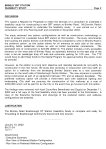
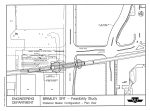
Some years later with the RT well established, local Councillors pressed for a Brimley Station. Council funded this and the TTC in due course produced a design. That’s as far as things ever got, and despite development near the station site, nothing more has ever come of the idea.

Brimley SRT Station Feasibility Study, January 2004:

Given its very light usage and difficulty of access, one might even argue that Ellesmere Station could be replaced by one at Brimley in any new design.

We will never know, because “LRT” in at least this corridor is a naughty word.

The Dwindling Capacity of the Yonge Subway

Yesterday’s launch by York Region of their Yonge Subway Now website brought to the fore the question of just how much room remains on the Yonge Subway for additional riders. Over many years, claims about capabilities of new subway technologies together with changing projections for future demand have left Toronto in a position where its subway is badly overloaded with little relief in sight.

This article traces the evolution of those claims and the reality of what can actually be provided to show that building a Relief Line is not a project for a future decade but one that must begin now.

Continue reading

York Region Wants a Subway, Overstates Available Capacity (Updated)

Updated July 6, 2016 at 5:10 pm: “Yonge Subway Now” has updated their website to remove the double counting of capacity improvements, and to clarify that their claims about subway capacity apply to the peak point south of Bloor Station. The revised text is included in the main article.

Although in theory there will remain 4% of free capacity on Yonge south of Bloor in 2031, this is hardly the sort of margin we should be planning for. The Relief Line’s demand projections show that it has a major effect if it runs north to Sheppard, and it will have to be in place sooner rather than later to avoid deadlock on the Yonge line.

A related problem is the question of station capacity to handle passengers with trains arriving about 30% more frequently than they do today.

York Region has wanted a subway to Richmond Hill for years, and there is even a completed Environmental Assessment and its Addendum for this project.

Today, July 5, 2016, a new website extolling the virtues of this project went live. It contains the usual things one would expect about the growing need for transportation and how a subway will improve the region’s future. Unfortunately, it also contains a misrepresentation of available and future subway capacity.

But what about overcrowding you say?

  • Metrolinx’s Yonge Relief Network Study analyzed options for crowding relief to the existing Yonge Subway line by examining new local and regional travel opportunities and improving mobility across the GTHA. Key findings include:
    • Significant relief to the Yonge Subway line will be achieved through already committed transit improvements, including:
      • TTC’s automatic train controls [adds 29% capacity];
      • New subway signals [adds 10% capacity];
      • New six-car subway trains [adds 10% capacity];
      • Toronto-York Spadina Subway Extension [adds 5% capacity]; and
      • Regional Express Rail/SmartTrack/DRL will add even more capacity.
    • With the above capacity improvements in place the Yonge Subway line will be running under capacity when it opens and beyond 2031.
    • The Yonge North Subway Extension only adds 9% demand at peak period.

Updated July 7: The text above was the original version. The page now reads:

But what about overcrowding you say?

  • Metrolinx’s Yonge Relief Network Study analyzed options for crowding relief to the existing Yonge Subway line by examining new local and regional travel opportunities and improving mobility across the GTHA. Key findings include:
    • Significant relief to the Yonge Subway line will be achieved through already committed transit improvements, including:
      • TTC’s automatic train controls [adds 29% capacity];
      • Toronto-York Spadina Subway Extension [diverts 1,300 riders to free up 5% capacity]; and
      • Regional Express Rail diverts 4,200 riders to free up 15% capacity.
    • With the above transit improvements in place the Yonge Subway line will be running under capacity when the extension opens in 2031.
    • The Yonge North Subway Extension has a projected ridership of 14,000 to 22,000, but is only expected to add 2,400 demand during the AM peak hour, at the peak point south of Bloor.

Let’s start off with the increased capacity for the Yonge Subway. The Metrolinx report cited here says (p 15) that the existing capacity is 28,000 passengers per hour per direction, and that by 2021 this will rise to 36,000.  That’s roughly a 29% increase, and is possible because of the new signal system which includes automatic train control. This will allow trains to run closer together, roughly every 110 seconds in place of the current 140 seconds.

Capacity of the new subway cars is already included in the 28k value as these trains have been exclusively providing service on the Yonge line for a few years. They no longer represent a marginal improvement that is still available. The design load for service planning (average loads over an hour, not peak loads on a train or car) for the new trains is 1,100 passengers. If trains run every 140 seconds, that is equivalent to 25.7 per hour or a capacity of about 28k/hour. Moving to a 110 second headway gives 32.7 trains/hour or a capacity of 36k/hour.

Traffic diverted to the TYSSE (Toronto York Spadina Subway Extension) at 5% of current capacity represents 1,400 per hour. This is in line with the value shown in the Metrolinx study (see chart below).

GO/RER has only a modest effect on the Yonge corridor because the Richmond Hill line is not part of the RER network, and other routes paralleling Yonge (the Barrie and Stouffville corridors) are too far away to have a meaningful impact. There is also the issue of the fare differential between GO/RER and the TTC which could discourage some riders from travelling on GO.

SmartTrack was originally claimed to be capable of subway-like service down to a 5 minute headway (12 trains/hour) that would serve Unionville and Milliken stations. However, we now know that “SmartTrack” will really be just a few more GO trains (part of the already planned RER improvement) stopping at a few more stations within Toronto, not the “subway like” operation some in York Region might have expected.

The Metrolinx study includes a chart showing the interaction of demand and capacity changes to 2031.

YongeNorthDemandProjection

The current 2015 demand is shown as higher than the actual capacity (31.2k vs 28.0k) based on the level of overcrowding now experienced on the line. The light blue dotted line shows the capacity before the new signal system is activated, and the solid blue line shows the added capacity. Even this will not be sufficient to handle the projected growth to 2031 absent other changes.

The TYSSE and other changes  are expected to shift 1,300 per hour from the Yonge line, and a further 4,200 would be attracted by GO/RER. This mostly, but not completely, offsets the anticipated growth so that by 2031 the “base case” demand is 32.3k, slightly higher than the demand today, but in less crowded conditions thanks to more trains/hour.

The Yonge North extension adds only 2,400 peak hour passengers and brings the line up to 96% capacity. Note that this is the peak hour average, and there will be some overcrowding due to variations over the hour.

This leaves no room for growth, but it also shows the paltry additional demand expected on a very expensive subway extension. Indeed, this makes the Scarborough extension to STC positively shine by comparison with 7,300 peak hour riders. The projected demand on the Richmond Hill line appears to be lower than the existing ridership of the SRT!

But things are really not that bad.

Those 2,400 are net new riders attracted by the subway in place of existing bus service. Total ridership will be a combination of then-current bus passengers feeding into Finch Station plus the 2,400 new riders.

Metrolinx shows that the “long” version of the Relief Line to Sheppard produces a sizeable reduction in projected demand on both the Yonge line and for the Bloor-Yonge transfer movements.

YongeReliefDemandEffects

If Metrolinx, Toronto and York Region are really serious about providing capacity for future extension and ridership growth on the Yonge Subway, then construction of a Relief Line is absolutely essential despite its cost.

Meanwhile, York Region should update its website to provide accurate claims about future changes to subway capacity. Blatant inaccuracy such as we see here are the marks of hucksterism designed to sell a project, not a professional representation of what is actually needed.

Update: The new version of the website addresses these issues, but I must wonder why the incorrect information appeared there in the first place.