Metrolinx Fare Integration Survey

Metrolinx is running a survey of “fare integration”, whatever that might mean to you, until November 30, 2015.

This survey is striking in the way that it reinforces options and viewpoints commonly seen in Metrolinx analysis of fare systems. It is quite 905-centric both in the types of questions and options, and the view of how people might use a transit network.

The survey begins by asking about someone’s “typical trip” to establish an origin-destination pair. Of course, many riders within the city have many regular destinations, especially when their travel (like my own) is not dominated by commute trips to work or to school. After one gets through that section, another comes up asking about non-commute trips but with no attempt to quantify them or ascertain where they might occur.

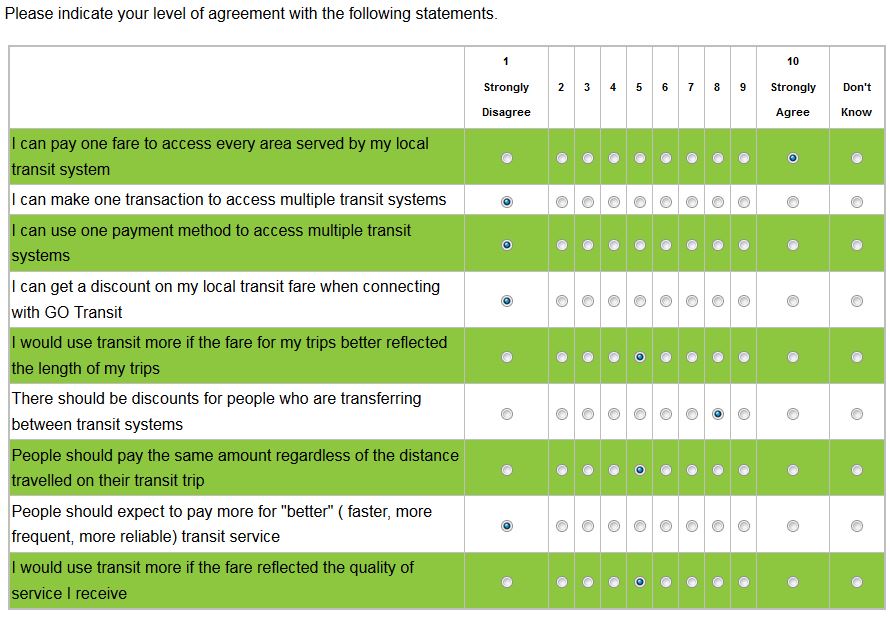
Cross-border and multi-carrier travel figure prominently in the survey, something by which, self-evidently, a regular TTC rider using only that system is not affected. The following list of fare options reappears in different guises elsewhere in the survey. As a piece of design, it fails because some questions are in the “I can …” format while others are “would” or “should” questions. It is unclear how an “I can” question can have anything beyond a “yes” or “no” answer. Does Metrolinx want our opinion on paying one fare for all of a local transit system, or asking if I can already do this?

There is a big problem in that some options interact, but there is no provision for this. Metrolinx is obsessed with the idea of paying more for “better” service which could mean anything from a GO Train or a Highway coach, to a local express bus, the subway or even a new LRT line. One might agree with a premium for the GO train (although that would also relate to distance travelled), but not for other types of service. There is no option to distinguish between these.

20151118_Survey_FareOptions

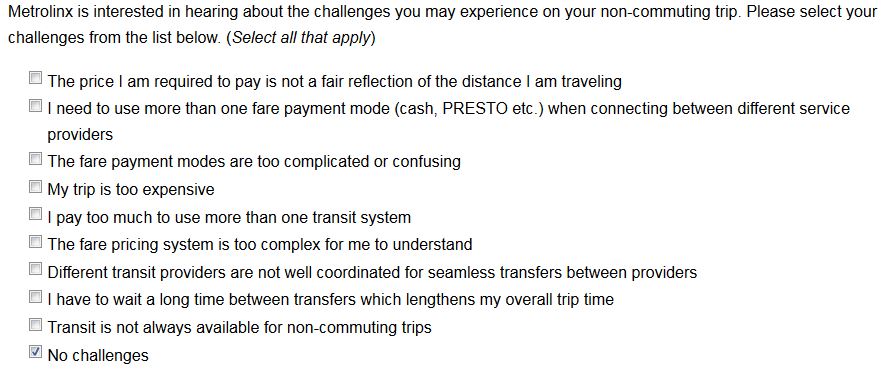
The ideas reappear as a list of challenges to transit travel. For a monthly pass holder, many of these options don’t really apply although one could certainly complain about the cost (high fare multiples) and the fact that on some parts of even the TTC, transfers can be a big headache thanks to unreliable service.

20151118_Survey_Challenges

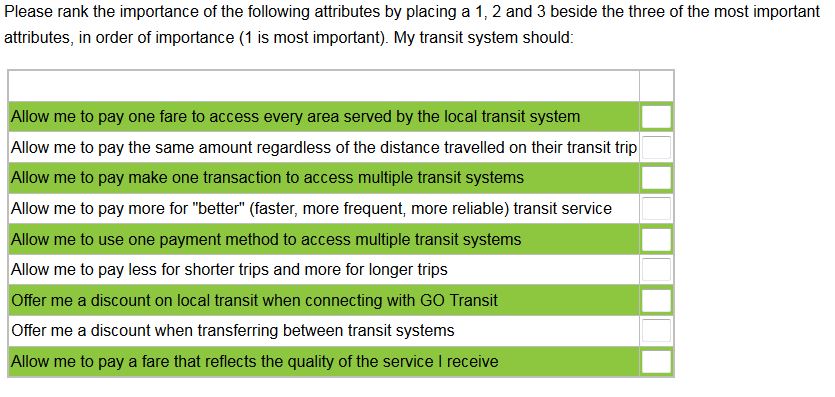
Another set of options requires the choice of a top three issues and ranking them rather than using the 1-to-9 scale for all of them.

20151118_Survey_Wants

Later the survey asks about co-fares between systems including local-to-GO and local-to-local transfers, but is silent on the question of how new co-fares might be funded, indeed on the whole question of regional fare revenue and subsidy sharing. Similarly, questions about distance or zone-based fares give no hint of what the effect might be for different journeys. Time based transfer and return trip privileges are nowhere to be found, typical for Metrolinx that only grudgingly acknowledges them as an option within local systems, not for the network as a whole.

No doubt the results from this survey will be trotted out to support whatever fare scheme Metrolinx comes up with, but it could be strongly biased to “typical” Metrolinx riders who have a very different view of the transit world and fares than their (much more numerous) “local” network cousins. It would be amusing to see what a similar survey carried out for the population within Toronto would yield. The survey includes a request for one’s postal code, and so at least there should be some idea of the distribution of responses across the GTHA.

A Smarter SmartTrack

The SmartTrack scheme was born of an election campaign, but it was John Tory’s signature project, one he is loathe to relinquish despite its shortcomings.

What’s that you say? I am just being one of those “downers” who cannot see our manifest destiny? What’s that line about patriotism and scoundrels?

At the recent Executive Committee meeting, Tory actually had the gall to say that during the campaign, he didn’t have access to a squad of experts and had to make do with the people he had. Funny that. This is the crowd that estimated construction costs on the back of an envelope, who “surveyed” the line using out of date Google images, who ignored basics of railway engineering and capacity planning to make outrageous claims for their scheme.

When the dust settled and John Tory became Mayor Tory, I thought, ok, he will adapt his plan. Indeed, it didn’t take long for a reversal on TTC bus service and the recognition that Rob Ford had stripped the cupboard bare and then started to burn the lumber at the TTC. A campaign attack on Olivia Chow’s (far too meagre) bus plan changed into championing the restoration of TTC service to the days of the “Ridership Growth Strategy” and beyond. Good on the Mayor, I thought, he can actually change his mind.

SmartTrack is another matter, and what Tory, what Toronto desperately needs is a fresh look at what GO, SmartTrack and the TTC could be if only the fiefdoms and the pettiness of clinging to individual schemes could be unlocked. That would take some leadership. I wonder who has any?

Inevitably comments like this bring out the trolls who say “so what would YOU do” (that’s the polite version). Here’s my response as a scheme that bears at least as much importance as a way of looking at our transit network as the competing visions in the Mayor’s Office, Metrolinx, City Planning and the TTC.

Continue reading

Playing Fast and Loose With SmartTrack (Updated)

In a previous article, I wrote at length about the City of Toronto’s reports on the status of SmartTrack to be discussed at the October 20, 2015 meeting of the Executive Committee.

Two related items also deserve comment.

First up is an article in the Star by Tess Kalinowski in which she reveals that Metrolinx CEO, Bruce McCuaig, wrote to City Manager, Peter Wallace on October 6, over a week before the reports were posted on the Executive Committee Agenda. His letter said quite clearly that SmartTrack would only be an incremental upgrade of GO service, not a separate operation running on GO’s trackage.

“Metrolinx and the province believe that the (city report) should reflect the scenario where SmartTrack is an incremental increase in RER (regional express rail) service, rather than an independent and parallel service that co-exists with RER,” he wrote.

“The risk of creating unmet expectations is too great,” said McCuaig.

The letter also suggests the city stop referring to SmartTrack as a “surface subway” since federal rail regulations would prohibit TTC-style subway trains from operating on GO tracks.

The full text of the letter is not yet online, and it is notably absent from the Executive Committee agenda.

Updated October 19, 2015 at 11:45 am:

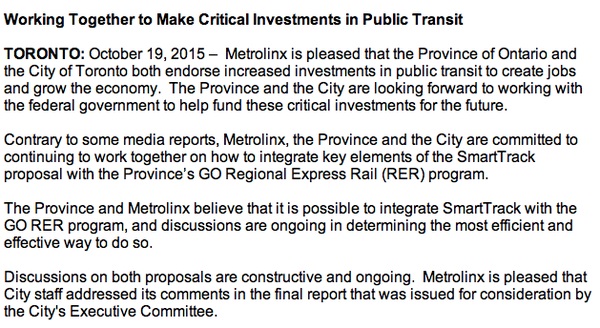
Metrolinx has issued a statement pledging its continued support for “key elements” of SmartTrack, whatever that means.

MetrolinxStatement_20151019

Second is the appearance of an “advocacy group” called FAST (Friends and Allies of SmartTrack) which appeared to spring out of nowhere earlier this week. This is no ordinary citizens’ group plotting in someone’s kitchen how to get some new transit line built, but a well-financed group with close ties to Mayor Tory. Their website reproduces the Tory campaign colours and links to SmartTrack material from that era.

Continue reading

SmartTrack Update: Many Reports, Many Unanswered Questions (Updated)

Updated October 21, 2015 at 9:30 am:

The Executive Committee spent a few hours discussing this report. As the morning wore on, it was clear that Mayor Tory was becoming unhappy with questions about his scheme. By the end of the debate when he spoke, he said:

I think a number of the questions raised by members of council today are perfectly legitimate questions which I’m sure our staff have taken note of and if they weren’t already being asked and answered, those questions, they will now be.  I just hope and I sense a generally positive sort of sense around here but I hope that we don’t get into being either sort of Douglas or Debbie Downer about these things. [Adapted from a quotation in the Toronto Sun]

Tory went on to say that he had “a mandate” from voters to build SmartTrack in a manner distressingly reminiscent of Rob Ford’s “mandate” to tear up Transit City. The problem with both claims is that voters did not elect Tory or Ford for those specific purposes, but in a reaction against the previous administrations, particularly in Tory’s case. Moreover, that “mandate” does not mean that the platform necessarily made sense as proposed, only that it was an attraction to voters that a candidate had concrete ambitions. We have already seen Tory backtrack on his claims that Toronto did not need more bus service (responding to Olivia Chow’s half-hearted support for transit), and there is no reason for SmartTrack to be treated as a divine plan on stone tablets.

As answers from staff to various questions made abundantly clear, there is a lot of work to do between now and first quarter 2016 when all of the details are supposed to return to Council. Staff went out of their way to avoid giving any indication of the way preliminary work might be headed lest they be drawn into a debate about “conclusions” before the supporting studies are in place.

The Executive Committee made a few amendments to the report’s recommendations:

1.  Requested the City Manager to forward the report (October 15, 2015) from the City Manager for information to the Toronto Transit Commission, the Ministry of Transportation, Metrolinx, the City of Mississauga and York Region.

2.  Requested the Chief Planner and Executive Director, City Planning to report to the Planning and Growth Management Committee on the results of the public consultations arising from the Preliminary Assessments of the Smart Track Stations, as set out in Appendix 2 to the report (October 15, 2015) from the City Manager, particularly with respect to the development potential of new stations.

3.  Requested the City Manager to work with Toronto Transit Commission, Metrolinx, and GO Transit, to develop a One Map Strategy where by major intersections and/routes of these transit operators are shown on future hard copy and electronic local and regional transit maps, once SmartTrack routes and stations are established.

The first recommendation is the original staff proposal simply to transmit the update report to other agencies. The second arose from a concern by Councillor Shiner, chair of the Planning & Growth Management Committee, that implications of and potential for redevelopment around SmartTrack stations be understood as soon as possible. During debate, he spoke about the success of development a long the Sheppard line, an ironic stance considering how strongly he had opposed development around Bayview Station when it was at the design stage.

The third recommendation arose from Councillor Pasternak, who never tires of advocating the “North York Relief Line” (otherwise known as the Sheppard West extension to Downsview). His desire is that maps show all of the projects that are in the pipeline during studies, not just the one that happens to be the subject of debate.

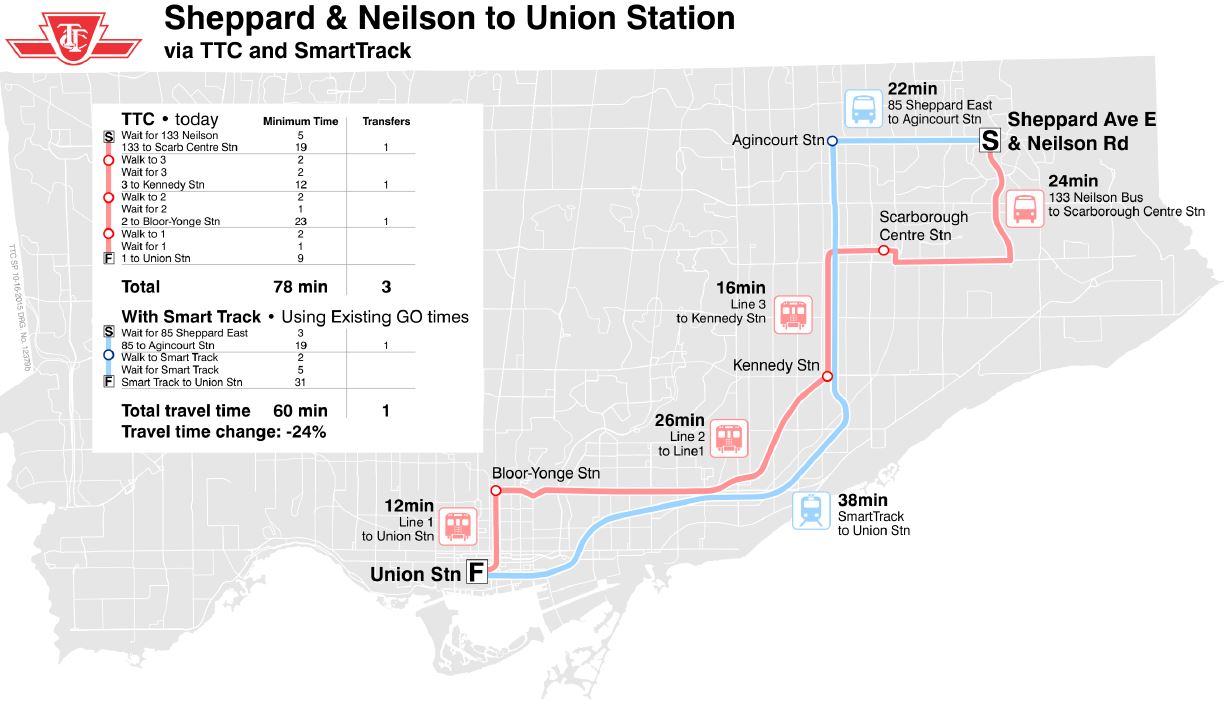
A notable absence in the staff presentation was any reference to the Scarborough Subway Extension as an alternative route for travel to downtown. That presentation covered substantially the same information as the background reports, but it included a few new charts about comparative travel times with SmartTrack in place.

STvsTTC_TravelTimes1

The important difference between this map [at p23] and the Tory SmartTracker website (which shows comparative travel times) is that the TTC includes the access and wait times for SmartTrack in its calculations. This reduces the proportionate saving over a trip. Another issue, of course, is that many riders do not work at Union Station, and taking SmartTrack there would be an out-of-the-way trip. This is not to downplay what SmartTrack might do, but to point out that if ST is to be part of a “network”, then advocacy for it must look at how it benefits all of the trips originating in some part of the city (say northeast Scarborough), not just those that conveniently lie on its route. This will be an issue in comparative ridership projections for ST and the Scarborough Subway Extension because those who are bound for midtown will almost certainly have a shorter trip simply by taking the subway rather than ST.

The original article follows below:

Continue reading

A Frustrating Update on Transit Expansion Plans

The TTC Board received an update from City and TTC staff on the status of major transit expansion plans in Toronto at its meeting of September 28. The presentation was largely delivered by Deputy City Manager John Livey with backup from Mitch Stambler, TTC’s Head of Service Planning. Also at the table, but notable for her silence, was the Toronto’s Chief Planner Jennifer Keesmaat. A contingent from Metrolinx, another agency studying transit expansion, was in the public gallery, but they did not participate in the presentation or discussion.

This session was a prologue for a report coming to Toronto’s Executive Committee on October 20, 2015, but a great deal of detail remains to be fleshed out. This proved frustrating for the Board members on two counts. First, the lack of detail prevented the TTC from making informed comment on the plans, and second, the process itself has largely bypassed the TTC Board and concentrated work at the City and Metrolinx.

To some extent, the TTC has itself to blame for this situation. During the Ford/Stintz era, meaningful policy debates at the TTC were rare, and the TTC ceded responsibility for large scale planning to the City of Toronto under Keesmaat’s department. At the political level, staying informed about issues is a comparatively new desire by Board members (not to mention some members of City Council) when the issues are more complex than a dumbed-down subways-subways-subways mantra. They have a lot of catching up to do.

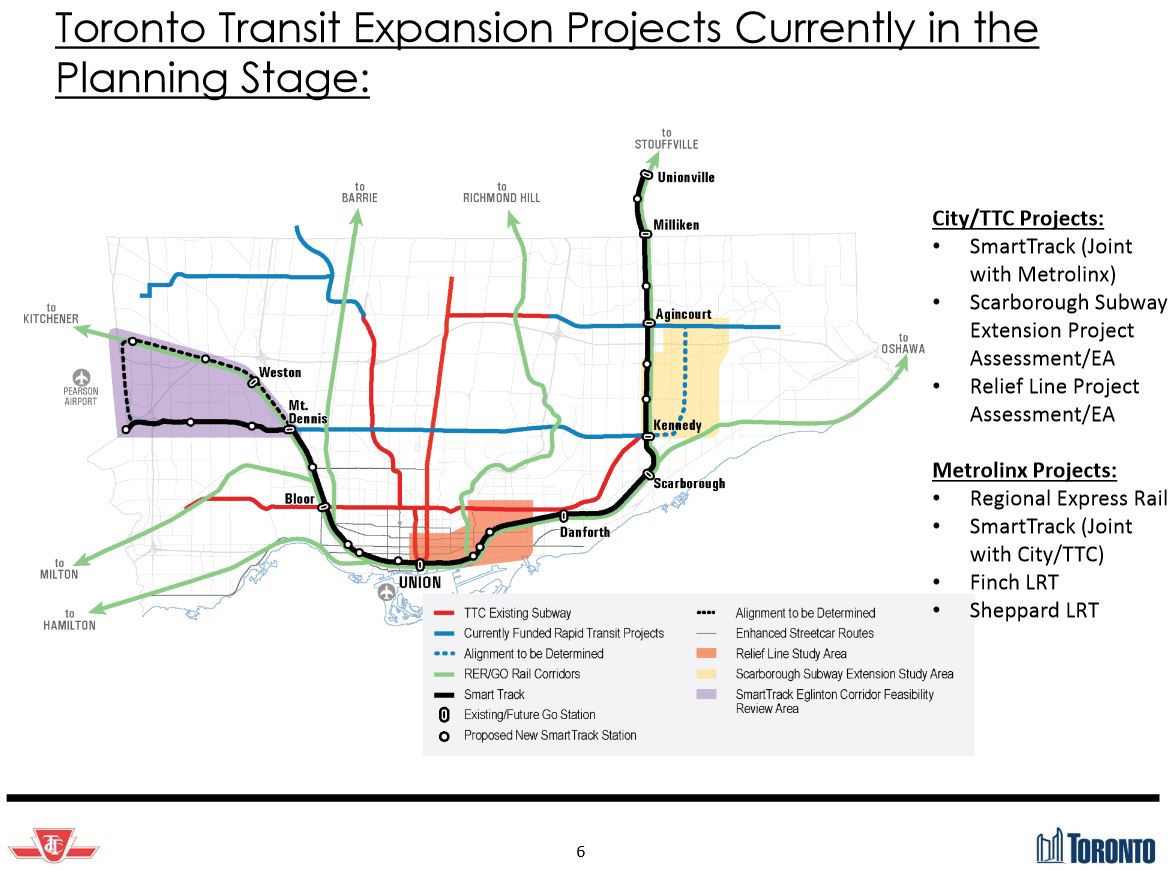
Detailed reports on four major projects will come before the TTC and Council over coming months, and these will inundate members with not only a great deal of information but force some hard decisions about just which projects, and at what scale, the City should pursue. These are:

  • The Relief Line
  • The Scarborough Subway Extension
  • Waterfront transit
  • GO/RER, SmartTrack and TTC service integration

ExpansionPlanMap_6

The situation is complicated by parallel work at Metrolinx, an agency with very different goals from the TTC and the City, and by the inevitable political wrangling over the relative importance of projects. Whether any reports coming forward from staff will be trusted, especially in an environment where Councillors and the Mayor routinely dismiss “expert” advice that does not suit their biases, remains to be seen. Equally difficult will be the question of whether the reports are spun, in advance, to suit specific outcomes rather than presenting “just the facts”.

One difficulty already lurking in the wings is the question of demand modelling. The University of Toronto together with City Planning is developing a new model for GTHA travel. This is much more ambitious than current models in that it covers the entire region and models travel over the entire day, rather than focussing on AM peak flows. The model also allows for route and mode choice by incorporating considerations of fares and line capacity (crowding). At this point, the model is still being calibrated and validated, a process that uses known historical data (from the 2011 Transportation Tomorrow Survey) to confirm whether the model generates flows that accurately mimic what actually happened. (The TTS is conducted every five years by UofT on behalf of municipal and provincial agencies, and the next set of data will reflect demands in 2016.)

Draft results for the new projects and network will not be available until October 2015, and a report on details will not come to Council until the first quarter of 2016. One suspicion is inevitable given this delay: is the “calibration” intended to produce a desired outcome? That’s a tricky question both because it speaks to the independence of the process and also to the way in which the model is used. For example, a model may well reproduce past behaviour perfectly, but that’s a known target and the context for it (then-existing transit, road and land use configurations) are a matter of record.

Future modelling depends not only on the nuts and bolts of the model itself, but of the assumptions put into its configuration. A well-known example of flawed modelling was for the Sheppard Subway in which unduly rosy assumptions about job numbers and locations gave the subway a projected demand well above what it actually achieved. The further one goes into the future, the cloudier the view becomes, and the presumed distribution of population and employment can involve political as well as basic economic dimensions. If, for example, the concentration of jobs in the core area and the polarization of high and low income housing concentrations continues, this has profound effects on future demand. Moreover, such concentration may not suit politicians who view their own turf as the rightful place for future growth.

Continue reading

The Evolution of Demand on the Union Pearson Express

Updated September 24, 2015 at 11:30 am:

Metrolinx has released details of its daily ridership counts.

Ridership Summary 20150921

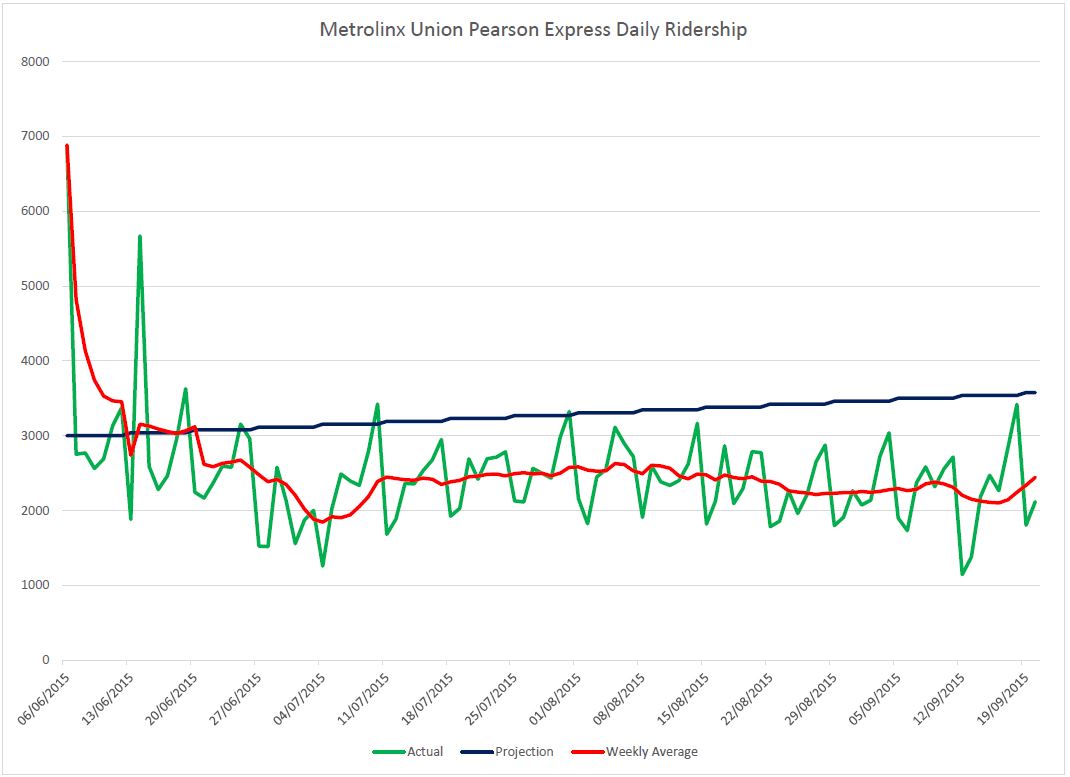
Although they claim via Twitter that ridership is going up, when the numbers are actually graphed, this is not true.

The chart below shows:

  • The projected ridership rising from 3,000 per average weekday to 5,000 over the first year of operation (blue).
  • The actual ridership from the Metrolinx stats (green).
  • The moving average weekly ridership (red). For the first six days, these are the values for the operation to date.

It is quite clear that the ridership has settled into a regular pattern after a dip in early July. There is little evidence of a Pan Am Games effect on the numbers. As and when Metrolinx releases additional ridership data, I will extend this chart.

What is missing from the Metrolinx data is a statement of the average fare paid and a breakdown by fare type. This would reveal both the nature of ridership and the effect, if any, of promotional fares on demand.

UPX_Ridership_20150924

The original article follows below.

Continue reading

Metrolinx Fare Integration Study: Heading to a Foregone Conclusion?

Updated September 22, 2015 at 8:00 pm:

A few issues raised in this article were addressed during the presentation and debate on the Metrolinx report.

  • The dismissal of “time based fares” refers only to fares that are calculated by the length of a journey measured in hours rather than kilometres or zones. Times based transfer privileges (in effect, limited time passes) are still part of the mix of fares under discussion.
  • Although the initial goal of the study is to produce a revenue-neutral model, Metrolinx will also expand the scope to look at adjustments to reduce the effect of bringing about that “neutrality”, in effect to offset unwanted side-effects of balancing who pays for what. This is an important consideration so that all interested parties can debate whether we want more subsidy, or higher fares, or some combination of these in aid of the greater good of an integrated and “fair” regional system. Just telling everyone “this is how it will be” is a recipe for political disaster, especially considering any reorganization of regional fares is likely to occur just in time for the next round of elections.
  • Integration is a big issue for Metrolinx because the distinction between “local” and “regional” travel is vanishing. This is actually more important than the off-cited cross-border double fare, and the RER service concept cannot operate without close integration of local fares and service to whatever Metrolinx runs.
  • Still unanswered is the question of just what service classes Metrolinx will propose, and the effect of making rail services like subway and LRT lines a separate fare class when they were designed, for the most part, to be integrated with local systems as replacements for existing bus routes.
  • Metrolinx plans to publish the background papers for this study including a review of the fare structures now in use by the GTHA’s transit systems.

The original article follows below:

The Metrolinx Board will receive an update on the status of its regional fare integration study at its meeting of September 22, 2015. To no great surprise, the study is pointing strongly toward fare by distance as the preferred scheme, no matter how much the entire exercise wants to give the impression of an unbiased approach and of “consultation” with municipal transit operators and the public. For some time, the Metrolinx review has the air of “any colour you like as long as it’s black”, and this update does little to change the impression.

The fundamental problem is that Metrolinx is a regional commuter system where any kind of flat fare simply won’t work, although their pretensions to being truly fare-by-distance fall apart the longer a trip gets. As the role of Metrolinx changes, both with the construction by Ontario of urban lines, and with the evolution of its market beyond the hinterland-to-downtown model, a one-size-fits-all fare system simply won’t work. Things get even more complicated where there is a mix of GO and local services serving the same territory whether these be rail or bus operations.

An “integrated fare system” has long been the goal for regional planners, although just what this means has varied over the years. For a long time, “integration” meant little more than having one farecard (Presto, of course) that would work everywhere while the actual fare structures were unchanged. The farecard would simply eliminate the pesky business of having different fare media – tickets, tokens, passes, cash, transfers – for different systems. Now that completion of Presto’s rollout is within sight, the question turns to the matter of fare boundaries and “fairness” in fare structures.

Continue reading

A Little Rant About Transit Fares

A recent article, The Flirtation With Fare By Distance, has sparked a debate in the comment thread about the relative merits of flat vs distance-based fares, and the whole issue of how we choose to subsidize some groups of riders versus others. In a recent reply, I took strong issue with some of the concepts advanced by writers, and the thread of my argument is strong enough that it deserves to be seen in an article of its own.

There are two related comments, and I will reproduce them here to set the stage:

Rishi (@PlanGinerd) wrote:

Fare-by-distance is a tricky one that I’m not yet firmly decided on. It clearly works on many large systems worldwide, and I have tons of friends and family who live in Zone 4 or Zone 6 in London who while they do complain the Tube is expensive, they still take it daily and never ever drive or take a cab or a regional train into the core. Perhaps it can only be coupled by changing the economics/costs of driving?

I am 100% sympathetic that FBD benefits those who can afford to live closer to the core, whilst disadvantaging those who live within the borders of Toronto but farther out. I haven’t done enough research yet, but I always think about why someone who lives so far from the City of TO core, would still choose to live within our borders vs. in Peel, York, or Durham regions. Is it really the cheap access to the TTC or is it other services? In other words, what incentives are there to convince them to live in “expensive” Toronto in the first place?

My friends deep within Metrolinx and TTC are also torn. They feel that it is not the role of the operator to handle the social equity, but the role of the province through transfers and tax breaks. I ask Steve and the community, if the province was to pair FBD for all GTA transit agencies and truly integrated fares, with a tax break to help those disadvantaged, would that change your mind?

It reminds me of a conversation I had last week on Twitter with Moaz RE how social programs that give out free TTC fares would cope without tokens. I see Presto tech. as enabling if done right, and it would be easy to give out cards with balances on them, or a periodic reload to help with fares, whilst also giving valuable O-D and usage data.

Maybe I’m too much of an optimist but things like this, and exiting fare gates are commonplace and the norm in cities everywhere. Yes local context is critically important, but I think we have to get away from the nay-saying that Toronto is always different and every other best practice could never work here.

Jonathan C wrote:

Flat fares are a very ineffective way to reduce inequality as the benefit is not well-targeted to those who need the help. There are plenty of people making long trips who could afford a higher distance based fare, and plenty who struggle to pay the flat fare for short trips or end up walking long distances because they can’t justify the cost. In most cases everyone would prefer better service. If you want to help those in need then push for an increase in the low income tax credits, don’t try to use the transit system as it is a very blunt instrument.

In a way the flat fare leads the poor to live further from the core as only those who are better off can afford higher housing costs plus the flat fare. The poor service to far-flung locales also pushes commuters into cars, while those who can’t afford to drive end up trading their time for a lower fare.

My replies:

This discussion seems to be taking place as if we were proposing to introduce flat fares as a net new subsidy that would benefit people who don’t need it. If that were the case, I could certainly understand arguments for targeted rather than broad-brush subsidies.

We are not. The discussion is of the potential effect on a wide range of transit users who now have a common fare no matter how far they travel compared to what they pay today. If you want to talk about actual need, then let’s expand the debate to free fares for all children, or reduced fares for all students and seniors. During the whole debate over cheaper fares for university students, I was struck by the absence of advocates for the truly poor saying “hey, what about us”, and the hand-wringing extended to a group that on the whole comes from relatively affluent backgrounds.

I have yet to hear a cogent argument for distance-based fares beyond “other people are doing it”. Well, no, throughout much of the GTHA, “local” fares are flat. Even London UK, that oft-cited bastion of fare-by-distance, uses flat fares for its surface system with time-based transfer privileges.

Correction: London does not have time-based transfers on its surface routes, with very limited exceptions. [July 2, 2015]

The question of flat fares vs fare by distance has nothing to do with “nay-saying” or “best practices”, it is a political and social choice the city has made. If we want to talk about fare collection technology, or the best way to operate a transit system, those are fair game for criticisms of the “not invented here” syndrome so common in Toronto.

“Equity” as Toronto defines it may well mean a flat fare. Don’t forget that the pesky border with the 905 is a comparatively recent phenomenon, and problems of low market share for transit within 905 systems (i.e. for local travel in York Region, or Durham, or Mississauga) have nothing to do with fare by distance, but with built form and the relative lack of competitive transit services. Fare by distance will only “solve” the problem for trips that are now cross-border by giving them a (presumed) discount. It won’t add better bus service unless there is a substantial jump in revenue to offset costs, net costs that are higher in the 905 because of the much richer per rider subsidies.

Where people choose to live is a product of many factors including income and service (broadly defined) availability. Try living without a car out in the 905 — the TTC for all its problems is a damn sight better, and it can certainly be argued that there is a stronger, longer history of community support services within Toronto than elsewhere even if these are stronger in the “old city” than in Toronto’s suburbs. Some of this is also historical — the 905 suburbs simply didn’t exist when many families moved to the outer 416, or they were aimed at a very different demographic. Markham is not noted for its large pool of social housing.

When we speak of transit discounts as a “social service”, this is usually in the context of truly disadvantaged groups who for mainly economic reasons are deemed worthy of additional social supports. There is a big problem with arguments that they should be funded through alternative means to transit fares such as tax rebates. Social subsidy programs are chronically underfunded and have exclusionary eligibility tests. Tax credits are a wonderful thing, but they are almost always structured to benefit those who have a taxable income in the first place, and can even disproportionately benefit the well off.

If we start talking of flat transit fares generally as a “social service”, we miss the whole point that encouraging people to use transit has an economic benefit for the city by avoiding pressure for more road construction, and a general benefit to all residents by reducing the need for one or more cars in their families. This is the sort of thing that would show up in any full accounting of costs and benefits. The hidden subsidies to motorists are not subject to the same scrutiny, nor are they regarded as some sort of social service. We also build roads for the economic benefit of the trucking industry and all of its clients. Maybe we should start thinking of that as a “social service” too because it is a form of job creation.

It is very easy to characterize things we don’t want to spend money on as “social service” or even worse “welfare”, while the things we prefer (often for political and ideological reasons) as “investments”.

Any scheme that discourages transit use relative to what is and has been in place for decades is the equivalent of a “disinvestment”, almost like asset stripping where dividends are more important than the health of a company.

If you want to call me a “nay-sayer” for that attitude, you have that right, but it’s a pejorative term, an artificial, ad hominem argument that does not engage in debate of the basic principles.

I would remind you that the “nay-sayer” epithet was used by John Tory during his campaign against those who criticized SmartTrack, and we now know what a bag of crap that proposal was.

The availability of vast amounts of travel data is routinely cited by those who would move us to fare by distance. Dare I remind readers that distance-based fares have existed for much, much longer than the ability to collect this data, and they are a product of political and business decisions about pricing service, not a means to collect O-D info.

The next time you go shopping and someone makes it harder for you to get through the store because they want detailed data about your buying habits, be sure to co-operate fully.

The TTC does not, repeat, not need a mountain of O-D data to provide better service. You can find out where the riders are simply by looking at the buses and streetcars, and broad network demands can come from O-D data in the TTS survey.

They already have a mountain of data documenting the behaviour of their vehicles, and after many decades are finally starting to analyze it in ways similar to the work I have published. Problems with vehicle bunching and poor headway management contribute a great deal to crowding on the TTC. Even with this documented in excruciating detail, little is done to fix problems of “TTC culture”. This is even a double-edged sword in that with all this data, some claim that all we need to do for more capacity is to improve management and schedules, not to actually operate more service. This is a variation on the “efficiency” argument that neatly avoids an actual commitment to better service.

Let us have a debate on fare structure by all means, but let it be a real debate, not simply a fait accompli that shows up because Andy Byford and Bruce McCuaig decide to impose fare-by-distance on us all as a matter of simplicity for Presto’s implementation. The technology should serve what we, collectively as cities and a region, want to help transit achieve, not get in the way or penalize riders who happen to live in the wrong place. Let’s talk about GO Transit’s uneven handling of short trip fares and the discount structure that makes travel from Kitchener to Union Station far cheaper, by distance, than travel from Rexdale. Let’s talk about what is needed to make transit service in the 905 truly attractive so that more people will want to use it, and transit will have political support for spending on more than a few subway extensions and GO improvements.

That would be a real debate. What we have today is an utter sham.

The Flirtation with Fare by Distance

Recent presentations by TTC CEO Andy Byford both to his own Board and at a recent Metrolinx Board meeting included an undercurrent of references to charging fares based on distance travelled or some form of zone system. This shows up in the description of new fare gates for subway stations that would be provisioned at the TTC’s expense as part of the Presto farecard rollout.

What, you ask, is this all about? Don’t we already have Presto readers on existing turnstiles? Well, yes, but they have two problems according to Byford:

  • The reader is not ideally located (“it is too low”) for customers, and
  • New fare gates can be designed with provision for future “tap out” capability that would be needed for a distance or zone based fare structure.

The cost of this change is projected to be $38.1-million, and this is a net addition to the TTC’s already bulging 10-year capital project list.

Oddly enough, the new fare equipment arises from a joint effort with Metrolinx/Presto and it would be no surprise if the same gates show up at stations on the Eglinton Crosstown line.

Continue reading

The Vanishing Relevance of SmartTrack

The Metrolinx Board received a presentation today from their Chief Planning Officer, Leslie Woo, about the Yonge Relief Network Study. One item in this report raised eyebrows – the projection that GO RER and SmartTrack services would divert only 4,200 passengers during the peak AM hour from the Yonge corridor.

In the discussion, it was clear that service in the SmartTrack corridor would be every 15 minutes. Four trains per hour is hardly an inducement to change routes although at least if SmartTrack operates with TTC fares, it could still be atttractive.

However, I wondered just what that 15 minute headway meant, and so I wrote to Leslie Woo for clarification:

When you talk about 15 minute headways, does this mean an RER train every 15′ and an ST train every 15′ for a combined 7’30” headway, or is this 15′ for the combined service with a wider (e.g. 30′) headway on each one?

Her reply:

15 mins – combined.

Keep in mind that where Kitchener/Milton/and Barrie corridors converge we are already at less than 15 min headway in the peak.

This is a fascinating statement. SmartTrack is, among other things, intended to add stations along the GO corridors so that a more finely-grain service can be provided in Scarborough and at some locations along the Weston corridor such as Liberty Village. However, if the combined express GO and local ST services will only run every 15′, this implies a wider headway on ST, possibly every over train or 30′. With only a pair of tracks on the Stouffville corridor, and likely only a pair dedicated to GO+ST on the Kitchener corridor, it is impossible for express GO trains to pass local ST trains, and this limits how many trains per hour, in total, can possibly operate there.

During the press scrum, Metrolinx CEO Bruce McCuaig was asked about the equipment to be used, and he said that both GO and ST services would run with GO trains. It would appear that the only difference will be where they stop. Of course we already have this type of arrangement on the Lake Shore corridor, and didn’t need an election campaign to get it.

When candidate John Tory pitched SmartTrack, it was to be a “surface subway” using, mainly, existing GO rights-of-way but operating with quasi-subway service level, speed and station spacing. There were claims made for 200k/day in ridership, and the whole project was pitched as if it was the one line to solve every problem. Ask about the weather? SmartTrack will fix it. Out of a job? SmartTrack will speed you more quickly to job locations you never dreamed of. Why don’t we have more buses? Buses are a waste of money and what you really need is a shiny new fast train.

The problem with these claims is that they depended on SmartTrack actually being “like a subway” with frequent service, something it is quite clear that it will not be, at least not as Metrolinx sees things. The challenge here is that unless there is a very substantial investment in infrastructure by Metrolinx beyond what is planned for GO/RER, the network cannot handle the very frequent service contemplated for SmartTrack and this limits the effect it will have region-wide.

Even if SmartTrack did operate more frequently (a situation that was modelled by Metrolinx), it doesn’t attract much more ridership away from the critical Yonge corridor. The basic fact is that the west end of SmartTrack (wherever it might actually go) is so far from Yonge Street that it addresses a completely different market. Even the eastern branch on the Stouffville corridor is a fair distance from Yonge and, if anything, would bleed demand from the Scarborough Subway rather than the Yonge line.

A vital but missing piece of information in the presentation is the count of likely riders on various routes in the modelled networks. This report tells us how many riders are diverted from Yonge, but not how many riders would be on the other corridors and, therefore, the value of and need for more service in them. This information should come out in a technical background paper expected in July 2015.

Although the Metrolinx discussion did not get into SmartTrack costs, there are fundamental questions to be answered:

  • What are the comparative costs and benefits of serving the Eglinton West corridor with the proposed SmartTrack tunnel or with the planned westward extension of the Eglinton Crosstown LRT? (This should be answered later in the SmartTrack study of that corridor.)
  • Will SmartTrack share GO’s corridor through Union Station, or will it split off into its own tunnel downtown? Would the more frequent service a tunnel implies actually be able to co-exist with GO operations when the line rejoined the GO corridors?
  • What is the actual, likely cost of SmartTrack? For election purposes, this was estimated simply by taking the average costs of a few European “surface subways” or “overground” lines as London calls them, and scaling this to the length of the SmartTrack route. Originally, it was claimed that there would be no tunnels, but the campaign quickly learned that their research was faulty on that score. The cost is important because Toronto has volunteered to pay 1/3 of the total, whatever that might be.
  • Why should Toronto taxes be used to pay for a service which had among its objectives improvement of access to commercial properties in Markham and Mississauga?
  • Can a local service that operates considerably less frequently than a subway route be expected to generate much development as associated tax revenue?

As things now stand, SmartTrack has all the appearance of a line on the map that fades gradually under the harsh light of actual planning, operational constraints, and the degree to which Ontario is prepared to build infrastructure to enable it.