TTC Board Meeting Review: February 25, 2016

The TTC Board met on February 25, 2016. This article is a review of some of the reports and discussions at that meeting. For the full list, please refer to the agenda.

In this article:

As part of an update on cycling initiatives, the Board passed a motion asking staff to work together with the City on improved parking facilities for bicycles at subway stations. An article on this appeared on Torontoist’s website.

Continue reading

A Rainbow of Rapid Transit

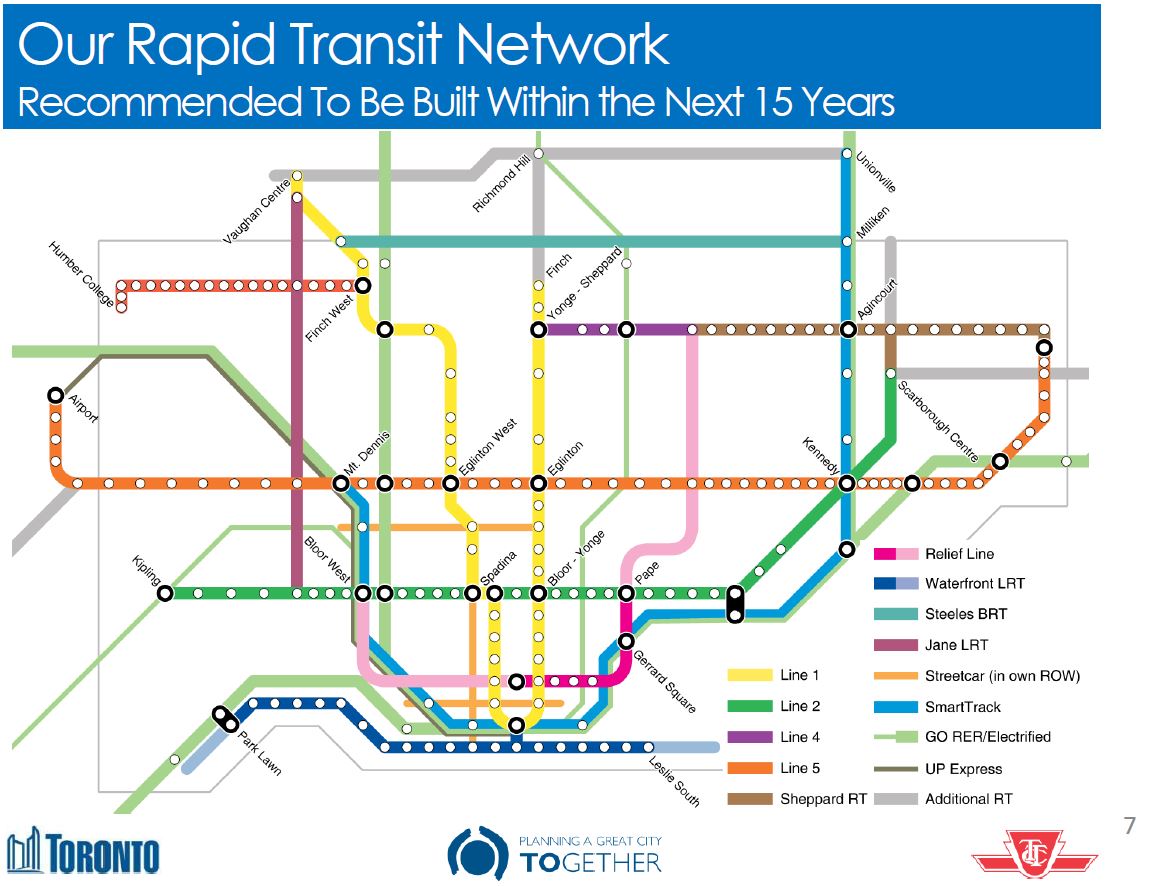
In Toronto’s never-ending fascination with new transit maps, the City Planning department has released a vision for our rapid transit network as it will be in 15 years.

201602_15YrPlan

Despite much talk of “evidence-based” planning, this is a very political map, and I cannot help remembering then-Premier David Peterson’s announcement of 1990 (not long before he lost an election and Bob Rae wound up as his much-surprised replacement) that amounted to a chicken-in-every-pot map.

There is nothing wrong with network-based planning, and indeed I have been beating a well-worn drum on that subject for years. But let us also remember that the Scarborough Subway exists because of the political clout of Brad Duguid, a former City Councillor, now Ontario’s Minister of Economic Development. Mayor John Tory, in Toronto Life, cites Duguid as saying that “if anyone tries to cancel the [Scarborough] subway, they’ll do it over his dead body”. “Evidence” apparently includes having a large cudgel to keep wandering pols in line.

The map also includes the Mayor’s pet project, SmartTrack, and it’s no wonder that he steers clear of the Minister’s position given the need for a provincial agency, Metrolinx, to accommodate SmartTrack on their network.

All of this is part of the “Motherlode” of public consultation sessions now running in various places around the City, and through Metrolinx in the wider GTHA. Background information and links to related material are available at Toronto’s TransitTO web site.

Continue reading

How Will SmartTrack and GO/RER Co-exist?

Metrolinx has published an update on studies of how the proposed SmartTrack service will be integrated with its own GO/RER (Regional Express Rail) offering. This will be considered at their board meeting on February 10.

This covers several issues, and begins to nail down just what SmartTrack might, or might not, resemble that is beyond the scale of postcard election literature. As we already know, major changes are planned to the western leg where the Crosstown West LRT will take over the function proposed for SmartTrack beyond Mt. Dennis. To the east, SmartTrack remains in the GO Stouffville corridor, but the Scarborough Subway Extension (SSE) has been scaled back to a one-stop line serving only the Town Centre, and the Crosstown East LRT will provide service to eastern Scarborough.

What is GO RER?

WhatIsRER

This graphic is amusing for its complete contrast with the way that Metrolinx/GO presented electrification of their services during early days of public consultation. That hit a low point when it was suggested that electric trains might not work in snow.

Note that the official line now is that lots of cities use this type of service, and that electrification is an integral part of the package.

Metrolinx owes us all an apology for their initial foot-dragging and misinformation campaign. Now if only they had been more supportive of LRT during the dark days of Rob Ford.

Continue reading

Metrolinx Fare Integration: Get Ready to Pay More For Subway Trips

One of the great mysteries surrounding the roll out of Presto on the TTC has been the whole debate about “Regional Fare Integration”. Now and then, discussion papers surface at Metrolinx, but folks at the TTC, especially the politicians, are strangely silent on the subject. “Wait and see” is the order of the day.

Well, folks, we have waited and now we are beginning to see the direction Metrolinx is heading in for a consolidated GTHA-wide fare structure. The results will not please folks in suburban Toronto or the inner 905 for whom long subway trips are a routine part of their commutes.

The Metrolinx Board will consider an update on this subject at its meeting on February 10.

The presentation is in a sadly familiar Metrolinx format: lots of wonderful talk about consultation and fairness, and philosophical musings about what a fare system should look like. One big omission is any evaluation of the relative numbers of riders who would be affected by various schemes, and even worse of any sense of calibration of the fares to produce different results.

This comes at a time when we know from SmartTrack demand studies the importance of fare levels in attracting ridership. It is important here to remember that we are not talking the relatively small differences between types of TTC fares, or year-by-year increments, but the much larger deltas between TTC fares and those on GO Transit.

The problem begins with the arbitrary segmentation of the travel market into “local”, “rapid transit” and “regional transit”.

201602_DefiningServiceTypes

This is a wonderful theoretical view of the world that might find a home in a sophomoric academic paper, but it ignores the very real world in which (a) “rapid transit” today only exists within Toronto and (b) Toronto decided over 40 years ago that “local” trips paid one fare regardless of the mode they used. The entire system is designed on this principle, one that has consistently evaded Metrolinx planners.

If only the world were so simple. Why is Bus Rapid Transit omitted from this list? Why is a streetcar (aka LRT) on right of way “rapid transit”, but not a bus? How close must subway or LRT stops be to each other for the service to drop back to a lower tier? Conversely, if someone slaps a “19x” route number on a bus, should it become “rapid transit”?

The basic problem with this world view is that transit modes, especially bus and streetcar/LRT, have a wide range of overlapping implementations.

Continue reading

GO Transit Electrification Study Public Meetings

Metrolinx has announced a series of meetings for public participation in the TPAP (streamlined Environmental Assessment for Transit Projects) for their GO Rail Network Electrification Study.

Four of these overlap with sessions previously announced by City Planning for other projects under review:

  • Tuesday February 16: John Vanier school in Scarborough
  • Wednesday February 24: Metro Toronto Convention Centre in downtown Toronto
  • Wednesday March 9: Lakeshore Collegiate in Etobicoke
  • Tuesday March 22: Nelson Mandela Park school in Toronto

The area of this study covers only the trackage already owned by Ontario through Metrolinx.

Relief Line, SmartTrack, GO/RER, Scarborough Subway Consultations

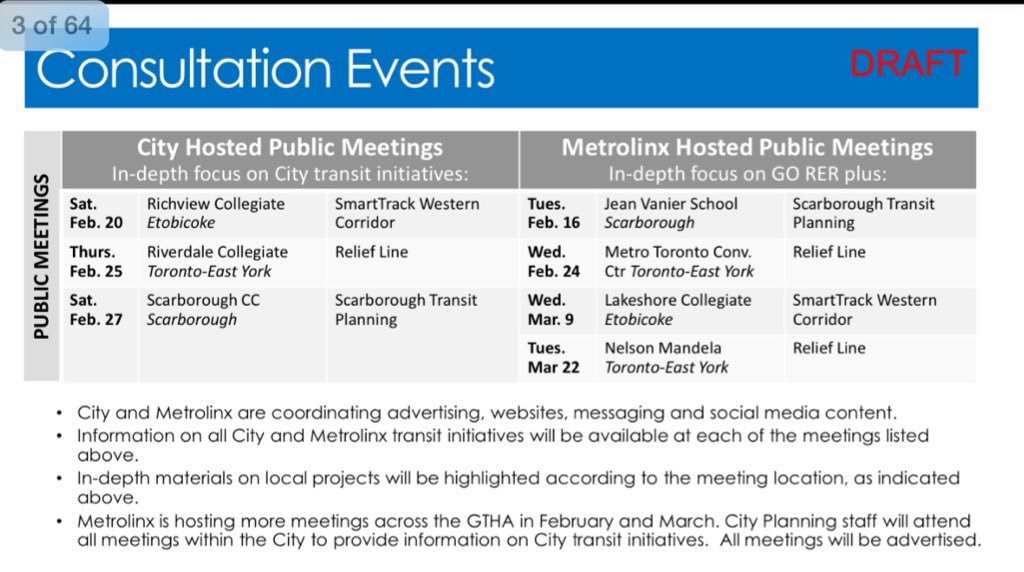
Toronto City Planning has released a draft list of upcoming public consultations on various transit plans including:

  • The Relief Line
  • The Scarborough Transit Plan (Subway, SmartTrack, Crosstown East LRT)
  • The Western SmartTrack Plan (SmartTrack, Crosstown West LRT)

2016_ConsultationCalendar

Additional meetings and information about Metrolinx plans (GO Regional Express Rail) will be organized by that agency.

Even more information will be available in March 2016 when the City releases a compendium report on all transit initiatives currently under study. These will include items listed above as well as the “Waterfront Reset” study, TTC Fare Integration proposals and a review of how (or if) Tax Increment Financing can contribute to the many transit projects under review. The intent is that this report will form the basis for public consultation and debate leading to recommendations at Council in June 2016. This is a very aggressive schedule, and there is no indication how consensus will actually be achieved in so short a time, especially with the usually-secretive Metrolinx as an essential player. At least the discussion will be at a network level, not ward-by-ward with a “relief” line for every member of Council, and there will be some filtering of various schemes based on engineering and operational realities.

What is sadly missing from all of this is a discussion of day-to-day transit operations and the backlog in the state-of-good-repair budget. We can blithely discuss billions worth of subway building to Scarborough and a Relief line, but Council won’t fund the basics of running a transit system.

SmartTrack: Now You See It, Now You Don’t!

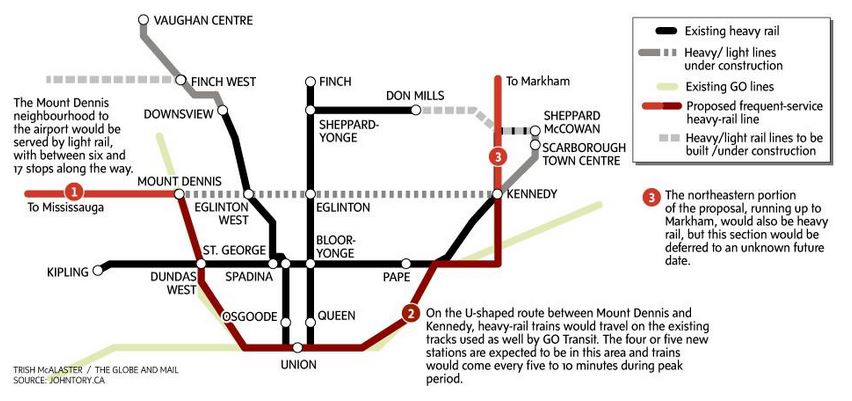
Oliver Moore in the Globe and Mail reports that there have been major changes to the SmartTrack plan, to wit:

  • The western branch of the service to the Airport district will be provided by the western extension of the Eglinton-Crosstown LRT as originally proposed.
  • “SmartTrack” per se will operate as a heavy rail service overlaid on GO Transit with the initial phase running from Mount Dennis to Kennedy Stations.
  • The northern extension of “SmartTrack” to Markham will be a separate phase of the project.

The map from the Globe & Mail is reproduced below.

GlobeSTLRTMap_20160114

According to Moore, the cost of adding SmartTrack to GO under this configuration would be much, much less than the originally quoted figure for the entire line. In turn, this would free up substantial capital spending headroom in City plans for other projects.

SmartTrack service at 15 minutes (the level proposed in Tory’s campaign) is far too infrequent to attract much riding, and especially to make a dent in demand on the existing subway interchange at Bloor-Yonge. We saw this in the June 2015 Metrolinx demand projections that were far more favourable to a Relief Line operating north to Sheppard and Don Mills. However, getting SmartTrack service down to as close a headway as every 5 minutes will be challenging for Metrolinx and for the corridors through which this would operate. There are no details yet on how this would be achieved.

The Eglinton West LRT has always been the superior way of serving this corridor compared to the heavy rail SmartTrack scheme. ST foundered on major problems with constructibility and neighbourhood effects, issues that were dismissed in a stunning display of cavalier “expert” knowledge during the campaign. Planning by Google Maps from an office in the UK has its limitations, but Tory’s campaign relied on this “expertise”. One shameless professor even rated ST with an “A+” in the CBC Metro Morning interview.

Keeping the first phase of ST confined south of Eglinton on both branches limits the operating costs the City must bear if this to be truly a “Toronto” project with “Toronto” fares, and it avoids the complexities of building into the 905.

Indeed, SmartTrack began as a real estate development scheme to make commercial property near the Airport and in Markham more accessible from downtown in a series of studies that actually claimed the market for downtown office space was static and falling. Yet another expert should be eating crow pie from his perch on the Metrolinx board. It was never clear why Toronto should shell out billions to improve property values in the 905, and this task now falls clearly to Metrolinx where it belongs.

The eastern leg of SmartTrack, north from Kennedy, obviously competes with the Scarborough Subway Extension, and there is no need for two routes serving the same demand, especially when GO already plans substantially improved service in the rail corridor. The long-standing issue of SSE demand may be clarified by the absence of SmartTrack as a competing service.

It is no secret that my own position would be to revert to the LRT plan in Scarborough, but that train has probably left the station, especially if the City can “save” a small fortune by scaling back on SmartTrack.

These changes could also foreshadow a revised schedule for the LRT projects at a time when “shovel ready” projects are in demand to soak up new federal spending. Eglinton West’s LRT extension is relatively easy to build, and it could be started soon enough to complete concurrently with the main Crosstown route. There is also the matter of the Sheppard East LRT including its proposed service linking to UofT Scarborough campus.

Coming weeks may bring many sputtering denials, or possibly, much improved clarity and acceptance of an – at last – realistic plan.


Metrolinx Fare Integration Survey

Metrolinx is running a survey of “fare integration”, whatever that might mean to you, until November 30, 2015.

This survey is striking in the way that it reinforces options and viewpoints commonly seen in Metrolinx analysis of fare systems. It is quite 905-centric both in the types of questions and options, and the view of how people might use a transit network.

The survey begins by asking about someone’s “typical trip” to establish an origin-destination pair. Of course, many riders within the city have many regular destinations, especially when their travel (like my own) is not dominated by commute trips to work or to school. After one gets through that section, another comes up asking about non-commute trips but with no attempt to quantify them or ascertain where they might occur.

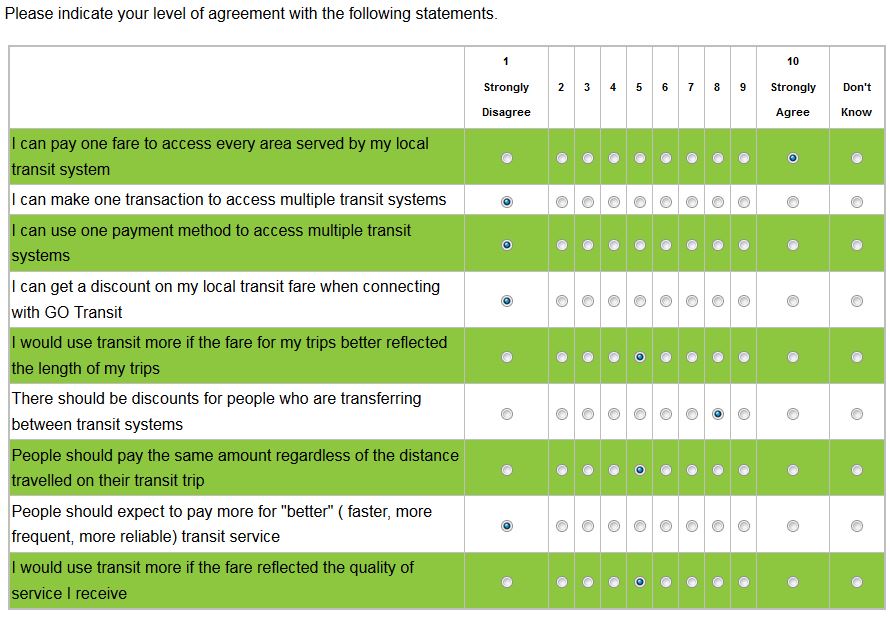
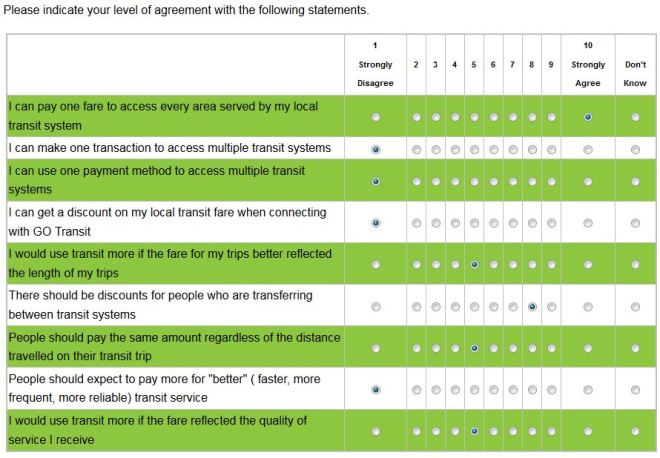
Cross-border and multi-carrier travel figure prominently in the survey, something by which, self-evidently, a regular TTC rider using only that system is not affected. The following list of fare options reappears in different guises elsewhere in the survey. As a piece of design, it fails because some questions are in the “I can …” format while others are “would” or “should” questions. It is unclear how an “I can” question can have anything beyond a “yes” or “no” answer. Does Metrolinx want our opinion on paying one fare for all of a local transit system, or asking if I can already do this?

There is a big problem in that some options interact, but there is no provision for this. Metrolinx is obsessed with the idea of paying more for “better” service which could mean anything from a GO Train or a Highway coach, to a local express bus, the subway or even a new LRT line. One might agree with a premium for the GO train (although that would also relate to distance travelled), but not for other types of service. There is no option to distinguish between these.
20151118_Survey_FareOptions

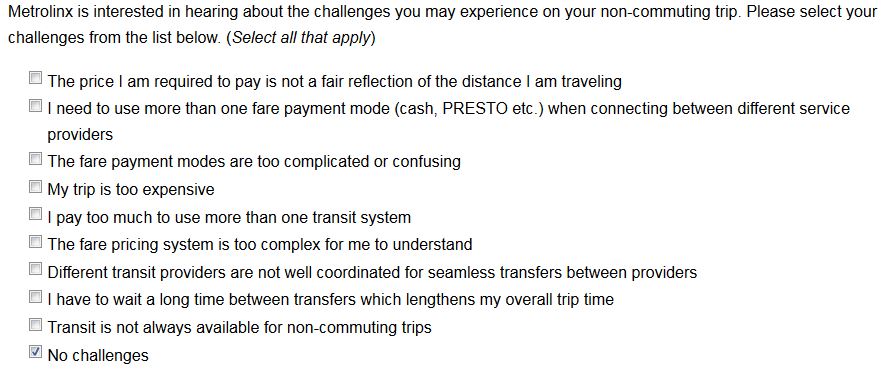
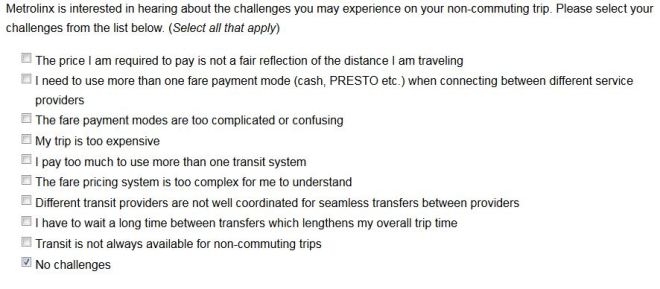
The ideas reappear as a list of challenges to transit travel. For a monthly pass holder, many of these options don’t really apply although one could certainly complain about the cost (high fare multiples) and the fact that on some parts of even the TTC, transfers can be a big headache thanks to unreliable service.
20151118_Survey_Challenges

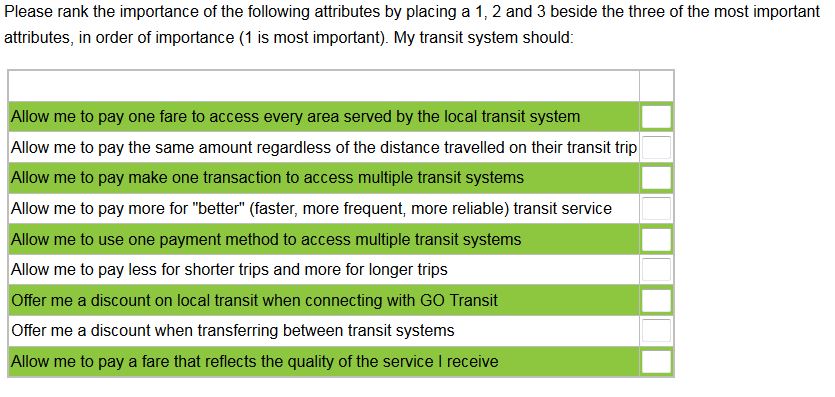
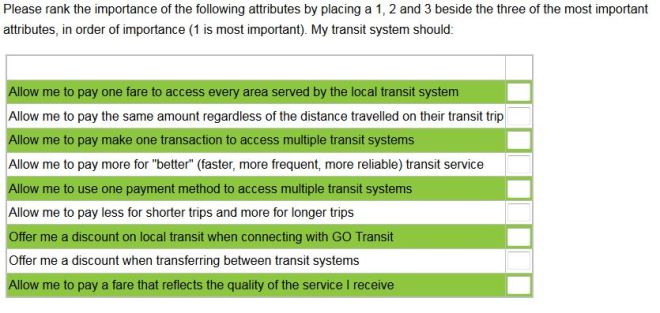
Another set of options requires the choice of a top three issues and ranking them rather than using the 1-to-9 scale for all of them.
20151118_Survey_Wants

Later the survey asks about co-fares between systems including local-to-GO and local-to-local transfers, but is silent on the question of how new co-fares might be funded, indeed on the whole question of regional fare revenue and subsidy sharing. Similarly, questions about distance or zone-based fares give no hint of what the effect might be for different journeys. Time based transfer and return trip privileges are nowhere to be found, typical for Metrolinx that only grudgingly acknowledges them as an option within local systems, not for the network as a whole.

No doubt the results from this survey will be trotted out to support whatever fare scheme Metrolinx comes up with, but it could be strongly biased to “typical” Metrolinx riders who have a very different view of the transit world and fares than their (much more numerous) “local” network cousins. It would be amusing to see what a similar survey carried out for the population within Toronto would yield. The survey includes a request for one’s postal code, and so at least there should be some idea of the distribution of responses across the GTHA.

A Smarter SmartTrack

The SmartTrack scheme was born of an election campaign, but it was John Tory’s signature project, one he is loathe to relinquish despite its shortcomings.

What’s that you say? I am just being one of those “downers” who cannot see our manifest destiny? What’s that line about patriotism and scoundrels?

At the recent Executive Committee meeting, Tory actually had the gall to say that during the campaign, he didn’t have access to a squad of experts and had to make do with the people he had. Funny that. This is the crowd that estimated construction costs on the back of an envelope, who “surveyed” the line using out of date Google images, who ignored basics of railway engineering and capacity planning to make outrageous claims for their scheme.

When the dust settled and John Tory became Mayor Tory, I thought, ok, he will adapt his plan. Indeed, it didn’t take long for a reversal on TTC bus service and the recognition that Rob Ford had stripped the cupboard bare and then started to burn the lumber at the TTC. A campaign attack on Olivia Chow’s (far too meagre) bus plan changed into championing the restoration of TTC service to the days of the “Ridership Growth Strategy” and beyond. Good on the Mayor, I thought, he can actually change his mind.

SmartTrack is another matter, and what Tory, what Toronto desperately needs is a fresh look at what GO, SmartTrack and the TTC could be if only the fiefdoms and the pettiness of clinging to individual schemes could be unlocked. That would take some leadership. I wonder who has any?

Inevitably comments like this bring out the trolls who say “so what would YOU do” (that’s the polite version). Here’s my response as a scheme that bears at least as much importance as a way of looking at our transit network as the competing visions in the Mayor’s Office, Metrolinx, City Planning and the TTC.

Continue reading

Playing Fast and Loose With SmartTrack (Updated)

In a previous article, I wrote at length about the City of Toronto’s reports on the status of SmartTrack to be discussed at the October 20, 2015 meeting of the Executive Committee.

Two related items also deserve comment.

First up is an article in the Star by Tess Kalinowski in which she reveals that Metrolinx CEO, Bruce McCuaig, wrote to City Manager, Peter Wallace on October 6, over a week before the reports were posted on the Executive Committee Agenda. His letter said quite clearly that SmartTrack would only be an incremental upgrade of GO service, not a separate operation running on GO’s trackage.

“Metrolinx and the province believe that the (city report) should reflect the scenario where SmartTrack is an incremental increase in RER (regional express rail) service, rather than an independent and parallel service that co-exists with RER,” he wrote.

“The risk of creating unmet expectations is too great,” said McCuaig.

The letter also suggests the city stop referring to SmartTrack as a “surface subway” since federal rail regulations would prohibit TTC-style subway trains from operating on GO tracks.

The full text of the letter is not yet online, and it is notably absent from the Executive Committee agenda.

Updated October 19, 2015 at 11:45 am:

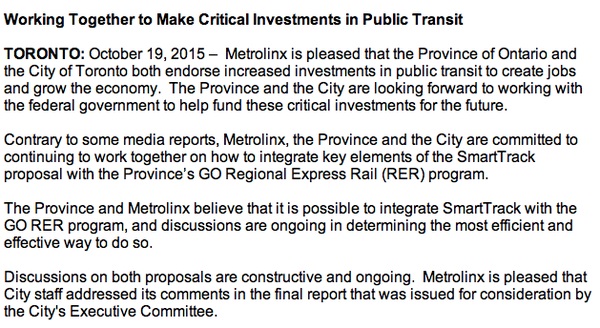
Metrolinx has issued a statement pledging its continued support for “key elements” of SmartTrack, whatever that means.

MetrolinxStatement_20151019

Second is the appearance of an “advocacy group” called FAST (Friends and Allies of SmartTrack) which appeared to spring out of nowhere earlier this week. This is no ordinary citizens’ group plotting in someone’s kitchen how to get some new transit line built, but a well-financed group with close ties to Mayor Tory. Their website reproduces the Tory campaign colours and links to SmartTrack material from that era.

Continue reading