This article continues the analysis of service on routes where the TTC claims to be implementing mid-route headway management. The routes included here are:
24/924 Victoria Park
25/925 Don Mills
29/929 Dufferin
See Part I for a general introduction and details of 7 Bathurst, 100 Flemingdon Park, 165 Weston Road North, 506 Carlton and 512 St. Clair.
A common factor evident in the charts for these routes is that service near the origins of routes is barely within the target range for headways, and more commonly well beyond it. AM peak service might squeeze within the target, but service falls apart from midday onward and does not recover in the evening.
Although the TTC reports performance based on “on time” departure from terminals, they actually have a headway standard, but never report on how well routes meet it. Note that the standard actually is very generous and allows a wider range of headways than the “on time” standard. For example, a bus operating every 10 minutes is allowed a 50% headway deviation either way meaning that the actual headway could be anywhere from 5 to 15 minutes, and 40% of the service can be even worse. This is a standard designed to make management look good to those who don’t peer “under the covers”.
For services that operate between 5 and 10 minutes, passengers do not rely on printed schedules, but expect vehicles to arrive at prescribed headways. Therefore, on-time performance for frequent service is measured by how well actual headways correlate to scheduled headway intervals. Trips are monitored at a location based on arrival time, without regard to whether the trip that arrived was scheduled for that time slot. The vehicle is considered on-time when the headway deviation is less than 50% of the scheduled headway. For example, a service that operates every 6 minutes is deemed on-time if the headway deviation falls between 3 minutes and 9 minutes. TTC’s goal is to have 60% of all trips operated within +-50% of the scheduled headway over the entire service day. [Service Standards at pp 15-16]
The TTC plans a review of its Service Standards in coming months. That review and much-needed reporting on service quality are long overdue.
Express routes can have very wide ranging headways making their benefit to riders dubious. The wait for an express bus can be longer than the travel time saving from skipped stops. Meanwhile riders at “local” stops cannot benefit from the express vehicles. The TTC plans a review of its Express Network later this summer, and service reliability should be a major issue. It is not enough to advertise a faster trip, but the network must actually provide it, including waiting time, reliably.
Another factor that appears in some of these charts (as well as in Part I) is that for some periods there is more service on a route than is scheduled. This is due in part to the assignment of the “run as directed” buses to supplement regular routes. However, the base schedule is not adjusted, and the RADs do not create a uniform combined headway. They can even contribute to bunching by running close to a scheduled run.
TTC still has not deigned to release detailed data from their APCs (Automatic Passenger Counters) and only coarse information (corresponding to the three levels of loading shown on their real time info) is publicly available. I have asked many times, but this request goes nowhere. Without detailed data it is impossible to know the loads on buses or to differentiate between a modest seated load and a partially standing one. Considering that the Service Standards call for at most a few standees in the off peak, this distinction is crucial to evaluating how service matches the standards.
When the use of RADs to supplement service began, the intent was to soak up spare bus operators (not to mention spare buses) without committing to a permanent service improvement. There has been no external report on whether the added service improved ridership, or the effect of its withdrawal.
The TTC “Annual Service Plan” has been rebranded as the “Network Plan” in the interest of clarity, but based on the 2026 edition’s meagre content so far, this is an infinitesimal network. In particular, it really does not deal with the transit network as a whole, but only small tweaks at the edges. Big decisions such as long range, city-wide plans, budgets, service levels and the future of transit as part of Toronto are all made elsewhere.
Issues such as strategies for improving ridership and budget reviews which bear directly on the amount of service riders see are not in this plan. Nor is any discussion of basic service quality and management, nor of the fractured nature of TTC information for and communications with its riders.
Round One of the Network Plan consultation addresses only a handful of proposed route changes. More substantial work including an Express Bus Network review and discussion of construction-related service changes won’t appear until Round Two in August.
The Network Plan presentation lists several parallel studies under development parallel to but not included in the Annual Network Plan consultations. Only those keen transit watchers know about all or most of these, and it is a hard slog keeping up. The table below is from the Round One presentation deck.
2026 Annual Service Budget
Sets service levels for each board period in 2026
Includes number of vehicles, service hours and distance
2026-2028 Ridership Growth Strategy (RGS)
Cost-benefit analysis of service, fare, infrastructure and customer experience initiatives
Could achieve ridership growth over the next 3 years (if funded)
RapidTO Transit Priority Lanes
Completed: Queens Quay East
Next: Dufferin St and Bathurst St corridors (pending July 2025 Council approval). Target: ready for 2026 FIFA World Cup
Feasibility and design studies are on-going for the Jane Street, Finch Avenue East, and Lawrence Avenue East roadways
FIFA World Cup Transit Service Plan
Increased service on key downtown routes
Additional service on match days and during Fan Festival
Reducing bunching and gapping
Efforts to reduce bunching and gapping on 10 of the most problematic routes with enhanced on-street presence as well as scheduling related changes
This may suit the TTC’s fragmented internal structure, but it drives people outside of the TTC mad. One does not have to be a seasoned transit advocate, merely a daily rider, to rail at the frustration of “consultation” on a handful of minor route changes. Basic service issues across the system must wait for the budget (no public consultation there at all), the Ridership Growth Strategy (budget limits again) and a Board that, until recently, actually believed (or chose not to challenge) management claims about quality.
Two burning issues are service quality (with associated crowding and unpredictable waits), and the effect of construction projects on routes (not to mention abjectly poor and inaccurate communications to riders). We will have to wait until Round Two in August to address at least some of these problems.
Consultation
An online survey opens July 7-16. There are separate consultations with the Advisory Committee on Accessible Transit (ACAT) and the TTC’s Planning Advisory Group which after many years now has a formal name. (Full disclosure: I am a regular contributor to that group.)
Pop-Ups will be held from 4-6pm at the following dates and locations:
July 9th: University of Toronto Scarborough Campus
July 10th: St. George Station
July 15th: Sherbourne & Rosedale Stations
July 16th: Lawrence West Station & Sunnybrook Hospital
In February-March 2025, the TTC added on-street supervisors on eleven routes in an attempt to reduce the incidence of gaps and bunching. This is described in the June 2025 CEO’s Report and the associated Metrics Report containing performance stats for the system.
Bunching and gapping of TTC service
Last March, the TTC expanded a pilot to improve service reliability on 11 key bus and streetcar routes. Working through the Transit Control Centre, uniformed Supervisors have been deployed mid-route to ensure our service frequency meets customer expectations and that we reduce the bunching and gapping of our buses and streetcars, which is a source of frustration for riders.
The pilot involves the following routes: 7 Bathurst, 24/924 Victoria Park, 25/925 Don Mills, 29/929 Dufferin, 100 Flemington Park, 165 Weston Rd North, 506 Carton, and 512 St Clair.
Starting in July, the CEO’s Report will include a Hot Topic that will provide news and updates on the progress – and challenges – related to this important issue. [CEO’s Report, p. 9]
Also:
TTC expanded a pilot to improve service reliability on key bus routes. Mid-route Field Supervisor presence on the nine priority bus routes was increased throughout the February and March Board Period, where the focus is on reducing bunching and gapping, in order to improve the reliability of service. Bunching and gapping is measured by “Headway Adherence”: the vehicle is considered on-time when the headway deviation is less than 50% of the scheduled headway. [Metrics Report, p. 15]
Mid-route Field Supervisor presence on the two priority streetcar routes continued throughout the February and March Board Period, to reduce bunching and gapping and improve the reliability of service. Bunching and gapping is measured by “Headway Adherence”: the vehicle is considered on-time when the headway deviation is less than 50% of the scheduled headway. [Metrics Report, p. 16]
Although there is a Service Standard for headway adherence, this is not measured and reported publicly, and results are never cited in ongoing service quality reports. For many years, the TTC clung to the concept that if routes were on time at terminals, the rest of the line would look after itself. However, the “on time” standard is sufficiently lax that badly bunched and gapped service can meet the target. That, combined with reporting only average results, hides the real character of service that riders experience day-to-day.
At the June 23 Board meeting, management gave the impression that they would not report on all routes in July and might have to farm some of the analytical work out.
This is a sad admission considering the years of articles I have written on service analysis showing what could be done with the hope that the TTC would develop internal tools to perform similar tasks. Sadly, however, I have been told by some at TTC they have what they need, and, in effect that I should run along and not bother them.
Partly to hold their feet to the fire, and to provide the type of information that should be routinely available to the Board, management and the public, this article will do the work the TTC claims they cannot. Here are headway reliability analyses for the routes involved over much or all of the period from January 1, 2024 to June 30, 2025.
In a very few cases, it is possible to see a change in service quality (measured as a smaller spread between minimum and maximum headways, or gaps between vehicles) around the beginning of March 2025. These are rare, and short-lived. February was a really bad time to try to implement any new practice as the city was digging out (or not depending on where you live) of a huge snowstorm. (The extended effect of the City’s poor snow clearing on transit routes is evident in the multi-day peaks in irregular service on some routes.)
I have presented 18 months of data to show that problems with headway reliability have existed for some time. There is more data going further back, but 18 months makes the point. Moreover, a consistent pattern is that headways might be well-behaved in the AM peak and Midday, but evening service does not fully “recover” from PM peak conditions, and erratic service is common.
Quite bluntly, service on all of these routes was poor, well beyond the TTC’s own Service Standards, for 2024 and early 2025, and showed little sign of improvement through to mid-year. It will be interesting to compare whatever stats TTC comes up with to the performance shown on charts here.
Part I of this series includes data for 7 Bathurst, 100 Flemingdon Park, 165 Weston Road North, 506 Carlton and 512 St. Clair. Part II will include 24/924 Victoria Park, 25/925 Don Mills and 29/929 Dufferin.
There are a lot of charts and this is a long read. I will put the “more” break here. Those readers interested in specific routes can soldier on. Thanks for reading!
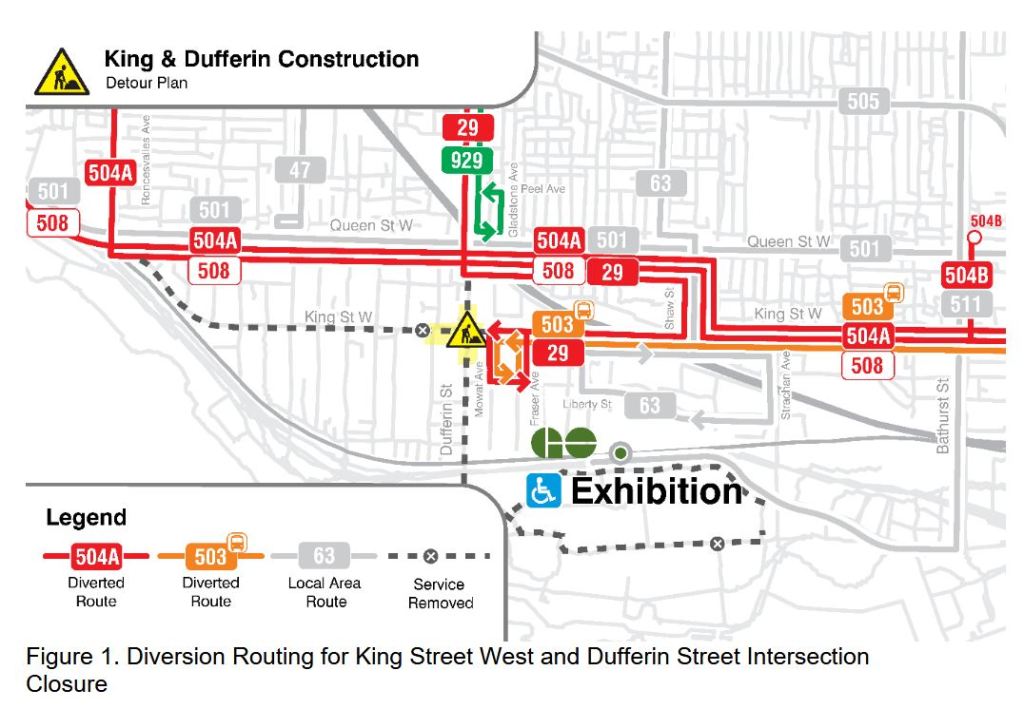
Starting after Labour Day in September, the TTC will rebuild the track at the King-Dufferin intersection. This work is expected to take about six weeks.
The project is left over from work on King West in 2024 when it could not be completed as planned due to supply problems. It was erroneously reported that the 2024 project finished “early” when in fact this was due to the scope change.
Transit services will be significantly changed in this area.
Source: City of Toronto Report at p. 5
Note that the diversions for King-Church construction are expected to end before King-Dufferin work begins, and transit services on the eastern part of King will be back to normal.
Route changes at King-Dufferin:
Routes diverting east of Roncesvalles via Queen and Shaw to King:
504A King streetcars from Distillery Loop to Dundas West Station
304 King night cars from Broadview Station to Dundas West Station
508 Lake Shore streetcars from Long Branch to Broadview Station
No service on King between Mowat and Roncesvalles
504B King streetcars will operate from Broadview Station diverting from King via Bathurst to Wolseley Loop (at Queen).
Kingston Road services:
503 Kingston Road converted to bus operation and cut back from Dufferin to loop via Mowat and Fraser.
303 Kingston Road night service suspended (it is not yet clear what will replace the 303 on Kingston Road)
Dufferin bus services:
29 Dufferin buses will divert via Queen, Shaw and King looping via Mowat and Fraser.
929 Dufferin Express buses will terminate at Queen looping via Queen, Gladstone and Peel.
No service on Dufferin south Queen nor through Exhibition Place to Princes’ Gate.
Parking and stopping provisions will change on Queen from Roncesvalles to Shaw, and on Shaw between Queen and King. Stopping will be prohibited on both sides of these streets seven days/week from 7:00 to 11:00am and 2:00 to 7:00pm.
Left turns will be banned from Shaw northbound at Queen and southbound at King. Left turns are now banned from King eastbound onto Shaw weekdays from 7:00 to 10:00am, and from 3:00 to 7:00pm. This will be extended to a ban from 7:00am to 7:00pm on all days.
Some existing parking spaces will be removed to make room for transit vehicles on Dufferin north of Queen, Peel, Mowat, Liberty, Fraser, and King. Details are in the report.
These changes will only last for the duration of the construction project.
The TTC plans to “conduct comprehensive targeted engagement to inform and educate customers, residents, local businesses, and other partners of the pending changes.” However, major changes are unlikely as this project is only two months away and temporary transit routes are already decided. The TTC does not yet have a page on its own site for this project.
This issue will be at Toronto & East York Community Council on July 8, 2025.
A major item on the agenda was the subway platform edge doors study. This is covered in a separate article.
There were overlapping threads in discussion of current results, the financial update, and the non-fare strategy all stemming from the 2025 shortfall between budgeted and actual fare revenue and ridership. Although some shortfall was expected thanks to the severe winter, ridership has not climbed to the budgeted level. An unanswered question is whether the TTC aimed too high in its expectations for 2025, or if there is an inherent limit in system growth that will occur over the year.
Midweek rides (Tuesday to Thursday) in Period 4 (roughly the month of April) were about 2% over the corresponding period in 2024, but overall ridership is about 5.1% below the budgeted level.
Fare revenue follows a similar pattern, although it is down by only 4.6% to budget because the average fare/ride is slightly higher than expected.
The use of various payment methods continues to evolve toward Presto with either a Presto card, app (“virtual card” below), or bank card (“open payment”). This chart only goes to week 17 of the year, and legacy media were still accepted for another month although they have dropped to 0.2% of all fare payments. In Period 4 about 46,000 tokens and 12,000 tickets were collected (about 2,000 fares/day).
Boardings continue to be below pre-pandemic levels across the system.
Note that a “boarding” is one link of a trip on a single route, with the exception that transfers are not counted as new boardings on the subway. A “ride” is one or more boardings paid for with one fare or card tap.
The lower recovery level on the rail modes is attributed mainly to the work-from-home pattern which is still felt by the transit system with the average day on Tuesday to Thursday being 6% higher than Monday and Friday.
Weekend demand is important and stands at about 60% of the weekday level (1.53 million/day vs 2.54 million/day). By extension weekend service is also important, although the demand is less concentrated in peak hours, and the high point falls in the afternoon rather than the classic AM and PM “rush hours”.
The main CEO’s Report contains more current data than the Metrics Report and states:
For the week ending May 30, the overall weekday boardings stood at 2.5 million per day and increased by one per cent from the same week last year. Weekday boardings by mode continue to be highest on the bus network at 1.2 million, followed by subway at 1.1 million, and streetcar at 245,000. Compared to a year ago, subway and streetcar demand, respectively, increased by six and four per cent, mainly due to an increase in downtown office commutes, while bus demand declined by three per cent.
There is no analysis of the degree to which ridership growth is constrained by the quality and quantity of service. Those of us who remember back before the pandemic will recall that the TTC was in a period of constrained growth. All surplus capacity had been consumed by new riders, but budgets, fleet size and subway capacity limited the amount of service and its attractiveness for new and increased riding.
Rider complaints continue to rank timeliness of service, missed stops, and vehicle operation as the top three concerns, and these outrank safety by a wide margin. This is not to downplay safety issues, but the TTC has severe problems with the dependability of its service which are probably depressing ridership recovery.
An updated Ridership Growth Strategy is expected later in 2025, and the mix of complaints indicates where they should concentrate efforts to woo back riders.
Two proposals before City Council attempt to deal with congestion issues downtown brought on by the King/Church water main and track reconstruction.
MM31.17 – Speeding Up Streetcars: Traffic Amendments on Adelaide Street, King Street and York Street – by Mayor Olivia Chow, seconded by Deputy Mayor Ausma Malik
This motion proposes the relocation of parking and loading zones from Adelaide Street to nearby streets to free up capacity on Adelaide.
Currently, the Financial District Business Improvement Area and their stakeholders use loading zones on the south side of Adelaide Street West, from Yonge Street to York Street, between 10:00 a.m. to 3:00 p.m., Monday to Friday. Based on the travel time data, streetcar operations are negatively impacted when the loading operations are in effect.
In consultation with the Toronto Transit Commission, Transportation Services and the Financial District have agreed that temporary loading zones will be established on the west side of York Street, between King Street West and Wellington Street, and on the north side of King Street West, between Yonge Street and York Street.
Delivery drivers will queue in the new loading zones, where Traffic Control Persons will marshal the delivery drivers into the loading bay only when it is clear. With the temporary loading zones in place, stopping will be prohibited on Adelaide Street West from 7:00 a.m. to 7:00 p.m., Monday to Sunday.
Mayor Chow proposed an amendment to her own motion authorizing payment “to deploy additional paid duty officers at seven locations near the King and Church worksite to manage traffic flow”.
MM31.18 – Re-Opening King Street for Business: Keeping Toronto’s Downtown Core and Canada’s Financial District Moving – by Councillor Brad Bradford, seconded by Councillor Stephen Holyday
This motion proposes the reopening of through traffic on King Street where streetcars are not operating during the construction diversion.
City Council direct the General Manager, Transportation Services, to make any necessary changes to reopen the portion of King Street between Spadina Avenue and Church Street to vehicular traffic for the duration of the King Street East and Church Street intersection closure, where streetcars are not currently in service.
Mayor Chow proposed an amendment limiting the reopened area to portions where “streetcars and buses” are not operating. This effectively neuters the motion because the only portion of King with no transit service now is east of Yonge Street.
The debate was mired by a combination of political rivalries, lack of familiarity with the affected area and transit services, and disinformation either through ignorance or misrepresentation.
The Mayor’s motion MM31.17 and amendment carried on a show of hands.
The Mayor’s proposed amendment to MM31.18 carried by 16-5. The motion as amended carried on a show of hands.
The debate was hampered by the absence of basic information such as a map and detailed information on items such as existing transit services, traffic pinch points and loading zone locations.
In support of his claim that King Street could be reopened, Councillor Bradford showed a photo looking west on King from Simcoe with the street completely devoid of traffic. The photo was taken at 6:30pm on Monday.
Monday is a very light day for office-bound traffic due to work-from-home patterns. This is also reflected in day-of-the-week travel time differences shown later in this article.
The theatre district (Roy Thomson Hall, Royal Alexandra and Princess of Wales Theatres, TIFF) are dark on Mondays, and there is little tourist traffic. There was no major event at the Rogers Centre.
Although an empty road can be found at times, the photo is deeply misleading, and Bradford should know better.
Among the most striking pieces of disinformation was the claim that replacement bus service carries far fewer riders than the streetcars did along the King Street corridor. When asked, staff gave riding figures of 24,000 on the King Street replacement bus, and 60,000 per day for the streetcars. These are all day values for the entire route, not for riding on the King Street transit corridor itself. At no point was there any discussion of the frequency (and hence capacity) of service. These numbers were cited by various Councillors to claim that transit priority was not needed on King because so many fewer people were riding there.
City staff should be chastised for failing to correct this point and for giving an answer that did not properly illuminate the comparison between service levels.
For the record, the scheduled service on the central portion of King Street with streetcars and buses is shown below. Note that there is substantially less scheduled capacity with the replacement bus service. Buses on King are quite crowded, and service is bunched and erratic.
It is quite likely that there are fewer riders on the buses than on the streetcars, although a major contributing factor will be the level of service provided by the TTC. From a capacity viewpoint, a service of 18 buses/hour with 50/bus (greater than the Service Standard level) would be 900 riders per hour past a point. The streetcar service would have a capacity more than double that level.
PM Peak Service
Streetcar Service (Apr/25)
Bus Service (June/25)
504A Distillery-Dundas West
10′ (6 cars/hour)
504B Broadview-Dundas West
10′ (6 cars/hour)
503 Kingston Road (EB from York)
10′ (6 cars/hour)
508 Lake Shore
20′ (3 cars/hour)
504D Broadview-Bathurst
5′ (12 buses/hour)
504C Distillery-Bathurst
10′ (6 buses/hour)
In the course of the debate, Mayor Chow noted that work at King & Church is progressing well and should be finished by August 8. This may allow the road to reopen, but resumption of streetcar service depends on the TTC finishing their work including reconstruction of streetcar overhead at that intersection and along King Street East.
The remainder of this article updates previously-published charts about streetcar travel times on Richmond and Adelaide Streets.
Approve addition of PEDs requirements, including operational and technical system requirements to the TTC Design Manual and Master Specifications for implementation at future new stations.
Direct staff to include funding based on estimates for the implementation of a pilot installation at TMU Station (Dundas) as part of the 2026 budget submission.
Approve ongoing planning work, including prioritizing stations for implementation of appropriate technologies based on specific needs and drivers of each station.
At the meeting, there was an attempt to refer the report to staff for further study:
Motion to Refer Item moved by Fenton Jagdeo (Lost)
Refer the report back to staff for further analysis to compliment [sic] the platform edge door study that includes:
Other technology, infrastructure, or passenger management solutions at stations that could improve operational efficiency, customer experience, and safety.
Prioritization of stations that would most benefit from platform edge doors and those that could realize safety, operational, and customer experience improvements utilizing other solutions.
Capital budget costs of (non platform edge door) station enhancement investments that could be implemented in 2026 to improve safety, operations, and customer experience.
Expanded business cases that include metrics for potential operational cost savings, service reliability improvements, and customer delay time savings that could be realized with platform edge doors at the highest priority stations.
A jurisdictional review of alternate platform edge door funding models that leverage non-fare (advertising) revenues.
There was also a motion to refer the report to the Strategic Planning Committee for further discussion:
Motion to Amend Item (Additional) moved by Councillor Dianne Saxe (Carried)
The TTC Board requests that staff provide the Strategic Planning Committee with class 5 estimates of the costs and benefits to the TTC of technically feasible options to detect or discourage track-level intrusions at subway and LRT stations, including those being installed by Metrolinx on new stations in Toronto.
The Feasibility Report by AECOM is a long document, but the core of it lies in the first 90 pages covering many aspects of potential implementations and designs. One significant conflict between this report and the management recommendations lies in the choice of stations for a trial installation. Although management recommends Dundas/TMU, a busy downtown station, the Feasibility Report recommends lightly used stations where problems can be worked out without a major upset to service and riders.
It is further highly recommended that TTC implement a number of PED installation pilot projects at different stations representing the typical condition for each type of design solution. Representative stations are proposed based on low ridership numbers to minimize impact to the subway system and ridership inconvenience associated with performance of the work and the anticipated learning curve. Potential stations include North York Centre, Lawrence, Glencairn and Old Mill. This variety of stations will allow contractors to familiarize themselves with all station groups and structural solutions. [p. 19]
The project is estimated to take over 20 years to complete system-wide at a substantial cost:
The total capital cost for the implementation of the PEDs system for Lines 1, 2 and 4 is estimated at $4.1 billion, with average costs of $44 million to $55 million for two platforms of a station based on the preliminary (Class 5) cost estimate, which includes a cost escalation to the midpoint of construction projected in 2036. The estimated cost was also included in the 2025-2039 Capital Investment Plan and remains unfunded. Subject to the approval of the recommendations of this report and available funding room available, $44 million will be included in the 2026-2035 Capital Budget and Plan submission for the implementation of a pilot installation at TMU Station (Dundas) for Board consideration. The preliminary cost estimate does not include the ATC interface. This will be further reviewed and discussed with the Line 1 ATC supplier as the PEDs project progresses and an implementation strategy is developed. [Management Report, p. 2]
Note that the study lists many other aspects of the project for which costs are not included. I will turn to these in the detailed part of this article.
The PED project is not funded in the Capital Plan and would have a significant effect on annual spending, especially if there is political pressure for a compressed timeline.
The study reviewed four different implementations:
Full-height doors with a roughly 300mm ventillation space at the top.
Partial height doors.
Intrusion detection systems (IDS)
“Rope” barriers.
Based on a scoring system full-height doors were favoured because they are the only proven system that completely prevents track level access. However, this is only one component of the evaluation and the differences overall are small, except for “rope” systems due to a “less-proven” ranking.
The costs for full- and half-height doors are substantial thanks to the station modifications needed for their installation many of which are common to both schemes.
Adapted from Board Report, Table 1, pp. 6-7
An important issue in such a review is to determine just what reason lies behind the desire to install PEDs. The commonly cited issue is suicides, and yet the TTC has a greater problem with people walking at track level. Other problems include fires caused by debris blown onto track level, and the potential contact between passengers on the platform and trains. Various implementations address each of these to a greater or lesser extent.
If the intent is to make track level access difficult and deter the majority of intrusions, then walls of some height are required. Sensors can detect unwanted intrusion, but they will not prevent it, and could be prone to false positives.
The operative word in “IDS” is “detection”. Such a system can detect entry into the guideway, but not prevent it. This will be used on the underground portions of the soon-to-open Lines 5 and 6 in Toronto, and we will see how well it works, especially in distinguishing between real intrusions and false positives that would halt service.
Installing PEDs is not simply a matter of erecting a wall along the platform. There are issues of structural integrity of platforms, relocation of services in the under-platform area, station and tunnel ventilation, power supply and control systems, and emergency operation of the doors. Most of these are common to half and full-height implementations, although the effect on ventilation is less for half-height doors.
The implementation of PEDs at existing stations will require extensive planning, with the majority of the work taking place at track level during non-operating hours and will need to be implemented alongside ongoing State of Good Repair (SOGR) work in subway tunnels and stations. Implementation of the PED system as part of major works, such as Bloor-Yonge Capacity Improvements (BYCI) will minimize operational and customer disruptions while addressing cost and schedule efficiency.
Extensive subway station closures and station bypasses will be necessary to effectively complete track-related work for the PED system and to minimize the challenges. Partial and full closures of subway lines and stations were used in Paris, Hong Kong, Singapore, Copenhagen, and Seoul’s Metros to successfully retrofit the PED system in existing stations. [Management report pp 1-2]
The TTC has never undertaken an “extensive” closure of a station, let alone a line, beyond weekend maintenance shutdowns. This has substantial implications at busy stations near major destinations or with extensive surface feeder services.
The Business Case (also by AECOM) presents the advantages and disadvantages of PEDs.
The Business Case is a troubling document because it purports to show the monetary value of the project, albeit over an extended period. I am not convinced that this is an appropriate way to address the issue. The majority of the savings comes from fatality incidents which contribute to many of the factors below, notably to the imputed value of lost lives. Some of these savings are not direct dollar spending (such as emergency response costs), and cannot be recouped as an offset to the capital cost.
Arguing the preservation of life as a “business case” begs the question of whether fiscal hawks would agree to the project if there were not a good “return on investment”. Conversely, a 20-year implementation plan has little sense of urgency. The question, then, is how quickly the project could actually unroll, at what cost, and a what disruption both to ongoing subway operations and the overall capital plans for the TTC.
The footnote above refers to anticipated longer dwell times at stations as the control systems for both the platform doors and trains agree with each other about opening and closing while trains are stopped.
There is some irony to the proposal of Dundas/TMU Station as a trial installation. At the previous TTC Board meeting, the University made a proposal to set up a research effort with the TTC based on their business startup model. The idea was that there were potential developments that could be marketed to the world. One of the focus areas was to be intrusion detection, although such systems have existed for decades in various forms. In December 1985, SkyTrain in Vancouver opened with an Intrusion Detection System, although a replacement technology is now under consideration. IDS is not a new concept, and whether TMU can bring some enhancement that does not already exist in the market remains to be seen.
At this point, management asks the Board for approval to continue study of a potential PED rollout. This would include evaluation of appropriate technologies for different types of stations. and make budget provision for a trial implementation at Dundas/TMU. Any installation work is still a few years away, and a full rollout further still. An obvious question is whether an interim Intrusion Detection System is worthwhile, or even sufficient for the less heavily-used stations.
The challenge is to define the system’s goal and the level of protection needed to achieve this. Will problems simply migrate from stations with full segregation between platforms and trains to others with lesser or no detection or barrier? What proportion of the system must be converted to achieve a significant reduction in unwanted events? How long would it take to achieve this?
The remainder of this article delves into the technical review of PEDs and what their implementation on the TTC network would entail.
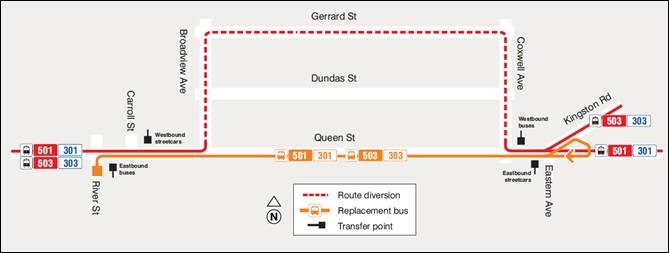
Effective Monday, June 23 at 7am until Thursday, June 26 at 7am, all streetcar service on Queen Street East will divert both ways via Coxwell, Gerrard and Broadview for emergency water main repairs at Vancouver St. just west of Russell Carhouse.
Notice of this change has not yet been posted on the TTC’s site.
Source: Councillor Paula Fletcher
Also effective June 23 at 11pm until Tuesday, July 8 at 4am, buses will replace streetcars on the Queen and Long Branch routes west of Humber Loop for track work.
Updated June 24, 2025: The TTC has now standardized the 504 King and 503 Kingston Road diversions so that both routes (and associated night services) operate via Queen and Shaw Streets
The diversions for track reconstruction on King Street will change again on Sunday, June 22. The TTC has posted conflicting information both on its website and in its weekly update memo regarding construction and special events. I have asked TTC for clarification and will update this page if and when they reply.
In an email on June 19, the TTC announced:
From 6 a.m. on Sun., June 22, until 4 a.m. on Sat., Jul. 12, the 503/303 Kingston Road streetcars will divert to accommodate streetcar track work on King St. between Shaw St. and Spadina Ave. 503/303 Kingston Road streetcars will run along Queen St. between Shaw St. and Dufferin St. 504D King replacement buses will be extended to run from King St. and Bathurst St. to Dufferin Gate Loop.
Affected routes:
503/303 Kingston Road cars which now operate via Queen, Spadina and King to Dufferin Loop will change to run via Queen Street to Dufferin and then south to Dufferin Loop. This changed on June 24. See below.
504D shuttle buses (Broadview/Bathurst) will be extended west from Bathurst via Queen and Dufferin to Dufferin Loop. In fact the buses ran west via King, not Queen.
Here are the original TTC maps.
Source: TTC 503 and 504D Diversion Notices (No longer online)
It appears that whoever designed this change notice is unaware that the 503 does not now operate via Queen and Shaw, but in fact runs on King from Spadina westward.
Updated Monday, June 23 at 10:45pm: The erroneous map of the 504D diversion has been replaced on the TTC’s site. Here is the corrected map.
Updated Tuesday, June 24 at 5:00pm: The diversion of 503/303 and 504/304 services has now been standardized via Queen and Shaw Streets, and the notice/map also include the 504D bus extension west from King and Bathurst to Dufferin Loop.
511 Bathurst cars resume service to Exhibition Loop and will not operate east on King from Bathurst to Charlotte Loop at Spadina.
508 Lake Shore service is discontinued for the summer.
There is no reference to the existing 504 streetcar route which operates via Queen and Shaw to King, nor is there any explanation of why the 503 and 504D services cannot use the same route. (Corrected effective June 24.)
Here is the construction plan included in the June 22, 2025 service change memo clearly showing where the 503 car runs today, but this will not, in fact, be how the routes operate starting June 22.
Taking the TTC notices at face value, this means that service on parts of King will be affected in different ways:
From Spadina to Bathurst, only the 504C/D shuttle buses will operate and will, presumably, dodge around construction as they have been doing in recent weeks during track margin repairs along King Street.
From Bathurst to Shaw, there will be no transit service. This affects stops at Tecumseth, Niagara and Strachan. Updated: The 504D buses are supposed to run west on King from Bathurst to Dufferin, but few of them actually get beyond Bathurst.
From Shaw to Dufferin depends on the continued operation of 504 King cars. As of June 24, 503 Kingston Road cars were also running via Queen, Shaw and King.
This is a repetition of the classic TTC communications cock-ups of past years where diversions are poorly or inaccurately explained. They are supposed to be “doing diversions differently” this year, but this is not a sterling example.
Updated 4:50 pm June 20: There are separate pages on the TTC website describing the 503/504 diversions which make no mention at all of the change effective June 22. They refer to the summer suspension of the 508 Lake Shore, but assure riders there are no other changes:
Starting Monday, June 23, 508 Lake Shore streetcar service will be suspended until early September for seasonal service adjustments. There will be no changes to 503/303 Kingston Rd, 504/304 King streetcars or to 504/304 King replacement bus routing. [Source: TTC Streetcar service changes.]
As of Tuesday, June 24, the separate streetcar diversion pages for the King and Kingston Road services still make no mention of the changes west of Bathurst Street.
In a recent article, I detailed the headway reliability of night buses on several routes. In a comment, a reader asked if I could relate that data to “on time” performance.
There are a few problems with that concept, not least that the TTC’s own standard is so lax. The charts presented here are an attempt to show the degree to which departure times on two routes are scattered (307 Bathurst) or more closely bunched in a more-or-less reliable group (335 Jane).
Depending on reader feedback, I will include these charts, or possibly a modified version of them, in future articles about night services.
Updated June 20, 2025: The charts for 307 Bathurst Night Bus have been modified to show the advertised times of buses to show the degree to which service is “on time” or not.
A separate set of charts has been added to show the evolution of departure times northbound over the route from Front to Steeles.





 Steve Munro