
Toronto’s election is out of the way, and we have both a progressive Mayor returned to office and a strengthened Council to support her. Now comes the hard part: making the city work and work better.
There are many key files both in sheer budget size and in their importance to the city’s future, and transit is one of the largest. The TTC’s operating budget is over $3-billion, and barely 40% of that comes from the farebox and ancillary revenue such as advertising. The rest comes through the City of Toronto either directly as subsidy or as a passthrough from other governments.
Not to be ignored is the capital budget that pays for major repairs, replacement and growth, except for projects like the Ontario Line that are provided by the Province through Metrolinx. Depending on the period one looks at, the total capital needs are in the tens of billions spread over 15 years or more, and this does not include the major Provincial rapid transit projects.
Toronto professes to want more transit ridership to stem the growth of auto travel, but goals set only a few years ago are nowhere near being achieved. “More of the same” is not a viable plan for the new Council term, let alone for the longer run into the next decade.
The post-pandemic era, fortunately, has not been an anti-transit nightmare, the sort of thing that could arise with a “business oriented” government looking to trim costs. However, support for real improvements has been lukewarm and shows little sign of increasing beyond basic inflationary growth.
The focus by Council and the Mayor (including the pre-Chow era) has been on fares, the transit equivalent of taxes, with freezes for many years and a revised tariff that rewards riders for increased transit travel. This will continue into 2027 with a planned reduction in the monthly fare cap from 47 to 40, and introduction of a weekly 10-fare cap, both likely in the Fall.
A long-standing bugbear for regional travelers was the lack of fare integration between the TTC and systems in the 905, not to mention GO Transit. This is no longer an issue thanks to the Province, but only if they continue their support.
For many years I supported fixed pricing for fares, an equivalent to passes but without the need to pre-pay in anticipation of future use. Even the TTC talked about fare capping a decade ago, but nothing came of this.
Under Mayor Chow’s plan, Toronto will no longer have monthly pricing that exceeds the basic 20-day commute pattern, and the up-front cost of a pass will not be a deterrent to those on tight budgets. However, these proposals pretty much exhaust options for fare structure. I will not go into “free transit” beyond saying that it would require at least $1-billion in new revenue annually, and would do nothing to improve service levels. Moreover, government funders are unlikely to shower Toronto with money just so that the City can give away transit for nothing.
Rider surveys, including those conducted by the TTC, show that the top priority is for reliable, uncrowded service. However, the lack of ridership growth implies that transit service does not address rider needs.
A common observation is that post-pandemic travel patterns have changed, that the reduction in foreign students has hit that segment of transit demand, that work-from-home is a new reality. These are all valid, but oddly enough roads are not empty of traffic. People are still moving around the city. The challenge is to get more of them onto the TTC.
Traffic woes suggest that there is a desire to travel, but limited growth tells us that the TTC is not “the better way” for many Torontonians. What is needed to fix this?
The TTC has many overlapping plans, and a thorough review of them is needed to set a roadmap for coming years. There are two immediate, obvious problems.
First, there are too many plans, and I doubt many if any on the TTC Board know what they contain or even that they all exist.
Second, there is a tendency for plans to come for approval as faits accomplis without necessarily getting a robust review or understanding by the very board who will authorize them.
A common problem throughout the plans is that they are not aspirational, that is to say, they do not reach for the stars, not even the moon. TTC has been through a long period of just keeping the wheels turning, and politicians do not want to see plans that involve big spending, unless they are for rapid transit projects someone else will pay for. The plans reflect the era in which they were written.
However, the last thing Toronto needs is a multi-year effort to completely rewrite these plans. At best, that would bear fruit half-way or more through the four-year term, barely in time to affect budgets and actual operations on a timescale riders can see. Key goals and options should be developed quickly enough to inform the 2028 budget. (Such a review was originally intended as part of of the Board’s Strategic Planning Committee aiming at 2027, but that never happened.) The plans should be reviewed and updated based on current priorities from the Mayor and Council, preferably well in time for the 2028 budget cycle which begins in summer 2027.
Plans for greater transit priority must not be just a few red-painted lanes and traffic signals, but a city-wide approach that affects all transit routes. Equally there must be a recognition that priority alone will not fix problems with irregular, undependable service and crowding. Strong advocacy for transit’s primacy on the road network must be matched by service deserving of a reallocation of road capacity.
If ridership really is to grow, added capacity in the short term can come from improved reliability and from surplus vehicles the TTC already owns. For the medium to long term, fleet expansions on both the bus and subway networks are needed, and yet the funding even to replace existing vehicles is not fully in place. (The streetcar fleet has already been expanded, but some hoped-for service improvements and network growth have not materialized.)
The basic question must be asked: why aren’t riders using the TTC as much as we hope? Transit’s job for decades was seen as getting commuters to and from downtown, and much subway construction aimed to increase transit’s reach and capacity. Similarly GO Transit was created as an alternative to highway expansion. But “downtown” isn’t the only place people travel, and many trips begin and end elsewhere. The bus network whose initial purpose in the 60s and 70s was to expand the subway’s reach into new suburbs now has the task of serving travel within those suburbs and beyond.
An ambitious plan such as the TransformTO scheme for massively increased bus and streetcar service might be unaffordable in the short term, but we need to know whether it is at least practical, what it would entail, and how much investment – capital and operating – would be needed. A more modest goal might be the outcome, but at least we will have tried.
What should our new Council and TTC Board do?
The TTC needs a Board that will ask questions, will really try to understand what is needed to build ridership.
Irregular service brings calls for more route supervision, but sheer quantity is meaningless without an underlying philosophy of what “good” service should look and feel like. Meanwhile, service growth is limited by the number of operators and fleet/facility plans created in an era when aggressive growth was not City policy.
Safety concerns bring promises of more security and social support staff. These must be a visible presence, but without spending every penny just to “show the flag” on every transit vehicle and in every station. Indeed, if that level of pervasive security is really needed, Toronto has much bigger problems than getting more riders on the system.
There is a strong temptation to do everything at once: better service, affordable rides, full funding for system renewal. All of these deserve focus, but with the caveat that the overall aim should be to increase transit use. That means change on a timeframe riders can actually see and feel, and a network that takes people where they want to go, when they want to travel, reliably, comfortably and without delay.
The TTC Has Many Plans
The TTC and City have several overlapping plans and policies that, in theory, should provide a blueprint for growth.
- 5-Year Service and Customer Experience Action Plan
- TTC Corporate Plan 2024-2028
- 2027 Annual Network Plan
- Service Standards Review
- Capital Budget and Plan (part of the annual budget)
- The TransformTO plan with a goal of greening many aspects of Toronto including transit
There is also a Fare Policy, an Accessibility Plan, and others. A major problem with all of these is that they tend to show up in isolation at Board meetings, and are rubber stamped without substantial debate. This is the sort of thing that should occur at a committee level such as Strategic Planning, but it doesn’t.
The 5-year plan covers the period 2024-28, and so we are just past the half-way mark of that plan and the companion Corporate Plan.
The 2027 annual network plan deals with proposed route changes, a review of the express bus network and construction projects that will primarily affect the streetcar system. The first round of consultation on this plan occurred a few months ago, and the second round is about to begin. I wrote about the initial proposals in Service Standards, Plans and Ridership Growth.
Also in progress is a review of the Service Standards, the Board-approved policies guiding staff in allocation of service. These standards drive out budget requirements for service quantity and quality, but the TTC rarely reports in detail on how well they are achieved.
The capital budget and plan lay out proposed funding and projects for the current year, for a 10-year look-ahead and beyond to projects with longer term implementations. Provincial transit projects are not included beyond any knock-on spending they might trigger on the TTC’s account. Discussion of the capital plans rarely gets into much detail because by the time the Board sees them (December-January), any significant decisions have already been made by staff. Changes are constrained to fit within the already-known level of capital funding from various sources.
Without question, the TTC, City and the Province operate in constrained financial times and many “nice to haves” will remain just that. The problems lie both in a failure to identify the absolutely key items, and what might be possible if only we chose to invest more in the transit system. This is particularly a problem with the operating budget that pays for day-to-day service and maintenance, areas where there is little scope for photo ops, and where significant improvement has an ongoing, not a one-time cost.
Progress Compared to the 5-Year Plan
Where can we find and encourage ridership?
The 5-Year Plan had a list of initiatives, but in many cases it was light on both specifics and on a reporting mechanism. Some of these are single projects that have been accomplished (e.g. opening Lines 5 and 6), but many are ongoing without explicit goals and metrics.
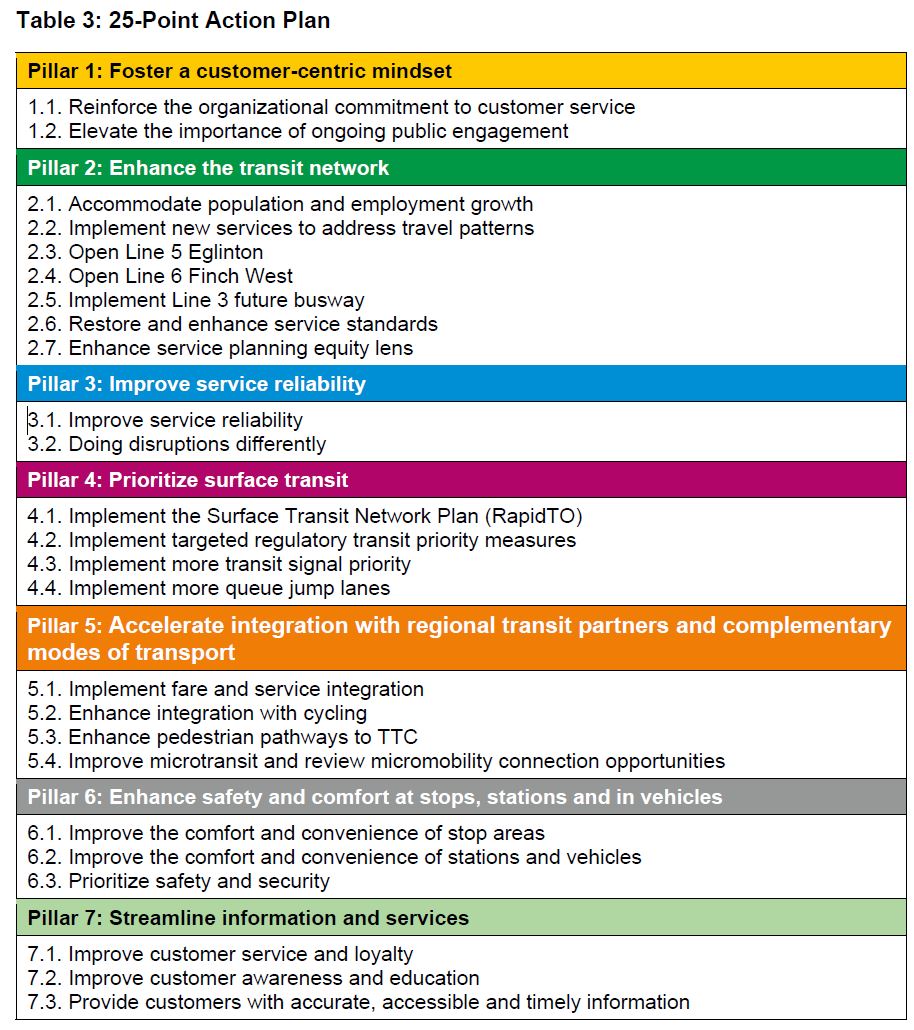
The ridership projections of the 5-year plan assumed continued post-pandemic growth with additional riding from potential changes. The “no investment” option foresaw ridership of about 430 million by 2026. However, the original budget number for this year was 426.4 million, and the projected result (as of the June 2026 financial update) is 408.1 million. That is below what the 5YP projected for 2024, never mind two years later.
There are four options shown here, but it is not clear what each one of them contains.
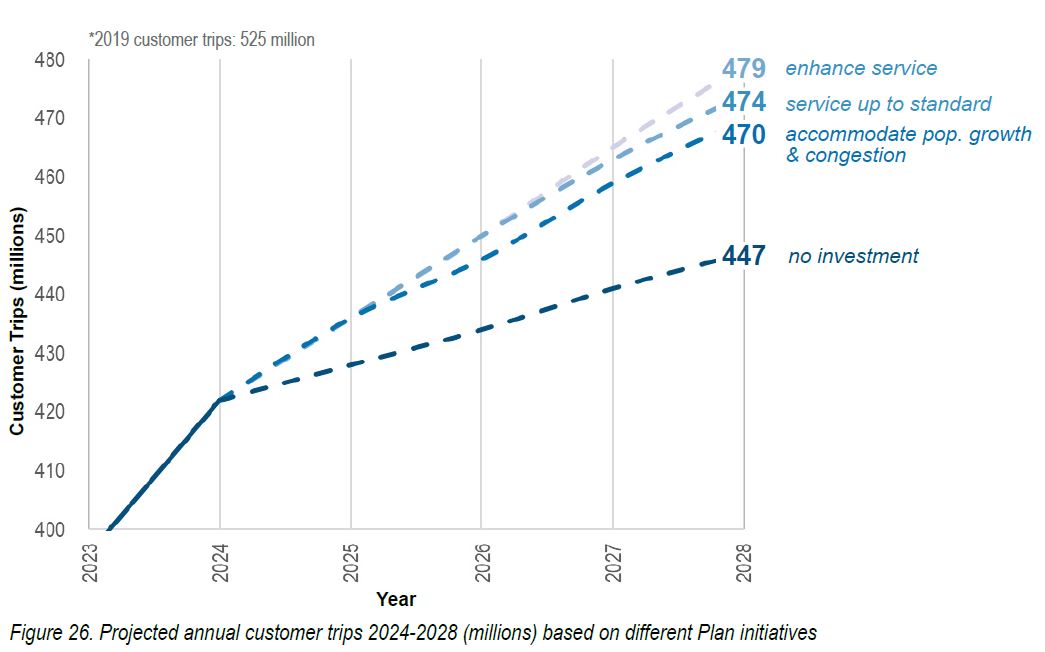
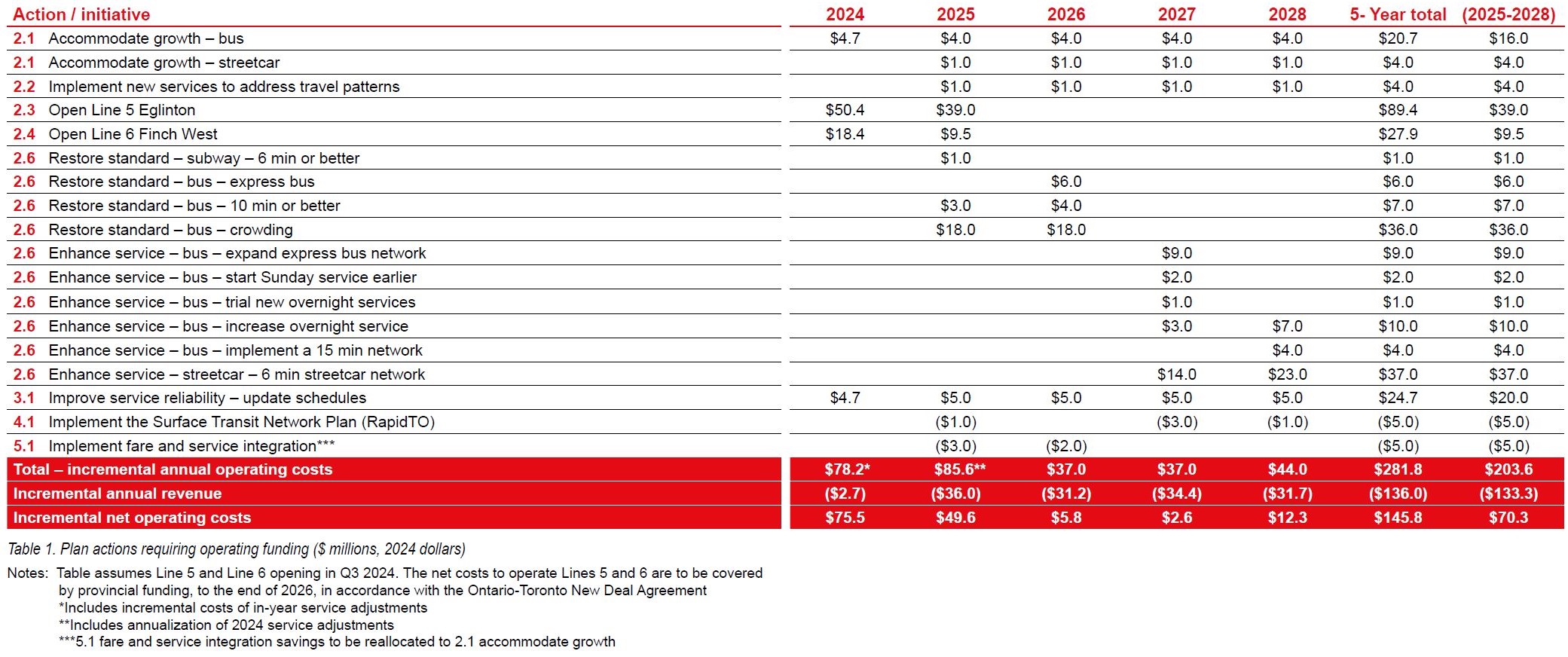
Potential investments in the system are summarized in the table below. The degree to which each of these initiatives actually was funded and occurred has not been reported. Note that as of 2024, fare capping was not part of the TTC’s plan. A few specific notes:
- Provision for growth in bus and streetcar service is modest.
- As of 2024, there was an acknowledgement that better service was needed to meet standards and to address crowding, but we do not know what was actually done.
- The proposed 6-minute streetcar network implementation actually started before 2027 with 512 St. Clair, 511 Bathurst and 505 Dundas. The 510 Spadina and 504 King were already operating at 6 minutes or better. Routes remaining to be upgraded are 501 Queen, 506 Carlton and 503 Kingston Road (although that may be viewed as a branch of the 501 rather than as a separate route).
- A small amount is provided in 2028 for a 15-minute bus network, but this is likely only for a few months’ operation and only on certain routes.
- The allocation to “improve service reliability” is substantial over the period, but there has been no reporting of where this was spent or what was actually accomplished.
The actions noted here also required capital funding, but the degree to which this was obtained and used has not been reported.
The modest growth implied for service translates to a modest need for capital for new buses. With the move to eBuses, that cost has gone up substantially just at a time when major capital subsidies are directed to rapid transit projects. The “greener” members of the TTC Board seemed more intent on having the lowest emission buses possible rather than focusing on the benefits of more service and getting people out of cars.
The level of service anticipated by the 5YP dictates a target fleet size. Here is the projection of what would have been needed, as seen in 2024. By comparison, the actual peak fleet usage in September 2026 is:
- Bus: 1,580
- Streetcar: 158
- Line 1: 64 trains (includes gap trains)
- Line 2: 49 trains (includes gap trains)
- Line 4: 4 trains
- Line 5: 28 trains
- Line 6: 15 trains
Note that only a small amount of growth was planned for 2026-28 on the bus network. There is no distinction between buses added to actually improve service and those used simply to offset congestion effects. Recently (November 2026 schedules) we have seen subway service on Line 1 decline because of the effect of slow orders due to track conditions.

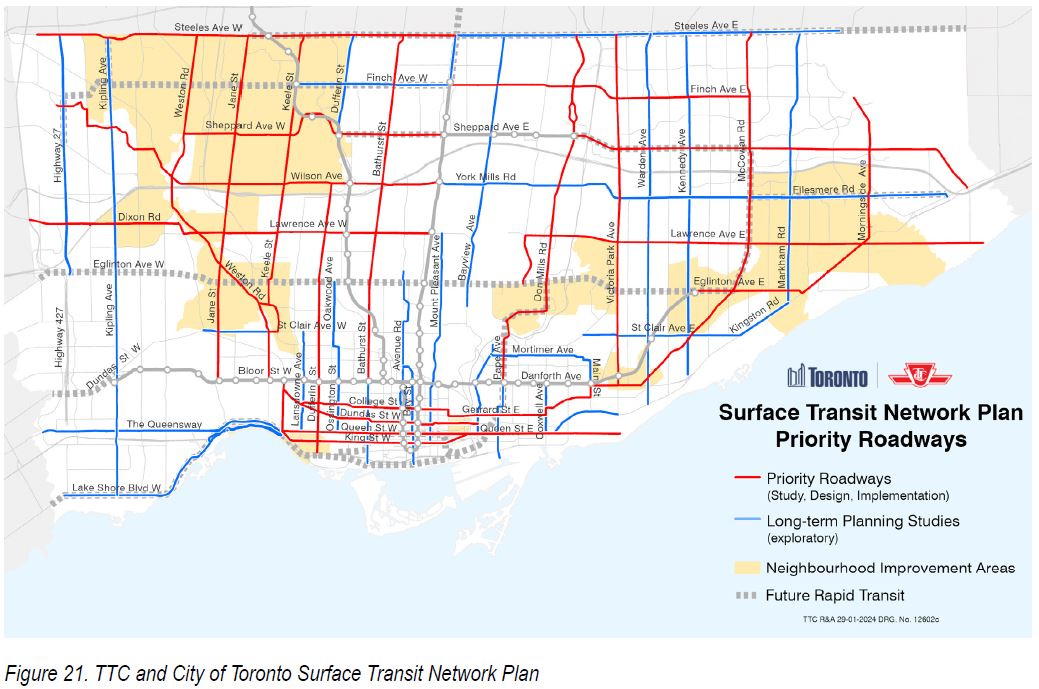
One major initiative not listed here (because it required capital, not operating, funding) is the surface priority roadway scheme. The extent of RapidTO foreseen by the 5YP dwarfs what has been implemented to date or is even in the consultation pipeline.
It is clear that the goals of the 5YP are badly out of sync with reality, and a rework of this plan is needed well before the 2029 renewal.
5-Year Corporate Plan 2024-28
The Corporate Plan covers more territory than the 5YP, but on a general level rather than with specific goals. This document likely does not require major revision beyond its level of ambition for the TTC’s future role and alignment with what is actually implemented.
The overall aims are:
- Build a future-ready workforce
- Attract new riders, retain customer loyalty
- Place transit at the centre of Toronto’s future mobility
- Transform and modernize for a changing environment
- Address the structural fiscal inbalance
There are several points under each major bullet, but less detail than good intentions. Some of the planning aims at future decades rather than 2024-28. This is not to say it should not occur, but it begs the question of just what will happen in the near term.
Staffing is a particular concern both for operations and for maintenance. In late 2026 service changes, the TTC cites a mixture of ridership changes and workforce limitations. It is unclear going into 2027 and beyond what the implications will be for service levels and whether riders will suffer crowding and delays in service improvements as the TTC tries to make do with available staff. That, of course, also relates to budget levels. If the budget does not provide headroom for more staff (or equivalently for more service hours), then there is a hard stop on service improvements. If new budgeted hours are consumed dealing with congestion, riders do not see more frequent service.
On the maintenance side, the ongoing issues with subway track are the most visible sign of a shortfall in capability versus need, but it is not clear how many other areas within the TTC might have problems from short-staffing. The TTC has a problem with the size and availability of work cars, specialized equipment used for subway maintenance projects, as we saw in the aftermath of the hydraulic fluid leaks of recent years.
Those of us with long memories will think back to the 1990s when the recession played havoc with TTC ridership and funding, but management repeatedly assured the Board that they could make do. The Board lived in blissful ignorance until the crash at Russell Hill. We do not need “good news” stories at a time when problems should be acknowledged and fixed.
Service reliability is an ongoing problem, and the TTC’s response has been a pilot project to reduce gapping and bunching. This is limited to certain routes, and problems are compounded by generous “on time” standards, and variations in the degree to which on street route supervisors can adjust service.
The fiscal inbalance has been with us for years, but now threatens to set back Toronto’s ability to maintain and operate its system. Premier Doug Ford has already stated that a “New Deal 2.0” is not be in the cards. The City’s arrangement that provided money to operate Lines 5 and 6 expires in 2027, and there is no indication that Ontario will renew it. Beyond that, calls for any added funding are unlikely to produce much new revenue from that level.
On the capital side, major funding has been announced for some projects such as new subway cars, signalling and LRT lines, but there is a long list of unfunded projects including buses for fleet renewal and growth, and subway trains beyond one-for-one replacement of existing service. Much of this funding will not even come due until the 2030s, but commitments are needed to allow for planning and early works. Beyond that are completely unfunded items such as Platform Screen Doors, a project whose scope and cost are still open to debate.
Megaprojects vs System-Wide Improvement
The ongoing demands for funding, and the political focus of announcements, has been large capital projects: new subway cars, new rapid transit lines, replacement signal systems. But there is so much more, and a lot does not lend itself to photo ops, to a combination of transit support and industrial development for Ontario or Canada’s engineering, construction and transit sectors.
New maps and new lines are the rage in the political and advocate communities, but nothing, none of the lines drawn today, will provide service before 2030 at best, likely much later. Riders cannot use service that is not there. A handful of rapid transit projects serve certain specific demands, great if they lie on your journey, but of no benefit if you’re far away. There will never be a Dufferin subway, and the 29/929 bus service will always be what “transit” means there.
There are two types of “new” travel on the TTC. One is to encourage more trips by existing riders through a combination of fare incentives and good all-day service that does not penalize off-peak travel. The other, moving riders out of autos and onto transit, is harder to achieve.
A Liaison Strategy/Toronto Star poll examined attitudes to and usage of transit, and it has a sobering message for transit advocacy. See Are You Riding the TTC More, But If Not, Why Not?
Where and when are the trips would-be riders are not making, or are not making by transit? Where will the growth in travel occur?
The TransformTO plan hopes to shift many trips away from autos, but something must be there, visibly, to attract new rides. Much attention goes to subway expansion which has a long lead time and huge capital cost. If the trains are not full on day one, we say “don’t worry, it’s an investment in the future” and we even zone land around stations to encourage development and, hence, ridership. Whether the subway actually serves the travel these new building will generate is quite another matter.
Meanwhile, we view surface transit as a cost to be optimized. Can I still see through a passing bus or streetcar? Horrors! What a waste of equipment and staff! There is a limit to how generous service can be, but ongoing complaints about reliability and crowding suggest that the product on offer leaves much to be desired. No wonder everyone wants a subway on their street.
Transit priority has many forms – reserved lanes and signalling the most common – but there are limits on what it can offer. Even in the most pro-transit context, priority changes tend to be one-time improvements, not something that can be repeated each year. Although they can reduce travel times, the main benefit lies in limiting travel time growth and shaving the worst of congestion peaks in day-to-day operations. However, there is a budget trap where priority schemes can be pitched as ways to save buses with better service as a happy side effect. This is not the way priority schemes should be promoted.
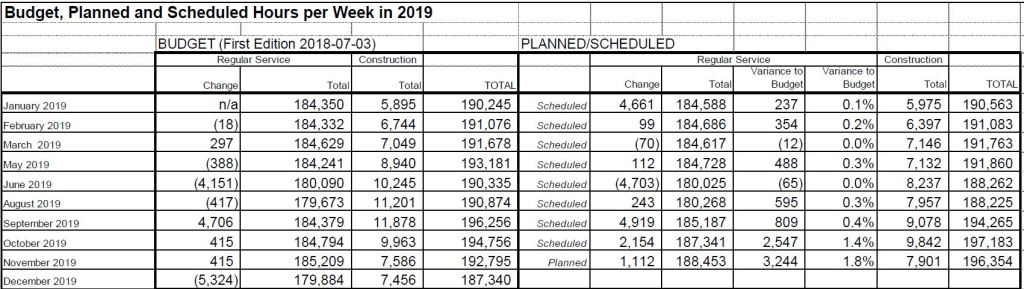
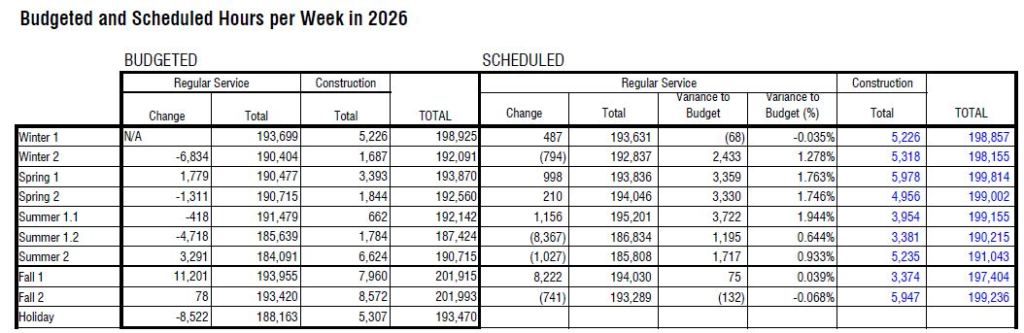
In previous articles, I have compared service levels today with pre-pandemic conditions, a period when crowding was severe and there were calls for much more service. Today, TTC compares service levels to historical values based on vehicle hours. Here are actual figures for 2019 and 2026. (Note that high values in the Summer 2026 periods are due to the World Cup and extra service operated for it.
There is a small increase over this period, but this masks the fact that service frequency is reduced compared to historical levels. Buses are travelling slower and come less often even with comparable vehicle hours.
For a detailed route-by-route review, see Fares, Ridership and Service.
Capacity for Growth
An important concern when making plans for additional service is the lead time for staff, vehicles and maintenance facilities. Management pushback (frankly I would call it foot-dragging) two decades ago produced a catch-22 situation where calls for more service were met with “but we have no buses” or “we have no operators”.
Today, the situation for each mode on the TTC is different, and it is important to recognize what can and cannot be done quickly.
On the subway, Line 1 YUS has a new signal system that should allow more frequent service. However, the Line 1 fleet limits growth. There is provision in the fleet plan for additional growth trains as add-ons to the order for Richmond Hill trains, but there is no funding. There is also no funding for a new maintenance facility at the north end of the extended Line 1. To make matters worse, service on Line 1 was reduced recently in order to stretch running times thanks to long-standing slow orders.
On Line 2 BD, there will be a new signal system, an extension and new trains by the early 2030s. However, as on Line 1 there is no funding for new trains beyond those needed to run the extended line at current headways. Peak service on Line 2 is constrained by the existing fleet and signalling.
Line 4 has a dedicated fleet of 6 four-car trains of which 4 are used at peak. At most, the service could be improved by running 5 trains, although this would leave only one spare for maintenance.
As of September 2026, the TTC listed 2,184 active buses of which 200 are the longer articulated variety. The fleet is about 53% diesel, 31% hybrid and 17% electric. Peak scheduled service was 1,580 buses leaving a whopping 38% of the fleet as spares, almost double the industry level (20%) considered normal.
This provides headroom for service growth if only the service budget were increased to provide it. We do not have to await a procurement cycle nor the construction of a new garage for an expanded fleet, at least in the short term. However, a longer term expansion plan will trigger the need for another garage, and that is already in the works at TTC, if only money can be found to build it.
The streetcar fleet has already been expanded to 264 cars as of early 2026 with the expectation that service improvements and, possibly, expansion (Waterfront East) would use the vehicles. One disincentive to streetcar use today is that with the larger cars, headways were widened typically to 10 minutes, and even that service was not reliable. Recently, routes 505 Dundas, 511 Bathurst and 512 St. Clair received 6 minute daytime service, but 501 Queen and 506 Carlton are still at 10. (504 King and 510 Spadina already have frequent service.)
Peak service, if all lines actually operated with streetcars, would need about 175 cars, with an additional 30 or so to implement 6 minute headways on 501 and 506. This is well within the capacity of the existing 264 car fleet. The only constraint is staffing and budget headroom.
The question for TTC management is just how much service could actually be operated given enough operating funding with the existing fleet. This would allow service improvements in the short term while further expansion could trigger funding needs for fleet and garage expansion.
A related question is the matter of eBuses vs hybrids, their comparative cost, availability and operating constraints. It is not clear how many additional vehicles would be needed simply to convert all existing service to eBuses, let alone expand service.
Finally, we must not forget maintenance capacity. This is affected both by the size and age of various fleets, but also by the need, in the subway’s case, to maintain infrastructure. The never-ending list of slow orders reflects both an increased attention to system inspection and keeping up state-of-good-repair, but also the limits on how much maintenance work can be achieved with the available fleet of work cars and staff levels.
Credible Standards and Reporting
The TTC reports on various aspects of its operation primarily through the CEO’s Report. Stats include current ridership, on time performance, and customer satisfaction scores. The report used to show much more including vehicle and infrastructure reliability, and sources of delay among other information. These vanished with the September 2026 report, and there is no indication when or if they will return.
I recently wrote about the evolution of subway delay counts and times, including the increase in recent years due to equipment and infrastructure problems. See: TTC Rapid Transit Delays 2014-2026. The CEO’s Report is silent on the effect of maintenance, or the lack of it, on service quality. Ironically, the report is filed under the “Transparency” page on the TTC’s site.
The Five Year Plan acknowledged that service back in 2024 was not up to standards, but gave no indication of the routes, locations or times. The TTC does not publish regular stats on service quality and crowding, and even when they do, these are given as averages over many hours or days making severe problems vanish in the mush of averaging.
A basic issue for the CEO’s Report is that “crowding” is not defined. This is listed in the Service Standards, but with different criteria for peak and off peak service. For the latter, the goal is to have no standees. The TTC shows expected vehicle loadings on their schedule pages and real-time info in their tracking data. However, the boundaries between low-medium-high loads do not correspond to service standards in that “medium” can go above the seated load level. This means that off-peak trips with some standees are not reported as “crowded”.
Service quality has many components: quantity and regularity, reliable speed, capacity, and sufficient staff and maintenance resources to field what is needed. None of this is reported at a route and time-of-day level by the TTC.
If Toronto is going to set forth on substantially improving the TTC, we need to know what the existing conditions are across the system and have this info tracked to show whatever improvement might occur.

