
Among several reports on their recent meeting agenda, the TTC Board considered an update on the various Metrolinx projects that will add to Toronto’s rapid transit system: the Ontario Line, plus extensions to Line 1 (Richmond Hill), 2 (Scarborough) and 5 (Eglinton West). These are all grand projects collectively worth billions, but discussion turned to capacity problems on the existing subway, especially Line 1 Yonge-University-Spadina.
In the Line 1 section of the Major Projects Update for April 30, 2026, TTC staff warn of risks about future capacity constraints:
- The YNSE Project currently includes a new train storage facility, which will provide additional storage and dispatching capacity for up to 15 trains, but no maintenance capacity. Based on a fleet of 84 trains after YNSE opening, the maintenance capacity of Line 1 facilities will be completely consumed and will exceed available capacity.
- Separate long-term travel models from Metrolinx and the City of Toronto agree that prior to 2051, Line 1 service levels, which can be operated with 73 in-service trains will not be sufficient to serve the anticipated demand in the peak hour, while meeting the TTC’s crowding standard. The precise time when additional trains are needed to serve demand on Line 1 is largely affected by how quickly development activity occurs and what the long-term work-from-home pattern will be.
- The City of Toronto’s 2025 Q4 Development Pipeline shows that development activity continues around the Yonge corridor despite the softer market. The Yonge corridor appears to remain the most desirable corridor for development in Toronto. The projected crowding levels on Line 1 based on the TTC/City of Toronto demand forecast with the service that can be provided with confirmed assets shows crowding emerging in the mid-2030s, coinciding with the opening of the YNSE. The opening of the YNSE is projected to increase Line 1 AM peak hour demand by 11% in the City/TTC model. This adds pressure as demand mounts travelling southbound toward Bloor-Yonge Station. Based on the City/TTC analysis, the quality of service is inadequate and will result in severe crowding levels from Lawrence Station to College Station.
- To address overcrowding on Line 1, the TTC has identified a program of investments under the Line 1 Capacity Enhancement Program. To achieve a higher level of service on the extended Line 1, further investment is required and is dependent on the funding and procurement of additional growth trains and a new Train Maintenance and Storage Facility. [p. 17]
The TTC Board has, at long last, recognized that there is a problem, and given the lead times for some remedial actions, the time to deal with this is “now”. We have had quite enough of drawing lines on maps and launching decade-long construction projects, but we have not as a city addressed the limitations of the existing system.
There are Capacity Expansion Programs for both Lines 1 and 2 dating back to the last decade, and status reports appear each quarter in the Major Projects Updates. Those reports typically are received by the Board without debate or comment. For its part, management does not provide an overview presentation and this contributes to the sense that the reports are unimportant.
An important factor with the CEPs is that they are not a single project. Moreover, as noted in the last bullet above, there are additional items in the Capital Plan integral to the CEPs but not included in them. This fragmentation can give the false impression that one can cherry pick which plan components to implement. Recent City lobbying efforts for capital funding have been very project focused (e.g. new subway trains, waterfront transit), but the greater challenge is to see the CEPs as a collection of needs requiring sustained and integrated funding.
A further problem is that the CEPs predate the change in planning permissions thanks to the provincial imposition of “Major Transit Station Areas” (MTSAs) around every GO, subway and LRT station. The effect is to substantially upzone permitted densities for large swaths of Toronto. How much of that density will actually be built remains to be seen given current market conditions, but development proposals continue to land at the City for approval.
The Board passed a motion directing staff to take a more active role in commenting on the effect of new development plans for transit growth and the network’s ability to handle added loads.
1. Direct TTC staff, through the City’s development review process, to identify when a proposed development is located in a corridor or network segment where:
- current or forecast demand indicates insufficient transit capacity based on currently funded plans;
- additional transit infrastructure, station capacity, service, or accessibility-related improvements may be required to support growth at a reasonable level of service;
- required improvements are not yet fully funded; and/or
- the anticipated in-service date of required improvements is not expected to align with projected development occupancy.
2. Request the Chief Executive Officer, TTC, to report back to the Board, through a future Transit Network Expansion Update or other appropriate report, on options for establishing corridor- and station-level service and capacity measures to support long-term planning, including how such measures could be used to inform development review, capital planning, and intergovernmental funding requests.
3. Direct that TTC staff request the Chief Planner and Executive Director, City Planning, when reporting to City Council on zoning by-law amendments, Official Plan amendments, or other planning approvals in identified high-demand transit corridors, to include any TTC comments regarding known funded and unfunded transit capacity requirements, including the expected timing of required infrastructure where available.
4. Direct TTC staff, in consultation with the City of Toronto, to develop strategies for funding transit infrastructure growth requirements that support City approved development, recognizing the TTC also has a priority need to address state-of good repair of existing assets.
There is a complementary motion on City Council’s agenda for July 29.
One potential problem with this approach is the “straw that broke the camel’s back” issue. Any individual project might not overload a portion of the transit system, but the collective effect of many projects could be more severe. The same issue comes up with other municipal services such as water and sewage hookups. It is difficult to prove that any one development will cause chaos, and even harder to stop it in the face of a provincial government bent on untrammeled development.
Despite projected needs for considerably more subway capacity in the coming decade, there is little provision for fleet and service growth on the surface network, nor are there demand projections indicating anything beyond modest growth. There are obvious questions:
- Where will all of the projected new riders come from, and how will this affect surface feeder routes?
- Is surface network growth constrained by the quality and level of service provided?
- What about travel demand that does not lie along the subway corridors?
- How much will development now in the pipeline affect demand on nearby surface routes?
A complete review of the CEPs for both lines, and for the surface network, is essential to inform Council and the TTC Board of the breadth of requirements for system expansion, capital and operating funding needs over coming years. It is ironic that while the capital plans foresee billions in new subway spending, schemes for Ridership Growth focus on small-scale changes and limited additional demand.
This is not just a contradiction in scope and ambition among TTC management, but speaks to City Council’s two-faced attitude to transit improvements. Big construction projects, new rapid transit a decade away, these are noble goals. Better service today is beyond affordability.
The remainder of this article reviews the Capacity Expansion Programs and related projects.
Line 1 Capacity Expansion Program
According to the Major Projects Update [p. 22], the Line 1 CEP contains the following items:
- Station modifications to improve station capacities and increase service at St Andrew, St George, and King stations.
- Tactics implementation [wayfinding signage and tiles on platforms] to improve passenger flow at 12 stations, including three pilot stations: St Andrew, St George, and TMU (formerly Dundas).
- Electrical Traction Power Upgrades
- Additional Fire Ventilation requirements to achieve target headways
- Guideway Enhancement
- A new Train Maintenance and Storage Facility with:
- Storage for 34 trains, including a test track, and access track to the site.
- Carhouse with seven bays for preventative and corrective maintenance.
- Operations and Infrastructure (O&I) facility to support maintenance activities (a small shop building, outdoor/indoor storage tracks for work cars, material storage, and a staging area).
- Ancillary facilities (Traction Power Substation (TPSS) and Hostler platform).
The CEP only addresses capacity issues at three stations, and yet there are problems at College with inadequate capacity to clear the platform between trains (typically AM peak), and to hold waiting passengers due to full trains (PM peak). There should be a review of station capacity generally in the context of more frequent service and passenger flows. Running more trains is only part of a solution to growing demand.
Traction power upgrades are needed to handle more frequent service and the presence of more trains in each power section of the route at a time. This affects substations, feeder cabling and third rail infrastructure. The CEP does not include an estimate of the scale or timeline for this work, but it is a basic constraint on the number of trains that can be operated. (By analogy, the TTC discovered during recent World Cup service that the electrical system serving Bathurst/Harbourfront service to the games could not handle the volume of streetcar service they attempted to operate.)
Many of the traction power issues listed in the report appear to address state of good repair (e.g. replacement of old existing cables), not a full route-review of power available for expanded service.
If the passenger load on a station rises and the station is expanded, an integral part of the work is improved ventilation to meet modern fire code.
The proposed “guideway enhancements” are not detailed.
The estimated cost of the Line 1 CEP is $6.8-billion of which only $1.1-billion is funded.
Not included in the CEP are:
- Additional equipment for Line 1 to bring the fleet up to 122 trains to operate a 100 second headway (1’40”) as compared to the current 2’30” and service currently possible of 2’20”.
- The Yonge North extension plans currently include a yard for 15 trains, but no maintenance facility. The CEP contemplates a much larger capacity and function for a new yard.
- Additional trains for the North Yonge extension are in Metrolinx’ project budget, but no trains for more frequent service.
- An updated estimate of the infrastructure changes needed to support a 100 second headway and predicted passenger volumes.
- Provision for Platform Edge Doors including physical station changes, power supply, signal system interfacing and ventilation (depending on the chosen design).
- Operating cost estimates for Line 1 running at a substantially increased capacity.
- The project to expand Bloor-Yonge Station is separate from the CEP and has its own funded budget line ($1.5-billion).
- Accessibility projects have their own budget line, but there is no provision for added facilities beyond the projects now in progress to achieve basic accessibility for all stations.
An important issue for a new yard is that it is impractical to dispatch all of the service from the west side of the line at Wilson Yard because it will take too long to load or shut down service from the extended line. A separate yard on the east leg of Line 1 would allow service to be loaded or removed from both sides at once shortening the time needed for the transition. It would also provide some redundancy in case access to part of the line is blocked.
(Note that Davisville Yard is small, and is now used to hold work trains and the Line 4 Sheppard fleet.)
Current predictions place the need for 100-second service in the mid-2030s which is not very far in the future considering lead times for many of these items. There is no comment on what would be done to handle growth beyond that point.
Line 2 Capacity Expansion Program
According to the Major Projects Update [p. 19], the Line 2 CEP contains the following items:
- Station capacity upgrades
- Traction power upgrades
- Guideway enhancements
- Greenwood Yard modifications for new subway trains
The actual component projects are less impressive than the list above might imply. The station capacity upgrades include only the expanded streetcar platform and concourse at Spadina, and modifications to Jane Station for a new fare line and staircase.
Traction power work include some feeder upgrades, one substation upgrade (Lansdowne) and one new substation (Danforth). It is not clear whether this is an exhaustive list of work needed to achieve more frequent service.
Guideway enhancements include only a storage track at Warden that, while it could be used to spot a “gap train”, would not add to peak scheduled service.
Greenwood Yard and shops require extensive modifications to support the new fleet of trains for Line 2. This work includes modifications of the carhouse and overhaul shops, signaling for the yard (ATC conversion) and Oakvale substation.
Not included in the CEP are:
- Any provision for station capacity expansions including ventilation upgrades.
- Platform edge doors and associated station changes.
- The 55 new trains to replace the existing Line 2 fleet are in a separate project with its own budget.
- Additional trains for the Scarborough extension are in Metrolinx’ project budget.
- Trains needed to allow 120 second headways on Line 2 (down from the current minimum of 140 seconds) on the existing and extended Line 2 are not included.
- Maintenance facilities for an expanded fleet. This would likely require construction of the new yard and MSF southwest of Kipling Station on the Obico Yard property already purchased by Toronto for this purpose.
- The Automatic Train Control (ATC) project has its own budget line, and the portion for the extension will be covered by Metrolinx.
- Accessibility projects have their own budget line, but there is no provision for added facilities beyond the projects now in progress to achieve basic accessibility for all stations.
As with Line 1, the projected timeframe for increased demand is moving closer and the 120 second capability is needed for 2037 rather than 2041 as originally thought. This is only a few years after the SSE will open and the ATC project will go live. There is no indication of what might be done for additional capacity beyond that.
The Capital Budget
The 2026 Capital Budget included tables summarizing the scale of funding needed just to address items that are officially part of the budget list. It does not include provision for scope changes between the original project designs and today’s expected demands.
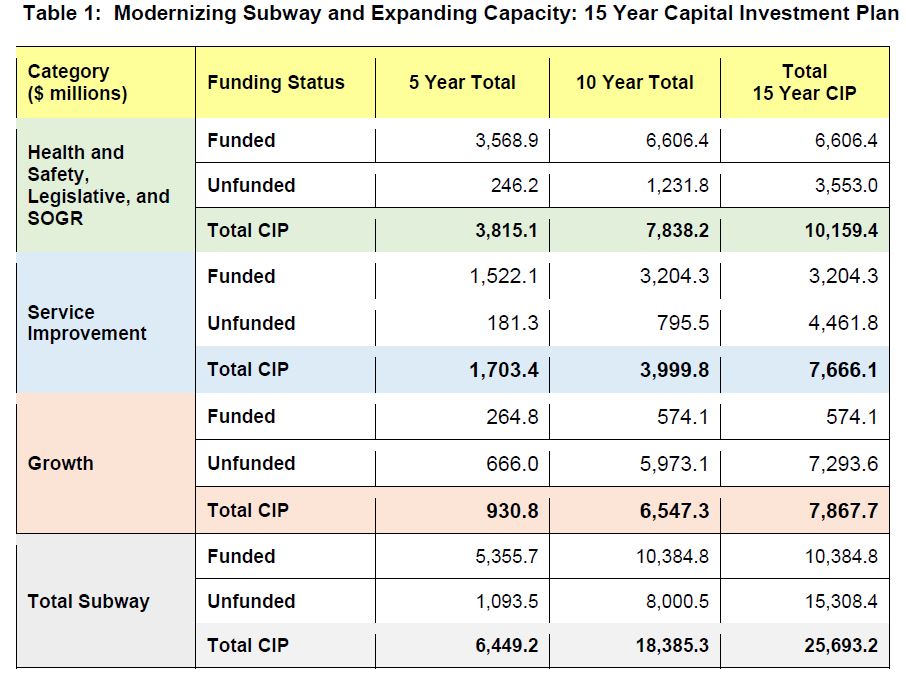
This is only part of the overall budget which also includes sections for buses ($11.4-billion), streetcars ($3.3-billion), facilities maintenance ($4.4-billion), network-wide projects, e.g. IT, ($1.8-billion), and TransformTO ($7.3-billion). For details, see the 2026 Capital Budget.


So, some kudos to Chair Myers and Cnclr Saxe for helping to draw a bit of attention to this mismatch, which may be more of a ‘Dougsaster’, given how we like to have some developmental overload atop a Fail in past decades to build a good relief line, and/or GO in the Richmond Hill corridor, even to Eglinton. Will we be at a point soon where there should be a development freeze due to inadequate transit capacities? And how’s that second exit at Dundas Station going….if we’re talking about unmet infrastructure need?
LikeLike
One wonders if this is angling towards an automate line one style project as seen in Paris.
There are benefits to this type of project as long term operational savings on drivers can be plowed into capital improvements, and these projects generally start out with a headway goal which then dictates which improvements get included in the project.
There are also benefits for shutdowns as it’s a lot easier to explain shutdowns to the public for an automation project. They also take a wholistic system approach as opposed to a project by project approach.
I have already sent emails to the board asking them to prepare for negotiations with the unions, as without contractual agreements negotiated ahead of time an automation project will never get off the ground. There are a few studies on the Paris examples on how to get unions onside ahead of the announcement of such a project.
It also seems that automation projects benefit from weird economies of scale when it comes to the cost of things like platform doors, platform improvements and ventilation. With many automation projects coming out significantly cheaper than these individual projects when done by themselves….
Steve: The TTC is quite firm that they are not pursuing total automation. As to savings, the real question is the tradeoff in staff count between ops, roving security and techies. I know from the transition to one-person crews the saving was not as gigantic as some expected for the basic reason that most of the people who collectively staff the subway don’t drive the trains.
The Ontario Line will be fully automatic and will be in effect the trial implementation of such operation.
LikeLike
Wouldn’t it make sense to extend line 4 From Sheppard West to Sheppard Yonge And all the way towards McCowan as well as expanding Wilson yard?
Steve: There are places equally if not more deserving than Sheppard.
LikeLike
The issue of “more power” should be future proofed. Power for traction, power for increased air circulation/fire ventilation, signals, platform edge doors, etc. should all be done as a combined project.
Probably makes too much (common) sense for TTC/City to implement.
As for a Line 1 east wing MSF, are there specific locations available to choose from? Is there potential in York region? Is a location available on an extension of Line 4 to the east? Can land be sequestered for a MSF? Would a joint Line 1/4 with a co-located Ontario line extension 2nd MSF be a possibility, or too much trouble?
I agree that a link from Line 4 to Wilson MSF is a possibility, but this just compounds the dependency on a single facility, whereas a second site would provide redundancy.
One other point that I am not clear on – how current are the studies these plans are based on. The time to make things right keeps narrowing, but plans based on old, outdated data are prone to create more issues than they solve.
Steve: There is land in York Region the TTC/Metrolinx are eyeing for a new yard, but Metrolinx sees it only as storage, not as a maintenance depot which would add substantially to the cost. Line 2 will eventually get a western yard at Kipling on land the City already owns for this purpose, but I am not holding my breath for it to be built. A Line 4 connection to Wilson presents operational challenges in the limited junction between Lines 1 and 4 at Sheppard-Yonge, plus the basic problem at Wilson of how quickly the entire service for Line 1 can be sent out into service at the start of the day, and pulled back to the yard at night.
The demand studies are from the pre-pandemic era, although they are being updated.
LikeLike
This idea of expanding out to the fringes and outside the city has seemed a bad idea to me for a long time. Steve, please correct any misconceptions I may have, but it seems to me that building out to Vaughan and Richmond Hill just means that trains are likely to fill up long before they reach city limits and the taxpayers who actually foot the bill for the TTC will, at best, get a standing ride all the way downtown, or, at worst, be left on the platform. I used to commute northbound and I’d see how jammed the southbound trains got at Finch with 905ers. My understanding of local transit is that the churn of riders who get on and off along the route helps a route serve more total passengers as they come and go. However, filling trains with long-distance riders in Richmond Hill and Vaughan (and Square One if certain parties have their way) seems that it would disproportionately overwhelm the system with passengers who don’t even pay for the service.
Steve: The pressure for subway extensions comes from two sources. One is the idea that stations breed development. That was a clear goal in the Wynne era with the Vaughan extension, and e’re seeing the same with Ford’s pals in Richmond Hill. The other source is political: at the time the extensions were conceived, GO transit wanted higher fares and integration with the subway system was unheard of. 905-ers saw subway extensions as a way to get TTC-level fares for their commutes, and Toronto is footing most of the operating cost.
LikeLike
From the sounds of it, extending the Ontario Line to Sheppard is about to jump higher on the priority list of line extensions; possibly to #1 of all line extensions not currently underway.
LikeLike
But if the YNSE project is ten years late like every other Metrolinx project, then the TTC will have plenty of time to do any upgrades! There’s still a lot of unknowns too. If the federal government doesn’t restore immigration to previous levels, then the city’s population will likely end up decreasing. High speed rail or punishing US tariffs might shift Canada’s growth away from Toronto and towards other cities. A different provincial government might impose land use restrictions to solve the capacity problem, forcing Richmond Hill to build only job centres and no condos along the extension. And there’s always the malicious compliance route where the TTC can intentionally make the service north of Steeles so bad that York Region residents will prefer to take the Langstaff GO Train.
Steve: The problem is that lead times for decisions affecting future capacity are long, and some choices today will benefit or constrain the system a decade out. We have already seen how penny-pinching by Tory and Leary even before the pandemic led to delays in provisioning new trains and signal systems. Only the ridership loss in the early 2020s, still not recovered to “normal” levels, saved the system from disaster. People forget those pictures of jammed platforms at Bloor-Yonge in 2019.
As for TTC running inadequate service north of Steeles, that would be a quick recipe for a provincial takeover even though it is bad planning at the provincial level that draws lines on maps but does not think about demand, fleet and maintenance facilities.
Metrolinx keeps looking at new lines without the province adequately providing for what’s already built or in the pipeline.
LikeLike