
At the July 22 meeting of the TTC Board, there was a fair amount of discussion about a motion by Commissioner Saxe asking for a study of improving the College streetcar, properly known as 506 Carlton.
The TTC Board:
1. Directed staff, in collaboration with the General Manager, Transportation Services, to report back to this Board in Q1 2027 with recommendations how to improve the speed and reliability of the College streetcar through measures that are within the control of the TTC.
There was a companion motion at the Infrastructure & Environment Committee on July 15 with the intent is that the TTC and City work together on this project.
A few deputants spoke to the issue including a challenger to Saxe’s Council seat in the coming election, and they advanced various possible solutions to streetcar speed problems. There was some debate about whether the motion should only address the portion of the 506 Carlton car within Saxe’s ward, the full line, or the streetcar network overall. A related issue is that the TTC already has a study of streetcar operations in general underway that will report back early in 2027. It is not clear what a 506-specific resolution adds.
This article reviews various proposals to speed up streetcar service in the context of the 506 Carlton route. Although this is usually cast as a “streetcar” issue, that is only because the major downtown routes operate with streetcars. Some of the problems, notably political resistance to giving transit better priority over cars, would apply even if these routes used buses.
Issues covered here include:
- Stop geometry and spacing
- Transit priority signals
- Track switch and control system design
- Operating practices
- Red lanes and rights-of-way
- Service reliability and frequency
- Current and historical route speed
- Why “Carlton” and not “College”?
Stop Geometry
The “typical” streetcar stop is in a street with mixed traffic where riders boarding or alighting must cross at least one, but sometimes two lanes of traffic between the curb and the streetcar. Although motorists are supposed to stop behind the doors, far too many speed by endangering riders. These are the target of automated enforcement cameras that are only now in the testing phase.
Some wider streets have a safety island where riders can wait and make the crossing to/from the curb when there is a break in traffic. Routes with reserved lanes line Spadina or St. Clair have islands built into the right-of-way. The platform height in both cases does not line up with the “low floor” of the new streetcars in part because this would make a high step down to the pavement, and partly because islands date from an era of high-floor cars where the interest was to provide a refuge, not a level boarding path.
In a few locations, notably on Roncesvalles and on the central part of King Street, the curb is built out to the streetcar lane making the road, in effect, one lane at streetcar stops. This is only practical on four-lane streets where the extended curb typically occupies a lane not intended for through traffic. Cyclists are allowed through the some stop areas via ramps, although this creates a conflict with riders.
The Flexity streetcars do not have a “self-leveling” feature that would allow them to adjust to the height of platforms to provide level boarding. The needed adjustment varies depending on actual platform height and the degree of wear on streetcar wheels. The intent of this feature would be the elimination of ramp deployment at stops, although this would only affect stops where platforms are adjacent to the car..
Stop service time can be reduced with direct boarding on streetcars, but this cannot be achieved everywhere.
Stop Spacing
Periodically the TTC argues that stops should be further apart so that streetcars do not have to stop as often. The current Service Standard for local bus and streetcar lines is a 400m maximum distance between stops. TTC has been trimming stops in recent years to eliminate particularly closely-spaced ones, and few of these remain on the streetcar system.
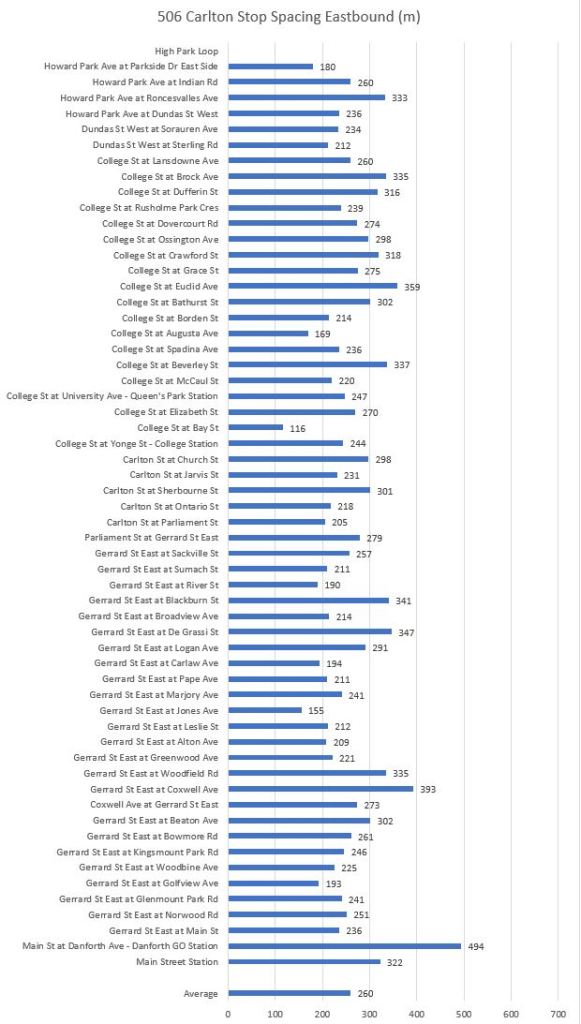
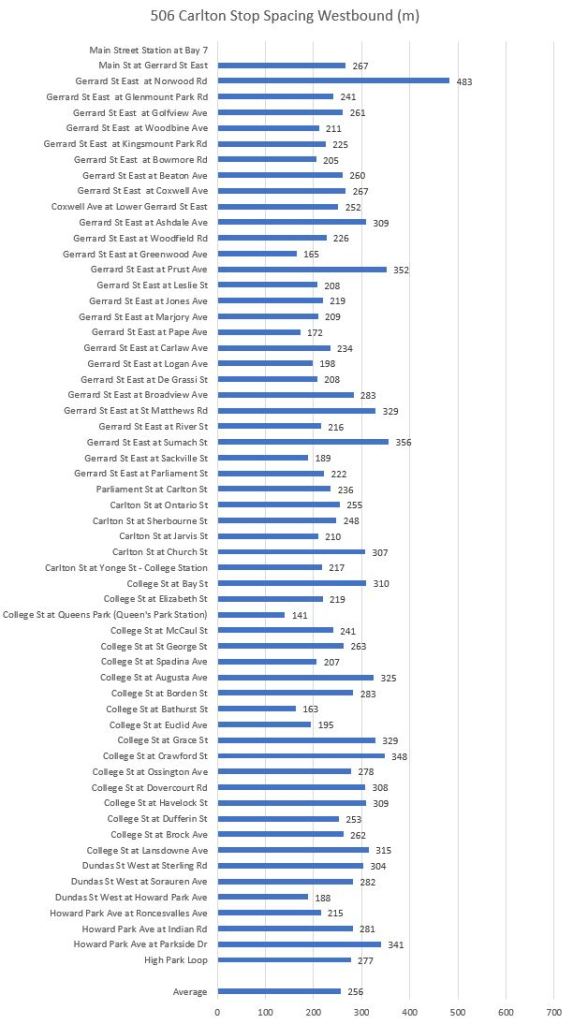
The layout of Toronto streets does not fit into a handy 400m grid, and many stops are closer than this to their neighbours. On 506 Carlton, the average is about 260m. The problem is that removing a single stop will usually create a gap greater than 400m, sometimes much greater. There is also the question of what that stop serves and what the demand level might be.
A related issue for vehicle speed is the frequency of encountering a traffic signal. Several location that formerly had a pedestrian crosswalk have been signalized for safety because of pedestrian volumes. These conversions do not necessarily have transit priority signalling, or if they do it is limited by local street geometry (see below). Streetcars can be forced to stop simply because there is cross-traffic from motorist and pedestrians.
The charts below show the eastbound and westbound stop spacings on 506 Carlton as of June 2026 based on information in the GTFS schedules used by trip planning apps. Few of the stops could be removed without pushing the remaining gaps beyond 400m. If the TTC does believe that fewer stops would make for significantly faster trips, they would have to widen the standard maximum.
Transit Priority Signals
There are two types of priority signals on the streetcar network. One adjusts green times in an attempt to avoid delaying streetcars. Priority is not granted at major intersections where the flow of cross traffic is considered more important, for example where streetcar routes cross University Avenue.
The other type is integrated with electric track switch controllers that call for priority when needed to provide advanced green arrows or “white bar” transit only phases to assist with turns. (See the following section.)
There are a few design issues that bedevil priority signals. First are the detector loops in the pavement that register a streetcar’s presence. These do not always work, as illustrated by a review of the St. Clair route during a recent major shutdown when a large proportion were found to have failed.
Second is the decision on when to activate priority. For intersections with nearside stops, a signal controller has no way to “know” when a streetcar actually needs to cross depending on stop service times. Where there is a signal but no stop, the detection point for an approaching streetcar and the time before it reaches the signal can be shorter than the time needed to pre-empt a cross-street green that is about to begin or is already in progress.
A minimum green time is needed to allow intersections to clear especially for pedestrians who cannot be left stranded just because a transit vehicle is approaching.
With farside stops, there can always be an assumption that a streetcar needs priority across the intersection when it arrives, but the stop location can complicate traffic flows.
Changes to signal timing and priority are site-specific.
Analysis by advocates is complicated by the lack of easily-accessible open data describing the programming of traffic signals.
Track Switch and Control System Design
Until the introduction of the articulated streetcars (ALRVs) in the 1980s, electric track switch controls were provided through contactors on the overhead wire. Through a button on the dashboard (or for hand-controlled cars like Peter Witts, a foot treadle) to a contact on the trolley pole, an operator could indicate that they wanted to turn. The overhead contactor was positioned one car-length back from the switch it controlled so that the route selection occurred just as a car reached the switch. (Additional contactors were used to interlock switches for MU trains on Bloor, and later on Queen.)
With a move to longer cars, this scheme no longer worked, and it was replaced by pavement loop antennae and transmitters under the cars. The front transmitter provided route selection and locking, and the rear transmitter unlocked the switch after a car had passed. This system had problems from the outset thanks to pavement loop failures, unreliable transmission between cars and the loops, and unreliable electronics in the switch controls. This, coupled with a few high-profile accidents, led to the stop-check-go protocol so that operators would verify the position of any facing point switch before they crossed it. A project to update and replace the switch controls is still underway years after the ALRVs were retired.
An important point about either design is that route selection only occurs just before a car reaches a switch, not in advance through co-ordination between vehicle tracking, switching and traffic signals. With nearside stops inevitably just before almost every automated switch, the idea of advance clearance had little application in Toronto, but this also meant that priority signals to aid turns were not called until a car pulled up to and set the switch. Where turns in both directions are possible, each switch is set separately rather than picking a route through multiple switches and receiving an appropriate priority signal.
At some locations (left turns eastbound or westbound at Spadina), the switch and its detection loop lie inside the intersection, and the route cannot be selected until a car has moved forward on a green signal. This makes a priority signal impossible for these left turns.
Many locations with commonly-used turns (e.g. for diversions) do not have priority signals, and this adds to the delays any diversions incur for service.
Locations with manual switches (or where electrical switching is disabled) do not, obviously, have any transit priority.
Operating Practices
Streetcar operations have been hobbled by many practices introduced over the years. Some of these were claimed to be for “safety”, but that word is a convenient way to avoid criticism. As I reported at the end of April, the TTC relaxed several of its rules effective May 24 including:
- Allowing operation up to the posted speed limit at signaled intersections and crosswalks, up from 25 km/h
- Removing the 10 km/hr speed limit at intersections on The Queensway
It is not clear how much benefit the rule changes brought, and streetcars are still slower in 2026 than they were in 2019. (This will be covered in a separate article.)
Speed restrictions in underpasses and at track junctions remain in place. For underpasses, the problem has always been concerns that trolley poles would dewire, although that is no longer an issue with pantographs. Also the clearances vary from one location to another, and one notorious location, Queen & Degrassi, now has higher overhead thanks to reconstruction of the Lake Shore corridor.
Track junctions are more complex because they have both the issue of switch reliability and the general condition of track. Streetcars used to cross reasonably quickly, but now the Flexitys cross slowly until the rearmost truck clears the last piece of special work. This is caution taken to an extreme. In recent memory, there have been locations with badly maintained track where a slow order was justified (although not the maintenance shortfall), but this should not apply across the system. Clearly when a streetcar is taking a curve, it must do so at lower speed than on a straight-through move, but most cars in regular service cross most junctions on the straight and should not be artificially delayed.
The TTC does not post slow orders on every inch of the subway because some tracks need repair or realignment, and the streetcar system should be treated the same way. Indeed a map of locations that truly need slow orders would be a useful check on the quality and promptness of track maintenance.
506 Carlton is an unusual route in that it has many turns thanks to the historical evolution of TTC routes and Toronto streets. A route such as 501 Queen, by contrast, runs straight across the city except for the Ontario Line construction diversion between Church and York. This has relevance on the double-blade switch debate.
Carlton cars take the curving route at several locations, and one might argue for improved track there if only to add insurance against derailment (a rare occurrence). However, they also cross many intersections on the straight, and there is no reason to slow operation especially on track that is in good condition provided that electric switches there are reliable. Double blade switches should not be needed. Again, the issue is to post speed restrictions where they are actually needed, not at every junction for every possible move.
Red Lanes and Rights-of-Way
The TTC has installed “red lanes” on much of the 511 Bathurst route, and three routes (512 St. Clair, 509 Harbourfront and 510 Spadina) operate in lanes completely separate from traffic.
Oddly enough Spadina has some of the slowest speeds on the system in spite of its reserved lanes, and this shows that other factors are at play. St. Clair’s speed has declined considerably since the lanes were introduced, and even since 2019 when new cars were already in operation. Some changes in traffic signal timing were introduced recently, and I will review the effects later this year when more data have accumulated that are not skewed by World Cup traffic conditions.
The red lanes on Bathurst have increased speed somewhat, although the saving in minutes is fairly small because the affected section of the route is short by comparison to a longer route like 506 Carlton. An important general point about red lanes is not that they produce huge changes in average speed, but that they can reduce the variability in travel times. That was the result on King Street when the transit mall was introduced. In turn this improves service reliability and decreases the need for short turns.
Faster operation depends not just on moving faster from one stop to the next, but also on freedom from delays thanks to auto traffic at busy intersections. This requires both turn restrictions where they are practical, and active management by traffic wardens to avoid blockages. There is a limit to what signals and bylaws can achieve especially without enforcement.
Service Reliability and Frequency
The issues of reliability and frequency have often been discussed on this site, probably at a level some readers find tedious. The fundamental issue is that the TTC does not do a good job of managing service, and this has been compounded by wider headways over the years where service gaps have a much greater effect.
When scheduled service was, say, every 3 minutes, a 50% variation in headway was comparatively short. Until recently, most streetcar routes were on 10 minute headways, and a 50% swing can mean a long wait for service. Some routes now operate every 6 minutes, but there is no guarantee that this will be extended to the rest of the network thanks both to budgets and staffing limitations. Routes now on a 10 minute headway include 506 Carlton.
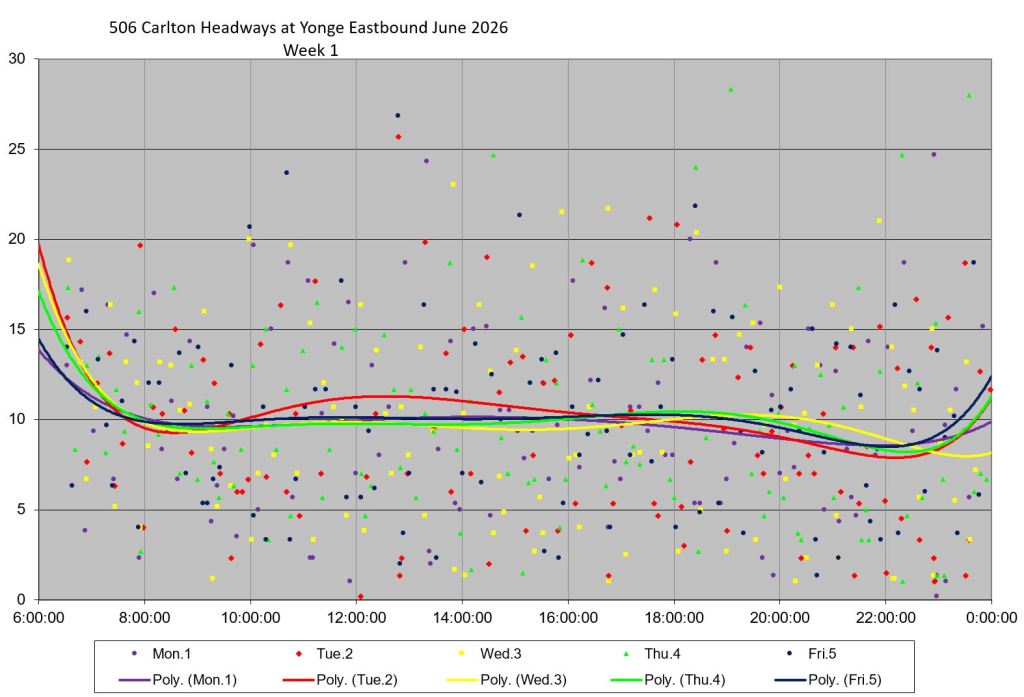
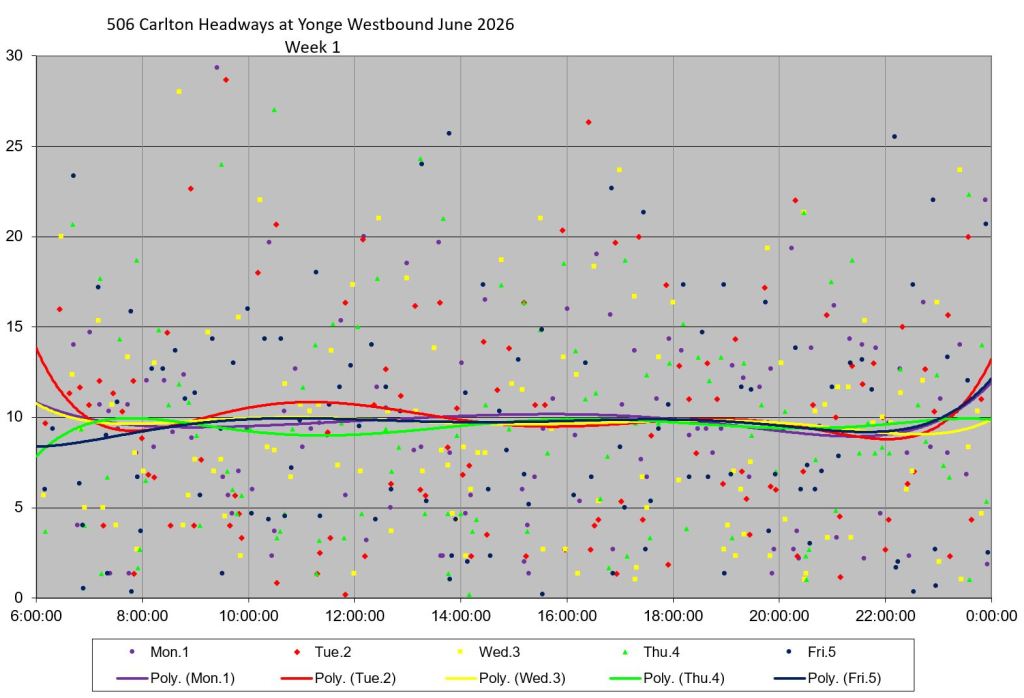
Adding Carlton to the six-minute network would decrease average wait times, and this could be further improved by reliable headways. The charts below show the headways at Yonge Street for the first week of June 2026. It is quite clear that many streetcars lie outside of the 50% range either side of the 10-minute scheduled service. The trend lines stay close to that value indicating that most service did show up, but the actual spacing between cars was widely scattered.
The same data, presented as quartiles, shows that about half of the service lay within a band from 5-15 minutes (the 2nd and 3rd quartiles, green and blue bars), but that the other half lay well outside of that range.
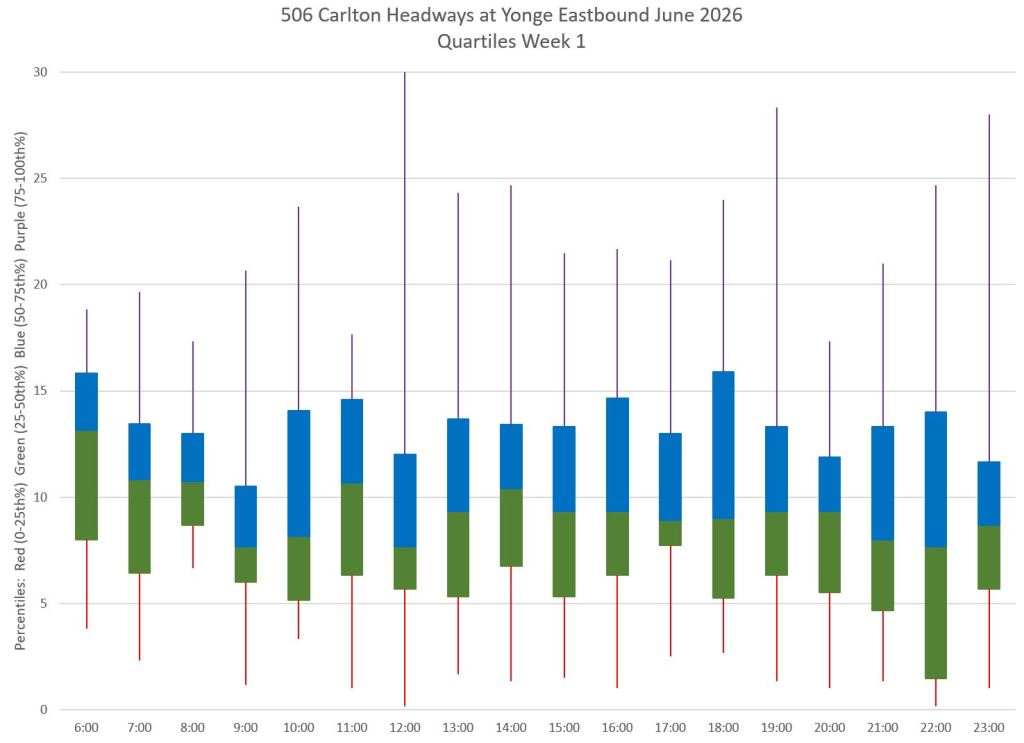
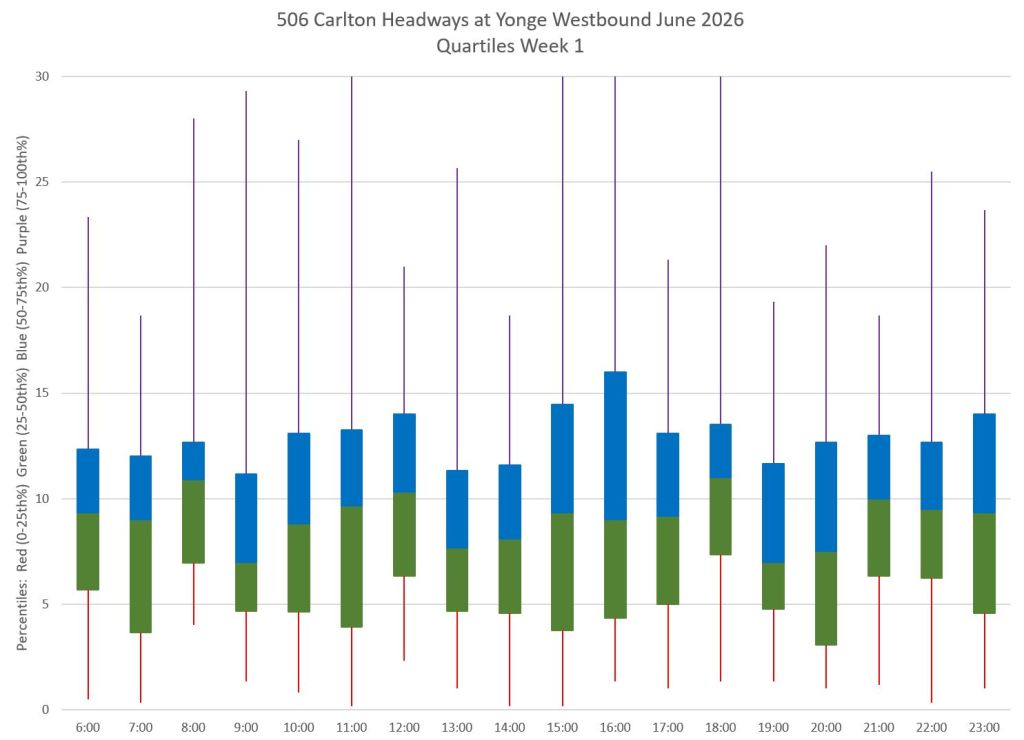
TTC measures service reliability (aka On Time Performance) at terminals. Here are the headway distributions eastbound from High Park Loop and westbound from Main Station Loop. The central quartiles are more compact here than at Yonge Street, but the 1st and 4th quartiles extend well beyond the target for service.
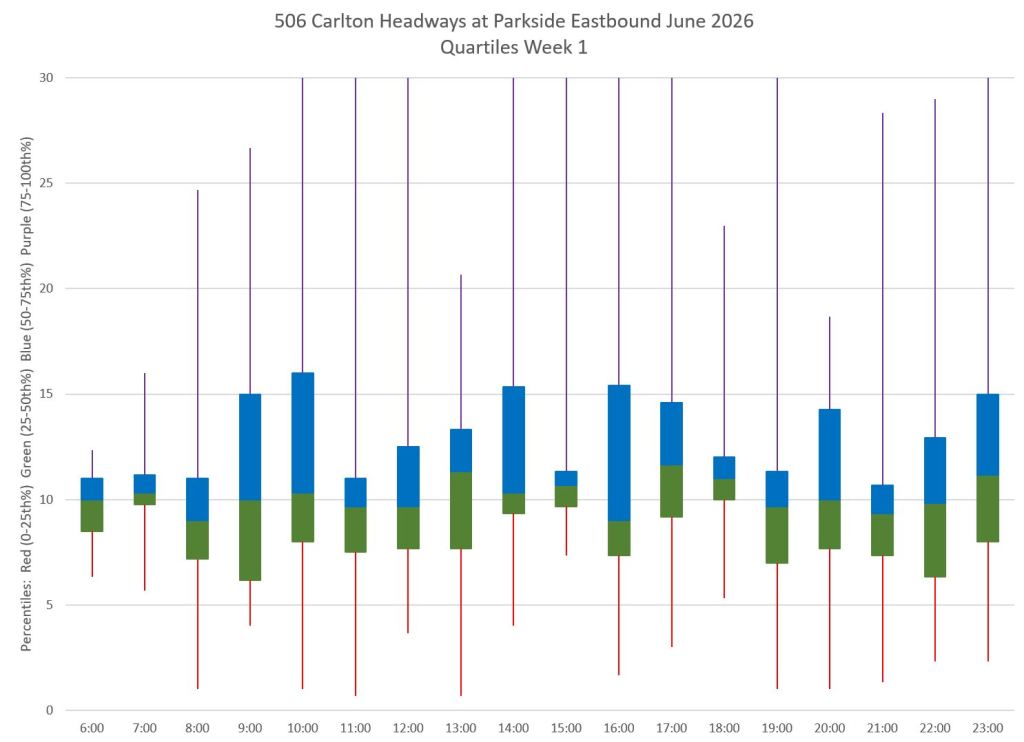
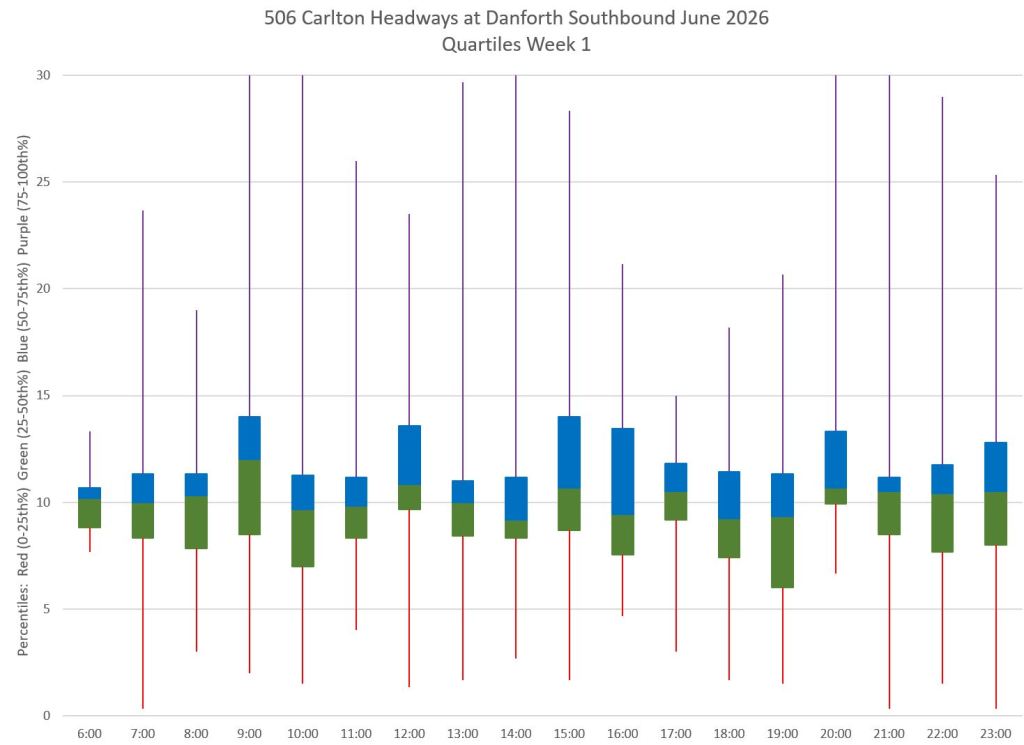
One might argue that some of the service does not reach these terminals thanks to short turns (although the TTC claims these are infrequent). The following charts show headways eastbound from Lansdowne & College, and westbound from Coxwell & Gerrard, locations of commonly used short turns. The 4th quartiles (purple, at the top) are not as extreme as at the terminals, but there are still many wide gaps and much bunching (1st quartile, red, at the bottom).
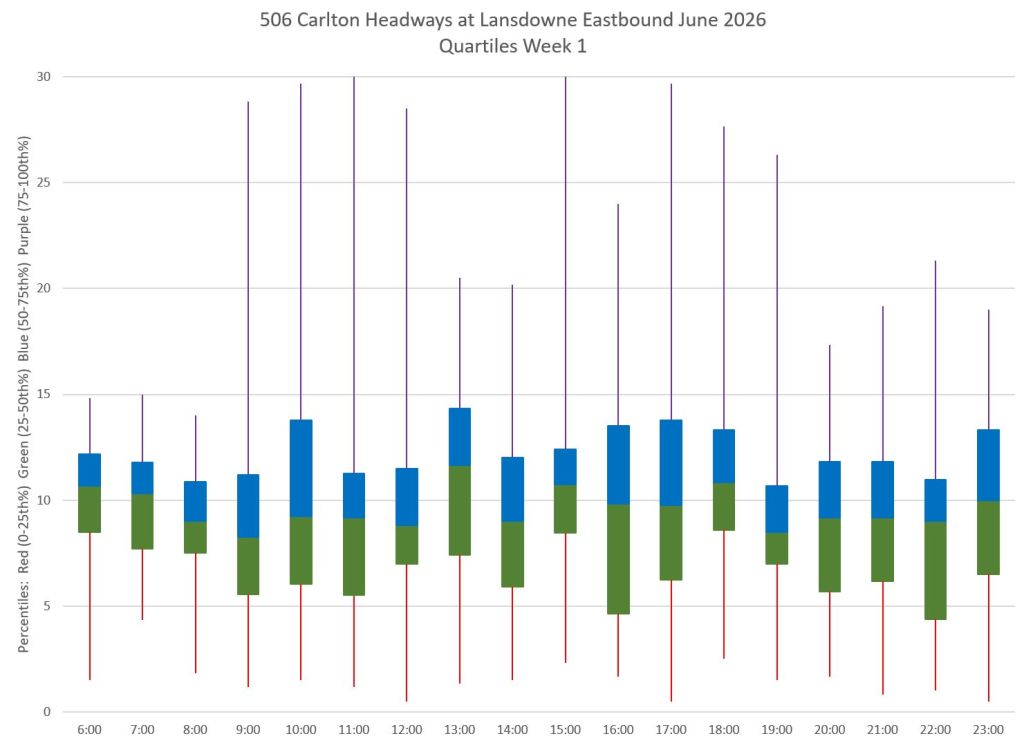
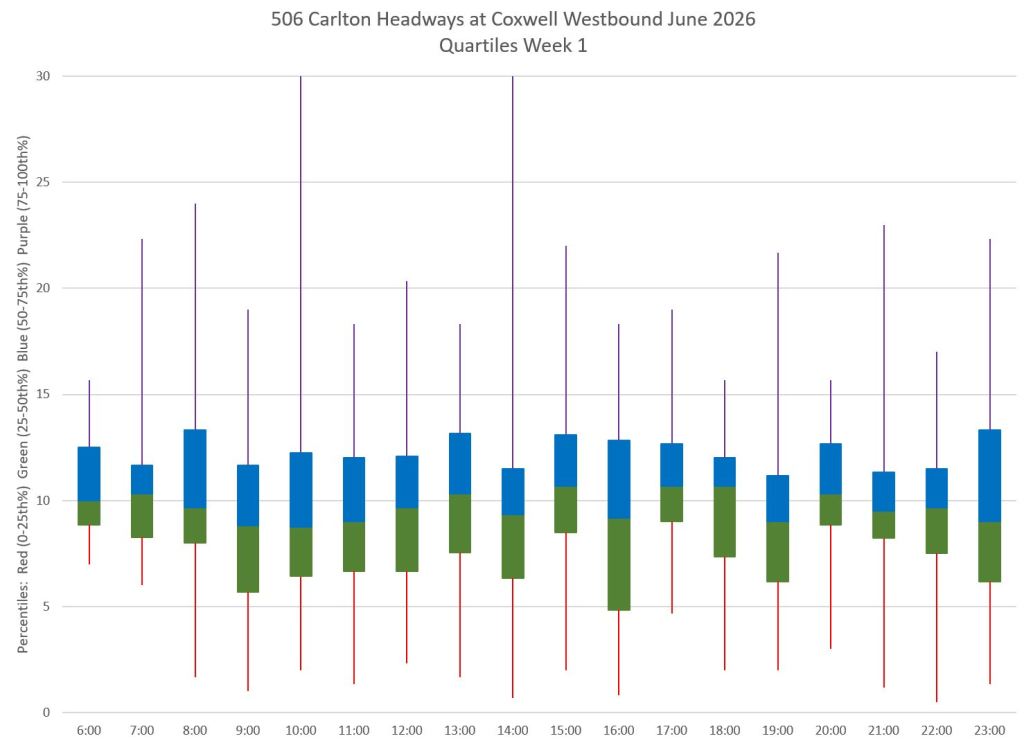
We can spend days arguing about the benefits of new switching, signal priority, even removal of many stops, but the basic problem is that the service does not leave the terminals reliably, and headways become even more scattered as cars make their way across the city.
Route Speed — Current and Historical
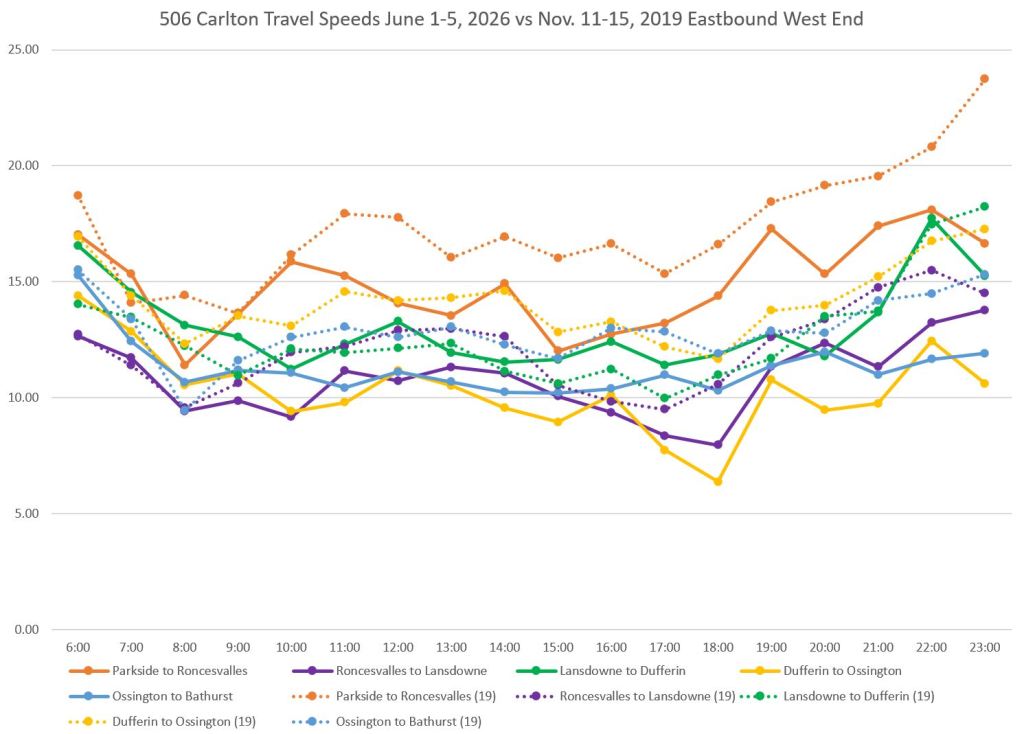
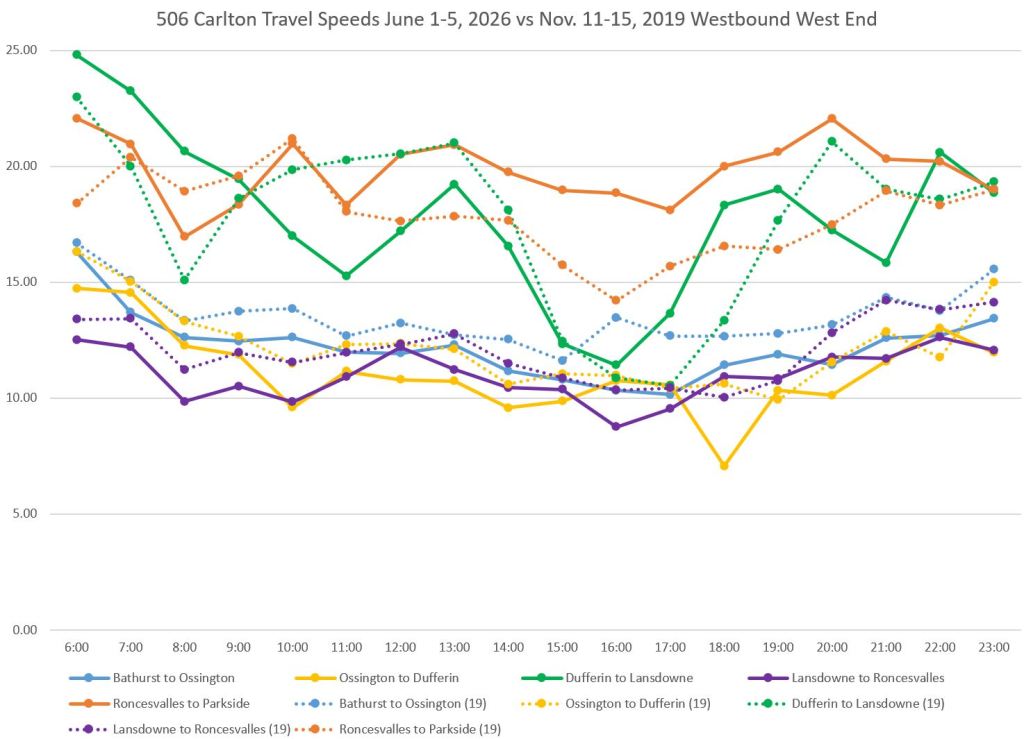
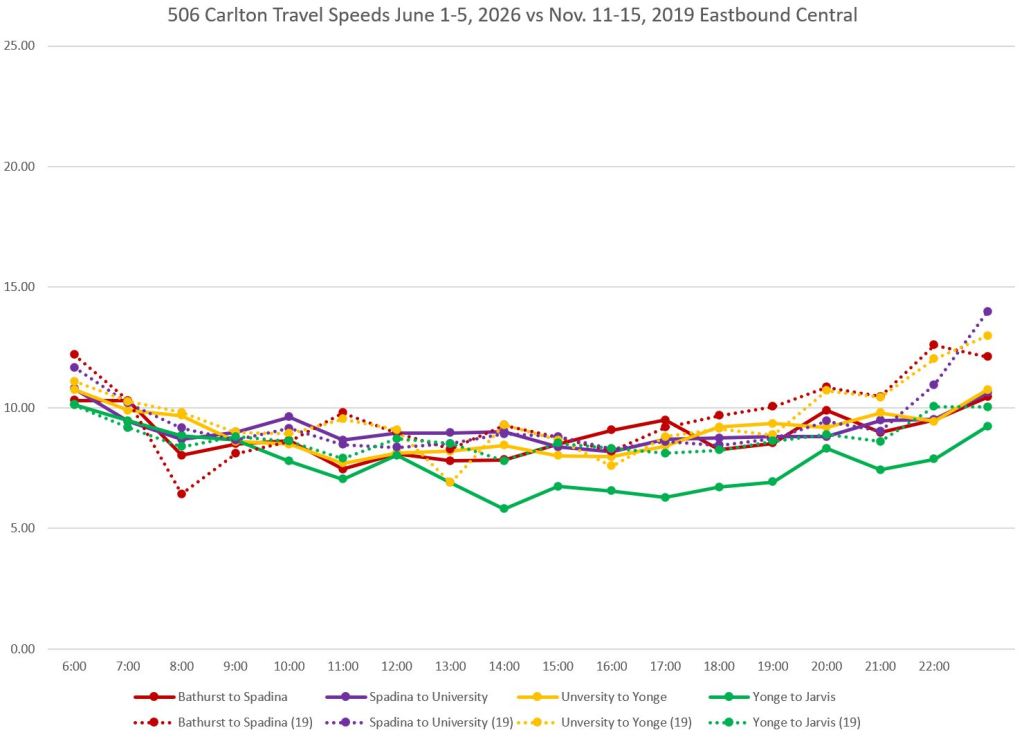
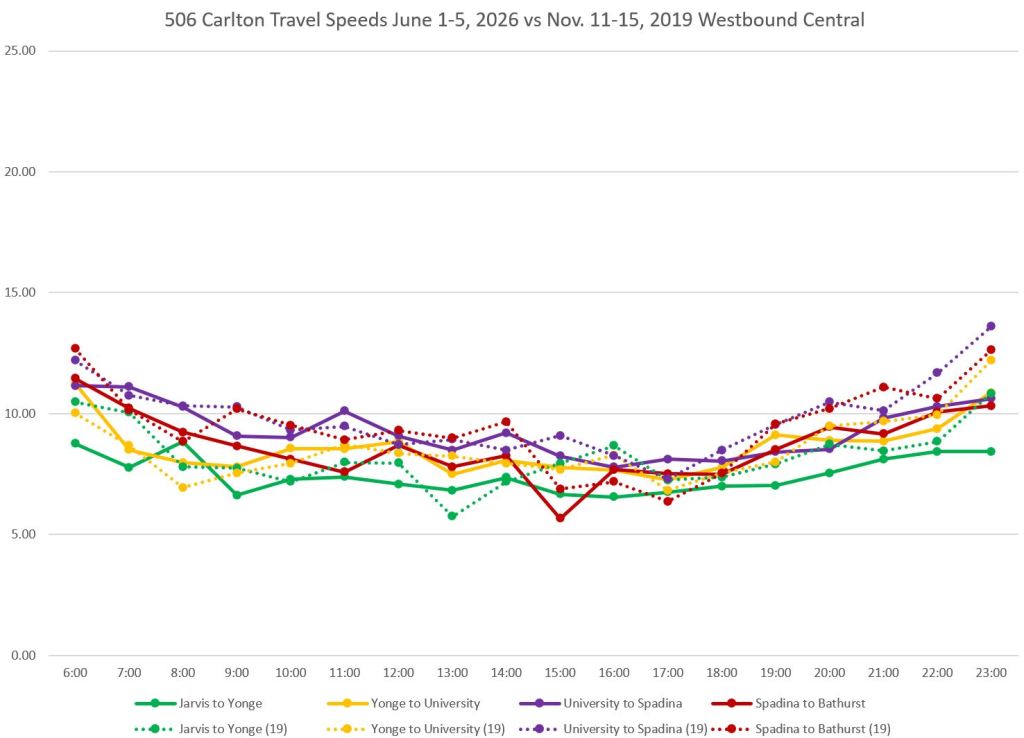
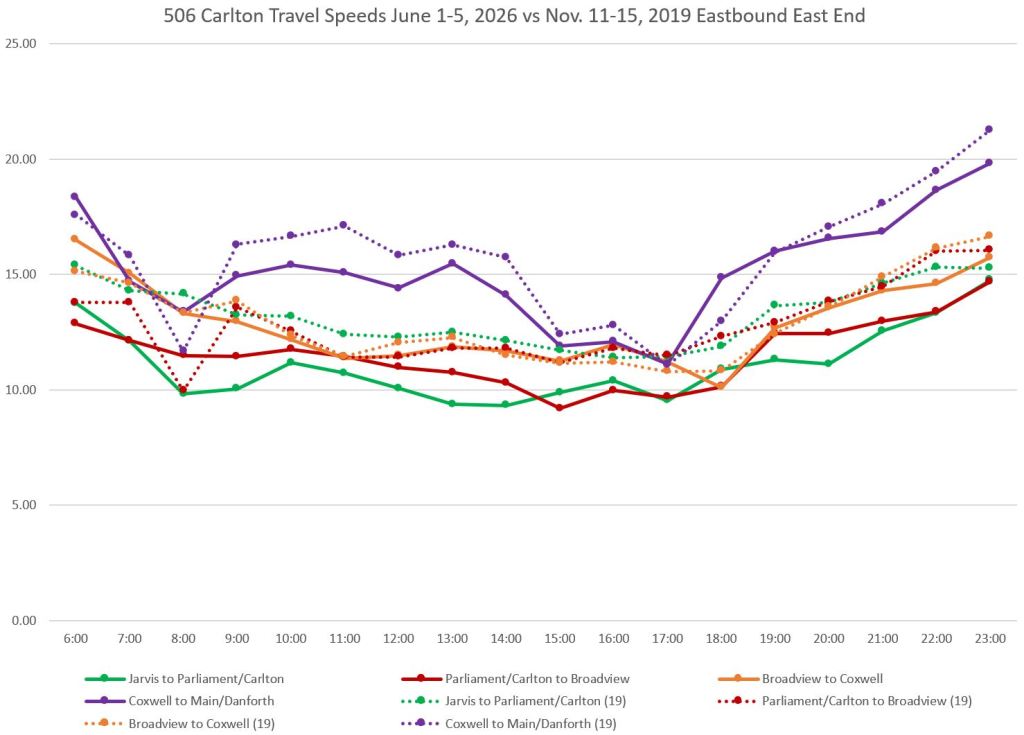
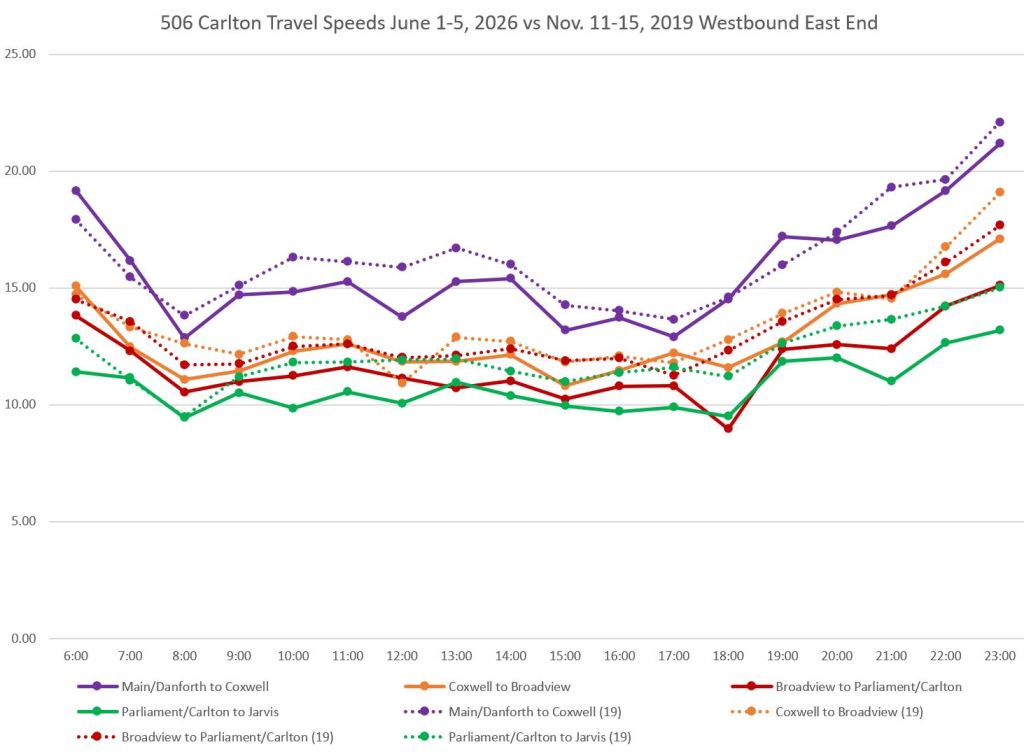
The charts below compare the average speed of streetcars across the 506 Carlton route by hour for weekdays at the start of June 2026 and in the second week of November 2019. The 2026 date was chosen because it was clear of construction disruptions but before the World Cup period, and the data are the same as presented in a recent article here about the streetcar network speeds. The 2019 date was the first schedule period in which the service design used the then-new Flexity streetcars.
The dotted lines show 2019 speeds while the solid lines show 2026. In almost every case, 2019 operations were faster, although the spread is less on the central part of the route (Bathurst to Yonge) than elsewhere.
[Charts for other routes will appear in a separate, future article.]
Historical Note – Why Carlton, Not College?
The 506 Carlton route takes its name from one of two routes dating back before the TTC was formed in 1921. The “College” and “Carlton” routes traversed a lot of common mileage, and the routes changed many times during both the Toronto Railway Company (TRC) and TTC eras. In the west end, High Park was an important weekend destination served mainly by the College car. The Carlton cars ran to various destinations including Royce Loop (Lansdowne and Dupont) and to Dundas & Humberside as well as High Park at various times. In the east end, the line ended at Broadview, then at Pape, but was not extended east to Main & Danforth until 1923. Service on the east end of Gerrard was provided by the former Toronto Civic Railway, absorbed by the TTC in 1921.
The College car was, roughly speaking, L-shaped and ran into downtown along various routes. This was common in the days when service to the core was provided by many streetcar routes converging on the then much-smaller business district. Streets which still have track but no scheduled service give some indication of the many routes pre-dating the Yonge subway. Bay and Sherbourne also were part of this network.
Eventually the College car morphed into the Harbord car, and Carlton was left as the east-west service from High Park to Main & Danforth.
For an extended description of the evolution of these routes, see Transit Toronto’s article on the Carlton streetcar route.


The loops for transit priority should be retired entirely. The biggest problem with them is they don’t take into account speed variations and changes to pedestrian crossing times.
Ie they are all in the wrong place if we assume 50kmh service instead of sub 30 service and old pedestrian crossing times (which were/are still being updated for slower pedestrians…ie longer yellow times). Cameras should be used exclusively – and this would be a big update to the system at far side stop locations.
Steve: More generally, the detection point and decisions need to exist in software, not as a hard wired decision based on the physical location of a sensor, whatever its technology.
It would be interesting to find the absolute fastest vehicle in all your data for each route. I’d be curious to know what the absolute fastest each line could be and how far we are from that ideal.
Steve: That depends on your parameters. The fastest speed at 6am is not applicable at 8am due to changes in demand even if there is no traffic. After the pandemic, I ran several articles comparing speeds on several routes when demand and traffic were light, and how travel times evolved afterward. That era was probably as fast as you’re going to see.
Travel times on 506 Carlton vary quite a bit, and it’s not clear whether every car could achieve the best case time for each hourly period. There are also day-to-day effects on some routes that schedules have to provide for. A fast trip on Monday does not guarantee that it’s possible on Thursday.
LikeLike
In their report “Improving LRT and Streetcar Speed and Reliability”, the TTC stated:
Am I correct in my understanding that the flange riding in special trackwork is a result of adapting the Flexity’s smaller wheels to the existing switches when the TTC had a mixed fleet?
Would a different but not backwards compatible switch design remove that speed restriction?
Steve: I believe that flange riding was intended to reduce noise and vibration from wheels bumping through frogs that did not have this provision. It actually is more of a challenge for smaller-wheeled cars on curves because it reduces the flange/rail contact area. That said, the question remains of why there should be a speed restriction on straight crossings where the concern about flanges and lateral forces is much smaller.
Also, remember that some practices, notably stop-check-go date to the previous vehicle era and were introduced due to concerns with track switch reliability.
LikeLike
Another interesting avenue to look into for speeds would be between two stops that 1) have no traffic 2) have no lights or intersections.
On Spadina there is Harbord to Wilcox and Dundas to Sullivan. I wonder what the longest section is and then what the variation would be.
Steve: I plan to publish detailed speed profiles, but you will have to wait a while.
LikeLike
Steve: I believe that flange riding was intended to reduce noise and vibration from wheels bumping through frogs that did not have this provision.
You believe, you don’t even know and you want to be making safety decisions for the rest of us when you have no education in this field and you have never worked in anything even remotely related. I am not saying that you don’t know a lot about transit but you have no education in this field, no work experience in this field, and nobody hired you to be making these decisions for us. Please don’t be offended. I am sure that you know a lot about transit but I know a lot about medicine but I have no medical education and no medical licence and so will you trust me to practice medicine? Of course not. If the experts are saying that the slow orders are necessary to prevent derailing, then I am going to trust that over some amateur blogger. Please don’t be offended, all I am saying is that we need to let the experts make safety decisions instead of some random people who think that they are qualified but they are not.
Steve: The distinction I have been trying to make is between moves straight through junctions where lateral forces on the wheels do not play as large a role as compared to curves where this is essential. Where derailments have occurred on straightaways, they have generally been due to switching failures or track in bad condition. One is a general safety issue that should have been fixed long ago, and the other is a maintenance issue that could be addressed with site-specific slow orders just as on the subway.
I might not work in this field, but I am not making decisions for anyone, simply asking basic questions informed by years of what I have learned from people who are experts. This is just like any journalist/commentator.
It is simply not credible that we are probably the only system in the world that has a blanket slow order on moves through special work. Many are happy to tout the line that we have the slowest streetcars without asking the basic question “why”.
LikeLike
Historically the switch loops were a response to the introduction of the extra length ALRV units alongside the CLRV’s, leading to a mixed length fleet. Now the fleet has once again become a standard length, however poles have switched to pantographs.
Would it be possible to return to a wire mounted switch system as previously existed?
What do European systems use to trigger switches?
The TTC does not need to use a homemade solution (as I believe the loops were) when world class option already exist.
Steve: Modern systems do not use contactors that depend on the specific position of a streetcar relative to a switch, but instead a combination of automatic vehicle tracking, route selection, and traffic signals set up switches for trams before a vehicle arrives. Converting to such a system would be a major change for Toronto. No impossible, just challenging, and in the meantime we would still have the problem of older, unreliable switch controllers. The question is whether we fix thesystem we have, or create a long delay (which most people including those within the TTC) will forget before the conversion is complete.
If the City is truly interested in improving transit, the political will must deployed to prioritize transit over private vehicles. The loss of the Mount Pleasant streetcar route due to Metro Roads not rebuilding the bridge over the old Belt Line railway at Merton to accept streetcars is a prime example. Yes they took my streetcar away! As long as Toronto retains any priority for private automobiles over public transit improvements will remain small, rare and mainly be lipstick. More citizens of the city are helped by prioritizing transit than an individual car.
Here is my radical solution…Make all TTC streetcar routes transit only, with a night window 10pm to 5am for deliveries to businesses – no cars period, then transit times will improve.
I know this is too extreme, but the King Pilot Project has proven that this system (if enforced) can work. If the goal is to get people out of their car and onto transit make getting into the “core” by auto more difficult and annoying for drivers – make transit the better choice.
The city can also raise parking prices in the “core” again to make the choice of transit more appealing.
While a core congestion charge may be blocked by the province, the city still has mechanisms and levers it can use to make a trip by auto into the “core” annoying enough to get one out of the car and onto the TTC. None of this would be popular, but it would work.
Also, if the City wants to see the TTC improve, give every city councilor a TTC pass and remove their car parking – make them use transit – things will actually get fixed…maybe, possibly, probably not.
LikeLike