
The TTC Board will meet on July 22 at 9:30am in Committee Room 2 at City Hall. The agenda includes several confidential items, and it is not yet clear when they will be considered and what period will be an open public session. As usual, the public portion will be streamed for those not making the trek to City Hall.
Items covered by this article:
- CEO’s Report
- Transit Network Expansion Update – Provincial Projects in Delivery
- New Entrance to Spadina Station
- New Entrance to Eglinton Station
- Large Contract Awards
- A proposed study of speeding up the 506 Carlton streetcar
Items with confidential material include:
- A update on the Fare Collection System
- Fitness for Duty Grievance Update
There is also an Accessibility Plan Status Report. I will cover this in a separate article.
This will be the last meeting of the current TTC Board before the municipal election in October.
CEO’s Report
The July 22 agenda includes the CEO’s Report for July with a focus on streetcar operations. Because of timing, the June report which reviews bus operations never came to a Board meeting.
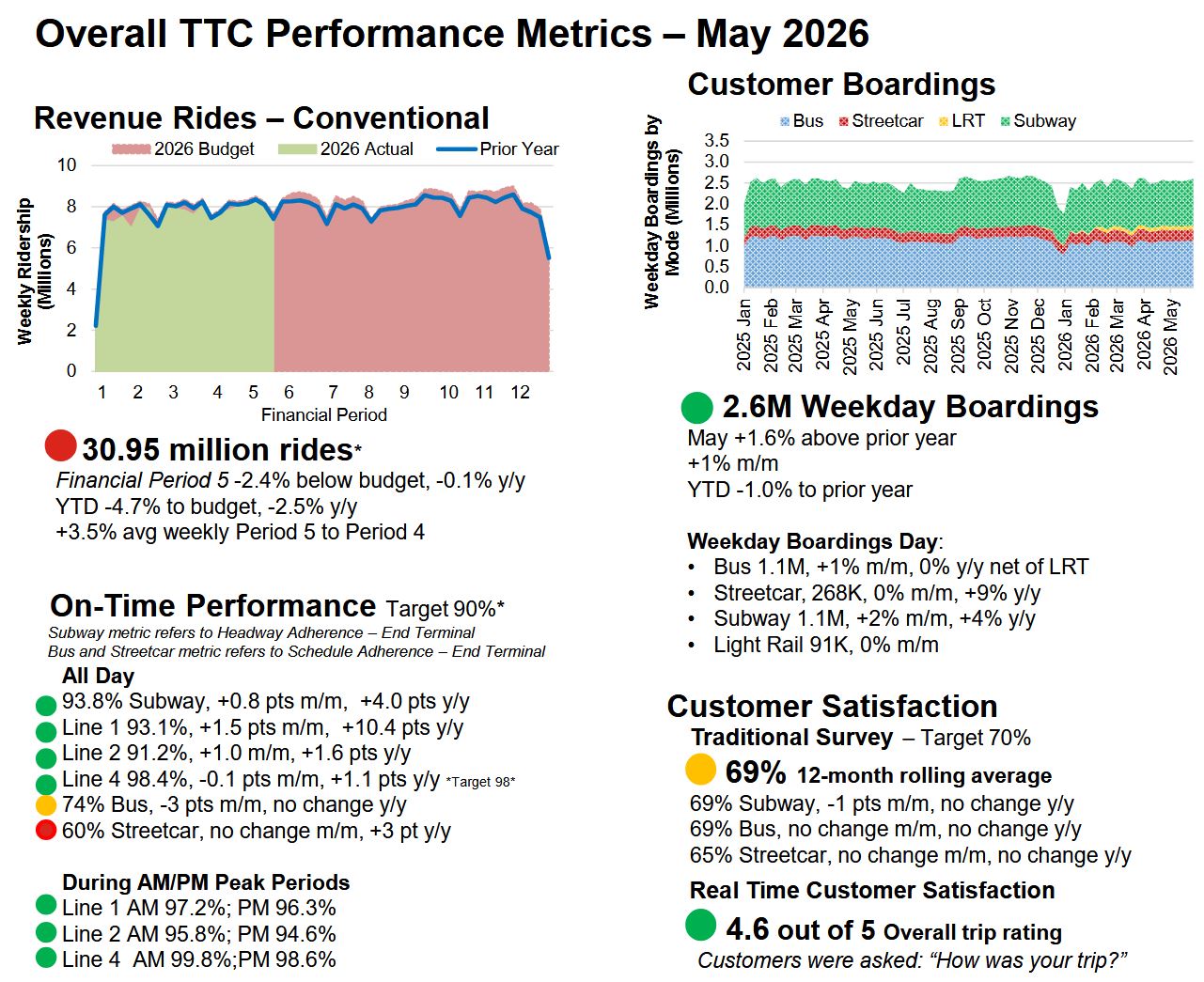
System level metrics for May are reported in the charts below.
Continuing a pattern seen both last year and early in 2026, current ridership is almost the same as last year at this time, but is running below budget. The first months of 2026 hit the TTC hard, but ridership recovered from March onward. The budget shortfall to date is $13.6-million. What is not clear is the effect this might have on service plans later in 2026 and if planned improvements will be deferred to 2027. There is an ongoing problem with shortfalls from optimistic budgets interfering with plans to run better service.
Boardings on the streetcar system are up 9% over last year, and on the subway by 4% reflecting stronger demand downtown. Bus boardings are also up slightly, 1.1%, over last year adjusted for the conversion of services on Eglinton and Finch to LRT.
Several studies are underway, but none will report to the current Board:
- Ridership Growth Strategy
- Service Standards Review (Public consultation expected in August)
- Streetcar Operations Review
- Review of Reporting Metrics
- 2027 Annual Service Plan
The format of the CEO’s Report introduced in mid-2025 no longer covers the entire system in detail, but reviews each of four modes in monthly rotation: subway, bus, streetcar and Wheel-Trans. This produces gaps in coverage at the Board level because there are fewer than 12 meetings in a year, and some CEO Reports do not appear on agendas. There are also gaps in mode-specific metrics because they are not reported for every month. (The full set of reports is available on the CEO’s Report web page.)
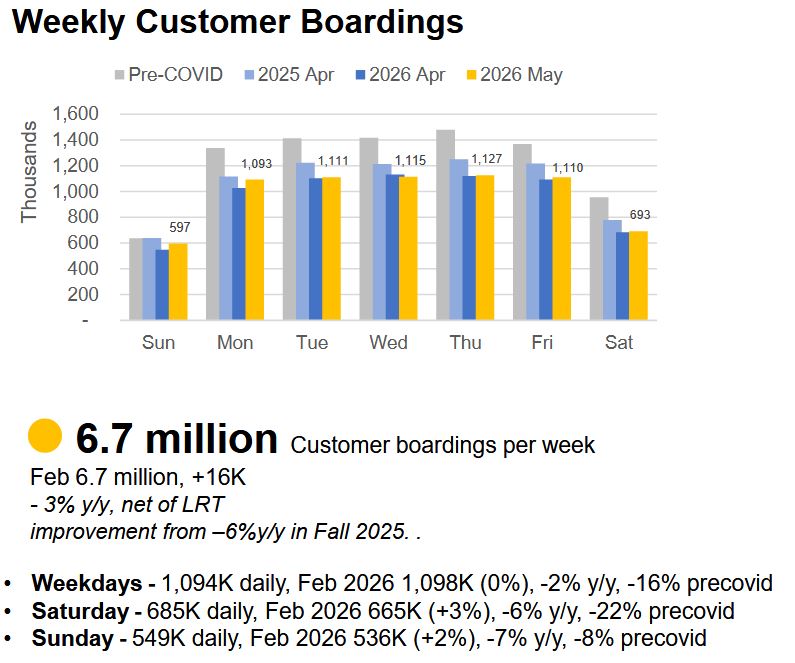
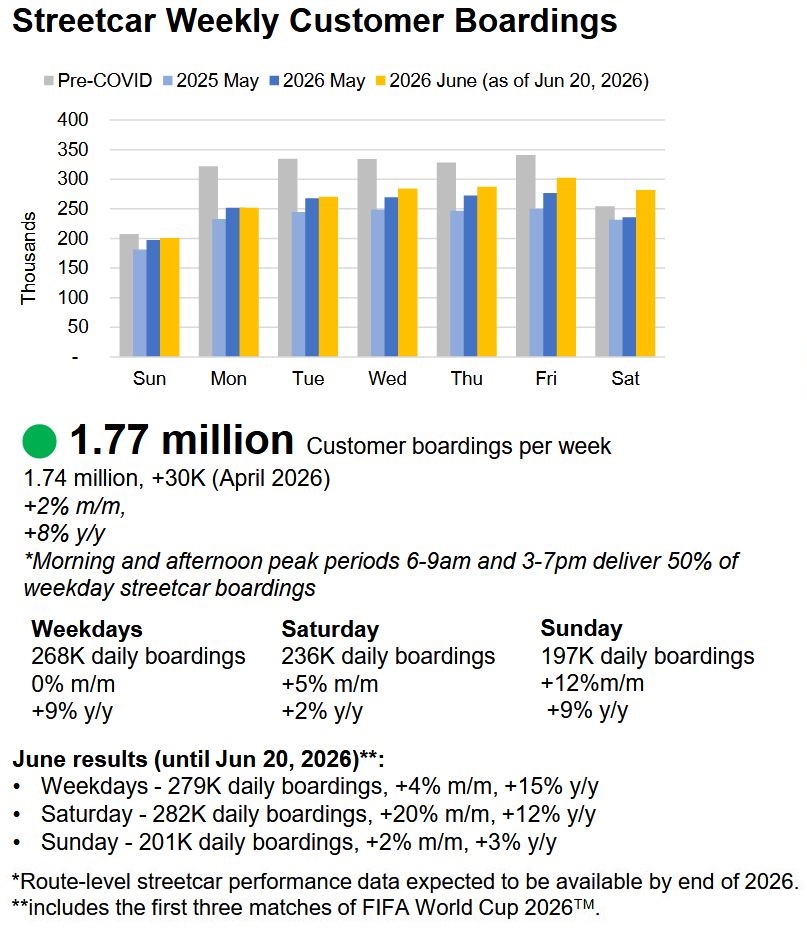
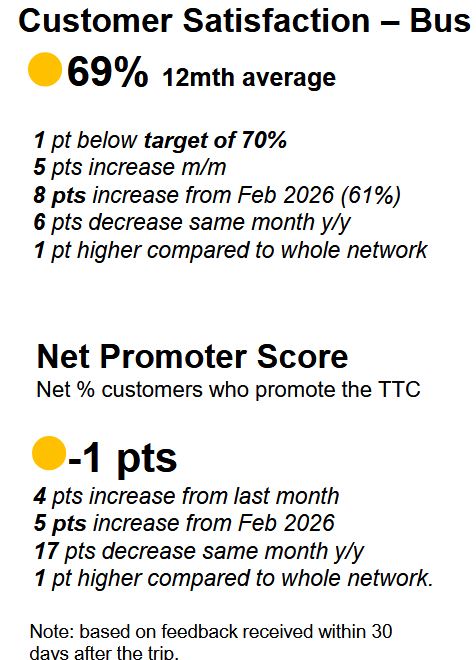
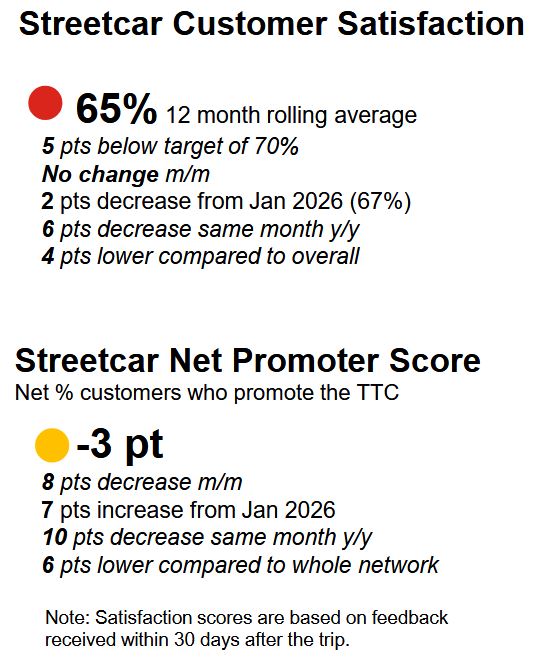
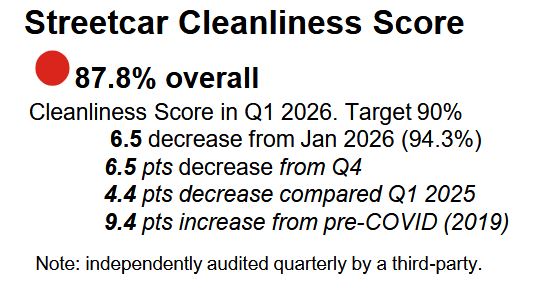
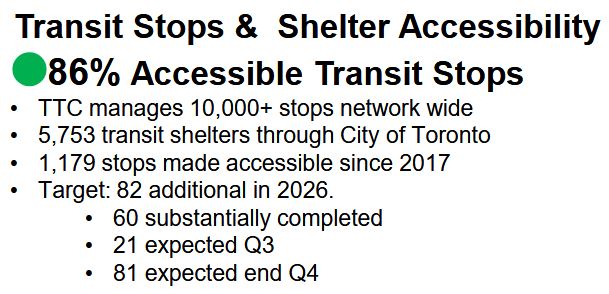
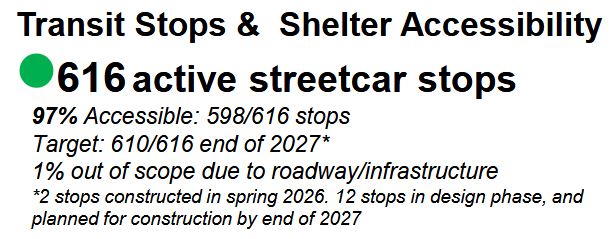
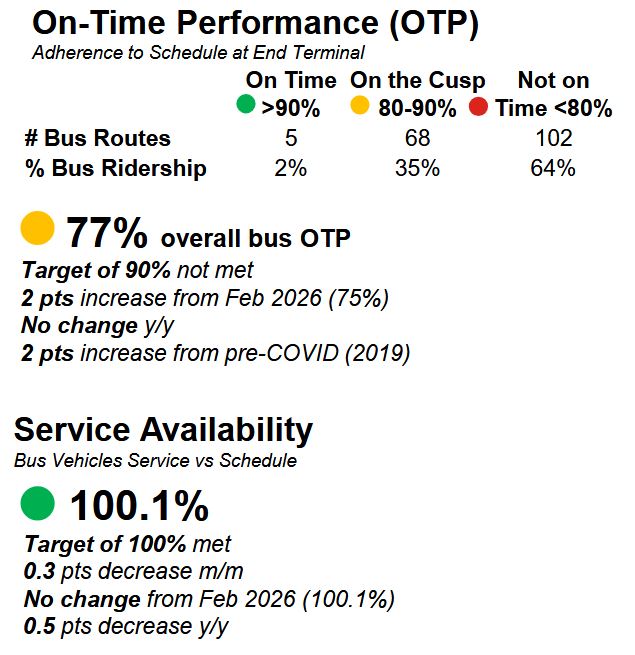
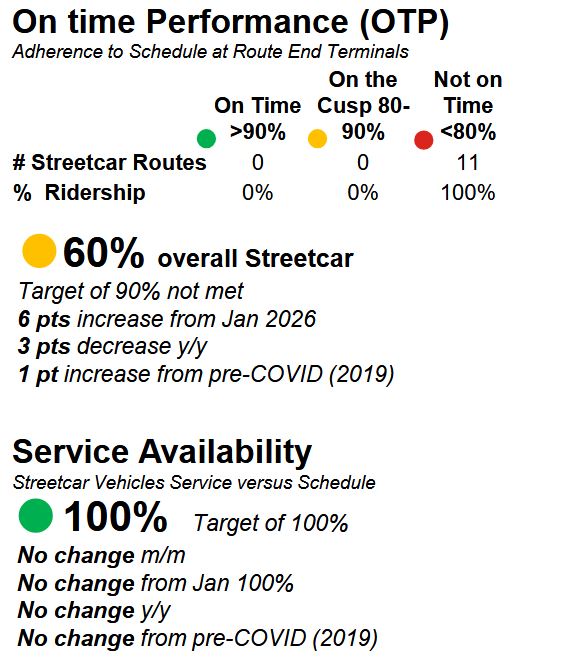
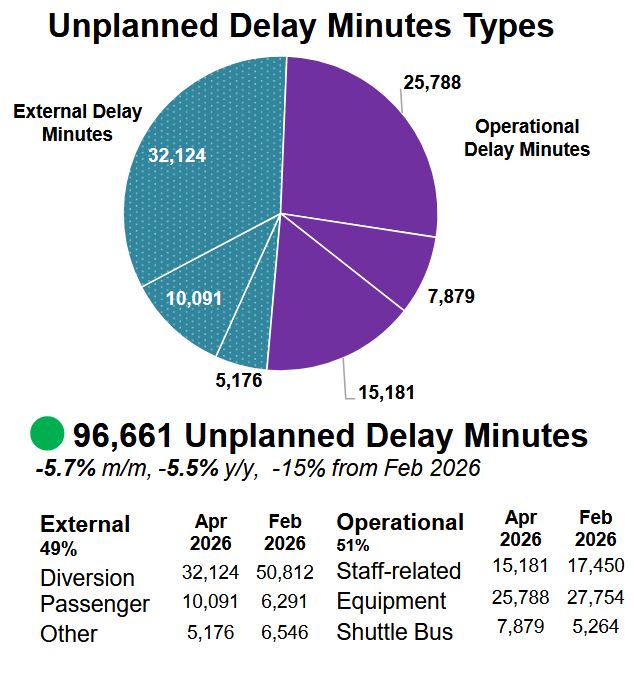
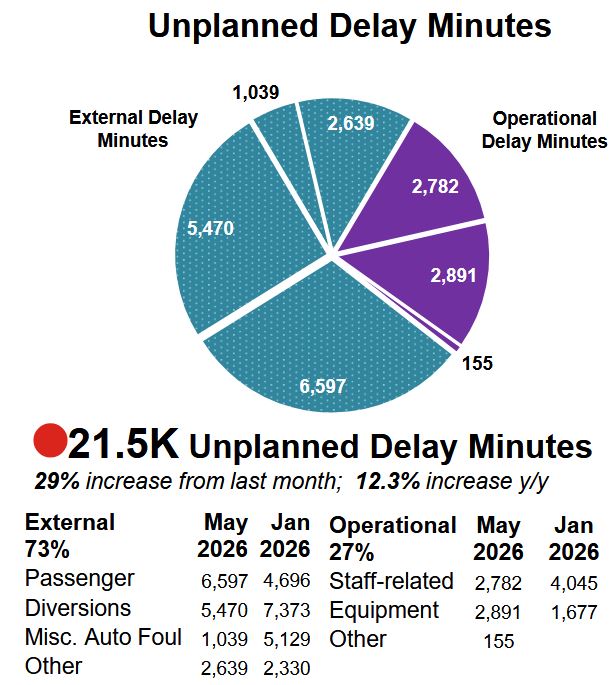
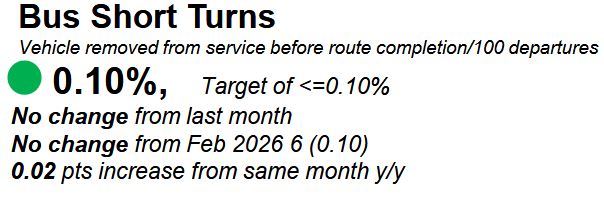
For readers’ convenience, I have consolidated the bus and streetcar charts from the two reports below. The bus data (left column below) in the June report covers April operations, and the streetcar data (right column below) in the July report covers May. The streetcar network, although much smaller than the bus network, carries about 1/4 as many boardings on weekdays, with a higher proportion on weekends.
Customer satisfaction scores for the streetcar network are slightly below those of the bus network. Both networks were affected by weather delays in the previous quarter and this makes trend comparison difficult.
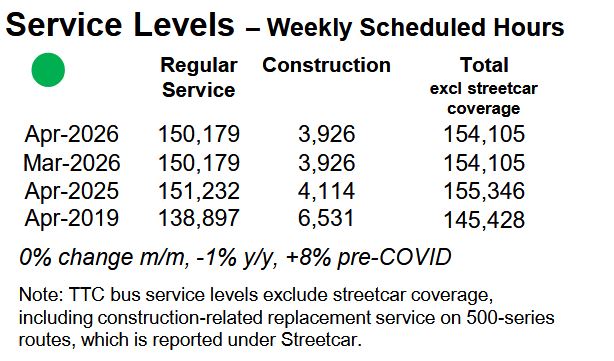
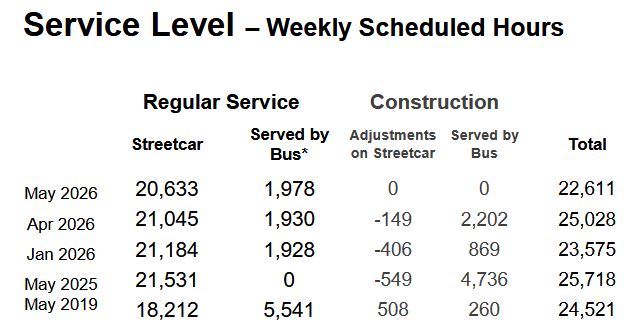
For budgetary purposes, TTC measures the amount of service operated in hours because operator wages are the driving force in overall costs. Streetcars operate less than 1/7 the hours compared to buses, but as noted above carry about 1/4 of the boardings. This reflects the higher capacity of the streetcars and, possibly, a higher turnover of riders on the downtown routes compared to longer bus trips.
In 2019, a substantial portion of streetcar service was provided by buses both because of construction projects and because of a shortage of vehicles (the new Flexity deliveries were still in progress). Routes 502 Downtowner, 503 Kingston Road, 505 Dundas and 511 Bathurst were operated with buses in early 2019, and several peak period trippers also used buses. The TTC has grown used to bus substitutions even though it has an underutilized streetcar fleet.
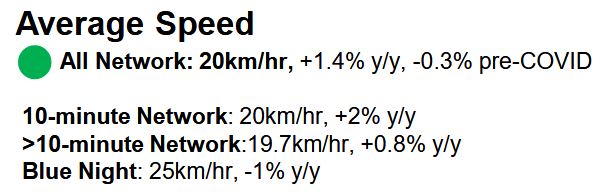
Although the TTC cites average speeds for bus routes, this information is incomplete for streetcars where some values are shown only as a percentage change.
The crowded trip counts should be read with care as they are all-day values and include both peak and counterpeak direction trips. It is also not clear whether the crowding standard used is adjusted for the lower (seated load) off-peak value for those trips. Streetcar routes generally operate at the same service level for most of the day, and so the trip stats are dominated by off-peak data. This is an example of how system-wide averaging can understate the degree of a problem.
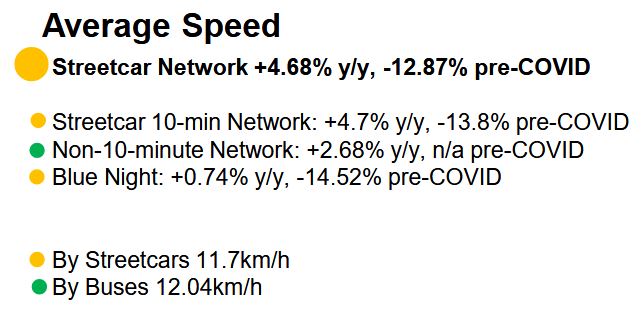
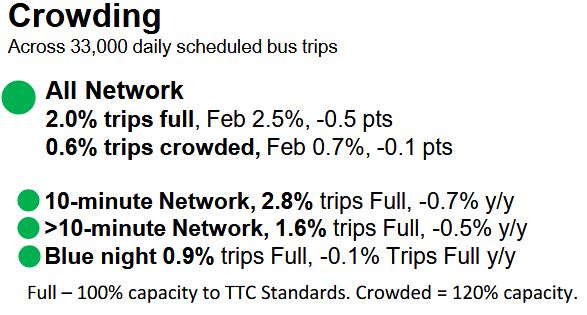
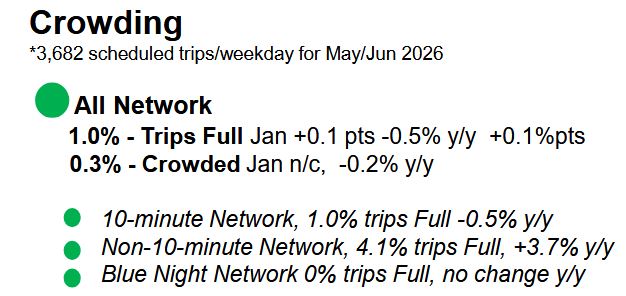
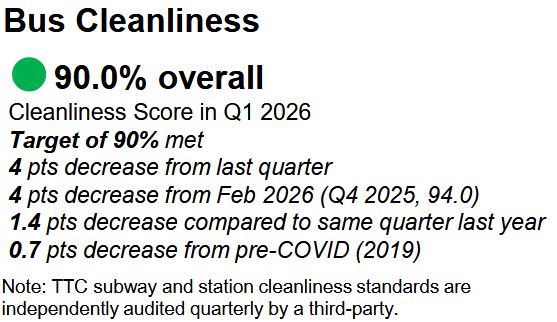
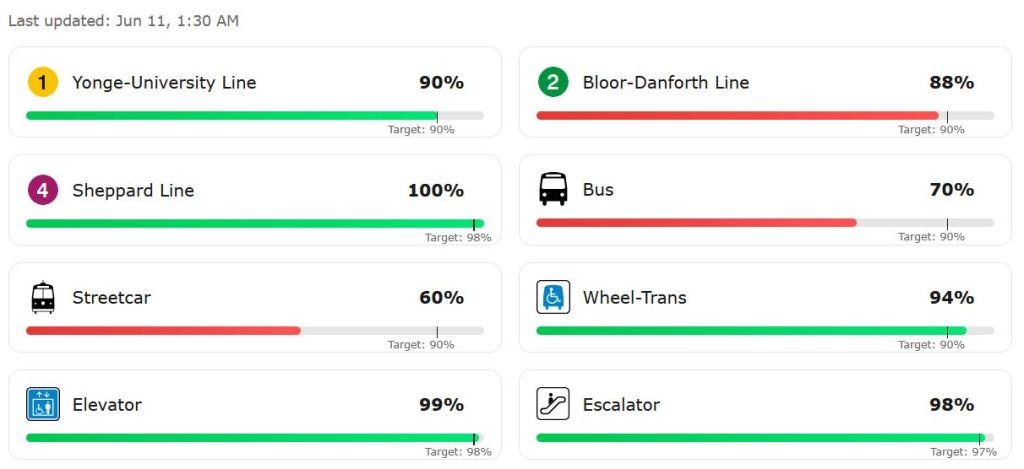
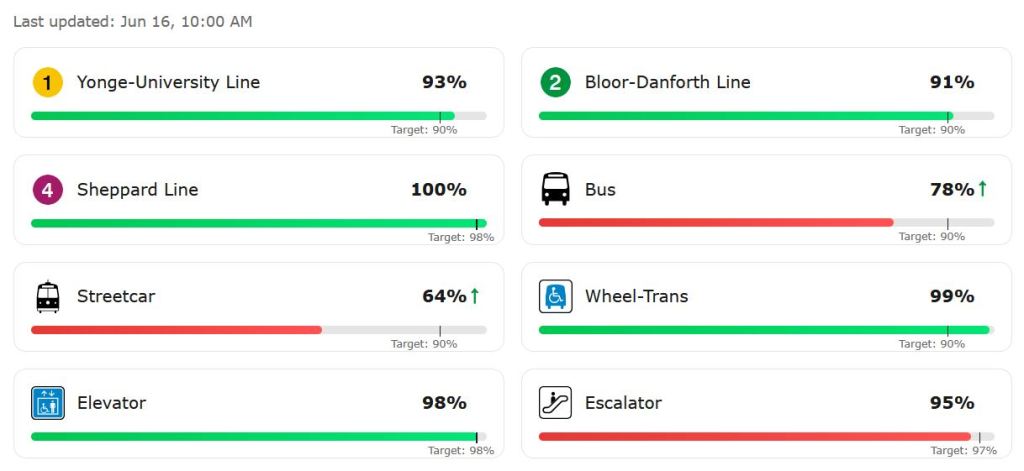
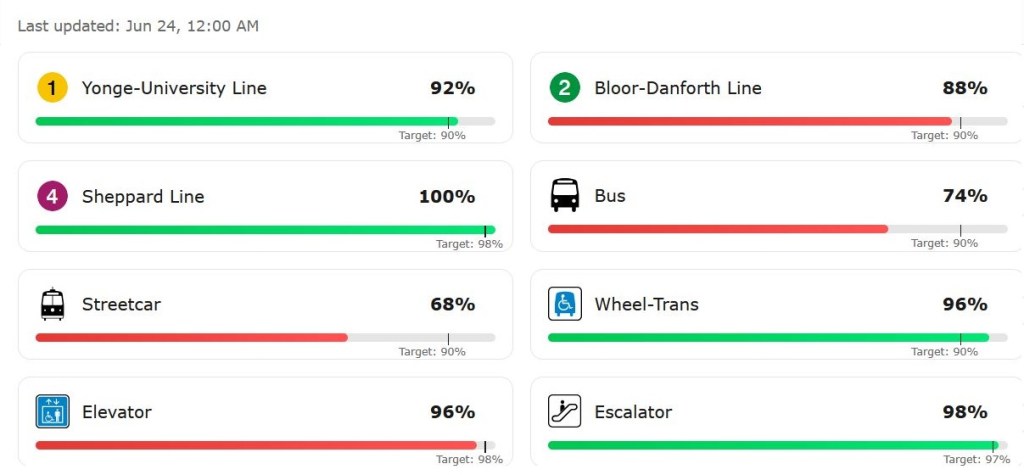
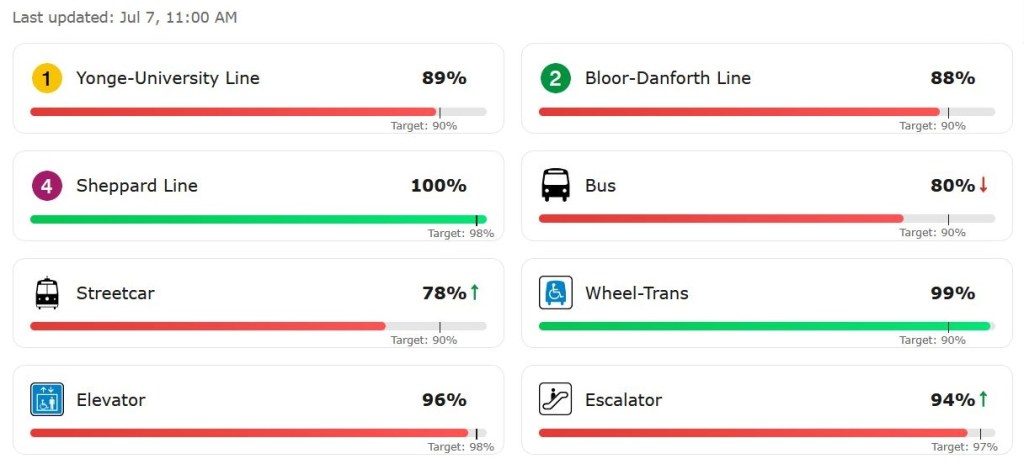
On-time performance (OTP) is measured only at terminals and for most routes is based on vehicles not leaving early, and leaving no more than 5 minutes late. The goal is to hit this target 90% of the time. There are also standards for mid-route headway reliability, but these are less strict and are never reported. Most riders, of course, do not board at terminals.
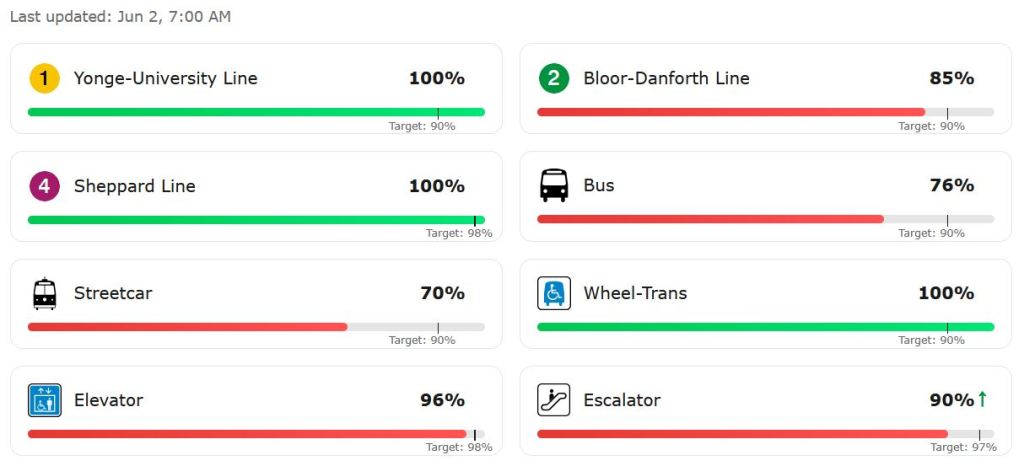
Although the bus performance numbers shown here are better than for the streetcars, recent stats on the TTC’s site show an improvement in streetcar performance, aided by the absence of major road upheavals and diversions during the World Cup period, with both modes showing comparable numbers.
Here are snapshots of OTP stats from the TTC’s website from June 2 to July 19:
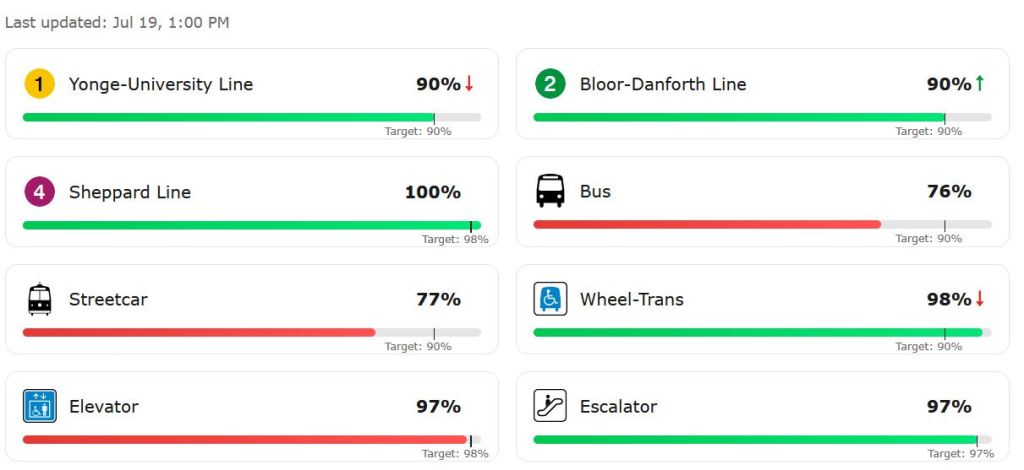
The “Service Availability” numbers are misleading in the sense that they show that all of the scheduled service operated, but do not show how many more vehicles could have been available. TTC spare ratios run well above the usual industry value of 20% (1 spare for every 5 scheduled vehicles). More service could be operated if there were budget headroom and operators to provide it. This is a case of hitting a target set low enough that the system cannot fail to meet it.
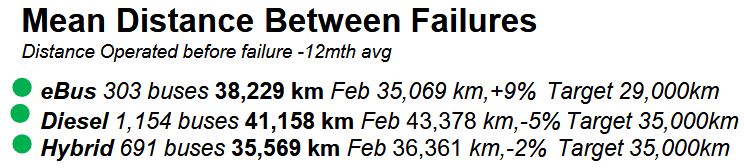
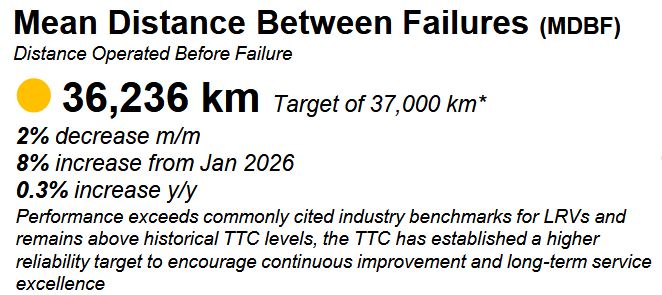
Mean distance between failures shows the average distance vehicles travel before failing in service. The numbers for eBuses have improved substantially now that the fleet is dominated by newer vehicles rather than prototypes. Diesel and hybrid numbers are very substantially higher than those reported a year ago which were capped values that made eBuses appear artificially better, by comparison, than they actually were.
| Reported MDBF (km) | October 2025 | July 2026 |
|---|---|---|
| Diesel | 20,000 (*) | 41,158 |
| Hybrid | 30,000 (*) | 35,569 |
| Electric | 30,000 | 38,229 |
This practice ended in September 2025, but prior months’ data were not restated and the capped values remain in the older CEO’s reports. One can only guess why TTC management persisted in reporting bogus numbers for so long.
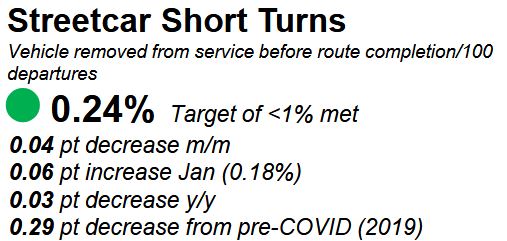
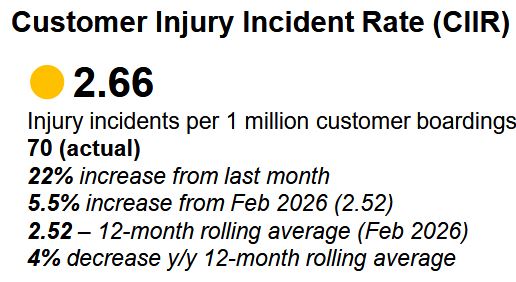
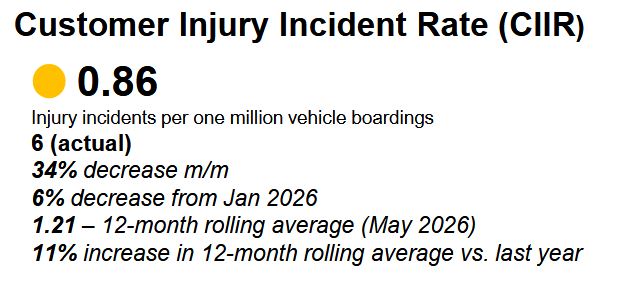
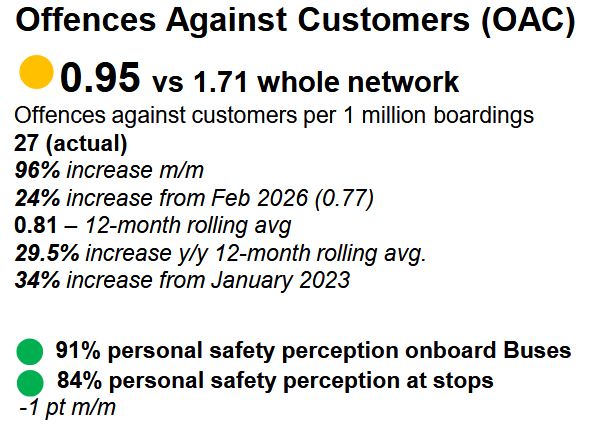
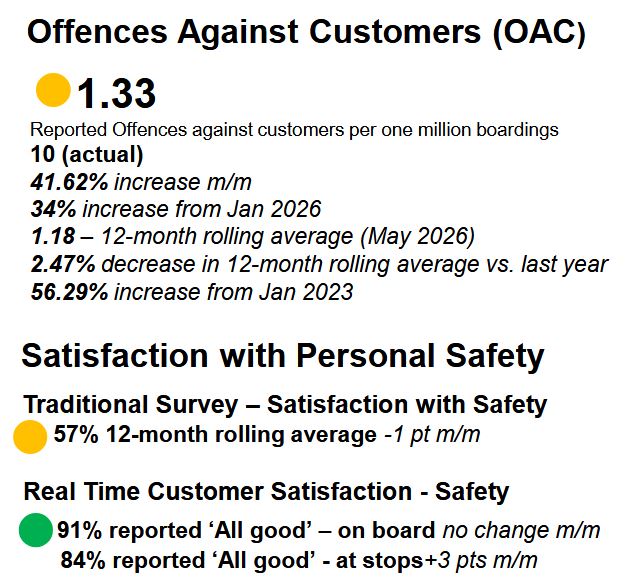
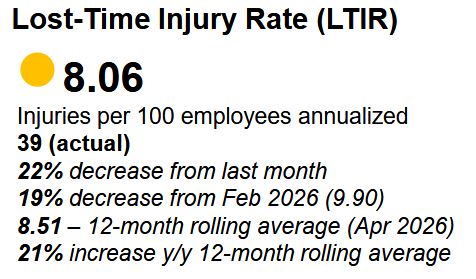
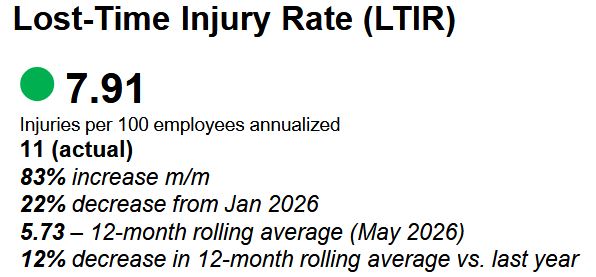
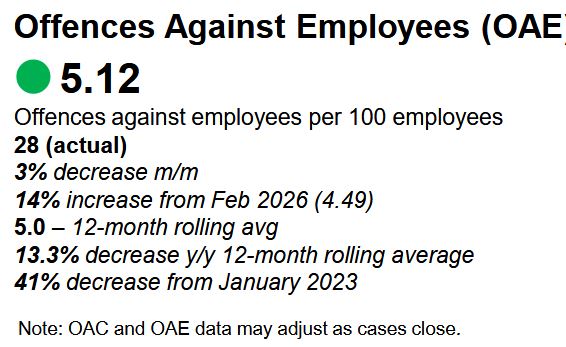
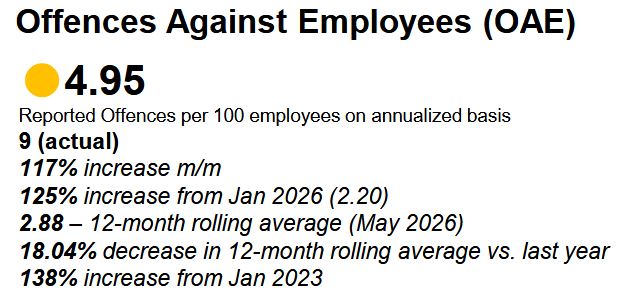
The reported rates of injuries and offenses involving riders and staff illustrate a problem with the new format of the CEO’s report. Changes are listed versus the previous month, the previous report for a mode (i.e. three months ago), and a year ago. However, month-to-month variations can skew these comparisons when tracking charts, previously available, would show overall patterns.
Automated Ticketing for Vehicles Passing Open Streetcar Doors
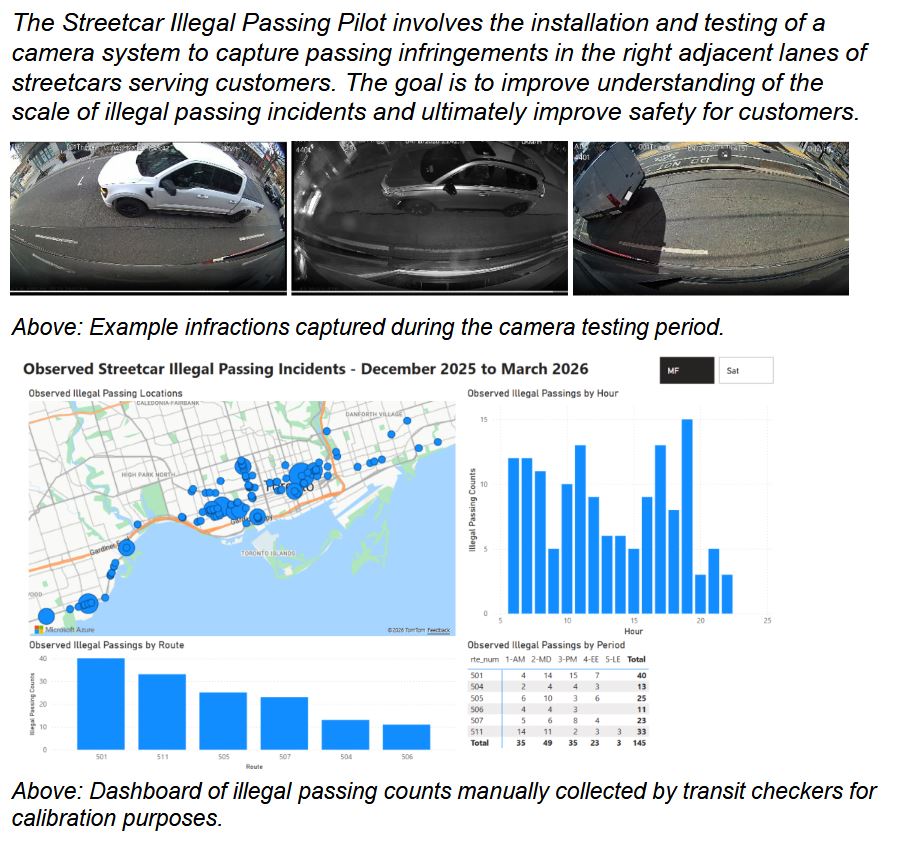
The TTC plans to test an automatic system to identify and, eventually, issue tickets to motorists who pass by open streetcar doors. This assumes of course that Premier Ford does not regard automated ticketing of this sort as an imposition on motorists. Unless both penalties and the chance of being caught are high, motorists will play the odds. The fine is $183.25 plus three demerit points. The Highway Traffic Act was changed to allow this in 2021, and came into force July 1, 2022. The TTC will test the system using four streetcars equipped with cameras over nine months on 501 Queen, 504 King, 505 Dundas, 506 Carlton, and 511 Bathurst.
Travel Times on LRT Lines
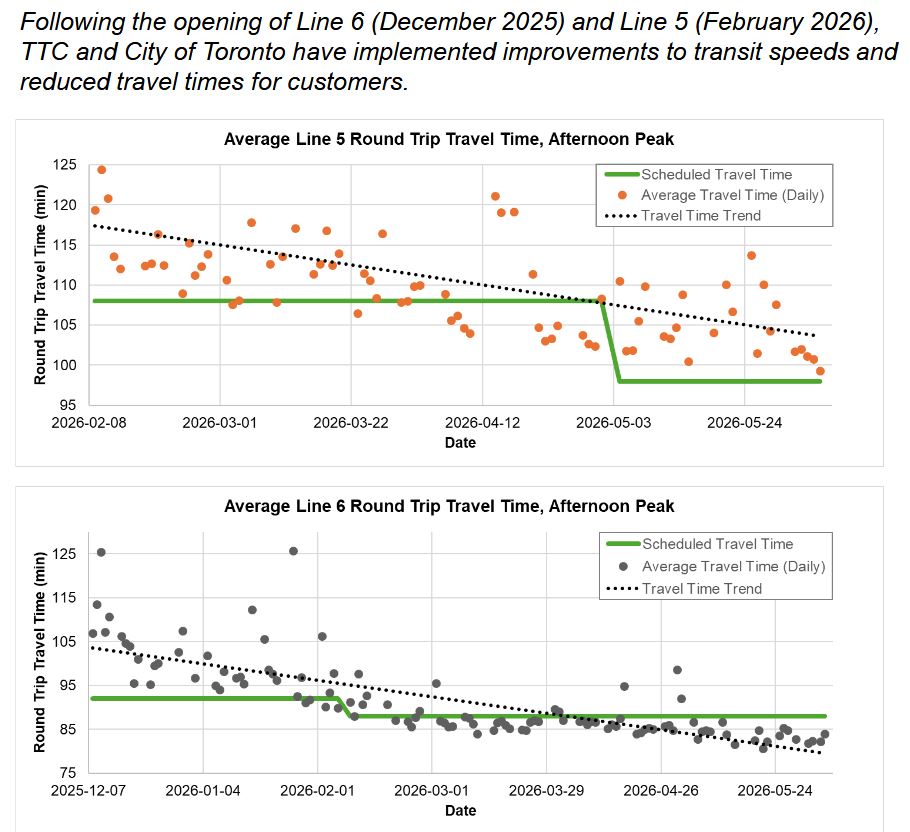
Although vehicle tracking data are not yet available for Lines 5 and 6 to provide the sort of analysis regularly presented on this site, the TTC has been keeping track of actual travel times across the routes. It is not clear what proportion of trips are covered by the charts below, or what the time-of-day variation might be. Only PM peak trips are shown, and they show considerable scatter in values on 6 Finch. Eglinton began with considerable variation in round trip times, but has improved in recent months.
Improvements for both lines have come gradually through changes in operating procedures, signalling and control systems. The obvious question is why this problem was not flagged in testing and resolved before the deeply embarrassing opening conditions, especially on 6 Finch.
Reduced Speed Zones
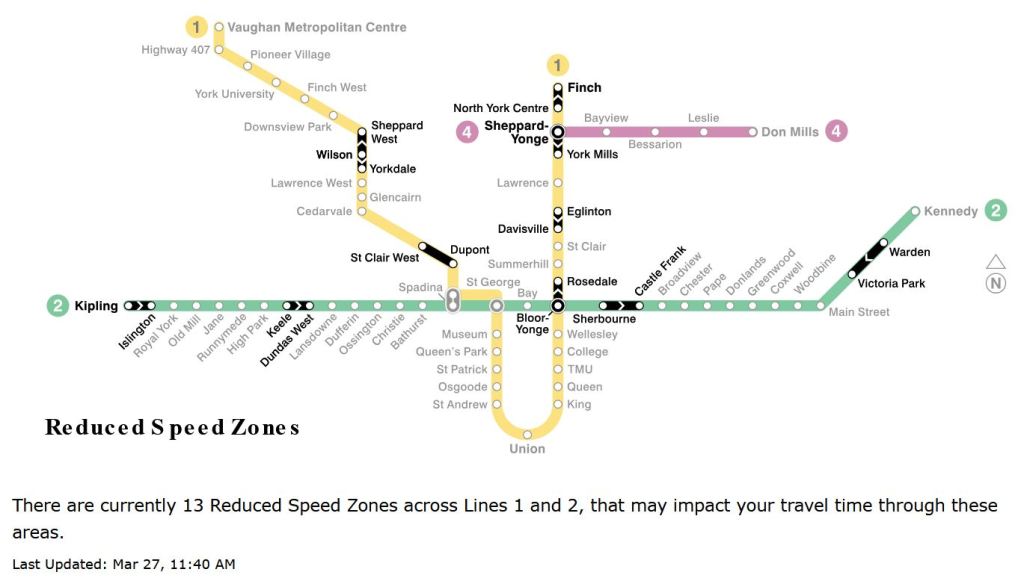
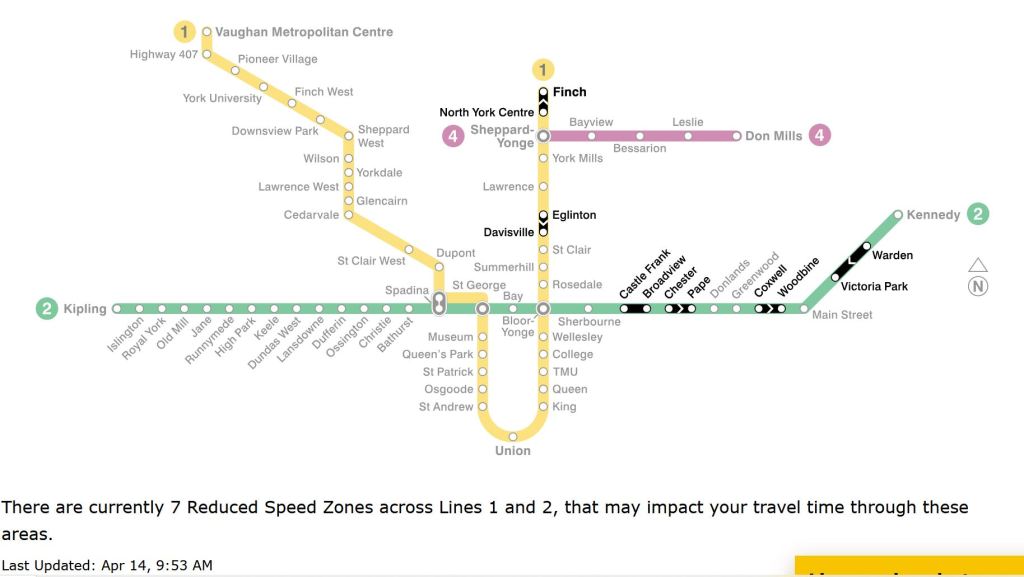
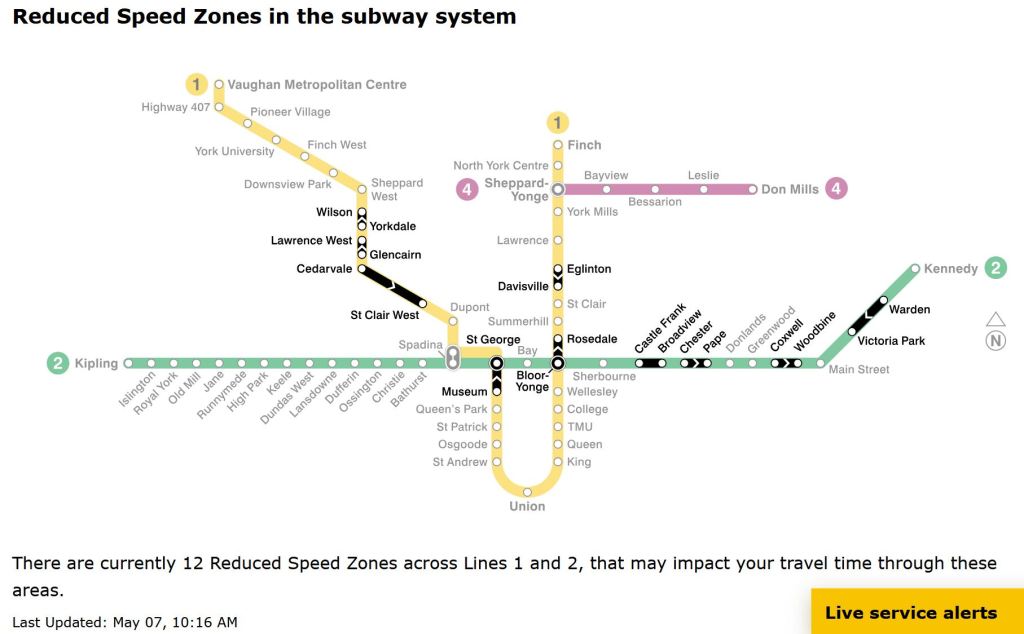
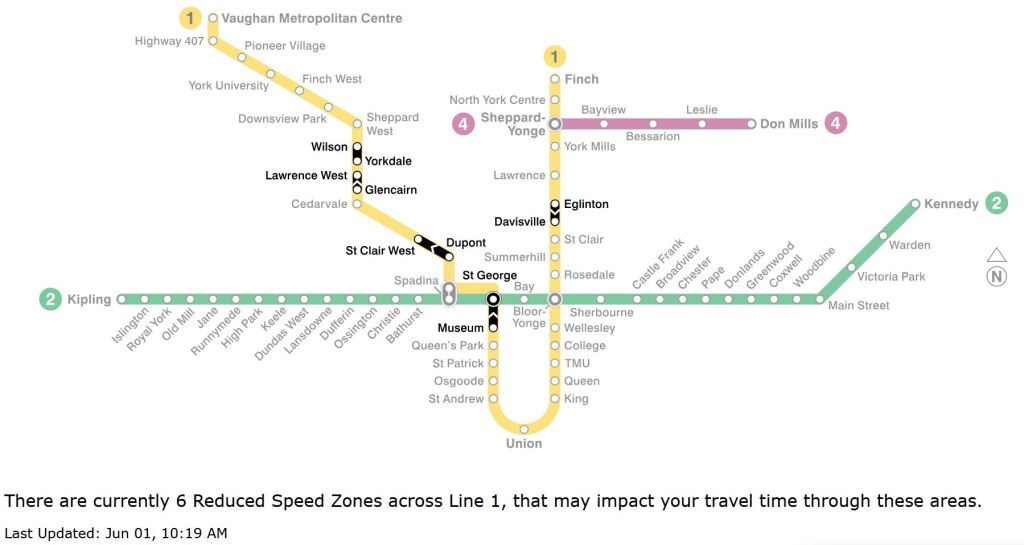
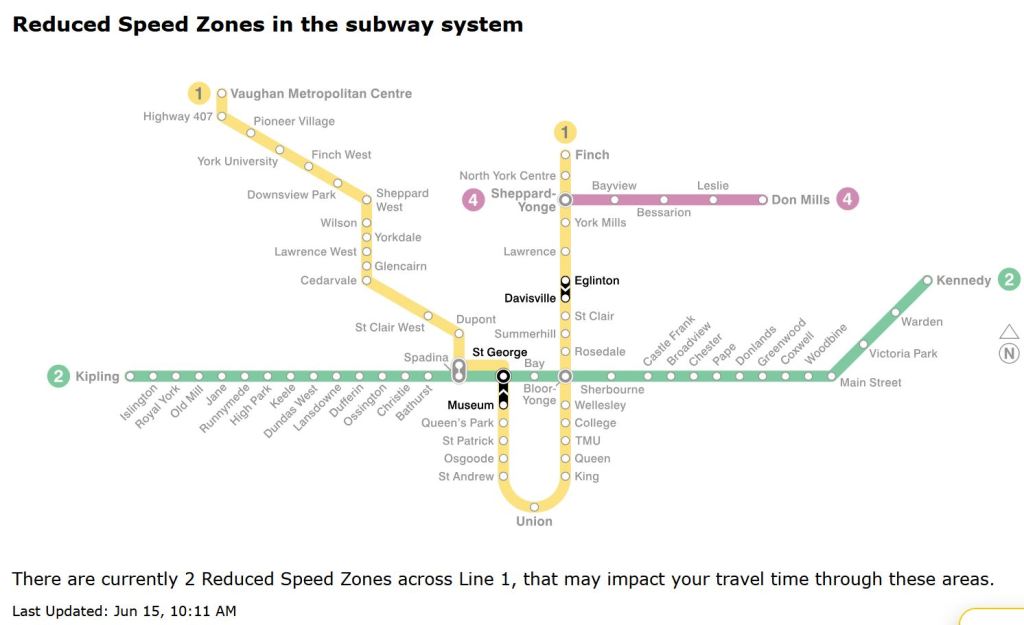
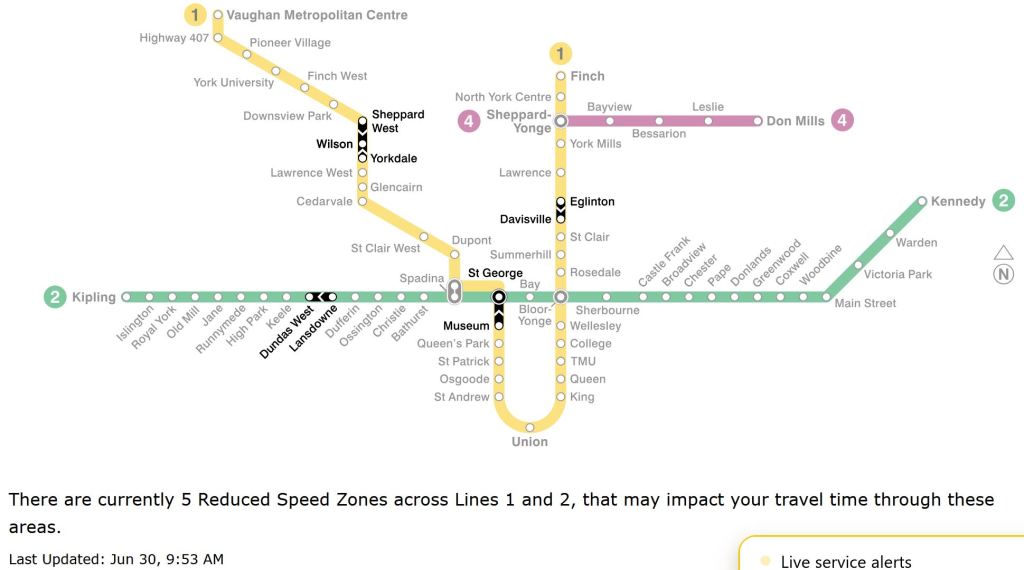
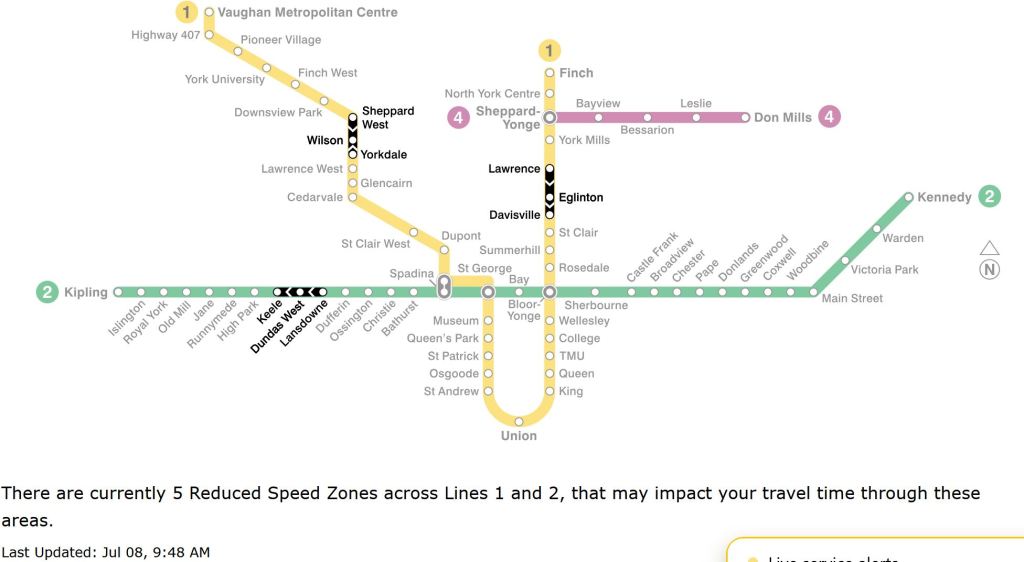
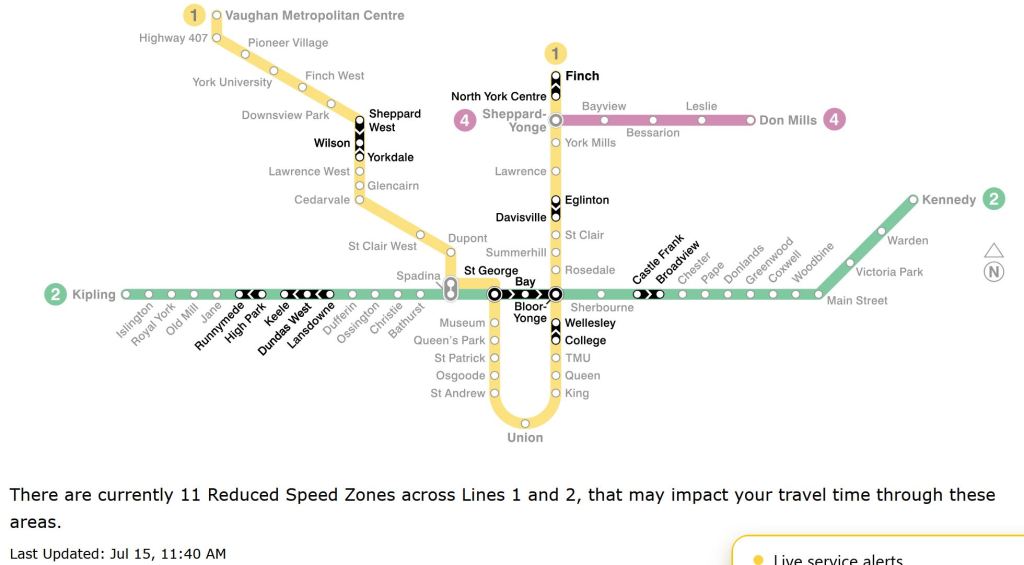
This is not a “subway month” for the CEO’s Report, and so there is no commentary about reduced speed zones. However, the evolution of maps of affected areas shows a clear story of a blitz to eliminate RSZs before the World Cup Period, but a gradual re-emergence of problem areas. What is not clear is how many of the problems “resolved” in early June were genuine repairs as opposed to pro tem fixes to get the TTC through the month-long period.
The next CEO’s Report dealing with Subway operations will not appear until September, and then only online as there will not be a Board meeting.
Transit Network Expansion Update
This report provides an update on the status of the Metrolinx projects within Toronto’s transit system with particular emphasis on the TTC’s role in each of them. Some of the information is a recap of past events, but a few points affecting future work, decisions and funding are worth attention. This information is in Appendix B in the report linked above.
Ontario Line
The TTC’s general roles and responsibilities in support of the project to assist with seamless integration into the existing transit network …
[…]
Discussions on operations and maintenance roles and responsibilities continue at the working group level between the TTC and Metrolinx, within the transit expansion governance framework. Subject to the New Deal negotiation between the City and the Province, the TTC is working with Metrolinx to confirm the details of the TTC’s roles and responsibilities, including revenue protection, safety and security, customer interface, and the network control centre.
From this statement, it is clear that basic issues regarding the Ontario Line’s operation and management have yet to be settled. The line will not open for many years, but assumptions about who-does-what will affect design, notably whether OL central management is integrated with the TTC control centre.
There will also be boundary issues of responsibilities at the interchange stations such as Queen, Osgoode, Pape and Don Valley.
Pape Station
Bus loop testing by Transportation Planning is scheduled for late July 2026.
Temporary bus loop at Pape Station targeted for opening in September 2026, where some on-street stops can be served within the temporary terminal (i.e. 72 Pape southbound).
The 25/925 Don Mills services are currently operating to Broadview Station, and the 72 Pape bus is through-routed with the former 81 Thorncliffe Park. The routing arrangements for September 2026 have not yet been announced.
The major structural work at Pape involves tunneling under the existing Line 2 station. Design of the interchange was at 90% as of the report date with completion expected in July 2026. Other major works include the construction of two new ventilation shafts to serve the much expanded station.
Don Valley Station
As of Q4 2025, the bus loop at Don Valley Station has been commissioned, and the bus terminal was operational for the Line 5 opening in Q1 2026. The TTC is coordinating with Metrolinx to address the elevator out of service issue at the temporary terminal.
Thorncliffe Park Station
Ongoing discussions with the City are underway regarding whether a bus loop will be constructed at Thorncliffe Park Station, pending the outcome of a Transit-Oriented Community (TOC) decision.
Lake Shore East Corridor (Leslieville and Gerrard Stations)
The Lakeshore East Joint Corridor-related work will require periodic short-term and extended shutdowns of the Queen Street East and Gerrard Street East streetcar tracks.
Bus replacement services will be required during the periods when streetcar tracks are non-operational. Co-ordination of these shutdowns is crucial, as one of two of these routes must be available at all times to allow deployment of streetcars from the David Miller Carouse at Leslie Barns and Russell Carhouse facilities.
Continuing discussions are underway between Metrolinx, the City, and the TTC to ensure that various infrastructure projects are scheduled to mitigate impacts to area-wide mobility and operations of the streetcar network.
See also:
Scarborough Subway Extension
Metrolinx has exercised an option for the installation, testing, and commissioning of the ATC system on SSE as part of the TTC’s Line 2 ATC contract. This opportunity will maximize the benefit from the ATC system and the New Subway Trains for the entire Line 2 service on the opening day of SSE and beyond.
Common sense has arrived on the SSE where original plans were to install a block signal system east of Kennedy. Part of this arose from delays on the TTC side where a commitment to ATC on Line 2 was unclear. Timing issues remain with delivery of ATC-capable trains for Line 2 and ATC installation at least on the extension.
See also:
Bus terminal design for the SSE has been a concern for TTC for some time. The amount of land Metrolinx allocated for the terminal is not enough to provide for the volume of bus traffic foreseen at the new Scarborough Centre Station.
This station has been planned as part of the Line 2 East Extension as far back as 2013 and was always identified as a focal point in the transit network, which would require an adequately sized bus terminal to accommodate the future transit network plan. This requirement has been communicated to Metrolinx since 2019, when the project was uploaded. However, the proposed designs have not met the TTC’s requirements. The TTC continues to collaborate with Metrolinx and other stakeholders to achieve an optimized design, from the number of bus bays and layover spots to the design features of the terminal, though the current station design remains suboptimal for TTC operations.
Guided by projected needs of the future transit network and the TTC’s Service Standards and Design Manual, the TTC requested 17 dedicated bus bays at the new Scarborough Centre Station. This would accommodate customer demand and growth, and support resilient operations at the new bus terminal. Metrolinx, citing site constraints and the need to deliver new development as part of the project (“Transit Oriented Communities” or TOC), recommended a design of only 11 bays assigned to the TTC for opening day (this number may change in future years through Metrolinx’s Change Management Process). This deficiency would result in multiple bus routes sharing a single bay, leading to customer crowding on the bus platforms and slower, less convenient service overall. The limited access in the proposed design will mean more circuitous routing and longer travel times for customers and higher operating costs for the TTC.
Metrolinx completed modelling of bus terminal operations, which confirmed the TTC’s initial concerns that the terminal would operate over-capacity and result in significant service delays. More discussions are scheduled to assess bay reassignment and potential use of other assets (e.g. the existing Scarborough Centre Bus Terminal) to offset capacity constraints. Through this work, and the future Change Management Process, the TTC remains committed to finding a viable solution with Metrolinx to address the terminal deficiencies for opening day and beyond.
Yonge North Subway Extension
Train Storage Facility (TSF): The TTC is working with Metrolinx to help design facility requirements that will meet the TTC’s needs as future Operator and Maintainer. The area of concerns being discussed include train maintenance feasibility, work car storage, winter O&M, scope of Rail Cars and Shops activities and parking space.
[…]
The YNSE Project currently includes a new train storage facility, which will provide additional storage and dispatching capacity for up to 15 trains, but no maintenance capacity. Based on a fleet of 84 trains after YNSE opening, the maintenance capacity of Line 1 facilities will be completely consumed and will exceed available capacity.
The proposed yard will only provide train storage, not maintenance. This is a matter of concern both for system capacity, and with a view to anticipated growth in demand.
Separate long-term travel models from Metrolinx and the City of Toronto agree that prior to 2051, Line 1 service levels, which can be operated with 73 in-service trains will not be sufficient to serve the anticipated demand in the peak hour, while meeting the TTC’s crowding standard. The precise time when additional trains are needed to serve demand on Line 1 is largely affected by how quickly development activity occurs and what the long-term work-from-home pattern will be.
The City of Toronto’s 2025 Q4 Development Pipeline shows that development activity continues around the Yonge corridor despite the softer market. The Yonge corridor appears to remain the most desirable corridor for development in Toronto. The projected crowding levels on Line 1 based on the TTC/City of Toronto demand forecast with the service that can be provided with confirmed assets shows crowding emerging in the mid-2030s, coinciding with the opening of the YNSE. The opening of the YNSE is projected to increase Line 1 AM peak hour demand by 11% in the City/TTC model. This adds pressure as demand mounts travelling southbound toward Bloor-Yonge Station. Based on the City/TTC analysis, the quality of service is inadequate and will result in severe crowding levels from Lawrence Station to College Station.
To address overcrowding on Line 1, the TTC has identified a program of investments under the Line 1 Capacity Enhancement Program. To achieve a higher level of service on the extended Line 1, further investment is required and is dependent on the funding and procurement of additional growth trains and a new Train Maintenance and Storage Facility.
The current assets available on Line 1 constrain the service that can be provided on an extended Line 1. Joint work between the TTC and Metrolinx needs to be conducted to develop an integrated plan for serving future demand on an extended Line 1. The TTC is proposing the joint scope of work with Metrolinx including following elements:
- Demand and capacity forecasts for Line 1.
- Review network opportunities to address capacity constraints on Line 1.
- Real estate strategy for network facility requirements.
Of particular interest is the projection of added demand and crowding in the mid 2030s between Lawrence and College Stations in spite of the opening of the Ontario Line. TTC plans to increase capacity on Line 1, but this requires more trains, maintenance facilities and many upgrades to infrastructure to support much more frequent service. Another question is whether the OL will be extended north from Eglinton to at least Sheppard, a scheme that an earlier Metrolinx study projected would substantially reduce demand on Line 1.
All of this depends on where the new demand will originate and where riders will travel. The core area focus of travel and transit construction shows no sign of relenting.
Eglinton West Crosstown Extension
The report notes that:
The TTC continues to work with Metrolinx to ensure interoperability with existing Line 5 Eglinton and seamless operation across future Line 5.
This is a rather odd statement in that one would expect any extension to be compatible with an existing line, but one never knows with Metrolinx.
New Entrance to Spadina Station
Spadina Station has three street entrances:
- The main entrance and bus loop on the east side of Spadina. This is fully accessible subject to outages for major repairs of elevators and escalators. This leads via a concourse to the Spadina streetcar loop and the east end of the subway platform.
- An entrance on the west side of Spadina leads to the same concourse as the east entrance, but it is not accessible having only an “up” escalator from the concourse to street level.
- A non-accessible entrance on Walmer Road. This is a stairs-only entrance leading to the west end of the subway platform.
- (There is also an roundabout route into the station via the Line 1 subway platform and connecting passage, but that is not part of the current discussion.)
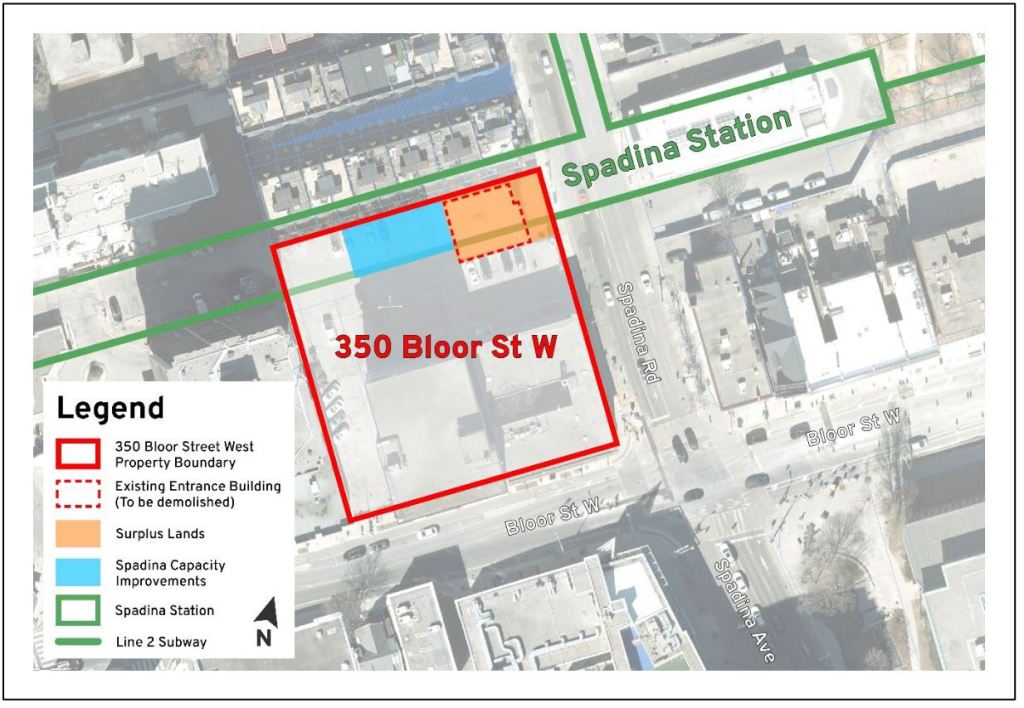
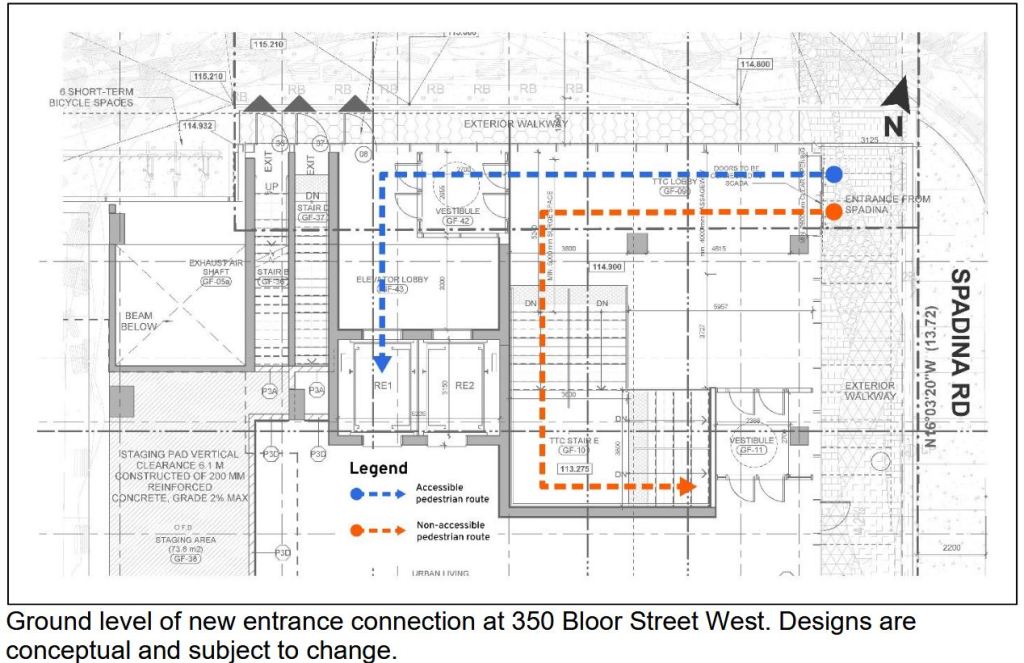
A proposed development on the northwest corner of Bloor and Spadina will incorporate the west entrance and extended concourse, but will take the entrance out of service during construction from 2028-2032.
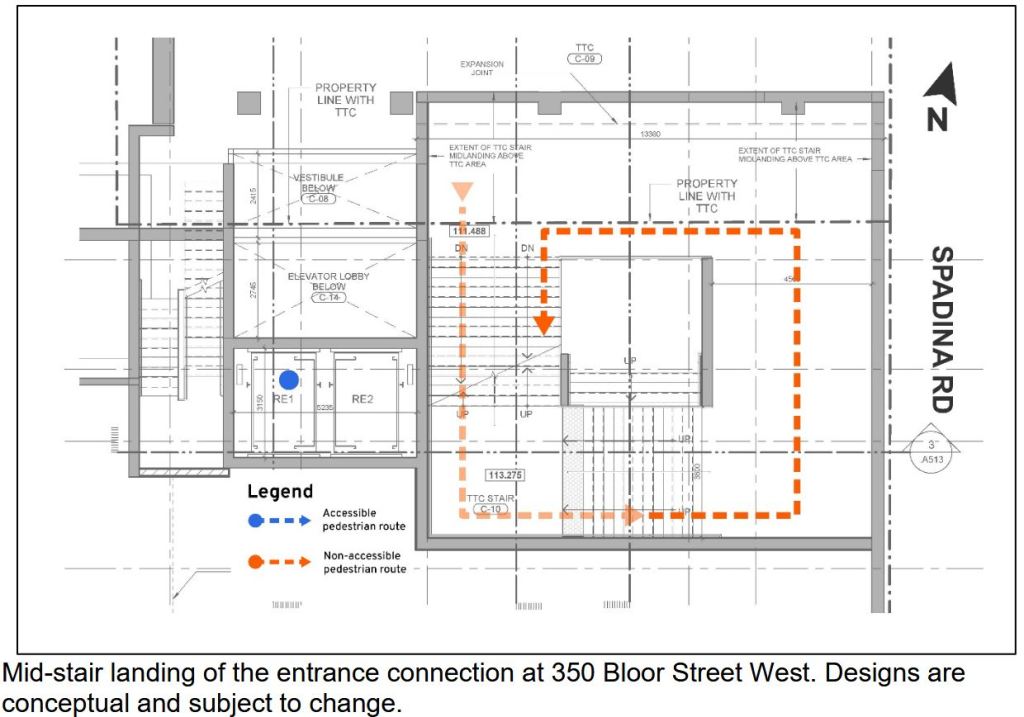
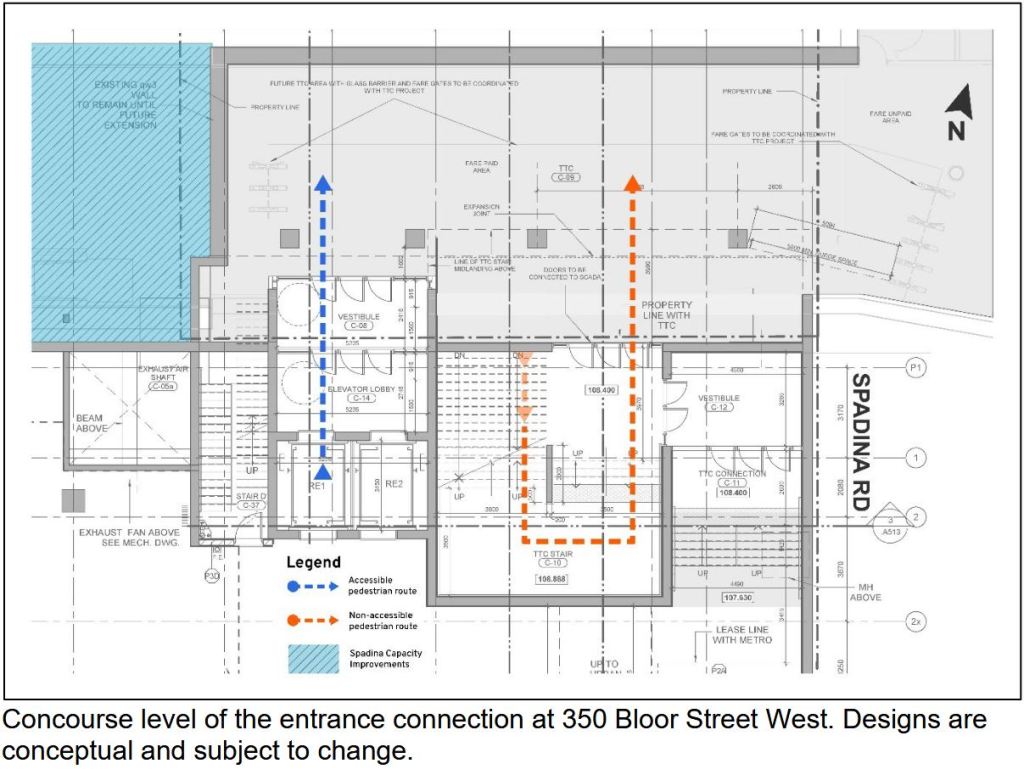
The new entrance will include an elevator from street to concourse level where riders can access existing elevators down to the platforms. There will not be any escalator at this entrance. The drawings below show the site location (upper left) and the three levels of the new entrance including elevator (blue) and stair (orange) paths into the station. Fare gates are now at street level, but in the new design they will be in the concourse just west of the point where the pedestrian walkway to the Line 1 portion of the station branches off to the north.
New Entrance to Eglinton Station
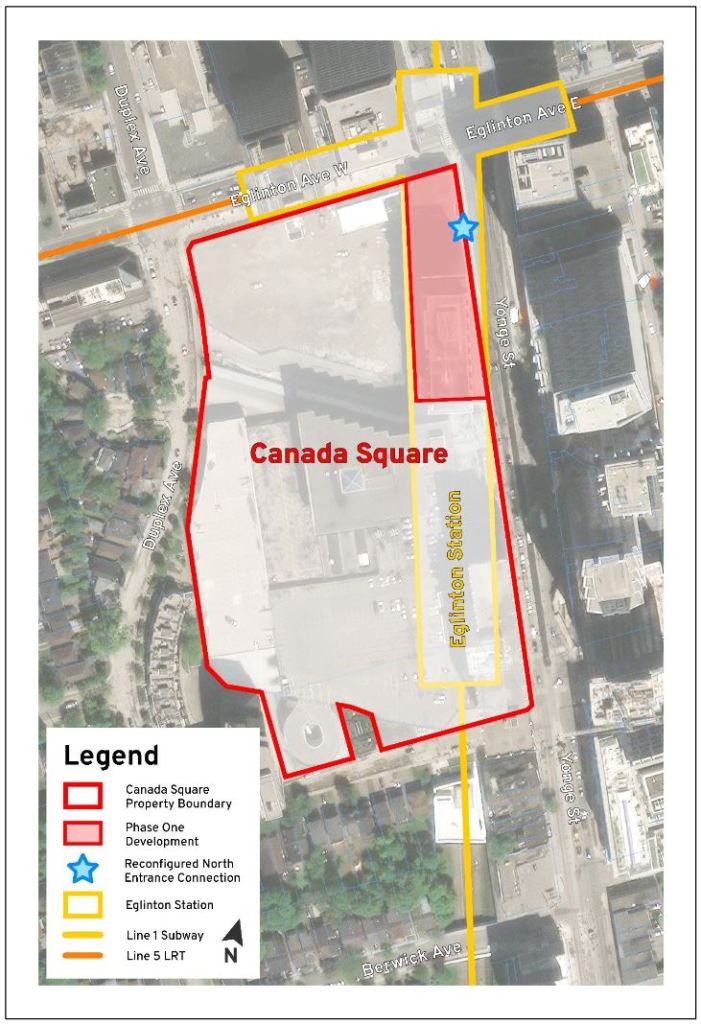
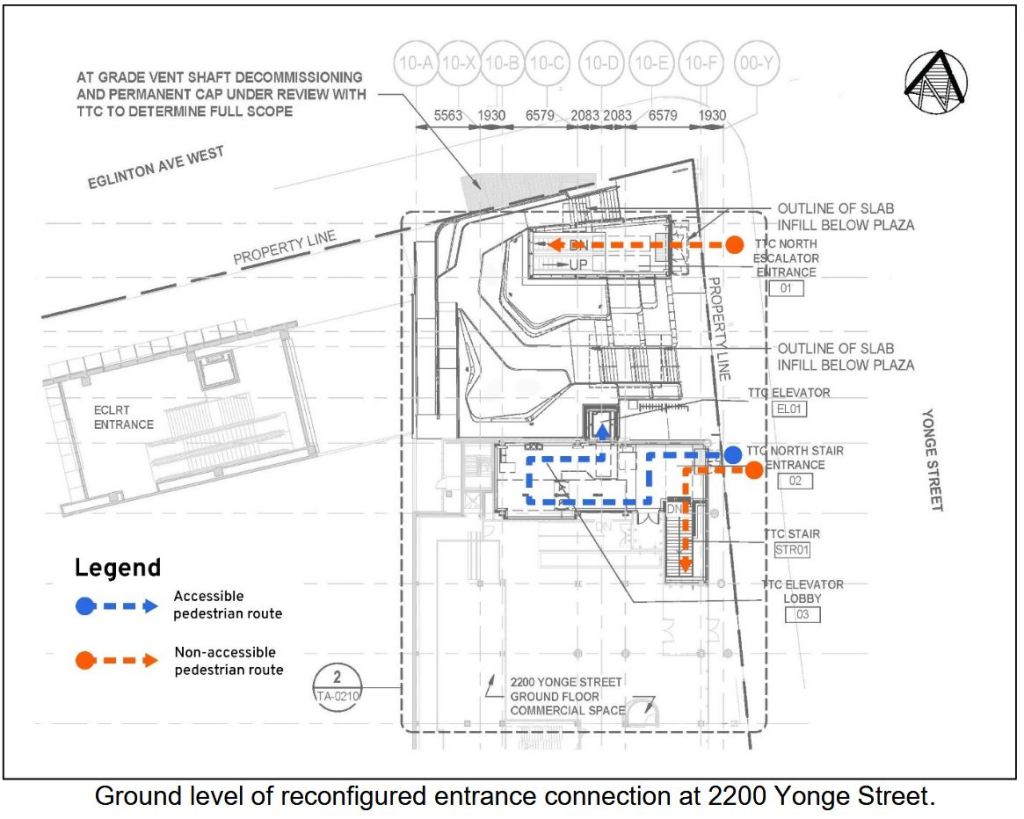
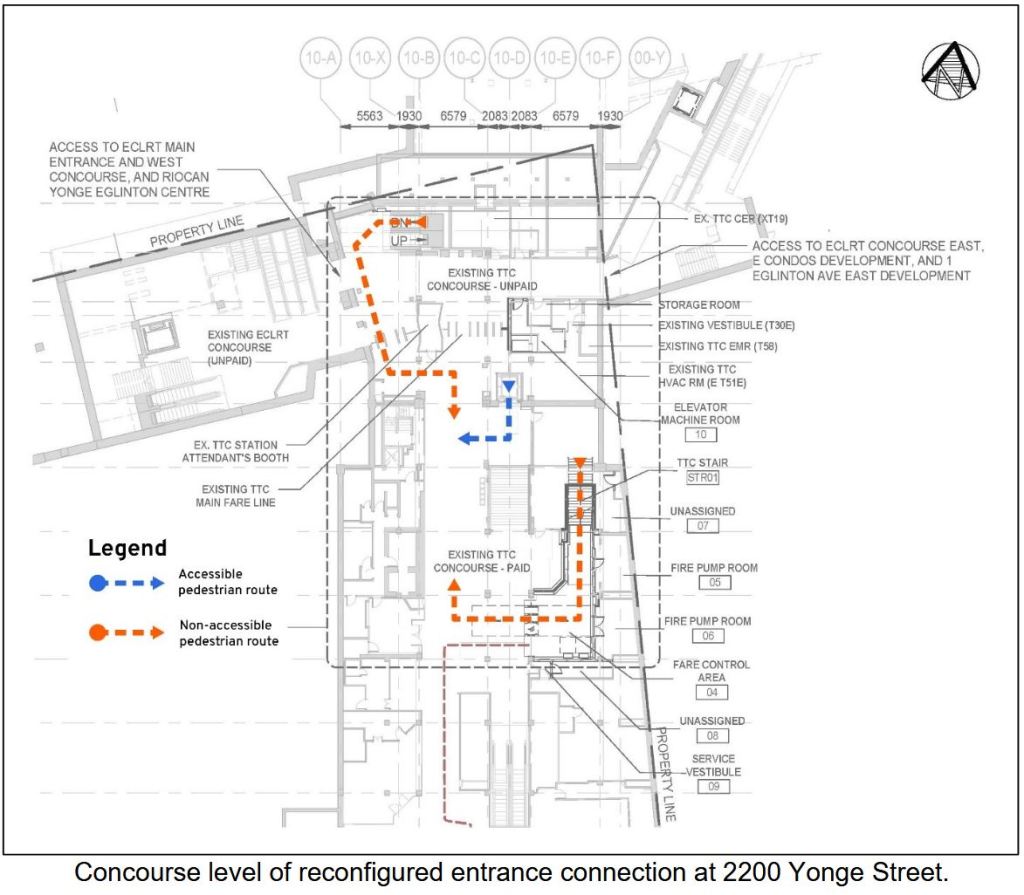
The Canada Square building on the southwest corner of Yonge & Eglinton is to be remodeled as part of the overall development on the block including Eglinton Station and the former bus terminal. The existing street entrance through a former Bank of Montreal branch at the corner will be closed during construction from later in 2026 through Q1 2028.
The existing escalators down to the concourse level will be reused in the new entrance building. The elevator that now runs from the concourse down to Line 5 will be out of service while it is extended to street level.
A new entrance will be created south of the former bank branch onto Yonge Street (middle diagram below) before the existing entrance closes. This includes a stair down to concourse level. Once the elevator is extended to street level, this will provide an accessible path through the same entrance. Eventually, the new entrance at the corner will open. There will be fare gates at the bottom of the new stairway, and in the street level elevator lobby.
During construction, riders will be diverted to alternate paths including the existing south entrance on Yonge Street which has an elevator, and through the Line 5 station concourse. Diagrams of these routes were not included in the report.
Large Contract Awards
In mid-2025, the TTC Board increased the delegated authority for contract approvals for the CEO. Previously, he could approve any amount up to $5-million, but this was changed to allow approval of any contract within an already-approved budget, with certain restrictions. This very substantially reduced the Board’s role in reviewing contract awards.
The intent was to streamline contract approvals in parallel with a move at the City of Toronto to eliminate its Bid Award Panel. The change decouples the award process from the Board meeting timetable and eliminates the need for staff to create Board reports explaining details of the contract.
Large contract awards are now reported on a summary basis with the most recent list covering the first half of 2026. This includes the $407-million award for Line 2 resignalling.
Proposed Study of Speeding Up the 506 Carlton Streetcar
A motion by Commissioner Dianne Saxe, seconded by Chair Jamaal Myers, would direct staff to report in Q1 2027 on possible transit priority improvements including changes to signals, parking and turn restrictions that could speed up the “College streetcar” (actually 506 Carlton). It is not clear whether this applies to the entire route, only to the portion west of Yonge (which is actually called “College”), or to the portion within Saxe’s ward (Yonge to Ossington).
Fare Collection System Update
The TTC’s agreement with Metrolinx for provision of fare collection services will expire on November 28, 2027. The TTC Board still has thoughts of moving their system to another vendor:
At the April 16, 2026 meeting, the TTC Board directed TTC staff to complete a market sounding to understand value for money of current industry offerings for an automated fare collection system. A request for information (RFI) was publicly posted on May 27, 2026, for submissions until July 17, 2026. TTC staff will evaluate RFI submissions upon closure date.
It is beyond belief that Ontario would allow the TTC to move away from Presto especially with the level of regional fare integration it provides, not to mention the revenue stream the TTC represents. An important issue here is that for 15 years, the TTC has enjoyed a comparatively low fee for use of the Presto system, but that could end bringing a substantial increase in fare collection costs.
Whether any fare system vendor would even respond to an RFI like this remains to be seen.
This item will be discussed in camera.
Fitness for Duty Grievance Update
Since 2011, the TTC and its primary union, Amalgamated Transit Union Local 113, have been locked in grievance proceedings about random drug testing.
Many of the initial issues raised in the grievance were resolved by the parties, with the exception of the use of random testing, the use of oral fluid testing, the cut-of levels with respect to random, post-incident and reasonable cause testing and safety flags for blood alcohol readings between 0.02% and 0.039%. [TTC Report]
The Toronto Star’s coverage of this decision includes a link to download the full 368-page pdf of Arbitrator Laura Trachuk’s ruling. For those wishing to jump to the analysis and conclusions, they begin on page 344.
The Arbirtator ruled that the random testing program
- contravenes Section 8 of the Canadian Charter of Rights and Freedoms: “Everyone has the right to be secure against unreasonable search or seizure”, and
- that it “is not a reasonable exercise of its management rights and is a violation of the collective agreement”. [Ruling at p. 351]
Going into the arbitration, there was a “scope document” setting out the issues to be resolved. (See par. 4, pp 3-5 of the ruling.) Of particular note here is that ATU 113 does not dispute the right to testing post-incident:
8. […] the Union does not challenge the legality of the TTC conducting reasonable cause and post-incident drug and alcohol testing or Post-Treatment Monitoring testing, pursuant to the FFD policy, in the Trachuk Arbitration or in any other proceeding. For the sake of clarity, nothing herein precludes the Union from challenging the circumstances under which any such test is performed and/or the specific aspects of each test on a case-by-case basis.
9. The Union is also not challenging that the use of breathalyzers to conduct breath alcohol tests is reasonable and lawful as set out in the Policy. For greater certainty, the Union is not challenging the use of breathalyzers as an unreasonable invasion of privacy, including (but not limited to) under section 8 of the Charter.
A major issue in the grievance is the use of random testing that is not connected to an actual incident. The arbitrator ruled in the Union’s favour and in particular challenged the supposed link between a test showing past consumption of substances and fitness for duty at the time of the test.
An outstanding issue is the status of the eight employees whose cases were cited as part of the grievance, as well as the much larger number of employees who were dismissed under the Fitness for Duty program.
The TTC has not yet announced whether it will appeal the ruling.
Local 113’s press release is here.
This item will be discussed in camera.


Arguably we should just be installing level platforms for most of the streetcar network which would alleviate the need for cameras and make the system more accessible and prevent cars from driving in the boarding area entirely. The temporary metal platforms are working well, not sure why we don’t just expand that program (maybe use the ticket revenue to buy them?)
I wonder if they are looking to make a case for automation of line 1. Obviously there are other ways to increase capacity, but none of them have a long term ability to significantly reduce operating costs as well. Would need to have a strong plan and agreement with the union before they started anything, but Paris has show us that it can be a win win for everyone, including labour.
Such a push would be a few years in the making as they would need platform doors and more vehicles to really get the benefit….but it would be interesting to know what headways they could reliably hit with automation.
Steve: Line 1 could be automated today. All the operators do is start the train, and close the doors. There are many challenges to moving to more frequent service including changes to stations (passenger handling capacity, ventilation), power supply (more trains need more power), terminal operation (very quick turnaround), and more. Of course more trains need more storage and maintenance facilities. Much of this is not funded in the TTC’s capital plans. The target headway is 100 seconds, compared to the 140-150 seconds now operated. This is not a trivial change.
LikeLiked by 2 people
A bus bay at Thorncliffe Station would be nice, a route that terminates at Thorncliffe Park currently has to use the >2km Thorncliffe Park Drive + Overlea Bl on-street loop with an annoying amount of stops(good for local service, not as a loop). A Thorncliffe bus bay would allow a route like the 72/81 which goes past Thorncliffe to Don Valley to save a bunch of time not slugging thru Thorncliffe. Plus, the existence of the Ontario Line removes the major demand for bus service on routes life 100, 72/81 and 25(south portion), so most southbound passengers on Thorncliffe Park Drive would be mainly focused of getting to their destinations via Thorncliffe Stn. It also allows far-fetched ideas like extending the 82 Rosedale bus to Thorncliffe via Governors bridge, Bayview and Southvale/Moore (a route that nearly nobody uses because it goes nowhere could become a useful link between lines 1 and 3 that helps take the burden off of the 88) that would terminate in the possible bus bay. It would be a major oversight to not include one in my opinion.
LikeLiked by 1 person
Hi Steve, always incredibly informative and great work! A bit off topic but are you looked at favorably by the TTC’s top brass or persona non grata? Do they ever seek you out for input or to have something passed on to your informed readers (general public)? Hope you don’t mind this query!
Steve: My relationship with TTC management has varied over the years with different CEOs (formerly called Chief General Managers) having very different attitudes. Most have been quite open and friendly, but a few have been quite unwelcome to questioning and criticism, and this filtered down to the level of co-operation by TTC staff. The worst of the lot was Al Leach for whom I was definitely persona non grata. The feeling was mutual.
Yes, I provide input by various routes such as advisory groups, but more commonly as background to members of the Board, Council and the media.
LikeLiked by 2 people
Mr Munro. Why are you not condemning this? You are up in arms when McGuinty’s Metrolinx does this but you fail to condemn this when the TTC does the exact same thing.
Steve: The TTC Board can only go into private session for certain specific types of item, notably labour relations, legal and security matters. By default, all other issues are public. At Metrolinx, a very small number of issues must be handled in public, and otherwise what we get are puff pieces extolling recent accomplishments. There is no public discussion of policy nor soul-searching on what might have happened with cock-ups like the 6 Finch rollout. TTC and City budgets are complex, but public. Metrolinx goes out of its way to hide information in the name of “commercial confidentiality”. The situation is like night and day.
David Miller carhouse? When was this named after David Miller? Has he passed away? How old was he? May be rest in peace along with his successor Rob Ford. No carhouses named after Rob Ford yet?
Steve: The decision to name the carhouse after David Miller was taken in fall 2025, but the actual ceremony took place in May 2026. Miller was a strong supporter of the streetcar system and Transit City. For his part, Rob Ford tried to kill the streetcar system and did manage to deep six much of TC, although portions were reborn as Lines 5 and 6 with lots of problems thanks to the combined incompetence of various agencies and their private sector partners.
If Rob Ford deserves to have anything named after him, it would be a rehab centre, not a carhouse.
LikeLiked by 1 person
With some respect for the late Rob Ford, who at least would send back a letter to my missives to all Councillors on some issues, maybe we could rename an ‘excessway’? (which was a term for a road, coined by I think a David or Michael Parkinson). And yes, they service suburbs, which do cost us, in a myriad of less-obvious ways, including climate.
LikeLike
I really hope the new Canada Square building ends up tearing down the LRT station and rebuilding something better. It’s such a waste of real estate, and the internal design is pretty awful.
Steve: The Canada Square building isn’t going away, only the small extension at the north end with the existing entrance and the former bank branch. This will be rebuilt. The LRT entrance on Eglinton west of Yonge will remain.
LikeLike