
The Metrolinx Board met on June 25, and as usual for that secretive organization, most of the agenda was discussed in private session. What they do talk about in public is inevitably “good news”, and there is rarely any indication that the Board might have issues with management.
Items included in this article:
- Write-Down of GO Transit Assets
- GO Transit Project Status
- Update on Line 5 and Line 6 LRT Operations
- Fare Enforcement Bylaw Update
Write-Down of GO Transit Assets
Of particular interest was an obscure item buried in the draft Annual Report. This was an accounting write-down of $500-million worth of signalling improvements in the Union Station Rail Corridor (USRC). In brief, much of the new plant that was installed is based on the 2013 track layout at Union and cannot be repurposed for planned revisions in the GO Expansion program.
Jack Hauen of The Trillium first spotted this and his article ran on June 22, three days before the meeting. There was only a brief mention of this by the Board in public session and no sense of why it took Metrolinx so long to realize that their GO Expansion and Union Station signalling plans were out of whack.
In brief, the existing station contains a large collection of switches that allow trains to move between the eastern and western approach tracks and almost any platform in the station. While this worked in the days of infrequent intercity passenger rail service, for frequent commuter rail operations this layout creates many conflicts between trains and limits station capacity. In the “new” station, if we ever see it, each GO corridor will have a dedicated platform and pair of tracks and the complex approach trackage will be greatly simplified. Metrolinx only realized their error a few years ago after the project had been underway for a decade.
In his remarks, CEO Michael Lindsay observed that the Union Station Rail Corridor is key to GO Expansion. Metrolinx has learned more about track configuration and what they will need, and appreciate the technical challenges for redoing tracks and signal. The original legacy signalling project was life extension program, bridge to modern system in USRC, but it will not provide much use to reconfigured corridor. This is part of the cost of meeting the ambition/mission of getting service levels to where they should be.
That’s a rather glib way of describing a major planning cock-up. It took ten years from the outset of the signalling project to recognize that the USRC track and platform layout would change, even though proposals for this had been floating around for many years. Metrolinx effectively compromised the potential for service expansion by clinging to a track layout designed for a very different service pattern.
Details of this are on pages 70-71 of the Annual Report, and are echoed in footnote 7 to the financial statements on pages 106-107.
Write-offs increased significantly primarily due to a $504 million charge for the Union Station Rail Corridor (USRC) Signalling System Project (known as the Train Control System project).
This project was initiated in 2013 to replace end-of-life signalling assets in the USRC, based on the existing track configuration and with limited allowance for future track layout changes. The concept of GO Expansion was launched after the initiation of TCS. The continued development of GO Expansion necessitated improvements to the track and station platform layout, impacting ongoing work related to replacing the signalling system in the USRC.
The project was paused in 2023 when the risk of incompatibility was identified and while advanced layouts for the track and platforms were still being developed. Therefore, there was material uncertainty in prior years as to which specific assets would no longer have permanent service potential as this was dependent on the advancement of the GO expansion track design. Accordingly, a reasonable estimate of impairment was made in prior years given incompatibility of work completed could not be fully assessed until GO Expansion track deign within the USRC was advanced.
Further developments over subsequent periods resulted in modified track layout designs that were advanced in the year ended March 31, 2026, and based on management’s evolving understanding of the project status and expected future asset usability, management determined that the initial work completed on signalling assets would not proceed as originally constructed and envisioned. This resulted in the recognition of an impairment charge in the current year and a usable portion of the work completed has been retained for the GO Expansion program. [p. 70]
Huge as this write-down might be, it does not affect the Metrolinx’ bottom line because the transaction is within capital assets, not the ongoing operating side of GO Transit. Under Public Sector Accounting Standards (PSAS), when an asset is acquired with subsidy money, two entries are created on the books. One is the asset itself, and this is depreciated over its useful life. The other is the subsidy which, although it is obviously spent up front, is carried as “future revenue” and recognized at the same rate as the depreciation. The two entries offset each other.
In this case, because the asset was written off earlier than planned, both the asset value and the corresponding deferred revenue were recognized at the same time. Metrolinx didn’t “lose” any money on operations, but a pile of capital went up in smoke leaving a future new project to install another signal system as yet another call on Provincial funding.
The USRC signals are not the only dubious Metrolinx investment, but write-downs have not yet occurred for the others. The report is silent on which projects are affected.
Future Year(s) Risks
Metrolinx has assessed certain construction-in-progress assets for impairment at March 31, 2026. In performing this assessment, management considered whether events or circumstances indicate that these construction-in-progress assets may no longer contribute to Metrolinx’s ability to provide goods and services, or whether there has been a permanent decline in their service potential.
Additionally, management identified measurement uncertainty relating to certain capital works in progress for which future government decisions, funding approaches, scope changes, evolving third-party interests, or project pauses may affect the manner or extent of their future use. Management recognizes that infrastructure investment is subject to future government funding decisions, which may affect projects currently underway and could require assessment of the resulting financial statement impacts. Management has identified three areas of measurement uncertainty within the current Metrolinx Capital Plan: the GO Expansion program, for which future government funding decisions may affect the scope and timing of planned works; Union Station and the Union Station Rail Corridor, where evolving third-party interests may affect current plans; and other capital projects that have been formally paused pending further direction and funding approvals from government.
Based on information available at March 31, 2026, management has determined that no write-down is required at this time; however, future decisions and outcomes relating to these projects may affect their expected service potential and future use. As a result there is a measurement uncertainty associated with these balances, and it is possible that a write-down may be required in a future period. [pp 70-71]
The basic problem is that Ontario has been announcing transit expansion projects and studies, and supposedly committing funds at a rate not seen before in local transit history. That well is running dry, and with it the possibility that some projects might never see the light of day. They may be “formally paused” for some time. This should be a warning to those who expect their pet projects to appear on the active list soon.
GO Transit Project Status
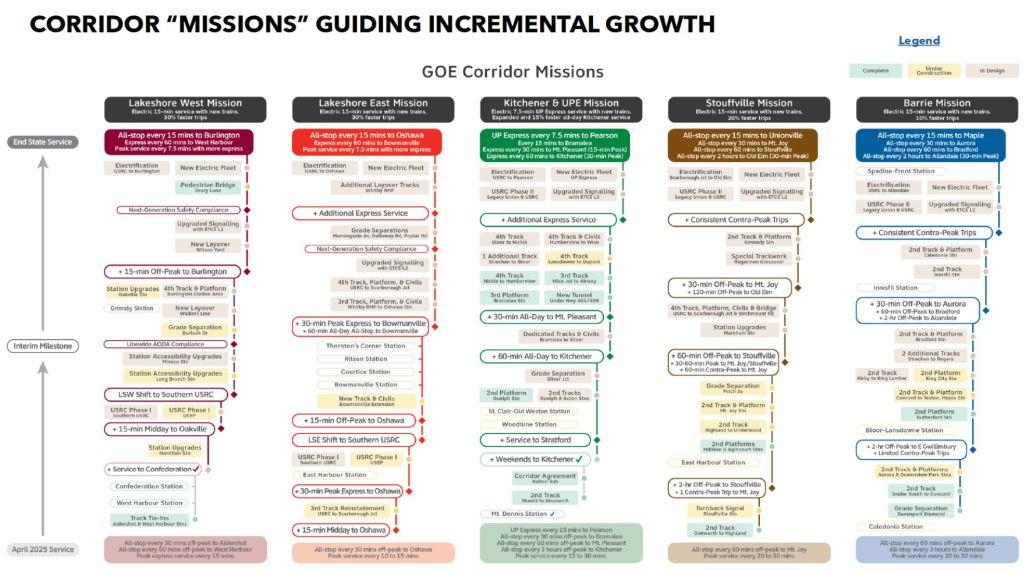
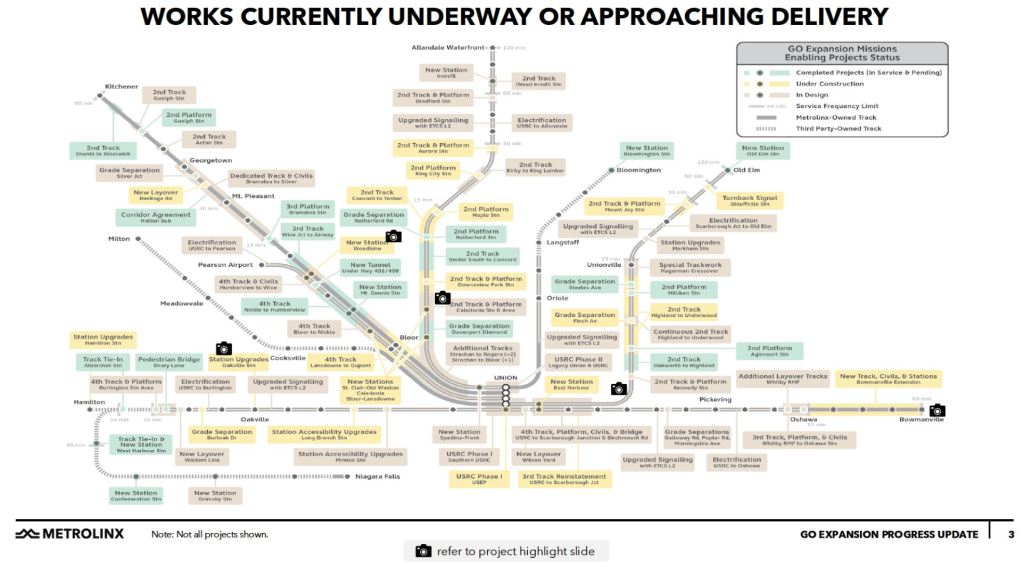
Charl van Niekerk, Chief Capital Officer (GO & UP), presented a “State of the Network” most of which was photos of construction in progress. This includes chart showings the various works needed to reach the target configuration for GO/UP services, and another showing the status of each component. (This is an update from a previous version.)
Although there is an “End State Service”, no dates are attached. Electrification including a new fleet comes at the very end of each corridor’s evolution.
Note that the Richmond Hill and Milton corridors are not included in the “missions” chart, although they are included in the works in progress.
Update on Line 5 and 6 LRT Operations
Every Metrolinx public meeting begins with a “safety moment”. This time out we had an exhortation from Sean Fuller, Chief Operating Officer, that passengers on the LRT lines, if standing, should hold on to seats or poles lest the train suddenly make an emergency stop. This verges on blaming riders for the technical problems with train control systems and the very sudden, unpredictable stops that can occur. Riders will know of the repeated reminder, in both official languages, that plays incessantly on trains. Just possibly, Metrolinx would fix their systems, but there was no mention of any ongoing work to deal with the problem.
According to CEO Michael Lindsay, in the week of June 15, Line 5 Eglinton achieved 90% on time status, and carried 75K riders per day. The round trip time is now 105 minutes, a claimed double digit improvement, and the “full complement” of vehicles is now in service. As for “on time” status, the TTC’s metric for this is rather elastic. Tracking data for the LRT routes is not available because the TTC forgot to include this in the operating agreement with Metrolinx, and so there is no independent way to verify claimed performance.
The original February schedule for Line 5 called for 108 minutes driving time plus 6 in recovery for a total of 114. The June 2026 schedule specifies 98 minutes driving time plus 10 in recovery for a total of 108. This is a “double digit” improvement in driving time only by a hair, an illustration of Metrolinx spin.
As for the “full complement” of vehicles, the Line 5 fleet contains 76 cars of which peak service consumes 28 2-car trains, or 56 cars. Allowing for spares at 20%, 67 cars in the fleet are spoken for.
On Line 6 Finch, on time performance was 93-95% with 25K riders per day according to Lindsay. There is a substantial difference between claims made in the Line 6 FAQ and the real world.
The FAQ claims that Line 6 will carry 46K riders per weekday, almost double the reported number.
It also claims a 33-34 minute travel time one-way. Scheduled times were 92 minutes round trip plus 6 minutes recovery in December 2025 when the line opened, and the June 2026 schedules provide 88 minutes travel time plus 10 minutes of recovery. 44 minutes one-way is one third more than the promised travel time.
Very bluntly, the Metrolinx Board might not know they are being misled, but anyone with basic internet skills can look up this info for themselves.
How fast will trains on the Finch West LRT travel?
Light rail vehicles on the Finch West LRT will take approximately 33-34 minutes to travel from end to end, for an average speed of 20-21 km/h (including stops). LRVs will reach a top speed of 60 km/h.
Once built, it will provide rapid transit to 46,000 passengers per weekday. [Line 6 FAQ]
In a rather amusing contrast to the TTC’s current fetish for removing stops to speed service, the Line 6 FAQ notes that system usage can be affected if passengers cannot easily access “in between” locations. This argument evaporates, of course, with grade separated lines where the high cost of stations limits their numbers.
Why are there so many stops?
Toronto City Planning provided inputs in determining the number of stops and their locations based on overall city planning and connectivity. The locations and spacing of stops are based on estimates of passenger demand and connections with existing TTC north/south routes. When stops are too far apart, it becomes more difficult for passengers to access when located in-between, which reduces overall system usage. [Line 6 FAQ]
Fare Enforcement Bylaw Update
Metrolinx is following the TTC in setting penalties for evasion much higher than the current rates. There were two questions from Board members, but no sense of umbrage that the fines, pardon me, “fees” were too high.
One member asked about the discretion available to fare enforcement officers. Management replied that there already is a procedure for this, and it depends on whether this is an isolated incident by a regular rider who normally pays their fare.
One member asked about the success of the body cameras officers now wear. Management replied that the cameras have changed the dynamic between riders and staff. Officers are “overwhelmingly excited” and the cameras reduce contention.
The updated structure is expected to generate 6.79M–$10.18M per annum. Because these are fees, not fines, the money goes to Metrolinx, not to general public revenue.
Metrolinx’s fare evasion rate for 2024/25 was 5.30% and this was reduced to 5.08% in 2025/26 when on board fare inspections rose by almost 30%. A one percent reduction in fare evasion is estimated to bring $4.28 million in additional revenue. The cost of achieving such a reduction is not discussed in the report, nor the issue of diminishing returns the closer to zero evasion one attempts to reach.
| Number of Violations | Sept 2022 Schedule | Sept 2026 Schedule |
|---|---|---|
| 1 | $35 fee | $200 fee |
| 2 | $50 fee | $300 fee |
| 3 | $100 fee | $400 fee |
| 4 | $200 PON | $500 PON |
| 5 | $500 PON | |
| 6 or more | Summons up to $1000 (determined by court) |
Miscellany
CEO Michael Lindsay reported that GO Transit is the North American rail agency with the highest recovery rate compared to pre-pandemic times. Ridership is up 8.2% in the last fiscal year, and the rate has increase to 9.2% in the first month of the new year (April 2026).
The contract with Alstom for GO/UP fleet maintenance has been extended five years following the collapse of the proposed deal with ON Express> Metrolinx is looking at the medium and long term, but management was silent on what this would entail.
The rebuild of the Presto system into an accounts-based platform is complete.
The Hazel McCallion LRT line (aka Hurontario) project was a P3 DBFOM (design, build, finance, operate, maintain) contract, but this has been reworked into two new contracts on the “alliance” model where the commercial arrangements are more collaborative than in a P3.
More police and safety staff have been deployed at Union Station, and Metrolinx is recruiting up to 36 new officers on a base of 90. With the Toronto Police Service presence at Unon, Metrolinx is considering redeployment of some of their own staff to other parts of the network.
A report on the USRC derailment in February 2026 was discussed in private session, but Metrolinx plans to make this public over the summer. Lessons learned include enhanced maintenance, new procedures for disabled trains and for handling of “captive” passengers.


Is that what they are calling Alto now?
HSR has the possibility of throwing basically the entire union area into chaos…just wait until they have to rip out the new bridge and station at east harbour or add two more HsR tracks to Hamilton…potentially will make these write offs look like a rounding error…
Steve: Actually, that refers to the rail deck west of Union Station. But yes Alto could cock up a lot too.
LikeLike
A couple weeks ago the TTC published a real-time arrival feed for the subways and LRTs. It doesn’t include Line 6 but Line 5 does works for a few hours a day.
TransSee has been gathering that data and some analysis reports are working, including the Stop History and Link Times. It doesn’t link to the schedule, so schedule adherence isn’t available.
For example, the travel from from Ionview Station → Keelesdale Station is 42 to 50 minutes. (Link requires TransSee Premium)
LikeLike
Wonder how many of the Metrolinx executives have only an accounting background?
LikeLike
No one likes fare evaders. But with the GO service model it’s possible to either forget to tap or not have your tap read properly. Some times you are in a hurry to make your train and don’t want to miss it. (For example, TSO concerts end when they end, but the LSE and LSW trains are only every half hour. I’ve done some jog-trots from RTH to Union staiton.)
I know there have been occasions where I wonder “Did I tap on?” There’s no way to check once you’re on the platform or train. Fortunately, as it turns out, I was legit every time. But there’s always a chance to make a mistake. It’s not like there’s a gate or turnstile that, by opening, verifies that you have tapped your card properly.
LikeLiked by 1 person
$500 million is a huge write-off, taxpayer money or not.
But the dollar amount of lost economic opportunity to the City of Toronto and the GTA / Southern Ontario due to government misadventures in delivering timely public transit expansion is staggering.
We have likely locked in lower economic growth for a long time, if not permanently.
LikeLike
Not living in The Big Smoke and not reading *every* post here, I don’t recall when Metrolinx was imposed on Toronto. Was it all the same people that were at GO previously plus a bunch of patronage jobs or … ? Was it a Fordism or one of his predecessors?
Steve: Metrolinx did not originally include GO and the marriage of a regional planning agency and an operating commuter system did not go smoothly. It dates back to McGuinty and originally had a fairly independent board with many regional pols and true professionals. This was painted as dysfunctional, but that was a convenient fiction advanced to allow a restructuring into a more politically obedient board. A lot of the secrecy at Metrolinx dates from that time, and the situation under Ford simply ramped up what was already there.
Before Ford came to power, Metrolinx was regarded by Tories as a cesspool of Liberals that should be dismantled. Former CEO Phil Verster turned Metrolinx into Ford’s transit agency and out came bold new plans shortly into the Ford era. Verster and Ford are both bullies and this was reflected in the Metrolinx style of dealing with the public and municipalities.
Expertise in actually building things is not required when you’re at the level of presenting “bold visions”, and it would be years before we saw the incompetence with which real projects were designed and managed.
There is a basic problem that for years Metrolinx was a development and construction company that happened to run a few trains and buses. They did not acquire in house expertise in the belief that this could be provided through P3s and consultants.
There are people at Metrolinx and GO trying to do a good job in spite of the organization and its love for spin and relentlessly good news.
We are several years away from a new government, and Metrolinx will be a real challenge. Whether they manage to escape the knife among the many disasters Ford has brought us remains to be seen.
Anyway, I feel bad for the engineering and planning types at GO who could see what was coming when the plans for an expanded GO didn’t no longer matched what they were designing, tried to draw management’s attention to this fact, and were brushed off. The org has since proved itself incompetent in the light rail sphere, too. The Ontario Line, I’m sure, will be similarly ridiculous.
Kudos to Metrolinx for blaming the strap-hangers for failing to hold on for dear life. Someone, decades ago, in the NYC area claimed that “the profit came from the strap-hangers” (paraphrasing). These days, it’s almost all “free” tax money running the system, but trains that are routinely carrying crush loads are usually more than covering their costs, at least above the rail.
As for Alto … The Québec City – Laval – Hawkesbury – Maybe Ottawa HSR “plan” is a joke. I am strongly in favor of HSR and believe it would do very well in the “Quebec – Windsor Corridor” but what they are proposing is just dumb. Yes, Québec’s AssNat threw a wrench into things by giving the Mount Royal tunnel to the public pension fund for their equally poorly planned “REM” minirail but having the Montréal station in Laval is … not going to make “Alto” work well. And then there’s the poor “public consultation” process that VIA Rail Canada d/b/a ALTO is following … yikes.
If Parliament was serious about passenger trains, there would be at least hourly service between Québec – Montréal – Ottawa – Toronto – Windsor *today* … but there is not. Not even close. And they can do that without spending billions and billions on a poorly planned project.
LikeLike
Yes, $500M is a HUGE amount of money. But my strong sense is that most of Mr. Ford’s transit schemes aren’t really of lasting value, including a too-short Relief Line that zig-zags overmuch, and fails to go far enough west, and may be an overbuild, compared to a plan B of somewhat light-rail in the Don Valley, including parts of the DVP, done theoretically in a couple of years vs. …… a decade? And while we need a Relief function, absolutely, as the main spines are far too long/brittle, I don’t think computers are going away, so the potential for remote work to undercut whatever mathemagics are in the Business Cases remains real. But, what’s a few billion eh?
LikeLike
Jason: $500 million is a huge write-off, taxpayer money or not. But the dollar amount of lost economic opportunity to the City of Toronto and the GTA / Southern Ontario due to government misadventures in delivering timely public transit expansion is staggering. We have likely locked in lower economic growth for a long time, if not permanently.
The same can be said about the streetcar/LRT system. Billions of working hours have been wasted over the last 50+ years by workers stuck on the streetcars/LRT. There is a reason that all of the manufacturing has moved to Asia. They build high speed infrastructure there while we are hellbent on building these extremely slow streetcar lines. To this day, Steve opposes grade separation because God forbid that it might speed up our transit system. Steve please, you don’t work and that’s fine but why are you hellbent on delaying the rest of us on our way to work and back?
Steve: I may be retired now, but commuted to work by streetcar most of my working life. Only when my job shifted to STC did I commute subway/SRT. I do not oppose grade separation per se but it simply cannot be justified everywhere. Also, there tend to be fewer stations and both the line and destinations along it are less accessible.
As for extremely slow new lines, they are a product of design stupidity by Metrolinx, TTC and Toronto Transportation Services who collectively hobbled the line with speed restrictions and other operating practices that were definitely not what LRT advocates like me wanted. But if the agenda was to demolish the concept of surface transit and make everything super-expensive, they did a fine job.
LikeLike
And what exactly did the Liberals build in their 15 years reign? A dirty noisy diesel line to the airport? Yes. Hydrail? Where is it? Maglev connecting Windsor to Toronto? Where is it? Oh yes, the Liberals wasted billions upon billions in building nothing in what was one multibillion dollar scandal after another after another and so on. At least Ford is building what he promised and no multibillion dollar scandals under the Ford administration.
Steve: Just to cite one agency, have you been following the continued circus at Metrolinx where project are late and way over budget? The half-billion dollar writeoff of an inappropriate signal system installed at Union Station? Equipment and infrastructure on brand new transit lines that regularly fails? We don’t know all of the Ford scandals yet because the government locks down all available information.
LikeLike
Make all the complaints about Metrolinx to Dalton McGuinty and his cronies. Dalton McGuinty ruined the Liberal brand, there is a reason that the Liberals can never win more than two seats.
Steve: Although not impressive for a party that was once the government, the Libs have 14 seats today, somewhat more than two. I’m looking forward to the day we can talk about how Ford and his cronies ruined the PC brand, but the Libs are not showing signs of growing into a credible opposition.
LikeLike
Ed said
For those with the PRESTO mobile phone app, it gives a near-live view of your tap history. I am not certain if this depends on the specific device / agency, but I recently rode TTC with family and was able to see the remaining transfer period counting down for two different cards on my account. Nice improvement.
LikeLike
Glad I checked in again, and some quickback to Mr. Josh, and thank you Steve for sharing this, because I’m sure he’s not alone. Yes, $500M is a Lot of $$$, but subways in the less-wise places are also not good spendings, and neither are highways like the proposed 413, which isn’t having its costs released if memory serves, though aren’t contracts somewhat given? And speaking of ‘free’ ways, the subsidies to private vehicles, and trucks, are also massive, likely in the billions per year, though the cars/trucks are costly to buy/run/insure etc. And heck, even Mr. Gardiner himself saw these vehicles as the main cause of congestion, so to return to the attack on Steve, a clear RoW for transit is cost-effective, but it takes political will vs ‘caronic’ denial and carruption, fairly common in North Americar. (Killed by a Traffic Engineer by Wes Marshall is a good newish book, with copies in TPL).
LikeLike
Perhaps “Howard” and “George” might recall another Ford, who cancelled everything in 2010 so it all had to be rebooted from scratch.
Plenty of blame to go around, and it doesn’t stop at the Fords, McGuinty, Wynne, or Tory.
LikeLike
I’m glad I checked in again, and glad for Ed’s adding reference to the late Mayor Ford scrapping things, and the Suspect Subway Extension is now about double, with NDP being a bit silent on it all, because votes. And yes, Liberals have the Sorbara Subway Extension, which wasn’t referred to by Howard nor George.
Oh, and overall provincial debt is about a half-trillion now, and it’s gone up a lot under Premier Ford, so unless they’re taking the ‘bankrupt the system’ up an order of magnitude or two, it’s a Lot!! more than a mere $500M.
And as I type this, there seems to be a blockage still of Bathurst NofBloor from a vehicular crash with one vehicle flipped over in the middle of the tracks, so no bus service on this part of Bathurst maybe, and at least it’s NofBloor, so buses can migrate, and I don’t think any deaths. TTC is a safe system, though we’re still not counting the streetcar track related bike crashes.
LikeLike
One concern I have with the idea of more collaborative “alliance” contracts is that it might result in problems with Metrolinx’s increasing use of foreign mega construction firms. In the past, Metrolinx used Canadian construction contractors. Being local, they were more cordial if only because they depended on the government for future contracts, and the Ontario government had the power to rewrite the contract at any time anyway using its government powers. Canadian construction firms need a good working relationship with the Ontario government if they want to survive in the future. But I don’t know if these large American construction firms that Metrolinx is using now are necessarily so collaborative in nature.
Perhaps I’m just stereotyping things, but I worry they may be more adversarial in culture and more litigious if things go wrong and more prone to taking advantage of loopholes in contracts for additional profit. And the balance of power is not equal with the government having less power over them because they’re foreign, and the construction firms potentially even being able to use other governments as shields. I guess we’ll find out once the Ontario Line contracts start exceeding their budgets and the lawsuits start getting swung about.
Steve: Well, in the older P3 days, we had Canadian contractors who had to sue Metrolinx to get paid what they were owed. In one case, Metrolinx tried to claim that the Covid pandemic did not count as an “act of God” that a contractor could use to justify extra costs. Metrolinx was laughed out of court on that one.
The real issue is whether Metrolinx, and their partners in contracting, Infrastructure Ontario, write good contracts that don’t expose projects to extra costs through bad design specs. At least with an “Alliance” model, in theory the contractor is partly responsible for the design and costing, and the relationship is supposedly more congenial. We will see as the OL project progresses.
LikeLike