
Updated July 4, 2011 at 11:10 am:
Recently, the Toronto Star reported that Metrolinx had claimed that the travel time by underground LRT from Kennedy Station to Jane Street would be 25 minutes. They have now confirmed that the correct figure should be 35 minutes.
Also, the full presentation given at the recent board meeting regarding the Eglinton line is now available online. Only the station design portion had been posted originally.
Updated June 26, 2011 at 10:00 am:
The June 23 presentation on the Eglinton LRT line contained a great deal of interest. In addition to the presentation on station design available from the Metrolinx site, staff gave us a new ridership projection based on the “all underground” alignment of the route.

Total ridership in 2031 is projected to be 30% higher than with the surface/subway LRT design primarily because of the higher speed and the availability of a through route from the Scarborough leg to the Eglinton line. Most of the increase comes from shifted riding from the Danforth subway to Eglinton, with a minor contribution from auto-to-transit migration. Riding on the Scarborough leg drops in the projection due to the line’s termination at McCowan and the absence of a through connection to Sheppard East.
Peak point ridership doubles from about 6,000 to 12,000 passengers per hour westbound to Yonge-Eglinton station.

This chart also plots flows on other parts of the network, although no numeric values were supplied in the presentation. I have requested this info so that the full implications of the chart can be better understood.
The chart asks more questions than it answers:
- The demand westbound from Kennedy is about 75% of the demand arriving at Yonge, although there may be some turnover along the route. Details of this would indicate the degree to which the new network is simply funneling traffic from northeastern Scarborough to the Yonge Subway as opposed to providing service to many points in between.
- Placing a scale on the chart to estimate the values on other network segments, notably the Yonge Subway southbound, the values appear to be in the same range as 2011 demand, or possibly lower. A reasonableness check is needed on the projection as a whole, and these values also feed into the debate about the need for added YUS capacity and/or a Downtown Relief Line.
- The projection leaves the Sheppard Subway in its current configuration, and we need to know what the flows would look like with the proposed extensions to STC and Downsview.
- It is unclear where the Yonge subway ends in the model and whether the projection includes the effect of a Richmond Hill extension.
- The role of GO Transit as part of the service carrying riders from the outer part of the 416 to downtown needs to be explored. Metrolinx plans include service on the CPR through northeastern Scarborough, and this could be an important alternate route for riders travelling to downtown.
Metrolinx is also considering the implications of the Eglinton corridor for major GO Transit interchanges, aka “Mobility Hubs”

Although the text on this page acknowledges the difficulty of a connection to the Richmond Hill GO service in the Don Valley, it completely misses the opportunity for a hub at Leslie Street where the CPR crosses Eglinton Avenue. The planners appear to be considering the network and service levels as they now exist on GO rather than the likely status by 2020 when the Eglinton line will open. This is echoed by the lack of “bumps” in the demand projections at locations where transfer traffic to/from GO might be expected.
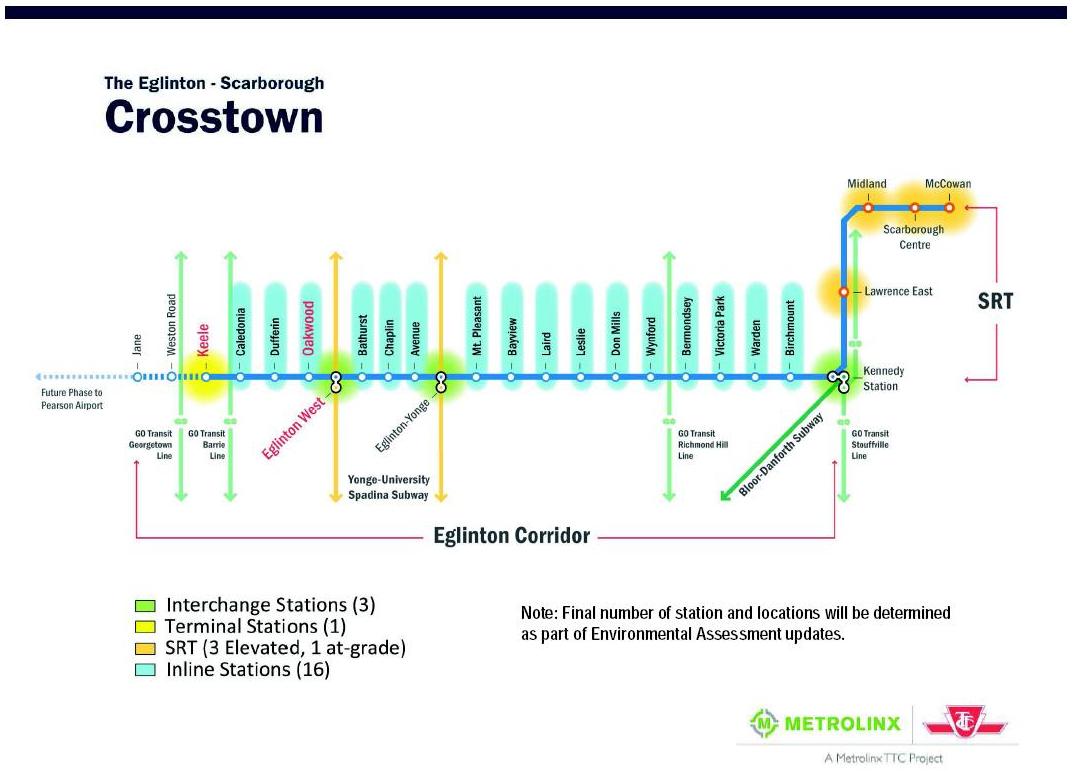
The report on station design provoked some discussion.
The proposed locations were chosen based on ridership potential, spacing, access and development potential. Although the “Mobility Hubs” map shown earlier implies a station at Black Creek, this is actually replaced by a station at Weston linking with the rail corridor.
Stations will be 125-130m long of which 97m will be the platform and the balance for utility functions, notably fan shafts. Building codes now require considerably more fire safety provisions in underground stations and this adds to the size and cost of the structures. Work on preliminary plans for five stations is underway. These will be presented at public consultations in fall 2011, Feb/Mar 2012 and May/June 2012 as they are refined.
The tunnel depth will range down to 30m. Although a preliminary design for the line to pass under the Don River has been prepared, Metrolinx is looking at an alternative crossing on a bridge between Brentcliffe and Leslie. This is expected to save at least $100m in construction cost, and avoids a need to change the location and depth of Laird Station to accommodate the approach to an underground crossing. The bridge would lie to one side of Eglinton rather than the originally proposed street-running in the middle of a widened roadway.
There was no mention of how the east branch of the Don will be handled between Wynford and Bermondsey Stations. This would also be the segment where any interchange with the Richmond Hill GO service would have to fit into the plans.
With the change to fewer stations, the issue of surface bus service came up again. Metrolinx is playing rather coy on this subject saying that this is a TTC decision, and the original Environmental Assessment for the line foresaw no local bus service.
This may seem to be a relatively minor issue, but it is an example of Metrolinx’ abdication of responsibility for local transit service. Many people will be affected if their existing short walks to a bus stop are replaced with long, possibly hilly walks to a rapid transit station. This comes up at every public meeting, and ducking the issue simply provokes resistance to the project.
[I will declare an interest in this matter as I regularly use a local stop at Banff and Eglinton, halfway between Mt. Pleasant and Bayview Stations, near a family home.]
Operation of the line will be fully automated with an onboard crew (like the SRT) as monitors, although the cars will have manual controls for use in any open sections such as yards and future surface LRT construction, not to mention during failures of the control system.
The projected 12K peak demand (in 2031) can be handled with a two minute headway of three car trains, and this includes some headroom for surges. The automated control system will allow headways down to 90 seconds, and this provides room for growth. Metrolinx and TTC are working on operating cost estimates, but these are not yet available.
Finally, the project now has a new official “branding” as the “Eglinton-Scarborough Crosstown” route with emphasis on “Crosstown”.

The typeface chosen for this is claimed/intended to be similar to the existing “Toronto Subway”. The resemblance is only superficial, and saying that it “looks like” the original does not make it so. Note particularly the difference in the “R”.

Update: Here’s what the logo looks like in Toronto Subway. (Thanks to Jonathan Chen) Note to Metrolinx: Don’t claim you are trying to match the old typeface, use it.

The name provoked some amused questions about how this would fit into a world including Etobicoke, home of Mayor Ford who is responsible for tearing apart the Transit City plan. Presumably by the time we actually have to worry about this, the words “Eglinton-Scarborough”, already a light gray, will have faded from view.
Original post from June 12:
Two major Metrolinx projects — the Eglinton-Crosstown LRT and the Georgetown South rail corridor — have had their share of road shows in past weeks, and this will continue through early summer. Metrolinx does feel-good publicity almost too well, but that’s not the sort of thing community groups particularly want to hear, especially when they’ve heard it all before.
Some of the knottier questions have a political edge, the ones the hapless staffers at public meetings cannot possibly answer, the problems that even the professional politicians and Metrolinx board and management will duck. Some are technical questions that should have an answer, but they are either evaded or answered inconsistently.
Here’s a grab bag from recent events along Eglinton.
Where Will the Stops Be Located?
Metrolinx dodges this question every time it comes up because they are still working on the design for the outer parts of the line (west of Keele, east of Laird). However, they also repeat that there will be up to 26 stations. It doesn’t take a planning degree to make a good guess where these will be.
First, we need to look at the original proposed route map for the Eglinton LRT. Between Jane Street and Kennedy Station, there are 27 stations including the terminals. Tacking on the SRT adds 5 more for a total of 32. This means that getting down to 26 will require the elimination of 6 stops. Here’s an attempt at picking them from west to east.
- Oakwood. This stop is notable by its absence from a list of stations where design work is already in progress, and it is also fairly close to both Dufferin and Eglinton West.
- Chaplin. This was a proposed site for extraction of the tunnel boring equipment (one set coming east from Black Creek, the other west from Laird), but it is unlikely to survive as a station location without major redevelopment.
- Leslie. There is little at Leslie and Eglinton to warrant a station unless GO begins operation of considerable service on the CPR line to Agincourt and beyond. “Considerable” is not two trains each way Monday to Friday. Will things be different in 2020 when the Eglinton line finally opens?
- There were 9 surface LRT stops between Don Mills and Kennedy, of which 4 are at major arterials. The Ferrand/Wynford stops will likely be consolidated, probably on the Wynford side of the DVP. A consolidated Victoria Park and Pharmacy stop with an off-street bus loop could also make sense, as part of redevelopment of the “Golden Mile”. Further east, there will be some debate about the “in between” stops given that the N-S arterials are about 1km apart, but most will not survive financial and ridership review.
- Ellesmere. This is the most lightly used station on the SRT because it has an extremely difficult walking transfer connection to the 95 York Mills bus. Parachutes and trampolines would be required to speed up this process.
This gives us more than 6 candidates, and I suspect that Metrolinx will attempt to keep the cost of this project under control by trimming as much as possible. This issue needs to be discussed openly sooner rather than later, and relates to the next question.
What Replacement Bus Service Will Operate?
When a good chunk of the LRT was to operate at grade, this question only affected the central, tunnelled portion from Laird to Keele. However, the issue is more complex now that the line will be underground. Walking distances between stations will be longer than to existing bus stops, and Eglinton is not the flattest street in Toronto. Some stations will be quite deep, and the vertical access adds to the travel time to or from a vehicle.
East from Yonge, there are many routes, but the most frequent services are 34 Eglinton East, 54 Lawrence East and 100 Flemingdon Park. Others run infrequently if at all. To the west, there is 32 Eglinton West briefly supplemented by the two Avenue Road services, when they run. The TTC would save much grief at public meetings by simply stating that there will be a surface bus that would operate (say) on no worse than a 15 minute headway. This would be comparable to the 97 Yonge bus in the “old” section of the city south of York Mills. (I would argue that all of the parallel-to-subway routes should be improved as an accessibility measure, but that’s a topic for a different post.)
This is an example of a jurisdictional split between Metrolinx (responsible for building the rapid transit line) and the TTC (responsible for operations). As Metrolinx/GO expands out from the core, they will produce new demand patterns that local transit systems may be ill-equipped (and funded) to address.
How Will the Line Cross the Don River?
Although the Metrolinx/Ford Memorandum of Understanding has an escape clause for surface construction at the Don River, various project staff have claimed that the line will go under the river.
From detailed drawings in the EA for the LRT proposal, we can see how much different the grades and elevation (depth underground) the line would have to be to get under the river. Five pages from the EA are discussed below.
- Plate 68 shows the proposed portal east of Brentcliffe. This shows the tunnel alignment (near the bottom of the drawing) and the declining elevation of Eglinton Avenue as it drops into the valley. Note that the vertical and horizontal scales are not equal, and the grade looks much steeper than it actually is. A 5% grade is the maximum that would be provided for LRT, and for full subway 4% is preferred (the grade from Summerhill to St. Clair is 4%).
- Plate 69 shows the bridge over the west branch of the Don at Sunnybrook Park. Note the additional depth of the river valley itself below the elevation of the bridge deck.
- Plate 70 shows Eglinton rising out of the valley and passing below the CPR viaduct.
- Plate 76 shows the Wynford station at the west side of the east branch of the Don. The plan does not show the elevation of the river itself, but the drop off into the valley is visible.
- Plate 77 shows the east side of the Don.
There is no question that a tunnel is possible, but going under two rivers adds substantially to the cost, and it affects the depth of nearby stations which may have to be further underground to keep grades down to the river crossings within allowable limits.
Going under both branches of the Don is an expensive decision, and at the very least Metrolinx should keep the options open until the cost tradeoffs are understood. Such a cost saving on Eglinton presents Mayor Ford with a dilemma: making Eglinton cheaper to build frees up money that could underwrite the Sheppard subway.
Underground Through Weston
During the Eglinton LRT EA, the TTC and Metrolinx were immovable on the subject of an underground line through Mt. Dennis, the section on either side of Weston Road. This produced local resentment in the vein of “North Toronto gets a tunnel, but we poor folks get stuck with surface operations and community disruption”.
The TTC produced plans for an underground alignment, but rejected this option to keep costs down. Here are excerpts from a January 2010 presentation.
- Recommended Weston Stop: This shows the arrangement for a surface stop on Eglinton west of Weston Road (the location is dictated by space constraints of the underpass to the east). A common centre platform is shared by both directions of travel.
- Recommended Alignment — Property Impacts: Because Eglinton is narrow where the platform would be located, there are extensive property effects notably for a block of houses on the north side of Eglinton that would be demolished to allow for road widening. To say that this is unpopular would be an understatement.
- Underground Alignment: This shows a variation with the line passing under Black Creek, the rail corridor and Weston Road underground. Whether both Black Creek and Weston would actually get stations given the cost and likely demands at each point is hard to say, but this illustrates the general placement of the line.
- Underground Alignment — Property Impacts: Like the surface scheme, this design requires demolition of houses on the north side of Eglinton. However, much of this is due to the presence of a storage track west of the station which is intended for use as an emergency turnback. This was a clear example of the TTC adopting a design that would skew the choice to their preference by making the demolition of homes common to both schemes. The station has a crossover east of the platform. This is quite adequate for emergency operations, or it could be dropped completely as there will be a crossover at Keele which also has a surface bus loop, and there would also be a crossover at the terminal, Jane Street.
The alignment through Mt. Dennis has been a delicate issue for some time, and Metrolinx would be wise to begin addressing this as soon as possible. Delay only feeds a suspicion that the line will never get past Black Creek or, at best, a connection to the Weston rail corridor.
Service Level
In response to a question about the level of service riders might see, a Metrolinx official replied that there would likely be 3-car LRV trains running every 6 minutes at peak, 12 at off peak. Metrolinx needs to understand that “rapid transit” is not the same as a GO train every hour. On a route where the average journey will likely be under 20 minutes (few will make the 45 minute trip from STC to Jane), long headways will contribute substantially to the trip length and to a perception that service is less than adequate. There’s a reason why the TTC runs subway trains every five minutes whether they are needed or not.
If this was an off-hand remark, it needs to be rethought, and quickly. Odd, indeed, that Metrolinx can muse on service levels in the Eglinton LRT subway, but not for what is almost an afterthought, a parallel surface bus.
Future Airport Service
After spending $8b to keep Mayor Ford happy by burying the entire line, we will still only be able to ride to Jane Street at best. Extending the line to the airport is a task for the next decade, presumably when this can be done on the surface without interference from the Mayor’s office. There will probably be a variation on Kipling Station’s Airport Rocket running west on Eglinton for many years.
Metrolinx still speaks of both the Eglinton and a future Finch line reaching the airport, but this is not going to happen using LRT in the current political climate. Meanwhile, we will have the Air Rail Link starting in 2015, but this is still to be a premium fare service and will be of little value to the most important group of potential riders, the people who work at the airport.
It’s worth noting that the ARL will provide about 18,000 daily seat-trips both ways from Union to Pearson (with a stop at Dundas West and possibly a station somewhere in the Weston area). They will not all be full — that is the nature of all-day transit service. (That’s 126 seats/train, 4 trains/hour, 18 hours/day.) The Airport Rocket already carries over 4,000 passengers daily to and from the airport, and more will eventually ride along Eglinton.
Metrolinx needs to start thinking about the airport beyond the scope of the ARL, and for riders whose trips do not originate downtown. Service may be provided by the TTC and any number of 905 transit agencies, but the “mobility hub” at Pearson should not grow haphazardly depending on the local funding and service decisions of each municipality.
 Steve Munro
As I had commented to the TTC and others about the Weston station/stop, I would prefer to see an underground Weston station on the Eglinton Crosstown. However, one without the tail tracks or crossovers they presented at the meetings, let them remain at Keele. Having the trains go underground at Weston basically allows the tracks to be more level without having to navigate up and down the large hill at Weston & Eglinton (Mt. Dennis).
LikeLike
Metrolinx, Rob Ford and Peak Oil are the perfect example of the perfect storm. These lines should have been built years ago; as it is, by the time they get them done now (if ever), a large percentage of the vehicular traffic Ford’s hoping not to ‘inconvenience’ by running surface lines will be gone, and gone for good.
LikeLike
I’m wondering, if these stations are underground, will they all have elevators and escalators?
Steve: That is the plan. This is required for accessibility. How many of them will actually work at any given time is quite another matter.
LikeLike
It makes one wonder about the capital cost of the line going directly to three-car station lengths from Day One if they’re only going to run them every 6 minutes at peak, when 2-car trains every 4 minutes would provide identical capacity per hour. Off-peak, the same service frequency could be maintained with single-car units running up and down the line (which was the original plan, if not on Eglinton, than at least on Sheppard and Finch), again providing the same hourly capacity as a 3-car train every 12 minutes. While the same number of vehicles is required, the higher service frequency incurs staff cost for additional drivers, but lowers capital cost. Metrolinx has to pick one, and should transparently present these two choices; pay now or pay later.
Mostly true, but there was an issue late in the EA with Swift Dr. I have big problems with the way this issue was handled, it left a lot to be desired and is emblematic of the problem of overoptimistic idealism that only takes into account half the picture (at best) cocking-up cost estimates through unrealistic assumptions like all streets in Toronto are relatively level and wide enough to accommodate tracks and platforms at grade. This locked in a budget request that quickly turned into a commitment that was impossible to stick to from the outset. Alternative options for Swift Dr were not transparent and so discussion was heavily stymied. The result was that stop, which lies in an area that has challenging terrain and a well-above-average concentration of senior patrons whom in a number of cases may have mobility challenges, got scrapped at the tail-end of the EA, after ample advertising of the line at public consultations that showed the stop included in the line design. This is from the same Mayor who gladly capitulated to the well-heeled Rosebank Park community for the SRT, spending over $70M to put in a gold-plated underground non-revenue junction solely for yard access (and was designed to be impossible to ever consider for use for any revenue operation) instead of an at-grade connection. If you’ve got money, no problem, but if you’re a community of Latvian seniors or an at-risk west-end community, too bad, you’re on your own. The handling of these design issues makes me sick.
As such, replacement bus service would have had to run to Vic Park, not Don Mills, or, less than ideal, would alternatively require a new community shuttle service be created even in the LRT design as put forward at the end of the EA, if replacement bus service only ran west from Don Mills.
My preference is to correct the design and do it right, by adding more stops to the line.
Originally, before McGuinty and Duncan unilaterally cut the funding without warning, there wasn’t going to be a crossover at Jane, which the TTC used during the EA debates to bolster its triple-track structure “requirement” (term used loosely) between Weston and Pearen Rds.
Steve: I was talking of the likely configuration now that Jane would be an underground terminal.
Speaking of the underground alignments, however, you didn’t mention the idea floated at one point in the EA process about a Black Creek Dr flyover that then dives under rail corridor and under Weston Rd. This must be cheaper than trying to go under Black Creek (the creek itself, not the road).
The preferred standard is 3.5%. The oldest part of the network may have 4%, but the King Curve doesn’t meet current preferred standards either, even though the vehicles can handle them (with a fair amount of caution).
LikeLike
And what exactly will happen to the Belt Line bike trail during and after construction? Does the tunnel tear a path through it, or underneath?
Steve: Underneath.
LikeLike
I have three additional questions:
1) Has there been any projected ridership impact of losing six of the original stations (almost a 20% reduction)?
Steve: Metrolinx claims that it will drop stations that are projected to have light usage. 20% fewer stations does not translate to 20% fewer riders.
2) How could burying the line affect ridership, if at all? How significant a role does station depth play, if any?
Steve: There would be an additional annoyance from the stations being further apart, plus access issues if the elevators and escalators were routinely out of service. This would be offset by the faster trip possible with fewer stops and without delays at traffic signals. Overall, Metrolinx expects ridership to be higher with the underground configuration, albeit at substantially higher cost.
3) If there will be a decrease in ridership as a result of the new design, will this significantly affect the long-term affordability of the line? In other words, are we buying another Sheppard line or will it not be quite that bad?
Steve: The analogy to Sheppard would be better put this way: if we spend a bundle on Eglinton putting it all underground, that’s money we don’t have available to spend elsewhere in the network.
LikeLike
To me it makes more sense to build a bridge for the Eglinton-Scarborough subway LRT to cross the Don river. Tunnels work well for river crossings (see the Montreal Metro’s yellow and orange lines) but they are more expensive. A bridge theoretically costs less and does the job just as well.
Metrolinx needs to rethink the headways for the Eglinton line. Running a subway-like service every 6 minutes during rush hour and every 12 minutes off-peak hours is not rapid transit. From my recollection, the ridership on the Eglinton-Scarborough line is projected to be much higher than on the Sheppard East LRT. If the latter was built, it was expected to run every 5 minutes. It doesn’t make sense to run trains less frequently on the former when it’s expected to be busier. I have taken the Montreal Metro on Sunday evenings when it runs every 12 minutes. It’s not a convenient and rapid mode of transportation when commuters have to wait 12 minutes for their train.
LikeLike
I am a little curious. If they don’t build a station at Leslie, what will happen to the 54 Lawrence East? It would make sense to have it terminate at one of the LRT stations, and not have to fight the traffic between Leslie and Yonge. Don Mills seems like the logical place, but that means people on Lawrence west of Don Mills as well as Leslie south of Lawrence will lose its frequent service?
Steve: I believe that one way or another, the 54 will run to Don Mills and Eglinton Station, and a separate service will be provided to the west and south via Leslie. As for the 51, I am surprised that the TTC has not already through-routed it with the 56 and taken it to Donlands Station.
On another note, any discussion about Ellesmere Station should also take a look at Midland Station.
-Midland does not have a proper passenger drop-off area. Judging by the number of local business posting no U-turns/No drop-off signs in their parking lots, it definitely is a problem.
-Northbound 57 buses don’t have access to a bus bay. This causes some traffic woes on Midland.
-People using the southbound bus bay as a drop-off will often do an illegal U-turn under the bridge (I’ve had a few close calls).
-Midland does not have commuter parking.
-The area around Midland Station is pretty much built up, so upgrades would be difficult.
Build a bus terminal on the west side of Ellesmere Station, and have 57 and 95 service it. It already has commuter parking, a drop-off area and a taxi stand. Once done, it would make more sense to close Midland Station, no?
Steve: That certainly sounds reasonable, but then the decision not to have a loop at Ellesmere Station as part of the original design was always rather odd.
LikeLike
“3-car LRV trains running every 6 minutes at peak, 12 at off peak”
This is going to be inadequate to handle demand. As a comparison, Sheppard runs 4 car subway trains every 5 minutes all day (although subway cars are shorter than LRV cars) and the trains are fairly full during rush hour, occasionally overcrowded. Given that Eglinton ridership should be much higher than the incomplete Sheppard stubway, I expect that it will need headways similar to the Bloor-Danforth line: 2-3 minutes peak, 5 minutes off peak.
LikeLike
Why is the Weston station on the west side of the street? Wouldn’t it make more sense to put it between Weston Rd. and the rail corridor, to connect to future a GO station and serve the Kodak lands? Black Creek Station could be cut under this scenario.
Steve: The space is very tight to the east, although part of the problem is that there is also a crossover ahead of the station taking up some room. If Weston became a line station rather than a turnback station, the geometry would be different.
LikeLike
Some comments already questioned the utility of the “every 6 minutes at peak, 12 at off peak” service level. Running every 6 minutes means 10 trains per hour. With about 500 people per train, that’s 5,000 pphpd.
The capacity of the existing SRT is about 4,500 pphpd, and it is over capacity already (parallel express bus service runs at peak, to carry people who can’t fit onto SRT). If the converted SRT is through-routed with Eglinton, how can a 5,000 pphpd capacity satisfy the demand even in the very near term?
Likewise, the LRT section between Yonge and Leslie is supposed to replace 5 existing bus routes (34, 54, 100, 56, 51) and accommodate all ridership growth prompted by the faster service. How can 5,000 pphpd be sufficient?
I wonder if the actual plan is to run every 3 min at peak and every 6 min off-peak, but there exists an error in one of the Metrolinx’s supporting documents and that error surfaced at the meeting …
Steve: Or equally likely, the person answering the question didn’t know what he was talking about.
LikeLike
If I remember correctly, during the AM peak, the frequencies on Eglinton East are 4 min (34), 4 min 30 (54), 13 min (51), 24 min (56), 15 min (103) and 15 min (100) which is approximately 50 buses/hr, or about 2500 pphpd. So in the short term, one LRV every 6 minutes might suffice, but I imagine there could be some serious platform crowding issues at Yonge and Eglinton, especially off-peak.
Steve: The two major ones during the peak period are the Eglinton and Lawrence East routes (34 and 54) which between them provide a headway of just above 2′. Adding in the rest gets you to about 40 buses/hour, not 50, for a design capacity of 2,000, and this drops off as you go further east and lose various routes. In the off-peak, 100 Flemingdon Park has a greater presence with an 8′ headway compared to 6’45” on the 34, and 6′ on the 54. This produces a combined service of 26.5 buses/hour west of Leslie Street, not including the infrequent services which tend to run in packs with the others anyhow.
LikeLike
Who’s to say that Eglinton will initially (and that is the key word) have more peak point ridership than Sheppard? The ridership on the Sheppard subway is now close to 50 000 per day, which ten years later is quite a bit more than the Sheppard bus carried, and likely more than currently use Eglinton.
Steve: This gets tricky because you have to decide which piece of Eglinton you are counting for comparative ridership. Unlike Sheppard, Eglinton has traffic that is not all going to Yonge Street. Two good examples are the Lawrence East and Flemingdon Park routes which both have demand patterns totally independent of Eglinton Avenue. Indeed, it’s not unusual to see short turns westbound at Bayview with buses that never reach Yonge Street. Total ridership and peak ridership are not the same thing, although the demand pattern on Sheppard is such that I suspect well over 90% of riders are traveling to or from Sheppard-Yonge Station. Eglinton would not be the same situation, and the ratio of total rides to peak demand would be very different.
LikeLike
The frequency will probably be changed. As with all transit in Toronto, the ridership will be vastly higher than expected, and within a year or two of the Eglinton Crosstown opening, there will probably be calls that it should have been built using subway trains due to the ridership.
TTC will probably insist on the regular 5 minute or less service at all times.
Steve: Please see my remark in the preceding comment about the difference between total rides and peak demand. As for the 5 minute policy headway, it will be interesting to see who makes the policy decisions for the Metrolinx urban lines, and whether the City of Toronto will be forced to pay an extra subsidy for “better” service than Metrolinx wants to provide. Meanwhile, they will continue to coddle and subsize their riders from the 905.
LikeLike
Minor nitpick: there are four trains each way on CPR’s Agincourt sub, not two. I agree that’s not sufficient to justify a stop. All-day trains every 15 minutes would be.
Steve: What trains? That’s a freight only line right now.
For the Don River crossing, I strongly suspect the cheapest option will win out, which means a bridge.
I agree with you that the Air Rail Link is not going to be useful for most people going to the airport, and extending the Eglinton LRT to the airport would be much useful. However, I disagree that employees are the most important market. Pearson has an average for 80,000+ passengers per day, far higher than the number of employees. If all passengers used transit, the effects would be much bigger than if all employees took transit. (Not that accessibility for employees isn’t important – it’s just they are smaller group than passengers).
Steve: The employees are important because they will be a consistent market for travel, and they are in no position to pay premium fares to ship themselves and their luggage to the airport. There are also the employees in the many businesses near the airport who could benefit from feeder routes leading into that hub.
LikeLike
@Michael Forest
“Likewise, the LRT section between Yonge and Leslie is supposed to replace 5 existing bus routes (34, 54, 100, 56, 51) and accommodate all ridership growth prompted by the faster service. How can 5,000 pphpd be sufficient?”
The combined peak ridership at Yonge/Eglinton due to these five bus routes totals less than 3 000 pphpd (2 867 to be exact). The bus routes from the west total 2 074 pphpd.
My guess is that most of the growth in ridership to 5 000 pphpd is due to the rediversion of trips from other parallel routes to the Eglinton LRT.
LikeLike
Hi Steve.
I haven’t gone to any of the meetings due to the fact that Metrolinx refuses to be accessible to blind/visually impaired people, also trying to read the ‘boards’ drives me nuts, & people staring at me trying to do it just annoys the crap outta me..
ok, so here are my thoughts on the Eg.
The station at Weston, it MUST be accessible, WITH accessible bus service connecting to it, (don’t get me started about the 12A). There is a Sheltered Workshop on Trethewey, 2 bus stops before PC 114 Tod Bayliss drive (just before Black Creek). It’s currently on the 32c bus route with horrible infrequent service. (Don’t bother reading the schedule, the drivers Don’t even follow it!) This sheltered workshop has 40-60 disabled people working there, most in wheelchairs, some of the clients are deaf or blind, including me.
Currently 90% use Wheeltrans. Most of the clients live east of Keele, north of Lawrence. If decent, fast & accessible transit was available with decent connections at an accessible transfer point with NO street crossing needed, these people would be able to get on regular transit instead of relying totally on WT, (since WT is crying poor! & literally begging users to please use regular TTC if possible.)
I also have a few worries about some of the current station ideas, especially with Metrolinx involved, I think of Aldershot & how horribly designed it was, no accessibility for blind people at all, other than the obvious talking elevators! Aldershot makes my blood boil in rage at GO/Metrolinx, therefore I have no faith in them whatsoever, going by current & past experiences with them, that they are going to do the absolute least amount of accessibility as usual.
LikeLike
Was there a particular reason the original plan called for a station there? Does the city plan to intensify around that stretch of the Beltline? Was it part of Miller’s assertion that stations would, on average, be 500 meters apart, so Chaplin automatically got one? I’m wondering, because Chaplin is incredibly low-density, both residentially and commercially. It likely would have been the LRT’s equivalent of the YUS’s Rosedale station. Obviously it would work wonders for passengers with mobility difficulties who live/work close by, but still, it was bound to be a very little-used station.
Steve: I think only the fact that it is in the gulch between Forest Hill and Avenue Road gave us a station there in the “LRT” proposal. People east of Yonge were rather jealous of the station spacing on the west side of the line.
LikeLike
I took the 34 today at around 10 am. It pretty much had cleared out of YUS loaded people by Bermondsey. Felt a lot like a 36 Finch bus, to be honest (including the token person taking the bus to go one stop east of Yonge).
Are there any stats on destinations for current route takers, like we have for Finch West?
Steve: Metrolinx should be able to map these from the same data source that was used to produce the Finch maps.
LikeLike
@Michael
My understanding of original plan for a station at Chaplin is due to the large, and rather steep, hill on Eglinton immediately east of Bathurst.
LikeLike
Part of the Weston alignment question is the future connection to GO which is “determined in a separate study” in the first 2010 slide. Well it should be determined now if the intent is to build a network. A GO stop at Eglinton would be way to close to the new Weston stop south of Lawrence. It wouldn’t make any sense. So rather than bring GO to the LRT then why not bring LRT to GO. I feel the ultimate path of the LRT should be directly under the Kodak lands towards a stop at Weston Rd/Jane St and then close to the GO station at Weston Rd south of Lawrence. The connection to the airport would then be a LRT bridge over the Humber to connect to Dixon Rd where it would hopefully be at surface at that point. The point is we can’t effectively build now if we can’t plan what we’re building towards. And it would be waste to spend money building a TMB launch box on Eglinton east of Black Creek if it really should be built here.
Steve: Changing the launch shaft site would delay the start of tunneling until the western tunnel segment was designed. Better to get the thing started heading east from Black Creek and then come back later to build the segment from there to Jane.
LikeLike
Steve said: “The two major ones during the peak period are the Eglinton and Lawrence East routes (34 and 54) which between them provide a headway of just above 2′. Adding in the rest gets you to about 40 buses/hour, not 50, for a design capacity of 2,000, and this drops off as you go further east and lose various routes.”
Yes, but this is a design capacity of a group of rather slow mixed-traffic routes. Once Eglinton East gets a rapid transit line, we can expect some riders shifting from the N-S routes (Don Mills and Victoria Park), and some people travelling from Scarborough Centre staying on the LRT line till it reaches Yonge, rather than transferring at Kennedy. Plus, there should be densification along and around Eglinton that brings more riders, and hopefully some motorists switch to transit once they get a rapid line nearby.
As I remember, two different modeling estimates for Eglinton LRT produced peak ridership predictions of 5,400 and 7,800 pphpd. Both are above the 5,000 limit possible with 6-min headways. Notably, those predictions were made for a slower (partly in-median) LRT line, not fully through-routed with SRT. If Eglinton is fully grade-separated and fully through-routed with SRT, even higher ridership volume should be expected.
Steve: I was correcting the statement about existing service level, not arguing for a specific projection after the rapid transit line opens.
LikeLike
In defense of the “lesser used” stations:
Oakwood – I highly doubt that this stop will be omitted. Considering the 1,300 metre gap in-between the Dufferin and Westside Mall (“Caledonia”) stations, the logical thing to do in this case would be to relocate the Dufferin stop to a few blocks west of the intersection (with exits at Fairbank and Ennerdale, portal to Dufferin). This would space out the distance between the “Dufferin” and Oakwood stops from 600 to 800 metres and reduce the distance between Dufferin and “Caledonia” to roughly a kilometre.
Chaplin – I must admit I laughed when you suggested it’ll be canned. I can easily see a mini-terminal a la Greenwood being erected on-site for the 33 Forest Hill and 14 Glencairn buses. Also the area is surrounded by mid-rise apartments, a high school and library, plus it’s the western extreme of the Eglinton Way BIA and access point to a popular recreational trail. How all this doesn’t translate into trip-generation I don’t know; ditto with Oakwood being the heart the York-Eglinton BIA. Plus as other posters have said, it’s location atop a hill pushes the limits pedestrians will be willing to walk from other stations to get to.
The east end – at bare minimum stops at Leslie, Wynford Heights (I advocate an elevated station at the intersection of Wynford/Wynford Hts slightly north of Eglinton proper to directly serve all those condominiums in the Concorde area), Bermondsey, Eglinton Sq/O’Connor, Warden and Birchmount will survive if for no other reason than to simplify bus connections. This means an average walking distance of 500 metres from the furthest point between stations. Leslie/Eglinton is actually a good spot to place a bus terminal for the 51 and 54 because it will divert traffic from the more busy intersections at Don Mills or Laird. An elevated Leslie station could also provide access to the new townhouse community on the hill east of Brentcliffe.
Ellesmere – of the two (it and Midland), Midland’s far more expendable. Midland inevitably will be competing against the Progress Stn on the Sheppard Line for ridership in roughly the same neighbourhood, thus it’s removal would have far less of an impact than Ellesmere where a stairwell/elevator combo leading down from the bridge could simplify connections between buses and the RT station. At any rate, I always took the “up to 26 stations” meme to pertain specifically to the Eglinton Avenue portion of the line – not the existing Scarborough RT segment – so I doubt either will be affected.
Steve: I can make arguments like these for several of the stations, but was simply pointing out the most likely candidates when Metrolinx starts trying to shave costs on the project. They owe people the proposed cut list so that we can have this debate on an “official” basis, and so that people can understand what they are losing thanks to the “all underground” option forced on us by the Fords.
LikeLike
@Mikey
I’m not sure about a terminal at Chaplin. There’s definitely space for one on the south-east corner, behind the Eglinton Way sign, but I think it would be incredibly difficult for buses to get in and out of during rush hour. More than a few times, I’ve walked faster than traffic between Avenue and Bathurst, and cars get especially bunched up around Chaplin/Spadina because of how close together the two intersections are.
As for how heavily the station might be used, I can’t shake the feeling that it just wouldn’t be very busy. I have no statistics to back this up, so please correct me if I’m off. I suspect that the Beltline trail sees the bulk of its use from local residents, with very few people coming from far away. The library also probably gets the majority of its visitors from local walk-in traffic. It would be nice, obviously, if an LRT station was right nearby, but the fact is there are also TPL locations at Dufferin and Yonge, both of which will have stops. Now, maybe there would be an “if you build it, they will come” effect on the Beltline and the library, but not necessarily. As for proximity to the BIA, there simply isn’t a lot of business close to Chaplin itself. There’s a now-defunct Coffee Time, a Shoppers, a seamstress and a dry cleaner within a 2-minute walk, with almost no real estate available for future expansion/development. With no major draw to the intersection, most users of this station would be local residents, and most of them would use it only in the mornings and evenings.
It’s a nice station to have on the map, especially given the distance between Avenue and Bathurst (not to mention the hill one has to climb in either direction), but I just don’t see the ridership to justify it.
LikeLike
Nonsense.
The distance between the Eglinton and relocated Weston GO stations would be 2.2km. That’s a very far cry from “way to (sic) close” compared to other existing pairs of stations, and to some other proposed additions.
The distance between Centennial and Markham GO stations is 2.4km.
The distance between Newmarket and East Gwillimbury stations is 2.0km.
The distance between Markham and Mount Joy GO stations is 1.9km.
If the Oriole GO station were moved up to Sheppard Ave, a concept that I have yet to hear anybody really disagree with (everyone seems to wonder why on earth this hasn’t already happened), would put that station within 2.4km of the Old Cummer GO station.
There’s been hints of plans for a station to be added at Mulock Dr in Newmarket, which would probably be 2.2km from the Newmarket GO station – just like the new Eglinton station from Weston.
GO needs to have stations much closer together than the current average within contiguous urban areas. The kind of thinking that GO stations should be 5-10km apart or more is fresh out of the 1970s’ car-oriented culture, reflective of a time when 905 local transit systems to connect people to the railway in many cases didn’t exist. The answer is to have local and express GO rail services along lines with more stops, not to have less stops on a line with only one service making all stops.
Stops every 2-3km in contiguous urban areas is where GO should be headed – and is. This will be even more relevant when they electrify (if the money ever comes).
LikeLike
Worth noting about Midland is because of its open, elevated design and its proximity to a recycling plant, it happens to be the smelliest station on the network.
LikeLike
A question regarding the original Transit City plan…
If the junction between the Don Mills and Eglinton LRT lines is to be separated (Eglinton line underground, Don Mills line on surface), how would vehicles be able to travel from one line to the other? How would a Don Mills line connect with the Sheppard LRT, since the Sheppard LRT would have been at subway level at that location?
Steve: Nobody had figured that out for Don Mills and Eglinton. At Sheppard, the LRT plans included a connection track on Sheppard to Don Mills Road. This would have run in mixed traffic from Consumers Road (the tunnel portal) and would be used only for carhouse moves to and from the Don Mills line.
LikeLike
“If I remember correctly, during the AM peak, the frequencies on Eglinton East are 4 min (34), 4 min 30 (54), 13 min (51), 24 min (56), 15 min (103) and 15 min (100) which is approximately 50 buses/hr, or about 2500 pphpd. So in the short term, one LRV every 6 minutes might suffice, but I imagine there could be some serious platform crowding issues at Yonge and Eglinton, especially off-peak.”
The current bus ridership is meaningless in determining the ridership on the Eglinton LRT.
Some ridership will be diverted from parallel bus and streetcar routes (e.g. Lawrence, York Mills/Wilson, St. Clair). Some ridership will be diverted from the Bloor-Danforth subway. Yet more ridership will come from car drivers who currently use Eglinton, Lawrence, St. Clair and various other roads in the area. Like the proposed Sheppard subway extension, I think that a significant amount of ridership may come from drivers who currently use Highway 401, particularly if the Eglinton line is extended to the airport. Most of this ridership is not headed downtown. Additional ridership will come from changes in places of residence and work due to the new subway. Finally in the long term development will create additional ridership.
Ridership estimates are notoriously inaccurate and should be taken with a grain of salt.
Steve: Many grains.
LikeLike
Is this line still going to be built to standard, rather than TTC gauge? I would surely think that at this point they would build it to TTC gauge.
Steve: Standard.
LikeLike
“Is this line still going to be built to standard, rather than TTC gauge? I would surely think that at this point they would build it to TTC gauge.”
Why would you suggest TTC gauge? The only reason to build to that oddball gauge would be for interoperation with the subway or streetcar system. If I understand the Transit City system properly, interoperation with the subway is somewhere between impractical and impossible, and interoperation with the streetcar is somewhere between questionable and useless.
On the other hand, taking the long view, as is the appropriate view when planning rail transit, there will be a need to interoperate with Mississauga, Brampton, and Vaughan LRT lines at the airport terminal. Similarly it would shortsighted to build Toronto LRT to a different gauge than Richmond Hill, Markham, Pickering, and Ajax LRT.
I know I’m a bit repetitive on this, but I wish somebody would make a serious effort to refute my argument.
LikeLike
@Isaac Morland
I think track gauge is the least of problems regarding interoperation between the two networks. Since the Legacy streetcars for Toronto would be unidirectional and have doors on one side only, they would never operate on the Transit City network. Designing the Transit City infrastructure to accept legacy vehicles is kinda a waste of money and resources (and ordering vehicles that would fit on the legacy network is also unjustifiably expensive).
LikeLike
“I wish somebody would make a serious effort to refute my argument.”
It is shortsighted to build a Toronto LRT at a different gauge then the existing system because it prevents it from interoperating with the existing system. The original plan for Transit City had a connection at Jane and St. Clair which could have allowed 512 St. Clair to operate out of Eglinton carhouse. Having connection also would allow repairs to be done at Hillcrest instead of building two or three more heavy maintenance centres.
The TTC gauge has been in use in Toronto for 150 years, since 1861. There is reason to hope it will be still around 150 years from now. In the decades to come it is possible that we will build Transit City and start adding additional lines with more connections between the two systems, like Dufferin, Bathurst, Victoria Park and Kingston Road.
As for the LRT network in Mississauga, Brampton, and Vaughan it should be built with LRT gauge too. At its peak TTC gauge track stretched into Mississauga and north all the way to Lake Simcoe. It is possible it will again. We certainly shouldn’t be so short sighted to preclude the possibility.
I made a deputation to the commission on this issue.
LikeLike
“I think track gauge is the least of problems regarding interoperation between the two networks”
Track gauge is the biggest problem. Unidirectional legacy streetcars may not be able to go on to the Transit City network, but Transit City LRTs could go on to the downtown network. Besides future generation of streetcars may be able to move between the two networks. There are ways around the problems of voltage and pantographs. With gauge it is very difficult to change, ever.
“Designing the Transit City infrastructure to accept legacy vehicles is kinda a waste of money and resources”
The cost of modify LRT truck design to use a slightly wider gauge should be small. It would only give them a bit more room to work with and increase stability.
I’d be interested if they actually compared to cost to build loops to support single ended cars on Transit City with the capital and maintenance costs and loss of capacity and reliability of having the additional cabs and doors needed for double ended cars (not to mention the loss of flexibility of sharing the fleet between the two systems).
Steve: Actually, the Transit City cars may not be able to operate on the downtown lines because they do not have the modifications needed for the tight curves, single-blade track switches and grades on the “legacy” system.
LikeLike
Not so, I have had TTC staff confirm what Darwin O’Connor is talking about. Transit City cars were designed to handle Legacy Network geometry. Apart from the double-ended design (and subsequent Metrolinx-imposed gauge change), they made the two LRV models as similar as possible.
Steve: I believe that you will find that the cars are actually more different than you think. My info is that the TC cars would not run on the legacy system, but I will check.
LikeLike
I thought Metrolinx’s separate order for Transit City LRV’s was the fact that they wanted to purchase more off-the-shelf models (reducing the cost per vehicle), rather than having every LRV to be able to handle downtown Toronto streets.
LikeLike
Re: Darwin O’Connor
The benefit of using TTC gauge on the Transit City network might not be that big.
The St Clair West line could benefit in the ways you mentioned. But it might not get connected to Eglinton. Because of the Jane width issues, it is possible that Jane LRT will operate from the Eglinton West station via Eglinton tunnel and then go north, with no chance to connect to St Clair.
Dufferin currently has streetcar tracks between Queen and the Gardiner only. If Dufferin (that has solid ridership but has width issues) ever gets LRT, that short section can be rebuilt. The Dufferin LRT would run to Exhibition or Ontario Place, there are no major benefits in running a branch along Queen or King.
Bathurst will never get a continuous LRT line, because of its width issues combined with the proximity to Spadina subway line.
Both Victoria Park and Kingston Rd might be prime candidates for LRT, but they will feed into Danforth subway. Those routes will not continue to downtown via the mixed-traffic Queen or Carlton streetcar lines, as that would take too long.
There could be small savings on maintenance and carhouse use if the LRT lines and the legacy streetcar network connect, even without revenue runs. But that might not offset the extra cost of customizing the vehicles for new LRT lines. Even if such customization is a small percentage of the vehicle cost, the costs will add up as the system grows.
And it would be hard to explain to the residents of KW, Hamilton, or even Mississauga (Hurontario LRT) that their light rail lines must use TTC gauge so that one day thay might connect to Toronto’s downtown network.
LikeLike
It wasn’t exactly a “separate order” as it was a contract option attached to the replacement fleet contract order TTC made for its existing system. TTC wanted the two systems on the same contract from the same supplier to get maximum similarity between models to streamline maintenance issues (parts, training, procedures, carhouse equipment, bulk purchasing, etc.).
Don’t forget that Toronto’s track geometry isn’t the big obstacle – some old European cities have similar geometry to Toronto. The issue is the ill-advised obsession of 100% low-floor ruling out 70% low-floor models from consideration. Designing a 70% low-floor model for Toronto grades and curves is simpler than with a 100% low-floor model, due to differences in space available around trucks/bogies.
Steve: I await feedback from the TTC on the differences between the two models.
LikeLike
Michael Forest:
Thanks for saying what I wanted to say.
I might add that if it is desired to interoperate St. Clair with Transit City, it could be re-gauged at the next re-build, and turned into a real Transit City line at the same time (*not* before the next re-build, thank you very much!). Similarly, Kingston Rd. could be re-gauged along with Lakeshore/Queensway as part of a project to build a new Transit City lakeshore line along the entire waterfront and up Kingston Rd. as far as is considered useful.
If this happened, the legacy gauge would be restricted to south of Bloor/Danforth (except for Hillcrest access) and from Roncesvalles to Main Station/Neville Park. This part would probably remain indefinitely as individual parts of this remaining system can’t really be re-gauged independently—the whole system or large parts of it would have to shut down all at once while most major roads in downtown were successively dug up for several years.
Another concrete reason not to use TTC gauge all over Southern Ontario is future sharing of trackage with other rail systems. Now I know right now the reaction to a proposal to run the occasional freight down a light rail line (yes, I know the track would have to be built to heavy rail spec for this to be possible at all) would be summarized something like “ZOMG! FRA! Won’t somebody think of the children!”. In the future however when there is a real economic incentive to do this, at some point the regulations will have to be re-written to provide actual safety rather than perceived job security for the regulators. The reality is I have seen low-speed trains moving cars around, stopping, and starting, and based on that I fail to see how it is more dangerous for a train to come up slowly behind an LRV, with appropriate signal control, than it is for the same train to cross a road which is used by trucks, cars, bicycles, and pedestrians.
LikeLike
Bruce McCuaig says,
Looking forward to your findings from TTC.
If Steve you could get some honesty about speed it would be a good thing. The Presentation speed shows the underground streetcar line as going faster than the average subway speed!
Steve: The speed of operation is affected by three factors: top speed, stop spacing and station dwell time. The Eglinton line’s stops will be further apart than on the BD subway or on the old part of the YUS. Dwell times should generally be short unless the line is badly overloaded, or the schedule padded with “recovery time”.
As an example, the Yonge line from Eglinton to Finch is roughly 8km (4 concessions) and with trains in “low rate” (their normal setting), the trip takes about 12 minutes. That’s 40km/hr. If a train is in “high rate”, it takes 10 minutes, and this translates to 48 km/hr. The YUS line overall has a scheduled speed of 30-31 km/hr, and this includes layovers at the termini.
When reviewing speeds and modes, it is important to make an apples:apples comparison.
LikeLike
@Patricia Sinclair
If you were to race a typical Toronto streetcar with a typical subway down a pair of grade-separated identical tracks, the streetcar would win. The top speed of a streetcar is 110 km/hr, whereas a subway’s top speed is only 88 km/hr. Streetcars accelerate faster than subways too.
So don’t always assume that any streetcar-related technology is slow.
Streetcars aren’t very impressive in their current working environments (in mixed traffic on narrow streets), but you cannot simply take that slow-streetcar experience and induce that that would be the experience on Transit City lines.
Steve: The CLRVs were designed with a high top speed on the mistaken assumption that suburban LRT lines could actually run that fast (that’s also why they have such heavy trucks). Even when they ran on the Riverside line in Boston for a trial many years ago, they were set to top out at 50mph (80kph). Subway cars are designed for a lower top speed for the simple reason that they don’t need to run at 110kph. Indeed, the quality of track needed for such operation would add to maintenance costs even assuming stops were far enough apart to routinely operate at that speed. The new LRVs for Toronto won’t run at 110kph because there is no place in the network this is required.
LikeLike