Various tactics are proposed including priority measures and a review of operating practices that can hobble streetcar service. A problem with some of the analysis is a poor or forgotten history of how current arrangements evolved. In some cases, there is a confusion of cause and effect, of equating co-incidence with causality. Some potential solutions have extremely long lead times that will doom riders to slow operation for years if not decades.
A thread running through some issues is slow operation at junctions where streetcar tracks diverge and cross. TTC has a lot of these thanks to its network descending from a dense grid of streetcar lines over a century old. Recently, operating practices from this “legacy” system were exported to the new LRT lines 5 Eglinton and 6 Finch giving these routes, and the technology generally, a black eye. The bad reputation is so severe that new “LRT” proposals face stiff criticism and outright “we told you so” hostility.
The blame for this rests squarely with TTC, Toronto Transportation Services, and Metrolinx who collectively accepted a much-diluted version of “priority” compared to what was promised during project development. This has been partly remedied, but should never have been allowed in the first place. Imagine if a new subway line opened with permanent slow orders. This would have been laughable and unacceptable, but for a “streetcar line”, it’s just fine.
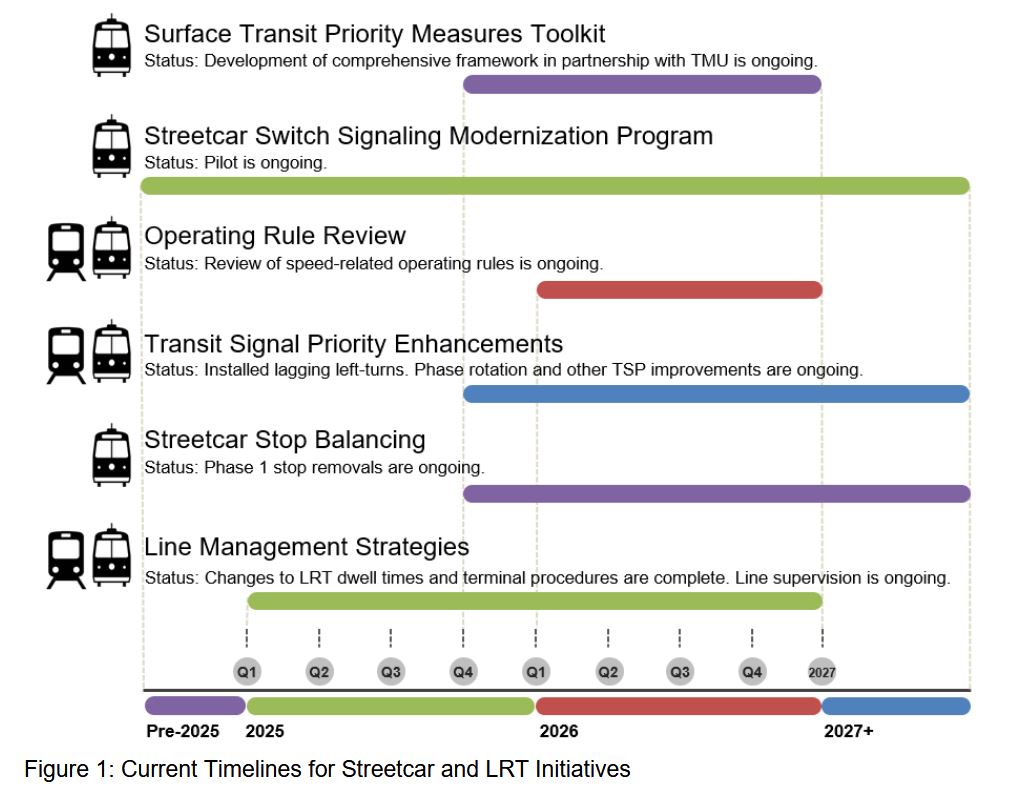
Six areas are proposed for review on the timelines shown below. The troubling part of the chart is the section labelled “2027+” which reaches into the indefinite future.
On April 7 and 10 two major outages on Line 2 Bloor-Danforth were caused by hydraulic fluid spills from work cars. The TTC has sidelined its entire fleet of work cars pending inspection and repair. This has placed much subway infrastructure work on hold at a time when there is already a backlog.
A previous leak incident in 2024 led to TTC Board reports, and the findings were not impressive. Some work cars were beyond their useful lives, and there were ongoing issues with inspection and maintenance of equipment.
A common thread in these delays has been a car leaking fluid onto the rails over an extended distance before this problem is discovered. That leads to extensive, manual cleanup work to ensure that revenue service trains can accelerate and brake without slipping.
Problems with these cars are not the only source of major disruptions, and failing signal systems requiring service suspensions are common.
The TTC has not published a list of signal failure incidents to give a sense of their frequency and severity, let alone any plan to improve reliability over the decade before a new ATC system can take over.
It is rather comical that TTC Board meetings can include extensive discussion of a new enterprise asset management system, but little info on actual condition, maintenance and plans for what we have. We should not have to wait for a large IT project to know what the issues are today.
Behind both the fleet and signals problems lie bad capital budget planning by TTC management in response to political pressure to trim spending. In past years, key interrelated projects were downplayed or sidelined including:
The need to refresh and expand the subway work car fleet
The need to convert Line 2 to Automatic Train Control
The need for a new Line 2 fleet
Under former CEO Rick Leary, in his early days, there was a sense that existing infrastructure and fleet could be stretched out to about 2040, fully ten years longer than the then-current target of 2030. In time, the ATC and new trains projects were restarted, but with much later delivery dates. According to the December 31, 2025 Major Projects Update Report, the delivery of 55 new trains will not complete until 2035, and the final cutover of ATC will not occur until 2037. Existing systems will have to last another decade.
Another factor is the timing of the Scarborough and North Yonge subway extensions which are planned to open in the early 2030s and will need new trains before the existing Line 2 fleet is retired. This is further complicated by demand projections showing the need for growth trains in the mid 2030s. Trains for new lines and extra service require production capacity that would otherwise go to a replacement fleet.
With ATC for Line 2 a decade away, the Scarborough extension will have to be built with conventional signals to tide it over until an ATC-capable fleet is running.
The TTC has not published a fleet plan showing how the various proposed deliveries of new trains will be staged. There is also the small matter of storage and maintenance space for the expanded fleets, and projects for new yards are not yet funded. The Province is happy to announce new subway lines, but conveniently omits the very large cost of the maintenance facilities.
This ties back to the work car reliability and fleet size issues because the volume of subway work will not decline, but will actually increase both thanks to aging infrastructure and system expansion. There are already severe scheduling problems for the work plans due to conflicting requirements for this fleet.
The focus at an upcoming TTC Board meeting will no doubt be on recent failures, but there are much larger issues affecting subway reliability for the coming decade and more. 2027 might seem a long time (and an election) away, but planning for that budget is already underway. The Board should demand a detailed review and plan to address the situation, and this should not be another “we’ll get back to you next year” report.
Two new lines on Toronto’s transit map suddenly sprang back to life this week with announced funding for the Waterfront East route by the City, Province and Federal governments. Days later, both Mayor Chow and her competitor, Councillor Bradford, came out with competing support for the Eglinton East LRT, now rebranded by Chow as the Scarborough East Rapid Transit, or “SERT”. “LRT” has become a dirty word thanks to the botched implementation on Finch, and a less than steller launch on Eglinton.
I will leave discussion of the details of SERT for another post once there is a better sense of just what technology and infrastructure options are actually on the table.
It’s important to remember that whoever is Mayor after the 2026 elections, there’s a good chance they will not be in office to see SERT, whatever it might be, open for service.
Meanwhile, long-suffering Scarborough transit riders will have only buses to ferry them around. The same can be said for other parts of the city waiting for transit improvements, and large parts of Toronto will never see anything more than a few RapidTO red lanes.
This raises two fundamental issues about TTC service:
How much service should there be on TTC routes, and
How much can crowding and convenience issues be addressed with existing services?
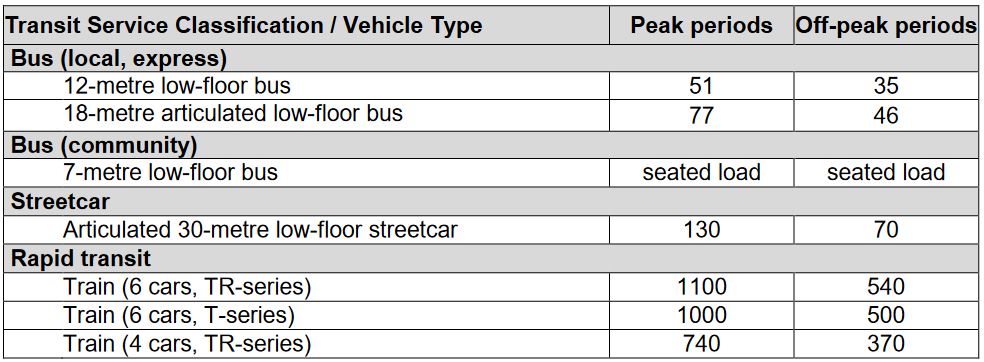
TTC Service Standards set out crowding levels for various types of vehicle, service and periods of operation.
Although the TTC reports that overall ridership has not returned to 2019 levels, they also acknowledge that some routes are crowded beyond the standards. They do not list specifics of routes and time periods, and so it is hard to know the scope of the problem or the affected locations.
This situation is not corrected thanks to budget limitations. The TTC owns buses and streetcars, but they cannot afford to run all of them.
From a rider’s point of view there is more to service quality than the number of buses on the road. These vehicles should also show up reliably so that loads are evenly distributed between them, and wait times are predictable. TTC loves to blame all problems on traffic congestion, but a fundamental issue is that service does not run on even spacing, and little is done to improve this. One difficulty is the acceptance in standards of being off schedule up to 5 minutes, and this only applies leaving a terminus. This allows buses to run together on frequent routes and still be “on time” while giving poorer service than advertised.
Back in the early days of debates on a Scarborough LRT or subway replacement for the former Line 3 SRT, important research from UofT showed that in the off-peak period, the majority of trips in Scarborough stay in Scarborough. A transit network designed to get people downtown does not necessarily address local travel unless it happens to lie along well-used commuter routes. Such a network can also miss travel patterns to and from major suburban work and academic locations both inside Toronto and in the 905 beyond. Off-peak service is important, but it must be more than a line on the map representing a bus that will appear sometime, maybe.
Later in this article, I will detail service frequency on routes across Toronto. In some quarters it is common to say “Scarborough gets the dregs”, but in fact the problem of infrequent and irregular service extends well beyond Scarborough borders. If there is to be advocacy for better transit, this will be more productive with all affected neighbourhoods.
The view ahead to the 2027 budget is not hopeful. Increased spending on service falls in various categories:
Inflationary and cost-of-living effects
Service added to address growth
Service hours added to address congestion
Service added to promote growth
The budget focus is on the first three, and growth for its own sake gets little attention. The TTC might produce a ridership growth strategy, but it will not affect the 2027 budget.
There has been no discussion of the level of service possible with existing infrastructure and fleet, as opposed to changes that would require more vehicles and, possibly, more garage space. Any added service will, of course, require more operators to drive it and that drives up the budget and subsidy requirement.
TTC planning in recent years focused on making changes within existing financial resources, and the funding shortfall to improve service overall is never presented for public debate. Meanwhile, the politicians do not want to talk about anything that would increase operating costs and lead inevitably to proposals for new revenues including fares and subsidies.
Better service both in quantity and quality is key to the TTC’s growth. Drawing lines on maps keeps the announcement machinery turning and fuels endless social media debates, but it does nothing for service today.
Any politician or advocate claiming to serve their community needs to address service and how it can be improved to serve everyone now, not just in the decade to come.
This post continues a series of articles reviewing travel times for streetcar and bus operations on 510 Spadina. Recent events include winter storms, temporary bus substitution for one week in February 2026 due to power supply issues, and implementation of better transit priority at three intersections.
This article includes data from January 2024 through March 2026 showing travel times on Spadina. Also included are comparisons of speeds and dwell times along the route from October 2025 and March 2026.
For an extended period in 2024-25, the 510 route operated with buses and was, for a time, diverted to St. George Station. Comparisons between streetcar and bus travel times varied through this period depending on the location, time of day, traffic conditions and the degree of priority given to buses, if any.
In February 2026, signals at College, Queen Dundas and King were modified to give streetcars a clear signal before allowing left turns. In the data to March 31, the effect of this change is small. At the level of an individual intersection, this is hard to measure because the change in wait time for a signal is comparable to the frequency with which streetcars report their location. This problem is discussed in more detail at the end of the article. [Corrected at 5:45pm, April 6]
Although signals may clear for streetcars more quickly, there is no change in TTC operating practices that force vehicles to crawl through intersections. The results were not as good as I had hoped, and there are areas on 510 Spadina that need priority far more than the three intersections modified so far.
At this point, confirmation of the benefit of signal changes awaits more data as well as possible expansion of the program.
More generally, the three modified intersections are only part of a larger route, and not necessarily the primary source of delay. Any attempt to improve 510 Spadina travel times must look at the whole route, and at the many locations where streetcars can be delayed.
One point of interest is that streetcar travel times rose slightly after the period of bus operation compared to before (Spring 2025 vs Spring 2024). The change is small but noticeable. What made the difference?
The City and TTC must address why it is possible for buses in mixed traffic to outrun streetcars on reserved lanes during periods when traffic is not congested. A mixture of signalling, stop location and TTC operating practices make this possible.
My apologies to readers who say “oh no, not more charts” and move on to something else. I have deliberately included a lot of them here so that those who are interested can see how the data behave. Any suggestions for changes in presentation or analysis are welcome.
The hours of service on Line 5 will be extended effective April 5, 2026. Trains will run later into the evening with buses covering the route at other times.
Service now ends just before 11pm inbound from the terminals, but will be extended to 1:20am weekdays and Sundays, 12:30am on Saturdays.
Bus services on Eglinton remain the same:
34 Eglinton provides local bus service every 20 minutes from 6:00am to 1:30am (8:00am start on Sundays).
The Line 5 shuttle bus will continue to run between 10:00pm and 1:00am stopping only at Line 5 stops.
The 334 Eglinton night bus runs from 1:00am to 5:30am (7:30am on Sundays).
Whether the Line 5 shuttle late night operation will continue beyond the next schedule change remains to be seen as it duplicates the extended LRT service.
Work on this article began before the March 30 announcement of tripartite funding for various housing and transit projects. Comments about this have been incorporated here.
At its meeting of March 31, the TTC’s Strategic Planning Committee will consider two reports relating to the financial future of both the Operating and Capital budgets.
The report on a long-term plan is less than its title might suggest in that it merely launches a process to develop a plan, but does not propose anything concrete. Some members of the TTC Board have wanted to see a long-term plan and options for years, but nothing usually comes of this beyond rehashing information we already know from the annual budget cycle. City Council cannot formulate capital and operating budget plans without a clear indication of the needs and trends at its most expensive agency.
A related problem is that conflicting indications come from the Council and the Mayor about spending priorities, and some TTC plans are closely linked to Provincial projects such as the North Yonge subway extension. Major committed projects have already claimed much of the announced Federal funding, and substantial additions will require net new funding.
That, in turn, requires the TTC and Council to think carefully about priorities rather than asking for money project-to-project on the assumption that money will always be available. In the context of high Provincial debt and considerable spending on transit, plus a refocus of Federal priorities and an attempt to decrease spending, Toronto is unlikely to receive everything it wants.
Short-Term Planning
Short-term planning placed the TTC in a very difficult position.
The short-term balancing of the TTC’s financial pressures would not have been achieved without a substantial City subsidy in recent years, including the Ontario-Toronto New Deal providing three-years of operating funding support, and project specific capital grant funding from the provincial and federal governments.
For instance, the injection of $5.1 billion in the 2025-2034 Capital Plan, which was predominantly city funding, reduced the TTC’s state-of-good-repair backlog by $3.9 billion, or nearly 50%. However, fleet plan changes, asset condition assessments and cost estimate increases have increased the SOGR backlog in the 2026-2035 Capital Plan to a projected $6.1 billion at the end of the 10-year planning window. Funding for new trains, buses and streetcars by other orders of government addressed immediate fleet needs, and the operating support through COVID, have kept the system going. While these efforts had significant impact in the immediate term, the TTC still has a long-term financial problem due to a fiscal framework that has not evolved at the same pace as the scale, complexity, and expectations of a world class transit system.
This cycle of finding immediate term solutions to the budgetary pressures of the organization is one repeated annually. With each successive year the balancing act produces increasingly limited opportunities to find new efficiencies and revenue generation opportunities. The TTC’s aging assets continue to drive state-of good repair investment needs to maintain existing levels of service, while struggling to fund capacity enhancements to keep up with growth. [Long Term Plan, p. 1]
As things stand, the projections for Operating and Capital Budgets assume very modest growth in demand, at least in the short term, but there is a long list of projects, mostly unfunded on the Capital side both for State of Good Repair (SOGR) and to accommodate projected demand growth. Rapid transit extensions now underway only include provision for fleets at the level needed to serve current demand, but not the extra trains to increase capacity nor the maintenance facilities to house the expanded fleets. Drawing lines on maps requires not just tunnel construction, but consideration for how the network will operate and what effect extensions and new lines will have on the existing network’s operations.
With all the focus on a few rapid transit projects, there is the much larger issue of subway and surface fleet renewal, not to mention infrastructure work. Any plan to increase service and ridership substantially places an additional load on the Capital budget not to mention the Operating budget to actually deliver new service.
Fare Revenue Will Not Pay For Capital
Fare revenue from ridership growth did not pay for expansion even when the cost recovery rate was 70%. Now that it is below 50%, the effect of additional service is even more acute. We cannot talk about system expansion and moving more people with transit if we are not prepared to pay for it.
Transit funding in other cities comes from a variety of sources as detailed in the jurisdictional review. Toronto’s problem is that actually levying most of these requires cooperation from senior governments, notably Ontario where new taxes or fees of any kind are not welcome. In at least the medium term, Toronto will have to make do with existing funding schemes while hoping/lobbying for increases.
Options For Ridership Growth
The other side of this dilemma is that Toronto has never been presented with options beyond modest business as usual transit service. We do not know what growth and service quality we might aim for because annual budgets only scrape by to keep the system running.
While ridership growth is essential to long-term sustainability, on it own it is insufficient to close the structural fiscal gap without complementary changes to funding, fare policy and cost structures. As a result, other options and strategies must be identified. Recognizing this, at the January 23, 2026 meeting, the City of Toronto’s Budget Committee directed City staff to work with the TTC to develop a multi-year operating budget that both supports ridership growth and addresses the underlying financial pressures.
Growing ridership and increasing the mode share of public transit trips will require additional levels of investment in both service and capital beyond what is currently projected and may demand consideration of other sources of revenue and/or fundamental changes in policy with respect to how transit is prioritized within the City. [p. 3]
The report proposes that various scenarios be developed for levels of future growth and service. This will inform future budgets, but not immediately. A four-phase program is proposed:
Jurisdictional review of major transit systems: See the attachment linked above.
Scenario development and long-term analysis
Balancing strategies including cost containment, fare policy including enforcement, funding, and capital priorities
Recommendations and implementation roadmap
There is no discussion of the range of options that might be considered, nor is there a proposed date to report back. Obviously major change will not occur overnight, but short-term plans should explore what can be achieved within existing resources (fleet, infrastructure) and at what cost to get more out of resources the TTC already owns. Further out, no rapid transit growth will come online until the early 2030s, but the surface system should not be ignored waiting for new trains to roll into Scarborough, Richmond Hill and Thorncliffe Park.
In parallel there is the TransformTO plan which has a very aggressive target for shifting travel away from cars. It includes a massive increase in transit service that will not be achieved overnight even assuming Council approves this and funding is available. The TTC Board and Council need to make hard decisions about the scope of transit expansion, and not just a few rapid transit lines, they are prepared to undertake.
Once again, Middle-East war has exposed economy to rising fuel prices. What this will do to economic growth and transit demand remains to be seen. Toronto is at least in the position of owning a large, if not entirely adequate, transit network serving a goodly chunk of demand. However, this is historically focused on downtown-oriented trips, with considerably less support for the more numerous trips between suburban areas.
Ontario bears some responsibility here too because for decades GO Transit’s downtown focus worked against better use for inter-regional trips, and support for local and regional bus service has not encouraged large-scale growth. Calls for us to “do something” to relieve the high cost of fuel, such as free transit, ignore the fact that transit simply is not present, or is too small-scale, to support a major shift of auto to transit travel. Moreover, this only addresses the cost of driving where transit is an option, not the much wider question of the wider economic effect of higher fuel costs.
The March 30 Announcement
The Federal, Provincial and Toronto governments announced funding for various transit projects, as well as tax relief for some new housing.
The first important point about this is that it affects only the TTC Capital budget, but provides no new support for transit operations. Moreover, none of this announcement addresses the TTC’s unfunded capital backlog. Note that Waterfront East is not part of the TTC capital plan.
The Federal contribution to several transit projects has been confirmed, but this is not “new money”, only the formalization of previous announcements. These projects are: Ontario Line, Eglinton Crosstown West Extension, Scarborough Subway Extension, Yonge North Subway Extension and Hamilton LRT. These are Metrolinx, not TTC, projects.
In the name of stimulating housing, municipal Development Charges will be reduced with the gap made up by transfers from other governments. This benefits housing prices, but has no effect on transit to the extent that TTC plans include a provision (albeit declining) for DC revenue as a capital funding source. The only change is which pocket the money comes from, tempered by the hope that replacement DC funding will match what might otherwise have been expected.
The Waterfront East transit line will be funded at $3-billion with one third coming from each level of government. Any overruns will be the City’s responsibility. Now that funding is announced, the next stage of design can get underway. Waterfront Toronto expects to reveal staging plans for construction soon to Council and to community stakeholders.
The City of Toronto has released its detailed mobility plan for the coming FIFA World Cup matches in June-July.
The document is over 100 pages long, although some of that is background on the city’s existing transportation infrastructure. In this article, I will primarily review the transit component and leave other topics to interested readers.
The World Cup matches will occur on June 12, 17, 20, 23, 26 and July 2. The June 12 and 26 games kick off at 3:00pm, June 20 at 4:00pm and the other at 7:00pm. From 5 hours before to 3 hours after each game there will be extensive constraints on the area around Exhibition Place, and transit will be the primary mode of access.
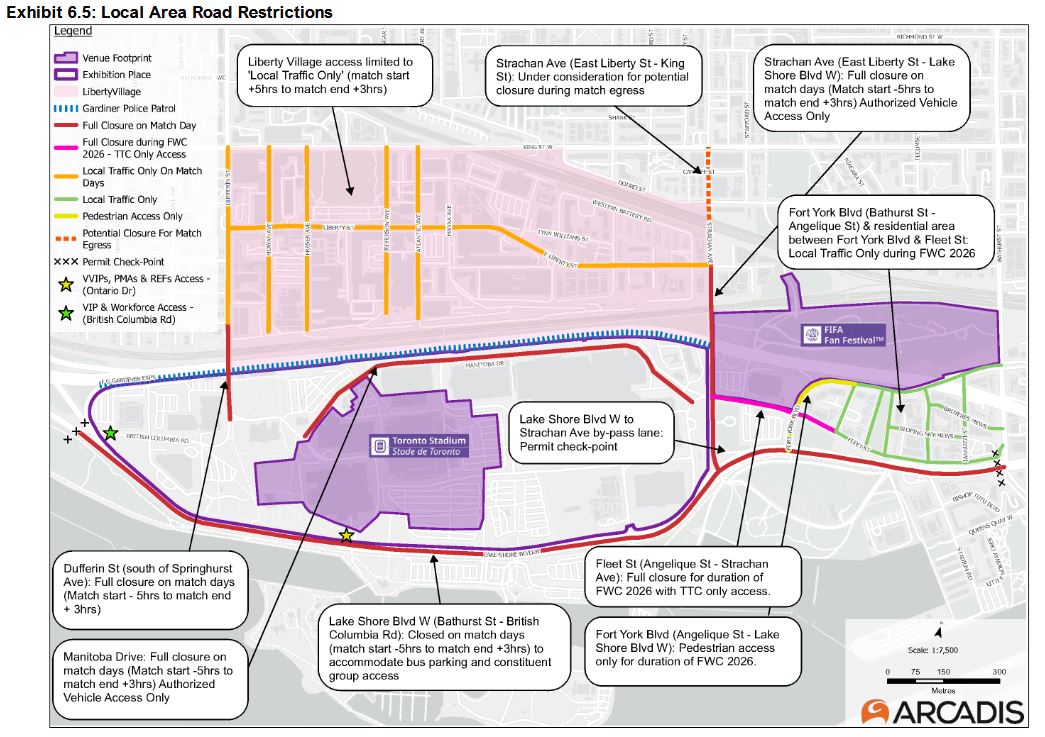
Road Restrictions
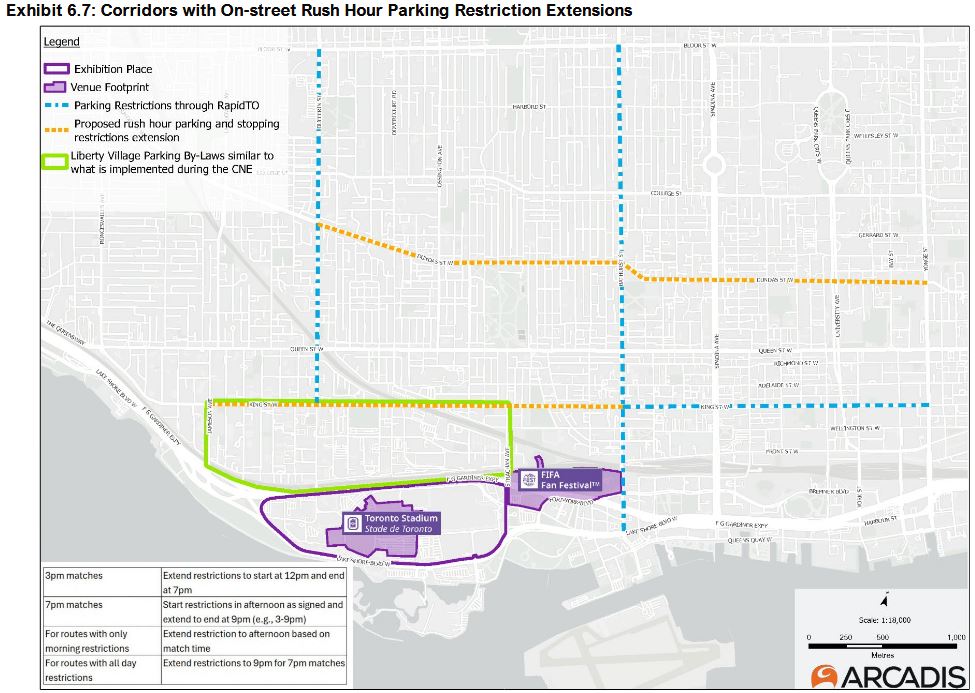
Parking restrictions on some arterials that now only exist during peak periods will be extended to improve road capacity.
Transit Access
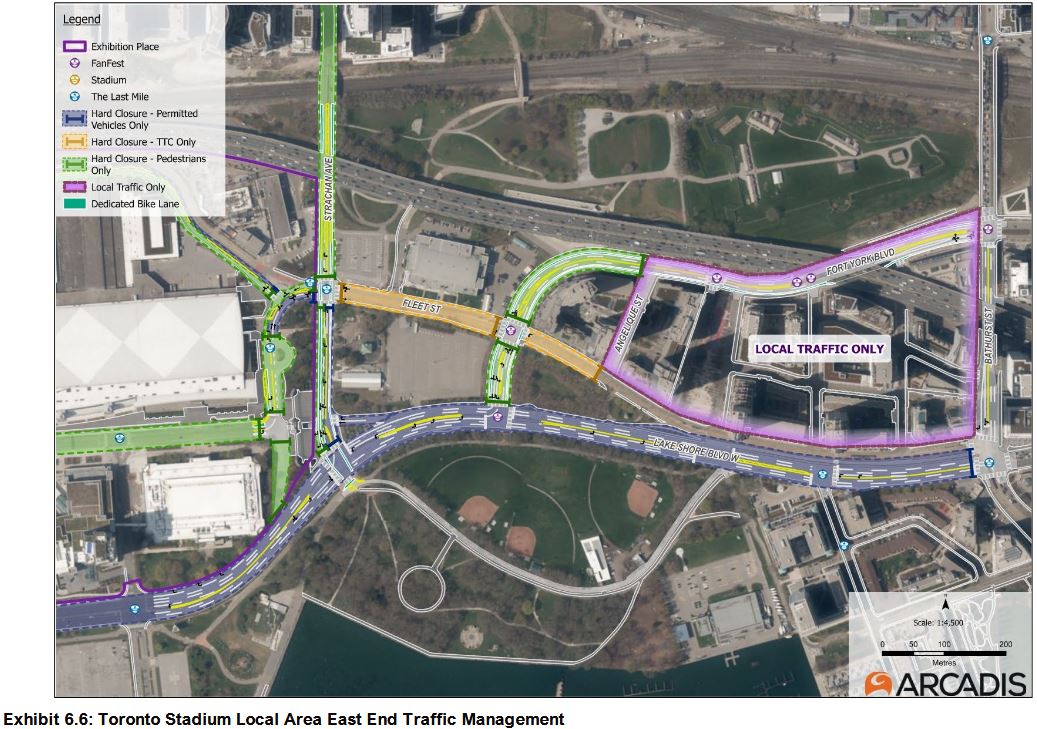
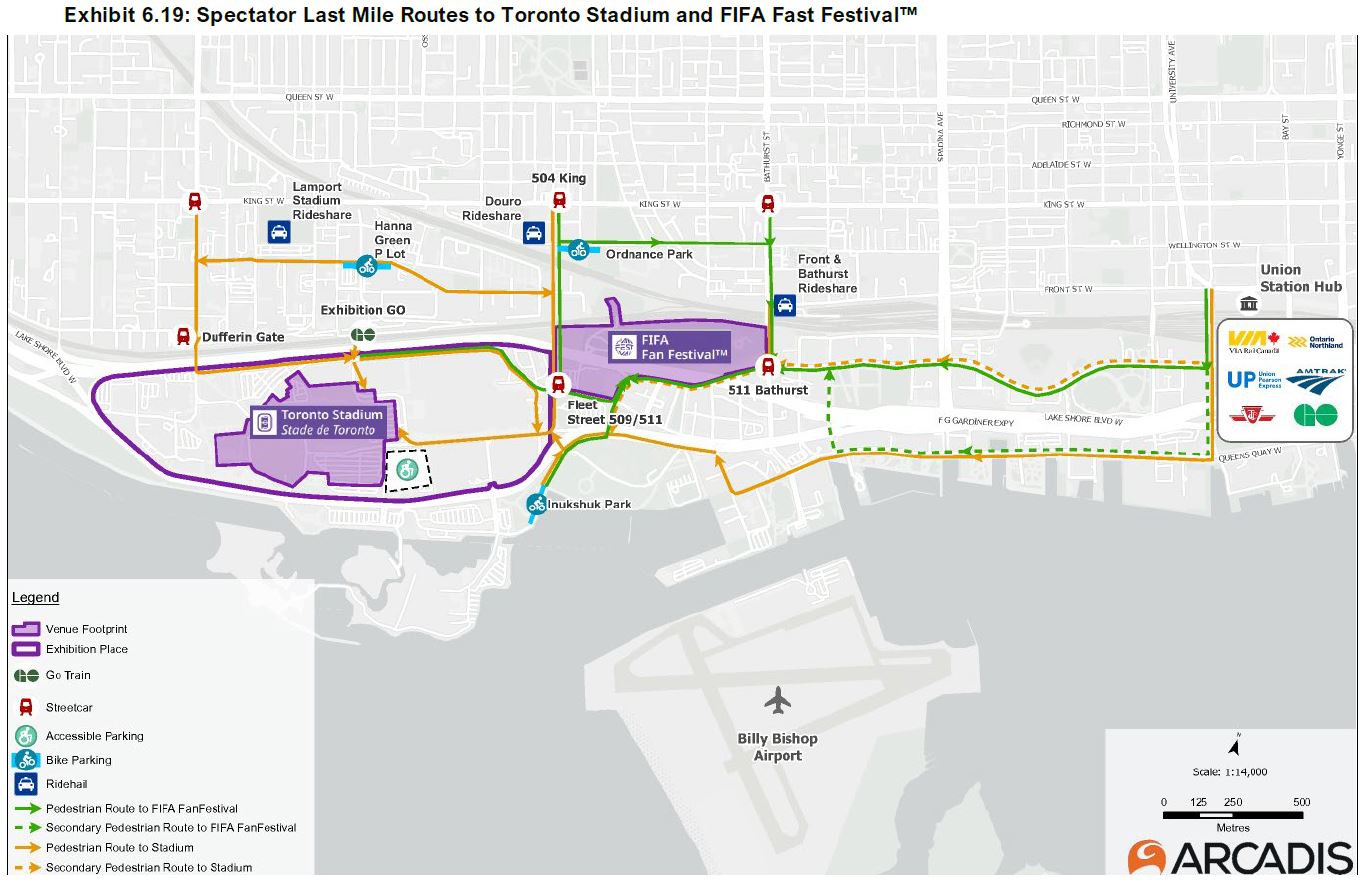
The area east of Exhibition Place will serve as a transit hub on Fleet Street plus the Fan Fest area at Fort York and The Bentway (under the Gardiner Expressway). The primary access for 509 Harbourfront and 511 Bathurst streetcars will be on Fleet between Strachan and Fort York Boulevard (orange in the map below). Exhibition Loop will be used only by riders requiring deployment of an access ramp. Transit stops at Bathurst & Fleet will be removed from service.
The projected mode shares both to the stadium and to the Fan Fest area are:
Transit (TTC+GO): 70%
Active Transportation: 13%
Taxi/Rideshare: 10%
Auto (self driven): 7%
The GO Transit share is expected to be lower for the FanFest area because it is further from Exhibition GO station.
The plan is inconsistent about the number of attendees to be served. This will affect the total transit demand and the need for extra service on game days.
Stadium
Fan Fest Area
Capacity
45,000
20,000
Planned attendance
36,000
25,000
Transit service is expected to accommodate arrivals and departures with the following profiles:
Arrivals
3 hours before: 20%
2 hours before: 50%
1 hour before: 30%
Departures
1 hour after: 70%
2 hours after: 25%
3 hours after: 5%
With an expanded stadium, the Fan Fest and limitations on parking, transit will carry far more people than it does today especially during the after event surge.
TTC service will be provided on various routes taking advantage of reserved lanes.
29/929 Dufferin bus service to Dufferin Loop
509 Harbourfront streetcar service from Union Station to Exhibition Loop
511 Bathurst express streetcar service from Bathurst Station to Exhibition Loop. Buses will run in parallel for local trips.
504 King will have extra service with riders expected to walk south to the stadium or Fan Fest. 504 cars will not use Dufferin Loop to maximize capacity for the 29/929 Dufferin bus.
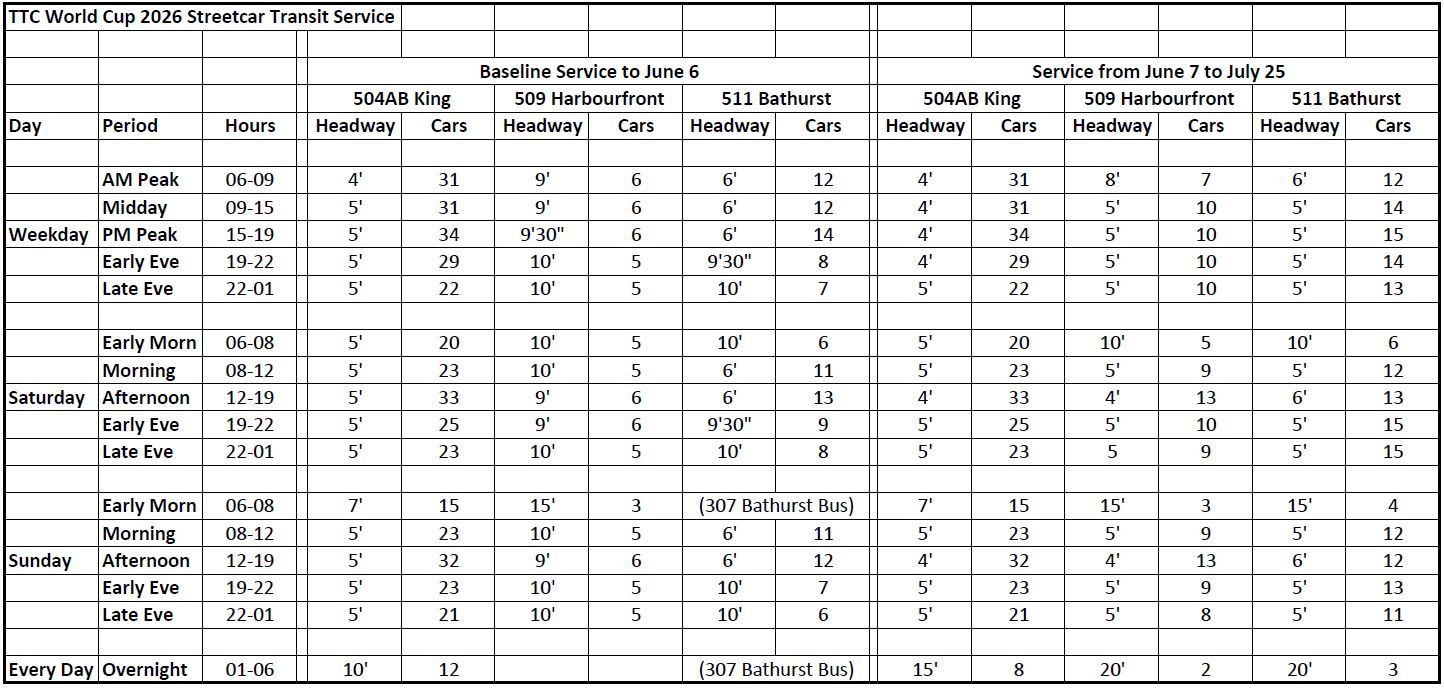
The scheduled streetcar services will be improved beyond what is normally provided. Additional service will operate on game days. The values below are from the Mobility Plan and have not yet been confirmed by the TTC.
Adapted from Exhibit 6.8 at p. 60 of the Mobility Plan
Specific service levels for 29/929 Dufferin are not shown beyond saying that there will be “enhanced” service plus match day express shuttles.
GO Transit will operate a 15 minute service on the Lake Shore corridor with extra trains possibly down to a 10 minute headway before and after matches. Their service is constrained by infrastructure including train spacing on the corridor and the combined service through Union Station. GO passengers arriving from other corridors face either a transfer to/from Lake Shore trains, a long walk from Union to Exhibition Place, or the limited capacity of the Harbourfront streetcar link notably the small loop and loading area at Union.
Taxis, Ride Share and Cycling
Access by taxis, ride sharing and cycling will, like all other traffic, not be allowed within the stadium or Fan Fest restricted zones. Three taxi/ride share drop off and pick up points will be created at Lamport Stadium, south of King at Strachan & Douro, and at Front & Bathurst.
Bike parking, including Bike Share terminals, will be at the Hanna & Liberty Green P lot, Ordnance Park east of Strachan, and at Inukshuk Park on the waterfront.
One challenge for cyclists is that there are areas with potential conflicts between large volumes of pedestrians and cyclists. “Walk your bike” will be the expected behaviour.
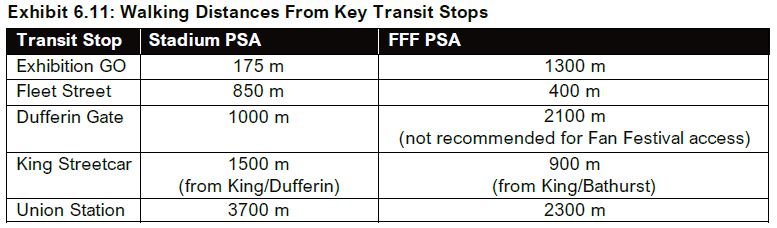
In the map below, a streetcar symbol is shown at Dufferin Gate, but the 504 streetcars will not actually go there, only the 29/929 Dufferin bus services.
Fare Payment
Fare payment will be via the PRESTO system at the standard rates including the GO/TTC integration. However, a limited time regional pass might be available.
A proposed new Regional Tourism Transit Pass pilot, subject to successful technology testing in early 2026, will provide visitors with an integrated and convenient means of payment across multiple transit systems while travelling throughout the GTHA. The PRESTO-enabled pass will offer unlimited travel on GO Transit, UP Express, and the TTC for 3-or 5-day periods. Modeled on established programs in global cities such as Paris and London, the initiative is intended to enhance the visitor experience, reduce transportation barriers, and support broader regional exploration. [p. 63]
The Rest of Downtown
Not mentioned in detail in the plan will be the effect of added travel demand and road closures both on traffic conditions and transit service in the central city. Past experience has shown that traffic control during events and in response to construction tends to focus on the immediate area, but locations further afield can be badly affected.
Not only does this snarl traffic, but transit service passing through affected areas deteriorates or vanishes affecting riders far from the event. Personally, I will completely avoid affected areas on game days, but many people do not have this flexibility.
Toronto talks a good line about transit priority, but does not always deploy the resources needed to provide it and to enforce restrictions on motorists’ behaviour. The FIFA games will be a major test in telling motorists that they are not in command of streets.
The TTC’s Strategic Planning Committee will meet on March 31, 2026 at 9:30am in the boardroom at TTC headquarters, 1900 Yonge Street. There are three items on the agenda. Two of them deal with financial plans, and I will turn to them in a separate article. The third is an updated Ridership Growth Strategy, although it is really a rehash of current plans with little attention to actually achieving growth.
Previous iterations of the RGS, especially the original in 2003, were built on the premise of showing what actions to gain riders might be possible and at what cost. This is repeated in the current report, but with no new initiatives beyond those already in the TTC’s Five Year Plan.
The report begins by noting that ridership growth has stagnated and sits at a level well below pre-pandemic figures. Travel declined generally in Toronto from 2024 to 2025, and the change (-3.1%) lies in the middle of the range of declines seen by TTC in various periods. The report notes:
The shift in ridership and customer boarding patterns suggests that the surface network is serving fewer long-distance bus riders, discretionary trips, and shift workers at manufacturing and warehousing areas, as well as work commutes to businesses in the educational services, administrative and support, real estate and rental and leasing, and retail trade sectors.
Overall, the decline in surface boardings is system-wide and not tied to particular corridors, though outer parts of the city are most affected with boarding losses strongest in suburban and outer urban areas.
[…] the most significant opportunity for ridership growth comes not from creating new travel where it no longer exists, but from ensuring the TTC is the most attractive, reliable and competitive option for the trips people are still making. [Report at pp 1-2]
Comparison to 2019
Ridership
80% to 83%
Revenue
92%
Expenses
137%
Cost Recovery
Down from 65-70% to 46%
Ridership decline since February 2025
Midday and evening
4% to 6%
Peak periods
1%
Weekends
4% to 7%
Toronto Travel by All Modes
Q4 2024
6.6 million trips
Q4 2025
6.4 million trips
The decline in offpeak travel is troubling because this segment showed stronger growth while the peak period recovery was hampered by changes in work and commuter patterns.
The perception of transit as an option is declining, but this is a refreshing, if not welcome, view of customer satisfaction stats. In past reports, TTC tended to pump every increase in values, no matter how small, without considering the overall trend as context.
Customer satisfaction declined in 2025 and is lower among priority groups: Gen Z, shift workers, women and customers with low income. Customers generally feel safe on the TTC, with 89% of customers reporting they feel safe on vehicles and 77% at stops, though there is room to improve. [p. 3]
The TTC recognizes the need to be more attractive to existing and would-be riders, but the challenge is how this could be achieved.
By improving speed, safety, affordability and making the experience seamless, the TTC can divert trips from other modes, most notably private vehicles and rideshare, and increase its overall mode share while retaining our existing customers. In a constrained travel market, growth depends on being the better choice: making transit the mode people prefer when they do need to travel and capturing a larger share of trips across all segments. [pp 3-4]
“Affordable, Fast, Safe and Seamless” are the plan’s four focus areas. Unfortunately, the detailed descriptions leave key questions unanswered.
What is “affordable”? The report notes that riders care more about speed than “minor” fare changes, but what are the implications for fare and revenue growth? Are fares frozen forever or will they start to rise to cover part of transit’s growing cost?
“Speed is not a luxury feature, it is a core performance requirement. Makes Transit Competitive with Driving. Travel time is the top factor in mode choice.” These statements imply an attempt to compete with auto speeds using transit, but this is simply not possible especially when access and waiting times, not just in-vehicle travel, are considered.
The Safety bullet concentrates on perceived and actual safety and security for passengers, a factor that depends not just on the TTC but a wider group of social agencies and policies to address a variety of economic and mental health issues.
The Seamless bullet talks about access to trip planning information, a positive experience on vehicles and in stations, and “confidence that they can predict and complete their trip”. This is not just a question of a better website or new ways to access information, but that transit operations reliably provide the advertised service. The Plan is utterly silent on the need for better service management and standards.
Long range strategic planning is not a common sight at the TTC. Yes, we see maps, we see service plans, we even have some nominally “bold” projects like RapidTO’s red lanes. But what we do not see is a focused debate about where Toronto and its transit system should be going, and how we will get there.
Pre-pandemic, the system was bulging with riders. Among other things, this launched the Bloor-Yonge station expansion project and deferred the Richmond Hill subway extension until we could be sure of having capacity to handle new riders from York Region.
Things changed in the early 20s with widespread ridership loss, especially downtown commuters. GO Transit was hit hard by this thanks to their long-standing commuter driven business model. On the TTC, although commuter traffic remains below 2019 levels, weekend demand has built higher. Demand does exist, although not always on the old model, but provided that there is service to handle the rides.
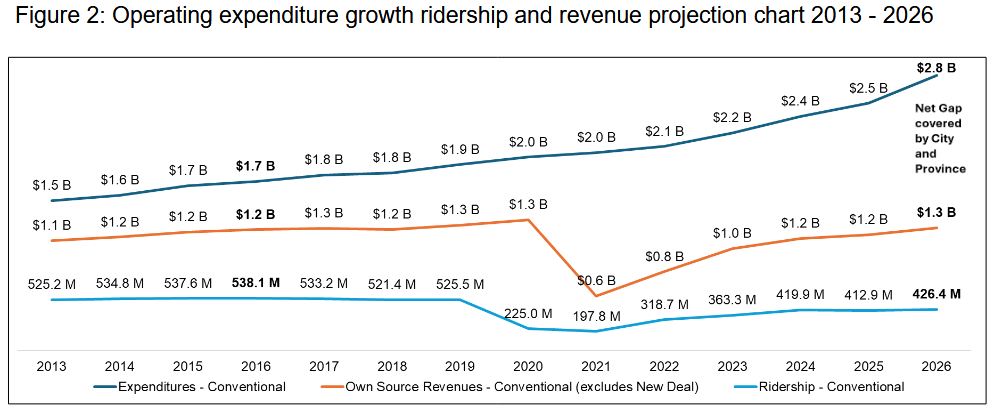
Since 2020, the overwhelming question has been where the money will come from to keep service running. A mixture of provincial and federal contributions got us through the worst of those years, and some special provincial subsidies still flow. The dollar value of the City’s share roughly doubled from 2019 (actual) to 2026 (budget) with the City now paying 49% of total operating costs (including WheelTrans). The Provincial share in 2026 is about 9% of the total of which about 3% is from gas tax and the rest from special subsidies which will soon end unless they are renegotiated.
Fare freezes under both the Tory and Chow administrations coupled with lost ridership limited revenue growth. Because fares now make up a much lower proportion of total revenue, a large fare increase would be required to restore the historic fares:subsidy ratio if that were the target.
The Capital Budget has an even worse situation with a long list of unfunded projects and no clear indication how much the Provincial or Federal governments have any appetite to fund them. In the short to medium term, the substantial Provincial spending will go to works in progress including Toronto subways and GO expansion.
With all of the focus on just finding money to keep the lights on, there has been little attention to service beyond preserving as much as can be afforded. TTC claims of service recovery use a metric, service hours, that appears to show recovery to 2019 levels, but does not allow for the effects of congestion. Actual service frequencies are down on many lines.
Back in 2018, the Ridership Growth Strategy proposed a tiered set of changes to drive growth at 1%, 2% or 5% annually. This was not pursued in any detail, and the pandemic overtook any thoughts of aggressive growth. The RGS was replaced by the Five Year Service Plan which, in its current version, covers years 2024-2028. It aims at modest growth, and yet even those goals are not fully funded.
What is needed to drive growth beyond business as usual levels? Is there a latent, unserved market for travel because transit is too inconvenient or simply not serving trips people need to make? Where is this market? Does the current network serve it well? Some growth can be achieved by making transit easier to use by existing riders, but what is needed for net new travel made by choice, not necessity?
Within this gloomy setting, the question of “where are we going” can turn into debates about funding without much thought to what might be possible, or what will be needed to encourage annual growth well above a few percent.
TTC’s Strategic Planning Committee meets on March 31. This will be their last chance to launch any discussion and study that can affect the 2027 budget cycle, and provide the basis for any post-election discussion of transit policy for 2028 and beyond.

 Steve Munro