TTC Annual Service Plan for 2020 (Updated)

This article is the second part of a series on the TTC’s 5 Year Service Plan & 10 Year Outlook.

Just after I posted the article, the TTC replied to several queries about its content. This article has been updated to incorporate additional information.

See also

Requests for Service and Route Changes

Returning to past practice, TTC staff will report annually to the Board on requests for changes in the network requested by, among others, Councillors, community groups and employers, as well as changes triggered by events such as new rapid transit lines or staff-proposed area restructuring (such as the recent updates to routes in the Junction).

There has been a backlog of such requests, and the report contains a long section detailing them. Unfortunately, it is not indexed nor arranged in route order. For the benefit of readers, I have created a summary sorted by status and route number. Page numbers refer to those within Attachment 2 to the Service Plan.

The requests range from substantial route changes to minor items such as stop eliminations. There has been no filtering on the external support for some of these ideas, and some proposals have more a sense of tinkering by individuals rather than true community input. But they’re all there. Some make it to “recommended” status, subject to funding. Some are on hold pending other changes such as the opening of the Crosstown which will affect many routes. Many are not recommended for various reasons, mainly low potential demand or violation of network design principles to serve a specific locale.

The list contains several entries where the underlying complaint is crowding. Proposals include route changes to redirect riders to other routes as well as the simple request of “run more buses”. The Service Plan does not address crowding levels on a route by route level or even acknowledge this growing problem. It is almost comic for the TTC to trumpet evaluation of new services while failing to deal with shortfalls in the service it runs today.

One proposed change is the extension of the 339 Finch East night bus to serve the Tapscott industrial area. Because so many TTC service changes are done on a “zero sum” basis where resources are shuffled between routes, this will be accomplished by terminating the 365 Parliament night bus which is a poor performing route with other nearby lines serving the same area (Bloor Danforth, Carlton, Queen, King). The 365 Parliament bus gets only 4 boardings per vehicle hour well below the standard of 10. The change will be implemented in 2020, but the specific date has not been announced.

The report notes that performance on the night routes is generally good, although it does not list values for individual routes.

New ridership data for the overnight network shows that ridership on almost all the routes meet TTC service standards – in fact, many routes are showing growth since the expanded network. The only service to not meet the TTC’s service standards is the 365 Parliament overnight service where the boardings per service hour do not meet the minimum threshold to justify the resources spent to provide the service. [Attachment 3, p 8]

On the streetcar night routes headways were improved simply to reduce storage requirement for cars. The 301 Queen, 304 King and 310 Spadina routes operate every 15 minutes, and the 306 Carlton route has 20 minute service. Previously, the headway on all four routes was 30 minutes. It is not clear whether the performance of these routes is such that this level of service should become permanent.

Updates

During the workshops for the Service Plan, there were proposals that did not appear in the final plan. The TTC has now clarified that these will be part of the 2021 plan which will be subject to public consultation and funding.

East Scarborough Route Changes

By comparison, here is the current system map of the area.

These changes include:

  • A new 938 Express bus from STC to the University of Toronto Scarborough Campus
  • Extension of 905 Eglinton East Express to take over the Conlins Road loop now served by 116A Morningside
  • A new all-day route 178 from STC to Coronation Drive via Brimley, Brimorton, Orton Park and Lawrence replacing the 54B Lawrence East Orton Park Loop and the 86D Scarborough Coronation Loop
  • Routing all 54 Lawrence East service to Starspray to provide more service east of Orton Park

Stanley Green Service

The list of proposed changes includes a new route to Stanley Green. Here is a map showing the route.

119 Torbarrie and 167 Pharmacy North

Additional periods of operation are planned on these routes in 2021.

Streetcar Network Changes

The plan shows an increase in the size of the streetcar fleet starting in 2022 although the TTC has not yet ordered any cars. The TTC advises that the plan assumes an additional order will be placed with Bombardier. These would be used to increase service on the network, to restore streetcar service to routes operating with buses, and to provide for route changes that would provide more overlap among services.

A proposed route network was shown in the workshops, but it is not in the final report.

The changes include:

  • Route 501A would operate between Neville Loop and Sunnyside Loop.
  • Route 501B would operate between Long Branch Loop and a new Riverside Loop to be built on the land now occupied by a parking lot on Broadview north of Queen. This land is owned by the TTC.
  • The consolidation of routes 502 Downtowner and 503 Kingston Road is permanent.
  • Route 503 would operate between Bingham Loop and Dufferin Loop.
  • Route 504B would operate between Broadview Station and Humber Loop, later to a proposed Park Lawn loop.

Note that this is a draft and only gives an indication of the TTC’s thoughts on what might happen. It is subject to the acquisition of more streetcars, public consultation on the route changes and budget approval.

Continue reading

TTC Express Bus Services: December 2019 Update

In a recent review of the TTC’s 2020 Service Plan, I was not very kind about the photo of an Express Bus on the cover page considering that many of the “Express” services were little more than rebranding of what already existed. These were not the net addition to the network contemplated by the TTC’s Board when it asked management to create this network. Simply renumbering routes and giving them a common brand is not much of an “accomplishment” worth such prominence.

This article updates a previous review to determine just how much of the Express Network really is net new service. The table linked below compares services as they existed in April 2018 with those scheduled for the November-December 2019 period, and includes the intervening changes to show how service has evolved.

20182019_ExpressNetworkService_201912

The following routes are identical in service levels to what existed in April 2018 before the 900-series routes came into being.

  • 903 Kennedy to STC (SRT bus supplement)
  • 927 Highway 27
  • 944 Kipling South
  • 945 Kipling
  • 986 Scarborough

This list is shorter than it was in the fall of 2018 because, at that time, many running times and headways had not been changed under the rubric of “service reliability”. These changes aim to match scheduled trip time with actual operating conditions, but in many cases this is done by stretching the scheduled interval between buses, not by adding more buses on the same headway.

The TTC claims that this simply gives riders the scheduled service they would have seen anyhow, but this is tough to credit given (a) the variation in TTC headways generally and (b) the fact that almost-worst case congestion conditions do not affect all trips equally, but all trips are scheduled to longer running times and headways. (TTC designs its reliability improvements to the 95th percentile of observed travel times.)

The following routes have less frequent service in December 2019 compared to service offered in April 2018. For details please refer to the PDF linked above. Some changes are as small as 15 seconds, others are over 2 minutes.

  • 924 Victoria Park
  • 925 Don Mills
  • 935 Jane
  • 941 Keele
  • 953 Steeles East
  • 954 Lawrence East
  • 960 Steeles West
  • 985A Sheppard East to STC
  • 996 Wilson

The following route has improved service in December 2019 compared to April 2018.

  • 913 Progress

The following routes have changes for the better and for the worse depending on the period.

  • 900 Airport Express
  • 905 Eglinton East (Note: Service was cut on this route for the summer of 2019, but the fall schedules did not bring a return to the previous level of service.)
  • 939 Finch East
  • 984 Sheppard West (Yonge to Sheppard West Station)
  • 995 York Mills (Less frequent peak service. Midday service added April 2019.)

Seven new routes were created for the Express Network. In all cases, the total of local and express buses was greater than the number of local buses before the change, although local headways were widened.

The following are new routes created for the Express Network have retained their initial service levels.

  • 902 Markham Road: Created September 2018.
  • 929 Dufferin: Created October 2018.
  • 952 Lawrence West: Created October 2018.

The following are new routes whose service has been cut since they were introduced.

  • 937 Islington: Created September 2018. Headways widened for reliability in May 2019.
  • 984A Sheppard West to Weston: Created September 2018. Headways widened for construction and reliability in September 2019.
  • 985B Sheppard East to Meadowvale: Created September 2018. Headways widened for reliability in January 2019 and September 2019.
  • 989 Weston: Created October 2018. Headways widened for reliability in September 2019.

The pattern here is clear in that the majority of the express routes have received widened headways to improve service reliability, according to the TTC.

The TTC publishes neither crowding nor reliability statistics along its routes. Therefore we do not know whether these services can potentially attract riders, or are on the cusp of needing more service, but do not receive it thanks to budget constraints. The 925 Don Mills is already scheduled over the capacity service standard for the AM peak and weekday midday periods.

No improvements to the Express Network appear in the 2020 Service Plan.

The 2021 Plan proposes some improvements, subject to budget considerations, including:

  • Express service on Warden and on Kennedy
  • Extended hours on Steeles East
  • Reroute the 905 Eglinton East via Morningside to replace the 116A service

TTC’s Service Plan 2020-2024: Too Much Gloss, Not Enough Substance?

Updated November 8, 2021: Links in this report have been changed to point to the new TTC website.

For much of 2019, TTC staff worked on a five and ten year service plan to address a basic political problem in our city – all of the focus for planning and spending looks to promises of new subway lines, or “better” versions of ones already on the map. While the subway and commuter rail networks may be the spine of Toronto’s transit, the skeleton and muscles are its surface routes of buses and streetcars without which vast areas of the city would be well beyond transit’s reach.

The TTC sought feedback from various stakeholders through public meetings as well as pop-up displays at locations around the city. Full disclosure: I attended and contributed to stakeholder workshops, and have refrained from publishing anything about the discussions because the plan was a work-in-progress. Some ideas found their way into the final report, others were changed or disappeared. Such is the nature of these processes. No, I was not paid to be there. We got free coffee, juice and cookies. People who came were there because they wanted to see a better TTC.

Two documents will be considered by the TTC Board at its December 12, 2019 meeting:

[Note: Both documents are published under the common name of the 5 Year Service Plan. For clartity, page citations refer to the glossy version as “Next Stop”. Note that this PDF is formatted two-up and so the page numbers are not the same as the sheet numbers in the file.]

The report is a mix of two separate items. One is the discussion of the multi-year plan, and another is a review of a grab-bag of service change proposals. Such proposals used to appear in annual reports to the Board and this was the standard conduit for route changes to be evaluated and approved (or not). This is a long-overdue return to a practice that seemed to have ended simply because there was never any money to pay for more service, so why bother to discuss the idea. However, many of the recommended proposals are still “subject to budget”, a constraint that undermines all the fine talk about the importance of transit in Toronto.

Right at the outset I must say that my reaction on reading the report, and especially the glossy version, was of disappointment at a lost opportunity. A theme at workshops, and not just from me, was that the TTC should “aim high”, that small-scale change would make little difference to riders and would have no effect on ridership or the system’s perceived worth. This was a time for advocacy, for a vision (and oh I hate that word) of what transit might be beyond political battles over subway routes.

The TTC has failed to advocate for substantial change. This is not unexpected, nor is it the first time. The political environment, especially for anything that affects operating costs and subsidies, is to spend no more, and if possible to spend less. Any report that shows what might be done, but which puts politicians on the spot to carry the torch for higher spending, or conversely to reject explicit improvements, is on delicate ground. Better to aim low at a target that might, possibly be met so that management and their political masters can get the publicity, the back-patting, the accolades that go with achieving a modest target. The TTC has been down this route before.

Probably the most telling point in the exercise is the cover of the “Next Stop, Even Better” glossy version of the report.

The Express Bus Network is a fraud perpetrated on the TTC Board and riders by management who gave the impression of change while, in fact, delivering almost nothing. The article Express Buses: Real Change or Photo Ops? includes a before-and-after comparison of the express routes showing how little really changed. In a separate article, I have updated this with current schedule information.

Almost all of the Express Network is nothing more than existing service (typically the “E” branches of routes) rebranded into the 900-series of Express services. Very little service was actually added, and in some cases there have been declines in service thanks to “reliability” changes in the schedules that stretched headways in order to give more running time at no added cost. Service is erratic, like many other parts of the TTC, to the point where waiting for an express bus to show up would cost more time for riders than they would save through its limited stop operation.

There are plans to add new express routes in 2020, but it is not clear whether these will actually add service or merely be the transit equivalent of a game of Three Card Monte.

Another problem facing the TTC is the inadequacy of service to meet demand, a widespread complaint among riders. There are Service Standards which set out average crowding levels, and the TTC claims to meet these in almost all cases. However, there are many problems:

  • The TTC has not published actual crowding statistics for its routes for some time, and there is no way for the public or the political representatives to monitor how “close to the line” existing service might be.
  • Some recent schedule changes have included pushing crowding beyond standards because the TTC cannot afford to run the service. This is not a question of peak fleet capacity because the TTC has a generous ratio of spare buses to service requirements. However, this can signal a trend which if not reversed will lead to the “standards” having no meaning or force because the real decision is made at budget time. [See page 8 of my recently published table of January 2020 service changes for details.]
  • Riding counts only tell us how many people are on the vehicles, not how many could not board or gave up trying because of crowding and unreliable service. The TTC publishes route-by-route ridership numbers in the City’s Open Data Catalogue, but this file has not been updated since December 2016. It contains no breakdown by time of day, only a full weekday count.
  • Irregular service with wide gaps makes crowding worse for most riders who tend to pack on the first thing that shows up, and can actually cause average load statistics to misrepresent demand because the half-empty following buses in a pack dilute the average crowding numbers. Averages do not show the conditions a typical rider, who is more likely to be on a crowded bus than an empty one, must face. The TTC has no measure of service reliability and its effect on rider experience.

There is no point in having standards if you don’t meet them, and especially if the fact that they are missed is not published in a widely-read document like the CEO’s monthly report. That report hides more than it tells by selective reporting and by averaging that masks the range of values in metrics. For example, we know whether ridership and revenue are tracking relative to budget, but we don’t know which routes have erratic service and overcrowding. These exist and cannot be wished away by a simplistic metrics such as end-of-line on time performance or a count of “short turns”, but the extent of these problems is rarely reported.

The report actually lays out very little detail of what might happen in coming years. There are five-year operating and capital budget projections, but few specifics as to what this spending will mean for riders on the street. Selling spending is hard work at City Hall, even with plans for new taxes because these are (a) often consumed for pet projects and (b) are currently only addressing the backlog in capital “state of good repair” spending, not day-to-day operating costs and subsidies which affect the amount of service riders actually see.

The goal is to increase customer trips by 35 million by 2024. That is on a base of 525.3 million projected for 2019, or a five-year increase of 6.67%. That is not a stunning goal especially with improved rapid transit services to come online during the interval.

Returning to past practice, TTC staff will report annually to the Board on requests for changes in the network requested by, among others, Councillors, community groups and employers, as well as changes triggered by events such as new rapid transit lines or staff-proposed area restructuring (such as the recent updates to routes in the Junction).

There is a backlog of such requests, and the main report contains a long section detailing them. I will deal with this in a separate article. Continue reading

TTC Service Changes Effective Sunday, January 5, 2020

The TTC will make several changes to its services in January 2020.

All seasonal changes implemented on December 22, 2019 have been reversed to the November 2019 schedules except where some other change affects a route.

On the streetcar network, the retirement of the CLRV fleet will be complete and service will be 100% accessible on all surface routes. Route allocations to carhouses have been revised with a view, in part, to current and future pantograph operations

511 Bathurst schedules will be adjusted slightly to compensate for the larger vehicles, and streetcar operation will continue until April 2020 when buses will return to the route for construction projects.

505 Dundas will return to streetcar operation in April. The 502/503 Kingston Road service consolidation running with buses will continue for the foreseeable future.

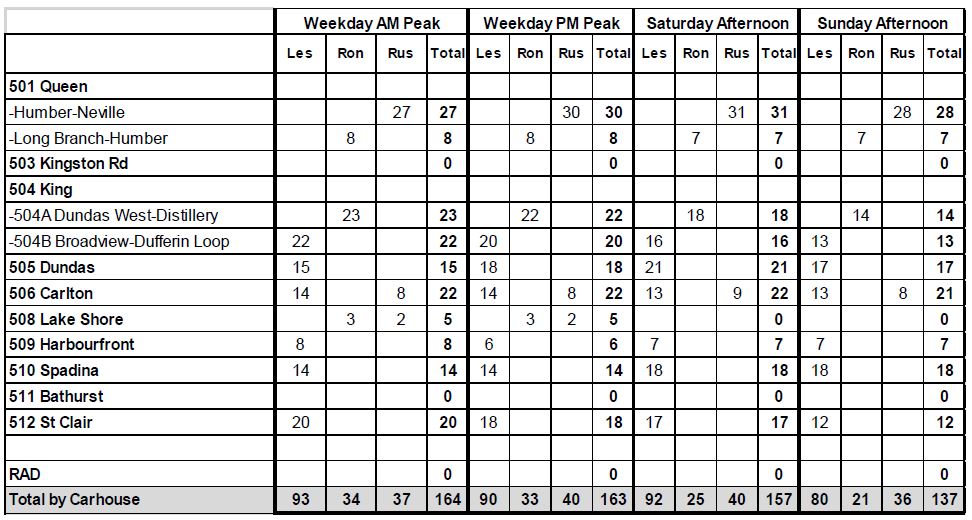
Cars entering service from Leslie Barns via King Street are already running under pans for their journeys to and from 509 Harbourfront, 510 Spadina, 511 Bathurst and 512 St. Clair. 505 Dundas will operate under pans when streetcar service resumes in April, and 506 Carlton is expected to switch over in late 2020. No conversion dates have been announced yet for 501 Queen or 504 King.

Implementation of “service reliability improvements” continues on several bus routes with, in most cases, wider headways and no added vehicles. The premise is that if driving plus recovery time covers 95% of actual conditions on the route, short turns should be rare and service will more closely match the scheduled/advertised level. This does not take into account headway irregularity and bunching which can contribute at least as much to the perceived (in)frequency of service as the fact that some drivers could not make their trips in the previously allotted time. The change is particularly striking on 52 Lawrence West.

Another effect of these changes is that many buses make their trips in well under the scheduled time causing bunching at terminals, especially in cases where the recovery time equals or exceeds the scheduled headway.

The eight bus trippers in the AM peak on 506 Carlton will be changed to provide service on other routes (23 Dawes, 24 Victoria Park, 47 Lansdowne and 67 Pharmacy) on their trips to the Carlton route. [Updated December 2, 2019: The origin of these trippers on existing and planned schedules has been clarified in the pdf linked below.]

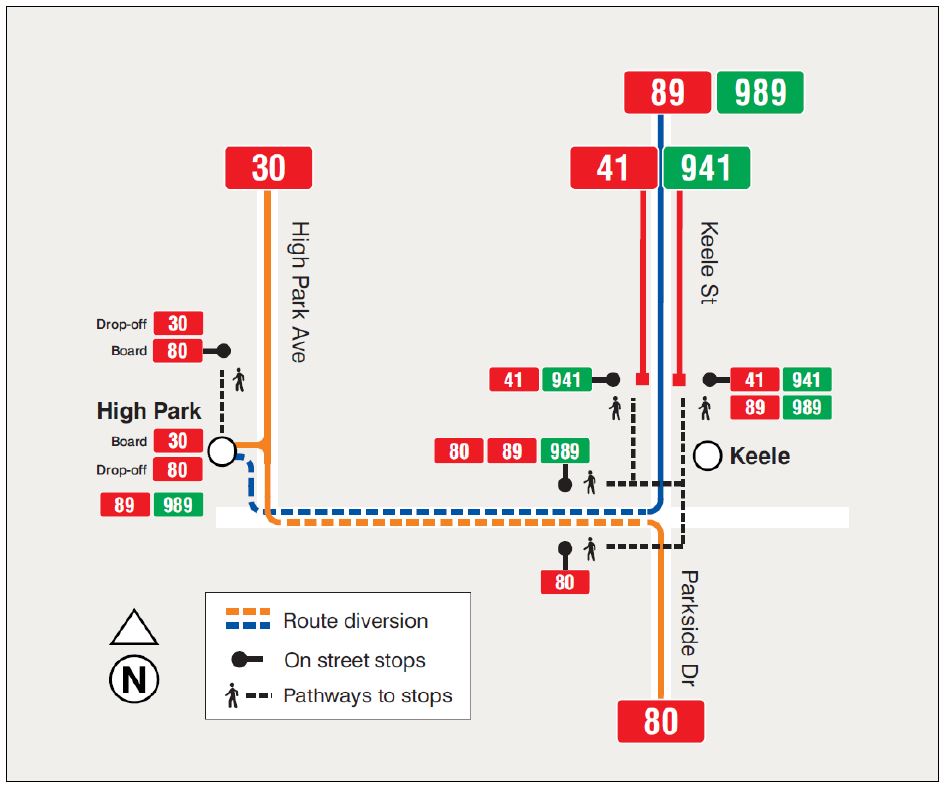
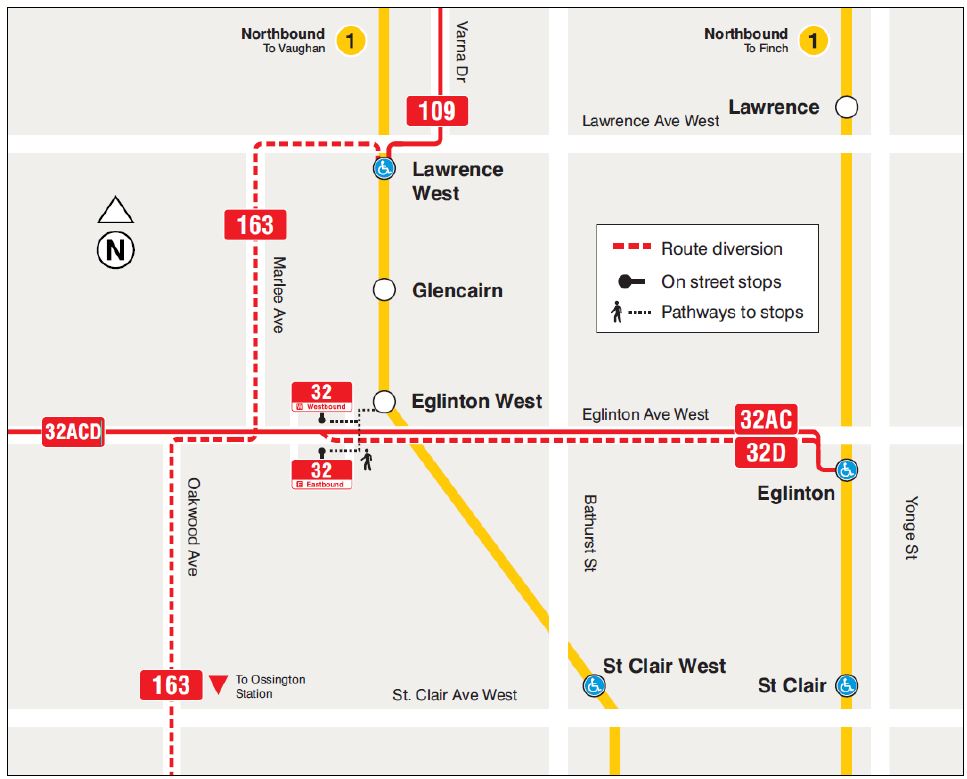
New trippers on 32 Eglinton West will serve the students from York Memorial Collegiate (Keele & Eglinton, damaged by fire) who have been relocated to Scarlett Heights Entrepreneurial Academy (Royal York & Trenholme).

Service will be improved on 300 Bloor-Danforth Night Bus Monday through Friday (Tuesday to Saturday mornings). Buses will be added to the Saturday and Sunday schedules, but the headways will not change. This is a “reliability” improvement that creates recovery times of half and hour and more. Service will also improve during the transition from night to daytime operations, but no details of this were included in the TTC’s service memo.

Planned overcrowding continues with three more routes (45 Kipling, 54 Lawrence East and 95 York Mills) slipping over the approved levels in some periods. These route will also lose their 10-Minute Network status during some periods.

Details of these changes are in the PDF linked below.

2020.01.05_Service_Changes_V2

TTC Service Changes Effective Sunday December 22, 2019

The last service changes for 2019 are all seasonal service adjustments for the Christmas and New Year holidays. These will be in place for two weeks with the next changes to occur on January 5, 2020. The details for January are not out yet.

Many routes will drop back to their summer service levels on weekdays between December 23 and January 3.

In anticipation of shopping traffic additional standby service will be provided on the Saturday and Sunday before Christmas, and on Boxing Day.

There are a few cases where the changes reduce running times, and this could affect service reliability. I have asked for comment from the TTC on this, but have not received a reply.

The routes in question are: 16 McCowan, 34 Eglinton East, 47 Lansdowne, 90 Vaughan and 125 Drewry.

2019.12.22_Service_Changes

Metrolinx Board Meeting: November 22, 2019

The Metrolinx Board met on November 22, 2019 with its usual mixed agenda of private session and public items. This article deals with the following public reports and mainly with the Kitchener and Niagara Falls business cases.

Continue reading

Farewell To The CLRVs

The TTC has issued a press release with details of the final runs of the CLRV streetcars.

After four decades of service to Toronto commuters, the TTC’s Canadian Light Rail Vehicle (CLRV) streetcars will make their last run on Sun., Dec. 29 – 42 years to the day the first vehicle arrived on TTC property.

Transit enthusiasts will have a chance to win a spot on the final ride.

From Nov. 24 through Dec. 28, CLRVs will operate on 511 Bathurst seven days a week with additional CLRVs deployed as extra service on 501 Queen on weekends only between Roncesvalles Ave. and Greenwood Ave.

On Dec. 29 from 10 a.m. to 2 p.m., two CLRVs will run as free service between Bathurst St. and Greenwood Ave. to commemorate the final day of service. The final ride, which is for contest winners, runs from Wolseley Loop at Bathurst St. to Russell Carhouse at Greenwood Ave.

Those wishing to be part of the historic last ride must enter the contest through the TTC’s Facebook and Instagram pages from Dec. 2 to Dec. 6. Ten winners from each platform will be selected at random and each will be awarded a seat for them and a guest on the final CLRV ride on the afternoon of Dec. 29.

The first CLRV arrived on property on Dec. 29, 1977 and entered service on Sept. 30, 1979 on the 507 Long Branch route. The final CLRV was delivered in 1982. In total, the TTC purchased 196 CLRV streetcars, supplemented in 1988 by an additional 52 Articulated Light Rail Vehicles (ALRVs), which were nearly double the length of the CLRV. The last of the ALRV fleet was officially retired on Sept. 2, 2019.

The fleet is being replaced by 204 Bombardier low-floor streetcars. The retirement of the CLRVs means that every TTC bus and streetcar route will be serviced by accessible vehicles as of Dec. 30.

Analysis of Route 70 O’Connor for October 2019

When I publish route analyses, they are usually of the heavyweights like the King and Queen streetcars, or major bus routes like those on Finch, Dufferin, Keele, or Don Mills.

Back on Saturday afternoon, October 5, 2019, I was watching my Twitter feed, and a message went by from someone complaining “where is my bus?” about 70 O’Connor. I looked at Nextbus and to my amazement, all four of the buses were running in a pack headed eastbound on O’Connor, and there was no service anywhere else on the route. I camped on to the route to see what would happen and this is how they evolved.

  • 3:55 pm: Four buses headed outward on the common section of the route on O’Connor
  • 4:00 pm: Two buses are headed east to Warden Station and two northeast to Eglinton
  • 4:33 pm: All four buses are southbound on Coxwell
  • 4:37 pm: All four buses are at Coxwell Station

To put this in context, here is the section from the TTC’s Scheduled Service Summary which describes the service as it should be on 70 O’Connor. (Click on the table to expand it.)

Before we go any further, there are a few important points here:

  • 70 O’Connor is not the most important route in the TTC’s system, but it serves Toronto East General Hospital and one would hope that this connection to the subway would be reliable. This route carried 7,745 riders per weekday in December 2016, the date of the most recent route-level statistics published by the TTC on Toronto’s “Open Data” site. This puts it in the same league as 6 Bay and higher than the express service to University of Toronto Scarborough.
  • When buses run together for an extended period with no visible effort to space out the service properly, this shows that nobody is “minding the store”. From a rider’s point of view, the long gaps in service are precisely why “TTC” means “Take The Car” when they cannot depend on service to show up. This theme was part of my recent exploration of the 41 Keele bus.
  • Service that operates this erratically will not attract customers, and even worse, a lot of the space in that pack of four buses was probably empty. When the TTC looks at vehicle loads, they do this on an average basis, and will see low utilization, a possible incentive for a service cut.

Making routes like this work properly (not to mention the really big routes that carry tens of thousands daily) is important. This is central to making transit service attractive.

On Saturday afternoon, there are four buses providing, in theory, a combined service every 11 minutes on the common portion of the route, and every 22 minutes on the branches.

After seeing this, I thought, well, maybe it’s an oddity, something must be wrong, and surely the TTC will sort things out. But just for interest, I added route 70 to my request for vehicle tracking data to see how it behaved for the rest of the month, including the parts of October 5 I had not been watching online. The results were not at all pretty, and I let loose a blast on Twitter about the appalling state of service. It struck a nerve and sparked the most activity I have seen on a Tweet of mine for quite some time. Riders, and not just on O’Connor, see bad service every day.

There is a problem with NextBus (the source of all vehicle tracking seen outside of the TTC) in that it only tracks scheduled runs. Applications that use a route-based data feed from NextBus will not “see” any extra unscheduled buses because NextBus does not follow them. However, they should still exist in the TTC’s source data somewhere. The data I use comes from the TTC, not from NextBus, and should at least show all vehicles that are “signed on” to the route, not just the scheduled buses. If an extra is not signed on to route 70, it will not show up in the data I receive for that route.

The TTC’s position is that I do not have the portion of the tracking data showing unscheduled extras (also known as “RADs” or “Run As Directed” buses) that were used to fill gaps on the route due to construction. My response is that this is as much a face saving stance than an examination of the details. It is one thing to have an extra filling in for extra running time caused by construction, but quite another to have all of the scheduled buses in the same place at the same time with no evident attempt to sort out the service. If the TTC does have records of where the extra(s) operated on O’Connor, I would be happy to receive them and blend them into my analysis. After all, the TTC should be doing the same thing itself already.

Here is what I found, at least for the buses reported in the data provided by the TTC.

Updated 5:56 pm November 20, 2019

The CBC posted a story on their site about this today.

Continue reading

41 Keele Update: October 2019

In a recent article, I reviewed the operation of the 41 Keele bus and compared its behaviour in April 2018 with the service in September 2019 running an “improved” schedule. The results were not exactly impressive and the route continued to have quite irregular service, particularly when one looks at the middle of the route rather than at the terminals where the TTC actually measures it.

For the September 2019 analysis, my ability to plot service behaviour at and near terminals was limited by the nature of the data provided by the new Vision tracking system. The data were stop based, rather than a continuous stream showing vehicle movements along the route. (The contrast to the old monitoring system, CIS, was explored in a separate detailed article.) The TTC is now providing Vision data in continuous location format, and this greatly improves the resolution of vehicle locations for the October 2019 analysis.

The data may be better, but I cannot say the same for the quality of service. Although the TTC implemented longer scheduled travel and recovery times (make up time at terminals to compensate for variations in congestion enroute) in September, the reliability of service continues to be poor compounding the longer scheduled waits between buses.

Service reliability improvements – the program for continuous monitoring and improvement to schedules to better match observed operating conditions …

This is a buzz phrase seen routinely through 2019 in service change announcements, but it almost inevitably means stretching the existing buses on a route over a longer round trip time while making headways (the time between buses) longer to compensate rather than adding more vehicles to a route. In some cases, there were routes that simply did not have enough time in their schedule for actual conditions, but this tactic has become a “magic bullet” that is supposed to fix service quality.

But that bullet is made of tin, not silver.

Through all of the charts in this article, it is important to remember that the TTC’s Service Standard, measured at terminals, is that all service should be within a six-minute window of “on time” to the schedule. However, the typical pattern is for over 50% of all trips to show headways ranging well over 6 minutes. The target level of service reliability simply cannot be met. This is with the new, “improved” schedules.

The missing piece in TTC service is the recognition that left to their own devices, vehicles (and their drivers) will not run on time or on a reliable headway. The situation is made even worse by a policy of limiting short turns while doing little or nothing to break up bunches of vehicles. TTC management pats itself on the back because the quality metrics it reports every month look good, but they mask service that can be appallingly bad.

This is not exactly a new situation at the TTC. I remember nearly 40 years ago when the then head of Planning was reported to be shopping around for awards the TTC could win, the better to buff the image of management. This was the same person who introduced “tuning service to meet demand”, a phrase that sounds good to the bean counters, but actually means packing as many riders on buses and running as little service as possible. Managing the service was not part of the program.

A major problem with TTC statistics is that they are reported on an average basis consolidating data from several days and times of the day. This masks behaviour at the fine-grained level riders experience. They do not wait for the “average” bus, but for the next one that shows up. Telling them that on average they have acceptable service is cold comfort waiting in a gap of over 20 minutes for two buses to appear. That might be “every 10 minutes” on average, but that is not what they see. The same is true of vehicle loading with uneven headways leading to uneven crowds, and the bus that arrives in a gap is often full, assuming one can even get on.

The first request of a deputation from Keele bus riders at the September TTC Board meeting was that 41 Keele be made part of the “ten minute network”. This might improve service slightly, but if the buses on the route are not much better managed, that “ten minute” headway will include many much wider gaps and pairs of buses running together.

Continue reading

A Potpourri of TTC Items

Several items have languished unreported here for a while, and it’s time to push them all out of the door in preparation for the deluge of budget information and the new Service Plan that will come in December. My apologies for not keeping you as up to date as I might have.

The items covered here are:

  • Ridership and revenue
  • Vehicle reliability
  • Service quality (briefly)
  • Automatic train control
  • eBuses (electric buses)
  • Fare evasion

Continue reading