The Importance of Transit in a Changing Travel Landscape

My latest for NOW Toronto.

As ridership drops on the TTC, just as on transit systems across the world, there will be a temptation to make big cuts, but then to fall behind in the recovery when the crisis passes.

This is also a time to rethink the design of public spaces, streets especially, and the balance between all users and types of travel: cars and transit, cyclists and pedestrians.

Best Laid Plans

My latest for NOW Toronto looks at the historical pattern of bold transit plans conceived when times are good that inevitably crash into the hard reality of economic upheaval every decade or so.

There will be less money sloshing around in the economy for many years, and the many expensive projects on our transit and other political menus are unlikely to proceed as planned.

The challenge for those who believe transit is an essential part of our future is to rethink priorities and focus on advocacy for meaningful, widespread transit improvements. This will be a difficult road.


Analysis of Route 505 Dundas Bus Operations

Route 505 Dundas has operated with buses since February 2018 thanks to various construction projects and the shortage of streetcars. March 29, 2020 will see Flexity streetcars on Dundas.

The past two years have not been kind to riders on this route. Flocks of buses travel back and forth, often in packs, and large gaps in service have been common. An easy answer to any complaints is that congestion induced by construction prevents the TTC from providing reliable service.

Actually tracking the route’s behaviour has been difficult because most of the vehicles on Dundas were using the new Vision tracking system, and the data extracts from Vision were, until recently, at a much simpler and less illuminating level than the data from the old CIS system that Vision replaced. This changed in October 2019 when detailed tracking data for Vision vehicles became available, and I have been collecting this for the past five months.

The High Points

This is a long read, and many will not do go through the whole presentation. The following points are of special interest:

  • Over the period of bus operation, schedules were changed a few times in response to conditions on the route, or at least that was the idea.
  • Some of these schedules had inadequate running time, but TTC management did not react, in general, with short turns which are a very bad thing from a point of view of reporting on service quality to the TTC Board.
  • Instead, they adopted the tactic of either running buses express across a parallel route (Dundas is “U” shaped) to make up time, or having buses lay over at terminals to get back on time for their next trip. This reduced the actual bus/hour count along the route below the scheduled level causing crowding and increased dwell time.
  • The schedules that added travel time back onto the route in mid-February had the unexpected effect of lowering travel times during some periods, and of improving line capacity because very few buses now run express to get back on time.
  • A problem with irregularly spaced service and gaps remains even with the new schedule, but the situation has improved considerably.

These observations should not be taken as a blanket endorsement of longer scheduled travel times. There will always be a trade-off between having enough scheduled time so that almost no service short-turns and having so much padding in schedules that buses and streetcars congregate in packs at terminals. Conditions vary from day-to-day and no schedule can be “perfect” for all situations.

Continue reading

Starving the Bus Network for Service

My recent article for NOW Toronto, TTC Bus Service Losing Ground, reviewed the problem of passenger congestion on TTC bus routes and the long-standing failure of service to keep up with the rising population and employment in Toronto. This article presents the details and the wider context.

When Transit City was proposed back in 2007, the TTC expected that over the course of its implementation a large number of buses would be replaced by an LRT network that would, by today, be substantially complete. In turn, this would reduce the need for new bus storage and maintenance facilities because the growth would occur in suburban LRT barns at the Mount Dennis yard on the Eglinton line, on Finch near Highway 400, and on Sheppard East at Conlins Road.

One new garage was planned in Scarborough, although the project was delayed by Mayor Rob Ford. The garage on McNicoll will finally open late in 2020. However, the demand for storage space at existing overcrowded garages simply means that McNicoll will be full the day it opens and the TTC will be back in a situation where fleet expansion requires garages to have more buses than they were designed for. A ninth bus garage sits in the long term plans with a 2031 opening date, but there is no funding for it and the TTC has yet to identify a potential property. They will remain short of garage space for the coming decade.

This creates an odd sort of response to requests for more service: we have no place to store the buses. That, of course, is a chicken-and-egg situation where the TTC (and the City) can avoid the cost of providing more service by claiming that they couldn’t run more buses if they wanted to. Unfortunately, this does not accelerate the provision of more garage space, and the service vs storage deadlock remains.

The amount of service the TTC fields every day is affected by several factors:

  • the size of the fleet
  • the average capacity of a bus
  • the average age and reliability of the fleet
  • the proportion of the fleet needed for maintenance spares
  • the number of buses required to supplement the streetcar network
  • the number of buses reserved for extra service, especially to handle subway emergencies
  • the budget for service

As the TTC migrated from a fleet of high-floor to low-floor buses, the capacity of vehicles dropped by about ten percent. This meant that more buses were required to provide the same level of service, a process that occurred gradually until late 2015 when the last of the high-floor buses were retired. Conversely, low-floor two-section articulated buses can carry about 50% more passengers than a standard bus. These vehicles began to appear in the TTC’s fleet in 2014, but they make up less than 10% of the fleet today. The only planned expansion is for the TTC to buy 68 more in 2021.

Older buses tend not to work as reliably as young ones, and if a fleet is not regularly replaced, a higher proportion of it can fall into those “twilight years” when maintenance needs are higher and buses are more likely to fail in service. The TTC used to keep its buses for about 18 years and overhauled them twice during their lifespan. The argument for this was that the overhauls were cheaper than simply buying a new bus.

However, the bus building industry no longer produces vehicles with a long intended lifespan, and 12 years is a more common retirement age. This also avoids the need for that second overhaul to keep an older bus on the street.

The TTC has shifted to a 12 year replacement cycle for buses, and took advantage of federal “stimulus” funding to replace many older vehicles that otherwise would have remained in service. This gets over the one time “hump” of changing to a shorter life-cycle, but it also accelerates the need for ongoing spending because the annual replacement rate is now 50% higher – about 180 buses per year, rather than 120. This budget effect is compounded by the shift to more expensive hybrid or all-electric vehicles.

The newer generation of buses is also more technically complex, and a larger proportion of the fleet is required for spares to ensure that maintenance is preventative, fix-before-break work rather than gambling that a bus will continue to run even after it should have come into the shop for a check-up. A few years ago, the TTC changed its maintenance practices so that buses cycled through routine inspection and repair more frequently with the aim of reducing in-service failures. This had the desired effect, but at a cost of taking a larger maintenance pool from the fleet than in past years.

Finally, new buses often go through retrofit programs during their warranty period, and this further increases spare requirements if there is a sudden influx of new buses in a short time period.

That’s just the story on the maintenance side, but there is also the dreaded line whenever service is discussed: “subject to budget availability”. In other words, even if there are enough buses to improve service, there may not be the operating budget dollars (and the drivers this would pay) to actually field more vehicles.

Both the streetcar and subway networks make demands on the bus fleet.

It is no secret that the TTC has had problems with both its old and new streetcar fleets, but the biggest problem now is that growing demand on the streetcar routes exceeds the capacity of the new streetcar fleet.

  • When there were too few streetcars to operate that network, buses substituted to make up the difference.
  • Traffic congestion continues to worsen leading to slower service.
  • Construction projects shut down parts of the streetcar network from time to time.

At various times over recent years, there have been buses running on portions of Carlton, Dundas, Queen, King, Kingston Road and Bathurst. Some of these cases have been complete replacements while others are on portions of lines affected by construction.

With the streetcar shortage, construction work provided a rationale to bus a route and free up vehicles, but this grew beyond beyond construction season to semi-permanent replacements.

During the summer, the TTC has surplus vehicles and streetcar substitutions do not affect the availability of buses on bus routes.

Long-running projects (such as the water main reconstruction on Dundas) and route conversions due to a shortage of streetcars (such as on Kingston Road) are another matter. These take buses away from the bus network during the peak season. That said, the number of buses involved has been overplayed in some circles primarily as a way of carping about the Bombardier cars or about streetcars in general.

Subway shuttles place their greatest demand on the bus fleet when emergencies occur during the peak period. There are some vehicles at each garage that are “run as directed” buses, but these are nowhere near enough to make up for losing a busy part of the subway system. If there is a peak period shuttle, it requires not just the spare buses but vehicles and operators “borrowed” from other routes.

There is always a balancing act between having enough spare buses and staff to drive them for most emergencies, and the cost of having unused resources that are always a target for the budget hawks looking for “waste” in the TTC.

All of these factors affected and constrained the growth in bus service over the past decade, and will continue to do so without a significant change in TTC planning and funding policy.

Continue reading

TTC Streetcar Network Changes in 2020 (Updated)

Construction projects and the ongoing shuffling of streetcars and buses between the 500-series routes will bring some changes over coming months.

Updated March 30, 2020

The planned switch to streetcars on 505 Dundas has been deferred to late April, and buses will continue to operate on this route.

In turn, streetcars will remain on Bathurst until Dundas switches to streetcars.

New overhead poles have begun to appear on Broadview at locations where the curves must be rebuilt for pantograph operation.

Continue reading

TTC Service Changes: Sunday, March 29, 2020 (Corrected)

The TTC has several changes planned for the schedules going into effect on March 29.

Updated March 5, 2020 at 10:20 pm: Incorrect information was in the original description of the 163 Oakwood route. It will operate from Ossington Station to Lawrence West Station, not from St. Clair as the southern terminus as I had originally described it. Thanks to reader Joseph (who got there first) and others for spotting this. I am not quite sure where that idea came from, but both the article and the detailed list of changes below have been updated.

Updated March 6, 2020 at 10:55 pm: Incorrect naming of the 109 Ranee branches corrected. Thanks to reader Steven for spotting that.

2020.03.29_Service_Changes_V3

Streetcar/Bus Mode Changes

The most significant change is the restoration of streetcar service on 505 Dundas after a long absence due to watermain construction and the shortage of streetcars. The new service plan represents an increase in capacity primarily in the off peak periods. The change in headways will be most noticed during the peak periods where there will be 6.9 new streetcars/hour in the AM, and 7.7 cars/hour in the PM as compared to 16 buses/hour AM and 15 in the PM. Of course the buses tend to travel in packs of two or three, and so the waits for service could be more comparable than the raw schedules suggest especially if the TTC manages to maintain proper vehicle spacing on these much wider headways.

Changes during off-peak periods are not as substantial, and the net effect will be an increase in capacity on this route

A related problem is that the TTC has extended the travel times for streetcars substantially over the bus times in some cases (and the bus schedules were themselves adjusted in Mid-February 2020). This could leave many streetcars with a lot of excess time at terminals where it is now common to see several buses laying over because they are early. I will publish an analysis of actual travel times for both bus and streetcar operations as data become available.

Service on Dundas will be supplemented by four bus trippers in each direction during the period from 8 to 8:30 am.

With 505 Dundas switching back to streetcars, the 511 Bathurst route changes to bus operation for various construction projects including work on the bridge over the rail corridor at Front, utility and track work from Front northward, and track work from Dundas to just north of Wolseley Loop (north of Queen). According to the TTC service change memo this will persist through all of 2020 implying that the streetcar service to the CNE will be provided only on the Harbourfront line this year. I have asked the TTC for service details, but they have not responded.

Keele Station Construction

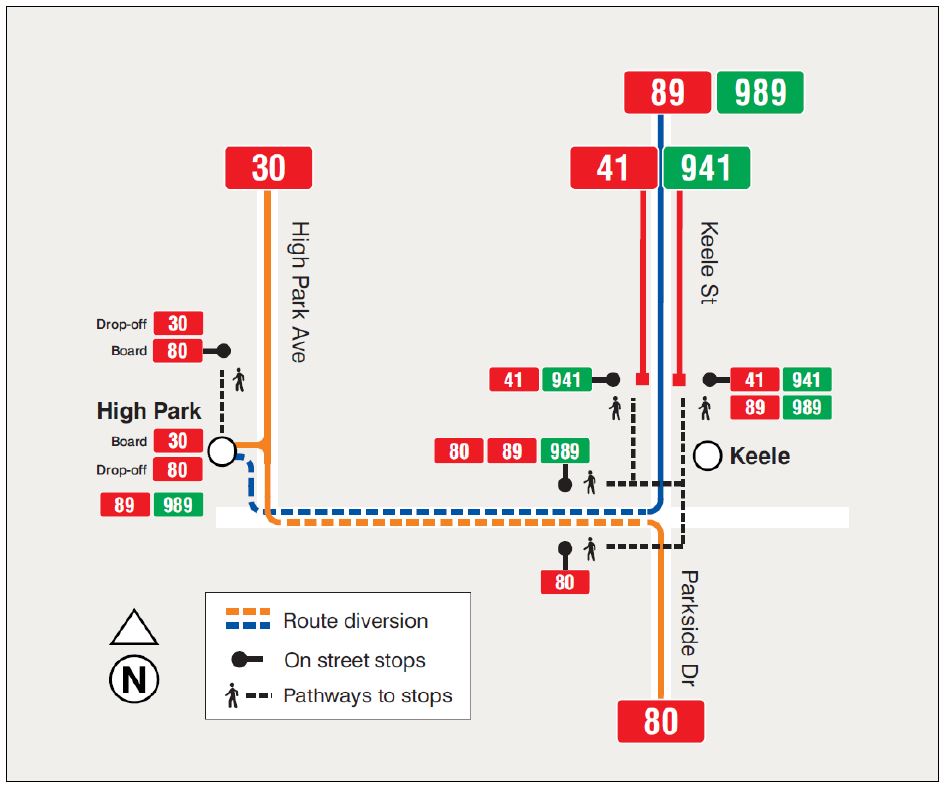
The bus loop roadway at Keele Station will be under construction until mid-October 2020. During this period all services that normally terminate here will be redirected.

  • The 41 and 941 Keele services will be extended south to Howard Park looping via Bloor, Parkside, Howard Park, Roncesvalles and Bloor back to Keele.
  • The 89 and 989 Weston services will be extended west to High Park Station Loop.
  • The 30 High Park and 80 Queensway services will be interlined.

Eglinton West Station Construction

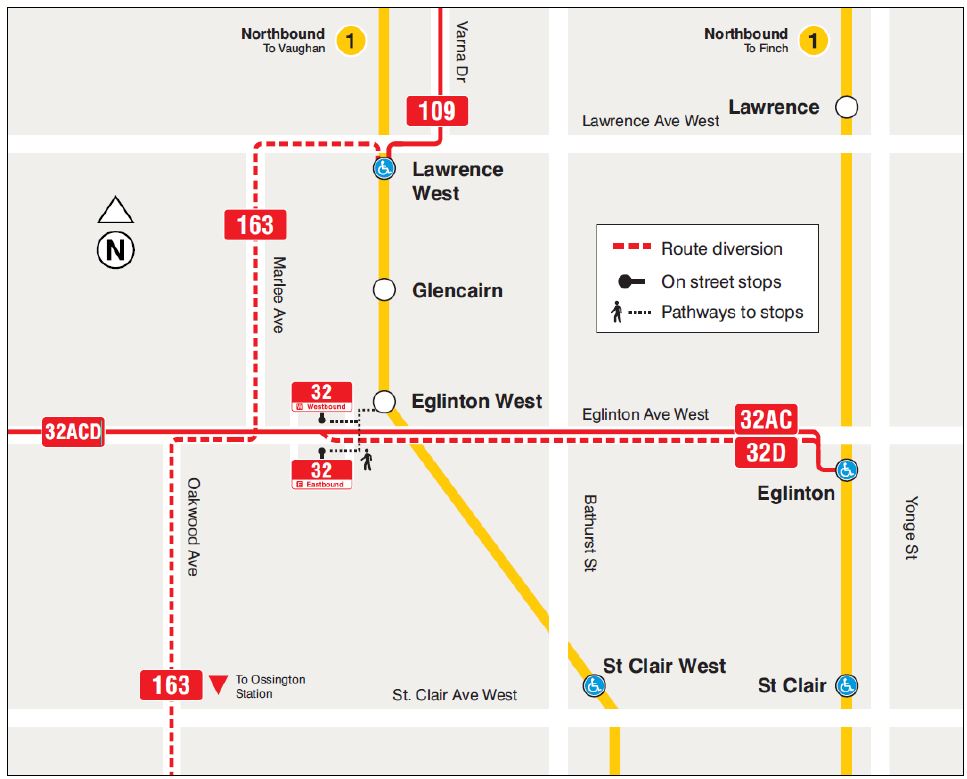
The bus loop at Eglinton West Station (to be renamed “Cedarvale”) will close for work on the Crosstown project. This will trigger several changes:

  • The 32D Eglinton West to Emmett service will be extended east to Eglinton Station.
  • The 63 Ossington and 109 Ranee routes will be reorganized into three segments.
    • 63B Ossington buses will run between Liberty Village and St. Clair (Oakwood Loop).
    • 163 Oakwood buses will run between Ossington Station and Lawrence West Station.
    • 109 Ranee buses will run between Lawrence West Station and Neptune (the street, not the planet).
  • The 51 Leslie and 56 Leaside buses at Eglinton Station will be shifted south to make room for a bay for the 32D service.

Passengers on the 32 Eglinton West bus will make connections to and from the subway from on street stops in what is already an area poorly set up for pedestrians. How this will operate with all of the additional foot traffic after March 29 remains to be seen.

Reliability Improvements

The TTC continues to “improve” routes by adding to running time and widening headways. Their claim is that they are just matching actual conditions, but what happens is that they aim for almost worst case situations (95th percentile) causing most vehicles to run early and bunch at terminals. From a rider’s point of view, service is less frequent most of the time.

Changes planned for March 29th affect:

  • 23 Dawes: Buses will run less frequently in all weekday periods except the AM peak. Off peak service is not affected.
  • 37 Islington and 937 Islington Express: Buses will run less frequently during the peak periods and midday weekdays. Evening service is not affected.
  • 111 East Mall: Buses will run less frequently during all weekday periods.
  • 161 Rogers Road: Buses will run less frequently during all weekday periods.

In one case, on 7 Bathurst, the TTC is clawing back excessive running time. During peak and weekday midday periods, there will be one bus less on the route, but scheduled headways stay the same. During the evening the number of buses and headways are unchanged, but some scheduled driving time is converted to make “recovery” time even longer than it is now.

Streetcar Carhouse Allocations

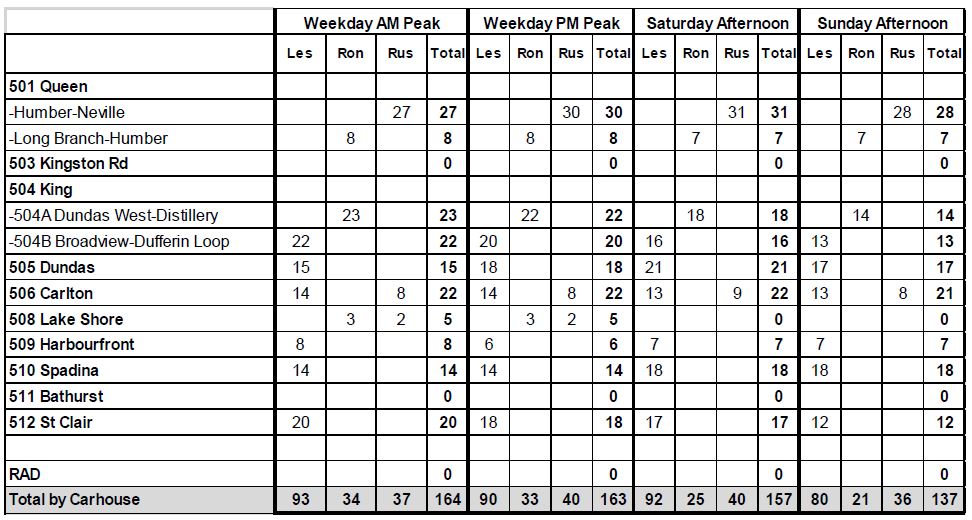
Due to trackwork at Roncesvalles Carhouse, there will be no access to the “North Gate” exit onto Roncesvalles for at least the remainder of 2020. Some services will be shifted among carhouse to allow for the reduced capacity at Roncesvalles.

  • All 501 Queen Humber-Neville service will operate from Russell Carhouse.
  • All 505 Dundas service will operate from Leslie Barns.
  • Some 506 Carlton service now operating from Leslie Barns will shift to Russell Carhouse.
  • Two of the five 508 Lake Shore trippers will operate from Russell Carhouse.

Crowding Standards

The TTC continues its practice of scheduling services at crowding levels above the board-approved standards. This occurs in some cases due to vehicle shortages, but more commonly because of budget pressures that do not allow provision of service at the level the standards would require.

New periods of scheduled crowding added on March 29 are:

  • 37 Islington weekday early evenings
  • 111 East Mall AM peak

TTC management are supposed to be reporting regularly to the Board on routes that exceed crowding standards, but this report has not yet appeared.

Eglinton West: An LRT Subway for Etobicoke?

On February 28, 2020, Metrolinx release a Preliminary Business Case for the Scarborough Subway Extension, and an Initial Business Case for the western extension of the Eglinton Crosstown LRT from Mount Dennis to Pearson Airport.

The Eglinton West Extension IBC is not as blatantly skewed as the Scarborough study in that it acknowledges the LRT plans and uses these as a starting point. The SSE study simply pretends that LRT does not exist and touts “benefits” of the subway versus a bus network.

The idea of a line along Eglinton West has been around for a long time.

  • 1972 ‘GO Urban’ and Rapid Transit Plan on Eglinton: Eglinton corridor was part of Province’s and TTC’s ‘Intermediate Capacity Transit System’ (ICTS) Network Plan (in which the present Scarborough RT was a part of)

  • 1985: ‘Network 2011’ and Eglinton West Plan: TTC Report identified Eglinton West as busway corridor as part of Metro Toronto’s rapid transit network plan (in which the present Sheppard subway was a part of)

  • 2007: ‘Transit City’ and Eglinton Crosstown Plan: Eglinton Crosstown LRT (spanning from Pearson in the west to Kennedy in the east) was part of the City of Toronto’s surface rapid transit expansion proposal

  • 2010: Crosstown LRT Project Approval: City of Toronto sought EA approval for surface LRT alignment from Kennedy to Pearson Airport Area boundary, one year after the City approved the full-length Eglinton Crosstown alignment

  • 2012: Eglinton West Segment Deferment: Metrolinx undertook Crosstown LRT construction, with Mount Dennis-Pearson Airport segment deferred due to funding constraint

  • 2016: Eglinton West LRT IBC: City of Toronto and Metrolinx co-published Eglinton West LRT’s first IBC and recommended surface LRT option, and the City approved funding for preliminary planning and design works

  • 2017: Grade Separation Review: City of Toronto approved arterial and midblock stops along Eglinton West and conducted grade separation study to address community concerns

  • 2019: Surface Option’s Affirmation: City of Toronto in its report maintained its preference for surface LRT based on fine-tuned benefit-cost analysis. [p 9]

As an historical note, a mid-1960s TTC plan to serve the airport with LRT linking southeast to the Bloor Subway and northeast to the Finch corridor was stillborn thanks to the 1972 GO Urban scheme.

We have arrived at a preferred subway option by provincial fiat:

In December 2017, the City of Toronto conducted further studies on additional grade-separated options based on inputs from the local community who are concerned with the at-grade LRT’s traffic impact. The number of options for the Toronto Segment were revised to four (featuring at-grade and below-grade alignments with frequent arterial and midblock stops, and a mostly below-grade alignment with either a single stop or multiple arterial stops) and re-evaluated using traffic model updates and additional metrics recommended by community representatives.

Nonetheless, the City of Toronto in early 2019 released a report re-confirming their preference for an at-grade LRT due to its cost-effectiveness in meeting all of the city’s project and policy objectives.

Subsequently, the Province’s 2019 Budget announcement included the extension of the Eglinton Crosstown LRT to Mississauga as one of the four budgeted rapid transit projects with an underground alignment. [p 27]

This is a second “Initial” study, but it is in the context of Premier Ford’s strong preference for subways. The usual caveats apply about the rough level of cost estimates and comparisons between options.

There is a fundamental conflict in the analysis in this study triggered both by the Premier’s distaste for “streetcars” and by Metrolinx methodology.

The surface option carries the greatest number of weekday riders, but one of the subway options carries the most “new” riders. In other words, the surface option does a better job of serving existing demand while not drawing as much new demand, while the subway option leaves some existing demand quite literally “out in the cold”, but (according to the modelling) shifts more people to transit from autos. The machinery of value assignment rewards the new riders more because they allegedly represent less auto use, and they tend to be longer-distance riders who save more travel time.

At no point does the study explain why carrying fewer total riders at much greater expense constitutes a valid planning outcome.

Continue reading

A Preliminary Snow Job on the Scarborough Subway Extension

The Government of Ontario has been responsible for a lot of hot air over the years, and that applies to all three political parties. But their agencies Infrastructure Ontario and Metrolinx have come up with the biggest pile of crap I have seen in a very long time going back to Bill Davis and the flim-flam surrounding his failed maglev train project.

The Scarborough Subway Extension Preliminary Design Business Case is a classic attempt to support a bad project by cooking the books outrageously and hoping nobody will notice. Even with their sleight-of-hand, Metrolinx cannot make the SSE look good as a business proposition. It fails not by a small amount that could be “adjusted” out of the way, but by a country mile.

This raises two fundamental questions:

  • Is the methodology of Metrolinx’ so-called business cases a valid way to examine transit projects?
  • Has Metrolinx used a comparison that so flagrantly misrepresents reality that it destroys credibility not only of the report, but of the organization?

This analysis has a fundamental problem. It compares two schemes, one of which is the flimsiest of straw men, in an attempt to make the subway look better than it is.

  • One option is the extension from Kennedy Station to Sheppard East with stops along the way at Lawrence/McCowan and Scarborough Town Centre.
  • The other is a network that assumes the Scarborough RT does not exist, but is replaced with many, many buses.

The latter option has never been on the table.

Missing is the one we all know and love or hate. The Scarborough LRT from Kennedy Station to Malvern is not even mentioned, not even in the potted history of rapid transit plans which begins with the SRT in 1985, not with the LRT plan that first appeared in the 1960s. Possibly Metrolinx planners are too young to know about this, or they are willfully ignorant.

The result? The subway “saves” thousands of hours of travel time, makes trips far more convenient, gets more cars off of the road, and on and on. But of course it would, just as the replacement of any surface network by a subway would make a huge difference.

However, that should not be the basis of comparison, and Metrolinx/IO flagrantly spend page after page extolling the subway’s virtue versus “Business As Usual”, a bus network that does not exist and has never been proposed. Their rationale is that the SRT will not last forever but will succumb to old age, and a bus network will be the “base case” against the subway would be measured.

Based on available information, it is understood that the SRT would require substantial investment to remain operational during the business case’s time frame (beyond 2029/2030) and so it would be inappropriate to include it for comparison purposes.

It has been assummed that a replacement bus network has been established to provide the type and volume of transit connections required to serve former SRT passengers. In reviewing this document it will be of value to keep this assumption in mind as the Scarborough Subway Extension is not being compared against the SRT, but rather against transit network scenario where Scarborough is largely served by surface route buses. [p 17]

Indeed, some text reads as if the SRT was never there, and the subway is a spectacular network addition built out into an area that has never seen rapid transit.

This is a deeply dishonest presentation. It does not review the real alternative to the subway, and it grossly inflates the subway’s benefit.

I am under no illusion that we will ever go back to the LRT plan. If the government would just say “a subway’s what we need and what we will build”, fine. That’s a policy decision. But when a collection of well-paid staff and consultants cook up this sort of BS to give a political decision a patina of professional respectability, that’s going too far.

If Metrolinx has stooped to this level in order to please their boss at Queen’s Park, they have shown just how trustworthy their work on everything else must be. For starters, there’s the Ontario Line, but that’s a whole other article.

As an aside, the document is littered with typos showing that it was not carefully edited even though it was considered by the Metrolinx Board in January, according to the Globe’s Oliver Moore. It has almost certainly been pushed out the door at the last minute in anticipation of public meetings next week.

It is also ironic that Hamilton lost its LRT plan thanks to provincial complaints about runaway costs while two signature Doug Ford projects, the three stop Scarborough Subway Extension and the underground version of the Eglinton West LRT extension roll on despite bad economic reviews.

There is little point in my reviewing this document in excruciating detail because almost every page depends on comparisons with an utterly invalid base case. However, there is the occasional point worth noting, a few of which will surprise readers I am sure.

Continue reading